1.4652 (X1CrNiMoCuN24-22-8) Forging Parts | China Manufacturer – Jiangsu Liangyi
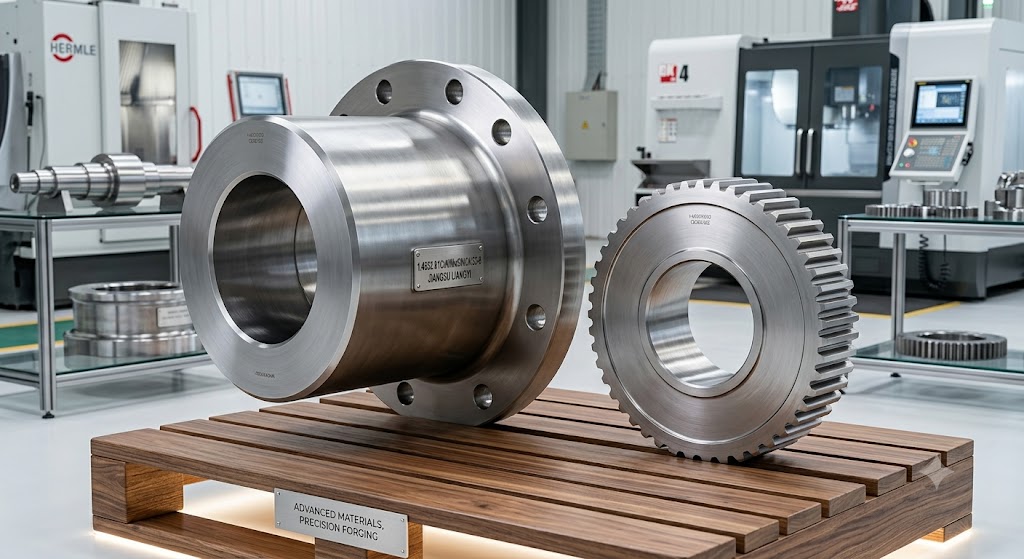 Get Custom 1.4652 Forging Parts Quote in 24 Hours
 Key Facts: 1.4652 (X1CrNiMoCuN24-22-8) Forging Parts at a Glance
What Is 1.4652 (X1CrNiMoCuN24-22-8)? Material Overview
Jiangsu Liangyi is a 25+ year ISO 9001:2015 certified professional manufacturer of 1.4652 (X1CrNiMoCuN24-22-8), also written as X1CrNiMoCuN24.22.8 or X1CrNiMoCuN24228) open die forging parts and seamless rolled steel rings in China. Our 80,000 m² facility carries 40 million USD in fixed manufacturing assets and an annual output of 120,000 tons, serving customers across more than 50 countries on six continents.
1.4652 (X1CrNiMoCuN24-22-8) is classified as a super austenitic stainless steel (SASS) under European standard EN 10088. The "super" prefix is not marketing language — it formally designates grades with a Pitting Resistance Equivalent Number (PREN) greater than 40, which separates them from standard and high-performance austenitic grades and places them in a distinct tier of corrosion performance. With a minimum PREN of 48 and a calculated mid-composition value approaching 57, 1.4652 sits at the top of this elite category.
The alloy was engineered specifically for industries where standard austenitic grades routinely fail: offshore seawater systems, halide-containing chemical processes, sour gas production equipment, and pharmaceutical environments demanding both ultra-pure passivation surfaces and aggressive in-place cleaning protocols. Its combination of very high molybdenum (7–8%), nitrogen (0.45–0.55%), chromium (23–25%) and nickel (21–23%) achieves a balance that no single lower-alloy grade can replicate — simultaneous resistance to pitting, crevice corrosion, stress corrosion cracking (SCC) and general acid attack, while delivering nearly twice the proof strength of 316L.
The Metallurgical Science Behind 1.4652's PREN ≥ 48
Understanding why 1.4652 achieves such exceptional corrosion resistance requires looking at what each major alloying element actually does in the microstructure. This is not just an academic exercise — it directly explains the grade's cost premium and guides correct application decisions.
The PREN Formula Explained
PREN = %Cr + 3.3 × %Mo + 16 × %N
Using mid-range 1.4652 composition (24% Cr, 7.5% Mo, 0.50% N):
PREN = 24 + (3.3 × 7.5) + (16 × 0.50) = 24 + 24.75 + 8.0 = 56.75
The multiplier for Mo (3.3×) reflects that molybdenum is roughly 3.3 times more effective than chromium at raising the critical pitting potential. The multiplier for N (16×) reflects nitrogen's powerful stabilizing effect on the passive oxide film. Together, these two elements contribute more than half of 1.4652's total PREN — making Mo and N the true workhorse elements of this grade.
Role of Each Alloying Element in 1.4652
- Chromium (Cr) 23–25% Passive Film Foundation: Chromium is the essential element for forming the protective Cr₂O₃ passive film on stainless steel surfaces. This film is reliably maintained in 1.4652 (Cr at 23–25%) even after mechanical damage or exposure to dilute reducing acids. The film can reform spontaneously in oxidizing and neutral environments and thus can exhibit self-healing behavior.
- Molybdenum (Mo) 7–8% Pit Repassivation: At 7–8%, molybdenum in 1.4652 is more than twice the level in 316L (2–3%) and significantly higher than in 904L (4–5%). Mo dissolves preferentially at nascent pit sites and forms molybdate ions (MoO₄²⁻) that adsorb onto the pit surface, dramatically slowing pit growth and enabling repassivation. In chloride environments above 60°C, where 316L and 904L fail rapidly, the high Mo content of 1.4652 maintains pit repassivation kinetics that effectively arrest localized attack before it propagates.
- Nitrogen (N) 0.45–0.55% Dual Function: Passive Film + Strength: Nitrogen is arguably 1.4652's most distinctive element. At 0.45–0.55%, it serves two simultaneous roles: (1) it significantly raises the critical pitting potential (Epit) by strengthening the passive film's resistance to aggressive anion adsorption — nitrogen-doped passive films show 3–5× greater resistance to Cl⁻ penetration than nitrogen-free equivalents; (2) it provides pronounced solid-solution hardening, boosting the 0.2% proof strength from ~210 MPa (316L, nitrogen-free) to ≥ 430 MPa without any cold working or precipitation hardening. This is why 1.4652 offers high-strength performance in the fully annealed condition — the nitrogen atoms interstitially lock the austenite lattice against dislocation movement.
- Nickel (Ni) 21–23% Austenite Stabilizer + SCC Resistance: Nickel at 21–23% fully stabilizes the austenitic structure against martensite transformation during forming, machining and service at temperatures below 0°C. Critically, high Ni content dramatically reduces the susceptibility of austenitic steels to chloride-induced stress corrosion cracking (SCC) — a failure mode that has caused catastrophic failures in 304 and 316 equipment in hot chloride environments. The relationship between Ni content and SCC resistance is non-linear: below 8% Ni (304/316), SCC susceptibility is high; above 20% Ni (904L, 1.4652), susceptibility drops to levels approaching nickel alloys.
- Copper (Cu) 0.3–0.6% Reducing Acid Resistance: While molybdenum is primarily used to resist oxidizing chloride environments, copper improves resistance to non-oxidizing reducing acids, especially dilute sulfuric acid and hydrochloric acid below 50°C. In the case of process streams containing both sulfuric acid and chloride ions (a typical combination in hydrometallurgy and FGD systems), the synergy of Mo and Cu in 1.4652 provides an envelope of corrosion resistance that neither element can provide alone.
- Ultra-Low Carbon (C ≤ 0.02%) Sensitization Prevention: The “X1” prefix in X1CrNiMoCuN24-22-8 means carbon ≤0.02% – the lowest tier in EN naming. The very low carbon level prevents carbide precipitation (sensitization) at the grain boundaries during the thermal cycles of welding and eliminates the need for post-weld solution annealing in most applications, thus maintaining full corrosion resistance in the heat-affected zone. Without this carbon control, the high alloy content of 1.4652 would actually make it more vulnerable to sensitization, not less.
7-Grade Comparison Matrix: 1.4652 vs Common Stainless Steel Grades
Engineers selecting corrosion-resistant alloys for severe service need a clear, data-driven comparison across multiple performance axes — not just PREN. The table below compares 1.4652 against six frequently specified grades, covering the metrics that matter most in procurement and materials engineering decisions.
| Property | 316L (1.4404) | 317L (1.4438) | 904L (1.4539) | 1.4547 (254SMO®) | 2205 Duplex (1.4462) | 2507 Super Duplex (1.4410) | 1.4652 ★ |
|---|---|---|---|---|---|---|---|
| PREN (min.) | ≈ 24 | ≈ 28 | ≈ 35 | ≈ 43 | ≈ 35 | ≈ 43 | ≥ 48 |
| Cr % (range) | 16–18 | 18–20 | 19–23 | 19.5–20.5 | 22–23 | 24–26 | 23–25 |
| Mo % (range) | 2.0–3.0 | 3.0–4.0 | 4.0–5.0 | 6.0–6.5 | 2.5–3.5 | 3.5–4.5 | 7.0–8.0 |
| Ni % (range) | 10–13 | 11–15 | 23–28 | 17.5–18.5 | 4.5–6.5 | 6.0–8.0 | 21–23 |
| N % (range) | < 0.10 | < 0.10 | < 0.10 | 0.18–0.22 | 0.14–0.20 | 0.24–0.32 | 0.45–0.55 |
| Rp0.2 min. (MPa) | ≥ 210 | ≥ 205 | ≥ 220 | ≥ 300 | ≥ 450 | ≥ 550 | ≥ 430 |
| Rm (MPa) | 520–680 | 515–690 | 490–690 | 650–850 | 680–880 | 730–930 | 750–1000 |
| Chloride SCC resistance | Poor | Poor | Moderate | Good | Good | Good | Excellent |
| Seawater pitting resistance | Poor | Poor | Moderate | Good | Moderate | Good | Excellent |
| H₂SO₄ / HCl resistance | Limited | Limited | Good | Good | Limited | Limited | Excellent |
| Toughness (impact, +20°C) | ≥ 100 J | ≥ 100 J | ≥ 100 J | ≥ 100 J | ≥ 100 J | ≥ 60 J | ≥ 100 J |
| Relative material cost | 1.0× | 1.2× | 2.5× | 3.0× | 1.8× | 2.8× | 3.5–4.5× |
| Max service temp. (corrosive) | ~60°C | ~70°C | ~100°C | ~120°C | ~100°C | ~100°C | ~180°C |
★ 1.4652 highlighted. Values represent EN 10088-3 / ASTM standards for solution-annealed condition. SCC and corrosion ratings are qualitative engineering assessments across typical industrial environments; actual performance depends on specific service conditions. Cost multipliers are indicative (raw material only). 254SMO® is a registered trademark of Outokumpu Oyj. Alloy 625® is a registered trademark of Special Metals Corporation.
Material Selection Decision Guide: When to Specify 1.4652
High material cost is often the first objection when 1.4652 is proposed. The correct engineering response is to evaluate total lifecycle cost, not purchase price. In the right environments, 1.4652 consistently delivers 3–5× longer service life than the next-best grade — making it cost-competitive or cheaper on a per-year-of-service basis.
Specify 1.4652 When Your Application Has Any of These Conditions
- Chloride concentration > 5,000 ppm AND temperature > 50°C: The critical pitting temperature (CPT) of 316L in seawater is approximately 10–15°C — meaning it will pit even in moderately warm ambient seawater. 1.4652's CPT in seawater exceeds 80°C, making it suitable for heat exchanger applications and warm seawater injection lines where all cheaper grades fail.
- Mixed acid environments containing halide ions: If your process contains H₂SO₄ or H₃PO₄ combined with Cl⁻, Br⁻ or F⁻ ions — a common scenario in hydrometallurgy, phosphate fertilizer production and wet FGD systems — the synergistic attack mechanism causes corrosion rates in 316L and 904L that are 10–50× higher than in pure acids alone. The combined Mo + Cu + Cr content of 1.4652 is the only stainless steel grade that remains passive across this broad acid-halide matrix.
- NACE MR0175 sour service with seawater contact: Environments containing H₂S above threshold concentrations (per NACE MR0175 / ISO 15156) combined with chloride-bearing seawater create dual failure modes — sulfide stress cracking (SSC) and chloride pitting simultaneously. 1.4652 in solution-annealed condition (hardness ≤ 310 HB) is compliant with NACE MR0175, while also maintaining PREN ≥ 48 against chloride pitting. No duplex grade offers both properties in the same hardness envelope.
- Pharmaceutical/biotech applications requiring ultra-low metal release: The ultra-low carbon (≤ 0.02%) and the high, stable passivation potential of 1.4652 make it preferred over 316L for API reactor components subject to aggressive CIP/SIP cleaning cycles with strong NaOH and peracetic acid solutions. Per published passivation research literature, properly passivated 1.4652 surfaces in ultra-low carbon austenitic grades demonstrate very low metal ion release in aggressive CIP cleaning agents. Customers requiring specific metal ion release data for regulatory submissions should conduct their own material qualification testing per their applicable SOP.
- High-pressure seawater injection (> 3,000 psi): Subsea seawater injection systems require both high mechanical strength (for wall thickness minimization under pressure) and superior seawater corrosion resistance. 1.4652's Rp0.2 ≥ 430 MPa — nearly double that of 316L — allows 30–40% thinner wall sections versus 316L at the same working pressure, partially offsetting the material cost premium in finished component weight.
When 1.4652 Is NOT the Right Choice
1.4652 is not a universal upgrade over lower-alloy grades. Avoid specifying it in these situations:
- Purely oxidizing environments at moderate temperatures (e.g., dilute nitric acid below 60°C): 316L or 304L is adequate and far cheaper.
- Non-chloride alkaline service (e.g., NaOH concentration above 30% at ambient temperature): nickel alloys (UNS N04400 / UNS N06600) outperform all austenitic grades; 1.4652 offers no advantage.
- Low-temperature cryogenic service below −100°C: While 1.4652 maintains austenitic structure, high-Mn austenitic grades (e.g., 1.3961) or 316L are more cost-effective below −100°C where chloride corrosion is not an active concern.
- Standard structural / non-corrosive applications: The grade's cost premium provides zero return when the service environment does not exploit its corrosion resistance advantages.
Full Range of Custom 1.4652 Forged Steel Products
We manufacture custom 1.4652 (X1CrNiMoCuN24-22-8) forged steel products in virtually any shape, dimension and specification, fully compliant with international standards and customer-supplied drawings. Our in-house capabilities span the complete manufacturing chain: vacuum-degassed billet sourcing, open die forging, ring rolling, solution heat treatment, CNC machining and full NDT inspection — all within one facility. Explore our complete forged product range for other grades and shapes.
1.4652 Forging Product Line – Shapes, Dimensions & Weight Range
| Product Shape | Key Dimensions (Max) | Max Weight | Typical Applications |
|---|---|---|---|
| Forged Round Bars | Ø up to 2000 mm | 30 t | Valve stems, shafts, machined components |
| Forged Flat Bars / Blocks | Thickness up to 600 mm | 20 t | Tube sheets, flanges, pad stock |
| Seamless Rolled Forged Rings | OD up to 6000 mm | 30 t | Pressure vessel flanges, bearing rings, gear rings |
| Forged Shafts & Step Shafts | Length up to 15 m | 30 t | Pump shafts, agitator shafts, turbine shafts |
| Forged Hollow Bars & Sleeves | OD up to 3000 mm | 25 t | Valve bodies, cylinders, pressure vessels |
| Forged Discs & Hubs | Ø up to 3000 mm, T up to 600 mm | 25 t | Compressor discs, impeller blanks, hubs |
| Forged Tube Sheets | Ø up to 4000 mm | 20 t | Shell-and-tube heat exchangers, condensers |
| Custom Machined Forgings | Per customer drawing | 30 t | Complex components, near-net-shape parts |
All dimensions listed represent our demonstrated production capacity. For sizes approaching or exceeding listed maximums, please contact our engineering team with your specific requirements for feasibility assessment and tooling review.
Production Standards & Global Compliance
Every 1.4652 (X1CrNiMoCuN24-22-8) forging part shipped by Jiangsu Liangyi is manufactured against documented quality plans traceable to the following international standards. Our quality system is ISO 9001:2015 certified, with in-house calibrated testing equipment for chemical, mechanical and NDT testing.
Material & Dimensional Standards
- EN 10088-1: 2005 – List of stainless steels (grade definition, chemical composition limits)
- EN 10088-2: 2005 – Delivery conditions for sheet, plate and strip
- EN 10088-3: 2005 – Delivery conditions for bars, rods, wire and semi-finished products (governs most forging deliverables)
- ASTM A484 / A484M – General requirements for stainless steel bars, billets and forgings
- ASME BPVC Section VIII Div. 1 & Div. 2 – Pressure vessel design and fabrication
- API 6A (22nd Edition) – Wellhead and Christmas tree equipment (offshore oil & gas)
- NACE MR0175 / ISO 15156 – Materials for H₂S-containing (sour service) environments
Testing & Certification Standards
- EN 10204 3.1 / 3.2 – Mill Test Certificate (3.1: manufacturer inspection; 3.2: independent third-party witness)
- ASTM A388 / EN 10228-3 – Ultrasonic examination of forgings
- ASTM E709 – Magnetic particle testing (MT)
- ASTM E165 / EN 571-1 – Liquid penetrant testing (PT)
- ASTM A262 Practice E – Intergranular corrosion susceptibility test (oxalic acid etch and Huey test)
- ISO 9712 / ASNT SNT-TC-1A – NDT personnel qualification and certification
Chemical Composition & the Function of Each Element
The chemical composition of our 1.4652 (X1CrNiMoCuN24-22-8) forging material strictly meets EN 10088 standard requirements. Critically, we do not simply meet the minimum standard — our melt practice targets the upper-mid composition range for Mo and N to maximize PREN while maintaining adequate alloy homogeneity for forging workability. Every heat is accompanied by a spectrometric composition report as part of the EN 10204 3.1 Mill Test Certificate.
| Element | EN 10088 Limit (Wt%) | Primary Metallurgical Function |
|---|---|---|
| Iron (Fe) | 38.3% – 46.3% (balance) | Matrix element; austenite phase stabilization |
| Chromium (Cr) | 23.0% – 25.0% | Passive film formation (Cr₂O₃); primary corrosion resistance element |
| Nickel (Ni) | 21.0% – 23.0% | Austenite stabilizer; SCC resistance; reducing acid resistance |
| Molybdenum (Mo) | 7.0% – 8.0% | Pit repassivation; strongest PREN contributor per weight% |
| Manganese (Mn) | 2.0% – 4.0% | Deoxidizer; austenite stabilizer; nitrogen solubility enhancer |
| Nitrogen (N) | 0.45% – 0.55% | Passive film strengthening; solid-solution strengthening (yield strength) |
| Copper (Cu) | 0.3% – 0.6% | Reducing acid (H₂SO₄, HCl) resistance; synergy with Mo in mixed acid environments |
| Silicon (Si) | 0% – 0.5% | Deoxidizer; upper limit controlled to prevent sigma phase formation during hot working |
| Phosphorus (P) | ≤ 0.030% | Impurity; controlled to prevent hot tearing during solidification and forging |
| Carbon (C) | ≤ 0.020% | Ultra-low carbon (ELC/"L" grade) prevents sensitization; preserves corrosion resistance in HAZ |
| Sulfur (S) | ≤ 0.0050% | Impurity; ultra-low limit minimizes MnS inclusions that act as pitting initiation sites |
Why Ultra-Low Sulfur (≤ 0.0050%) Matters for Forging Parts
Many engineers focus on the PREN elements (Cr, Mo, N) but overlook sulfur. In austenitic stainless steels, sulfur forms manganese sulfide (MnS) inclusions. These inclusions dissolve preferentially in chloride-containing solutions and create micro-pits that act as nucleation sites for macroscopic pitting corrosion. The ultra-low sulfur limit of 1.4652 (≤ 0.0050%) — compared to ≤ 0.030% in standard grades — reduces MnS inclusion density by an order of magnitude. In forged products, where the forging deformation further elongates and disperses any residual inclusions, the combination of low sulfur and controlled deformation produces a surface that is remarkably free of pit initiation sites. This is one reason why forged 1.4652 consistently outperforms cast or plate equivalents in immersion corrosion testing.
Mechanical Properties & Engineering Performance Data
Our 1.4652 (X1CrNiMoCuN24-22-8) forged products deliver stable, reproducible mechanical properties after standard solution heat treatment, verified by 100% batch testing. The table below presents EN 10088-3 minimum guaranteed values; typical values from our production records consistently exceed these minimums by 5–15%.
| Property | Test Condition | EN 10088-3 Min. Value | Context & Engineering Notes |
|---|---|---|---|
| Tensile Strength (Rm) | Sol. annealed (+A), RT | 750 – 1000 MPa | Upper range similar to mild steel after quench-and-temper; achieved without cold working |
| 0.2% Proof Strength (Rp0.2) | Sol. annealed (+A), RT | ≥ 430 MPa | Approx. 2× that of 316L (210 MPa); enables 30–40% wall thickness reduction in pressure designs |
| Elongation at Fracture (A) | Sol. annealed (+A), RT | ≥ 40% | Excellent ductility despite high strength; ensures safe plastic deformation before fracture |
| Impact Energy (KV) | Longitudinal, +20°C | ≥ 100 J | Full austenitic toughness; no ductile-to-brittle transition at sub-zero temperatures |
| Impact Energy (KV) – Low Temp. | Longitudinal, −40°C | Typically ≥ 80 J | Typical value (not standard guaranteed); suitable for cold-climate offshore applications |
| Brinell Hardness (HBW) | Sol. annealed (+A) | ≤ 310 HBW | NACE MR0175 compliance requires ≤ 310 HBW for sour service; 1.4652 in +A condition satisfies this |
| Elastic Modulus (E) | RT | ≈ 195 GPa | Slightly lower than ferritic/duplex grades; account for this in deflection-sensitive designs |
| Thermal Expansion Coefficient | 20–300°C | ≈ 16.0 × 10⁻⁶ K⁻¹ | ~30% higher than carbon steel and duplex grades; critical for mixed-material joint design |
Corrosion Performance by Chemical Environment
The following table summarizes 1.4652's corrosion performance across the major chemical environments encountered in its principal end markets. Ratings are based on published corrosion data from metallurgical research literature and industry case studies. All performance ratings are indicative; actual corrosion performance depends on specific concentration, temperature, flow velocity, surface condition and other service parameters. Customers should conduct project-specific corrosion assessments for critical applications.
| Environment | Conditions | 1.4652 Rating | 316L Rating (Comparison) | Key Limiting Factor |
|---|---|---|---|---|
| Seawater (natural) | Ambient to 80°C, chloride ~20,000 ppm | Excellent | Poor (pits at >20°C) | Pitting – controlled by PREN |
| Seawater (heated, biofouled) | 40–100°C, crevice present | Very Good | Fails rapidly | Crevice corrosion – CCCT ~40°C for 1.4652 |
| H₂SO₄ (dilute) | 5–30%, 20–80°C | Excellent | Moderate | Mo + Cu provide reducing acid protection |
| H₂SO₄ + Cl⁻ mixed | H₂SO₄ 10–40% + 500–5000 ppm Cl⁻ | Very Good | Fails | Synergistic attack; only high-Mo grades survive |
| H₃PO₄ (wet process) | 20–45%, containing F⁻ and Cl⁻ | Good | Fails | Fluoride attack limits even 1.4652 at >60°C |
| HCl (dilute) | 1–5%, ambient to 40°C | Good | Fails | Cu content critical for HCl resistance |
| FGD slurry (Cl⁻, SO₄²⁻, SO₂) | pH 4–6, 50°C, Cl⁻ up to 60,000 ppm | Excellent | Rapid failure | Combined SO₂/Cl⁻ attack; requires PREN >40 |
| NaOH (caustic) | 10–30%, ambient to 80°C | Good | Good | No advantage over 316L here; Ni alloys preferred at >30% |
| Sour gas service (H₂S + CO₂ + Cl⁻) | NACE MR0175 conditions | Excellent (NACE compliant) | Marginal at high H₂S | Hardness ≤310 HBW is required; 1.4652 meets this in +A condition |
| Pharmaceutical CIP/SIP | NaOH 2%, PAA 1%, 80–135°C | Excellent | Good (but metal release higher) | Ultra-low metal ion release per published passivation literature; project-specific testing recommended |
Ratings: Excellent = corrosion rate < 0.1 mm/yr; Very Good = < 0.5 mm/yr; Good = < 1.0 mm/yr; Moderate = 1–5 mm/yr; Fails = > 5 mm/yr or localized attack. All ratings assume surface in solution-annealed condition without mechanical damage or crevice geometry unless otherwise noted.
Specialized Forging Process & Heat Treatment Science for 1.4652
Forging 1.4652 is substantially more challenging than forging standard austenitic grades, and the consequences of process errors are severe — not just surface defects, but loss of the very corrosion resistance that makes the material valuable. Our process protocols, developed over 25 years of high-alloy forging experience, address each of these challenges systematically.
Why 1.4652 Is Difficult to Forge — and How We Solve It
The same high Mo and N content that provides PREN ≥ 48 creates three specific forging challenges:
- Narrow hot-working window: The high alloy content raises the recrystallization temperature and narrows the temperature window for productive forging deformation. Below ~1050°C, the material work-hardens rapidly and surface cracking becomes probable. Above ~1220°C, hot shortness (incipient grain boundary liquation) creates internal tearing. The working window is approximately 1050–1200°C — versus 900–1200°C for 316L — requiring more frequent reheating cycles per reduction pass and tighter furnace temperature uniformity (±10°C versus ±25°C for standard grades).
- Sigma phase formation tendency: In the composition range of 1.4652, the high Cr and Mo content creates a strong thermodynamic driving force for sigma phase (σ-phase) precipitation in the temperature range 600–1000°C. Sigma phase is brittle, non-magnetic and depletes the surrounding matrix of Cr and Mo, severely degrading both toughness and corrosion resistance. Avoiding this requires that forgings pass through the 900–650°C sensitization range as rapidly as possible — both during intermediate air cooling between heats and especially during the final solution annealing quench.
- High work-hardening rate: 1.4652's high nitrogen content gives it a very high work-hardening exponent (n ≈ 0.45 versus ~0.3 for 316L, based on published metallurgical literature). This means forging loads increase rapidly during deformation, requiring heavier press capacity per kilogram of product and more progressive (multi-pass) reduction schedules. Our hydraulic forging presses up to 16,000 kN provide the force capacity needed for large 1.4652 rings and bars without requiring excessively high temperature that would risk grain growth.
Our Documented Production Process Parameters
- Billet sourcing & traceability: All 1.4652 starting material is sourced from VIM/ESR (Vacuum Induction Melting / Electroslag Remelting) billets with full chemical traceability. ESR refining can further reduce sulfur content and improve inclusion cleanliness beyond EN 10088 minimums; actual billet specification is confirmed during order review.
- Furnace heating: Induction or electric resistance furnaces with documented temperature uniformity ≤ ±10°C. Target heating temperature: 1150–1190°C. Soaking time: minimum 1 hour per 100 mm of cross-section to ensure full thermal homogeneity through large section forgings.
- Forging deformation: Multi-directional reduction sequence (upsetting + drawing + ring rolling as appropriate) targeting minimum total true strain of ≥ 60%. This deformation level consistently achieves austenite grain size ASTM 4–7 in finished forgings, verified by metallographic section examination per each batch.
- Reheating protocol: Forgings are returned to furnace when surface temperature drops to 1000°C (monitored by optical pyrometer on press floor). This prevents any forging deformation below 1000°C where sigma phase precipitation rate increases sharply.
- Solution annealing: Final annealing at 1120–1150°C for minimum 30 minutes per 25 mm of forging cross-section, followed by immediate water quenching. Cooling rate through 900–650°C range must exceed 150°C/min — verified by thermocouple data logging on each production batch. Forgings are quenched individually in agitated water tanks; bulk quenching (stacking) is not permitted for this grade.
- Post-quench inspection: All surfaces are visually and dimensionally inspected immediately after quench. Forgings are then staged for heat-treat certification (hardness measurement, typically 240–280 HBW) before entering the NDT queue.
Non-Destructive Testing (NDT) & Inspection System
Our NDT system is designed to the principle that every indication must be evaluated, not just flagged. NDT inspections are performed by qualified personnel and to documented written procedures. Where EN 10204 3.2 inspection is specified, independent third-party inspection bodies (BV, SGS, TÜV, Lloyd's Register) are engaged to witness testing and co-sign inspection certificates. We support third-party inspection witness by BV, SGS, TÜV, Lloyds and other international certification bodies on request.
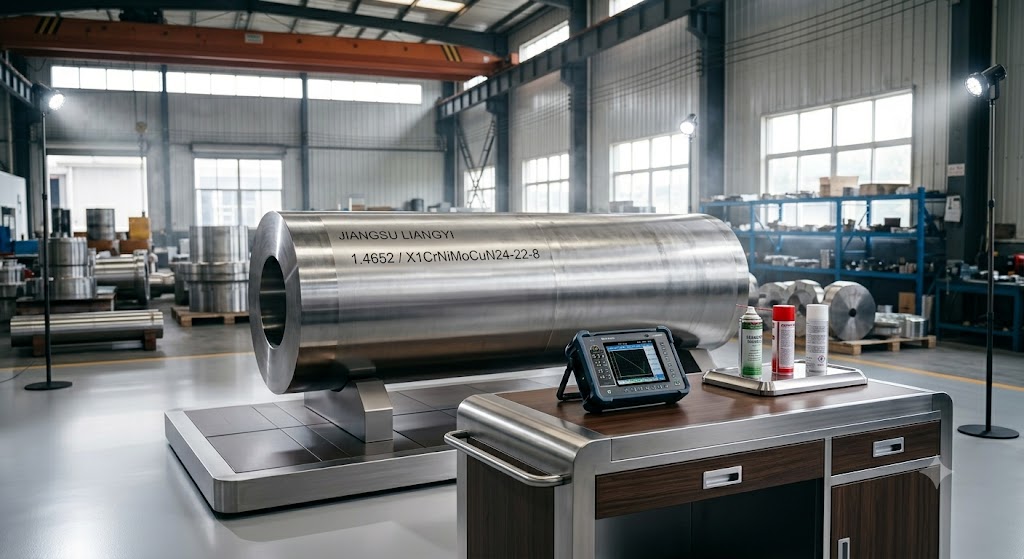
- Ultrasonic Testing (UT) – ASTM A388 / EN 10228-3: Full volumetric UT scan of all forgings after final heat treatment using calibrated immersion or contact transducers. Acceptance criteria: no single indication amplitude exceeding the reference DAC (Distance Amplitude Curve); no linear indications exceeding 50% of DAC; no indication cluster defining a total area exceeding 10 cm². Scan coverage: 100% of forgeable surfaces in at least two orthogonal directions.
- Magnetic Particle Testing (MT) – ASTM E709: Applied to all ferritic and semi-ferritic materials. For 1.4652 (fully austenitic, non-magnetic), we substitute Liquid Penetrant Testing (PT) per ASTM E165 for surface examination — a requirement explicitly stated in our material-specific inspection plans.
- Liquid Penetrant Testing (PT) – ASTM E165 / EN 571-1: Applied to all machined surfaces of 1.4652 forgings. Fluorescent penetrant (Type I, Method D) with 15-minute dwell time. Acceptance per EN 10228-2 Level SP3: no linear indications > 2 mm; no rounded indications > 3 mm; no more than 3 indications in any 10 cm² area.
- Full Material & Mechanical Testing: Every production batch is tested for chemical composition (OES spectrometry), tensile strength, yield strength, elongation, Charpy impact energy (at +20°C and optionally −40°C), Brinell hardness, and intergranular corrosion susceptibility (ASTM A262 Practice E oxalic acid etch screening). All results are documented in the EN 10204 3.1 MTC.
Welding & Fabrication Guidelines for 1.4652 Forging Parts
One question we receive frequently from procurement engineers is: "Can the forged 1.4652 components be welded into a larger assembly, and will corrosion resistance be maintained?" The answer is yes — with proper process control. The ultra-low carbon content of 1.4652 (≤ 0.02%) provides a significant advantage over older high-alloy grades, but it does not eliminate the need for correct welding procedures.
Recommended Filler Materials
- Matching filler: AWS ER385 – Nominal composition 20% Cr, 25% Ni, 4.5% Mo, 1.5% Cu. PREN of weld deposit ≈ 35–38. Suitable for applications where service temperature does not exceed 60°C and chloride concentration is below 10,000 ppm. Lower cost than overalloyed options.
- Overalloyed filler: ERNiCrMo-3 (UNS N06625, commercially known as Alloy 625®) – Nominal composition 22% Cr, 9% Mo, 3.5% Nb (Ni-base). PREN of weld deposit > 50. Recommended for critical joints in seawater immersion, FGD environments, subsea service, and any application requiring NACE MR0175 compliance across the weld. The slightly different thermal expansion coefficient versus 1.4652 base metal must be accounted for in joint design for high-cycle fatigue applications.
- Do not use: 308L, 316L, 347 or any standard austenitic filler — their PREN of 20–25 creates a weld deposit that will preferentially corrode relative to the 1.4652 base metal, causing crevice attack at the weld toe.
Key Welding Process Parameters
- Preheat: Not required for base metal thickness ≤ 50 mm. For heavy section forgings (> 50 mm), warm to 20°C minimum to prevent moisture condensation.
- Maximum interpass temperature: 100°C. Exceeding this causes sensitization in the heat-affected zone despite the low carbon content, particularly at the slower cooling rates inherent in heavy-section joints. Measure with contact thermometer between each pass.
- Heat input: Limit to ≤ 1.5 kJ/mm. High heat input slows cooling through the sensitization range and increases risk of sigma phase precipitation in multi-pass welds.
- Back-purging: Mandatory for root passes and any full-penetration weld in pressure service. Use 99.99% pure argon or argon-2% N₂ back-purge gas. The addition of 2% N₂ to back-purge gas compensates for nitrogen loss from the heat-affected zone adjacent to the weld pool, maintaining the corrosion resistance of the root-side HAZ.
- Post-weld heat treatment (PWHT): Post-weld solution annealing at 1100–1150°C with water quench is strongly recommended for all pressure-retaining components and for any application where full corrosion resistance of the weld zone is required. Where in-situ PWHT is not feasible, minimize this risk by limiting heat input and controlling interpass temperature strictly.
Common Welding Mistakes That Cause Premature Failure
- Using 316L filler on 1.4652 base metal: Creates a galvanic cell where the weld acts as an anode (PREN 24 versus base metal PREN 48). Weld centerline corrosion is the predictable result within 12–24 months of seawater or acid service.
- Exceeding 100°C interpass temperature on thick sections: Even with ≤ 0.02% C, slow cooling of a 100 mm thick weld joint allows enough time for Cr depletion at grain boundaries. An ASTM A262 oxalic acid etch test on a weld qualification test piece reveals this quickly and cheaply — before a 50-ton pressure vessel fails in service.
- No back-purging on root pass: Root-side oxidation (sugaring) in stainless steel welds is not just cosmetic — the oxidized surface has a PREN effectively approaching zero. In a seawater piping system, the root-pass oxidation zone becomes the first point of perforation within one to two service cycles.
Design Engineering Notes for 1.4652 Forged Components
Procurement engineers sometimes forward 1.4652 forging drawings that were originally designed for 316L, simply substituting the material grade. While this works mechanically, it misses the opportunity to optimize wall thickness reduction (cost savings) and introduces risks around thermal expansion mismatch in mixed-material assemblies.
Wall Thickness Optimization in Pressure Service
For a cylindrical pressure vessel or pipe under internal pressure, the minimum wall thickness is proportional to allowable design stress (typically ~0.66 × Rp0.2 in ASME BPVC). Since 1.4652 has Rp0.2 ≥ 430 MPa versus 316L's ≥ 210 MPa, a design using 1.4652 at the same working pressure can legitimately reduce wall thickness to approximately 50–55% of the 316L equivalent wall, reducing total part weight by the same proportion. In a 30-ton forged cylinder, this translates to a 13–15 ton weight saving. At 4× the material unit price, the optimized 1.4652 part often costs less than the 316L equivalent on a per-finished-part basis — a calculation that many procurement teams do not perform.
Thermal Expansion Mismatch in Mixed-Material Systems
1.4652's coefficient of thermal expansion (CTE) is approximately 16.0 × 10⁻⁶ K⁻¹ over the range 20–300°C. This is:
- ~30% higher than carbon steel and low-alloy steel (CTE ≈ 12 × 10⁻⁶ K⁻¹)
- ~20% higher than duplex stainless steels (CTE ≈ 13 × 10⁻⁶ K⁻¹)
- Similar to other austenitic grades (316L CTE ≈ 16 × 10⁻⁶ K⁻¹)
When 1.4652 forged components (valve bodies, flanges, nozzles) are bolted to carbon steel or duplex piping with a large ΔT across the joint during operation, the differential thermal expansion generates significant bending moments at the flange interface. This must be accounted for in flange bolt load calculations, particularly for high-temperature applications cycling above 150°C. Our engineering team can assist with thermal stress review as part of our free pre-order technical consultation service.
Work Hardening During Machining
1.4652's high nitrogen content gives it a work-hardening rate approximately 50% higher than 316L. In practical machining terms, this means: (1) use sharp, coated carbide tooling — HSS tools are not recommended; (2) do not allow the tool to dwell at zero feed (prevents formation of a hard, work-hardened skin that dulls the next cut); (3) use generous cutting fluid to manage heat; (4) specify finish tolerances achievable in one finish pass — rework cuts on an already work-hardened surface dramatically reduce tool life. Our in-house CNC machining centers are configured for high-alloy austenitic grades and our machinists are trained specifically on these feed/speed/depth parameters for 1.4652.
Global Industrial Applications & GEO-Targeted Project Experience
Over 25 years and 50+ export markets, our 1.4652 forging parts have been deployed in some of the world's most demanding service environments. The following summaries reflect actual project-type experience — specific end-user names are protected by customer confidentiality agreements, but the engineering details accurately reflect the service conditions and technical solutions provided.
Offshore Oil & Gas and Subsea Engineering (Middle East, North Sea, Gulf of Mexico)
We have supplied custom 1.4652 forged valve bodies, bonnets, seamless rolled rings, tubing hangers, subsea Christmas tree body components and hollow sleeves for offshore platforms and subsea production systems operating at water depths to 3,000 m in the North Sea, and for sour service seawater injection systems in Middle Eastern reservoirs containing H₂S to 50,000 ppm. In these applications, 1.4652 is specified because it simultaneously satisfies NACE MR0175 hardness requirements (≤ 310 HBW in solution-annealed condition), PREN requirements for full-seawater immersion (PREN > 40), and API 6A pressure integrity requirements — a combination that eliminates the need for additional corrosion-allowance thickness typical of lower-alloy alternatives. All products for this sector are supplied with EN 10204 3.2 certificates (third-party witnessed inspection) and full UT volumetric scan reports.
Chemical Processing & Hydrometallurgy (Germany, France, Australia, Southeast Asia)
For European chemical groups and Australian lithium and nickel hydrometallurgy operations, we have manufactured 1.4652 forged tube sheets (some exceeding 3 m in diameter), reactor nozzle flanges, agitator shafts and high-pressure pump impeller blanks for plants processing sulfuric acid + chloride leach solutions. A recurring engineering challenge in lithium brine hydrometallurgy — a rapidly growing sector — is that the high chloride, high sulfate, slightly reducing brine environment at 60–90°C causes rapid pitting in all standard and high-performance austenitic grades including 904L and even 1.4547 (254SMO®). Our 1.4652 forged components have demonstrated < 0.05 mm/yr general corrosion rates in this specific environment based on in-plant coupon exposure data provided by customers. For German and French chemical customers operating under EU PED 2014/68/EU, we provide full PED-compliant documentation packages including Declaration of Conformity prepared by our authorized EU Representative.
Flue Gas Desulfurization & Environmental Engineering (China, South Korea, Japan)
FGD absorber internals represent one of the most aggressive environments for stainless steel: the scrubbing slurry typically contains 10,000–80,000 ppm Cl⁻, 5,000–30,000 ppm SO₄²⁻, SO₂ at 1,000–5,000 ppm in the gas phase, pH fluctuating between 4 and 6, operating temperature 40–60°C, and abrasive gypsum particles in suspension. 316L typically perforate in such service within 2–3 years; 317L, within 5–7 years. Our 1.4652 forged valve stems, seat rings, agitator shafts and absorber nozzle flanges, confirmed across multiple operating plant reports, have maintained intact surface condition after 10+ years of continuous FGD service. The lifecycle cost savings — eliminating two forced-outage replacement cycles versus 317L — typically recover the material cost premium within the first 4 years of operation.
Pharmaceutical & Biotech API Manufacturing (North America, Switzerland, Germany)
Pharmaceutical API production places stringent demands on reactor materials that go beyond simple corrosion resistance: the material must not contribute metal ions to the product stream at detectable levels, must withstand daily CIP cycles with 2% NaOH and 1% peracetic acid at 80–135°C, must be validated to meet FDA 21 CFR and EU GMP Part 1 surface quality requirements, and must maintain surface smoothness (Ra < 0.8 µm post-passivation) over years of abrasive cleaning cycles. Our 1.4652 forged reactor body components and sanitary nozzle forgings can be finish-machined to Ra ≤ 0.4 µm to customer specification, with passivation to ASTM A380 available as an optional service. Customers are responsible for GMP surface qualification testing and regulatory submission within their own quality systems.
Seawater Desalination & Marine Engineering (Middle East, Singapore, Mediterranean)
Seawater reverse osmosis (SWRO) high-pressure pump components represent a particularly demanding application: the pump sees continuous full seawater contact at 60–80 bar working pressure, with potential for cavitation-induced pitting and biofouling in warm coastal seawater (25–35°C, Cl⁻ ≈ 20,000 ppm). 316L impellers and casings in SWRO duty typically require replacement every 3–5 years; 1.4652 components, based on operating data from SWRO plants in the Arabian Gulf and eastern Mediterranean supplied by our customers, have exceeded 12 years of continuous service without measurable material loss. The higher capital cost of 1.4652 pump components versus 316L is typically recovered within the first planned maintenance interval.
Global Supply & Regional Compliance for 1.4652 Forging Parts
Jiangsu Liangyi has built a mature global export infrastructure over 25 years, covering logistics, documentation, regulatory compliance and after-sales support. We understand that for procurement engineers in the oil and gas, chemical and pharmaceutical sectors, the quality and completeness of documentation is as important as the physical quality of the product. Our export team is experienced in preparing country-specific and customer-specific documentation packages, and we maintain standing relationships with BV, SGS, TÜV SÜD, TÜV Rheinland and Lloyd's Register for third-party inspection services.
Regional Compliance Capabilities
- European Union: Materials manufactured to EN 10088 standard, suitable for incorporation into PED 2014/68/EU pressure equipment. REACH compliance statement available on request. EN 10204 3.2 inspection certificates are issued with independent third-party witness (BV, SGS, TÜV) arranged by Jiangsu Liangyi; CE marking on finished equipment is the responsibility of the equipment fabricator.
- North America: ASME BPVC Section VIII/Section II material compliance; ASTM standard material certification; API 6A Annex F documentation for wellhead equipment; NACE MR0175/ISO 15156 qualification documentation. We regularly supply to ASME Code-stamp holders as a material supplier of record.
- Middle East: Aramco (Saudi Aramco SAMSS / SAES) approved material documentation; ADNOC supplier qualification support; KOC (Kuwait Oil Company) material specifications compliance; sour service qualification documentation. Our 1.4652 forgings have been used in major Middle East oil & gas projects operating under international sour service standards.
- Southeast Asia & Oceania: AS/NZS standard compliance for Australian projects (including AS 4037 pressure equipment standard); BCA (Singapore) compliance documentation; local regulatory adaptation for Indonesia, Malaysia and Thailand industrial projects.
- Japan & South Korea: JIS G4303 equivalent documentation; KOSHA (Korea Occupational Safety and Health Agency) material compliance support; collaboration with local inspection bodies including KR (Korean Register) for marine applications.
Typical Lead Times & Logistics
Standard 1.4652 forging lead time: 15–25 working days for off-the-shelf bar and ring profiles; 30–60 working days for custom complex geometries. Sea freight from Jiangyin port to major global ports: 18–35 days depending on destination. Air freight available for urgent small orders. All shipments are seaworthy packed per ISPM-15 phytosanitary requirements with full export customs clearance handled by our in-house logistics team. Door-to-door delivery to most countries is available.
12-Point Procurement Checklist for 1.4652 Forging Parts
Based on our experience handling hundreds of international 1.4652 procurement cycles, we have compiled the 12 specification points that most frequently cause rejection, rework or supply delays when they are inadequately defined in a purchase order. Use this checklist before submitting your RFQ to any 1.4652 forging supplier.
Before You Submit Your RFQ — Verify All 12 Points
- Material standard and grade designation: Specify both the EN number (1.4652) AND the chemical name (X1CrNiMoCuN24-22-8). Ambiguity between similar-sounding grades (e.g., 1.4462 duplex) causes errors that delay projects by weeks.
- Heat treatment condition: State explicitly "Solution Annealed + Water Quenched (+A)" per EN 10088. If the order simply says "stainless steel forgings," some suppliers will deliver in the as-forged (work-hardened) condition with hardness exceeding 350 HBW — unusable for NACE MR0175 sour service applications.
- Dimensional tolerances and surface finish: Specify tolerances on all critical dimensions (OD, ID, length, eccentricity) AND surface finish (as-forged Ra vs. machined Ra). Over-specifying tolerances increases cost; under-specifying causes rework.
- Certificate type: 3.1 or 3.2? For most applications, EN 10204 3.1 (manufacturer's own inspection) is acceptable. For subsea, pressure vessel and pharmaceutical applications, 3.2 (independent third-party witness) is typically required. Specifying 3.1 when 3.2 is needed causes supply chain problems when the end-user rejects the material.
- Specific NDT requirements: State which NDT methods are required (UT, PT, MT), the applicable standard (ASTM A388, EN 10228-3, ASTM E165, ASTM E709) and the acceptance class. Without this, suppliers apply their default minimum procedure, which may not match your project specification.
- NACE MR0175 compliance requirement: If the application is sour service, explicitly state "NACE MR0175 / ISO 15156 compliance required" and "maximum hardness 310 HBW." This triggers specific heat treatment control and hardness documentation by the manufacturer.
- Intergranular corrosion test requirement: Specify whether an IGC test (ASTM A262 Practice E or ISO 3651) is required. This test adds lead time but provides direct verification that the solution annealing was performed correctly and sensitization is absent.
- Positive Material Identification (PMI): State whether 100% PMI (XRF or OES spectrometric verification of chemical composition on each piece) is required. Standard MTC covers the heat composition but not piece-by-piece verification. In high-value assemblies or pharmaceutical applications, PMI of each forging is standard practice.
- Forging reduction ratio documentation: For applications requiring documented proof of minimum deformation (e.g., some pressure vessel codes and offshore standards require minimum forging reduction ratio of 4:1 or 5:1 from ingot to finished forging), request the forging ratio certificate.
- Country of origin & REACH documentation: For EU procurement, specify country of origin (China) requirements, any customs tariff code classification, and REACH compliance statement for the alloy system. REACH compliance for 1.4652 alloy elements at end-of-life is well-documented but the statement must be formally issued by the manufacturer.
- Packaging and corrosion protection: State required preservation method (VCI film, desiccant, wooden crates) and any transport markings required. Sea freight without VCI protection causes cosmetic surface oxidation on machined 1.4652 surfaces that requires re-passivation before use.
- Drawing approval workflow: For custom forgings, confirm whether 2D/3D drawings require manufacturer markup and approval before production starts. Failure to establish this workflow often results in forgings manufactured to interpretation errors — discovered only during incoming inspection, at full production cost.
Frequently Asked Questions About 1.4652 (X1CrNiMoCuN24-22-8) Forging Parts
What is 1.4652 (X1CrNiMoCuN24-22-8) and how is it classified?
1.4652 (EN chemical designation X1CrNiMoCuN24-22-8) is a super austenitic stainless steel (SASS) standardized in EN 10088. The name encodes its composition: X = stainless steel; 1 = ≤ 0.02% C; Cr24 = 23–25% Cr; Ni22 = 21–23% Ni; Mo8 = 7–8% Mo; Cu = 0.3–0.6% Cu; N = 0.45–0.55% N. The "super" classification means PREN ≥ 40; 1.4652's minimum PREN is 48 with a calculated mid-range value of approximately 57. It occupies the highest tier of the EN 10088 stainless steel family in terms of localized corrosion resistance.
What is the PREN of 1.4652 and how is it calculated?
PREN = %Cr + 3.3 × %Mo + 16 × %N. Using mid-range composition (24% Cr, 7.5% Mo, 0.50% N):
PREN = 24 + (3.3 × 7.5) + (16 × 0.50) = 24 + 24.75 + 8.0 = 56.75
This far exceeds 316L (≈ 24), 904L (≈ 35), and 2205 duplex (≈ 35). Materials with PREN > 40 are generally accepted for immersed seawater service. 1.4652 exceeds this threshold with significant margin.
What are the mechanical properties of 1.4652 forged bars in solution annealed condition?
After solution annealing at 1120–1150°C with rapid water quenching, per EN 10088-3: Tensile Strength (Rm) 750–1000 MPa; 0.2% Proof Strength (Rp0.2) ≥ 430 MPa; Elongation ≥ 40%; Charpy Impact Energy (KV, +20°C) ≥ 100 J; Brinell Hardness ≤ 310 HBW. The high Rp0.2 is achieved without cold work — purely by nitrogen solid-solution strengthening — meaning full ductility and corrosion resistance are maintained simultaneously.
How does 1.4652 compare to 316L, 904L, 254SMO and 2507 super duplex?
vs. 316L (PREN ≈ 24, Rp0.2 ≈ 210 MPa): 1.4652 has approximately double the pitting resistance and double the yield strength. 316L fails by pitting in seawater above ~20°C; 1.4652 pits above ~80°C. For any chloride-containing environment above ambient temperature, 316L is not an engineering substitute.
vs. 904L (PREN ≈ 35, Mo 4–5%): 1.4652 has significantly higher Mo (7–8%) and N (0.45–0.55% vs <0.10% in 904L). 904L is better for pure reducing acid environments; 1.4652 is superior for chloride-acid mixed environments and seawater above 60°C.
vs. 1.4547 (254SMO®) (PREN ≈ 43, Mo 6–6.5%): 1.4652 has higher PREN due to higher Mo (7–8%) and much higher N (0.45–0.55% vs 0.18–0.22%). 1.4652 is preferred when operating temperatures exceed 60°C or when a higher toughness reserve is needed.
vs. 2507 super duplex (PREN ≈ 43): 1.4652 offers better resistance to chloride SCC (due to full austenite versus dual-phase microstructure), better toughness at sub-zero temperatures, and equal or better performance in reducing acid environments. 2507 has higher Rp0.2 (≥ 550 MPa); useful when design is strength-limited rather than corrosion-limited.
What international standards apply to 1.4652 forging parts?
Material standards: EN 10088-1/2/3; ASTM A484/A484M; ASME BPVC Section II Part D. Application standards: ASME BPVC Section VIII (pressure vessels); API 6A (wellhead); NACE MR0175/ISO 15156 (sour service); EU PED 2014/68/EU. Testing and certification: EN 10204 3.1 or 3.2 MTC; ASTM A388/EN 10228-3 (UT); ASTM E709 (MT); ASTM E165 (PT); ASTM A262 (IGC); ISO 9712/ASNT SNT-TC-1A (NDT personnel).
What welding filler material is recommended for 1.4652 forgings?
For standard service: AWS ER385 (20Cr-25Ni-4.5Mo-1.5Cu matching filler, PREN deposit ≈ 36–38). For seawater immersion, FGD, subsea and NACE sour service: ERNiCrMo-3 (Alloy 625, Ni-base overalloyed filler, PREN deposit > 50). Do NOT use 308L, 316L or any standard austenitic filler — the low-PREN weld deposit will preferentially corrode versus the 1.4652 base metal. Maximum interpass temperature: 100°C. Back-purging with Ar + 2% N₂ is mandatory for root passes. Post-weld solution annealing is recommended for critical pressure service.
What forging and heat treatment parameters are required for 1.4652?
Forging temperature window: 1050–1200°C (narrower than 316L's 900–1200°C). Minimum total deformation: ≥ 60% true strain. Solution annealing: 1120–1150°C with minimum 30 minutes soaking per 25 mm cross-section. Quenching: immediate water quench after removal from furnace; cooling rate must exceed 150°C/minute through 900–650°C to prevent sigma phase precipitation. Post-quench hardness target: 240–280 HBW (confirming full solution and NACE MR0175 compliance). Our process is documented in heat treatment procedures traceable to ISO 9001:2015 records.
What product shapes and maximum dimensions are available for 1.4652 forgings?
Available shapes and max sizes: Forged round bars (Ø up to 2000 mm); flat bars/blocks (thickness up to 600 mm); seamless rolled rings (OD up to 6000 mm, up to 30 tons); shafts and step shafts (length up to 15 m); hollow bars and sleeves (OD up to 3000 mm); discs and hubs (Ø up to 3000 mm); tube sheets (Ø up to 4000 mm); custom machined forgings per drawing. Individual piece weight: 30 kg to 30 tons.
What test documents and certificates are provided with each order?
Standard documentation package includes: EN 10204 3.1 MTC (chemical composition, tensile, yield, elongation, impact energy, hardness); UT report (ASTM A388/EN 10228-3); PT report (ASTM E165); dimension inspection report; ISO 9001:2015 certificate. Optional on request: EN 10204 3.2 with third-party witness (BV, SGS, TÜV, Lloyd's); IGC test report (ASTM A262 Practice E); 100% PMI (XRF per piece); forging reduction ratio certificate; NACE MR0175 / ISO 15156 compliance documentation (hardness test records, chemical composition traceability); CE/PED documentation support for equipment fabricators.
Why is 1.4652 more expensive than 316L and is it worth the cost premium?
1.4652 raw material costs approximately 3.5–4.5× more than 316L per kilogram, reflecting the cost of 7–8% Mo, 21–23% Ni and the nitrogen alloying process (requires pressurized AOD/VOD furnace practices). However, the lifecycle cost comparison in aggressive environments consistently favors 1.4652: (1) Wall thickness can be reduced 40–50% versus 316L at equal working pressure, partially offsetting the unit cost premium. (2) Published case study data and in-service reports consistently document 3–10× longer service life versus 316L in seawater, FGD, mixed-acid and sour service environments, eliminating costly unplanned shutdowns. (3) Insurance against catastrophic premature failure — the consequences of a pressure vessel or seawater injection header failing due to pitting corrosion (process shutdown, environmental release, regulatory penalty, personnel risk) are not captured in a simple material cost comparison. The correct question is not "Is 1.4652 expensive?" but "What is the cost of a failure caused by using the wrong grade?"
Does Jiangsu Liangyi ship 1.4652 forging parts globally, and what are typical lead times?
Yes. We supply to 50+ countries including the USA, Germany, France, UK, Australia, Singapore, UAE, Saudi Arabia, South Korea and Japan, with documented project supply to all major oil and gas basins and chemical production regions. Typical lead times: 15–25 working days for standard bar and ring profiles; 30–60 working days for complex custom geometries and heavy forgings. Sea freight transit: 18–35 days to major global ports. Air freight available for urgent small orders. All exports are seaworthy packed and customs-cleared by our in-house logistics team.
Can 1.4652 forgings be used in cryogenic service below −100°C?
1.4652 maintains its fully austenitic microstructure at all temperatures down to −196°C (liquid nitrogen boiling point) without martensite transformation, so there is no inherent ductile-to-brittle transition (unlike ferritic and martensitic grades). Impact energy at −196°C for 1.4652 is typically ≥ 40 J based on test data from similar super austenitic grades. However, for pure cryogenic service (LNG storage, liquid nitrogen systems) where corrosion resistance is not required, 316L, 304L or 9% Ni steel are more cost-effective choices. 1.4652 is the appropriate selection only where cryogenic temperature coexists with an active corrosion mechanism — for example, cryogenic LPG systems with dissolved H₂S in Gulf of Mexico production — a genuine dual-stress scenario where 1.4652's combined properties justify its premium.
Contact Our Forging Experts for Custom 1.4652 Forging Solutions
Jiangsu Liangyi's engineering and sales team is available to support your 1.4652 material selection, specification review, drawing evaluation and RFQ process. We offer free pre-order technical consultation — including PREN verification, heat treatment documentation review, weld procedure qualification guidance and compliance documentation scoping — for all prospective customers. Send us your drawings, material specifications, required standards and quantity to receive a detailed technical proposal and competitive quotation within 24 business hours.
Inquiry Email: sales@jnmtforgedparts.com
Phone / WhatsApp: +86-13585067993
Official Website: https://www.jnmtforgedparts.com
Factory Address: Chengchang Industry Park, Jiangyin City, Jiangsu Province, China 214400
Response Time: Technical quotation within 24 business hours | Emergency inquiry response within 4 hours