1.4614 (X2CrNiTi12-11-2) Forged Steel Parts | China Manufacturer – Complete Technical Guide
1.4614 (European designation X2CrNiTi12-11-2; also written X2CrNiTi12112 or X2CrNiTi12.11.2) is a precipitation hardening martensitic stainless steel that achieves 50–54 HRC hardness and 1510–1648 MPa yield strength through age-hardening at 480 °C — without the brittleness penalties common in conventional martensitic grades. It contains approximately 12% Cr, 11% Ni, and 1.65% Ti, processed to AMS5773E via EAF + ESR or VAR remelting. Jiangsu Liangyi Co., Limited, an ISO 9001:2015 certified forging manufacturer in Jiangyin, Jiangsu Province, China, has produced 1.4614 forgings for over 25 years — supplying seamless rolled rings up to 6 m diameter, round bars to 2 m diameter, and custom components to the oil & gas, nuclear, valve, and power generation industries in 50+ countries. EN 10204 3.1/3.2 mill test certificates supplied as standard.
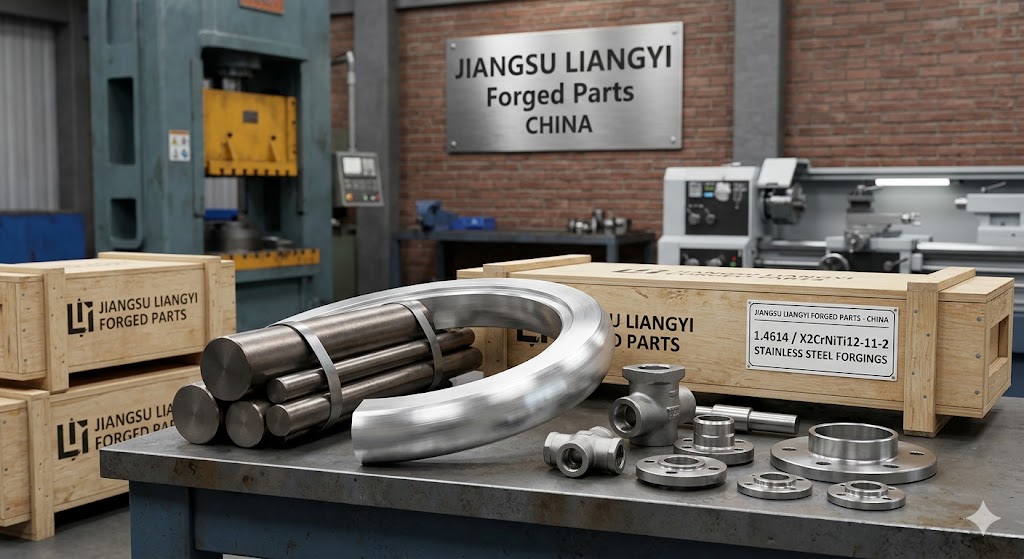
Product Overview & Why Choose Jiangsu Liangyi
Product Item: 1.4614 / X2CrNiTi12-11-2 | Factory: Jiangyin City, Jiangsu Province, China | Certification: ISO 9001:2015
Jiangsu Liangyi Co., Limited has been manufacturing 1.4614 (X2CrNiTi12-11-2) forged steel parts since 1998. Unlike trading companies, every kilogram of material is melted, forged, heat treated, machined, and tested within our own Jiangyin facility. This means complete traceability from raw charge material to finished component — and the accountability that comes with it. Over 25 years, we have shipped 1.4614 forgings to clients in the oil & gas, nuclear power, valve manufacturing, and turbomachinery sectors across more than 50 countries, building a reputation for meeting tight tolerances, strict NDE requirements, and first-article inspection standards without surprises.
Why Source 1.4614 Forgings from Jiangsu Liangyi?
- Vertically integrated, zero subcontracting: Steel melting, open die forging, ring rolling, heat treatment, machining, NDE and dimensional inspection all in-house under one roof in Jiangyin — giving you a single point of responsibility and no quality gaps between suppliers.
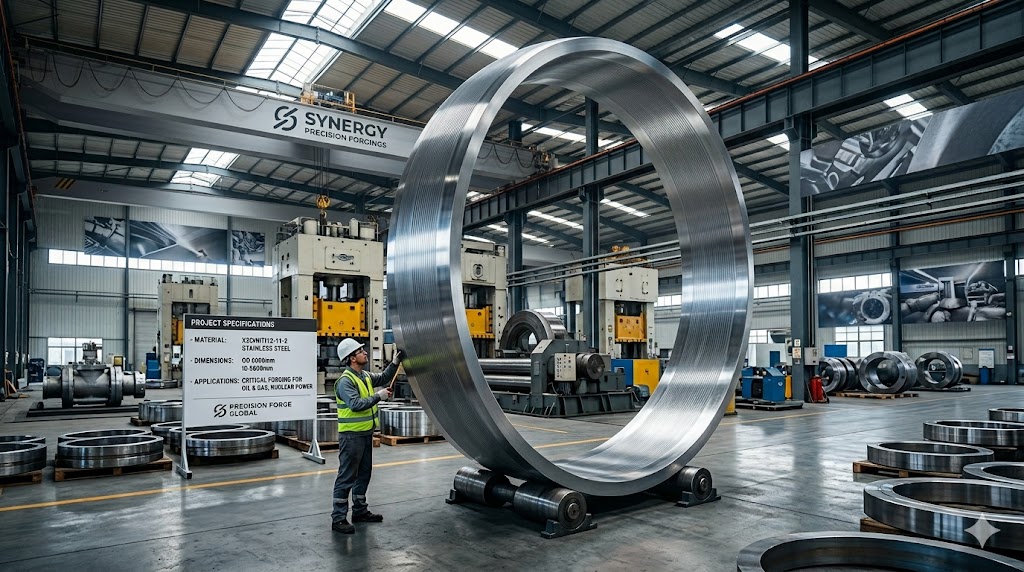
- Large-format capability: Our 6,000-ton hydraulic press and 5-metre ring rolling machine handle pieces that most Chinese forges cannot — rings to 6 m OD, bars to 2 m diameter, pieces to 30 tons — reducing the need to split components or source from Europe at three times the cost.
- ESR and VAR remelting on-site: We own our own ESR and VAR furnaces. This is not standard in China. It means we control the most quality-critical step of 1.4614 production ourselves, rather than relying on an upstream steel mill whose process we cannot audit.
- Port proximity: Jiangyin is 90 km from Shanghai Yangshan Deep-Water Port — one of the world's busiest container terminals — enabling competitive freight rates and lead-time predictability to Europe, North America, and the Middle East.
- Competitive pricing without grade substitution: We quote and deliver exactly what is ordered. Our production data shows zero confirmed cases of material grade substitution in our export history — a risk that remains real with unvetted Chinese suppliers.
- Third-party inspection welcomed: We actively support and facilitate on-site witness inspection by client-nominated inspection bodies including DNV-GL, Bureau Veritas, Lloyd's Register, ABS, RINA and TÜV. Our facility has dedicated witness areas for inspection personnel. Note: we hold ISO 9001:2015 as our sole formal certification — "inspection supported" means we welcome and accommodate these inspectors on site, not that we hold a formal vendor approval from these organisations. NDA coverage is available for proprietary drawings.
🏆 Our Certification & Quality Credentials
Every 1.4614 forging manufactured at Jiangsu Liangyi is produced and tested under our ISO 9001:2015 Quality Management System — our sole held certification. We issue EN 10204 3.1 or 3.2 mill test certificates with every shipment, and actively support third-party witness inspections by any internationally recognised inspection body nominated by the client.
Note: "Inspection Supported" means we welcome and facilitate on-site witness inspection by the named body, coordinated by and at the cost of the client. It does not imply that Jiangsu Liangyi holds a formal approval or vendor qualification from these organisations.
1.4614 Forged Product Shapes & Available Sizes
Our manufacturing infrastructure allows us to produce the full spectrum of forged geometries in 1.4614, from small precision blanks for valve balls to giant seamless rings for nuclear reactor coolant pumps. All shapes can be supplied in rough forged, rough machined, semi-finished, or fully finish-machined condition.
| Product Form | Max. Outer Diameter | Max. Length / Height | Max. Weight | Typical Applications |
|---|---|---|---|---|
| Seamless Rolled Rings | 6,000 mm OD | 3,000 mm H | 30,000 kg | Turbine discs, pump casings, flanges |
| Round Bars | 2,000 mm Ø | 4,000 mm L | 25,000 kg | Drill collars, shaft billets, valve balls |
| Hollow Bars / Shells | 3,000 mm OD | 3,000 mm L | 20,000 kg | Pressure vessels, piping billets |
| Discs & Blocks | 3,000 mm Ø | 800 mm H | 25,000 kg | Turbine rotor discs, pump impeller blanks |
| Square / Flat Bars | 1,500 mm wide | 3,000 mm L | 15,000 kg | Compressor blades, flat components |
| Custom Die Forgings | Up to 3,000 mm | Per drawing | 30,000 kg | Wellhead bodies, manifolds, valve bonnets |
For geometries or weights not listed above, contact our engineering team with your drawing — we regularly evaluate non-standard requests and have successfully produced components outside these nominal limits through multi-heat or composite forging approaches.
Metallurgy of 1.4614 – Why This Steel Works
To specify and buy 1.4614 intelligently, it helps to understand why this steel achieves properties that conventional stainless grades cannot. The key is the precipitation hardening (PH) mechanism — a fundamentally different strengthening route from the martensite-quench hardening used in grades like 410 or the cold work strengthening in austenitic grades like 316.
The Precipitation Hardening Mechanism in 1.4614
1.4614 starts life in the solution annealed condition (Condition A) — a relatively soft, martensitic structure around 28–32 HRC that is easily machined, ground, and welded. At this stage, the Ni, Ti, and Mo are dissolved uniformly in the iron matrix. When the component is aged at 480 °C for a minimum of 4 hours, these elements diffuse and combine to form extremely fine Ni3Ti intermetallic precipitates — nanometre-scale particles coherently embedded in the martensite lattice.
These precipitates act as highly effective obstacles to dislocation movement, which is the microscopic mechanism of plastic deformation. The result is a dramatic increase in strength and hardness — from ~28 HRC to 50–54 HRC — without any shape change, warping, or the quench cracking risks associated with through-hardening grades. This is why 1.4614 is the material of choice for components that must be precision machined to final geometry before hardening: drill pipe connections, valve balls, turbine disc bores.
💡 Practical Insight from Our Heat Treatment Team
After 25 years of heat treating 1.4614, our team has found that the 480 °C ageing window is narrower than many buyers appreciate. Ageing below 470 °C under-develops the Ni3Ti precipitation, leaving hardness short of 48 HRC. Ageing above 510 °C begins to over-age the precipitates — they coarsen, lose coherency with the matrix, and hardness can drop to 44–46 HRC while toughness actually decreases. We run our ageing furnaces with temperature uniformity of ±5 °C, verified by 9-point survey per AMS2750, and we do not compromise on soak time: minimum 4 hours from full load temperature, not from furnace setpoint.
Why Titanium — and Why the Ti/Ni Ratio Matters
Titanium is the defining alloying element that separates 1.4614 from other 12Cr-11Ni PH grades. At 1.50–1.80 wt%, Ti is present in stoichiometric proportion to Ni for maximum Ni3Ti precipitation. However, titanium also has a high affinity for carbon, forming TiC carbides that compete with Ni3Ti for titanium availability. This is why 1.4614 specifies carbon below 0.020 wt% — ultra-low carbon eliminates TiC competition and ensures all available Ti contributes to precipitation hardening. Our ESR and VAR remelting processes routinely achieve carbon levels of 0.008–0.015 wt%, significantly below the 0.020% maximum, maximising the effective Ti available for strengthening.
Chemical Composition of 1.4614 – Element-by-Element Analysis
Understanding the role of each alloying element in 1.4614 helps engineers write better specifications and helps buyers evaluate supplier compliance more critically than a simple wt% check allows.
| Element | Specification Range (wt%) | Jiangsu Liangyi Typical (wt%) | Primary Function |
|---|---|---|---|
| Carbon (C) | < 0.020 | 0.008–0.015 | Must be ultra-low to maximise Ti availability for Ni₃Ti precipitation |
| Chromium (Cr) | 11.0–12.50 | 11.5–12.2 | Corrosion resistance; keeps passive oxide film; prevents pitting |
| Nickel (Ni) | 10.75–11.25 | 10.90–11.10 | Austenite stabiliser; combines with Ti to form Ni₃Ti precipitates; toughness |
| Titanium (Ti) | 1.50–1.80 | 1.60–1.75 | Primary hardening element; precipitates as Ni₃Ti intermetallics at 480°C |
| Molybdenum (Mo) | 0.75–1.25 | 0.90–1.10 | Solid solution strengthener; improves pitting corrosion resistance (PREN contribution) |
| Manganese (Mn) | < 0.25 | 0.05–0.15 | Deoxidiser; kept low to avoid competing with Ni₃Ti precipitation |
| Silicon (Si) | < 0.25 | 0.05–0.18 | Deoxidiser; low content minimises delta ferrite formation |
| Phosphorus (P) | < 0.015 | < 0.010 | Tramp element; lowers toughness at grain boundaries; must be tightly controlled |
| Sulfur (S) | < 0.010 | < 0.005 | Tramp element; causes hot-shortness during forging if not controlled |
| Iron (Fe) | Balance | Balance | Matrix element |
Detailed Role of Each Alloying Element
🔵 Chromium (Cr): 11.0–12.5%
Chromium forms the passive Cr₂O₃ oxide film that gives all stainless steels their corrosion resistance. In 1.4614, the 12% Cr level is carefully balanced — high enough for a robust passive film in sour-gas environments, but low enough to maintain a fully martensitic matrix (higher Cr promotes delta ferrite, which is harmful in hardened components). Mo at 0.75–1.25% synergistically boosts the effective Cr equivalent for pitting resistance.
🟢 Nickel (Ni): 10.75–11.25%
Nickel has a dual role in 1.4614. It acts as an austenite stabiliser, opposing the ferrite promoting effect of chromium and titanium, and ensuring a fully martensitic matrix after quench. Ni is the partner element in the hardening precipitate, combines stoichiometrically with Ti at a 3:1 atomic ratio (Ni 3 Ti). The specification window of 10.75–11.25% is tightly controlled to ensure the correct Ni/Ti ratio for maximum precipitation density and peak hardness.
🔴 Titanium (Ti): 1.50–1.80%
Titanium is the defining alloying element of 1.4614. At 480 °C, Ti diffuses to combine with Ni, forming coherent Ni₃Ti precipitates that block dislocation movement and drive hardness from ~30 HRC (solution annealed) to 50–54 HRC (aged). Ti also forms TiC carbides at high temperatures — which is why carbon must be ultra-low (<0.020%) to ensure sufficient free Ti remains for Ni₃Ti precipitation.
🟣 Molybdenum (Mo): 0.75–1.25%
Molybdenum contributes to 1.4614's pitting and crevice corrosion resistance by entering the passive film and increasing its stability in chloride and H₂S environments. It also provides solid solution strengthening of the martensite matrix, contributing approximately 50–80 MPa to yield strength independent of the Ni₃Ti precipitation mechanism. This makes Mo particularly valuable in high-temperature service where some over-ageing of Ni₃Ti may occur.
⚫ Carbon (C): < 0.020%
Ultra-low carbon is critical and non-negotiable in 1.4614. Every atomic percentage of carbon consumed as TiC carbide removes three times its weight in titanium from the precipitation-hardening pool. Our EAF + ESR/VAR process consistently achieves 0.008–0.015 wt% — well below the 0.020% specification — maximising available Ti for Ni₃Ti precipitation and delivering the most consistent hardness values of any production run.
🟠 Phosphorus (P) & Sulfur (S): Ultra-low
Phosphorus segregates to grain boundaries during solidification, reducing toughness and increasing susceptibility to stress corrosion cracking — a serious risk in sour-gas service. Sulfur forms MnS inclusions that act as pitting initiation sites. Our ESR and VAR remelting processes are particularly effective at reducing both elements through directional solidification and slag refining, routinely achieving P < 0.010% and S < 0.005%.
Heat Treatment of 1.4614 – Science & Practical Conditions
1.4614 requires a two-stage heat treatment cycle. Misunderstanding either stage — particularly the ageing parameters — is the most common cause of out-of-specification hardness in the field. Below is the complete heat treatment framework used at Jiangsu Liangyi, based on 25+ years of production data.
Stage 1: Solution Annealing (Condition A)
The forged blank is heated to 1,000–1,070 °C and held for a time proportional to its cross-section thickness (minimum 30 minutes after achieving through-temperature, typically 1 hour per 25 mm of section). The component is then rapidly cooled — by air blast for thin sections or water quench for heavy sections — to produce a fully martensitic structure with dissolved Ni, Ti, and Mo. Hardness in Condition A is approximately 28–32 HRC.
Why Solution Anneal Before Machining?
Condition A hardness (~30 HRC) is significantly easier to machine than the aged condition (~50 HRC). For components requiring tight tolerances, fine surface finishes, or complex internal features, we strongly recommend rough machine in Condition A, then age to final hardness. Ageing at 480 °C causes a predictable dimensional change of approximately −0.05% to +0.02% depending on geometry — a known quantity that can be compensated in pre-age machining tolerances. Our engineering team provides dimensional compensation guidance for specific geometries at no charge with confirmed orders.
Stage 2: Ageing / Precipitation Hardening
After machining (or directly after forging for rough-supply orders), the component is aged at 480 °C ± 8 °C for a minimum of 4 hours from equilisation temperature. The critical details:
- Temperature window is critical: <470 °C = under-precipitation → hardness below 48 HRC. >510 °C = over-ageing → coarsened precipitates, hardness drops to 44–46 HRC and toughness also decreases.
- Soak time from equalisation, not setpoint: Large cross-sections take 1–3 hours to equalise. Starting the 4-hour hold from when the surface reads 480 °C, not the core, will under-age heavy sections.
- Multiple ageing cycles: For very heavy sections (>300 mm thickness), double ageing (480 °C × 4 h, air cool, 480 °C × 4 h) is recommended to ensure complete precipitation throughout the cross-section.
- Cooling after ageing: Air cool. Water quench after ageing is not recommended as it creates thermal gradients that can induce residual stress cracking in machined components.
| Condition | Treatment | Hardness | Yield Strength | Use Case |
|---|---|---|---|---|
| Condition A (Solution Annealed) | 1,000–1,070 °C + Quench | 28–32 HRC (≤ 363 HB) | ~895 MPa min. | Pre-machining state; welding; inspection |
| H480 (Peak Aged) | 480 °C × 4 h min. + Air Cool | 50–54 HRC | 1510–1648 MPa | Final hardened state for service |
| H510 (Slightly Over-aged) | 510 °C × 4 h + Air Cool | 46–50 HRC | 1310–1450 MPa | Where slightly lower hardness with better toughness is needed |
| H550 (Over-aged) | 550 °C × 4 h + Air Cool | 40–44 HRC | 1100–1250 MPa | Special applications requiring maximum toughness |
Mechanical Properties of 1.4614 (X2CrNiTi12-11-2)
| Property | Typical Value | Minimum (Delivery Spec) | Test Method |
|---|---|---|---|
| 0.2% Proof Strength (Rp0.2) | 1648 MPa (239 ksi) | 1510 MPa | ISO 6892-1 / ASTM E8 |
| Ultimate Tensile Strength (Rm) | 1751 MPa (254 ksi) | 1580–1720 MPa | ISO 6892-1 / ASTM E8 |
| Elongation (A5) | 14% | 8% min. | ISO 6892-1 / ASTM E8 |
| Reduction in Area (Z) | 63% | 40% min. | ISO 6892-1 / ASTM E8 |
| Hardness | 50 HRC (476 HB) | 48–52 HRC | ISO 6508 / ASTM E18 |
| Charpy V-Notch Energy (CVN) | 27 J (20 ft-lb) at +21 °C | 20 J min. | ISO 148-1 / ASTM E23 |
| Fracture Toughness (KIC) | 98 MPa·m½ (89 ksi·in½) | 70 MPa·m½ min. | ASTM E399 |
| Density | 7.78 g/cm³ | – | – |
| Young's Modulus (E) | 196 GPa (28.4 Mpsi) | – | – |
| Thermal Expansion (20–300 °C) | 10.8 × 10⁻⁶ /°C | – | ISO 11359 |
| Thermal Conductivity (at 20 °C) | 16 W/(m·K) | – | – |
📌 Note on Transverse vs Longitudinal Properties
The values above are for longitudinal direction (parallel to forging reduction direction). Transverse properties are typically 10–15% lower for toughness and elongation. For ring forgings, circumferential direction properties apply to tangentially oriented test specimens. Always specify the test specimen orientation when writing procurement specifications. For seamless rolled rings where the critical stress is in the hoop direction, circumferential (tangential) test specimens are mandatory — we sample from sacrificial material cut from the ring end face after all NDE.
Grade Selection Guide: 1.4614 vs Alternative Materials
Choosing the right precipitation hardening stainless steel is one of the most consequential material decisions in critical component design. Below is an honest comparison of 1.4614 against the most common alternatives, based on data and practical experience from manufacturing all four grades.
Recommended for: Maximum hardness + corrosion resistance
Best for: Multiple HT conditions, wider availability
Best for: Aerospace, higher toughness than 17-4PH
Best for: Low-cost, general purpose, non-critical
⚠️ When NOT to Use 1.4614
Cryogenic service below −40 °C: 1.4614 in the H480 condition exhibits a ductile-to-brittle transition above −40 °C. For cryogenic valves and LNG equipment, 316L or duplex grades are more appropriate. Highly oxidising environments: Concentrated nitric acid rapidly attacks the Cr-Ni passive film at the alloy's chromium content. Budget-driven general applications: Where hardness above 40 HRC is not required and sour service is not a factor, 17-4PH H900 or even 410 provides comparable performance at lower cost. Contact our metallurgical team if you are uncertain which grade fits your application.
Forging vs Bar Stock vs Casting: Why Forging Wins for Critical Applications
Many engineers default to machining from rolled bar stock when lead time is tight or when component weights are moderate. Understanding the material science behind this choice — and when it matters — is essential for specifying 1.4614 components in safety-critical service.
| Property / Characteristic | Open Die Forging / Ring Rolling | Rolled Bar Stock | Investment Casting |
|---|---|---|---|
| Grain Structure | Wrought, equiaxed, refined (ASTM 5–8) | Wrought, elongated in rolling direction | As-cast, coarse, dendritic |
| Porosity / Voids | Eliminated by forging reduction (min. 3:1) | Reduced but may retain pipe | Potential for shrinkage porosity |
| Grain Flow | Engineered to follow component geometry | Straight, may cut across critical sections | Random, non-directional |
| Transverse Toughness (CVN) | 20–30 J typical | 15–22 J typical (15–25% lower) | 8–15 J typical |
| Fatigue Life (rotating bending) | Highest — up to 30% longer than bar | Good | Lower — surface and sub-surface defects |
| Size Availability | Up to 6 m OD, 30 tons | Limited to ~800 mm max. diameter commercially | Complex shapes, moderate size |
| Design Flexibility | High for standard shapes, limited for complex geometry | Machined to any shape | Highest for complex geometry |
| Traceability & NDE Coverage | 100% UT possible on all section thicknesses | UT per ASTM A388 | Limited UT coverage on thin walls |
| Lead Time | 4–8 weeks from Jiangsu Liangyi | 1–3 weeks if in stock | 8–14 weeks |
| Typical Code Requirement | Mandatory for pressure-containing & rotating parts per API, ASME, PED | Acceptable for non-critical components | Not accepted for pressure-retaining parts in most codes |
For nuclear reactor coolant pump shafts, turbine discs, and wellhead pressure-containing components, forging is not optional — it is code-mandated. The improved grain flow and closed porosity of a forging translate directly into the statistical margin between in-service reliability and premature failure. Jiangsu Liangyi's forging reduction ratios are documented in our press logs and included in the material test certificate package, providing your quality team with verifiable evidence that the forging process met the required reduction criteria.
Machining Guide for 1.4614 (X2CrNiTi12-11-2) Forgings
1.4614 is significantly more challenging to machine than austenitic stainless steels or mild steels. Its work-hardening rate and abrasiveness in the aged condition mean that tool selection, cutting parameters, and coolant application are all critical. The following guidance reflects what we have learned from rough machining over 10,000 tons of 1.4614 in our own CNC workshop.
Recommended Approach: Machine in Condition A, Age After
Wherever component geometry and drawing tolerances permit, machine to final geometry in Condition A (~30 HRC), then age at 480 °C. Ageing at 480 °C causes a predictable, repeatable dimensional change that our engineering team can compensate in the pre-age machining allowances. This single decision reduces tool wear by a factor of 3–4, improves surface finish, and eliminates the need for CBN tooling in most operations.
| Operation | Condition A (~30 HRC) | H480 Aged (~50 HRC) | Tooling Recommendation |
|---|---|---|---|
| Turning (roughing) | Vc: 80–110 m/min, f: 0.20–0.35 mm/rev, ap: 2–5 mm | Vc: 35–55 m/min, f: 0.08–0.15 mm/rev, ap: 0.5–2 mm | PVD TiAlN coated carbide (Condition A) / CBN grade (H480) |
| Turning (finishing) | Vc: 100–130 m/min, f: 0.08–0.15 mm/rev, ap: 0.3–1 mm | Vc: 50–70 m/min, f: 0.04–0.10 mm/rev, ap: 0.1–0.5 mm | Sharp positive geometry inserts; high edge quality |
| Milling | Vc: 60–90 m/min, fz: 0.10–0.20 mm/tooth | Vc: 25–45 m/min, fz: 0.04–0.08 mm/tooth | High-feed milling cutters; 4-flute end mills minimum |
| Drilling | Vc: 15–25 m/min, f: 0.08–0.18 mm/rev | Vc: 8–15 m/min, f: 0.04–0.10 mm/rev | Solid carbide drills; through-spindle coolant strongly recommended |
| Grinding | Conventional alumina wheel; aggressive dress | CBN or alumina wheel; light passes; flood coolant | Avoid dry grinding — thermal damage risks hydrogen embrittlement |
- Always use flood coolant or mist: 1.4614 work-hardens rapidly at the surface during cutting. Coolant removes heat and reduces the depth of the work-hardened layer that the next tool pass must cut through.
- Never allow tool dwelling: Pausing the feed while the tool remains in contact generates heat and work hardens the workpiece surface — a guaranteed way to destroy both the tool and the surface finish.
- Climb milling where possible: Reduces the work-hardening effect at the workpiece entry surface and extends tool life by 20–30% compared to conventional milling.
- Inspect and replace tools proactively: Worn tools work harder, generate more heat, and produce sub-surface microcracking in the machined surface — a particularly serious defect in fatigue-loaded rotating components.
Corrosion Resistance of 1.4614 – Environment-by-Environment Analysis
1.4614's corrosion performance derives from its chromium-rich passive film, stabilised by Mo and protected by the ultra-low carbon content. Here is how it performs across the environments most relevant to our customers.
| Environment | Performance | Notes |
|---|---|---|
| H₂S / CO₂ (Sour Gas) – NACE MR0175 | Very Good | NACE compliant in H480 condition with verified hardness ≤ 50 HRC per application environment. See NACE MR0175/ISO 15156 for exact hardness limits by H₂S partial pressure. |
| Seawater / Offshore Marine | Good | Superior to 410 and 17-4PH H900. Pitting resistance enhanced by Mo (0.75–1.25%). Not recommended for prolonged stagnant seawater contact without cathodic protection. |
| Chloride Environments (non-marine) | Good | Passive film stable up to moderate chloride concentrations. Pitting initiation resisted by Mo. Crevice corrosion possible in tight clearance designs — specify venting slots in valve body designs. |
| Freshwater / River Water | Excellent | No practical corrosion concern at neutral pH in the aged condition. |
| Atmospheric (industrial) | Excellent | Fully passive in most industrial atmospheres. No post-service pitting or rust staining observed in our shipped components after 10+ years. |
| Steam at Elevated Temperature | Good to 400 °C | Protective oxide scale stable below 400 °C. Avoid steam above 480 °C — over-ageing risk in service. |
| Concentrated Sulphuric Acid (>10%) | Poor | Passive film breaks down. Not recommended. |
| Concentrated Nitric Acid | Poor | Strongly oxidising — attacks alloy; not suitable. Use 316L or high-alloy grades. |
| Nuclear Coolant Water (PWR) | Excellent | Extensively validated in primary coolant environments. Low cobalt content must be specified (<0.01% Co) for nuclear applications to control activation. |
NACE MR0175 / ISO 15156 Compliance for Sour Service
When customers specify 1.4614 for H₂S-containing environments, they are typically referencing NACE MR0175/ISO 15156 Part 3 (stainless steels, titanium alloys, and nickel alloys). 1.4614 is listed in ISO 15156-3 as an acceptable material for sour service subject to maximum hardness limits that depend on the specific service temperature and H₂S partial pressure. In practice, this means:
- For most sour gas service at temperatures above 60 °C, hardness must be documented ≤ 50 HRC (in H480 condition — achievable at Jiangsu Liangyi).
- If the application requires NACE compliance, specify this explicitly in the RFQ. We will adjust ageing temperature to target the high end of the 480 °C window and provide statistical process control data demonstrating hardness distribution across the lot.
- We provide written NACE MR0175/ISO 15156 Part 3 compliance statements as part of the documentation package for qualifying orders.
Standards & Specifications: 1.4614 Compliance Reference
| Standard / Code | Issuing Body | Relevance to 1.4614 |
|---|---|---|
| AMS5773E | SAE International | Primary composition, melting (VIM+VAR or EAF+ESR/VAR), and mechanical property specification. Most stringent and widely accepted in aerospace and defence supply chains. |
| EN 10088-3 | CEN (European) | European composition specification for X2CrNiTi12-11-2. Material number 1.4614. Widely referenced in European oil & gas and nuclear procurement. |
| EN 10250-4 | CEN (European) | European open die steel forgings — stainless and heat resisting steels. Dimensional, surface condition, and inspection requirements. |
| NACE MR0175 / ISO 15156-3 | NACE International / ISO | Sour service requirements. 1.4614 listed as acceptable with hardness and heat treatment restrictions. Specifiable as part of our documentation package. |
| ASME Section II Part A (SA-705) | ASME | Age-hardening stainless steel forgings for pressure vessel applications. Covers chemistry and mechanical property requirements similar to AMS5773E. |
| ASTM A705 | ASTM International | Standard Specification for Age-Hardening Stainless Steel Forgings. Covers 1.4614 (UNS S13800 or similar) under Grade designation. |
| EN 10204 3.1 / 3.2 | CEN (European) | Material test certificate standard. 3.1 = validated by manufacturer's own quality function; 3.2 = validated by independent third-party inspector. Both available from Jiangsu Liangyi. |
| ASTM A388 | ASTM International | Standard Practice for Ultrasonic Examination of Steel Forgings. Our 100% UT inspection protocol meets or exceeds this standard. |
| EN 10228-3 / EN 10228-1 | CEN (European) | Non-destructive testing of steel forgings: Part 3 = ultrasonic testing, Part 1 = magnetic particle testing. |
1.4614 Forging Applications & Representative Project Examples
The following representative project examples illustrate the types of 1.4614 forging applications and technical requirements we regularly handle. Specific client names, project names, and identifying details have been omitted or generalised to protect client confidentiality. Technical parameters (dimensions, specifications, test results) reflect the standard requirements and performance levels typical for these application categories based on our production experience.
Oil & Gas: Downhole Drilling & Wellhead Components
1.4614 is the dominant material choice for downhole drilling components requiring the combination of high torsional strength, bending fatigue resistance, and H₂S resistance that no conventional martensitic grade can achieve simultaneously.
Case Study 1 – North Sea Offshore Drilling: ESP Motor Shafts & Mud Motor Drive Shafts
A Norwegian drilling contractor had been experiencing premature fatigue failure of mud motor splined drive shafts after an average of 680 operating hours in sour service (H₂S partial pressure 0.003 MPa, temperature 90 °C). The shafts had been manufactured from 17-4PH H900 bar stock machined from 200 mm diameter rolled bar. Failure analysis identified fatigue crack initiation at the bar stock centre — a known weakness of large-diameter rolled bar from which the rolling skin properties are lost during machining to shaft geometry.
We produced 48 replacement shafts forged from 1.4614 EAF+VAR with a forging reduction ratio of 4.5:1, solution annealed, rough machined (all splines cut in Condition A), then aged at 480 °C ± 5 °C for 5 hours. 100% UT to ASTM A388 Class C showed zero indications. Hardness across all pieces: 49.8–51.4 HRC.
- Drilling collars, heavyweight drill pipe, and drill stem stabilisers in H₂S-containing formations
- ESP motor shafts, thrust bearings, and seal section shafts for electric submersible pump systems
- Mud motor splined drive shafts, flex shafts, and universal joint bodies
- Casing heads, tubing heads, casing hangers, tubing hangers and spacer spools
- Wellhead connector bodies, adapter spools, and studded crosses for high-pressure gas wells
- Subsea manifold connectors and ROV torque tool interfaces requiring anti-galling properties
Valve Manufacturing: High-Pressure & Cryogenic Valve Bodies
The combination of 50+ HRC hardness, corrosion resistance, and the ability to be machined in Condition A before hardening makes 1.4614 uniquely suited to valve trim components where sealing surfaces must be both hard enough to resist erosion and corrosion-resistant enough for process service.
Case Study 2 – Natural Gas Transmission: 10,000 psi Ball Valve Trim Components
A leading European valve manufacturer required 220 sets of ball valve trim (ball + stem + seat ring + retainer) for class 10,000 natural gas transmission isolation valves operating at 690 bar service pressure. The balls required ≥ 48 HRC surface hardness, ≤ 0.4 μm Ra surface finish after lapping, dimensional tolerance ± 0.02 mm sphericity, and NACE MR0175 compliance documentation.
We forged 1.4614 (EAF + ESR) round bars at 50% reduction, solution annealed, and delivered to the valve manufacturer's own machine shop in Condition A (hardness 29–31 HRC verified). After machining, lapping, and final inspection by the client, the components were returned to us for ageing at 480 °C. Post-age hardness: 50.2–51.8 HRC across all 220 balls. Sphericity: all within ± 0.015 mm.
- Valve balls, stems, seats, and retainers for API 6A, 6D, and 6DSS rated equipment
- Butterfly valve main shafts and disc assemblies for cryogenic LNG service
- Check valve discs, poppets, and spring guides in high-cycle fatigue service
- Control valve plugs and cages where cavitation-induced erosion is a concern
- Flowseal HPBV shaft assemblies for pipeline pigging bypass service
Nuclear Power: Reactor Coolant Pump Components
Nuclear applications impose the strictest qualification requirements of any industry. 1.4614 is accepted under ASME Section III for specific component families because of its combination of strength, toughness, and corrosion resistance in PWR coolant water environments.
Representative Example – Nuclear Reactor Coolant Pump: Ring Forgings for Impeller Applications
Nuclear-grade 1.4614 ring forgings for reactor coolant pump (RCP) impeller applications typically require: Co content ≤ 0.01% (to limit activation product build-up in reactor coolant), 100% UT per ASME Section III NB-2540, EN 10204 3.2 certificates with client-nominated third-party witness inspection, and chemical composition verified by two independent laboratories. Ring sizes typically range from 800 to 1,400 mm OD at 400–2,000 kg each. VAR remelting is standard for this application class.
VAR-processed 1.4614 ingots typically achieve inclusion cleanliness at K0–K1 per ASTM E45. Mechanical test results from tangential specimens (CVN impact average: 28–32 J against 20 J minimum; Co content: 0.004–0.008% across heats) reflect the consistency our process delivers for nuclear-grade material.
- Reactor coolant pump impeller forgings and volute rings (with Co ≤ 0.01% requirement)
- RCP shaft forgings for primary coolant circulation systems
- Containment seal chamber forgings and mechanical seal housings
- Primary circuit valve bodies and bonnets for isolation and control valves
- Control rod drive mechanism (CRDM) pressure housing components
Power Generation & Turbomachinery: Gas & Steam Turbine Components
1.4614's high temperature strength retention (up to 480 °C), fatigue resistance, and dimensional stability under cycling loads make it a standard material in gas turbine disc, impeller, and blade attachment applications worldwide.
Representative Example – Combined Cycle Power Plant: Gas Turbine Compressor Disc Rings
Seamless rolled ring forgings supplied as compressor disc blanks for gas turbine sets typically specify rings from 1,200 to 2,400 mm OD with tight bore and face concentricity requirements (≤ 0.3 mm TIR after ring rolling, before machining), 100% UT to EN 10228-3 Class UT4, and magnetic particle testing of all machined surfaces to EN 10228-1 Class MT3 after finish machining.
Ring rolling to ± 0.2 mm OD tolerance and ± 0.15 mm face parallelism before solution annealing is achievable on our 5-metre rolling machine. Post-age hardness uniformity across ring circumference: typically max 1.0–1.5 HRC variation in our production data.
- Gas turbine compressor and turbine disc ring forgings for stage 1–4 blade attachment
- Steam turbine rotor disc forgings and coupling flanges
- Turbocharger impeller and shroud ring forgings
- Centrifugal compressor impeller and balance piston forgings for natural gas service
- Turbine and compressor labyrinth seal ring forgings and guide rings
- Gas turbine LPT stage casing rings and torque ring assemblies
General Engineering Applications
- Venturi tube bodies, Annubar flow element housings, and V-cone meter bodies for custody transfer metering
- Pump casings, impellers, stuffing box covers, wear rings and shaft sleeves for chemical process pumps
- Boiler, heat exchanger and pressure vessel component forgings (tube sheets, nozzle forgings, channel head forgings)
- Subsea BOP (blowout preventer) component forgings for deepwater drilling
- Marine propulsion shaft forgings for naval vessel applications
How We Manufacture 1.4614 Forgings at Jiangsu Liangyi
The following describes our full in-house manufacturing process. Every step takes place within our Jiangyin facility — no subcontracting, no quality gaps between suppliers.
Raw Material & Charge Preparation
Chromium, nickel, titanium, and molybdenum master alloys are sourced from qualified vendors and verified by XRF spectrometry before use. Low-residual charge materials are selected specifically for 1.4614 heats to achieve the ultra-low phosphorus (<0.010%) and sulfur (<0.005%) targets our production data requires. Charge chemistry is pre-calculated and verified before furnace loading.
Primary Melting: Electric Arc Furnace (EAF) + AOD
The electric arc furnace primary melt achieves liquid steel chemistry within specification windows. Argon Oxygen Decarburisation (AOD) refining drives carbon below 0.015% and fine-tunes alloy additions. Final melt chemistry is confirmed by multiple OES (Optical Emission Spectroscopy) analyses before tapping. The melt is poured into electrodes for remelting.
Secondary Remelting: ESR or VAR (In-House)
For standard 1.4614 orders, Electro-Slag Remelting (ESR) produces a clean, dense ingot with controlled solidification. For nuclear, aerospace, or highest-criticality applications, Vacuum Arc Remelting (VAR) is used — eliminating dissolved gases (H₂, N₂, O₂) and producing inclusion cleanliness at ASTM E45 K0–K1 rating. Both furnaces are owned and operated in-house. ESR slag chemistry and VAR melt rate are continuously monitored and logged as part of the production record.
Ingot Conditioning & Heating
Remelted ingots are stripped, inspected by visual and ultrasonic survey, and any surface defects removed by grinding before forging. Ingots are charged into gas-fired soaking pits at 1,150–1,200 °C with hold time calculated for full through-temperature — minimum 1 hour per 100 mm of ingot diameter. Temperature uniformity across the soaking pit is ± 15 °C, verified by calibrated thermocouples.
Open Die Forging (Bars, Discs, Blocks) or Seamless Ring Rolling
Bars, discs, and custom shapes are forged on our 2,000 ton, 4,000 ton, and 6,000 ton hydraulic presses. Forging temperature is maintained between 950 °C and 1,150 °C with reheating as required. Minimum forging reduction ratio is 3:1 (verified by press displacement measurement and logged). Rings are hot-pierced then rolled on our 5-metre ring rolling machine using mandrel and main rolls to achieve the target OD, ID, and height. Ring OD dimensional control: ± 0.5% of OD, or ± 3 mm, whichever is greater.
Solution Annealing (Condition A)
All 1.4614 forgings are solution annealed at 1,000–1,070 °C in our controlled-atmosphere gas furnaces. Furnace temperature uniformity is ± 5 °C (AMS2750 Class 2). Hold time is calculated from the mass and cross-section of the load, with minimum 30 minutes after full load temperature equalisation. Cooling: rapid air blast for rings and blocks; water quench for heavy bars and discs where through-thickness cooling rate is critical. Resulting hardness: 28–32 HRC confirmed on each piece by Brinell hardness test.
Machining (If Specified)
CNC turning, milling, boring, drilling, and grinding to customer drawings using our fleet of large-capacity CNC lathes (swing to 4,000 mm), CNC vertical turning and milling centres, and horizontal boring machines. Machining is performed in Condition A (soft state) where possible. All critical dimensions are verified by calibrated CMM (Coordinate Measuring Machine) with full dimensional report generated for the documentation package.
Ageing Heat Treatment (480 °C)
Components are aged at 480 °C ± 8 °C for a minimum of 4 hours from full load equalisation temperature. Furnace temperature uniformity ± 5 °C (AMS2750 Class 2, surveyed quarterly). Ageing temperature and time are recorded on a continuous strip chart recorder that is included in the MTC documentation. Air cool after ageing. Hardness verified on sacrificial test piece (ring sacrifice or bar end cut) from same heat: acceptance criterion 48–54 HRC (typically 50–52 HRC). Hardness also verified on each component at accessible surface.
Non-Destructive Testing (NDT)
100% volumetric Ultrasonic Testing (UT) per ASTM A388 or EN 10228-3, performed by Level II ASNT/PCN certified technicians. Surface testing by Magnetic Particle Testing (MT, wet fluorescent method) per EN 10228-1 for all ferromagnetic surfaces, or Liquid Penetrant Testing (PT, fluorescent method) for non-ferromagnetic surfaces. Radiographic Testing (RT) available on request for complex geometries. All NDT records maintained in our quality management system for 20 years.
Final Inspection, Documentation & Delivery
Final dimensional inspection by certified metrologist — CMM report generated for all machined components. Chemical analysis by two independent OES analyses from the same heat. Mechanical testing from sacrificial specimens (tensile, impact, hardness) — all individual results reported, not averaged. EN 10204 3.1 or 3.2 MTC compiled and reviewed by QA Manager before release. Parts individually stamped with heat number, material grade designation, heat treatment condition, and inspector ID. Export-grade wooden crating with moisture-absorbing silica gel packs and VCI film wrap. Shipped from Jiangyin, Jiangsu via Shanghai Port with full shipping documentation (Bill of Lading, Certificate of Origin, Packing List, Commercial Invoice, MTC, and any required customs documentation).
Quality Assurance & Testing: What Every 1.4614 Certificate Contains
Our quality system is built around the principle that the certificate is only as reliable as the process that produced it. The following describes not just what we test, but how each test result is generated and what it proves about the material.
| Test / Inspection | Method / Standard | Coverage | What It Proves |
|---|---|---|---|
| Chemical Analysis | OES (primary) + WDS (verification), double-checked by accredited external lab on request | Every heat (not every piece) | Alloy composition meets AMS5773E / EN 10088-3 exactly as certified |
| Tensile Testing | ISO 6892-1 / ASTM E8 – round sub-size specimens from product specimens | One set per heat per heat treatment charge | Rp0.2, Rm, Elongation, Reduction in Area meet specification minimums |
| Charpy Impact | ISO 148-1 / ASTM E23 – standard V-notch at +21 °C | One set (3 specimens) per heat per HT charge | Toughness adequate for service; no embrittlement from over-ageing or HT anomaly |
| Hardness Testing | ISO 6508 (Rockwell C) / ASTM E18 | Every piece | Every individual piece meets the hardness specification (not just the heat average) |
| Ultrasonic Testing (UT) | ASTM A388 / EN 10228-3, Level II ASNT/PCN operators | 100% of volume — every piece | No internal cracking, porosity, segregation or non-metallic inclusions exceeding acceptance class |
| Magnetic Particle Testing (MT) | EN 10228-1 / ASTM E1444, wet fluorescent method | All accessible surfaces after final machining | No surface or near-surface linear indications from forging laps, hydrogen flakes, or grinding cracks |
| Liquid Penetrant Testing (PT) | EN 571-1 / ASTM E165, fluorescent method | On request or where MT is not applicable | Surface-open defects on non-ferromagnetic surfaces |
| Dimensional Inspection | CMM (ZEISS Contura G2) + conventional gauging | All machined components; sample for rough machined | All dimensions and GD&T features within drawing tolerances |
| Heat Treatment Records | Calibrated thermocouple + strip chart recorder | Every furnace charge | Time-at-temperature actually achieved the specified ageing condition; not just set by digital controller |
| Forging Reduction Ratio | Press displacement log + ingot weight / finished weight calculation | Every forging campaign | Material achieved minimum wrought reduction to break down cast structure |
All test reports, furnace records, UT scan maps, and dimensional reports are compiled into a single documentation package and reviewed by our QA Manager before MTC release. These records are retained in our Quality Management System for a minimum of 20 years and are accessible for audit by clients or third-party inspectors during this period.
How to Write a Complete RFQ for 1.4614 Forgings
Incomplete RFQs are the single biggest cause of quotation delays and post-order surprises in forging procurement. Below is a checklist of everything we need to quote accurately — and what happens if each item is missing.
📋 1.4614 Forging RFQ Checklist
- Material designation: "1.4614 (X2CrNiTi12-11-2) per AMS5773E" is unambiguous. Just "stainless steel" or even "PH stainless" opens substitution risk. If a specific compliance standard is required (e.g. AMS5773E vs EN 10088-3 vs ASTM A705), specify it.
- Heat treatment condition: "H480 (aged at 480 °C per AMS5773E)" or "Condition A (solution annealed only — customer will age after machining)". Missing this is very common and leads to shipments in the wrong condition.
- Melting method: State "EAF + ESR" or "EAF + VAR" if required. Do not assume the default. VAR adds lead time and cost; if you need VAR for nuclear or aerospace, say so.
- Part drawing with tolerances: PDF + DXF preferred. For rough forgings, provide "forging envelope" dimensions (OD + ID + height + ID bore diameter, with machining allowances marked).
- Quantity and delivery date: Separate these. "I need 20 pieces by September 15" is better than "I need 20 pieces ASAP."
- Certificate type: "EN 10204 3.1" (standard) or "EN 10204 3.2" (third-party witnessed). 3.2 requires us to coordinate a TPI witness inspection — add 1–2 weeks to lead time and confirm which inspection body you require.
- NDE requirements: Indicate UT class (for example, ASTM A388 Class C, or EN 10228-3 UT4) and surface testing method (MT by EN 10228-1 Class MT3 or PT by EN 571-1). Clarification will be required if NDE is specified without a class designation.
- Additional testing: Please list NACE MR0175 compliance statement, inclusion rating (ASTM E45), grain size (ASTM E112), macro-etching, chemical analysis by external lab, or low-temperature impact testing if needed.
- Surface condition: Rough forged, rough machined, semi-finished, or fully finished. If finished, specify Ra and any critical surface requirements (e.g. "valve ball sealing surface Ra ≤ 0.2 μm after lapping").
- Application / end use: Tell us what the component does. This allows our engineering team to flag any specification gaps that could create problems downstream — at no charge, before you place the order.
Send your complete RFQ to sales@jnmtforgedparts.com and our technical team will respond with a detailed quotation within 24–48 business hours. For complex multi-component packages or first-article qualification projects, we recommend a preliminary engineering discussion before issuing formal documentation — contact us to arrange a video call with our technical team.
Frequently Asked Questions – 1.4614 (X2CrNiTi12-11-2) Forgings
These are the questions our technical sales and engineering teams answer most frequently. Each answer reflects direct manufacturing experience, not generic data sheet information.
Request a Quotation for 1.4614 Forgings
Jiangsu Liangyi is ready to quote your 1.4614 (X2CrNiTi12-11-2) forging requirements. As a direct manufacturer — not a trading company — every quotation comes with our engineering team's analysis of your specification, confirmation of capability, and a binding lead time commitment. Send us your drawing, specification, quantity, and required delivery date for a detailed quotation.
We respond to every technical enquiry within 24 business hours.
Jiangsu Province, China 214400
(90 km from Shanghai Yangshan Port)