1.4563 (X1NiCrMoCu31-27-4) Forging Parts | China Jiangyin Professional Manufacturer
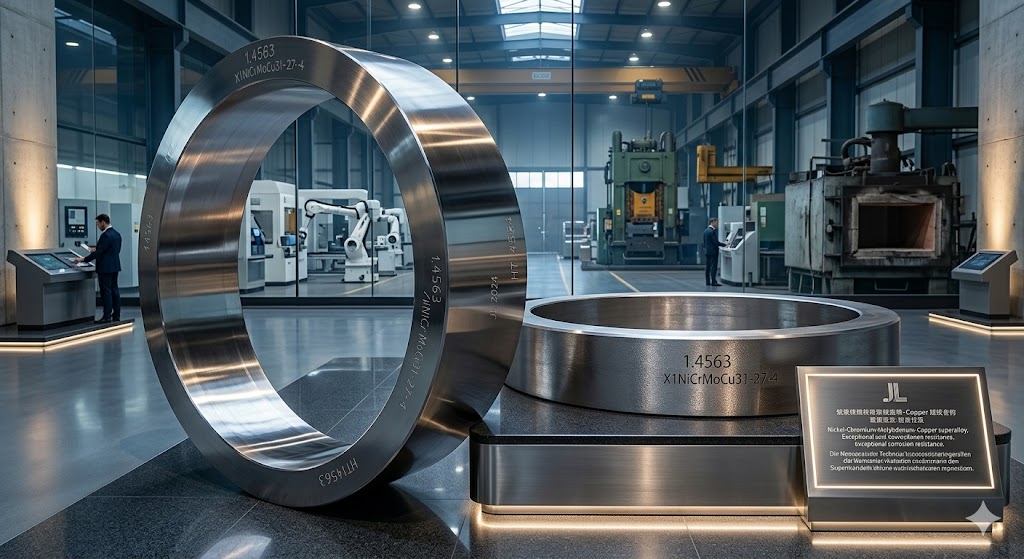
About 1.4563 (X1NiCrMoCu31-27-4) Material & Our China Jiangyin Factory
Jiangsu Liangyi Co., Limited is based in Chengchang Industrial Park, Jiangyin City, Jiangsu Province, China. With over 25 years of experience, we are an ISO 9001:2015 certified professional manufacturer specializing in 1.4563 (also called X1NiCrMoCu31-27-4, X1NiCrMoCu31.27.4) open die forgings, seamless rolled forged rings, and custom forged parts.As a top Chinese forging manufacturer,we provide a full range of service from steel melting, open die forging and heat treatment to CNC machining .We supply high-performance 1.4563 forged products to customers in more than 50 countries throughout Europe, North America, the Middle East, Southeast Asia, Australia and South America.
Why Choose 1.4563 (X1NiCrMoCu31-27-4) Super Austenitic Stainless Steel?
1.4563 is a premium high-alloy super austenitic stainless steel, and it is used in extreme corrosive environments that conventional 300-series stainless steels and duplex steels cannot handle. Due to it has the content of Nickel (30–34%), Chromium (26–28%) and Molybdenum (3–4%), and Copper (0.6–1.4%), this material has exceptional performance:
- Outstanding resistance to pitting, crevice corrosion, and stress corrosion cracking in chloride-rich and acidic media
- Fully meet NACE MR0175/ISO 15156 for sour oil and gas service
- Excellent low-temperature impact toughness, maintaining ≥ 60 J even at −196 °C
- Great resistance to sulfuric acid, phosphoric acid, acetic acid, and reducing acid environments
- Stable mechanical properties across both elevated-temperature and cryogenic service conditions
Full Range of 1.4563 (X1NiCrMoCu31-27-4) Forging Products
We produce a full range of custom 1.4563 forgings in all kinds of shapes and specifications, and they all meet international standards including ASTM, DIN, EN, ISO and NACE. API 6A dimensional references are available upon request, and we also produce custom parts based on clients drawings, with weight ranges from 30 kg to 30 tons per piece. Full dimensional traceability and inspection are provided for every production batch.
1.4563 Forged Steel Bars & Rods
Our factory in Jiangyin, China supplies 1.4563 forged steel round bars, square bars, flat bars, rectangular bars and step shafts.The maximum forging diameter is up to 2 meters, and maximum length up to 15 meters.All forged bars are given full heat treatment and ultrasonic testing, and can be supplied with EN 10204 3.1/3.2 material test certificates.They are widely used for valve stems, pump shafts, conveyor rollers, drill rods and different mechanical parts.
X1NiCrMoCu31-27-4 Seamless Rolled Forged Rings
We produce custom X1NiCrMoCu31-27-4 seamless rolled rings and open die forged rings using our 1–5 meter seamless rolling equipment, with a maximum ring diameter of up to 6 meters and weight up to 30 tons per single piece.Our 1.4563 forged rings include gear rings, valve body rings, flange rings, bearing rings and custom profiled rolled rings, and they are widely used for pressure-resistant and rotating parts in the oil and gas, chemical and power generation industries.
1.4563 Forged Hollow Components & Pressure Parts
Our 1.4563 forged hollow parts include hubs, casings, shells, sleeves, bushings, heavy-wall hollow bars, seamless pipes, tubes and cylindrical shells, with an outer diameter up to 3000 mm.These seamless hollow forgings avoid welding defects and provide better mechanical stability and corrosion resistance, so that they are the best choice material for pressure vessel shells, reactor nozzles, heat exchanger tubes, valve bodies and downhole tool casings.
X1NiCrMoCu31-27-4 Forged Discs, Plates & Custom Components
We also produce X1NiCrMoCu31-27-4 forged discs, blocks, plates, tube sheets, baffle plates, impeller blanks, and custom machined parts.All products are forged using our2000–6300 T hydraulic forging presses, which makes sure all of the products have a consistent internal matrix and fully meet needed mechanical properties.
1.4563 Forging Product Dimension Capabilities
The table below shows Jiangsu Liangyi's standard production capacity for each type of 1.4563 forging product. All figures reflect our confirmed in-house capability based on our forging presses and rolling equipment. We may also be able to produce sizes outside these ranges — please contact us with your specific requirements.
- Round bar Ø
- 50 – 2,000 mm
- Max. length
- Up to 15,000 mm
- Square / flat
- 50 – 1,500 mm across
- Weight / pc
- 30 kg – 10 tons
- Tolerance
- Per EN 10243 / custom
- Surface finish
- Black, turned, ground
- OD range
- 300 – 6,000 mm
- Wall thickness
- ≥ 50 mm
- Max. height
- Up to 2,500 mm
- Weight / pc
- 30 kg – 30 tons
- Profile
- Flat, L, T, contoured
- Rolling machine
- 1 M – 5 M ring rollers
- OD range
- 200 – 3,000 mm
- Wall thickness
- ≥ 30 mm
- Max. length
- Up to 10,000 mm
- Weight / pc
- 50 kg – 20 tons
- Forms
- Tube, shell, sleeve, hub
- Standard
- ASTM / EN / custom
- Disc Ø
- 200 – 3,000 mm
- Plate dimensions
- Up to 3,000 × 2,000 mm
- Thickness
- 20 – 600 mm
- Weight / pc
- 30 kg – 20 tons
- Includes
- Tube sheets, baffle plates, impeller blanks
- Machining
- Full CNC finish available
| Product Type | Key Dimension Range | Max. Single-Piece Weight | Applicable Standards |
|---|---|---|---|
| Round Bar / Rod | Ø 50 – 2,000 mm; L ≤ 15,000 mm | 10 tons | EN 10243, ASTM A484 |
| Seamless Rolled Ring | OD 300 – 6,000 mm | 30 tons | EN 10243, ASTM A484 |
| Open Die Forged Ring | OD 300 – 4,000 mm | 20 tons | EN 10243, ASTM A484 |
| Hollow Component / Shell | OD 200 – 3,000 mm; L ≤ 10,000 mm | 20 tons | ASTM A182, EN 10222 |
| Disc / Plate / Tube Sheet | Ø 200 – 3,000 mm; T 20 – 600 mm | 20 tons | ASTM A182, EN 10222 |
| Custom Machined Component | Per client 2D/3D drawing | 30 tons (rough) | Per client specification |
Chemical Composition & Mechanical Properties of 1.4563 Forgings
Jiangsu Liangyi strictly controls the chemical composition of every heat of 1.4563 (X1NiCrMoCu31-27-4) forged material.We adjust alloy elements and reduce harmful impurities during primary melting and secondary refining.For important applications, we provide double melted (VIM+VAR) and triple melted (VIM+ESR+VAR) material options to get the highest purity and consistent matrix.
Chemical Composition of X1NiCrMoCu31-27-4 (EN 10088)
| Element | Specified Range (wt.%) | Role in Performance |
|---|---|---|
| Nickel (Ni) | 30.0 – 34.0 | Austenite stability; resistance to reducing acids and SCC |
| Chromium (Cr) | 26.0 – 28.0 | Passive film formation; pitting and oxidation resistance |
| Molybdenum (Mo) | 3.0 – 4.0 | Pitting and crevice corrosion resistance in Cl⁻ media |
| Copper (Cu) | 0.6 – 1.4 | Resistance to H₂SO₄ and non-oxidising acids |
| Carbon (C) | Max 0.030 | Low C limits sensitisation and intergranular corrosion |
| Manganese (Mn) | Max 2.5 | Austenite stabiliser; sulphide morphology control |
| Silicon (Si) | Max 1.0 | Deoxidation during melting |
| Phosphorus (P) | Max 0.030 | Impurity; controlled to minimise hot-shortness |
| Sulfur (S) | Max 0.010 | Ultra-low S required for NACE MR0175 sour service |
| Iron (Fe) | Balance (~29.0 – 40.4) | Base metal |
Mechanical Properties of 1.4563 Forgings (Solution Annealed + Quenched)
| Property | Requirement | Test Standard |
|---|---|---|
| 0.2% Proof Strength (Rp0.2) | ≥ 220 MPa | ISO 6892-1 / ASTM E8 |
| Tensile Strength (Rm) | 500 – 700 MPa | ISO 6892-1 / ASTM E8 |
| Elongation (A50) | ≥ 40 % | ISO 6892-1 / ASTM E8 |
| Reduction of Area (Z) | ≥ 50 % | ISO 6892-1 / ASTM E8 |
| Hardness | ≤ 230 HB | ISO 6506-1 / ASTM E10 |
| Charpy KV at +20 °C (longitudinal) | ≥ 100 J | ASTM E23 / EN ISO 148-1 |
| Charpy KV at +20 °C (transverse) | ≥ 60 J | ASTM E23 / EN ISO 148-1 |
| Charpy KV at −196 °C (transverse) | ≥ 60 J | ASTM E23 / EN ISO 148-1 |
All mechanical tests are carried out using qualification test coupons taken from the same heat and heat treatment batch.Hardness testing meets ISO 6506-1 (Brinell) or ASTM E10.Charpy impact testing follows ASTM E23.A test report with all results is included with every delivery.
Heat Treatment Specification & Pitting Resistance Equivalent (PREN) of 1.4563
Standard Heat Treatment Process for 1.4563 Forgings
Unless otherwise specified by the customer, all 1.4563 (X1NiCrMoCu31-27-4) forgings supplied by Jiangsu Liangyi are delivered in the solution-annealed and water-quenched condition.This process dissolves all precipitated phases, including sigma phase and carbides, and creates a fully austenitic, uniform microstructure that maximizes corrosion resistance and toughness.The specific heat treatment parameters we use are:
Pitting Resistance Equivalent Number (PREN) of 1.4563
The Pitting Resistance Equivalent Number (PREN) is the standard measure used in the stainless steel and corrosion engineering industry to compare how well a material resists local pitting corrosion in environments with chloride.The formula used for austenitic stainless steels is:
PREN = %Cr + 3.3 × %Mo + 16 × %N
Based on the typical composition of 1.4563 (Cr = 27%, Mo = 3.5%), its calculated PREN value is about 38.6 to 44, depending on the actual chemical analysis of each heat.This range puts 1.4563 in the top class of corrosion-resistant alloys, performing significantly better than standard austenitic stainless steels and most duplex stainless steels.The visual comparison below shows this more clearly:
Note: PREN values are calculated from nominal composition midpoints. Actual values vary by heat analysis. Higher PREN indicates greater pitting resistance in chloride environments.
However, what PREN does not reflect — and where 1.4563 has a clear advantage over 254 SMO and duplex alloys — is its performance in reducing acid environments.
The high copper content (0.6–1.4%) in 1.4563 greatly inhibits active corrosion in sulfuric acid, phosphoric acid, and similar media.No other widely used wrought alloy in the same PREN range offers this unique combination of properties.
Corrosion Performance Data for 1.4563 Forged Steel
Choosing a material only based on its nominal composition and PREN value can leave hidden performance gaps that matter in real-world use.The data below covers the main corrosion behaviors most important to the industries we serve.All reference values are in line with published technical literature and testing carried out according to ASTM and ISO standards.
Critical Pitting Temperature (CPT) — ASTM G48 Method A
The Critical Pitting Temperature (CPT) is measured by immersing a test coupon in a 6% FeCl₃ solution (ASTM G48 Method A) and recording the lowest temperature at which pitting starts within 72 hours.CPT serves as a practical material selection standard for equipment used in hot chloride-containing process fluids, seawater, or cooling water.
| Grade | CPT (°C, typical) | Practical Implication |
|---|---|---|
| 316L (1.4404) | 0 – 15 °C | Not suitable for hot chloride service |
| 904L (1.4539) | 30 – 40 °C | Moderate chloride resistance |
| SAF 2507 duplex (1.4410) | 55 – 70 °C | High pitting resistance; limited in reducing acids |
| 254 SMO (1.4547) | 60 – 75 °C | Excellent chloride resistance |
| 1.4563 / Alloy 31 (X1NiCrMoCu31-27-4) | ≥ 60 °C | Excellent pitting resistance + superior reducing acid resistance |
Sulfuric Acid Corrosion Resistance
Resistance to sulfuric acid (H₂SO₄) is one of the main reasons 1.4563 is chosen over 254 SMO and high‑PREN duplex grades in chemical processing.With 0.6–1.4 wt.% copper, 1.4563 forms a protective passive layer in non‑oxidizing acids, greatly lowering corrosion rates at concentrations where even 904L suffers significant attack.
| Test Condition | 316L | 904L | 1.4563 / Alloy 31 |
|---|---|---|---|
| 10% H₂SO₄, 25 °C | High attack (> 1 mm/year) | < 0.5 mm/year | < 0.1 mm/year |
| 30% H₂SO₄, 60 °C | Severe (> 5 mm/year) | Moderate (0.5–2 mm/year) | < 0.3 mm/year |
| 50% H₂SO₄, 25 °C | Not suitable | < 0.5 mm/year | < 0.1 mm/year |
Sour Service Performance — NACE MR0175/ISO 15156 Compliance
1.4563 (X1NiCrMoCu31-27-4) is listed as an acceptable material for sour oil and gas service under NACE MR0175/ISO 15156-3, provided the following conditions are maintained in the supplied forgings:
- Hardness: ≤ 35 HRC (≈ 327 HV) on all cross-sections, including surface and subsurface measurements
- Carbon content: ≤ 0.030 wt.% (controlled to minimise sensitisation and carbide precipitation)
- Sulfur content: ≤ 0.010 wt.% — our standard specification. For extreme sour environments, we can supply ultra-low sulfur ≤ 0.005 wt.% on request
- Heat treatment: Solution annealed and water quenched — as detailed in Section 4 of this page
- Documentation: NACE-compliant test reports covering hardness mapping, chemistry, and mechanical properties are supplied with every order upon request
Our factory in Jiangyin, China has supplied 1.4563 forged parts that meet NACE MR0175 standards. These parts are used for wellhead equipment, valve bodies, downhole tools and subsea connector systems, which work in environments where the H₂S partial pressure is over 0.3 kPa. We also provide full documents and third-party material certifications from organizations like BV, SGS and TÜV.
1.4563 (Alloy 31) vs. Alternative Grades — Technical Comparison
Choosing a corrosion-resistant alloy for a specific application needs evaluating multiple material properties at the same time.Price alone never determines the right grade — total cost of ownership, replacement frequency, and compliance requirements are equally important factors.The table below helps engineers and procurement teams make an objective comparison between 1.4563 and the alloys it most often competes with or replaces.
| Property / Criterion | 316L (1.4404) | 904L (1.4539) | 254 SMO (1.4547) | SAF 2507 Duplex (1.4410) | 1.4563 / Alloy 31 |
|---|---|---|---|---|---|
| Ni content (wt.%) | 10–14 | 23–28 | 17–22 | 6–8 | 30–34 |
| Cr content (wt.%) | 16–18 | 19–23 | 19–21 | 24–26 | 26–28 |
| Mo content (wt.%) | 2–3 | 4–5 | 6–7 | 3–5 | 3–4 |
| Cu content (wt.%) | — | 1–2 | 0.5–1 | — | 0.6–1.4 |
| PREN (approximate) | ~24 | ~32 | ~43 | ~42 | ~38–44 |
| Pitting resistance (Cl⁻) | Low | Moderate | Excellent | Excellent | Excellent |
| Resistance to reducing acids (H₂SO₄, H₃PO₄) | Poor | Good | Limited (no Cu) | Limited (no Cu) | Superior (high Cu + Ni) |
| SCC resistance in Cl⁻ | Poor | Good | Good | Good | Excellent |
| Low-temperature toughness (−196 °C) | Good | Good | Good | Limited (brittle duplex) | Excellent (≥ 60 J at −196 °C) |
| NACE MR0175 sour service | Conditional only | Yes (with limits) | Yes | Yes | Yes — fully compliant |
| Microstructure | Austenitic | Austenitic | Austenitic | Duplex (α+γ) | Fully austenitic |
| Weldability (for assemblies) | Excellent | Excellent | Good | Moderate | Excellent |
| Relative material cost tier | Low | Medium | Medium–High | Medium–High | Medium–High |
When to Specify 1.4563 Over Other Grades
- Replace 316L or 317L when equipment suffers repeated pitting, SCC, or premature failure in chloride or acidic service — 1.4563 has a step-change improvement
- Replace or upgrade from 904L when the process stream contains moderate-to-high chloride concentrations or strong reducing acids — 1.4563 has superior pitting resistance and better reducing-acid performance at comparable cost
- Prefer 1.4563 over 254 SMO for applications involving sulfuric acid, phosphoric acid, or vinyl chloride — the additional copper content gives 1.4563 a decisive corrosion rate advantage in these media
- Prefer 1.4563 over SAF 2507 duplex for cryogenic service (below −50 °C), where duplex microstructures lose impact toughness, and for reducing acid environments where the duplex phase structure has no copper-equivalent benefit
- 1.4563 is the correct first choice when a single alloy must perform reliably across sour gas (NACE MR0175), oxidising chloride media, reducing acids, and low-temperature service simultaneously
Industry Applications & GEO-Targeted Project Cases of 1.4563 Forging Parts
Our 1.4563 (X1NiCrMoCu31-27-4) forged parts made in China are widely used in extreme industrial fields needing excellent corrosion resistance, extreme temperature stability and reliable long‑term performance.Below are our main application areas and verified project cases supplied to global customers:
Oil & Gas Upstream & Downstream Industry
1.4563 forged steel is the premium material for sour oil and gas exploration and production equipment.It has excellent resistance to sulfide stress corrosion cracking (SSCC) and hydrogen-induced cracking (HIC), fully meeting NACE MR0175/ISO 15156.
Our main products for this industry include forged valve balls, valve bodies, bonnets, stems; wellhead Christmas trees, casing heads, tubing heads, casing hangers, tubing spools; downhole drilling tools, drill pipes, mud motor splined drive shafts; ESP parts risers, connectors, double studded adapter flanges, and gaskets.
Middle East Sour Gas Project Case
We supplied custom 1.4563 (X1NiCrMoCu31-27-4) forged wellhead equipment, casing heads, valve bodies and downhole drilling tool parts for a large-scale sour gas development project in the Middle East.
All products were made based on NACE MR0175 and API 6A standards, featuring ultra-low sulfur control and triple-melted (VIM+ESR+VAR) material. Our forgings have been running reliably for more than 5 years in harsh H₂S- and CO₂-containing environments, fully satisfying the customer’s corrosion resistance and safety requirements.
Chemical & Petrochemical Processing Industry
For chemical processing equipment operating in highly corrosive environments, our 1.4563 forged parts have outstanding long-term corrosion resistance, far superior to conventional stainless steels. We produce forged heat exchanger shells, tube sheets, baffle plates, pressure vessel shells, reactor nozzles, pump casings, impellers, pump shafts, pipeline fittings, and process equipment forgings for systems handling sulfuric acid, phosphoric acid, acetic acid, vinyl chloride, as well as fertilizer and pharmaceutical production facilities.
German Chemical Plant Project Case
We supplied 1.4563 forged heat exchanger tube sheets, pressure vessel shells, pump casings and pipeline flanges for a leading German chemical company specializing in phosphoric acid production.These parts work for a long time in highly concentrated acidic media with high chloride levels.Our 1.4563 forgings fully passed the corrosion resistance qualification tests needed for the customer’s PED 2014/68/EU pressure equipment certification. Compared with their previously used 904L parts, our forgings have significantly longer lifetime and greatly reduced maintenance costs.
Nuclear Power & Thermal Power Generation Industry
Our X1NiCrMoCu31-27-4 forgings are widely used in nuclear power, thermal power and renewable energy equipment, and they all have excellent radiation resistance, low-temperature toughness and structural stability. We provide forged nuclear reactor coolant pump impellers, casings and containment seal chambers, gas and steam turbine tie rods, turbo centrifugal compressor impellers, generator parts and high-performance butterfly valve shafts for power generation systems.
Asian Nuclear Power Project Case
We supplied X1NiCrMoCu31-27-4 forged impellers, pump casings and containment seal chambers for reactor coolant pumps in a large-scale nuclear power project in Asia.Our forgings were given rigorous nuclear-grade material testing, including ultra-low temperature impact testing, non-destructive testing and metallographic examination, fully meeting the stringent safety and performance requirements for nuclear power applications.
Cryogenic Engineering & LNG Industry
1.4563 forged steel has outstanding ultra-low temperature impact toughness, so that it is widely used in cryogenic equipment, LNG storage and transportation systems, and cryogenic processing facilities.Unlike conventional austenitic stainless steels, because 1.4563 keeps excellent ductility and impact resistance even at −196 °C, it is the best choice material for cryogenic valves, flow meters and pressure vessels.We produce cryogenic valve stems, butterfly valve main shafts, ultrasonic flow meter bodies, Venturi cone meter parts and custom forgings for cryogenic applications.
Norwegian Cryogenic Engineering Project Case
We supplied 1.4563 forged cryogenic valve stems, butterfly valve main shafts and flow meter bodies for a large‑scale LNG cryogenic project in Norway.All parts were impact‑tested at −196 °C, with impact energy exceeding 60 J, fully satisfying the customer’s ultra‑low temperature service requirements.
Other Industrial Applications
Our 1.4563 forgings are also widely used in marine engineering, mining equipment, pulp and paper production, aerospace structural parts, flue gas desulfurization (FGD) systems and general industrial machinery.We provide fully customized forging solutions according to your specific operating conditions, media environments and performance demands, supported by full technical service from our experienced engineering team.
Full-Process Quality Control & Certification
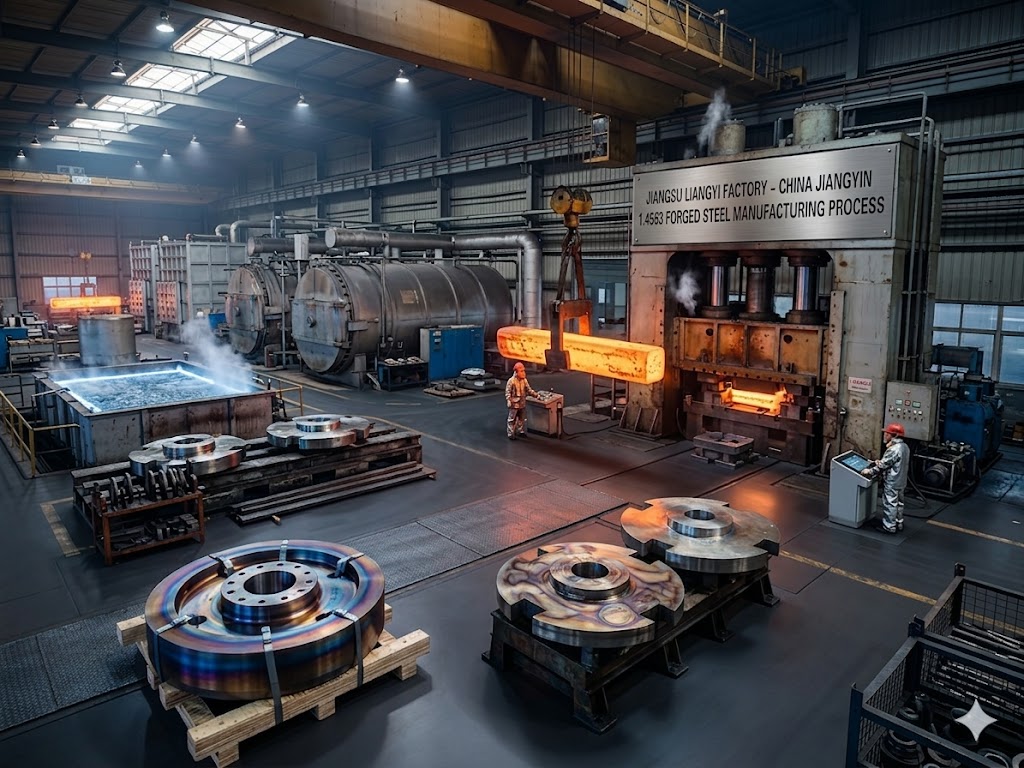
At Jiangsu Liangyi, our factory provides a full range of process quality control system from raw material melting to final inspection and shipment, making sure all 1.4563 (X1NiCrMoCu31-27-4) forgings have the highest quality.We have made significant investments in advanced production and testing equipment, making sure every production stage is strictly controlled and fully traceable.
Advanced Production Equipment for 1.4563 Forgings
- Steel melting equipment: 30 t EAF electric arc furnace, 30 t LF ladle refining furnace, VOD vacuum degassing furnace, VIM vacuum induction melting furnace, ESR electroslag remelting furnace, VAR vacuum arc remelting furnace
- Forging equipment: 2000 T / 4000 T / 6300 T hydraulic forging presses, 0.75 T–9 T electro-hydraulic forging hammers, 1 M–5 M seamless ring rolling machines
- Heat treatment: 10 full-automatic heat treatment furnaces, supporting quenching, tempering, solution annealing, and aging treatment for 1.4563 material
- Machining: CNC machining centers, CNC lathes, milling machines, drilling machines, supporting precision machining of custom 1.4563 components
Non-Destructive Testing (NDT) & Inspection
All 1.4563 forging parts are given 100% NDT to make sure all of them have no internal and surface defects:
- Ultrasonic Testing (UT): After heat treatment, per ASTM A388/388M, ASTM E127, and EN standards
- Magnetic Particle Testing (MT), Penetrant Testing (PT), Radiographic Testing (RT): Per client requirements, ASTM and EN compliant
- Full chemical composition analysis, mechanical property testing, metallographic examination, and corrosion resistance testing for every heat
Certification & Documentation
Standard supply documentation includes an EN 10204 3.1 inspection certificate covering chemical composition, mechanical properties, heat treatment records, NDT results, and full material traceability.EN 10204 3.2 third-party certification (BV, SGS, TÜV, etc.) is available upon request.Our factory is ISO 9001:2015 certified.Products are made based on NACE MR0175 / ISO 15156 requirements.API 6A dimensional references are available on request.For PED-regulated equipment, we provide materials compatible with your Notified Body certification process.
Packaging, Export Documentation & How to Get a Quotation
Export Packaging Standards for 1.4563 Forgings
All 1.4563 forged parts are packed according to export-grade standards for shipping by sea or air. Our packaging method protects our parts against rust, mechanical damage, and shifting during long-distance shipping.The size, weight, and fragility of each product determine how it will be packaged.
Small & Medium Components (≤ 500 kg)
- Anti-rust oil is applied to all machined surfaces
- VCI (Volatile Corrosion Inhibitor) poly film wrap
- Wooden case or plywood crate, heat-treated per ISPM 15
- Internal cushioning: foam padding or wood dunnage
- Labels: part number, heat number, gross weight, handling instructions
Heavy Components (> 500 kg)
- Anti-rust oil is coated on all exposed metallic surfaces
- VCI poly film or stretch wrap on each piece
- Steel pallet or steel-framed wooden crate with welded lifting lugs
- WLL (Working Load Limit) marked on all lifting points
- Bolt-down strapping for container loading
Export Documentation Provided with Each Shipment
| Document | Standard or Optional | Details |
|---|---|---|
| EN 10204 3.1 Mill Test Report | Standard | Chemistry, mechanical properties, heat treatment, NDT, traceability |
| Commercial Invoice | Standard | HS code, unit price, total value, Incoterms |
| Packing List | Standard | Item-by-item weight, dimensions, package numbers |
| Certificate of Origin | Standard | Issued by local Chamber of Commerce, China |
| Bill of Lading / Airway Bill | Standard | Issued by freight forwarder |
| EN 10204 3.2 Inspection Certificate | Optional | Third-party witness inspection — BV, SGS, TÜV, BUREAU VERITAS |
| NACE MR0175 Compliance Statement | Optional | Issued with supporting hardness and chemistry data |
| API 6A Material Compliance | Optional | Per client specification and agreed quality plan |
| Dimensional Inspection Report | Optional | Dimensional records per client drawing and agreed tolerances |
| Phytosanitary Certificate for Wood Packaging | If required | Confirms ISPM 15 heat treatment of wood packaging |
How to Request a Quotation — 5 Steps
Our quotation process is straightforward. To get an accurate, detailed quote for 1.4563 forging parts, prepare the following information and send it to our sales team. We will reply within 24 hours on business days.
Minimum Order & Pricing Structure
- No strict MOQ: We accept single-piece orders from 30 kg for prototype, qualification, or replacement part applications
- Pricing basis: FOB Tianjin / Shanghai or CIF destination port, priced in USD. EXW factory is available for freight forwarder collections
- Volume discounts: It is available for repeat orders and long-term supply agreements. Contact us for framework pricing
- Payment terms: T/T (bank transfer) or L/C at sight — subject to order value and client credit history
- Lead time: 25–35 days standard (material melting, forging, heat treatment, inspection). Expedited schedule is available on request
Frequently Asked Questions — 1.4563 (X1NiCrMoCu31-27-4) Forging Parts
What is the equivalent grade of 1.4563 (X1NiCrMoCu31-27-4) steel?
1.4563 is the EN material number. Its full chemical name is X1NiCrMoCu31-27-4, its UNS number is N08031, and it is commonly called Alloy 31 in the market. It is a type of super austenitic stainless steel, different from 904L (N08904), 254 SMO (S31254), and duplex stainless steels like SAF 2507 (S32750). What makes it different is its very high nickel content (30–34%), along with the mix of chromium, molybdenum and copper — these elements make it work better in reducing-acid and sour-gas environments.
What is the solution annealing temperature for 1.4563?
What is the minimum order quantity (MOQ) for 1.4563 forging parts?
We have no fixed minimum order quantity. Our factory in Jiangyin, China accepts single-piece orders starting from 30 kg — including orders for prototypes, qualification parts, and replacement parts. We provide both one-off custom forgings for engineering projects and large-volume production orders for OEM and EPC clients. Please contact us with your drawings and required quantity to get a specific quotation.
What is the delivery time for custom 1.4563 forged components?
The standard lead time for custom 1.4563 forged parts is 25–35 days. This includes the whole process from melting the raw material, forging, heat treatment, non-destructive testing (NDT), machining (if needed), inspection, to issuing the required certificates.
The delivery time may change based on the clients drawings, the thickness of the forged parts, and the needed testing. If you have urgent needs, we can speed up the production — just contact our sales team with your needed delivery date.
Can you supply 1.4563 forgings compliant with NACE MR0175/ISO 15156?
Yes. All 1.4563 forgings can be made to meet the requirements of NACE MR0175/ISO 15156-3 for sour oil and gas service. The main compliance parameters we control and document are as follows: hardness ≤ 35 HRC (for all sections), carbon ≤ 0.030 wt.%, sulfur ≤ 0.010 wt.% (we can also provide ultra-low sulfur ≤ 0.005 wt.% if you request it), the forgings are in solution annealed and water quenched condition, and full material traceability is provided for each heat. For sour-service orders, NACE compliance documentation is included as standard with the EN 10204 3.1 certificate.
What melting processes are available for 1.4563 forgings?
We offer three melting routes depending on application requirements: (1) Standard EAF + LF + VOD — suitable for most industrial and oil & gas applications; (2) Double melted: VIM + VAR — for improved cleanliness and homogeneity in demanding chemical, nuclear, or aerospace applications; (3) Triple melted: VIM + ESR + VAR — for the most important applications needing maximum material purity, such as nuclear components, subsea downhole tools, and aerospace parts. All melt routes are supplied with full traceability documentation.
How does 1.4563 perform in sulfuric acid compared to 904L and 316L?
1.4563 performs much better than both 904L and 316L when exposed to sulfuric acid. In a 10% sulfuric acid (H₂SO₄) solution at 25 °C, 316L has a corrosion rate of more than 1 mm per year, so it is not suitable for use in this environment. 904L works better, but in concentrated or high-temperature acid, its corrosion rate still ranges from 0.1 to 0.5 mm per year. By comparison, 1.4563 has a corrosion rate of less than 0.1 mm per year in 10% sulfuric acid at 25 °C, and less than 0.3 mm per year in 30% sulfuric acid at 60 °C. This advantage mainly comes from its copper content (0.6–1.4%) and high nickel content; together, these two elements form a protective layer on the alloy’s surface in reducing acidic environments, while other materials still corrode easily.
Do you support third-party inspection (TPI) and witness testing?
Yes. We regularly allow third-party inspection at our Jiangyin factory by accredited agencies such as BV (Bureau Veritas), SGS, TÜV, and Intertek. We can provide EN 10204 3.2 certificates, which needs the 3.2 inspector to witness the tests and sign the test records.You are also welcome to send your representatives to attend the witness testing in person. For important orders, we can agree on inspection hold points and release procedures in a pre-production Quality Plan (QP).
Contact Our China Jiangyin Factory for Custom 1.4563 (X1NiCrMoCu31-27-4) Forging Parts Quotation
Jiangsu Liangyi Co., Limited is your reliable Chinese manufacturer and supplier of high-quality 1.4563 (X1NiCrMoCu31-27-4) forged parts and custom forged steel parts. With over 25 years of forging experience, complete in-house production capabilities and a strict quality control system, we are dedicated to providing global customers with high-quality products at competitive prices, along with professional technical support and after-sales service.
Please send us your drawings, material requirements, order quantity and project specifications to get a detailed free quotation. Our sales team will reply within 24 hours on business days.
Inquiry Email: sales@jnmtforgedparts.com
Phone / WhatsApp: +86-135-8506-7993
Official Website: https://www.jnmtforgedparts.com
Factory Address: Chengchang Industry Park, Jiangyin City, Jiangsu Province, China 214400