1.4543 (X3CrNiCuTiNb12-9) Forgings | China ISO 9001 Manufacturer
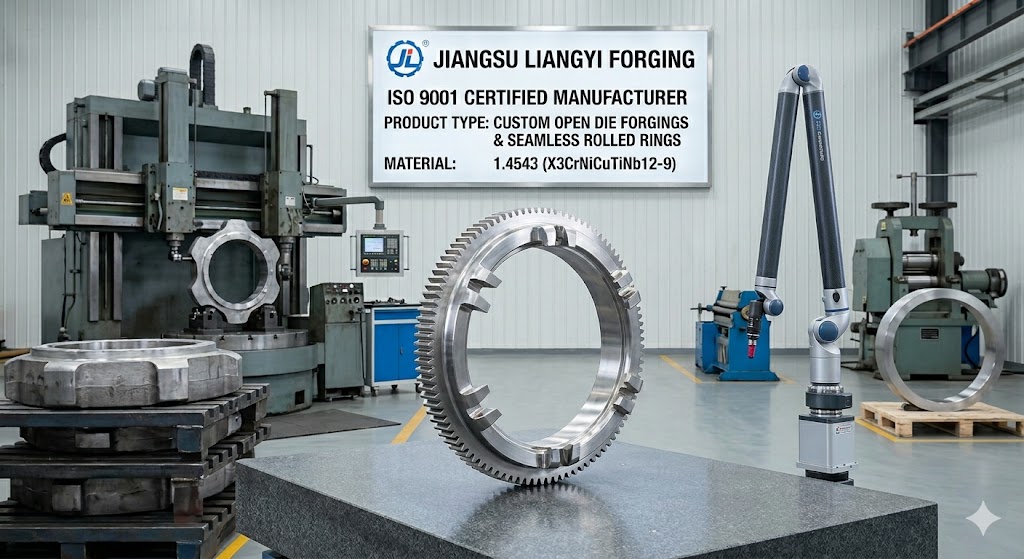
Jiangsu Liangyi Co., Limited is an ISO 9001:2015 certified manufacturer of 1.4543 (X3CrNiCuTiNb12-9) forging parts located in Jiangyin City, Jiangsu Province, China. With over 25 years of dedicated experience in special steel forging, we supply precision-engineered 1.4543 open die forgings, seamless rolled rings, forged shafts, valve components and turbine parts to customers in more than 50 countries across Europe, North America, the Middle East, Southeast Asia and Australia. Our vertically integrated production — from in-house VIM/ESR double melting and precision forging, through custom heat treatment, full NDT inspection to CNC machining — enables us to deliver complex custom forgings with tight tolerances, full traceability and documentation packages meeting internationally recognized standard requirements including API 6A, EU PED 2014/68/EU and NACE MR0175, coordinated through customer-nominated third-party inspection bodies.
Understanding 1.4543 Metallurgy: Why This Grade Outperforms Standard PH Grades in Heavy Forgings
1.4543 (X3CrNiCuTiNb12-9) belongs to the martensitic precipitation-hardening stainless steel family, but its alloying philosophy differs fundamentally from the more widely known 17-4PH (UNS S17400) in ways that directly translate into superior forging performance for heavy industrial components. Understanding these differences helps engineers specify the correct material for critical applications.
The Dual Precipitation Mechanism: Ti + Nb vs. Copper-Only Hardening
In standard 17-4PH, strengthening is achieved primarily through the precipitation of copper-rich epsilon-copper (ε-Cu) clusters during aging at 480–620 °C. While effective, ε-Cu precipitates are relatively coarse after extended aging and show limited stability above 400 °C. In contrast, 1.4543 employs a dual precipitation system:
- Primary hardening: Fine Ni₃Ti and Ni₃(Ti,Al) intermetallic precipitates, formed through the controlled Ti content of 0.8–1.4%, provide a dense, coherent dispersion that impedes dislocation movement far more effectively than coarser ε-Cu particles.
- Secondary stabilization: Niobium (0.1–0.5%) combines with carbon and nitrogen to form NbC and NbN carbides and nitrides at grain boundaries and within the matrix. These fine particles suppress grain growth during both hot forging and heat treatment, locking the ASTM grain size at ≥ 5 even in large-cross-section forgings.
- Copper supplementation: The Cu content of 1.5–2.5% contributes additional ε-Cu precipitation, but at a secondary level, acting synergistically with the Ti/Nb phases rather than as the sole hardening mechanism.
The result is a finer, more thermally stable precipitate distribution that delivers a minimum yield strength of 1510 MPa — typically 100–150 MPa higher than 17-4PH Condition H900 — while retaining superior room-temperature impact toughness (minimum 20 J KV versus approximately 10–15 J for comparable 17-4PH H900 sections). This combination is particularly valuable in heavy forgings above 200 mm cross-section, where 17-4PH commonly shows mechanical property gradients between surface and core that 1.4543's grain-boundary stabilization largely eliminates.
Why VIM/ESR Double Melting Is Non-Negotiable for 1.4543 Forgings
The tight control of Ti and Nb contents (narrow specification windows of ±0.3% and ±0.2% respectively) means that 1.4543 is extremely sensitive to melting process quality. Our in-house production mandates VIM (Vacuum Induction Melting) as the primary melt followed by ESR (Electro-Slag Remelting) or VAR (Vacuum Arc Remelting) as the secondary melt, for the following specific reasons:
- VIM primary melt: Enables precise addition of reactive elements Ti and Nb without oxidation losses. Achieves oxygen content below 20 ppm and nitrogen below 80 ppm, preventing formation of coarse TiN inclusions that act as fatigue crack initiation sites in high-cycle rotating components.
- ESR secondary melt: The liquid slag pool progressively refines sulfide inclusions (achieving S ≤ 0.003%), removes macro-segregation bands from VIM ingot solidification, and produces a directionally solidified ingot with a fine, uniform dendritic structure. The result is a homogeneous Ti and Nb distribution throughout the ingot cross-section, which translates directly into uniform precipitation response during heat treatment.
- VAR alternative: For NACE MR0175 sour service applications where even lower inclusion content is required, we offer VIM+VAR double melting, achieving oxygen below 10 ppm and sulfur below 0.002%.
Air-melted or EAF-only 1.4543 forgings — a cost-cutting approach offered by some suppliers — suffer from variable Ti/Nb recovery, higher inclusion content and inconsistent mechanical properties in heavy sections. We provide full melting records and chemical homogeneity analysis reports as part of our standard documentation package.
Full Range of Custom 1.4543 (X3CrNiCuTiNb12-9) Forging Products
We manufacture custom 1.4543, X3CrNiCuTiNb12-9, X3CrNiCuTiNb129, X3CrNiCuTiNb12.9 forging steel products in a comprehensive range of shapes and specifications. Single-piece weight capacity ranges from 30 kg to 30 tonnes, and maximum outer diameter reaches 6 metres for seamless rolled rings. Our product range includes, but is not limited to:
Forged Bars & Custom Rods
1.4543 forged steel round bars, square bars, flat bars, rectangular bars, step bars and custom profiled rods. Maximum forged bar diameter: 2,000 mm; maximum length: 12,000 mm. All bars are forged with a minimum forging ratio of 4:1 to break down the as-cast ingot structure. Straightness tolerance: ≤ 2 mm/m (standard), ≤ 0.5 mm/m (precision). Supplied in solution-annealed condition or solution-annealed + aged condition per customer specification. Explore our full forged bars capability
Seamless Rolled Forged Rings
X3CrNiCuTiNb129 forged seamless rolled rings including flat rings, rectangular section rings, contoured rings (L-section, T-section, U-section), gear ring blanks, labyrinth seal rings, flange blanks and custom near-net-shape rings. Maximum outer diameter: 6,000 mm; maximum ring height: 2,500 mm; single-piece weight up to 30 tonnes. All rings are ring-rolled with a controlled reduction ratio to ensure full grain refinement across the radial direction, followed by full through-thickness UT inspection per EN 10308. Explore our 1.4543 seamless rolled rings up to 6m diameter
Hollow Forged Components
X3CrNiCuTiNb12-9 forged hubs, housings, sleeves, bushings, casings, heavy-wall hollow bars, seamless forged pipes and tubes. Maximum outer diameter: 3,000 mm; maximum wall thickness ratio OD/WT from 2:1 to 20:1 depending on forging method. Hollow forgings are produced by punching and mandrel forging to eliminate the core zone that carries the highest segregation density in solid forgings, making them ideal for pressure vessel nozzles and high-pressure pump bodies.
Forged Discs, Plates & Blocks
X3CrNiCuTiNb12.9 forged discs, disks, blocks, plates, flanged disc blanks, turbine disc blanks and custom flat components. Maximum diameter: 3,000 mm; maximum height: 800 mm; single-piece weight up to 20 tonnes. All discs are 100% volumetrically UT tested per ASTM A388 Class B acceptance criteria as standard. For nuclear applications, UT is performed per ASME SA-388 with enhanced sensitivity.
Custom Forged Shafts & Rotating Components
1.4543 forged step shafts, turbine rotor shafts, compressor shafts, pump shafts, valve stems, flanged shafts, splined drive shafts and eccentrically loaded rotating components. Maximum forged shaft length: 15,000 mm; maximum diameter: 1,800 mm. Shafts are straightened after heat treatment to ≤ 1 mm/m total indicator runout (TIR), then 100% magnetic particle inspected (MPI) on the surface and UT inspected volumetrically before machining. Explore our custom forged shafts up to 15m length
Valve & Oilfield Forged Components
1.4543 forged valve balls, valve bodies, valve bonnets, valve seat rings, plug bodies, gate valve bodies with integral weld-neck ends, casing heads, tubing hangers, wellhead components, choke body forgings and oilfield forgings manufactured to API 6A technical specifications. Available in NACE MR0175 sour service condition with hardness ≤ 33 HRC and sulfur ≤ 0.003%. Pressure rating up to 20,000 psi (138 MPa). Explore our API 6A-spec valve & oilfield forgings
1.4543 vs. Alternative Grades: Engineering Comparison for Forging Selection
Selecting the right precipitation hardening stainless steel grade for a heavy forging application requires a detailed engineering comparison. The table below reflects our direct production experience manufacturing these grades, not just catalogue data:
| Property / Criteria | 1.4543 (X3CrNiCuTiNb12-9) | 17-4PH (UNS S17400 / 1.4542) | 15-5PH (UNS S15500 / 1.4545) | 13-8Mo (UNS S13800 / 1.4534) |
|---|---|---|---|---|
| Min. Yield Strength (MPa) | 1510 | 1170 (H900) | 1170 (H900) | 1380 (H950) |
| Tensile Strength (MPa) | 1580–1720 | 1310 (H900) | 1310 (H900) | 1450 (H950) |
| Min. Elongation (%) | 8 | 10 | 10 | 10 |
| Impact Toughness (KV, J) | ≥ 20 | ≥ 10–15 | ≥ 20–27 | ≥ 40–60 |
| Hardness Range (HRC) | 45–50 | 40–44 | 40–44 | 43–47 |
| Max Service Temp (°C) | 450 | 315 | 315 | 425 |
| Precipitation Mechanism | Ni₃Ti + NbC/NbN + ε-Cu (dual) | ε-Cu only | ε-Cu only | Ni₃Al + NiAl |
| VIM/ESR Melt Required | Yes (standard) | Optional | Optional | Yes (required) |
| Large Section Properties (>300mm) | Excellent (Nb grain pinning) | Moderate gradient | Good | Excellent |
| NACE MR0175 Sour Service | Yes (≤ 33 HRC variant) | Yes (≤ 33 HRC) | Yes (≤ 33 HRC) | Yes (≤ 35 HRC) |
| EU PED 2014/68/EU | Yes (primary EN grade) | Yes (via EN 10250-4) | Yes (via EN 10250-4) | Yes |
| Relative Material Cost | Medium-High | Medium | Medium-High | High |
| Best Fit Applications | High-load valves, turbine discs, API wellheads, large rings | General PH applications, moderate load | Aerospace, moderate toughness priority | Cryogenic, ultra-high toughness priority |
Engineer's Note: 1.4543 is the optimal choice when both ultra-high yield strength (above 1400 MPa) and reliable toughness (above 15 J KV) are required simultaneously in heavy cross-section forgings. If toughness is the primary driver and strength requirements are more moderate (< 1200 MPa yield), 13-8Mo or 15-5PH may be preferable despite higher cost. If budget is constrained and strength requirements are moderate, 17-4PH is a practical alternative. Contact our engineering team for a free application-specific grade selection consultation.
Why Choose 1.4543 (X3CrNiCuTiNb12-9) Stainless Steel Forgings?
1.4543 is a high-strength martensitic precipitation hardening stainless steel that can be hardened by aging treatment. It is designed for critical working parts that require top mechanical performance and stable corrosion resistance. Apart from standard technical data, this grade brings clear practical benefits for industrial forged parts.
Ultra-High Strength Without Toughness Sacrifice
A single-step low-temperature aging treatment (480–540 °C) develops a minimum yield strength of 1510 MPa and tensile strength of 1580–1720 MPa while retaining a minimum elongation of 8% and Charpy impact energy of 20 J at room temperature. This combination — which standard 17-4PH H900 cannot reliably achieve in sections above 150 mm — makes 1.4543 the preferred choice for wellhead equipment, compressor impellers and high-pressure valve bodies where both strength and resistance to brittle fracture are non-negotiable.
Consistent Cross-Section Properties in Heavy Forgings
The Nb addition (0.1–0.5%) pins grain boundaries during hot forging at 950–1150 °C and suppresses grain growth during solution annealing at 830 °C, maintaining a fine grain structure (ASTM grain size ≥ 5) even in forgings with effective cross-sections exceeding 500 mm. This ensures that core mechanical properties match surface properties within ±5% — a uniformity that competing copper-only PH grades (17-4PH, 15-5PH) rarely achieve in equivalent section sizes, because their grain boundary carbides coarsen rapidly at forging and annealing temperatures.
Superior Atmospheric & Industrial Corrosion Resistance
The 11–12.5% Cr content builds a stable native Cr₂O₃ passive film, while the 7.5–9.5% Ni and 1.5–2.5% Cu additions improve the film's repassivation kinetics in mildly chloride-containing environments. In salt spray testing per ASTM B117, aged 1.4543 components show no red rust formation after 500 hours under standard conditions — comparable to 17-4PH H900 — while outperforming martensitic grades such as 1.4021 (420 stainless) or 1.4057 (431) by a wide margin in the same test.
Dimensional Stability After Aging: Critical for Precision Components
The aging temperature of 480–540 °C is significantly lower than the heat treatment temperatures used for conventional martensitic stainless steels (typically 550–650 °C tempering). This means that thermal expansion during aging is minimal and fully recoverable, resulting in dimensional changes of less than 0.05% linear after aging. For precision components such as turbine labyrinth seal rings, compressor impellers and CMM-checked valve balls, this dimensional predictability eliminates re-machining after heat treatment — a significant cost and lead time advantage compared to grades requiring higher-temperature tempering.
Thermal Stability Up to 450 °C in Service
The dual Ni₃Ti + NbC precipitation system is significantly more thermally stable than ε-Cu alone. At 400 °C continuous service temperature, 1.4543 aged components retain above 85% of their room-temperature yield strength, making them suitable for steam turbine control valve discs, high-temperature pump stages and reactor coolant system components. At 450 °C, a minimum yield strength of approximately 1200 MPa is maintained — well above the design limits of standard 17-4PH, which begins to over-age and lose strength above 315 °C.
Single-Pass Low-Temperature Aging: No Distortion Risk
Unlike conventional quench-and-temper martensitic steels that require rapid oil or water quenching (creating significant distortion and quench cracking risks in complex geometries), 1.4543 solution anneals at 830 °C and can be cooled in still air or even furnace-cooled — then aged at 480–540 °C with still-air cooling. This eliminates quench distortion entirely, a major practical advantage for long shafts, thin-walled rings and precision valve components where geometric distortion from quenching would require expensive corrective machining.
All our 1.4543 forging parts are manufactured from premium steel produced by vacuum induction melting + electro-slag re-melting (VIM/ESR) or vacuum induction melting + vacuum arc re-melting (VIM/VAR) processes. Explore our in-house 30t EAF, LF, VOD and VIM/ESR smelting equipment, which ensures ultra-low oxygen and sulfur content, uniform Ti/Nb distribution and stable mechanical performance batch-to-batch.
Jiangsu Liangyi's 1.4543 Forging Manufacturing Process: Step-by-Step
Our end-to-end in-house production capability eliminates the sub-supplier chain risk that affects multi-source procurement. Every 1.4543 forging we produce passes through the following controlled production stages at our single Jiangyin facility:
Raw Material & Chemistry Verification
Incoming alloy additions (Ti sponge, Nb wire, Cu master alloy) are OES-analysed before charging. Target chemistry is calculated via proprietary heat balance to hit mid-specification Ti and Nb within ±0.05% of aim. C/S combustion analysis verifies carbon ≤ 0.05% and sulfur ≤ 0.008% pre-ESR.
VIM Primary Melting
Base melt in 5t or 12t VIM furnace under vacuum (≤ 0.1 Pa). Reactive Ti and Nb additions made in final 10 minutes before tapping to minimize oxidation loss. Oxygen ≤ 20 ppm, nitrogen ≤ 80 ppm achieved. Electrodes cast at controlled cooling rate to minimize macro-segregation.
ESR / VAR Secondary Remelting
ESR under CaF₂-Al₂O₃-CaO flux system at controlled melt rate (3–6 kg/min per electrode diameter class). Slag refining removes sulfide inclusions to S ≤ 0.003%. Directional solidification produces fine columnar dendritic structure with dendrite arm spacing ≤ 150 µm in 500 mm diameter ingots. VAR used for NACE-critical heats.
Ingot Homogenization
ESR/VAR ingots are homogenized at 1180–1220 °C for 8–24 hours (scaled to ingot cross-section diameter) to eliminate residual dendritic segregation. Ti and Nb are particularly prone to dendritic segregation in large ingots; our extended homogenization protocol reduces Ti segregation ratio from 3:1 (as-cast) to below 1.2:1 (post-homogenization).
Hot Forging / Ring Rolling
Forging start temperature: 1100–1150 °C; finish temperature: ≥ 900 °C to prevent deformation of austenite below the Ac3. Minimum forging ratio ≥ 4:1 for bars and discs; ring rolling reduction ≥ 60% wall thickness reduction. Multi-pass forging with re-heating between passes for cross-sections requiring heavy reduction. Press capacity: 2,500t hydraulic press for open die forging; 1,200t ring rolling mill for seamless rings.
Solution Annealing
830 ± 15 °C in programmable furnace with ±5 °C temperature uniformity (verified by AMS 2750 class). Hold time calculated at minimum 1 hour per 25 mm of effective cross-section thickness. Cooling in still air or controlled furnace cooling depending on section size and distortion sensitivity. Confirmed complete dissolution by hardness check: annealed hardness should be ≤ 32 HRC.
Precipitation Hardening (Aging)
480–540 °C (customer-specified based on strength/toughness balance). Hold 2–8 hours. Uniformity verified by three-point thermocouple placement for sections above 300 mm. Still-air cooling to room temperature. Post-aging Rockwell HRC measurement on minimum 3 locations per piece; target 45–50 HRC.
Full NDT Inspection
100% volumetric UT per ASTM A388 (bars) / EN 10308 (rings). Surface MPI per ASTM E709 on all magnetic phases. PT for any non-ferritic sections. Dimensional inspection by CMM for machined features. PMI by XRF on every piece. Grain size, microstructure and mechanical property testing per project-specific test plan.
CNC Machining (Optional)
Rough and finish machining in our in-house CNC workshop. Hard turning of aged 1.4543 (45–50 HRC) using CBN tooling at controlled cutting parameters to prevent re-tempering the surface. Final dimensional check by CMM to drawing tolerances. Surface roughness verified by contact profilometer.
Documentation & Certification
EN 10204 3.1 or 3.2 material test certificates, heat treatment records, full NDT reports, dimensional inspection reports, PMI records, third-party inspection reports (TÜV/SGS/BV on request), packing lists and export documentation. All records traceable by heat number and piece serial number.
Global Industrial Applications of 1.4543 (X3CrNiCuTiNb12-9) Forgings
Our 1.4543 (X3CrNiCuTiNb12-9) forging parts are engineered and supplied for critical industrial sectors worldwide, with solutions customized to regional industry standards, national codes and project-specific qualification requirements:
Oil & Gas Industry (Middle East, North America, West Africa, Russia)
Manufactured to meet the technical requirements of API 6A, API 17D, NACE MR0175/ISO 15156 and ISO 10423 standards (third-party certification coordinated through customer-nominated inspection bodies upon request). 1.4543 is chosen for oil and gas applications because its combination of ≥ 1510 MPa yield strength and ≤ 33 HRC hardness (NACE variant) satisfies the rare engineering requirement of high cyclic load resistance alongside resistance to sulfide stress cracking (SSC) in H2S-containing wellbore environments. Typical components we supply for this sector include: forged wellhead casing heads, tubing heads, tubing hangers, Christmas tree bodies, choke valve bodies and seats, gate valve bodies and bonnets, ball valve balls and stems, subsurface safety valve components, flexible riser end fittings, hydraulic accumulator bodies, drill collar sections and stabiliser blanks.
Power Generation & Nuclear Industry (EU, China, Japan, South Korea)
Manufacturable to EU PED 2014/68/EU, RCC-M (French nuclear standard), ASME Section III NQA-1 and GB/T 150 (China pressure vessel code) documentation requirements — with third-party inspection and notified body witness coordinated on a per-project basis. In power generation, 1.4543 is selected where steam turbine components simultaneously require high tensile strength to handle centrifugal stresses at operating speed, high fatigue resistance for cyclic steam admission loading, and sufficient oxidation resistance to operate continuously at steam temperatures up to 450 °C. We supply: steam turbine disc blanks, compressor impeller forgings, labyrinth shaft seal rings, turbine casing segment forgings, control valve discs and seats, boiler feed pump casing rings, and nuclear reactor coolant pump impeller and casing forgings for auxiliary cooling circuits.
Valve Manufacturing (Germany, Italy, USA, South Korea, India)
Meeting DIN EN 10250-4, ASTM A705, EN 10088-3 and customer-specific valve body material qualifications. Global valve manufacturers specify 1.4543 for gate, globe, ball, check and control valves in services where: design pressure exceeds 500 bar, operating temperature cycles between −40 °C and +300 °C (requiring stable dimensional properties through the thermal cycle), the valve internals require a seating surface hardness above 40 HRC after aging without separate hard-facing, or the piping system handles mildly corrosive hydrocarbons or industrial gases. Components we supply include: monolithic gate valve bodies, flanged valve body forgings, ball valve ball and stem sets, plug valve bodies, butterfly valve shaft blanks, axial flow valve body forgings, ultrasonic and Coriolis flowmeter body forgings.
Turbomachinery & Industrial Compressors (Europe, USA, China, Brazil)
For centrifugal compressor and pump manufacturers, 1.4543 forged impellers, shrouded impeller blanks and compressor rotor disc blanks offer a critical combination: the yield-to-tensile ratio above 0.90 (indicating low notch sensitivity), fatigue endurance limit above 700 MPa (R = −1, fully reversed bending), and the absence of hydrogen embrittlement susceptibility at the hardness levels achievable via aging — properties that allow thinner, lighter impeller blade profiles at equivalent safety margins compared to lower-strength alternatives. We supply: centrifugal compressor impeller forgings (up to 2000 mm OD), integrally forged closed impellers (milled from solid disc forgings), balance drum rings, shaft seal rings, stage disc blanks and thrust collar forgings.
Petrochemical, Refinery & Pressure Vessel Industry (Southeast Asia, Middle East, Australia)
Manufacturable to ASME VIII Div.1, EN 13445, PED 2014/68/EU and AS 1210 documentation requirements. In high-pressure reactor vessels, heat exchangers and column equipment, 1.4543 forged nozzles, tube sheets and flange blanks are specified for high-pressure connections where the combination of pressure (above 200 bar), moderate corrosion (wet H2S, CO2, amine solutions) and thermal cycling would cause fatigue failure in standard carbon steel forgings. We supply: pressure vessel forged nozzle blanks, welding-neck flange blanks, tube sheet forgings (up to 2,500 mm OD), channel flange rings, swept branch tee forgings and reactor saddle support forgings.
Regional Standards & Certification Guide for 1.4543 Forging Procurement
Different target markets require different certification frameworks. The following guide summarizes the documentation and standard requirements that our customers in each region typically specify — and that we are equipped to support through our ISO 9001:2015 quality system and coordination with customer-nominated third-party inspection bodies:
- Material standard: EN 10250-4 (open die forgings) or EN 10088-3 (semi-finished)
- Certification: EN 10204 3.2 with notified body (TÜV SÜD, Bureau Veritas, Lloyd's)
- PED category: Article 4(1) — Category III or IV per Annex II table
- Inspection witness: Mandatory notified body witness for Category III/IV
- Design code: EN 13445 (pressure vessels) or EN 12952/12953 (boilers)
- NDT standard: EN ISO 17640 (UT), EN ISO 17638 (MPI)
- Material standard: ASTM A705 Grade 630 (closest equivalent) or customer-specified
- Certification: EN 10204 3.1 (MTR) or ASME Material Certification per Section II Part A
- Design code: ASME B31.3 (process piping), ASME VIII Div.1/2 (pressure vessels)
- Oil & gas: API 6A PSL1–4 per customer specification
- NACE: MR0175/ISO 15156 for sour service (H2S > 0.0003 MPa partial pressure)
- Third-party: ABS, Bureau Veritas, Intertek available
- Primary standard: API 6A (wellhead & X-mas tree), API 17D (subsea)
- Certification: EN 10204 3.2 with ARAMCO-approved TPI (TÜV, SGS, APAVE)
- Sour service: NACE MR0175 mandatory for most wellhead applications
- ARAMCO standards: SAES-A-301, SAES-L-109 material requirements
- NDT: UT + MPI + PT as standard minimum; RT on weld-neck ends
- Factory audit: ARAMCO or customer QA audit accommodation available
- Pressure vessel code: AS 1210 (pressure vessels), AS 4037 (examination)
- Material: AS 4041 (pressure piping) or EN 10250-4 accepted
- Certification: EN 10204 3.1 minimum; 3.2 for Class 1 pressure equipment
- State authority: WA DoMines, NSW SafeWork, QLD WHSQ registration may be required
- NDT acceptance: AS 2205 (UT), AS 1171 (MPI)
- We support PED + AS 1210 dual-documentation requirements for LNG and gas processing projects
- Singapore MOM: Pressure Vessels (PV) Act; EN or ASME codes accepted
- Indonesia MIGAS: BPMigas approval for oil & gas components; API 6A compliance
- Malaysia DOSH: Factories and Machinery Act — SIRIM-approved TPI preferred
- Thailand DIW: Industrial Works Department — ASME VIII or EN 13445
- Philippines DOE: API and ASME codes generally accepted
- SGS Singapore and Bureau Veritas Singapore available as local TPI
- Pressure vessels: Indian Boiler Regulation (IBR) or IS 2825
- Forgings: IS 11169 or EN 10250-4 accepted by most operators
- Oil & gas: OISD (Oil Industry Safety Directorate) standards; API 6A accepted
- Certification: EN 10204 3.1 minimum; IBR Form III-B for boiler forgings
- TPI: LRIS, GL, BV India office accepted; local IBR inspector for boiler parts
- Import duty: HS Code 7326.90 or 7228.40 depending on forging type
Documentation Flexibility: We prepare full documentation packages in English as standard. Translated inspection plans, material specifications and test reports in German, French, Arabic, Indonesian or Portuguese are available upon request at no additional charge. Our in-house documentation team has over 10 years of experience preparing certification packages for all the above markets.
Global Project Cases: 1.4543 (X3CrNiCuTiNb12-9) Forging Parts in Service
With over 25 years of manufacturing 1.4543 forgings, we have resolved real engineering challenges for global clients across multiple industries. The following cases reflect our actual engineering problem-solving approach, not marketing summaries:
Case 1: Sour Service Wellhead Equipment for Onshore Oilfield, Saudi Arabia (API 6A PSL3 / NACE MR0175)
Engineering challenge: The client required 1,200+ sets of casing heads, tubing hangers, valve bodies and choke seats for wells producing at H2S partial pressures of 0.34 MPa (49 psi) — well above the NACE MR0175 threshold. Standard 1.4543 in the H900 condition (45–50 HRC) was not qualified due to NACE hardness restrictions. The client needed hardness ≤ 33 HRC, but also enough tensile strength for 10,000 psi (69 MPa) rated working pressure per API 6A PSL3.
Our solution: We developed a modified over-aging protocol at 560 °C for 8 hours, which reduced hardness to 30–32 HRC while keeping yield strength at 1100–1150 MPa, which fully meets the body-to-bonnet stud tensile requirements for 10,000 psi API 6A service. Sulfur was controlled to ≤ 0.002% via VIM+VAR double melting. Each piece was hydrogen-induced cracking (HIC) tested per NACE TM0284 in saturated H2S solution (NACE solution A). Full EN 10204 3.2 certification with customer-nominated TPI witness was provided. Components have been in stable H2S service for over 6 years with zero field failures reported.
Case 2: 660 MW Thermal Power Plant Turbine Forgings, Indonesia (ASTM A370 / EN 10002-1 Dual Certification)
Engineering challenge: The client (a major South Korean EPC contractor) required 1.4543 steam turbine disc blanks up to 1,200 mm diameter and control valve disc forgings for a 660 MW supercritical coal-fired power plant in East Java, Indonesia. The critical constraint was cross-section property uniformity: tensile and impact tests had to be taken at both surface (25 mm from OD) and core (geometric centre) of each disc, with a maximum property gradient of 10% between the two locations.
Our solution: We selected the largest available VIM/ESR ingot (1,800 mm diameter, 8-tonne ingots) to allow a forging ratio of 5.5:1 from ingot to finished disc blank. A two-stage homogenization protocol (1200 °C × 16 h + 1150 °C × 8 h) was applied before forging to achieve Ti and Nb homogeneity ratio below 1.15:1 core-to-surface. Solution annealing was extended to 1 h per 25 mm effective thickness plus 4 h soak to ensure full dissolution throughout the 1,200 mm disc section. Core versus surface Rp0.2 variance achieved: <7% (well within the 10% limit). All components passed high-temperature tensile testing at 400 °C and impact testing at −20 °C per ASTM A370. The plant has operated at full load since 2021 with no component issues.
Case 3: Nuclear Power Plant Auxiliary System, France (EU PED / RCC-M / EN 10204 3.2)
Engineering challenge: A French nuclear EPC contractor needed 1.4543 forged containment seal chamber bodies, reactor coolant auxiliary pump casings and impellers for the auxiliary cooling system upgrade of a nuclear power plant. Per French nuclear standard RCC-M Class 2 requirements, full traceability must be kept from ingot melting records through to final machined parts. Scope also includes: 100% volumetric UT inspection with improved sensitivity class, intergranular corrosion testing according to ISO 3651-2 Method A, Huey test under 65% boiling nitric acid for 5 cycles of 48 hours each, heat treatment records certified by an accredited notified body.
Our solution: We established a dedicated lot traceability system linking each piece serial number to its position in the VIM/ESR ingot cross-section by chemical sampling coordinates. A 12-point chemical homogeneity map of each ingot was provided as part of the traceability package. The Huey test results showed corrosion rate ≤ 0.15 g/m²·h across all five periods — meeting the RCC-M Class 2 acceptance criterion. Customer-nominated third-party inspection performed full EN 10204 3.2 certification with notified body witness. This project demonstrated our capability to support nuclear auxiliary system documentation requirements through our ISO 9001:2015 quality system and customer-directed TPI coordination.
Case 4: LNG Cryogenic Valve Forgings for German Valve Manufacturer (DIN EN 10204 3.2 / Low-Temperature Impact)
Engineering challenge: A leading German valve manufacturer required 1.4543 forged ball valve balls (600 mm diameter), stems and seat ring blanks for LNG pipeline cryogenic service at −162 °C. The challenge: standard 1.4543 impact toughness specifications (20 J KV at room temperature) gave no guarantee of adequate toughness at cryogenic temperatures, and the customer required a design impact energy of ≥ 27 J KV at −196 °C (liquid nitrogen immersion test).
Our solution: We optimized the aging temperature to 510 °C (mid-range between full strength at 480 °C and maximum toughness at 540 °C) and applied a controlled slow-cooling rate of 30 °C/hour from aging temperature to 300 °C before air cooling, to minimize quench-related retained austenite transformation products. Impact testing at −196 °C was performed on Charpy specimens per ISO 148-1, achieving 32–38 J KV — exceeding the 27 J requirement. Seating surface finish of Ra 0.4 µm was achieved on the ball seats using CBN turning followed by lapping. Stellite 6 PTA hardfacing was applied to ball-to-seat contact surfaces per WPS qualified per EN ISO 15614-7. Mass production for the client's global supply chain commenced in 2022 at a rate of 50 sets per month.
Chemical Composition of 1.4543 (X3CrNiCuTiNb12-9) Forged Steel
The following chemical composition limits are per EN 10088-1 and EN 10250-4. Our actual production aim chemistry targets the mid-specification range for all primary alloying elements to maximize process margin and property consistency. Residual element controls beyond the standard specification are applied for critical applications:
| Element | Min. Content (%) | Max. Content (%) | Jiangsu Liangyi Aim (%) | Function in 1.4543 |
|---|---|---|---|---|
| Carbon (C) | — | 0.05 | 0.02–0.04 | Kept ultra-low to maintain corrosion resistance; forms NbC with Nb to stabilize grain boundaries |
| Manganese (Mn) | — | 0.50 | 0.20–0.35 | Austenite stabilizer; controlled low to promote full martensitic transformation on cooling |
| Silicon (Si) | — | 0.50 | 0.15–0.30 | Deoxidizer; improves oxidation resistance at elevated service temperatures |
| Sulfur (S) | — | 0.030 | ≤ 0.003 (ESR) | Minimized to prevent MnS inclusion formation; critical for NACE sour service compliance |
| Phosphorus (P) | — | 0.040 | ≤ 0.020 | Grain boundary embrittler; controlled low to preserve impact toughness in heavy sections |
| Chromium (Cr) | 11.0 | 12.5 | 11.5–12.0 | Primary corrosion resistance element; forms stable Cr₂O₃ passive film |
| Niobium + Tantalum (Nb+Ta) | 0.10 | 0.50 | 0.20–0.35 | Forms NbC/NbN to pin grain boundaries; stabilizes carbon; prevents sensitization |
| Nickel (Ni) | 7.5 | 9.5 | 8.0–8.8 | Ensures fully martensitic microstructure; forms Ni₃Ti precipitates with Ti; improves toughness |
| Copper (Cu) | 1.5 | 2.5 | 1.8–2.2 | Forms ε-Cu precipitates contributing secondary hardening; also improves mild-acid corrosion resistance |
| Molybdenum (Mo) | — | 0.50 | 0.10–0.30 | Improves pitting corrosion resistance (PRE contribution ≈ 3.3×[%Mo]); solid solution strengthener |
| Titanium (Ti) | 0.80 | 1.40 | 0.95–1.15 | Primary precipitation hardener via Ni₃Ti intermetallics; most important element for achieving target strength |
| Iron (Fe) | Balance | — | Balance | Matrix element |
Custom Heat Treatment Process for 1.4543 Forged Components
Heat treatment is the single most critical post-forging process step for 1.4543 — it directly determines the final mechanical properties, dimensional accuracy and microstructural stability of every component. Our heat treatment protocols are developed by our in-house metallurgical team and validated by extensive mechanical testing across multiple section sizes and geometries:
Stage 1: Solution Annealing Process
- Standard Temperature: 830 ± 15 °C (1,526 ± 27 °F)
- Custom Holding Time: Minimum 1 hour per 25 mm effective thickness, with a minimum total soak of 2 hours regardless of section size. Thick sections (above 200 mm) receive 1.5 hours per 25 mm to ensure complete Ti and Nb re-dissolution into the austenite matrix. Extended soaks do not cause grain coarsening because Nb-rich particles at grain boundaries resist dissolution below 900 °C and pin boundary migration.
- Temperature Uniformity: Furnace qualified to AMS 2750 Class 3 (±8 °C uniformity); upgraded to Class 2 (±5 °C) for nuclear and aerospace-quality forgings.
- Cooling Method: Still air cooling (standard for sections below 150 mm); controlled furnace cooling at 30–50 °C/hour for sections above 150 mm to minimize thermal distortion. Water quenching is never used for 1.4543 — it creates unnecessary quench stresses and does not improve solution treatment effectiveness at this temperature.
- Verification: Post-annealing hardness check — should be 26–32 HRC. Hardness above 35 HRC indicates incomplete solution annealing and requires re-treatment.
Stage 2: Precipitation Hardening (Aging) Process
- Temperature Options and Property Outcomes:
- 480 °C aging: Maximum hardness (48–50 HRC), maximum yield strength (~1580 MPa), reduced impact toughness (~20 J KV)
- 510 °C aging: Balanced properties (46–48 HRC, ~1550 MPa yield, ~28 J KV) — our recommended standard for most applications
- 540 °C aging: Maximum toughness (~35 J KV at RT, ~27 J at −60 °C), reduced hardness (44–46 HRC), ~1510 MPa yield — specified for cryogenic and dynamic-load applications
- 560 °C over-aging (NACE variant): 30–33 HRC, ~1100–1150 MPa yield, ~50–60 J KV — NACE MR0175 compliant for sour service
- Holding Time: 4 hours standard for sections up to 100 mm; 6 hours for 100–300 mm; 8 hours for sections above 300 mm, to ensure uniform precipitation throughout heavy-section forgings.
- Cooling Method: Still air cooling to room temperature. No water, oil or forced-air quench — thermal shock during the aging cycle causes distortion and may trigger cracking in complex geometries.
- Post-Aging Verification: Rockwell HRC measurement at minimum 3 locations per piece (opposite surfaces and mid-length where applicable). Metallographic sample from test coupon (heat-treated simultaneously in same furnace load) confirming ASTM grain size ≥ 5 and precipitation phase visible at ×500 magnification.
Special heat treatment protocols are available for non-standard applications that require intermediate aging temperatures and/or step-aging or double aging cycles. For each project, our metallurgical team issues a written heat treatment procedure (HTP) which is reviewed and approved by the customer’s QA team prior to production.
Mechanical Properties of 1.4543 Forging Parts (Delivery Condition)
All our 1.4543 forging parts meet or exceed the following mechanical properties after standard heat treatment (solution annealing at 830 °C + aging at 510 °C). Each production batch has a full mill test certificate (MTC according to EN 10204 3.1 or 3.2) and test results are traceable to the specific heat number and forging piece number:
Standard Aged Condition (510 °C Aging)
- Tensile Strength (Rm): 1580–1720 MPa
- Yield Strength (Rp0.2): ≥ 1510 MPa
- Elongation (A5): ≥ 8%
- Impact Toughness (KV, RT): ≥ 20 J
- Hardness: 45–50 HRC
- Grain Size (ASTM): ≥ 5
Balanced Condition (510 °C, 4h)
- Tensile Strength (Rm): ~1600–1680 MPa
- Yield Strength (Rp0.2): ~1540–1570 MPa
- Elongation (A5): ~9–11%
- Impact Toughness (KV, RT): ~25–35 J
- Impact Toughness (KV, −20 °C): ~20–28 J
- Hardness: 46–48 HRC
NACE Sour Service Condition (560 °C Over-Aged)
- Tensile Strength (Rm): ~1100–1200 MPa
- Yield Strength (Rp0.2): ≥ 1000 MPa
- Elongation (A5): ≥ 12%
- Impact Toughness (KV, RT): ≥ 50 J
- Hardness: 30–33 HRC (NACE MR0175 compliant)
- Sulfur content: ≤ 0.003%
Elevated Temperature Properties (at 400 °C)
- Tensile Strength (Rm): ~1250–1350 MPa
- Yield Strength (Rp0.2): ~1180–1260 MPa
- Elongation (A5): ≥ 10%
- Modulus of Elasticity: ~185 GPa
- Thermal Expansion Coeff.: ~11.5 × 10⁻⁶ /°C (20–400 °C)
- Thermal Conductivity: ~16 W/(m·K) at 200 °C
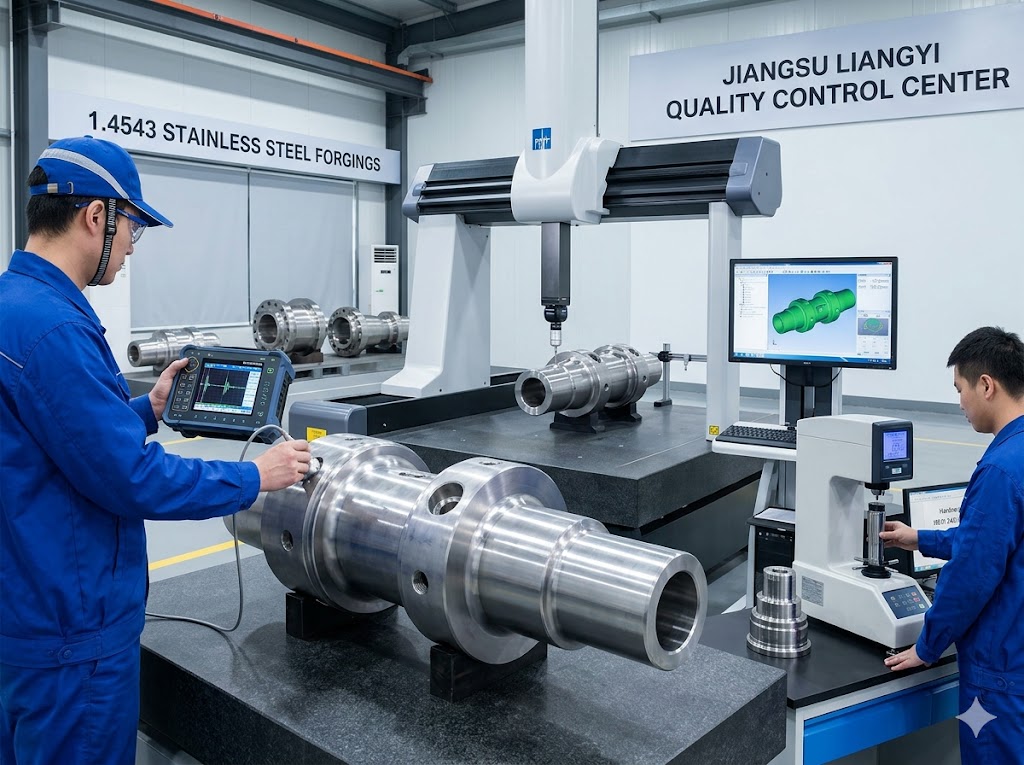
Quality Inspection & International Compliance Standards
Our 1.4543 forged products are manufactured to meet the requirements of global testing and quality standards, including EN ISO 9001:2015 (our current certification), EN 10002-1, ASTM E8M, ASTM E8, EN 10045, EN 10021, EN ISO 6506-1, ASTM E112, DIN 50602, DIN 50601, ASTM E45, SEP 1923, EN 10204, ASTM A370, API 6A and PED 2014/68/EU. Third-party inspection and certification coordination is available upon request. Learn more about API 6A standards and EU PED certification.
Every 1.4543 forging part undergoes a strict multi-stage inspection process before delivery. The following reflects our actual standard inspection flow, not a minimum requirement summary:
- Incoming Material: Chemical composition analysis via OES (optical emission spectrometer) for all 14 specified elements; C/S by combustion method; O/N/H by inert gas fusion; comparison to VIM heat record for process consistency.
- Post-Forging Visual & Dimensional: 100% visual inspection per EN 10163; dimensional mapping by tape, vernier and CMM; straightness check for shafts and bars per tolerance class.
- Mechanical Testing: Tensile test (room temperature, 200 °C, 400 °C as required); Charpy V-notch impact at −196 °C / −60 °C / −40 °C / −20 °C / RT per project specification; Brinell, Rockwell and Vickers hardness; bend test for thin-section forgings; fatigue testing on witness pieces for rotating component qualifications.
- NDT — Volumetric: 100% ultrasonic testing (UT) per ASTM A388 or EN 10308 — Class B acceptance for standard applications; enhanced sensitivity Class A for nuclear and aerospace. Immersion UT available for complex geometries.
- NDT — Surface: 100% magnetic particle inspection (MPI) per ASTM E709 / EN ISO 17638 — wet fluorescent method for highest sensitivity; liquid penetrant testing (PT) per ASTM E165 / EN ISO 3452 for non-magnetic sections.
- Metallography: Grain size measurement per ASTM E112; inclusion rating per ASTM E45 / SEP 1923 / DIN 50602; microstructure examination at ×100, ×200 and ×500 magnification; verification of precipitation phase distribution in aged condition.
- Corrosion Testing: Intergranular corrosion test per ISO 3651-2 (Method A — oxalic acid etch) and Huey test (Method C — boiling 65% HNO₃) for nuclear and chemical process applications; salt spray test per ASTM B117 for atmospheric corrosion qualification; pitting potential measurement by electrochemical polarization for seawater applications.
- Dimensional Final: 3D CMM inspection of all machined features per customer drawing; surface roughness measurement by contact profilometer; thread gauge verification; flatness and perpendicularity per GD&T specification.
- Positive Material Identification (PMI): 100% XRF PMI on every piece, verifying Cr, Ni, Cu, Ti, Nb contents against specification. PMI report included in documentation package.
- Third-Party Inspection: TÜV SÜD, Bureau Veritas, SGS, Intertek, APAVE or other customer-nominated TPI available for witness of mechanical testing, NDT, heat treatment and final release. Advance notice of test schedule provided minimum 5 working days.
Surface Treatment & Post-Processing Options for 1.4543 Forged Components
Beyond standard forging and machining, Jiangsu Liangyi offers a comprehensive range of in-house and partner-supported surface treatment options for 1.4543 components, selected based on the application's wear, corrosion and dimensional requirements:
Passivation (ASTM A967 / AMS 2700)
- Citric acid or nitric acid bath passivation
- Restores native Cr₂O₃ passive film after machining
- Removes free iron contamination from tooling
- Improves salt spray resistance by 2× vs. as-machined
- No dimensional change (<1 µm removal)
- Required for food-grade and pharmaceutical applications
Electropolishing
- Reduces Ra by 50–80% (e.g. Ra 1.6 → Ra 0.2–0.4)
- Removes micro-asperities that trap corrosive media
- Improves pitting corrosion resistance in chloride environments
- Removes 5–20 µm stock — must be accounted for in final dimensions
- Used for pharmaceutical API valve bodies and ultrapure water fittings
Gas / Salt Bath Nitriding
- Surface hardness up to 65 HRC (0.1–0.3 mm case depth)
- Treatment temperature 480–520 °C (below aging temperature — no softening)
- Improves wear resistance on valve stems, pump shaft journals
- White layer thickness ≤ 15 µm (controlled to prevent spalling)
- Slight dimensional growth ~0.01 mm/surface — accounted in machining plan
Stellite 6 / Inconel 625 Hardfacing
- GTAW or PTA (Plasma Transferred Arc) deposition
- Stellite 6 overlay: 38–42 HRC, excellent galling resistance for valve seats
- Inconel 625 overlay: corrosion resistance for sour-service sealing surfaces
- Deposit thickness: 1.5–4 mm single layer
- WPS qualified per EN ISO 15614-7 / AWS D10.18
- Finish-machined to Ra 0.4 µm on seating surfaces
Shot Peening (AMS 2430)
- Introduces compressive residual stress to depth 0.1–0.3 mm
- Improves high-cycle fatigue endurance by 20–40%
- Required for aircraft-grade rotating components and gas turbine impellers
- Intensity: Almen 0.006–0.018A depending on component section
- Coverage: 100% verified by fluorescent saturation method
PVD / DLC Coating (Partner Facility)
- PVD TiN coating: 2200 HV surface hardness, gold color, 3–5 µm thickness
- DLC (diamond-like carbon): 3000+ HV, friction coefficient 0.08–0.15
- Reduces galling in dry-running valve applications
- Maximum coating temperature 200 °C — no re-tempering risk on aged 1.4543
- Available via qualified partner facility with Jiangsu Liangyi coordination
Packaging, Export Documentation & Logistics for 1.4543 Forgings
Reliable delivery of precision forgings requires as much attention to packaging and export logistics as to manufacturing quality. Our export team has shipped 1.4543 forgings to over 50 countries, and we have developed standardized packaging protocols that prevent transit damage and satisfy international customs and import documentation requirements:
Standard Packaging Specifications
- Rust prevention: All machined 1.4543 surfaces are coated with VCI (Vapour Corrosion Inhibitor) film or Tectyl 506 rust preventive oil before packaging. Passivated surfaces are wrapped in VCI polyethylene bags. The rust preventive is compatible with subsequent welding and is easily removed with standard industrial degreasers.
- Inner packing: Individual pieces wrapped in bubble film or foam padding, secured with strapping tape. Flanges and rings protected with wooden end caps on all sealing faces. Valve balls individually boxed and padded to prevent rolling and surface contact.
- Outer packaging: Fumigated wooden crates (ISPM 15 certified, with IPPC stamp) for sea freight; steel pallets or steel-banded wooden frames for heavy pieces above 2 tonnes. Maximum single package weight: 30,000 kg on steel-reinforced skids for port crane handling.
- Marking: Each piece marked by vibro-engraving (on non-critical surfaces) or low-stress dot peening with: heat number, piece serial number, material grade (1.4543 / X3CrNiCuTiNb12-9), Jiangsu Liangyi forge symbol and third-party TPI stamp. Marking scheme approved by customer QA before production start.
Export Documentation Package (Standard)
- Commercial invoice (stating HS Code, country of origin: China, unit weight and total weight)
- Packing list with individual piece weights and dimensions
- Bill of lading or airway bill
- Certificate of origin (China Council for Promotion of International Trade / CCPIT, notarized on request)
- EN 10204 3.1 or 3.2 material test certificate
- Heat treatment records
- Full NDT reports (UT, MPI, PT as applicable)
- Dimensional inspection report
- PMI report
- Third-party inspection certificate (TÜV, SGS, BV, etc. as specified)
- MSDS / SDS (Material Safety Data Sheet) for surface treatment chemicals if applicable
Incoterms: We ship on EXW, FOB Tianjin / Shanghai, CFR and CIF basis. DDP (Delivered Duty Paid) to EU ports available for established accounts. Typical transit times: China to Western Europe — 25–30 days (sea); China to US Gulf Coast — 28–35 days (sea); China to Dubai, UAE — 18–22 days (sea). Air freight available for urgent small components.
Frequently Asked Questions (FAQ) About 1.4543 (X3CrNiCuTiNb12-9) Forging Parts
1.4543 (X3CrNiCuTiNb12-9) is a European EN-standard martensitic precipitation hardening stainless steel with no direct ASTM or UNS equivalent. It is most frequently compared to 17-4PH (UNS S17400, AISI 630, EN 1.4542) due to similar precipitation hardening characteristics, but the two grades differ fundamentally in strengthening mechanism. While 17-4PH relies solely on ε-Cu precipitation, 1.4543 employs a dual Ni₃Ti + NbC/NbN + ε-Cu system that develops a minimum yield strength of 1510 MPa — approximately 300 MPa higher than 17-4PH H900 — while maintaining 20 J minimum impact toughness. If your project requires ASTM documentation, we can provide additional reports of chemical analysis and mechanical tests to demonstrate conformance to your specified property requirements derived from ASTM A705 test methods while the base material specification is the EN standard.
Minimum order quantity for custom 1.4543 forgings including prototype samples for material qualification or design validation is 1 piece. We work from customer drawings or 3D CAD files and produce a forged blank or machined finished component with full MTC and inspection documentation for single-piece prototype orders – the same quality system as volume production.Small-batch orders of 2–20 pieces are typically processed as a dedicated production run. Volume production orders above 5 tonnes per shipment qualify for progressive pricing adjustments. We have no minimum value restriction; our smallest single orders are typically test coupons for material qualification, and our largest are multi-year supply agreements for offshore platform valve components. Contact us with your drawing, material specification, quantity and required certification to receive a detailed quotation within 24 hours.
Standard lead times depend on whether the order requires new VIM/ESR melt or can be sourced from our semi-finished forging stock:
- New VIM/ESR melt + forging + heat treatment + full inspection: 25–35 working days
- From forging stock (if standard section size available) + heat treatment + inspection: 15–22 working days
- From forging stock + CNC machining to finished dimension: 30–45 working days depending on machining complexity
- Urgent expedited production (new melt + forging): 15–18 working days with priority scheduling, available on request at a small schedule premium
Third-party inspection scheduling (TÜV, SGS, BV witness testing) is coordinated within the above timelines. We provide a detailed production schedule with milestone dates upon order placement, updated weekly by our project coordinator.
Yes. We manufacture 1.4543 forging parts fully compliant with NACE MR0175 / ISO 15156-3 for sour service (H2S-containing oil and gas environments). Our NACE-compliant protocol includes: VIM+VAR double melting to achieve sulfur ≤ 0.002%; modified over-aging at 560 °C × 8 hours to achieve hardness ≤ 33 HRC (meeting the ISO 15156-3 hardness limit for PH stainless steels); microstructure verification by metallographic examination confirming fully martensitic matrix with no delta-ferrite bands; Charpy impact testing at −20 °C; and Positive Material Identification (PMI) on every piece. Optional HIC testing per NACE TM0284 and SSC testing per NACE TM0177 Method A are available upon request. All NACE-compliant forgings are certified with EN 10204 3.2 MTC, with TPI witness available from TÜV SÜD, Bureau Veritas, SGS or APAVE.
Yes. When our customers require EU PED 2014/68/EU compliance for pressure equipment destined for the European market, we support the full process through coordination with authorized EU notified bodies (such as TÜV SÜD or Bureau Veritas) nominated by the customer or EPC contractor. Our role covers: producing forgings in conformance with EN 10250-4 or EN 10088-3; providing EN 10204 3.2 material test certificates with notified body witness signature; accommodating notified body witness of heat treatment, mechanical testing and NDT within our production schedule; and preparing the forging-level documentation required for CE marking by the responsible pressure equipment manufacturer. Please note that Jiangsu Liangyi holds ISO 9001:2015 certification; PED notified body approval is coordinated on a per-project basis through the customer-designated notified body, as is standard practice for forging sub-suppliers under the PED framework. Contact us to discuss your specific PED documentation requirements.
Our standard minimum forging ratio for 1.4543 forgings is ≥ 4:1 (measured as the ratio of ingot cross-sectional area to final forging cross-sectional area). In practice, most of our 1.4543 production achieves 5:1 to 8:1. The forging ratio matters for this grade for three specific reasons: first, it determines the degree to which dendritic Ti and Nb segregation from the ESR ingot solidification is mechanically homogenized by plastic deformation — our process validation shows that a 4:1 ratio reduces the as-ESR Ti segregation ratio from 2.5:1 to below 1.3:1, and a 6:1 ratio brings it below 1.15:1, which is essential for consistent precipitation response during aging. Second, the forging deformation introduces dislocation density that acts as heterogeneous nucleation sites for fine Ti and Nb precipitates during aging, improving precipitation kinetics and final property consistency. Third, sufficient plastic deformation eliminates columnar as-cast grain structure and promotes equiaxed fine grain development (ASTM ≥ 5) that resists fatigue crack initiation. For thick-section forgings where achieving the full forging ratio in one pass would require impractical force levels, we apply multiple intermediate forging passes with reheating between passes, each at ≥ 1:2 deformation ratio, with the cumulative reduction exceeding 4:1.
Yes. We offer complete end-to-end service from VIM/ESR melting through forging, heat treatment and precision CNC machining, eliminating all external subcontracting. Our in-house CNC workshop is equipped with: 5-axis CNC machining centers (table size up to 2,500 × 2,500 mm); heavy-duty CNC lathes (swing up to 3,000 mm, between-centers distance up to 10,000 mm); deep-hole boring machines (bore diameter 50–500 mm, depth up to 3,000 mm); cylindrical grinding machines (OD up to 1,500 mm); surface grinding machines; and gear hobbing/milling equipment. Machining of aged 1.4543 (45–50 HRC) is performed using solid CBN inserts and CBN-tipped tooling at controlled cutting speeds (typically 60–80 m/min for turning, 15–25 m/min for milling) with flood coolant to prevent thermal re-tempering of the surface — a critical quality control point that is often neglected by general machine shops unfamiliar with precipitation-hardening steels. Achievable tolerances: ISO 2768-m general; H7/h6 fits as standard; tighter tolerances to ±0.01 mm on critical diameters with premium tooling and CMM verification after each critical operation pass.
We offer the following surface treatments for 1.4543 components, selected based on the application's wear, corrosion and dimensional requirements:
- Passivation (ASTM A967 / AMS 2700): Citric acid or nitric acid treatment restoring the Cr₂O₃ passive film after machining. Required for pharmaceutical, food-grade and ultrapure water applications. No dimensional change.
- Electropolishing: Ra improvement of 50–80%, enhanced pitting corrosion resistance, removal of micro-defects. Used for pharmaceutical API valve bodies.
- Gas or salt bath nitriding at 480–520 °C: Surface hardness up to 65 HRC, 0.1–0.3 mm case depth, no core softening (treatment temperature below aging temperature). Improves sliding wear resistance on valve stems and pump journals.
- Stellite 6 / Inconel 625 hardfacing (GTAW/PTA): Deposited on valve seating and wear surfaces. WPS qualified per EN ISO 15614-7. Seating faces finish-machined to Ra 0.4 µm.
- Shot peening (AMS 2430): Compressive residual stress introduction for fatigue life improvement of rotating components. Almen intensity 0.006–0.018A with 100% coverage verification.
- PVD/DLC coating (via partner): TiN (2200 HV) or DLC (3000+ HV) for dry-running low-friction applications. Maximum process temperature 200 °C — safe for aged 1.4543.
1.4543 is weldable but requires specific procedure controls due to its martensitic transformation characteristics and the risk of hydrogen-induced cracking (HIC) in the weld HAZ. Our welding procedure qualification covers: GTAW (TIG) welding using ER630-equivalent filler or custom Ti+Nb alloyed wire; preheating to 150–200 °C and maintenance of interpass temperature ≤ 150 °C; post-weld hydrogen bake-out at 200 °C × 4 hours before cooling to room temperature; and full solution anneal + aging cycle after welding to restore weld HAZ properties to match base metal. We provide welding procedure specifications (WPS) and welder qualification records (WPQR) qualified per EN ISO 15614-1 (European) or ASME Section IX (North American) as required by the customer's applicable design code. For PED pressure equipment, WPS/WPQR is reviewed and approved by the notified body. Note: weld repairs on finished aged components are generally not recommended without re-solution annealing and re-aging, as the HAZ loses precipitation-hardened properties due to the weld thermal cycle.
1.4543 exhibits good impact toughness down to approximately −60 °C in its standard 510 °C aged condition (27–35 J KV at −60 °C based on our production test records), making it suitable for LNG-adjacent valve applications, cold-climate oilfield equipment and cryogenic gas compressor components. For lower temperatures (to −196 °C for LNG service), we apply an optimized aging at 540 °C for maximum toughness before the cryogenic application, achieving 30–38 J KV at −196 °C on our production test coupons. Impact tests at −20 °C, −40 °C, −60 °C and −196 °C are performed per EN ISO 148-1 or ASTM E23 as customer-specified, with results included in the MTC. For service temperatures below −196 °C, we recommend contacting our engineering team to evaluate alternative grades such as 13-8Mo or austenitic stainless steel forging grades, as the ductile-to-brittle transition in 1.4543 martensitic matrix becomes a relevant design consideration below −196 °C.
Contact Us for Custom 1.4543 Forging Parts Quotation
Jiangsu Liangyi is your trusted China source for high-quality 1.4543 (X3CrNiCuTiNb12-9) forging parts. ISO 9001:2015 certified. From single-piece prototypes to multi-year volume supply contracts, we bring 25+ years of precipitation-hardening stainless steel forging expertise, VIM/ESR double-melt quality, and full third-party inspection coordination (TÜV, SGS, BV, Intertek) to every order.
Send us your drawing, material requirement, quantity, required certifications and delivery port — we will respond with a detailed technical and commercial quotation within 24 hours.
Inquiry Email: sales@jnmtforgedparts.com
Phone / WhatsApp: +86-13585067993
Official Website: https://www.jnmtforgedparts.com
Factory Address: Chengchang Industry Park, Jiangyin City, Jiangsu Province 214400, China