1.4534 (X3CrNiMoAl13-8-2) Forged Parts | China Jiangsu Manufacturer
ⓘ Key Facts: 1.4534 / X3CrNiMoAl13-8-2 at a Glance
Quick Navigation
Introduction to 1.4534 (X3CrNiMoAl13-8-2) Steel
Jiangsu Liangyi, located in Chengchang Industry Park, Jiangyin City, Jiangsu Province, China, is a professional ISO 9001:2015 certified manufacturer of 1.4534 (X3CrNiMoAl13-8-2) open die forging parts and seamless rolled steel forged rings. Also known as X 3 CrNiMoAl 13-8-2, X3CrNiMoAl1382, X3CrNiMoAl13.8.2, UNS S13800, and commonly referred to as 13-8 Mo PH stainless steel, this material is an acid-resistant special steel with a martensitic structure that undergoes precipitation hardening. It exhibits excellent mechanical properties including high hardness, exceptional strength, and relatively high corrosion resistance, making it ideal for components subjected to dynamic loads and cracking resistance.
Compared to other high-alloyed corrosion-resistant grades, 1.4534 steel has much stricter limits on sulfur and phosphorus content in its chemical composition (P ≤ 0.01%, S ≤ 0.008%). This results in a more challenging manufacturing process but ensures exceptionally high purity and quality of the final product. As a leading 1.4534 China manufacturer, Jiangsu Liangyi has mastered the complex production techniques required to deliver consistent, high-quality X3CrNiMoAl13-8-2 forgings to customers worldwide from our advanced facility in Jiangyin, Jiangsu.
Available 1.4534 (X3CrNiMoAl13-8-2) Forged Products
As a premier X3CrNiMoAl13-8-2 Jiangsu supplier, Jiangsu Liangyi manufactures a comprehensive range of 1.4534 (X3CrNiMoAl13-8-2) forging steel products in various shapes and sizes, from 30 kg to 30,000 kg single-piece weight:
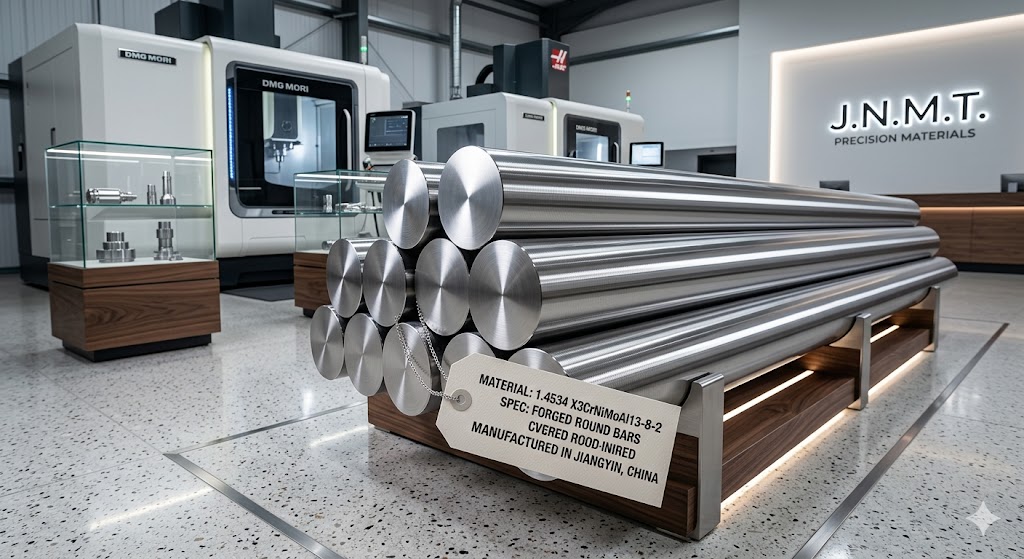
Forged Bars & Rods
- Round bars (up to 2000 mm diameter), square bars, flat bars, and rectangular bars
- Custom diameters and lengths up to 15 meters to meet your specifications
- Available in all standard and custom sizes with EN 10204 3.1 mill test certificates as standard; 3.2 (third-party witnessed) available upon request
- Precision machined to tight tolerances for immediate use in your production
Seamless Rolled Rings
- Seamless rolled rings and open die forged rings up to 6 meters in diameter
- Ideal for critical rotating and pressure applications in power generation and oil & gas
- Large diameter capabilities up to industry standards with uniform grain structure
- Produced on our advanced 1-meter and 5-meter seamless rolling machines in Jiangyin, China
Hollow Forgings & Sleeves
- Hubs, housings, shells, sleeves, and bushes up to 3000 mm outer diameter
- Hollow bars and casing components with heavy wall thickness options
- Precision-machined to tight tolerances for hydraulic and pressure vessel applications
- Manufactured using advanced open die forging techniques at our Jiangsu factory
Discs, Plates & Blocks
- Forged discs, disks, blocks, and plates up to 3000 mm in diameter
- Uniform material structure for enhanced performance under high pressure
- Suitable for turbine discs, valve bodies, and pressure vessel components
- Produced using our 2000T, 4000T, and 6300T hydraulic forging presses
Pipes & Tubes
- Forged steel pipes, tubes, tubings, and piping for high-pressure applications
- Shells, casings, case barrels, and housings for nuclear and petrochemical industries
- Designed to withstand extreme temperatures and corrosive environments
- Manufactured in accordance with international standards including ASTM, EN, and DIN; fully tested and documented per applicable standard requirements
Chemical Composition of 1.4534 (X3CrNiMoAl13-8-2)
The precise chemical composition of 1.4534 (X3CrNiMoAl13-8-2) forged steel ensures its superior mechanical properties and corrosion resistance. At our Jiangyin 1.4534 factory, we strictly control every element to meet EN 10088-3 standards:
| Element | Content (%) | Standard Requirement |
|---|---|---|
| Carbon (C) | max. 0.05 | EN 10088-3 |
| Chromium (Cr) | 12.25 – 13.25 | EN 10088-3 |
| Manganese (Mn) | max. 0.1 | EN 10088-3 |
| Molybdenum (Mo) | 2.0 – 2.5 | EN 10088-3 |
| Nickel (Ni) | 7.5 – 8.5 | EN 10088-3 |
| Phosphorus (P) | max. 0.01 | EN 10088-3 |
| Sulfur (S) | max. 0.008 | EN 10088-3 |
| Silicon (Si) | max. 0.1 | EN 10088-3 |
| Titanium (Ti) | max. 0.1 | EN 10088-3 |
| Nitrogen (N) | max. 0.01 | EN 10088-3 |
| Aluminum (Al) | 0.8 – 1.35 | EN 10088-3 |
International Standard Equivalents for 1.4534 Steel
The steel grade 1.4534 is designated under multiple international standards. The table below lists the most widely used equivalent designations to help engineers and procurement specialists specify the correct material globally:
| Standard System | Designation | Specification / Norm |
|---|---|---|
| European (EN) | 1.4534 / X3CrNiMoAl13-8-2 | EN 10088-3 |
| UNS (USA) | S13800 | ASTM A564 / ASTM A693 |
| Common Trade Name | 13-8 Mo PH / Custom 13-8 Mo | — |
| AMS (USA) | AMS 5629 (Bar, Wire, Forgings, Rings) | AMS 5629 |
| AMS (USA) | AMS 5864 (Bar, Ring, Forgings) | AMS 5864 |
| MIL-SPEC (USA) | MIL-S-81591 | — |
| Japanese (JIS) | SUS XM-13 (similar) | JIS G4303 |
Note: While these designations refer to essentially the same alloy system, minor compositional differences may exist between standards. Always verify against the specific standard applicable to your project. As an ISO 9001:2015 certified forging manufacturer with 25+ years of experience, Jiangsu Liangyi is capable of manufacturing to any of the above specifications upon request.
Mechanical Properties of 1.4534 (X3CrNiMoAl13-8-2)
1.4534 (X3CrNiMoAl13-8-2) exhibits excellent mechanical properties at room temperature, with different heat treatment conditions providing varying strength and toughness combinations. All our X3CrNiMoAl13-8-2 forgings are tested in our in-house mechanical testing laboratory in Jiangsu, China:
| Condition | Min. Yield Strength | Min. Tensile Strength | Min. Elongation | Hardness |
|---|---|---|---|---|
| H950 | 1,413 MPa (205,000 psi) | 1,517 MPa (220,000 psi) | 10% | 44–48 HRC |
| H1000 | 1,310 MPa (190,000 psi) | 1,413 MPa (205,000 psi) | 10% | 42–46 HRC |
| H1050 | 1,138 MPa (165,000 psi) | 1,207 MPa (175,000 psi) | 12% | 39–43 HRC |
High Temperature Performance
1.4534 (X3CrNiMoAl13-8-2) stainless steel has excellent oxidation resistance up to approximately 1100 °F (593 °C). However, prolonged exposure in the temperature range of 600–900 °F (288–482 °C) may cause toughness degradation in this precipitation-hardening stainless steel. In some cases, this loss of toughness can be minimized by applying higher aging temperatures. Short-term exposure to elevated temperatures is permissible, provided the peak temperature is at least 50 °F (28 °C) below the aging temperature. As an experienced manufacturer of 1.4534 turbine forgings in China, we can provide tailored heat treatment solutions to optimize your parts for specific high-temperature applications.
Corrosion Resistance
In aggressive environments (excluding moisture resistance), 1.4534 (X3CrNiMoAl13-8-2) exhibits very good resistance to:
- Sodium Chloride (NaCl) solutions (up to 10% concentration)
- Nitric Acid (up to 65% concentration at room temperature)
- Sodium Hydroxide (up to 50% concentration at room temperature)
This makes it the best choice material for parts operating in corrosive industrial environments, particularly in the petrochemical, marine, and nuclear industries. Our X3CrNiMoAl13-8-2 valve parts are widely used in sour service applications where corrosion resistance is important.
Physical Properties of 1.4534 (X3CrNiMoAl13-8-2)
Beyond mechanical strength, the physical and thermal properties of 1.4534 (X3CrNiMoAl13-8-2) directly determine its suitability for precision part design. Values below apply to the alloy in the solution‑annealed condition at room temperature (21 °C / 70 °F) unless otherwise specified. These data align with typical values from EN 10088‑3 and recognized metallurgical references for this alloy group, and have been verified against Jiangsu Liangyi’s internal material test records.
| Property | Value | Unit | Condition / Notes |
|---|---|---|---|
| Density | 7.78 | g/cm³ (0.281 lb/in³) | Room temperature |
| Elastic Modulus (Young's Modulus) | 197 | GPa (28.6 × 10⁶ psi) | Room temperature |
| Shear Modulus | 76 | GPa (11.0 × 10⁶ psi) | Room temperature |
| Poisson's Ratio | 0.30 | — | Room temperature |
| Thermal Conductivity | 14.0 | W/(m·K) | 21 °C (70 °F) |
| Thermal Conductivity | 17.8 | W/(m·K) | 538 °C (1,000 °F) |
| Mean Thermal Expansion Coefficient | 10.6 × 10⁻⁶ | /°C (/°F: 5.9 × 10⁻⁶) | 0 – 260 °C (32–500 °F) |
| Mean Thermal Expansion Coefficient | 11.2 × 10⁻⁶ | /°C (/°F: 6.2 × 10⁻⁶) | 0 – 538 °C (32–1,000 °F) |
| Specific Heat Capacity | 460 | J/(kg·K) | Room temperature |
| Electrical Resistivity | 0.80 | µΩ·m | 21 °C (70 °F) |
| Magnetic Permeability | > 1 (ferromagnetic) | — | Annealed condition; becomes more ferromagnetic after aging |
| Melting Range | 1,400 – 1,440 | °C (2,552–2,624 °F) | Approximate solidus–liquidus range |
Design note on thermal expansion: A notable advantage of 1.4534 (X3CrNiMoAl13-8-2) is its relatively low coefficient of thermal expansion, measuring 10.6 × 10⁻⁶/°C at moderate temperatures, compared to austenitic stainless steels like 316L at approximately 16 × 10⁻⁶/°C. In assemblies combining 1.4534 with carbon steel or titanium parts, this closer thermal expansion match greatly reduces differential thermal stress under cyclic operating conditions.This is a main reason the alloy is the best choice material for aerospace and nuclear turbine applications.
Heat Treatment of 1.4534 (X3CrNiMoAl13-8-2): Complete Process Guide
The excellent performance of 1.4534 (X3CrNiMoAl13-8-2) relies entirely on a precisely controlled, multi‑stage heat treatment process.Unlike conventional quench‑and‑temper steels, this alloy attains its final properties via a two‑step thermal cycle: first, solution annealing to form a homogeneous martensitic matrix,followed by age hardening (precipitation hardening) to precipitate fine intermetallic strengthening phases. At Jiangsu Liangyi’s Jiangyin plant, all heat treatment is carried out in computer‑controlled gas‑fired or electric resistance furnaces with continuous temperature monitoring.Complete thermal cycle records are included in the material certification documents.
Step 1 — Solution Annealing (Conditioning Treatment)
Solution annealing dissolves all carbides, secondary phases and existing precipitates, restoring a uniform, low‑hardness martensitic structure that is ideal for machining, forming or welding before final aging.
- Temperature: 927 °C ± 14 °C (1,700 °F ± 25 °F)
- Soak time: Sufficient to uniformly heat the entire cross-section — typically 30 minutes minimum plus 1 hour per 25 mm of maximum cross-section thickness
- Cooling: Air cool or accelerated cool (fan-assisted air or water quench for heavy sections) to below 32 °C (90 °F). Rapid cooling through the martensite transformation range (approximately 120 °C / 250 °F to room temperature) is important to guarantee complete conversion of the austenite to martensite before aging begins
- Result: Hardness typically 28–34 HRC in the solution-annealed condition — ideal for machining large forged blanks before final aging
Step 1A — Optional Sub-Zero Treatment (Cryogenic Conditioning)
For demanding aerospace and nuclear applications, Jiangsu Liangyi can apply an optional cryogenic sub-zero treatment between solution annealing and aging:
- Temperature: −73 °C (−100 °F) or colder, typically in liquid nitrogen
- Hold time: Minimum 8 hours
- Purpose: Drives retained austenite content to near-zero by completing the martensite transformation; improves dimensional stability and fatigue life in critical rotating parts
- Note: Parts must return to room temperature before aging
Step 2 — Aging (Precipitation Hardening)
Aging precipitates fine NiAl (β‑NiAl) and Ni₃Al intermetallic particles within the martensitic matrix, creating the pronounced strengthening effect typical of this alloy family.The selected aging temperature directly controls the final balance between strength and toughness:
| Condition | Aging Temp. | Hold Time | Cooling | Typical Hardness | Characteristics |
|---|---|---|---|---|---|
| H950 | 510 °C (950 °F) | 4 h | Air cool | 44–48 HRC | Maximum strength; lowest toughness; best for static high-load applications |
| H1000 | 538 °C (1,000 °F) | 4 h | Air cool | 42–46 HRC | High strength with improved impact toughness; widely used for aerospace structural parts |
| H1025 | 552 °C (1,025 °F) | 4 h | Air cool | 40–45 HRC | Intermediate condition; good balance for valve bodies and pump shafts |
| H1050 | 566 °C (1,050 °F) | 4 h | Air cool | 39–43 HRC | Optimum toughness-to-strength ratio; preferred for dynamic and impact-loaded parts |
| H1100 | 593 °C (1,100 °F) | 4 h | Air cool | 35–40 HRC | Best toughness; suitable for components requiring maximum impact resistance |
| H1150 | 621 °C (1,150 °F) | 4 h | Air cool | 31–36 HRC | Best corrosion resistance in the aged family; used post-welding to restore properties |
Critical process control note:The aging soak time shall be calculated only when the entire cross‑section of the forging reaches the target temperature, not when the furnace itself reaches temperature. For large cross‑section 1.4534 forgings such as rings with wall thickness exceeding 500 mm, Jiangsu Liangyi employs calibrated thermocouples embedded in the heaviest section to record the actual metal temperature, guaranteeing full compliance with soaking requirements.This method prevents under‑aging in the core, a failure mode that can reduce core toughness by up to 30% relative to surface properties in heavy forgings.
Industrial Applications of 1.4534 (X3CrNiMoAl13-8-2) Forgings
1.4534 (X3CrNiMoAl13-8-2) is widely used for the aerospace, nuclear, and petrochemical industries for parts subject to corrosion and heavy loads. Additional applications include medical technology, high-pressure pumps, valves, and high-strength bolts. As a leading 1.4534 China manufacturer, we have supplied parts for many important projects in over 50 countries worldwide from our Jiangyin production facility.
Aerospace Industry Applications
- Gas compressor and turbine blades for commercial and military aircraft
- Turbine disks, impellers, and blisks for jet engines
- Aircraft structural components requiring high strength-to-weight ratio
- Landing gear parts and hydraulic system parts
- Engine parts needing high strength and corrosion resistance
Power Generation Industry Applications
- Gas and steam turbine parts for thermal and nuclear power plants
- Turbine guide rings, seal rings, and labyrinth rings
- Packing seal diaphragms and rotor end rings
- Contours and casing rings for turbine assemblies
- Nuclear power reactor coolant pump parts including rotors, impellers, and casings
- Nuclear reactor containment seal chambers and pressure vessel parts
Oil & Gas and Petrochemical Industry Applications
- High-pressure valves including balls, bonnets, bodies, stems, closures, seat rings, cores, and discs
- H-type two-way and one-way back pressure valves, ball valves, check valves, and gate pumps
- Ultra-high pressure water jet cutting machine parts for offshore platforms
- Hydraulic cylinders, accumulators, and attenuators for subsea applications
- Intensifier pump sealing heads and high-pressure piping parts
- Boiler and heat exchanger parts including tube sheets, nozzles, and channel flanges
- Pressure vessels, reactors, and heaters for chemical processing plants
Marine Industry Applications
- Ship and boat propeller shafts for commercial and naval vessels
- Marine engine parts and propulsion system parts
- Offshore platform equipment and subsea valve parts
- Marine hydraulic system parts needing corrosion resistance
Downhole Drilling Applications
- Mud motor splined drive shafts for oil and gas exploration
- Downhole electric submersible pump (ESP) motor splined shafts
- Integral mud flanges, flanged outlets, and studded crosses for wellhead assemblies
- Drill string parts and downhole tooling
General Industrial Applications
- Injection molding parts, molds, and die blocks for plastic manufacturing
- Tooling and fixtures for high-precision machining operations
- Turbomachinery and turbo centrifugal compressor impellers
- Compressor shrouded impellers and rotor parts
- Pump parts including casings, covers, barrels, impellers, shafts, housings, shells, bodies, and wear rings
1.4534 vs Other Precipitation Hardening Stainless Steels: Grade Selection Guide
Engineers specifying precipitation-hardening stainless steels for new projects often need to compare 1.4534 (X3CrNiMoAl13-8-2 / S13800) with three closely related grades: 17-4PH (1.4542 / S17400), 15-5PH (1.4545 / S15500), and 17-7PH (1.4568 / S17700).The table below summarizes main compositional and performance differences to support material choice.All comparative data represents typical room-temperature properties of forged products.
| Property / Parameter | 1.4534 (S13800) ★ | 17-4PH (S17400 / 1.4542) | 15-5PH (S15500 / 1.4545) | 17-7PH (S17700 / 1.4568) |
|---|---|---|---|---|
| Steel Family | Martensitic PH | Martensitic PH | Martensitic PH | Semi-austenitic PH |
| Chromium (Cr) | 12.25–13.25% | 15.0–17.5% | 14.0–15.5% | 16.0–18.0% |
| Nickel (Ni) | 7.5–8.5% | 3.0–5.0% | 3.5–5.5% | 6.5–7.75% |
| Hardening Agent | Molybdenum + Aluminum (2.0–2.5% Mo; 0.8–1.35% Al) | Copper (3.0–5.0% Cu) | Copper (2.5–4.5% Cu) | Aluminum (0.75–1.5% Al) |
| Max Yield Strength (highest H-cond.) | 1,413 MPa (H950) | 1,172 MPa (H900) | 1,172 MPa (H900) | 1,241 MPa (RH950) |
| Toughness (impact) vs 17-4PH | Higher — improved Ni content and Mo addition reduce delta-ferrite, increasing fracture toughness by ~20–35% at comparable strength levels | Baseline reference | Similar to 17-4PH | Higher in austenitic range; lower after hardening |
| Corrosion Resistance in Cl⁻ Environments | Superior — Mo addition (2–2.5%) significantly improves pitting resistance; better than 17-4PH and 15-5PH in chloride-containing media | Good | Good (slightly better than 17-4PH in some media due to lower Co) | Good in austenitic condition; reduces after hardening |
| Pitting Resistance Equivalent (PRE = Cr + 3.3Mo) | ~19.5 (12.75Cr + 3.3×2.25Mo) | ~16.3 (16.3Cr; no Mo) | ~14.8 (14.8Cr; no Mo) | ~17.0 (17.0Cr; no Mo) |
| Weldability | Good — lower delta-ferrite content than 17-4PH reduces hot cracking tendency | Moderate — delta-ferrite in weld can cause toughness issues | Moderate — similar to 17-4PH | Complex — requires strict process control |
| Max Continuous Service Temp. | ~316 °C (600 °F) in H1000/H1050 | ~315 °C (600 °F) in H1025 | ~315 °C (600 °F) | ~315 °C (600 °F) |
| Typical Applications | Nuclear, aerospace turbines, downhole drilling, high-pressure valves in sour service | General aerospace, oil & gas, food processing equipment | Aerospace forgings, nuclear, marine (lower delta-ferrite than 17-4PH) | Springs, diaphragms, flat-rolled strip applications |
| Relative Price Level | Higher (Mo + strict P/S limits) | Reference (most common) | Similar to 17-4PH | Slightly higher |
When to Choose 1.4534 Over 17-4PH
Based on Jiangsu Liangyi's 25+ years of forging experience across these four grades, the engineering scenarios where 1.4534 (X3CrNiMoAl13-8-2) should be specified over 17-4PH (1.4542) are:
- Chloride or sour-service environments: The 2–2.5% molybdenum content gives 1.4534 a pitting resistance equivalent (PRE) of ~19.5 versus ~16.3 for 17-4PH, so that it is the best choice material for subsea valves, downhole drilling tools, and marine shaft applications where chloride-induced pitting is the primary failure mode.
- High-fracture-toughness requirements: The higher nickel content (7.5–8.5% vs 3–5%) and near-zero delta-ferrite structure of 1.4534 provide measurably superior Charpy impact values at equivalent strength levels — critical for parts subject to shock loading or low-temperature service.
- Nuclear applications with strict impurity limits: The tighter P ≤ 0.01% and S ≤ 0.008% limits in EN 10088-3 for 1.4534 meet nuclear quality requirements that 17-4PH typically cannot satisfy without special melting practice.
- Weldable assemblies at high strength: The lower delta-ferrite content in 1.4534 welds reduces hot cracking susceptibility, so that it is easier to achieve sound, high-toughness weld joints in thick-section assemblies.
Weldability and Machinability of 1.4534 (X3CrNiMoAl13-8-2)
Welding 1.4534 (X3CrNiMoAl13-8-2)
1.4534 (X3CrNiMoAl13-8-2) is regarded as weldable using conventional fusion welding processes.However, due to its precipitation-hardening characteristics, strict control over pre-weld preparation, in-process parameters and post-weld procedures is required to maintain the alloy’s outstanding mechanical properties in the heat-affected zone (HAZ).The guidelines below are based on Jiangsu Liangyi’s internal welding procedure specifications (WPS) qualified for repair and assembly welding of 1.4534 forged parts.
Recommended Welding Processes
- GTAW (TIG / Gas Tungsten Arc Welding): Preferred process for precision joints and thin sections. Provides the best arc control, lowest heat input, and cleanest weld pool — essential for keeping corrosion resistance. Use pure argon shielding gas (99.999%) at 10–15 L/min.
- GMAW (MIG / Gas Metal Arc Welding): Acceptable for larger section fillets and build-up applications. Use pulse-spray transfer mode to minimise heat input. Argon + 2% O₂ or Ar + 2% CO₂ shielding blend.
- PAW (Plasma Arc Welding): Used for precision keyhole welding of pipe and ring butt joints where full penetration is needed without a backing bar.
- Electron Beam Welding (EBW) & Laser Beam Welding (LBW): Best choice for highly controlled, low-distortion welds in aerospace parts where the narrowest possible HAZ is needed.
Filler Metal Selection
- Matching filler (preferred): ER13-8Mo (AWS A5.9 classification) — produces welds with near-matching composition and allows post-weld precipitation hardening to achieve ≥85% of base metal strength.
- Dissimilar joints: For joints to carbon steel or low-alloy steel, ER309L or ER309LMo austenitic filler may be used as a buffer layer; a final capping pass with ER13-8Mo is recommended where corrosion resistance is important.
- For sour-service welds (NACE MR0175 compliance): Filler hardness must not exceed 22 HRC (≈248 HV10) in the as-welded condition. In this case, H1150 post-weld heat treatment is mandatory to bring weld metal hardness into compliance.
Pre-Heat and Inter-Pass Temperature
- For sections up to 25 mm thickness: Pre-heat not required, but parts should be at ≥ 10 °C (50 °F) to prevent moisture condensation
- For sections 25–75 mm: Pre-heat to 65–93 °C (150–200 °F)
- For sections > 75 mm: Pre-heat to 93–150 °C (200–300 °F)
- Maximum inter-pass temperature: 150 °C (300 °F) — exceeding this causes excessive softening of the adjacent aged base metal
Post-Weld Heat Treatment (PWHT)
After welding 1.4534 parts, a full post-weld heat treatment is strongly recommended for structural and pressure-retaining applications:
- Full re-solution + re-age: Solution anneal at 927 °C followed by aging to H950–H1050 — restores full base metal properties in both weld metal and HAZ. This is the preferred PWHT for critical aerospace and nuclear parts.
- Age-only PWHT (H1150 condition): For situations where re-solution is impractical (e.g., large assemblies), aging at 621 °C (1,150 °F) for 4 hours will recover a significant portion of weld zone properties and guarantees NACE-compliant hardness levels. This option sacrifices some strength but is widely accepted for oil & gas valve assemblies.
Machinability of 1.4534 (X3CrNiMoAl13-8-2)
1.4534 (X3CrNiMoAl13-8-2) is a low‑carbon martensitic alloy, not an austenitic grade, so it does not show the severe work‑hardening behavior of 304 or 316L.Even so, its high hardness in the aged condition and molybdenum‑enhanced strength make tool selection and cutting parameter optimization important. The guidance below is based on Jiangsu Liangyi’s practical experience in rough and finish machining large forged blanks.
Machinability Rating and Comparison
- Relative machinability (solution-annealed): about 45% of AISI 303 free-machining stainless (used as 100% reference)
- Relative machinability (aged H950–H1050): about 25–35% of AISI 303 — significantly harder to machine but still achievable with correct tooling
- Preferred machining sequence: perform all major material removal in the solution-annealed condition, then age to final hardness, then perform only finish machining passes to final dimensions
Cutting Tool and Parameter Recommendations
- Tool material: Uncoated or TiAlN-coated submicron carbide grade (ISO M20–M30) for turning; CBN inserts for hard turning aged condition above 45 HRC
- Cutting speed (turning, annealed): 60–100 m/min; aged condition: 30–60 m/min
- Feed rate: 0.10–0.25 mm/rev for roughing; 0.05–0.12 mm/rev for finishing
- Depth of cut: Roughing up to 4 mm; finishing 0.25–0.5 mm
- Coolant: Flood coolant (soluble oil at 8–10% concentration) is mandatory — dry cutting causes rapid tool wear and surface work hardening
- Surface finish achievable: Ra 0.8 µm with carbide tools; Ra 0.4 µm or better with CBN inserts in aged condition — meets shaft sealing surface requirements without grinding
- Key caution: Avoid rubbing passes or insufficient feed rates — these cause surface work hardening that dramatically reduces tool life on subsequent cuts
Quality Forging Process at Our Jiangyin, China Factory
Jiangsu Liangyi applies a strict quality control system throughout the full manufacturing cycle of 1.4534 (X3CrNiMoAl13-8-2) forgings at our 80,000 ㎡ production base in Chengchang Industrial Park, Jiangyin, Jiangsu Province, China.
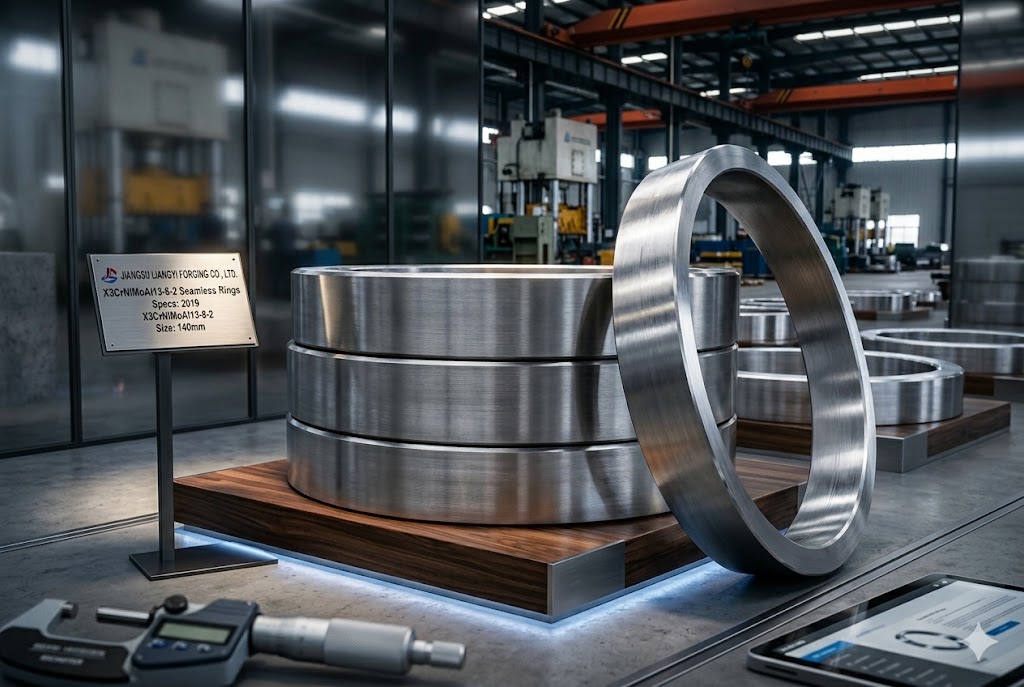
- Raw Material Inspection: Steel ingot received into warehouse with chemical content testing using our in-house spectrometer
- Cutting: Precision cutting to required dimensions using advanced sawing equipment
- Forging Process: Controlled open die forging using our 2000T, 4000T, and 6300T hydraulic presses
- Post Forging Heat Treatment: Normalizing and tempering (N+T) in our computer-controlled heat treatment furnaces
- Ultrasonic Testing (UT): First round of non-destructive testing per ASTM A388 standards
- Rough Machining: Initial machining to near-final dimensions using CNC equipment
- Second Ultrasonic Testing (UT): Additional quality verification to detect any internal defects
- Quenching and Tempering (QT): Final heat treatment for improved mechanical properties
- Comprehensive Inspection: UT, mechanical properties testing, hardness testing, and grain size analysis
- Grooving: Precision grooving as required by customer drawings
- Stress Relieve Tempering: To relieve residual stresses from machining operations
- Machining Holding Positions: For rotor parts during high-speed testing (HST)
- High-Speed Testing (HST): For rotating parts to guarantee dynamic balance
- Final Dimensional Inspection: Verification of all critical dimensions using CMM equipment
- Packing and Marking: Steel stamping and proper marking for identification and traceability
- Storage and Shipment: Careful handling and timely delivery to customers worldwide
Why Choose Jiangsu Liangyi as Your 1.4534 Forging Partner in China?
- 25+ Years of Experience: Established in 1997, we have a lot of experience of producing high-quality 1.4534 forged parts
- ISO 9001:2015 Certified: Our quality management system guarantees consistent product quality meeting international standards
- Advanced Equipment: We operate state-of-the-art forging, machining, and testing equipment at our Jiangyin factory
- Comprehensive Testing: In-house chemical analysis, mechanical testing, metallography, and non-destructive testing facilities
- Custom Solutions: We make custom parts according to your drawings and technical specifications
- Global Delivery: We supply to customers in over 50 countries worldwide with reliable shipping options
- Complete Traceability: All products come with EN 10204 Type 3.1 mill test certificates as standard; EN 10204 3.2 (third-party witnessed) available upon request
- Competitive Pricing: As a direct X3CrNiMoAl13-8-2 China manufacturer, we offer competitive prices without compromising quality
- Fast Lead Times: Our efficient production process allows us to meet tight delivery schedules
- Technical Support: Our experienced engineering team provides technical support throughout the entire project
Frequently Asked Questions (FAQ)
Contact Us for 1.4534 (X3CrNiMoAl13-8-2) Forging Quotations
Jiangsu Liangyi is committed to providing the best price and superior quality 1.4534 / X3CrNiMoAl13-8-2 forged steel parts for global clients. As a trusted X3CrNiMoAl13-8-2 Jiangsu supplier with over 25 years of experience, we welcome your inquiries for custom forgings tailored to your specific requirements.
📧 Inquiry Email:
📞 Phone/WhatsApp: +86-13585067993
🌐 Website: https://www.jnmtforgedparts.com
📍 Address: Chengchang Industry Park, Jiangyin City, Jiangsu Province, 214400, China
Send us your custom drawings, material requirements, and quantity for a detailed quotation today! Our team will respond to your inquiry within 24 hours.