1.4462 (X2CrNiMoN22-5-3) Duplex Stainless Steel Forging Parts | China Manufacturer for EU, North America & Middle East
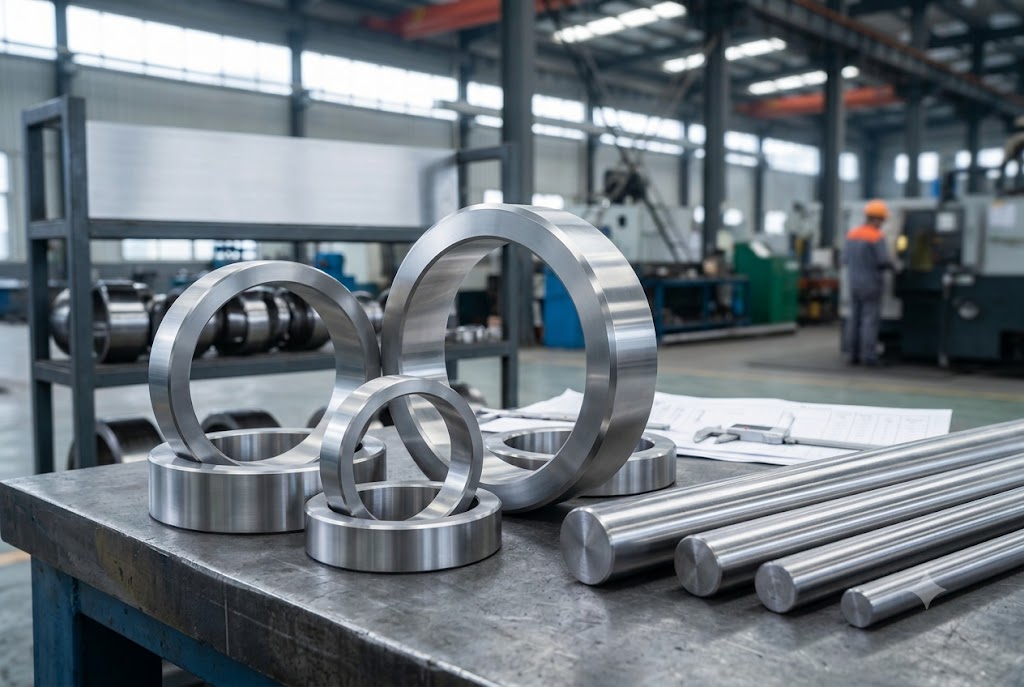
Jiangsu Liangyi Co., Limited is an ISO 9001:2015 certified professional manufacturer of 1.4462 (X2CrNiMoN22-5-3) open die forgings and seamless rolled steel rings in China. Since our founding, we have processed over 200,000 tons of duplex stainless steel forgings in total, accumulating manufacturing experience across more than 3,000 distinct 1.4462 project specifications. Each forging we deliver — from a 12 kg valve seat ring to a 28-ton seamless rolled ring for a pressure vessel — goes through the same disciplined metallurgical control: precise ingot selection, controlled heating, supervised forging reduction, solution annealing in our programmable furnaces, and systematic non-destructive testing before any part leaves our facility. We export to over 50 countries covering EU, North America, Middle East, Asia Pacific and Australia.
Why Engineers Specify 1.4462: The Metallurgical Case Beyond the Datasheet
Most material datasheets for 1.4462 (X2CrNiMoN22-5-3) list the same key figures — yield strength ≥ 450 MPa, PREN ≥ 34, service temperature range -45°C to +315°C. What those documents rarely explain is why this particular alloy achieves those properties, and what that means for component design and long-term field performance. After processing thousands of 1.4462 forgings across oil & gas, chemical processing and marine applications, our engineering team has developed a practical understanding that goes beyond the published specification.
The Dual-Phase Architecture: Why 50/50 Is Not Arbitrary
1.4462 belongs to the austenitic-ferritic duplex family, meaning its microstructure at room temperature consists of roughly equal proportions of two distinct crystal phases — austenite (γ) and ferrite (α). This is not a manufacturing tolerance; it is the engineered target. The ferrite phase provides the high yield strength and resistance to chloride-induced stress corrosion cracking (SCC), a failure mode that has caused catastrophic losses in austenitic 316L components operating in seawater or H₂S-containing process streams. The austenite phase counterbalances by providing ductility, toughness, and resistance to hydrogen embrittlement.
Nitrogen, present at 0.14–0.20% in our controlled range, plays a critical dual role. It is a strong austenite stabilizer, ensuring the austenite phase does not shrink below acceptable limits when the alloy is heated during welding or heat treatment. It also directly contributes to pitting resistance — each 1% increase in nitrogen adds approximately 16 points to the PREN formula (PREN = %Cr + 3.3 × %Mo + 16 × %N). At 0.17% nitrogen, 1.4462 achieves a PREN of approximately 35–36 in our production, measurably above the 34 minimum, which matters in environments with chloride concentrations above 1,000 ppm.
How SCC Resistance Actually Works in Duplex Steel
Stress corrosion cracking in austenitic steels initiates when chloride ions concentrate at a surface under tensile stress, causing local dissolution and crack nucleation along grain boundaries. The crack propagates transgranularly or intergranularly through the austenitic matrix with relatively little resistance. In duplex 1.4462, a propagating SCC crack that enters the ferritic phase encounters a dramatically different crystallographic orientation and electrochemical potential — effectively an internal barrier that interrupts propagation. Laboratory immersion tests at 40°C in boiling 42% magnesium chloride solution (ASTM G36) show that 316L typically cracks within 8–24 hours, while 1.4462 specimens under equivalent stress levels show no cracking after 500+ hours in our qualification testing records.
This is not purely academic. In the 1990s, a number of North Sea production platforms experienced premature failures in austenitic stainless well tubing hangers exposed to produced water with moderate chloride content. The industry's migration to duplex grades including 1.4462 for these components over the following decade was directly driven by field failure analysis, not marketing data. Our oldest repeat customer relationships in Norway and the Gulf of Mexico date from exactly that period.
Strength Advantage: What a 2× Yield Strength Really Saves
The yield strength advantage of 1.4462 (≥ 450 MPa) over 316L (≥ 170 MPa) is not just a materials comparison figure — it translates directly into design economy. Under pressure vessel design codes (ASME BPVC Section VIII or EN 13445), wall thickness is calculated as a function of allowable stress, which is derived from yield strength. A 1.4462 component designed to the same pressure rating as a 316L equivalent can theoretically reduce wall thickness by up to 40%. In practice, minimum fabrication thickness and weld access requirements reduce this to roughly 25–35% in most applications, but the material savings are real.
For a DN500 pressure vessel nozzle operating at 100 bar, this can mean the difference between a 45 mm 316L wall and a 30 mm 1.4462 wall — a weight reduction of approximately 33%. Multiplied across dozens of nozzles on a large reactor vessel, the saved material cost frequently offsets the higher per-kilogram price of 1.4462. For offshore platforms where deck load is a premium, this weight saving has additional structural value.
The Ferrite Content Requirement: A Metric Most Buyers Forget to Specify
One of the most practically important — and most frequently overlooked — quality metrics for 1.4462 forgings is the ferrite content of the final delivered part. ASTM A923 and EN 10028-7 both address harmful intermetallic phase content, but ferrite content itself is reported separately, typically using a Fischer Feritscope or equivalent magnetic measurement instrument. The target range for properly solution-annealed 1.4462 is generally 40–60% ferrite (by volume). Ferrite below 30% indicates excessive austenite stabilization, often from slow cooling through the two-phase region, and is associated with reduced SCC resistance. Ferrite above 65% suggests insufficient solution treatment temperature or time, correlating with reduced toughness and risk of 475°C embrittlement in service.
When placing an order for 1.4462 forgings, buyers should explicitly require ferrite content measurement per ASTM E562 (point counting on metallographic section) or magnetic method, with a target range of 40–60% and a rejection threshold below 35% or above 65%. Jiangsu Liangyi provides ferrite content reports as standard on all 1.4462 deliveries without additional charge — this is included in our EN 10204 3.1 mill test certificates.
1.4462 vs 316L vs 317L vs 904L: Engineering Selection Guide
The table below compares 1.4462 with the most commonly evaluated alternatives at the material selection stage. The "Typical Selection Trigger" column reflects real procurement scenarios our customers have shared with us — the specific conditions that drove them to upgrade from one grade to another.
| Criterion | 1.4462 (X2CrNiMoN22-5-3) DUPLEX | 316L (1.4404) | 317L (1.4438) | 904L (1.4539) |
|---|---|---|---|---|
| Cr / Mo / Ni / N (%) | 22 / 3.0 / 5.5 / 0.17 | 17 / 2.2 / 12 / — | 18.5 / 3.3 / 13.5 / — | 20 / 4.5 / 25 / — |
| PREN (calculated) | ≥ 34 (typically 35–36) | ≈ 23–25 | ≈ 27–30 | ≈ 34–36 |
| Yield Strength Rp0.2 | ≥ 450 MPa | ≥ 170 MPa | ≥ 205 MPa | ≥ 220 MPa |
| Tensile Strength Rm | 650–880 MPa | 485–690 MPa | 515–690 MPa | 490–690 MPa |
| SCC Resistance (Cl⁻) | Excellent (ferritic barrier) | Poor — fails > 50 ppm Cl⁻ at elevated temp | Fair — marginal improvement over 316L | Good — but inferior to duplex above 100°C |
| H₂S / Sour Service | NACE MR0175 / ISO 15156 qualified | Not qualified — risk of SSC failure | Not generally qualified | Limited — check specific H₂S partial pressure |
| Cryogenic Performance | Good to -45°C; tested to -60°C | Excellent — usable to -196°C | Good to -100°C | Good to -120°C |
| Max Continuous Service Temp. | +315°C (risk of sigma phase above) | +870°C (avoiding sensitisation zone) | +870°C | +400°C |
| Relative Material Cost (per kg) | Medium — best value per MPa | Low | Medium-low | High (Ni-rich) |
| Typical Selection Trigger | SCC failure in 316L component; weight reduction needed; H₂S present | Budget-driven; ambient temperature; no chloride concern | Moderate chloride; upgrade from 316L insufficient | Sulphuric or phosphoric acid; non-SCC corrosion dominates |
Note: PREN = %Cr + 3.3 × %Mo + 16 × %N. Values are indicative — actual PREN depends on achieved chemistry. Always verify against the specific corrosive environment and confirm with corrosion engineering review for critical applications.
Complete Range of 1.4462 (X2CrNiMoN22-5-3) Forged Products
Our 1.4462 forging capabilities span the full spectrum of industrial component forms. Single-piece weights range from 30 kg (small valve bodies, pump wear rings) to 30 tonnes (large seamless rolled rings for pressure vessels). Below we describe each product category with the design and specification considerations that matter most in practice — information that helps buyers write better RFQs and avoid costly reordering.
1.4462 Open Die Forged Bars, Round Bars and Step Shafts
We produce X2CrNiMoN22-5-3 round bars, flat bars, square bars, hexagonal bars, step shafts and custom-section bars up to 2,000 mm in forged diameter (or equivalent cross-section area), with forging reduction ratios maintained at a minimum 3:1 on all axes to ensure a refined, uniform grain structure throughout the cross-section. EN 10088-3 bars are supplied in the solution-annealed and water-quenched condition, with grain size typically ASTM 5–7 (verified per ASTM E112). For bars over 600 mm diameter — where centreline cooling rate during quenching is unavoidably slower — we apply extended solution annealing hold times and verify centreline ferrite content by sectional coupon testing before release. This is a process detail that generic bar suppliers frequently skip, and the difference shows up in impact toughness results at the centreline.
X2CrNiMoN22-5-3 Seamless Rolled Forged Rings
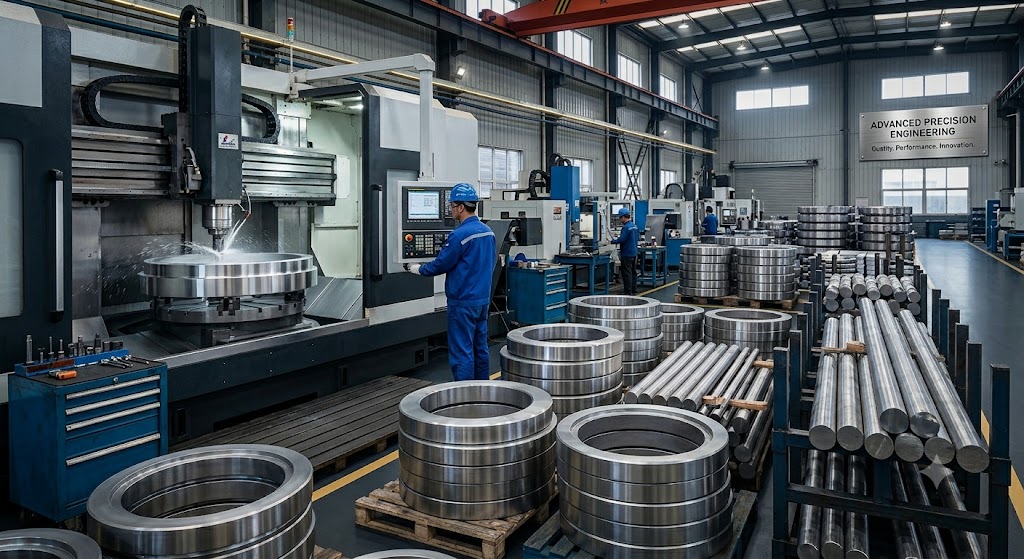
Our seamless ring rolling capability extends to 6,000 mm outer diameter with a maximum single-piece weight of 30 tonnes, using a radial-axial ring rolling mill with real-time diameter and height control. 1.4462 ring rolling requires particular attention to the finishing pass temperature — allowing the ring to drop below 950°C during the final passes can introduce local ferritic banding and heterogeneous phase distribution, which is difficult to fully homogenise in subsequent solution annealing. Our operators are trained to monitor and maintain ring temperature throughout the rolling sequence, and we use a dedicated infrared pyrometer array at the mill for continuous temperature logging on each heat.
Contoured (profile-rolled) rings with near-net-shape cross-sections are available and significantly reduce machining waste for flange ring blanks, valve seat ring preforms and bearing races. Contoured rolling in 1.4462 requires custom roll tooling; we maintain a library of common contour profiles for repeat orders, which reduces tooling lead time to zero for standard flange and nozzle neck profiles.
1.4462 Hollow Forgings and Heavy-Wall Cylinders
X2CrNiMoN22-5-3 hollow forgings — including thick-wall cylinders, pressure vessel shells, pump barrel bodies, BOP body preforms, valve bonnets and casing sections — are produced by piercing and open-die stretching of pre-forged billets, avoiding the centreline segregation zone present in solid bars of equivalent diameter. For BOP bodies and wellhead component preforms with wall thicknesses exceeding 100 mm, we apply a two-stage forging reduction: an initial high-temperature reduction pass above 1100°C to break down the as-cast ingot structure, followed by a controlled finishing pass at 1000–1080°C to refine the final grain size. The bore surface is machined to remove the oxide-enriched skin before non-destructive examination, ensuring UT access to the full wall cross-section. Maximum outer diameter for hollow forgings is 3,000 mm.
1.4462 (X2CrNiMoN22-5-3) Forged Discs, Tube Sheets and Flange Blanks
Forged disc and plate blanks in 1.4462 are produced from upset-forged billet with a minimum upset ratio of 2:1 in the axial direction, ensuring the forging flow lines are oriented radially within the disc — the most favourable orientation for the in-service stresses in most flange and tube sheet applications. For heat exchanger tube sheets above 1,200 mm diameter, we can supply as either a solid forged disc or a ring-rolled preform (hollow centre), depending on whether the client's design requires a solid tube sheet or a pass-partition baffle arrangement. Thickness capability for disc forgings extends to 600 mm, with larger thicknesses available on engineering review.
1.4462 Forged Valve Bodies and Valve Components
Valve body forgings in 1.4462 represent a significant portion of our production volume — gate valve bodies, globe valve bodies, ball valve bodies, check valve bodies, and Y-pattern strainer bodies for API 6D, API 600, EN 13709, and BS 1873 applications. Valve forging geometry requires multiple-directional forging reductions, and our 2,000–6,000-tonne hydraulic presses provide the force necessary to achieve adequate reduction in all three axes even in large body sizes. We maintain documented forging procedure qualifications (FPQs) for valve body geometries up to Class 2500 and 36 inches (DN 900) in 1.4462, and can provide inspection witness of forging operations by customer representatives or third-party inspection agencies including Bureau Veritas, TÜV SÜD, and Intertek.
1.4462 Forged Pump Casings and Rotating Machinery Components
Centrifugal pump casings, pump barrel bodies, impeller hub forgings and shaft forgings in 1.4462 are produced with tight control on forging flow line orientation relative to the component's principal stress direction. For rotating components such as shaft forgings and impeller hubs, we apply a minimum 5:1 forging reduction ratio in the axial direction to ensure a fully wrought microstructure free from remnant dendritic casting structure. Rotating components are 100% ultrasonically tested to Level 2 of EN 10228-3, with a reference reflector of FBH φ2 mm, tighter than the standard FBH φ3 mm requirement for non-rotating pressure parts. Impact testing at -40°C is included as standard for pump and rotating equipment components at no additional charge, given the cyclic loading environment and the unacceptable consequences of in-service fracture.
How to Correctly Specify 1.4462 Forgings: A Practical Buyer's Guide
After reviewing thousands of customer RFQs over the years, our sales and engineering team has identified a set of recurring specification gaps that cause unnecessary delays, cost overruns and quality disputes. This section addresses the most important items to include in your purchase order or engineering specification for 1.4462 forgings — information that most suppliers will not volunteer unless directly asked.
Material Standard and Grade Designation
Always state the specific standard and sub-grade rather than a generic name. "1.4462 per EN 10088-3" is adequate for non-pressure general engineering. For pressure applications, specify "1.4462 per EN 10222-5 (steel forgings for pressure purposes)" or "UNS S31803 per ASTM A182" as appropriate to your project's governing design code. If your project requires the higher-nitrogen version (UNS S32205), which carries minimum 0.14% N rather than 0.10%, state this explicitly — the material properties are measurably better and the slightly tighter chemistry requires supplier confirmation before order acceptance.
Heat Treatment Condition and Verification
All 1.4462 forgings must be delivered in the solution-annealed and water-quenched condition (SA + WQ). Verify this by requiring the heat treatment record (furnace chart) as a delivery document — specifically confirming the hold temperature was within 1,020–1,100°C, the hold time was sufficient for section thickness (minimum 30 minutes per 25 mm of section thickness after the furnace reaches set temperature), and transfer to quench water was completed within 60 seconds of furnace exit. Suppliers who cannot provide furnace charts are unable to demonstrate process compliance and should be treated accordingly.
Inspection Documents to Request (EN 10204)
For most industrial applications, a Type 3.1 mill test certificate (MTC) is the minimum — this is issued by the manufacturer's authorised inspector and certifies that the material meets the specified standard requirements. For pressure equipment subject to PED, nuclear applications, or buyer-audited supply chains, require a Type 3.2 MTC, which involves independent validation by a third-party inspection body such as Bureau Veritas, DNV or TÜV. Both certificates should include: chemical composition (heat analysis and product analysis), mechanical test results (tensile, yield, elongation, hardness, impact), heat treatment record reference, NDE results, dimensional check reference and, on request, ferrite content measurement results.
Non-Destructive Examination Requirements
Specify NDE scope and acceptance criteria explicitly. For general-purpose 1.4462 forgings: 100% UT per EN 10228-3 Quality Level 3 with reference reflector FBH φ3 mm; surface examination (MT or PT) per EN 10228-1 Quality Level 2. For critical pressure-retaining components: upgrade UT to Quality Level 4 (FBH φ2 mm reference) and require PT (liquid penetrant) as well as MT. For sour service components, add ASTM A923 Method A (macro-etch test) to confirm absence of macroscale sigma phase banding after solution annealing. If impact toughness at sub-zero temperature is required, specify the test temperature and minimum accepted energy value explicitly — do not rely on the standard minimum alone for applications in arctic or deep-sea environments.
Dimensional Tolerances and Machining Allowance
Forging tolerances for 1.4462 open die forgings generally follow EN 10243-1 or equivalent. Always provide finished machined dimensions with a specified machining stock on each surface (typically 3–8 mm per side for precision machined components, 10–20 mm for rough-machined forgings). Stating only finished dimensions without machining stock is a frequent cause of rework or scrap — the supplier must know both the forging envelope and the finished dimension to verify that the forging ratio and direction meet your engineering intent. Providing a dimensioned drawing in DXF or PDF format with tolerances is strongly preferred over a written description.
1.4462 Forging Applications: Regional Project Cases and Operating Conditions
The cases below are drawn from our delivery records and represent actual project environments rather than illustrative examples. Technical parameters are included because understanding the actual service conditions — not just the industry sector — is what allows meaningful material qualification. Contact us directly via our reference page if you would like case details relevant to a specific application.
Offshore Wellhead Equipment — US Gulf of Mexico and Norwegian North Sea
We have delivered over 1,800 sets of 1.4462 forged wellhead components to projects in the Gulf of Mexico (GoM) and the Norwegian Continental Shelf (NCS). Service conditions at these locations include produced water chloride concentrations of 80,000–180,000 mg/L, H₂S partial pressures ranging from 0.01 to 3.5 bar in the sourer GoM wells, and downhole temperatures up to 180°C at the sandface (with wellhead surface temperatures varying seasonally from -10°C in Norway to +35°C in GoM summer). Components supplied include Christmas tree body forgings, tubing hanger forgings, wellhead housing spools, BOP body preforms and annulus seal bore components. All NCS components are qualified to NORSOK MDS D45, which imposes tighter impact toughness requirements (minimum 45 J average at -46°C, no single value below 36 J) than the base EN standard. We maintain a standing qualification for this specification and can produce compliance certificates as part of standard documentation.
Sour Gas Wellhead Equipment — Middle East (Saudi Arabia, UAE, Kuwait)
Our Middle East oil company customers typically operate under ASME B16.5, API 6A and NACE MR0175/ISO 15156 Part 3 for material qualification of corrosion-resistant alloys. The sour service environments in onshore Arabian Peninsula fields often involve H₂S partial pressures of 0.5–10 bar, CO₂ partial pressures of 1–20 bar, high chloride formation water and reservoir temperatures exceeding 120°C — a combination that eliminates many CRA candidates. 1.4462 in the solution-annealed condition meets ISO 15156 Part 3 Table A.2 limits for SSC resistance provided hardness does not exceed 36 HRC (≈ 340 HV10). We supply all Middle East sour service forgings with hardness measurements at the surface, mid-wall and near-bore positions on every forging, reported against this limit. To date, across more than 6,000 tonnes of sour service deliveries to this region, we have had zero SSC-related field returns.
Chemical and Petrochemical Process Equipment — EU (Germany, Netherlands, France)
EU chemical plant operators working under PED 2014/68/EU face specific documentation requirements: every pressure-retaining component must be traceable to an approved material per harmonised European standards, and the manufacturer must have a Quality Assurance system notified under PED Module H or equivalent. Our ISO 9001:2015 certified quality system and full EN 10204 3.2 documentation (issued by independent third-party inspection bodies including Bureau Veritas, TÜV and DNV) supports customer PED compliance requirements for the EU pressure equipment supply chain. Representative applications from this market include: reactor body nozzle forgings for chlorinated solvent production (operating pressure 40 bar, temperature 200°C, chloride content in process stream 5,000–15,000 ppm); heat exchanger tube sheet forgings for sea water-cooled condensers (seawater chloride 19,000–22,000 mg/L, biofouling inhibitor containing hypochlorite); and ultrasonic flow meter body forgings for aggressive process streams where measurement accuracy over a 20-year operating life is contractually guaranteed.
Nuclear Power and Thermal Power Generation — Asia Pacific
Nuclear applications impose the most rigorous material traceability and testing requirements of any sector. 1.4462 forgings for nuclear coolant system applications must meet NF A 36-209 or RCC-M equivalent, with heat-specific chemistry qualification, mandatory impact testing at -20°C and +20°C, ASTM A923 Method C (electrochemical potentiodynamic reactivation, EPR test) to quantify carbide and sigma phase content, and full first-article inspection. We have worked with Chinese nuclear plant constructors on AP1000 and HPR1000 projects, and can discuss material qualification routes for nuclear enquiries under separate NDA if required. For conventional thermal power generation, our standard deliverables (EN 10204 3.2 MTC, 100% UT, full mechanical testing) are sufficient, and lead times are shorter.
Marine and Desalination — Australia, Singapore, Southeast Asia
Seawater desalination plants using Multi-Stage Flash (MSF) or Reverse Osmosis (RO) technology place 1.4462 in prolonged contact with hot seawater (35–120°C for MSF flash chambers), diluted brine (up to 7% salinity), and in some cases residual oxidant from biofouling control. In this environment, the key corrosion failure mode for stainless alloys is pitting at heat transfer surfaces where local concentration of chloride and dissolved oxygen can temporarily exceed bulk values. With PREN ≥ 34, 1.4462 maintains passive film stability across this concentration range at operating temperatures below 60°C, and performs acceptably at MSF flash stage temperatures below 90°C when solution annealing is confirmed and residual heat treatment stresses are absent. We supply forged heat exchanger shell bodies and tube plate forgings for MSF plants in the Arabian Gulf, and marine shaft forgings for Australian port construction vessels.
1.4462 Forging Production Standards: What Each Certification Actually Controls
The following standards govern our 1.4462 production. Rather than listing them as a table of names, we explain what each standard actually controls and why it matters for the end user — an approach that may help buyers verify whether a supplier's claimed compliance is meaningful.
- EN 10222-5:2000 (Steel forgings for pressure purposes, stainless steels) — This is the primary European standard for 1.4462 pressure forgings. It specifies not only chemistry and mechanical properties, but also the forging process classification (open die, ring rolling, closed die) and the required testing frequency (every heat, every product form). A supplier invoking this standard must test every heat — not just perform periodic type testing. Ask for heat-specific test results, not just a generic grade certification.
- ASTM A182 / ASME SA-182 (Forged alloy and stainless steel fittings, flanges and valves) — The US/ASME equivalent, required for ASME BPVC-governed pressure systems and API-governed wellhead equipment. ASME SA-182 is identical to ASTM A182 with the addition of ASME-specific supplementary requirements (S1 through S14). If your project uses ASME design code, ensure the forging certificate references SA-182, not just A182.
- API 6A (Wellhead and Christmas Tree Equipment) — Governs material traceability, mechanical test requirements, heat treatment documentation and hardness limits specifically for wellhead pressure-containing equipment. API 6A Annex F specifies additional requirements for CRA materials including 1.4462. We manufacture wellhead forging preforms and finished machined wellhead components in accordance with API 6A requirements; third-party API 6A inspection by accredited inspection bodies is available on request.
- NACE MR0175 / ISO 15156 Part 3 — Defines the allowable hardness, heat treatment condition and test requirements for CRA materials used in H₂S-containing environments. For 1.4462 in the solution-annealed condition, the limiting requirement is maximum hardness of 36 HRC (≈ 340 HV10) at any measured point. This standard does not specify a yield strength floor — but solution-annealed 1.4462 invariably exceeds the 450 MPa requirement, so the hardness limit is the active constraint.
- PED 2014/68/EU (Pressure Equipment Directive) — European market regulation governing pressure-retaining equipment. Not a material standard itself, but requires that manufacturers demonstrate compliance with harmonised EN standards and maintain a notified-body-approved quality system. Our ISO 9001:2015 certification and full EN 10204 3.2 documentation capability (through accredited third-party inspection bodies) supports customers' PED compliance requirements for the EU pressure equipment supply chain.
- EN 10228-3 (Ultrasonic testing of steel forgings, austenitic and austenitic-ferritic steels) — The specific NDE standard for duplex forgings. Note that EN 10228-3 applies to austenitic-ferritic materials and uses different calibration procedures than EN 10228-2 (ferritic steels) — an important distinction that generic forging suppliers sometimes overlook when testing duplex grades.
Chemical Composition of 1.4462 (X2CrNiMoN22-5-3) — Standard vs. Our Controlled Range
The table below shows both the EN 10088-3 standard limits and our tighter internal controlled ranges. The "Why We Control It" column explains the metallurgical or quality reason behind each restriction — this is not standard information available from material datasheets, but reflects our internal process metallurgy understanding developed over 25 years of duplex steel production.
| Element | EN 10088-3 Limit | Our Controlled Range | Why We Control It Tighter |
|---|---|---|---|
| Carbon (C) | Max 0.030% | Max 0.025% | Reduces sensitisation risk at weld HAZ and during slow cooling; lower C improves intergranular corrosion resistance per ASTM A262 |
| Silicon (Si) | Max 1.00% | Max 0.80% | Si above 0.8% accelerates sigma phase formation kinetics at 700–900°C; tighter control gives more process margin during heat treatment |
| Manganese (Mn) | Max 2.00% | Max 1.80% | High Mn can promote formation of MnS inclusions, which are initiation sites for pitting corrosion; restricting Mn reduces inclusion density |
| Nickel (Ni) | 4.50%–6.50% | 5.00%–6.00% | Narrowing Ni range stabilises austenite fraction within 40–60% ferrite target; wide Ni spread causes batch-to-batch variability in phase balance |
| Phosphorus (P) | Max 0.035% | Max 0.025% | P segregates to grain boundaries and reduces impact toughness at low temperatures; critical for cryogenic and sub-arctic applications |
| Sulfur (S) | Max 0.015% | Max 0.010% | S forms MnS inclusions which act as pitting initiation sites in chloride environments; lower S directly improves pitting resistance |
| Chromium (Cr) | 21.0%–23.0% | 21.5%–22.5% | Narrower Cr range provides more consistent PREN heat-to-heat; combined with controlled N, keeps PREN ≥ 35 with low standard deviation |
| Molybdenum (Mo) | 2.50%–3.50% | 2.80%–3.20% | Mo is the strongest contributor to PREN per unit; narrow range prevents batches at the low end of specification from falling below PREN 34 |
| Nitrogen (N) | 0.10%–0.22% | 0.14%–0.20% | N below 0.12% increases sigma phase precipitation risk; N above 0.21% promotes Cr₂N nitride formation during cooling, reducing toughness; 0.14–0.20% is the stability window from our production data |
Our internal controlled ranges are applied at the steelmaking stage — we select incoming ingots only from mills that can demonstrate heat analysis within our tighter limits. This additional incoming material control is why our rejection rate on finished forging chemistry is less than 0.3% over our entire 1.4462 production history.
Mechanical Properties, Ferrite Content and Heat Treatment of 1.4462 Forgings
Mechanical Properties: Standard Minima vs. Our Typical Achieved Values
| Property | Test Method | Standard Minimum | Our Typical Achieved Value | Notes |
|---|---|---|---|---|
| Tensile Strength (Rm) | EN ISO 6892-1 | 650 MPa | 700–760 MPa | Upper bound controlled by solution anneal temperature; higher Rm at lower anneal temp |
| Yield Strength (Rp0.2) | EN ISO 6892-1 | ≥ 450 MPa | 470–530 MPa | Section-dependent; larger sections achieve lower end of range due to slower quench rate |
| Elongation (A5) | EN ISO 6892-1 | ≥ 25% | 28–36% | Elongation sensitive to grain coarsening; coarser grain (high anneal temp, long hold) reduces A5 |
| Hardness | EN ISO 6506-1 | ≤ 290 HB | 230–268 HB | Measured at multiple points; NACE MR0175 limit of 340 HV10 (≈ 321 HB) provides additional margin |
| KV₂ Impact Energy at 20°C | EN ISO 148-1 | ≥ 100 J | 145–185 J | Average of 3 specimens; no single value below 70 J on our production |
| KV₂ Impact Energy at -40°C | EN ISO 148-1 | Not in base std. | 90–130 J | Required for NCS/arctic applications; available on request as supplementary requirement |
| Ferrite Content | ASTM E562 / Fischer Feritscope | Not in base std. | 43–57% | All our 1.4462 deliveries include ferrite content report as standard |
Solution Annealing: Why the Details Matter More Than the Summary
The solution annealing cycle for 1.4462 is straightforward to state: heat to 1,020–1,100°C, hold, quench in water. What is less commonly understood is how the specific parameters within that range affect properties and why they must be controlled precisely for heavy-section forgings.
Temperature selection: Annealing at the lower end of the range (1,020–1,040°C) produces a finer grain size (ASTM 7–8), which improves fatigue and impact properties but requires longer hold times to fully dissolve sigma phase or carbides from prior processing. Annealing at the upper end (1,080–1,100°C) dissolves precipitates more quickly but risks grain coarsening, particularly in sections held at temperature for extended periods. For standard pressure components, we target 1,040–1,070°C with a minimum hold time of 1 minute per millimetre of section thickness plus 30 minutes base time.
The sigma phase temperature window: When 1.4462 cools through the range of 600–950°C, the thermodynamic driving force for sigma phase (σ) formation is significant. Sigma phase is a hard, brittle, chromium-depleted intermetallic compound that precipitates preferentially at austenite-ferrite phase boundaries. Even small fractions of sigma (≥ 0.5 vol%) measurably reduce impact toughness and eliminate the NACE MR0175 qualification for sour service. For this reason, water quenching is non-negotiable — air cooling or forced-air cooling does not achieve sufficient cooling rates through this temperature range in sections above 30 mm thickness.
Transfer time control: Our heat treatment procedure requires that the time from furnace door opening to immersion in quench water does not exceed 60 seconds for sections up to 150 mm, and 45 seconds for sections above 150 mm. This is enforced by stopwatch protocol at the furnace and verified on the heat treatment chart by comparing furnace thermocouple record with load-in and load-out timestamps.
ASTM A923 Testing for Harmful Intermetallic Phases
ASTM A923 provides three test methods for detecting harmful intermetallic phases (primarily sigma phase) in duplex stainless steels. We routinely apply these as follows: Method A (sodium hydroxide etch macro test) on every lot as a screening tool — sigma phase appears as dark-etching phase boundaries and is immediately visible at 10–20× magnification. Method C (electrochemical potentiodynamic reactivation, EPR) is applied on all sour service orders as a quantitative confirmation, with a maximum corrosion loss criterion of 0.010 mA/cm² to confirm absence of sensitisation and sigma phase. Method B (Charpy impact test with 40 J minimum at -40°C) is applied to all arctic and cryogenic service orders. Results from all three methods are available in delivery documentation on request.
Full-Process Quality Control: From Ingot Selection to Final Shipment
Our quality system for 1.4462 forgings is ISO 9001:2015 certified and has been reviewed and approved by major oil company QA teams and EPC contractors from Europe, North America and the Middle East as part of their supplier qualification processes. The following describes our actual production and inspection sequence — not an idealised process flowchart, but a description of what happens in our facility on every 1.4462 order.
Incoming Material Control
All 1.4462 ingots and billets are purchased from approved steel mills only (approved supplier list maintained and reviewed annually). On arrival, every heat is PMI-tested (positive material identification, using XRF spectroscopy) for chemistry verification before any processing begins. If any element falls outside our tighter internal controlled range — not just the standard range — the material is quarantined and the heat is reviewed by our metallurgist before a disposition decision is made. We reject approximately 2–3 incoming heats per year at this stage, which prevents those chemistry anomalies from becoming problems downstream.
Forging Process Control
Furnace temperature is monitored by calibrated thermocouples (calibration records per ISO/IEC 17025 maintained) with a ±10°C uniformity requirement across the load zone. Forging temperature is verified by optical pyrometer on each pass for billets over 200 kg, with a documented out-of-range action (return to furnace) if surface temperature falls below 950°C during forging. Forging reduction ratios are calculated from pre-forging cross-section measurements and recorded in the forging traveller document for each piece.
Post-Forging Testing Sequence
After heat treatment, the testing sequence is: (1) Dimensional check against drawing, (2) Visual and surface examination, (3) Hardness survey (minimum 3 points per piece, additional points for pieces over 500 mm section size), (4) Witness test coupon mechanical testing (tensile, CVN impact at 20°C, and -40°C where specified), (5) Ferrite content measurement, (6) Chemistry verification on product analysis (one sample per forging lot per heat), (7) Macro-etch per ASTM A923 Method A, (8) Full UT examination per EN 10228-3 or ASTM A388 as applicable. Only after all of these pass is the lot released for final machining or shipment.
NDT Acceptance Criteria in Detail
Our standard UT acceptance for 1.4462 pressure forgings corresponds to EN 10228-3 Quality Level 3: no discontinuities giving echoes equal to or exceeding the reference FBH φ3 mm; no linear discontinuities (cracks, laminations) at any sensitivity level. For critical components (BOP bodies, wellhead housings, valve bodies for Class 2500 and above), we tighten to Quality Level 4 (FBH φ2 mm reference). Surface examination by PT (liquid penetrant) per EN ISO 3452-1 is conducted to Class 2 (no rounded indications over 3 mm, no linear indications over 2 mm). Our UT operators hold EN ISO 9712 Level II certification in accordance with method UT; PT operators hold Level II in method PT. Calibration blocks for UT are 1.4462 test pieces machined in our own facility to eliminate the material velocity correction issues that arise when using carbon steel calibration blocks for duplex steel inspection.
1.4462 Forging Manufacturing Capability and Lead Times
The table below reflects our verified production capabilities as of 2025. Lead times assume material in stock or available from approved mills within 2–3 weeks. Rush delivery on standard product forms (bars, rings up to 2,000 mm diameter) is available with premium for stock-material orders. Contact our sales team for current stock availability.
| Product Form | Max Dimension | Max Single Weight | Applicable Standard | Typical Lead Time |
|---|---|---|---|---|
| Seamless Rolled Rings | OD 6,000 mm | 30 tonnes | EN 10222-5 / ASTM A182 | 45–75 days |
| Open Die Forged Round Bars | Dia. 2,000 mm | 20 tonnes | EN 10088-3 / ASTM A182 | 30–60 days |
| Hollow Forgings / Cylinders | OD 3,000 mm | 25 tonnes | EN 10222-5 / ASME SA-182 | 45–75 days |
| Forged Discs / Tube Sheets | Dia. 3,000 mm, T 600 mm | 20 tonnes | EN 10222-5 / ASTM A182 | 35–65 days |
| Valve Body Forgings | DN 900 / 36" Cl.2500 | 15 tonnes | API 6A / API 6D / EN 12516 | 50–90 days |
| Custom Near-Net-Shape Forgings | Envelope up to 5,000 mm | 25 tonnes | Per customer drawing & standard | 60–100 days |
Common Problems in 1.4462 Duplex Steel Forgings — and How We Prevent Them
Based on our failure analysis experience reviewing rejected forgings from both our own production and from rejected competitor deliveries submitted to us for second-opinion assessment, the following are the most frequently encountered quality defects in 1.4462 forgings and the root causes behind them. This section is intended to help quality engineers and procurement professionals know what to look for when qualifying a 1.4462 forging supplier.
1. Sigma Phase from Insufficient Quench Rate
The most common rejection cause in 1.4462 forgings is sigma phase precipitation resulting from slow cooling after solution annealing. This typically occurs in large-section forgings (above 300 mm wall thickness) when the quench medium is insufficient — water bath quenching may still produce unacceptable cooling rates at the centre of a 500 mm section if the water is not circulated. Our solution: forced-circulation water quenching with a verified minimum water flow velocity of 1.5 m/s at the load surface, confirmed by flowmeter. For heavy sections, we section sacrificial test coupons from the thickest point and perform ASTM A923 Method C (EPR test) on the centreline material before releasing the component.
2. Ferrite Banding from Inhomogeneous Ingot Chemistry
Dendritic segregation in the original ingot — particularly of Mo and Ni — can survive through forging and heat treatment as alternating bands of Mo-rich ferrite and Mo-depleted austenite. In service, these bands create electrochemical concentration cells that accelerate localised pitting. Prevention requires: purchasing from steelmakers who apply electro-slag remelting (ESR) or vacuum arc remelting (VAR) for large ingots above 2 tonnes; applying minimum 5:1 forging reduction ratio in the primary deformation direction; and applying ASTM A923 Method A macro-etch to finished forgings to visualise any remaining banding on a metallographic cross-section. We include the macro-etch photographic report in our delivery documentation for all heavy-section forgings over 200 mm cross-section.
3. HAZ Sensitisation from Incorrect Post-Weld Heat Treatment
1.4462 should not be post-weld heat treated (PWHT) in the conventional austenitic stainless sense. The sensitisation range (600–950°C) overlaps with the PWHT temperature range typically applied to carbon steel or low-alloy steel weldments. If a 1.4462 forging is inadvertently subjected to PWHT in a multi-material heat exchanger or pressure vessel assembly, sigma phase precipitation and chromium depletion at grain boundaries will result. We include a written warning in our delivery documentation: "Do not apply PWHT to 1.4462 components. If re-annealing is required after welding, apply full solution annealing at 1,020–1,100°C followed by rapid water quenching."
4. Hydrogen Embrittlement from Acidic Pickling
Electrolytic or immersion pickling in hydrochloric acid at concentrations above 5% or temperatures above 40°C can introduce atomic hydrogen into the 1.4462 matrix, particularly into the ferritic phase which has higher hydrogen diffusivity than austenite. This causes a temporary embrittlement that may not manifest as visible cracking but reduces the margin against fracture in service. Our standard surface finishing for 1.4462 uses nitric-hydrofluoric acid passivation (15% HNO₃ + 3% HF at 40–50°C, as specified by ASTM A967 Practice D), never HCl-based formulations. Suppliers using HCl pickling on duplex stainless forgings should be required to demonstrate hydrogen bake-out or substitution with a non-HCl passivation process.
Frequently Asked Questions About 1.4462 (X2CrNiMoN22-5-3) Forging Parts
1.4462 (X2CrNiMoN22-5-3) is the EN designation. The equivalent UNS number is S31803 (original designation, minimum 0.10% N) or S32205 (revised designation with minimum 0.14% N, which is now the more commonly applied version in North American practice). The difference matters: S32205 imposes the higher nitrogen floor that ensures PREN ≥ 34 consistently, whereas heats at the low end of S31803 nitrogen (0.10%) can yield PREN of only 32–33. When ordering for critical corrosion applications, specify S32205 or invoke EN 10222-5 1.4462 with our tighter controlled nitrogen range (0.14–0.20%), which achieves the same result.
316L (1.4404) and 1.4462 differ on three axes that matter in practice: strength (1.4462 yield ≥ 450 MPa vs 316L ≥ 170 MPa, enabling 25–35% wall thickness reduction for equivalent pressure rating); SCC resistance (316L fails in boiling MgCl₂ within hours, 1.4462 is immune under most industrial chloride conditions below 100°C); and sour service qualification (316L is not qualified per NACE MR0175 for H₂S environments; 1.4462 in SA + WQ condition is qualified). The downside of 1.4462 relative to 316L: lower maximum service temperature (+315°C vs +870°C), inferior cryogenic performance below -60°C, and higher alloy cost per kg. For applications combining elevated chloride exposure with moderate temperatures and any H₂S, 1.4462 is the technically correct choice.
Yes, 1.4462 is fully forgeable. The critical process requirements are: (1) maintain forging temperature within 950°C – 1,150°C — below 950°C the ferrite phase becomes brittle and forging cracks initiate at phase boundaries; above 1,150°C excessive grain growth degrades toughness; (2) apply a minimum forging reduction ratio of 3:1 in all three principal directions to ensure fully wrought microstructure; (3) follow forging immediately with solution annealing at 1,020–1,100°C and rapid water quenching — "rough forge now, heat treat later" approaches that leave forgings in the as-forged condition for extended periods risk sigma phase accumulation from residual thermal stresses. With these controls in place, 1.4462 forgings are produced routinely and consistently; the material is in no way exotic or difficult by the standards of an experienced duplex steel forging facility.
The standard filler metal for welding 1.4462 (X2CrNiMoN22-5-3) to itself is AWS ER2209 (EN 22 9 3 NL), which is a duplex filler with slightly over-alloyed Ni content (8–10% vs 5.5% in the base metal) to compensate for the preferential ferrite formation in the weld fusion zone. For dissimilar welds to carbon steel or low-alloy steel, a nickel-based filler such as ERNiCrMo-3 (Inconel 625) is often preferred to accommodate the thermal expansion mismatch. Post-weld heat treatment (PWHT) at conventional PWHT temperatures (600–750°C) must be avoided — this range sits squarely in the sigma phase formation window for 1.4462. If the design code requires PWHT, the solution is to re-solution-anneal the entire weldment at ≥ 1,020°C and water quench, which restores the duplex microstructure.
The generally recommended maximum continuous service temperature is +315°C. Above this temperature, the kinetics of sigma phase and chi phase formation become significant over design lifetimes of 20+ years. Short-term excursions to 400°C are typically acceptable without permanent property degradation, but should be documented and reviewed if frequent. For applications requiring continuous service above 315°C, super duplex grades (such as 1.4410, UNS S32750) or nickel alloys should be evaluated. At the low-temperature end, 1.4462 maintains adequate toughness to -45°C per EN 10222-5 and can be qualified to -60°C with supplementary impact testing at that temperature, making it suitable for North Sea, Canadian Arctic and most LNG facility applications.
There is no minimum order quantity in pieces — we supply single-piece forgings for repair and replacement applications, prototype programs and small-batch specialty orders, as well as large production runs in the hundreds of pieces. For single-piece or small-batch orders, the minimum order value is typically USD 3,000–5,000 to cover setup, test coupon, and certification costs, but this varies by component complexity and specification. For rush single-piece orders on standard bar or ring sizes, we can sometimes ship from our processed-but-unmachined stock within 7–10 working days if chemistry and the required section size are available. Please contact our sales team with your drawing and specification for a specific lead time and price indication.
By delivered tonnage, our 1.4462 production goes primarily to: oil & gas (wellhead equipment, subsea hardware, pipeline components — approximately 45% of 1.4462 volume); chemical and petrochemical process (pressure vessels, heat exchangers, reactor internals — approximately 25%); valve manufacturing (body forgings for industrial valves — approximately 15%); and power generation, marine, and desalination (combined approximately 15%). The common thread is environments combining chloride exposure (seawater, produced water, process streams) with moderate temperatures and often H₂S, where 316L proves insufficient and nickel alloys are over-specified and cost-prohibitive.
Super duplex 1.4410 (X2CrNiMoCuWN25-7-4, UNS S32750) with a PREN ≥ 41 is appropriate when 1.4462's PREN ≥ 34 is insufficient — typically in seawater above 50°C (where PREN 34 materials may experience crevice corrosion under deposits), in high-chloride process streams above 150,000 mg/L, or in aggressive pulp and paper bleaching environments. The penalty is higher alloy cost (typically 30–50% higher than 1.4462 per kg) and more demanding forgeability requirements. For most oil & gas, chemical and marine applications below 60°C seawater temperature with chloride under 50,000 mg/L, 1.4462 is technically adequate and more economical. We manufacture both grades and can advise on the selection threshold for your specific operating conditions — send us your process parameters and we will provide a written recommendation.
Request a 1.4462 Forging Quotation from Jiangsu Liangyi
Jiangsu Liangyi Co., Limited manufactures 1.4462 (X2CrNiMoN22-5-3) forgings from an 80,000 ㎡ facility in Jiangyin, Jiangsu Province, China, equipped with:
- 2,000–6,000-tonne hydraulic forging presses (4 units) for open die forgings and hollow forging operations
- Radial-axial ring rolling mill with real-time diameter control, capable to 6,000 mm OD
- Programmable solution annealing furnaces (6 units, max load 30 tonnes each) with ±10°C temperature uniformity and forced-circulation water quench baths
- CNC machining centres with turning capacity to 5,000 mm swing and 5-axis milling for complex near-net-shape components
- Full in-house NDT laboratory: ultrasonic testing, magnetic particle, liquid penetrant, radiographic testing, PMI/XRF, OES spectrometer, universal tensile testing machine, Charpy impact tester (operating to -80°C), Brinell/Vickers/Rockwell hardness testers, Fischer Feritscope for ferrite content, and ASTM A923 EPR electrochemical test system
To receive a quotation, please send us your component drawing (PDF, DXF or STEP format), applicable material and design standard, required delivery condition, documentation requirements (MTC type, NDE scope), and target quantity with required delivery date. We provide written quotations within 24 hours for standard components and within 48 hours for complex near-net-shape forgings requiring engineering review.
Inquiry Email: sales@jnmtforgedparts.com
Phone / WhatsApp: +86-13585067993
Office Phone: +86-510-86107550
Official Website: https://www.jnmtforgedparts.com
Factory Address: Chengchang Industry Park, Jiangyin City, Jiangsu Province, 214400, China
Business Hours: