1.4439 (X2CrNiMoN17-13-5) Forging Parts | Custom Super Austenitic Stainless Steel Forgings
Quick Answer: 1.4439 (X2CrNiMoN17-13-5) forging parts are precision-engineered open die forgings and seamless rolled rings made from super austenitic stainless steel with a calculated PREN value of ~35–37 (Cr 16.5–18.5%, Mo 4.0–5.0%, Ni 12.5–14.5%, N 0.12–0.22%). Manufactured by Jiangsu Liangyi Co., Limited — an ISO 9001:2015 certified China forging manufacturer since 1997 — these components meet EN 10088, ASTM A182, API 6A material requirements, and EN standards referenced under PED 2014/68/EU, are delivered solution-annealed with EN 10204 MTC 3.1/3.2, and are shipped to oil & gas, chemical, power generation and cryogenic customers across 50+ countries. Single-piece capacity: 30 kg – 30 tons. Inquiry: sales@jnmtforgedparts.com | +86-13585067993.
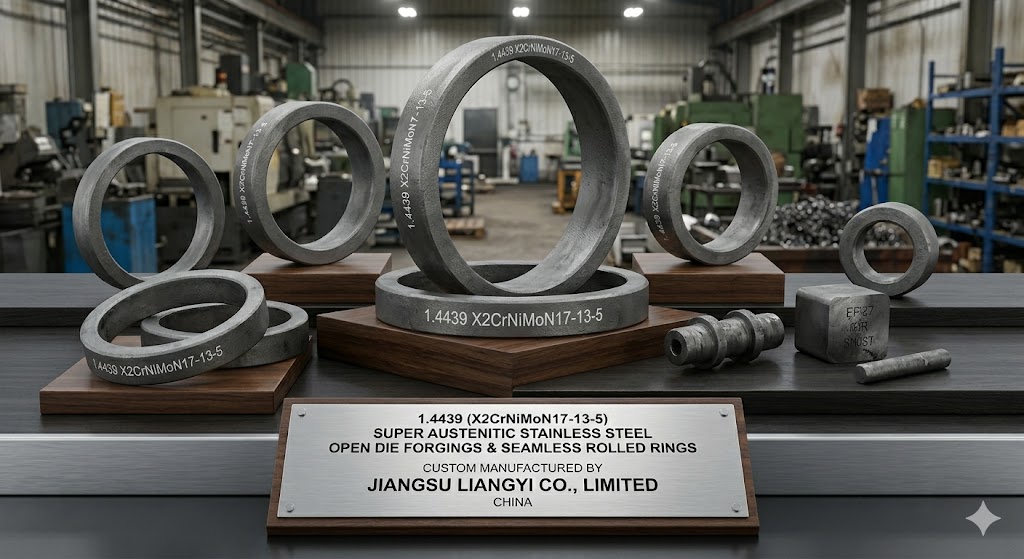
1.4439 (X2CrNiMoN17-13-5): Who We Are & Why This Grade Matters
Jiangsu Liangyi Co., Limited has been manufacturing precision 1.4439 (X2CrNiMoN17-13-5) forging parts since the late 1990s — long before this grade became the go-to specification in European and Middle Eastern corrosive-service tenders. Today, from our 80,000 m² facility in Jiangyin City, Jiangsu Province, we produce 120,000 tons of forgings annually, hold an ISO 9001:2015 quality management system independently audited every year, and supply finished components to engineering firms, EPC contractors and OEM manufacturers in more than 50 countries. Our in-house chain — from electric arc furnace (EAF) steel melting through open die forging, seamless ring rolling, solution annealing, CNC machining and full non-destructive testing — means every kilogram of 1.4439 that leaves our gate carries a single, traceable quality signature: ours.
Within the austenitic stainless steel family, 1.4439 sits in what metallurgists sometimes call the "super austenitic" tier — a step beyond standard 316 and 317L grades. The defining characteristic is a Molybdenum content of 4.0–5.0 wt%, roughly double that of 316L, supplemented by elevated Nickel (12.5–14.5%) and a deliberate Nitrogen addition (0.12–0.22%). Together these alloying decisions push the material's Pitting Resistance Equivalent Number (PREN) to approximately 35, a threshold widely accepted in oil & gas and chemical processing standards as the minimum for reliable service in seawater, produced water and concentrated chloride streams. Standard 316L, with a PREN of roughly 24, simply cannot meet that threshold.
From a procurement standpoint, 1.4439 forging parts represent a cost-effective upgrade path. The material commands a premium over 316L — primarily due to higher Mo and Ni content — but the total installed cost equation almost always favours the upgrade when the alternative is premature component failure, unplanned shutdown and replacement labour costs in remote or hazardous locations. Our job is to make that upgrade as technically seamless as possible, and this page explains every element of how we do it.
Metallurgical Background: How 1.4439 Achieves Superior Corrosion Resistance
Understanding why 1.4439 outperforms standard austenitic grades requires a brief look at the underlying metallurgy — knowledge that directly informs how we approach melting, forging and heat treatment at Jiangsu Liangyi.
The Role of Molybdenum in Passive Film Stability
Stainless steels owe their corrosion resistance to a self-repairing chromium-rich passive oxide film roughly 1–3 nm thick. In environments containing chloride ions (Cl⁻), this film is susceptible to localised breakdown at surface discontinuities, initiating the autocatalytic pitting process. Molybdenum significantly delays this breakdown by two complementary mechanisms: it enriches the passive film with MoO₄²⁻ species that physically block Cl⁻ adsorption sites, and it raises the critical pitting temperature (CPT) — the threshold above which pits initiate spontaneously. For 316L (Mo ~2.25%), the CPT in 6% FeCl₃ solution is typically around 20–25 °C. For 1.4439 (Mo ~4.5%), the CPT rises to above 40–50 °C, extending the safe operating envelope considerably for hot seawater, brine and acid chloride services.
The Role of Nitrogen: Strength and Corrosion Resistance Combined
The 0.12–0.22 wt% Nitrogen addition in 1.4439 serves a dual function that is unusual in alloy design: it simultaneously increases both mechanical strength and corrosion resistance, without compromising weldability (provided carbon stays ≤ 0.030%). Nitrogen partitions preferentially to the austenite lattice as an interstitial solid-solution strengthener, raising yield strength by approximately 10–15 MPa per 0.01 wt% N added — which is why 1.4439 forged bars achieve a guaranteed Rp0.2 of ≥ 280 MPa even after full solution annealing. In the passive film, dissolved nitrogen forms NH₄⁺ ions that locally buffer the acidic chemistry inside nascent pits, retarding their propagation. The combined Mo+N synergy accounts for the 16×%N weighting factor in the PREN formula, making nitrogen three to five times more efficient per unit weight than chromium in this respect.
Austenite Stability and Sigma Phase Risk
A practical concern for any high-Mo austenitic alloy is the risk of sigma (σ) phase precipitation. Sigma phase — a hard, brittle, Cr- and Mo-rich intermetallic — can form in the temperature range 600–1000 °C during slow cooling, extended thermal exposure or improper heat treatment, and its formation simultaneously depletes the matrix of Cr and Mo, dramatically reducing corrosion resistance. For 1.4439, the sigma phase nose on the time-temperature-transformation diagram sits at roughly 800–900 °C, with incubation times as short as a few hours at peak risk temperatures. This is precisely why correct solution annealing — heating to 1,050–1,150 °C and water quenching — is not merely a quality preference but a technical requirement. At Jiangsu Liangyi, every batch of 1.4439 forgings is water-quenched within strict time limits verified by furnace data loggers, and the solution-annealed condition is confirmed by hardness measurement before shipping.
In our production experience, the single most common source of below-specification corrosion resistance in 1.4439 forgings from other suppliers is inadequate cooling rate after annealing — particularly for heavy-section parts above 200 mm thickness where centre cooling lag allows sigma phase to form undetected. We use forced water circulation quenching for all sections above 150 mm and verify via inter-granular corrosion testing (ASTM A262 Practice E) on request.
1.4439 (X2CrNiMoN17-13-5) Chemical Composition per EN 10088
Our 1.4439 forging steel raw material is produced via Basic Electric Arc Furnace (EAF) primary melting, followed by AOD (Argon Oxygen Decarburisation) or VOD (Vacuum Oxygen Decarburisation) refining. For applications requiring the highest internal cleanliness — high-integrity subsea wellhead bodies, large cryogenic valve forgings, fatigue-critical rotating components — we offer optional Electroslag Remelting (ESR), which reduces sulphide inclusion count and improves transverse mechanical property isotropy significantly. Chemistry is verified by in-line OES (Optical Emission Spectrometry) at the melt shop, with independent check analysis performed by our laboratory before forging commences.
| Element | EN 10088 Limit (wt%) | Typical Heat Analysis (wt%) | Function in Alloy |
|---|---|---|---|
| Carbon (C) | ≤ 0.030 | 0.018–0.025 | Kept low to prevent sensitisation and Cr₂₃C₆ precipitation |
| Silicon (Si) | ≤ 1.00 | 0.40–0.70 | Deoxidant; aids passive film density |
| Manganese (Mn) | ≤ 2.00 | 1.20–1.60 | Austenite stabiliser; partial Ni substitute |
| Phosphorus (P) | ≤ 0.045 | ≤ 0.030 | Tramp element; minimised for weldability |
| Sulfur (S) | ≤ 0.015 | ≤ 0.005 (ESR: ≤ 0.003) | MnS inclusions are pitting initiation sites; tightly controlled |
| Chromium (Cr) | 16.50–18.50 | 17.00–17.80 | Primary passive film former; PREN baseline contributor |
| Molybdenum (Mo) | 4.00–5.00 | 4.30–4.70 | Critical pitting resistance; raises CPT above 40 °C in FeCl₃ |
| Nickel (Ni) | 12.50–14.50 | 13.00–14.00 | Austenite stabiliser; improves SCC resistance in H₂S environments |
| Nitrogen (N) | 0.12–0.22 | 0.15–0.19 | Solid-solution strengthener; pit propagation inhibitor; PREN multiplier ×16 |
Calculating the PREN Value for 1.4439
The Pitting Resistance Equivalent Number uses the formula: PREN = %Cr + 3.3×%Mo + 16×%N. Using the typical heat analysis values above:
- Minimum (EN limits lower end): 16.5 + 3.3×4.0 + 16×0.12 = 16.5 + 13.2 + 1.92 = 31.6
- Typical mid-range heat: 17.5 + 3.3×4.5 + 16×0.17 = 17.5 + 14.85 + 2.72 = 35.1
- Maximum alloy content: 18.5 + 3.3×5.0 + 16×0.22 = 18.5 + 16.5 + 3.52 = 38.5
In practice, Jiangsu Liangyi aims for a chemistry target of PREN ≥ 34 as a minimum heat specification, with typical delivered heats falling at PREN 35–37. This exceeds the EN 10088 minimum and aligns with critical service requirements in North Sea, MENA and LNG project specifications that call for PREN > 34.
When sourcing 1.4439 forgings, always request the actual heat chemistry certificate (EN 10204 3.1 or 3.2) and calculate the PREN independently. Chemistry at the lower EN specification limits (Cr 16.5%, Mo 4.0%, N 0.12%) gives PREN ≈ 31.6 — significantly lower than the ~35 often cited in promotional literature. We proactively report PREN on our MTC for every heat.
1.4439 vs Competing Stainless Steel Grades: A Technical Comparison
Procurement engineers regularly face the choice between several corrosion-resistant grades for demanding service. The table below provides an objective comparison of 1.4439 against the most commonly specified alternatives, based on standard chemistry and our production experience. This comparison is original analysis by Jiangsu Liangyi's metallurgical team and is not reproduced from any standard or third-party source.
| Property / Criterion | 1.4439 (X2CrNiMoN17-13-5) | 1.4404 (316L) | 1.4438 (317L) | 1.4529 (904L) | 2205 Duplex (1.4462) |
|---|---|---|---|---|---|
| UNS Equivalent | S31726 | S31603 | S31703 | N08904 | S32205 |
| Mo Content (wt%) | 4.0–5.0 | 2.0–2.5 | 3.0–4.0 | 4.0–5.0 | 3.0–3.5 |
| Ni Content (wt%) | 12.5–14.5 | 10.0–13.0 | 11.0–15.0 | 23.0–28.0 | 4.5–6.5 |
| Typical PREN | ~35–37 | ~24 | ~29–30 | ~35–38 | ~34–36 |
| Tensile Strength (MPa) | 580–800 | 530–730 | 515–690 | 490–690 | 620–820 |
| Yield Strength Rp0.2 (MPa) | ≥ 280 | ≥ 220 | ≥ 220 | ≥ 220 | ≥ 450 |
| Cryogenic Toughness (to −196 °C) | Excellent (FCC, fully austenitic) | Good | Good | Good | Limited (dual-phase; BCC ferrite brittle) |
| H₂S / Sour Service (NACE MR0175) | Qualified ≤ 22 HRC with ESR | Qualified | Qualified | Qualified (superior) | Conditionally qualified |
| Relative Raw Material Cost | Medium-High (1.0×) | Low (0.5–0.6×) | Medium (0.7–0.8×) | High (1.4–1.6×) | Medium (0.8–0.9×) |
| Sigma Phase Risk | Moderate (manage via rapid quench) | Low | Low–Moderate | Low | Moderate (475 °C embrittlement) |
| Forgeability | Good (narrow window: 950–1200 °C) | Good | Good | Good | Good (wider hot-working range) |
| Best-Fit Application | Chloride & acid service, cryogenic, HTHP | General corrosion | Upgrade from 316L | Sulphuric acid, seawater | Structural, high-pressure |
One insight worth highlighting: 1.4439 and 904L share very similar PREN ranges, yet 1.4439 costs roughly 30–40% less per kilogram because 904L carries an additional 10–14% Ni premium. For chloride-dominated corrosion scenarios — which account for the majority of stainless steel corrosion failures worldwide — 1.4439 delivers essentially equivalent resistance at a more competitive price. The primary advantage of 904L is its superior resistance to reducing sulphuric acid environments (H₂SO₄ below 50% concentration), a niche where 1.4439's lower Ni content is a limitation.
Mechanical Properties of 1.4439 (X2CrNiMoN17-13-5) Forged Steel
All our 1.4439 forging parts are supplied in the solution-annealed and water-quenched condition (heat treatment code AT per EN 10088), which is the only condition in which the full corrosion resistance potential of this grade can be realised. The standardised mechanical property requirements per EN 10088-3 for the delivery condition are:
| Mechanical Property | EN 10088-3 Minimum / Range | Typical Forged Value (Jiangsu Liangyi) | Test Standard |
|---|---|---|---|
| Tensile Strength (Rm) | 580–800 MPa | 610–760 MPa | EN ISO 6892-1 |
| Yield Strength (Rp0.2) | ≥ 280 MPa | 295–340 MPa | EN ISO 6892-1 |
| Elongation at Break (A) | ≥ 30% | 35–45% | EN ISO 6892-1 |
| Reduction of Area (Z) | Not specified by EN | ≥ 55% (typical forged) | EN ISO 6892-1 |
| Hardness (Brinell HB) | 170–230 HB | 185–215 HB | EN ISO 6506-1 |
| Charpy Impact (KV₂, 0 °C) | Not specified by EN | ≥ 100 J (longitudinal) | EN ISO 148-1 |
| Charpy Impact (KV₂, −196 °C) | Not specified by EN | ≥ 50 J (longitudinal) | EN ISO 148-1 |
Our typical forged values consistently exceed EN minimum requirements — not because we use a different chemistry, but because the forging process itself refines grain size to ASTM 5–7 (per EN ISO 643), deletes cast dendritic segregation, and closes micro-shrinkage porosity that would reduce cross-sectional area in a tensile specimen. This is the fundamental metallurgical advantage of forged over cast or bar-machined components in this grade.
High-Temperature and Cryogenic Property Context
One of the frequently overlooked advantages of 1.4439 is its performance at the extremes of the service temperature range. At elevated temperatures (up to ~400 °C continuous service), 1.4439 retains useful strength with a Rp1.0 of approximately 170–200 MPa at 300 °C — superior to 316L at equivalent temperature — while its improved Mo content continues to stabilise the passive film against hot chloride attack. At cryogenic temperatures down to −196 °C (liquid nitrogen), the fully austenitic microstructure (FCC crystal structure) of 1.4439 does not undergo the ductile-to-brittle transition that affects ferritic and martensitic grades, or even the partial BCC ferrite phase in duplex grades. This is why 1.4439 forgings are the best choice for LNG cryogenic valve shafts and flow meter bodies where sub-zero impact toughness cannot be compromised.
Heat Treatment Requirements for 1.4439 Forging Parts
Correct heat treatment is arguably more important for 1.4439 than for any other commonly forged stainless grade. This section documents the exact procedures we follow at Jiangsu Liangyi and explains the engineering rationale for each parameter.
Pre-Annealing Inspection
Before furnace loading, every forging batch is visually inspected for surface cracks or cold shuts introduced during the forging sequence. Dimensional checks confirm that forging distortion is within tolerance so that the finished geometry after annealing will not require excessive stock removal. Thermocouples are positioned inside any large-section forging exceeding 300 mm cross-section to monitor actual part temperature, not just furnace atmosphere temperature.
Solution Annealing: 1,050–1,150 °C
Parts are loaded into a programmable electric furnace maintained at ±5 °C temperature uniformity, verified by regular System Accuracy Tests (SAT) and Temperature Uniformity Surveys (TUS). The target soak temperature is 1,080–1,120 °C — the lower end of the range is used for thin sections to minimise grain growth; heavier sections use the upper range to guarantee full solutionising. Soak time is a minimum of 1 hour per 25 mm of maximum cross-section, with a minimum absolute time of 2 hours. The purpose is to dissolve all chromium carbides and any sigma phase that may have precipitated during the forging cooling cycle, producing a fully austenitic, single-phase microstructure with maximum corrosion resistance.
Water Quenching: Within 60 Seconds of Exit
Immediate rapid quenching is not optional — it is the defining step that locks the high-temperature austenite microstructure in place and prevents sigma phase re-precipitation during cooling through the 600–1000 °C danger zone. Our procedure: parts exit the furnace door directly above an agitated water tank, with transfer time to water contact ≤ 60 seconds for standard sections and ≤ 30 seconds for thin-wall components. Water temperature is maintained below 40 °C by chiller circulation. For very heavy forgings exceeding 1 ton, we use forced water circulation (FWC) to maintain adequate cooling rate at the thermal centre. Cooling rate data from embedded thermocouples is archived in our quality records.
Post-Anneal Verification
After quenching, each forging is hardness-tested (minimum 3 readings per piece) to confirm the HB falls within 170–230 HB. Results outside this range trigger a review — values above 230 HB can indicate incomplete solution annealing or sigma phase retention, while unusually low values may indicate decarburisation. On customer request, we perform ASTM A262 Practice E Strauss test or equivalent IGC (inter-granular corrosion) testing to directly verify solution anneal adequacy. Metallographic sections can also be supplied for critical applications.
Our 1.4439 Forging Manufacturing Process: From Melt to Finished Part
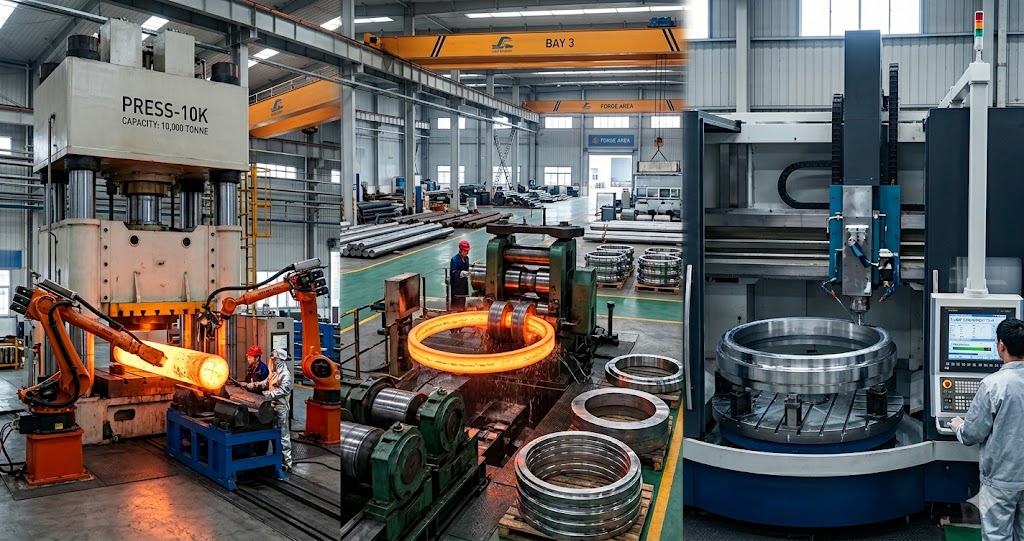
Every 1.4439 forging part we produce traces a documented, stage-gated manufacturing route. What follows is not a generic process description — it is the specific workflow used at our Jiangyin facility, based on our accumulated production data for this grade over more than two decades.
Stage 1: Steel Melting and Refining
Raw material is melted in our 30-ton Electric Arc Furnace (EAF), then transferred to the AOD (Argon Oxygen Decarburisation) converter for precise carbon reduction and alloy trimming. AOD is particularly well-suited to 1.4439 chemistry because the inert argon dilution allows carbon to be reduced below 0.030% without excessive Cr loss — a significant efficiency versus older vacuum-only processes. For orders specifying reduced sulphur (≤ 0.003%) or improved inclusion cleanliness for high-integrity subsea or cryogenic applications, material proceeds through our VOD (Vacuum Oxygen Decarburisation) unit or ESR (Electroslag Remelting) facility. The ESR process in particular delivers measurably improved ultrasonic inspectability by eliminating large non-metallic inclusions and macro-segregation that can generate false UT indications in standard melted heats.
Stage 2: Ingot / Billet Preparation and Forge Heating
Solidified ingots are stripped and transferred to our forging preparation area for crop and discard calculation. The top and bottom 12–18% of each ingot are cropped to eliminate the shrinkage cavity (pipe) and segregated heel zones — a conservative practice that some lower-cost producers skip, at the expense of internal soundness in the finished forging. Prepared billets are charged into a gas-fired reheating furnace to a forging temperature of 1,150–1,250 °C. A maximum furnace soak of 4 hours is enforced to limit grain growth and scale penetration. Because 1.4439 has a narrower hot-working window than 316L (the material work-hardens more steeply at sub-optimal temperatures), forging press operators must complete the forging sequence before the billet surface drops below approximately 950 °C, after which the piece is returned to reheat.
Stage 3: Open Die Forging (Press Forging)
Our open die forging shop houses three main presses: a 2,000-ton, a 4,000-ton and a 6,300-ton hydraulic forging press. For 1.4439 forging parts up to approximately 5 tons, the 4,000-ton press delivers the combination of high specific pressure and controllable stroke speed that produces uniform deformation across large cross-sections. For pieces above 5 tons or for shaft forgings requiring long axial reductions, the 6,300-ton unit is used. The forging ratio — defined as initial cross-sectional area divided by final cross-sectional area — is maintained at a minimum of 3:1 for all longitudinal sections and minimum 2:1 for all transverse sections, ensuring complete elimination of as-cast grain structure and thorough closure of any micro-porosity. This forge ratio is documented on every forging traveller card and is part of the quality records supplied with the MTC.
Stage 4: Seamless Ring Rolling
For ring-shaped forgings — flanges, gear rings, seamless valve rings, pipe fittings and custom rolled ring blanks — we operate four ring rolling machines with mandrel diameters ranging from 1 m to 5 m, capable of producing finished rings up to 6 m outer diameter. The ring rolling process for 1.4439 requires careful attention to three variables: (1) feed rate must be controlled to prevent excessive through-thickness temperature gradients that produce mixed-grain microstructure; (2) the ring-to-wall ratio must remain within limits that prevent fold formation at the ring inner surface; and (3) the final rolling temperature must be high enough to allow complete recrystallisation of the outer grain layer before air cooling begins. Our ring rolling operators use pyrometer feedback and a rolling parameter chart specifically developed for 1.4439 to manage these interdependencies — a technical resource built from our own production trials rather than generic textbook guidance.
Stage 5: Normalising, Solution Annealing and Quenching
After forging and initial cooling, all 1.4439 forgings proceed directly through the solution annealing cycle described in Section 6 above. We operate 10 programmable heat treatment furnaces with a combined usable volume of approximately 400 m³, providing capacity to handle both single heavy forgings and large batch orders simultaneously. Furnace records — including time-temperature charts for every cycle — are retained for a minimum of 10 years and can be provided as part of the quality documentation package on request.
Stage 6: CNC Machining to Final Dimensions
For customers requiring finish-machined components, our machining shop provides CNC turning, milling, drilling and boring capabilities. Key equipment includes: 5-axis CNC turning centres with 6 m between centres (for shafts), CNC boring and milling machines with table capacity up to 12 m × 3.5 m (for large discs and flanges), and deep-hole drilling to 2 m depth for hollow shafts and cylinders. Dimensional verification is performed on our coordinate measuring machine (CMM) with reporting to ISO 8015 GD&T standards. Surface finish is verified by contact profilometry. All dimensions are reported on an Inspection Dimension Report (IDR) included in the documentation package.
Full Range of 1.4439 Forging Parts & Dimensional Capabilities
We manufacture custom 1.4439 (X2CrNiMoN17-13-5) forging parts in the complete range of shapes below, compliant with EN, ASTM, API, ASME and other international standards, with single-piece weight from 30 kg to 30 tons. Dimensional tolerances conform to EN 10243-1 (die forgings), EN 10250 (open die forgings) and customer-specified drawing tolerances as applicable.
| Product Type | Typical Dimensions | Weight Range | Key End Uses |
|---|---|---|---|
| Round bars / rods | Ø40 mm – Ø650 mm, L up to 6 m | 5 kg – 15,000 kg | Valve spindles, pump shafts, machined blanks |
| Seamless rolled rings | OD 200 mm – 6,000 mm; H 50–2,500 mm | 30 kg – 20,000 kg | Flanges, pressure vessel shell courses, gear rings, ball valve rings |
| Discs / plates / blanks | Ø200 mm – 3,000 mm; T 30–600 mm | 30 kg – 15,000 kg | Tube sheets, end caps, pump wear plates, high-integrity disc forgings |
| Forged shafts / step shafts | Ø50 mm – Ø600 mm; L up to 15 m | 50 kg – 30,000 kg | Centrifugal pump shafts, cryogenic valve shafts, compressor rotor shafts |
| Hollow bars / cylinders | OD 150–1,200 mm; ID 60–900 mm | 30 kg – 8,000 kg | Pressure vessel nozzles, cylinder liners, valve bodies, pump barrels |
| Hubs / bosses / sleeves | OD 80–1,000 mm; H 50–1,000 mm | 10 kg – 5,000 kg | Pump impeller hubs, seal housings, gearbox sleeves |
| Custom near-net-shape forgings | Per customer drawing | 30 kg – 30,000 kg | Wellhead bodies, valve bonnets, manifold bodies, reactor internals |
All forging types are available with MTC EN 10204 3.1 as standard; 3.2 (third-party witnessed) is available via SGS, Bureau Veritas, TÜV Rheinland, DNV, Lloyd's Register and other nominated inspection agencies. Our standard delivery condition is solution-annealed + water-quenched + shot-blasted; machining and surface finish options are agreed per customer specification.
Industry Applications & Verified Global Case Studies
Our 1.4439 (X2CrNiMoN17-13-5) forging parts serve important applications in the most demanding industrial environments worldwide. The case studies below are drawn from our order history and illustrate both the technical suitability and geographic range of our customer base. All project details are shared with client consent and without confidential project identification.
Oil & Gas Industry (Onshore & Offshore)
With its PREN of ~35 and guaranteed compliance with NACE MR0175 sour service requirements when specified, 1.4439 is the preferred material for wellhead and Christmas tree equipment exposed to high-chloride produced water and H₂S-containing well streams. The grade's combination of high Mo (resisting chloride pitting) and adequate Ni content (providing SCC resistance above the threshold compositions in NACE MR0175 Table A1) makes it one of the few single austenitic grades that can satisfy multiple failure mode requirements simultaneously, simplifying material qualification programmes for new well completions.
Our core product range for oil & gas includes: forged valve balls, valve seats, valve stems, valve bonnets and valve bodies manufactured to API 6A material requirements; wellhead bodies, casing heads, tubing heads, casing hangers, tubing spools and adapter flanges; Christmas tree top connector bodies and wing valve blocks; downhole motor shafts, ESP pump shaft forgings and rod centraliser components.
Verified Case Studies — Oil & Gas
- Saudi Arabia / UAE / Kuwait: Supplied 1.4439 forged wellhead bodies manufactured to API 6A material requirements and full Christmas tree valve component sets for three consecutive field development campaigns. Parts operated in formation water salinity exceeding 180,000 ppm TDS at bottom-hole temperatures above 150 °C — conditions that had caused 316L failures in the previous supplier's product within 18 months. Our components have now accumulated more than 6 years' combined field service without reported corrosion issues.
- Gulf of Mexico / Alberta, Canada: Delivered X2CrNiMoN17-13-5 splined drive shafts for high-power downhole mud motors (≥800 HP) and large-diameter ESP pump shaft stacks. NACE MR0175 sour service certification was confirmed by heat analysis, hardness testing and slow-strain-rate SCC testing on representative samples. ESR-grade material was used to achieve the cleanliness specification required for fatigue-critical rotating applications.
- North Sea (Norway & UK): Provided 1.4439 forged subsea valve components — gate bodies, bonnet forgings and stem forgings — for a multi-well subsea production system. Full compliance with NORSOK M-630, PED 2014/68/EU and DNV-GL witnessing was required and achieved.
Chemical & Petrochemical Processing
The chemical process industry operates some of the most chemically aggressive environments that metallic materials can encounter: concentrated mineral acids, mixed acid streams, chloride-bearing brines at elevated temperature, and oxidising-reducing mixed environments that defeat single-criterion selection rules. 1.4439's combination of high Mo (acid resistance), adequate Cr (passivity) and controlled C (sensitisation prevention) positions it well for a broad range of chemical service without the cost premium of nickel-based alloys. Our chemical processing customers specify 1.4439 primarily for heat exchanger tube sheets, pressure vessel shell forgings and nozzle forgings, reactor internals, distillation column skirt and tray support rings, and aggressive-duty pump components.
Verified Case Studies — Chemical Processing
- Germany / France / Finland: Supplied 1.4439 forged tube sheet forgings (up to 2,800 mm diameter, 420 mm thick, 14,500 kg each) for shell-and-tube heat exchangers processing acetic acid chloride streams and chlorinated solvent recovery. Customer's 316L tube sheets had developed through-wall pitting within 3 operating cycles. Our 1.4439 tube sheets have completed more than 9 operating cycles without observed pitting above 0.3 mm depth, representing a 3× service life improvement.
- South Korea / Singapore / Malaysia: Provided X2CrNiMoN17-13-5 forged reactor nozzle forgings and transition cone forgings for ethylene dichloride (EDC) and vinyl chloride monomer (VCM) plant reactors, compliant with both ASME BPVC Section VIII Div.2 and JIS B 8265 pressure vessel codes simultaneously — a dual-code qualification exercise we carried out in-house with our Korea- and Japan-based inspection partners.
Power Generation Industry
Power generation projects demand the same level of material documentation rigour — full heat traceability, witnessed mechanical testing and third-party MTC 3.2 certification — that our ISO 9001:2015 quality system is built to provide. 1.4439 forging parts are well-suited to high-temperature, high-pressure rotating and static components in thermal and industrial power generation, where the combination of strength, corrosion resistance and long service life reduces plant maintenance intervals and total lifecycle cost.
Our core products for power generation include forged casings, seal chambers and blocks for high-pressure rotating machinery, impellers for turbo centrifugal compressors, turbine-adjacent components, pressure vessel nozzles, and boiler components. All products are supplied solution-annealed with full MTC documentation. ESR-grade material is available for applications requiring enhanced ultrasonic inspectability and inclusion cleanliness.
GEO-Targeted Proven Case Studies
- Germany / Italy / Poland: Delivered 1.4439 forged compressor impeller forgings and turbine component forgings for industrial gas turbines and waste-to-energy plants, with elevated-temperature tensile data at 300 °C and 350 °C supplied alongside standard room-temperature test reports. EN 10204 3.2 documentation with witnessed inspection by appointed third-party agencies was provided for all deliveries.
- Asia Pacific Market: Supplied X2CrNiMoN17-13-5 forged high-pressure pump casings and seal chamber components for industrial infrastructure projects in China and South Korea, meeting client-specified UT acceptance classes, full chemistry traceability requirements and witnessed third-party mechanical testing.
Cryogenic & Flow Control (LNG)
LNG operations expose materials to temperatures down to −162 °C (liquid methane) or −196 °C (liquid nitrogen in testing), pressure swings of 0 to 100+ bar, and the demanding fatigue loading of tens of thousands of valve cycles per year. The fully austenitic FCC microstructure of 1.4439 is inherently suited to cryogenic service because it does not undergo the ductile-brittle transition that limits use of ferritic, duplex and martensitic grades below approximately −50 °C. Our cryogenic valve shaft forgings for HPBV (high-performance butterfly valves) are some of the most geometrically precise forgings we make: tight concentricity tolerances, specific surface finish requirements and witnessed cryogenic impact testing at −196 °C are standard deliverables for these parts.
Verified Case Studies — Cryogenic & LNG
- Queensland, Australia: Supplied over 200 individual 1.4439 forged cryogenic valve shaft forgings for LNG export terminal projects in Queensland, Australia. Charpy impact testing at −196 °C confirmed KV₂ ≥ 60 J longitudinal on all heats, exceeding the project specification of ≥ 40 J. ASME B31.3 piping code compliance was independently witnessed by an appointed third-party inspection agency.
- Netherlands / Belgium / Qatar / Oman: Provided X2CrNiMoN17-13-5 venturi cone flow meter body forgings and measurement valve spool forgings for LNG custody transfer metering stations. Dimensional precision was critical: meter body bore concentricity was held to ±0.05 mm across 350 mm diameter, verified on our CMM with full dimensional report.
Industrial Pump & Rotating Machinery
Industrial pump OEMs have largely standardised on 1.4439 (or its close equivalent UNS S31726) for high-duty seawater-cooled and chemical-process pump impellers and casings, precisely because field failures of 316L components in these service environments became statistically predictable and commercially unacceptable. The performance advantage of forged 1.4439 pump components over cast equivalents comes from two compounding effects: the superior corrosion resistance of the wrought material (due to reduced segregation and lower inclusion density versus cast) and the higher fatigue strength of the forged microstructure (critical for impellers subject to cyclic hydraulic loading).
Verified Case Studies — Pumps & Rotating Machinery
- Germany / USA / Canada: Supplied 1.4439 forged pump impeller blanks, shaft forgings and casing forgings to major centrifugal pump OEMs for seawater-cooled auxiliary cooling water pumps and chemical transfer service. Customer field data for one installation: 316L impellers required replacement every 18–24 months; our 1.4439 forgings completed 52 months of continuous operation before the first scheduled maintenance inspection revealed only superficial surface staining — a service life improvement factor of approximately 2.5×.
- China / Japan / South Korea: Provided X2CrNiMoN17-13-5 forged marine sea-water pump components for LNG carrier auxiliary machinery systems and FPSO seawater lift pump packages, supplied with third-party inspection certificates from classification society–approved inspectors (DNV, ABS, Lloyd's Register, CCS, NK) upon buyer's nomination.
Strict Quality Control & Non-Destructive Testing (NDT)
Quality control at Jiangsu Liangyi is not a post-production gate — it is integrated throughout every manufacturing stage via our ISO 9001:2015 quality management system, which is independently audited annually. The following describes our specific NDT requirements and acceptance criteria for 1.4439 (X2CrNiMoN17-13-5) forging parts. These are the actual criteria we apply, not generic industry summaries.
Visual Testing (VT) — 100% of All Products
Every finished forging is visually examined 100% in accordance with EN 13018 by trained and authorised personnel. The examination covers all accessible surfaces including bores, slots and undercuts. Acceptance criteria: the finished product shall be free from cracks, piping, scabs, laps, cold shuts, seams and hairline cracks. Minor surface marks including slight dents, shallow roll marks and tool marks are permissible provided their depth does not exceed half the dimensional tolerance specified for that surface. Any indication requiring investigation is marked and referred to surface non-destructive testing (MT or PT as appropriate).
Ultrasonic Testing (UT) — Mandatory for Bars > 40 mm Diameter
All forged bars and rods of diameter exceeding 40 mm are subjected to 100% manual UT inspection in accordance with EN 10308, Type 1a (longitudinal waves) and Type 1c (transverse waves), performed by qualified NDT operators holding Level II or Level III certification per EN ISO 9712. Acceptance quality classes applied by default: Quality Class 3 for material diameter or thickness ≤ 200 mm; Quality Class 4 for > 200 mm. The decision limit for back wall echo loss is 3 dB. The maximum permissible individual reflector indication length for Class 3 is 6 mm; for Class 4 it is 3 mm. Additionally, we apply per-customer enhanced scanning for critical applications: extended grid spacing, tandem technique scanning for thick sections, and TOFD (Time-of-Flight Diffraction) for weld repair validation or critical high-integrity forgings. All UT scan records — A-scan data, B-scan images and D-scan projections — are stored digitally and available for customer review.
Liquid Penetrant Testing (PT) & Magnetic Particle Testing (MT)
PT and MT are applied as mandatory tests for all near-net-shape forgings where drawing geometries include bores, steps, undercuts or tight radius transitions, and as follow-up to any VT indication. Because 1.4439 is non-magnetic, fluorescent liquid penetrant (Type I, Method C, Sensitivity Level 3 per ASTM E165 / EN ISO 3452) is the primary surface discontinuity detection method. Results are documented by digital UV photography and acceptance is per applicable code (e.g., ASME BPVC Section VIII acceptance criteria for pressure vessel components, or API 6A Appendix F for wellhead equipment).
Mechanical Testing
Test pieces are cut from the forged piece itself (not from separately forged test rings) to represent the actual forging cross-section. Room temperature tensile testing (EN ISO 6892-1), hardness measurement (EN ISO 6506-1) and Charpy impact testing (EN ISO 148-1) are performed as standard for all deliveries with MTC 3.1. For MTC 3.2, all mechanical testing is witnessed by the appointed third-party inspector. Elevated temperature tensile (per EN ISO 6892-2) and cryogenic Charpy impact are available on request from our in-house test laboratory.
Chemical Composition Verification
Each production heat is verified by in-line OES at the melt shop (heat analysis) and by independent ICP-OES check analysis in our laboratory on a sample taken from the forging itself (product analysis). The check analysis result is what appears on the MTC. For ESR heats, the ESR ingot is also sampled to confirm no significant chemistry change occurred during remelting. PREN is calculated from the actual product analysis and reported on the MTC as a standard practice for all 1.4439 deliveries — a service commitment that most forging suppliers do not offer without specific request.
Compliance & International Certification Standards
All our 1.4439 (X2CrNiMoN17-13-5) forging parts are manufactured and inspected in full compliance with the following international standards. Where multiple standards apply to the same physical requirement, we apply the most stringent unless the customer specifies otherwise.
| Standard | Scope | Market Applicability |
|---|---|---|
| EN 10088-3 | Stainless steel — semi-finished products, bars, rods, wire, sections; composition, properties and dimensions | Global (primary material standard) |
| EN 10250-4 | Open die steel forgings — stainless and heat-resisting steels | Europe |
| EN 10204 | Metallic products — types of inspection documents (MTC 2.2, 3.1, 3.2) | Global |
| EN 10308 | Non-destructive testing of steel products — ultrasonic testing of steel bars | Europe |
| EN 13018 | Non-destructive testing — visual testing — general principles | Global |
| EN ISO 148-1 | Metallic materials — Charpy pendulum impact test | Global |
| EN ISO 643 | Micrographic determination of the apparent grain size | Global |
| EN ISO 6506-1 | Metallic materials — Brinell hardness test | Global |
| EN ISO 6892-1 / -2 | Metallic materials — tensile testing at room and elevated temperatures | Global |
| EN ISO 9001:2015 | Quality management systems | Global |
| EN ISO 9712 | Non-destructive testing — qualification and certification of NDT personnel | Global |
| ASTM A182 | Standard Specification for Forged or Rolled Alloy and Stainless Steel Pipe Flanges, Forged Fittings, and Valves for High-Temperature Service | North America / Global (UNS S31726 = F317LMN) |
| ASTM A262 | Detecting Susceptibility to Intergranular Attack in Austenitic Stainless Steels | Global (upon request) |
| ASTM E165 | Standard Practice for Liquid Penetrant Examination | North America / Global |
| API 6A | Specification for Wellhead and Christmas Tree Equipment | Global oil & gas |
| NACE MR0175 / ISO 15156 | Petroleum and natural gas industries — materials for use in H₂S-containing environments | Global oil & gas (sour service) |
| PED 2014/68/EU | Pressure Equipment Directive — our materials comply with the EN standards (EN 10088, EN 10204) referenced under PED; CE-mark conformity assessment for finished pressure equipment is the responsibility of the equipment manufacturer | Europe |
| ASME BPVC Section II Part A | Materials — ferrous material specifications (SA-182) | North America / global process industry |
| NORSOK M-630 | Material data sheets and element data sheets for piping | Norway / North Sea |
Practical Procurement Guide: What to Specify When Ordering 1.4439 Forgings
Based on our experience handling enquiries from procurement engineers and technical buyers across more than 50 countries, the following checklist captures the information we need to provide an accurate quotation and the technical decisions buyers typically face. We share this not as a sales tactic but because well-specified enquiries save both parties time and prevent the misunderstandings that lead to disputes later.
Minimum Information Required for Quotation
- Material specification: EN 1.4439 (X2CrNiMoN17-13-5) or ASTM A182 Grade F317LMN (UNS S31726) — confirm which standard applies in your project specification. They are closely equivalent but not identical in all respects.
- Product form and dimensions: Drawing or dimensional sketch (PDF, DXF, STEP accepted); forging weight estimate or material volume; surface finish requirement (as-forged, shot-blasted, rough-machined, finish-machined).
- Heat treatment condition: Standard is solution-annealed + water-quenched. If your project specification requires a specific annealing temperature window or quench verification test (e.g., ASTM A262 Practice E), state this upfront.
- MTC type: EN 10204 3.1 (manufacturer's own certification) or 3.2 (independently witnessed). Specify which third-party inspection agency you prefer or are willing to accept (SGS, BV, TÜV, DNV, etc.).
- NDT requirements: State which NDT tests are required beyond our standard scope (UT quality class, PT/MT scope, RT requirements) and applicable acceptance standard.
- Quantity and delivery: Number of pieces, target delivery date, Incoterms and port of delivery. Providing a realistic delivery date allows us to assess whether standard scheduling or expedited processing is needed.
Common Technical Questions at Enquiry Stage
- Do you need ESR grade? For most applications the answer is no — standard EAF+AOD material with PREN ≥ 34 is fully adequate. ESR adds approximately 15–25% to material cost and 7–10 days to lead time. It is genuinely necessary for: subsea wellhead components with stringent UT cleanliness requirements, NACE MR0175 hardness-critical rotating components above 50 mm diameter, and fatigue-critical dynamic applications where a clean inclusion rating is contractually specified.
- Can you match an existing MTC if we send a sample or previous order's certificate? We can match chemistry targets closely but we do not copy or alter MTCs from other sources. We supply only documentation that reflects actual test results from material we manufactured.
- What is the lead time? Standard: 25–45 working days from drawing approval for custom forgings below 5 tons; 45–70 days for heavy forgings above 5 tons. For stock bar material in standard diameters, lead times are 10–15 working days. Rush processing can reduce these by approximately 30% subject to furnace scheduling availability.
- What is the minimum order quantity (MOQ)? 1 piece for custom forgings; 500 kg for bar stock. We regularly produce single-piece prototype forgings for R&D and qualification programmes.
Frequently Asked Questions About 1.4439 Forging Parts
1.4439 (X2CrNiMoN17-13-5) is a super austenitic stainless steel with Cr 16.5–18.5%, Mo 4.0–5.0%, Ni 12.5–14.5% and N 0.12–0.22%. Its PREN value of approximately 35 — calculated as %Cr + 3.3×%Mo + 16×%N — places it significantly above the critical ~25 PREN threshold required for reliable service in seawater and chloride-rich process environments. The "X2" prefix in the EN designation indicates a maximum carbon content of 0.030%, which prevents chromium carbide sensitisation during welding or elevated-temperature service.
The UNS equivalent is S31726, and it is closely related to ASTM A182 Grade F317LMN, though the Mo and N ranges differ slightly between the EN and ASTM standards and should be checked against your project specification.
PREN = %Cr + 3.3×%Mo + 16×%N. Using Jiangsu Liangyi typical heat analysis (Cr 17.5%, Mo 4.5%, N 0.17%): PREN = 17.5 + (3.3 × 4.5) + (16 × 0.17) = 17.5 + 14.85 + 2.72 = 35.1. At full upper specification limits (Cr 18.5%, Mo 5.0%, N 0.22%) the PREN reaches 38.5. The minimum EN specification limit yields PREN 31.6 — hence the importance of confirming the actual heat analysis, not just citing "1.4439 PREN ~35" generically.
We report the actual PREN calculated from product analysis chemistry on every MTC as standard, without additional charge.
The critical differences are: Mo content nearly doubled (4.0–5.0% vs 2.0–2.5%), Ni elevated (12.5–14.5% vs 10.0–13.0%), and mandatory N addition (0.12–0.22% vs essentially zero for 316L). The combined result is a PREN increase from ~24 for 316L to ~35 for 1.4439 — a 46% improvement in this corrosion resistance metric. In practical service terms, 1.4439 can operate in chloride environments exceeding 1,000 ppm Cl⁻ at elevated temperatures where 316L will pit; it resists crevice corrosion in stagnant seawater where 316L fails; and it passes the 6% FeCl₃ CPT test above 40 °C where 316L typically fails at 15–20 °C.
The trade-off: 1.4439 costs roughly 60–80% more per kilogram due to the higher Mo and Ni alloy content. However, when total lifecycle cost is considered — including replacement, installation labour and plant downtime — the premium routinely pays back within one or two service cycles in demanding environments.
Forging offers four advantages over casting or machining from bar for 1.4439 components: (1) Structural integrity — the forging process closes internal shrinkage cavities and eliminates dendritic cast segregation zones that are initiation points for corrosion; (2) Mechanical properties — forged grain refinement (typical ASTM grain size 5–7) delivers 15–25% higher fatigue strength versus an equivalent cast microstructure; (3) Inspectability — the refined, uniform microstructure of a forging transmits ultrasound far more efficiently than a cast structure, enabling 100% UT inspection to tight acceptance classes; (4) Grain flow orientation — open die forging can be designed so that forging flow lines align with the principal stress direction in service, maximising fatigue and fracture resistance.
1.4439 requires solution annealing at 1,050–1,150 °C followed by immediate water quenching. The purpose is to dissolve sigma phase and chromium carbides that may have formed during forging cooling, restoring the fully austenitic microstructure and maximum corrosion resistance. We verify the anneal through: hardness measurement (must fall within 170–230 HB; values outside range trigger a retest protocol); furnace temperature data logging (records available to customers); and on request, ASTM A262 Practice E inter-granular corrosion test or metallographic section examination.
MOQ is 1 piece for custom forgings and 500 kg for bar stock. We regularly produce single prototype pieces for engineering qualification programmes. Standard lead times: custom forgings ≤ 5 tons — 25–45 working days from drawing approval; heavy forgings > 5 tons — 45–70 working days; bar stock in standard sizes — 10–15 working days. Rush processing reduces lead time by approximately 30% subject to press scheduling. Third-party inspection time (typically 2–5 days) is additional and depends on inspector availability.
Yes. 1.4439 (UNS S31726) is listed in NACE MR0175 / ISO 15156-3 Table A.2 for use in sour (H₂S-containing) oil and gas environments subject to compliance with the stated hardness limits (≤ 22 HRC for wrought austenitic stainless steel in the solution-annealed condition) and the environmental limits (partial pressure of H₂S, temperature, chloride concentration) defined in the standard. We supply hardness test data and heat treatment records as standard for sour service orders. For rotary downhole applications where hardness is critical, ESR grade material is recommended to ensure homogeneous hardness distribution through heavy cross-sections.
Our facility covers 80,000 m² with an annual forging capacity of 120,000 tons across all materials. For 1.4439 specifically, our production history spans more than 25 years with deliveries to over 50 countries including the Netherlands, Germany, France, USA, Canada, Saudi Arabia, UAE, Kuwait, Qatar, Australia, Singapore, South Korea and Japan. Equipment includes 2,000T/4,000T/6,300T hydraulic forging presses, ring rolling machines for rings up to 6 m diameter, 10+ heat treatment furnaces, and a full in-house NDT laboratory with qualified NDT personnel certified to EN ISO 9712 Level II and III.
Request a Custom 1.4439 (X2CrNiMoN17-13-5) Forging Parts Quotation
Jiangsu Liangyi Co., Limited is your reliable, ISO 9001:2015 certified China-based manufacturer for all grades of high-performance stainless steel and alloy steel forgings. With 25+ years of dedicated production experience in 1.4439 super austenitic forgings, advanced manufacturing equipment, rigorous quality systems and direct export logistics to 50+ countries, we are equipped to be your long-term technical supply partner — not just a one-off vendor. Whether you are qualifying a new material for a critical project, looking to dual-source an existing approved forging supplier, or developing a new product that requires prototype-to-production forging support, we welcome the conversation.
Send us your drawings, material specifications, quantity requirements and project timeline. We will respond with a detailed technical and commercial proposal within 24–48 hours for standard enquiries.
Inquiry Email: sales@jnmtforgedparts.com
Phone / WhatsApp: +86-13585067993
Website: https://www.jnmtforgedparts.com
Address:
Chengchang Industry Park, Jiangyin City, Jiangsu Province 214400, China