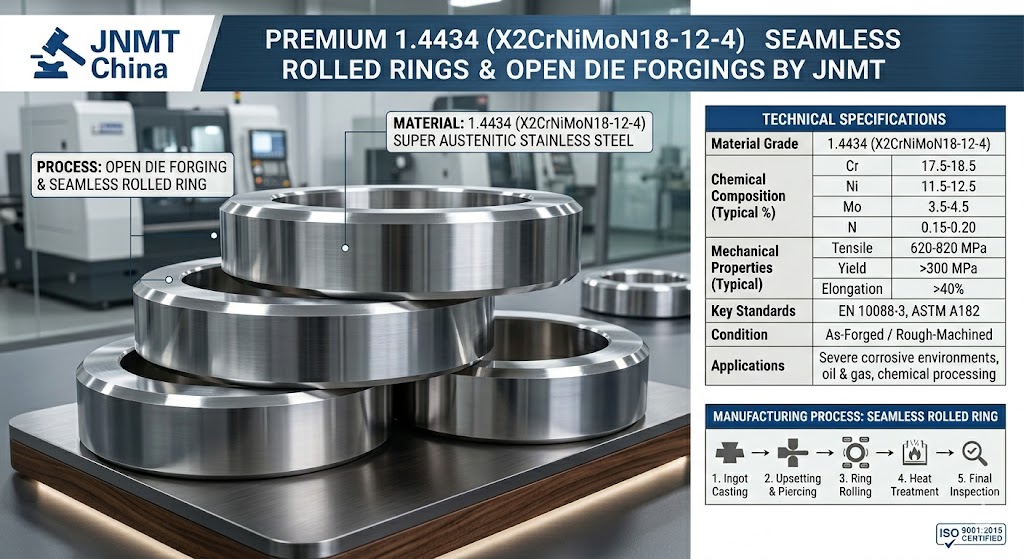
1.4434 (X2CrNiMoN18-12-4 / UNS S31653) Forged Parts China Professional Manufacturer — JNMT
Open Die Forgings · Seamless Rolled Rings · Hollow Forgings · CNC Finish Machining 30 kg – 30 tons · Single Ring OD up to 6 m · Delivery in 20–50 Days
ISO 9001:2015 CertifiedEN 10088 / ASTM A182API 6A CapablePED-Compatible MaterialsNACE MR0175 Requirements MetBV / SGS / TÜV on Request50+ Export CountriesEst. 1997 · 25+ Years
Manufacturer Overview: Who Is JNMT?
Jiangsu Liangyi Co., Limited — operating globally as JNMT Forged Parts — is a vertically integrated open die forging manufacturer headquartered in Jiangyin City, Jiangsu Province, China. Founded in 1997, JNMT has spent more than 25 years building one of Asia's most technically complete facilities for producing stainless steel, alloy steel, and special alloy forgings in full compliance with the world's most demanding industrial standards.
25+
Years Specialized Forging Experience (Est. 1997)
80,000㎡
Factory Floor Area with Full In-House Production
50+
Export Countries across 6 Continents
$40M
Fixed Asset Investment in Equipment & Infrastructure
Our 1.4434 (X2CrNiMoN18-12-4) forging capability is underpinned by a self-contained production chain: in-house electric arc furnace (EAF) melting, AOD + VOD secondary refining, 5,000-ton and 8,000-ton hydraulic open die forging presses, ring rolling mills capable of rings up to 6 meters outer diameter, a fully automated heat treatment line, and a comprehensive metrology and NDT laboratory staffed by EN ISO 9712-certified personnel. This end-to-end control — from raw charge to certificated delivery — is what separates JNMT from brokers, distributors, and single-process subcontractors.
JNMT holds ISO 9001:2015 quality management certification and welcomes third-party production audits and inspection witnessing by Bureau Veritas (BV), SGS, TÜV Rheinland, and Lloyds Register. Third-party inspection can be arranged at any stage of production upon client request, with full access to process records, calibration certificates, and personnel qualification documents.
The Nitrogen Advantage: Material Science Behind 1.4434 (X2CrNiMoN18-12-4)
To understand why 1.4434 outperforms its predecessor grades, it is necessary to examine what nitrogen actually does to austenitic stainless steel at the atomic and microstructural levels. This section presents JNMT's metallurgical perspective based on 25 years of production data and customer feedback across hundreds of demanding industrial projects.
What Defines 1.4434 Metallurgically?
1.4434, standardized as X2CrNiMoN18-12-4 in EN 10088-1 and registered as UNS S31653 in the AISI/ASTM system, belongs to the family of nitrogen-strengthened, molybdenum-bearing austenitic stainless steels. It can be regarded as a deliberately engineered upgrade of 316L (EN 1.4404 / UNS S31603): the molybdenum content is raised from a nominal 2.1% to a nominal 3.2%, carbon is kept ultra-low at ≤0.03% (the "L" specification), and — critically — 0.10–0.20% nitrogen is intentionally added as an alloying element rather than appearing as an unwanted trace impurity.
Key Identity: 1.4434 = 316L base + raised Mo (3–4%) + deliberate N addition (0.10–0.20%). These two changes together transform a good general-purpose grade into a high-performance engineering material for aggressive environments.
How Nitrogen Works in the Crystal Lattice
Nitrogen is an interstitial atom: it occupies the spaces between iron, chromium, nickel, and molybdenum atoms in the face-centered cubic (FCC) austenitic lattice. Following are three direct consequences:
Solid-solution strengthening: Interstitial N atoms create local lattice distortions that act as obstacles to dislocation movement. The result is a measurable increase in both yield strength (Rp0.2 rises from ≈220 MPa in standard 316L to ≥270 MPa in 1.4434) and tensile strength, without any reduction in ductility or toughness — a rare combination in structural metallurgy.
Austenite stabilization: Nitrogen is a powerful austenite former, with a Ni-equivalent weighting approximately 30× that of nickel on a weight-percent basis. Even the small additions in 1.4434 (0.10–0.20 wt%) provide significant austenite stabilization, suppressing the formation of α′-martensite (deformation-induced martensite) and δ-ferrite at lower temperatures. This is the primary reason 1.4434 retains stable austenitic behavior down to -196°C, where many austenitic grades undergo partial martensitic transformation and lose toughness.
Pit and crevice corrosion resistance (PREN enhancement): In the empirical Pitting Resistance Equivalent Number formula — PREN = %Cr + 3.3×%Mo + 16×%N — nitrogen carries a coefficient of 16, meaning each 0.1% N addition contributes 1.6 PREN points. Combined with the elevated Mo content (coefficient 3.3), 1.4434 achieves a calculated PREN of ≥32 vs. ≈24 for 316L — a 33% improvement that translates to a substantially higher critical pitting temperature (CPT) and critical crevice corrosion temperature (CCT) in standardized laboratory testing.
Carbon Ultra-Low Specification: Why It Matters for Forgings
The ≤0.03% carbon limit in 1.4434 is not merely a cosmetic designation. During hot forging and subsequent heat treatment, carbon in austenitic stainless steel has a strong thermodynamic tendency to migrate to grain boundaries and combine with chromium to form chromium carbides (M23C6), a phenomenon called sensitization. Sensitized zones become severely chromium-depleted (Cr content drops to below the corrosion-resistant threshold of ~12%) and become vulnerable to intergranular corrosion attacks in even mildly aggressive environments.
By holding carbon to ≤0.03%, the driving force for carbide precipitation is drastically reduced, making 1.4434 resistant to sensitization not only in the as-welded condition but also in heavy-section forgings where slow cooling rates after heat treatment are unavoidable. For JNMT's clients producing welded pressure vessels, flanged assemblies, and heat exchangers from 1.4434 forgings, this ultra-low carbon content is a critical safety margin — not just a number on a mill certificate.
The Role of Elevated Molybdenum (3–4%) in Corrosive Service
Molybdenum enhances corrosion resistance through two complementary mechanisms. First, Mo enriches the passive oxide film that forms spontaneously on stainless steel surfaces, making the film denser, more adherent, and more resistant to breakdown by aggressive anions — particularly chlorides and bromides. Second, Mo promotes the formation of Mo(IV) and Mo(VI) oxide species at incipient pit sites, which act as cathodic inhibitors and can actually suppress pit re-initiation after a passive film breakdown event. In practical terms, 1.4434 at 3–4% Mo provides meaningful pit resistance in seawater, chloride-containing process streams, and acidic environments where 316L (at 2–2.5% Mo) would experience active pitting within months of service.
1.4434 (X2CrNiMoN18-12-4) Chemical Composition & Mechanical Properties
Chemical Composition — EN 10088-1 Standard Limits
Element
Symbol
EN 10088-1 Limit (wt%)
Functional Role in 1.4434
Carbon
C
Max 0.030
Ultra-low C prevents sensitization and intergranular corrosion after welding or slow cooling
Silicon
Si
Max 1.00
Deoxidizer during melting; minor beneficial effect on oxidation resistance at elevated temperature
Manganese
Mn
Max 2.00
Austenite former; assists nitrogen solubility during melting
Phosphorus
P
Max 0.045
Strictly controlled; excess P segregates to grain boundaries and promotes hot cracking
Sulfur
S
Max 0.015
Strictly controlled; MnS inclusions act as pit initiation sites — low S is critical for corrosion resistance
Chromium
Cr
16.50 – 19.50
Primary corrosion-resistant element; forms the Cr₂O₃ passive film; contributes strongly to PREN
Nickel
Ni
10.50 – 14.00
Stabilizes austenitic FCC structure; improves low-temperature toughness and acid resistance
Molybdenum
Mo
3.00 – 4.00
Significantly enhances pitting/crevice corrosion resistance in chloride environments; adds 3.3× PREN per wt%
Nitrogen
N
0.10 – 0.20
Solid-solution strengthener; austenite stabilizer; major pitting resistance enhancer (16× PREN per wt%)
Iron
Fe
Balance
Base matrix element
Table 1: 1.4434 (X2CrNiMoN18-12-4) chemical composition per EN 10088-1. JNMT's actual heat chemistry is traceable per EN 10204 3.1/3.2 Mill Test Certificates.
High load-bearing capacity for pressure-retaining forgings
0.2% Proof Yield Strength
Rp0.2
EN ISO 6892-1
≥ 270 MPa
≈40% higher than standard 316L (≈220 MPa); critical for ASME pressure design calculations
1.0% Proof Yield Strength
Rp1.0
EN ISO 6892-1
≥ 310 MPa
Used in some EU pressure equipment design codes (EN 13480)
Elongation at Fracture
A (L₀=5d)
EN ISO 6892-1
≥ 35%
Excellent ductility; tolerates high plastic deformation without cracking
Reduction of Area
Z
EN ISO 6892-1
≥ 50%
High Z value confirms good through-thickness ductility for thick forgings
Longitudinal Impact Energy @ +20°C
KV₂
EN ISO 148-1
≥ 100 J
Excellent ambient toughness; well above ASME VIII and PED minimum requirements
Transverse Impact Energy @ -196°C
KV₂
EN ISO 148-1
≥ 60 J
Cryogenic qualification for LNG and liquid nitrogen service per EN 13458 and ADO criteria
Brinell Hardness
HBW
EN ISO 6506-1
Max 215 HBW
Hardness ceiling ensures NACE MR0175 compliance for sour service environments
PREN Value
%Cr + 3.3×%Mo + 16×%N
Calculated
≥ 32
Minimum PREN for meaningful chloride pitting resistance in offshore and chemical service
Table 2: Guaranteed mechanical properties for 1.4434 forgings in solution annealed condition. Values based on EN 10088-2 and JNMT in-house statistical data from production lots 2018–2024.
Physical & Thermal Properties of 1.4434 at Key Service Temperatures
Physical and thermal properties are essential data for engineering calculations involving thermal expansion, heat transfer, and dynamic loading. The following values are representative for 1.4434 in the solution annealed condition and are used by JNMT's engineering team to support client design reviews.
Property
Unit
At 20°C (68°F)
At 100°C (212°F)
At 300°C (572°F)
At -196°C (-321°F)
Density
g/cm³
8.00
—
—
—
Thermal Conductivity
W/(m·K)
14.0
15.0
18.0
~8.5
Specific Heat Capacity
J/(kg·K)
500
530
560
~270
Coefficient of Thermal Expansion
10⁻⁶/K (mean, from 20°C)
—
16.5
17.5
~12.0
Electrical Resistivity
µΩ·m
0.75
0.82
0.99
~0.55
Modulus of Elasticity (E)
GPa
195
191
180
~210
Modulus of Rigidity (G)
GPa
75
73
69
~81
Magnetic Permeability
µ (rel.)
~1.003 – 1.010 (practically non-magnetic in annealed condition)
Table 3: Representative physical and thermal properties of 1.4434 (X2CrNiMoN18-12-4). All cryogenic values shown at -196°C for liquid nitrogen / LNG service reference.
Cryogenic Note: Unlike ferritic or martensitic grades which exhibit a ductile-brittle transition temperature (DBTT) above -100°C, 1.4434's fully austenitic FCC microstructure does not exhibit a DBTT at any temperature above absolute zero. This makes it inherently cryogenic-capable without any special low-temperature heat treatment — a critical advantage for LNG equipment designers.
Five-Grade Performance Comparison: 1.4434 vs 316L vs 317L vs 904L vs 2205 Duplex
Selecting the correct stainless steel grade for a forged component is a technical decision that must balance corrosion performance, mechanical requirements, weldability, availability, and cost. The following comparison — drawn from JNMT's 25 years of application experience — positions 1.4434 (X2CrNiMoN18-12-4) against the four grades it most frequently competes with or replaces in global procurement decisions.
Property / Criterion
1.4404 (316L)
1.4434 (X2CrNiMoN18-12-4) ★
1.4438 (317L)
1.4539 (904L)
1.4462 (2205 Duplex)
EN Number
1.4404
1.4434 ★
1.4438
1.4539
1.4462
UNS Number
S31603
S31653
S31703
N08904
S31803
Cr% (nominal)
16.5–18.5%
16.5–19.5%
18–20%
19–21%
22–23%
Mo% (nominal)
2.0–2.5%
3.0–4.0%
3.0–4.0%
4.0–5.0%
3.0–3.5%
N% (nominal)
trace / none
0.10–0.20%
trace / none
trace / none
0.14–0.20%
Calculated PREN (typical)
~24
≥32
~30
~35
~35
Yield Strength Rp0.2 (annealed)
≥220 MPa
≥270 MPa (+23%)
≥220 MPa
≥220 MPa
≥450 MPa
Cryogenic Toughness (to -196°C)
Good
Excellent (≥60J @ -196°C)
Good
Good
Limited (DBTT risk below -50°C)
Sensitization Resistance (post-weld)
Good (L-grade)
Excellent (N + ultra-low C)
Good (L-grade)
Excellent
Good
NACE MR0175 Sour Service
Yes (with HRC limit)
Yes (controlled chemistry)
Yes
Yes
Yes (with restrictions)
Relative Forging Cost Index
1.00 (base)
1.25–1.40
1.20–1.35
2.20–2.80
1.35–1.55
Typical Best Applications
General chemical, food, pharma
LNG, oil & gas, chemical, nuclear, cryogenic
Moderate chloride chemical service
Severe acid/chloride service
High-strength structural, seawater
Table 4: Comparative property matrix for common stainless steel forging grades. ★ = Featured grade. Cost index is approximate and market-dependent.
JNMT Application Engineer's Recommendation: For the majority of oil & gas, LNG, cryogenic, and chemical pressure equipment applications requiring both corrosion resistance and reliable low-temperature toughness, 1.4434 represents the optimal cost-to-performance ratio. 904L should be specified only where 1.4434's PREN proves insufficient in bench or pilot testing. 2205 duplex should be considered where wall thickness reduction through higher strength is the primary design driver — but clients must account for duplex's inferior cryogenic toughness.
Corrosion Resistance Data & In-House Test Results for 1.4434 Forgings
The following corrosion performance data represents published technical benchmarks for grade 1.4434 (X2CrNiMoN18-12-4) based on its specified composition (PREN ≥32) compared to standard 316L (PREN ≈24). Where clients require specific corrosion testing on production material (e.g., ASTM G48 per production heat), this can be arranged as part of the inspection scope at order placement.
Critical Pitting Temperature (CPT) — ASTM G48 Method C
Test Medium
Standard
316L (1.4404) CPT
1.4434 CPT (Grade Literature Range)
Improvement
6% FeCl₃ solution
ASTM G48 Method C
15–20°C
35–42°C
+20–22°C higher
10% FeCl₃ solution
ASTM G48 Method D
5–12°C
22–30°C
+17–18°C higher
1M NaCl (pH 3, H₂SO₄ adjusted)
Electrochemical potentiostatic
28–35°C
50–60°C
+22–25°C higher
Table 5: Critical pitting temperature comparison. Values are published literature ranges for 1.4434 (PREN ≥32) vs. 316L (PREN ≈24). Clients requiring ASTM G48 testing on specific production heats may request it as part of the inspection scope at order placement.
Intergranular Corrosion Resistance — ASTM A262 Practice E (Strauss Test)
Grade 1.4434 with its ultra-low carbon specification (≤0.030% per EN 10088-1) is specifically designed to resist sensitization after welding or slow cooling. When tested per ASTM A262 Practice E (Strauss) after deliberate sensitization at 650°C for 1 hour, the low carbon content prevents chromium depletion at grain boundaries, ensuring no grain dropping in the copper sulfate-sulfuric acid test. Clients requiring ASTM A262 verification on production material can request this as part of the agreed inspection scope.
Stress Corrosion Cracking (SCC) Resistance
1.4434 austenitic stainless steel is susceptible to chloride-induced stress corrosion cracking (SCC) above approximately 60°C in high-chloride environments under tensile stress — this is a characteristic shared by all austenitic grades and is an important design consideration. Our controlled hardness (≤215 HBW), low carbon content and verified chemical composition within the allowable range of the standard, assures NACE MR0175/ISO 15156 compliance in sour service (H₂S containing environments). For applications involving both high temperatures and high chlorides, JNMT’s engineering team can advise on whether duplex or super-duplex grades would provide better SCC resistance.
Ambient temperature seawater (chloride ~19,000 ppm): 1.4434 performs reliably in stagnant and flowing conditions; passive film stability is well-documented in published corrosion literature for PREN ≥32 grades.
At 50–80°C with chloride >5,000 ppm: 1.4434 is the recommended minimum specification; 316L is not recommended.
At >100°C with chloride >1,000 ppm: engineering review required; consider 2205 duplex or 1.4539 (904L) depending on mechanical and cryogenic requirements.
JNMT's 1.4434 forging capability covers the complete spectrum of industrial product forms, from small precision-machined valve components weighing under 1 kg to massive seamless rolled rings weighing 30 tons with outer diameters up to 6 meters. All products are available with in-house CNC finish machining to net or near-net shape. Explore our full product range and equipment list for complete capability details.
OD: up to Ø6000mm Height: up to 1500mm Wall: from 40mm
30 kg – 30,000 kg
As-rolled, Solution annealed, Rough-machined, Net shape
EN 10228-3, ASTM A522, EN 10250-4
Hollow Forgings (Sleeves, Casings, Cylinders)
OD: up to Ø3000mm Wall thickness: ≥50mm
100 kg – 15,000 kg
As-forged, Heat-treated, Bored & turned
EN 10088-2, ASME SA-182, ASME BPVC Sec. II
Forged Discs, Plates & Hubs
OD: up to Ø2500mm Thickness: 30–600mm
50 kg – 12,000 kg
As-forged, Heat-treated, Faced & bored
EN 10250-4, ASTM A182
Custom CNC-Machined Forged Components
5-axis CNC: up to Ø3000mm turning / 4000mm×3000mm milling
30 kg – 20,000 kg
Finish-machined to ±0.02mm tolerance; 2D/3D drawing compliance
Per client drawings and applicable pressure/mechanical standards
Valve Components (Balls, Bodies, Bonnets, Stems)
DN 15 to DN 1200 range API 6A WP: 2000–20,000 psi
0.5 kg – 2,000 kg
Finish-machined, pressure-tested, NDT certified
API 6A, API 6D, ASME B16.34, EN 12516
Flange Blanks & Flange Forgings
DN 15 to DN 1500 Class 150 to Class 2500
0.3 kg – 3,000 kg
As-forged, Rough-turned, Finish-machined
ASME B16.5, ASME B16.47, EN 1092-1, API 6A
Table 6: Complete 1.4434 forging product capabilities. Custom sizes and weights beyond these ranges are possible — consult JNMT engineering team for feasibility assessment.
JNMT's 1.4434 Forging Process: From Melt to Certificated Delivery
The following process description covers JNMT's actual production workflow for 1.4434 (X2CrNiMoN18-12-4) open die forgings and seamless rolled rings. Every step is documented in our ISO 9001:2015 quality management system and is traceable through the material's unique heat and batch number to its delivery documentation.
1
Raw Material Procurement & Incoming Inspection
Certified ingots or electroslag remelted (ESR) billets are procured from approved smelters with EN ISO 9001 certification. Each delivery is subject to incoming inspection: spectrometric analysis (OES), visual and dimensional checks, certificate verification against EN 10204 3.1. Only material chemistry as per EN 10088-1 limits is accepted for production.
2
Secondary Refining: AOD + VOD (+ Optional ESR)
For in-house melting, charges are refined via AOD (Argon Oxygen Decarburization) for carbon and nitrogen control, followed by VOD (Vacuum Oxygen Decarburization) to get the ultra-low carbon specification (≤0.030% per EN 10088-1). This dual refining route provides tight chemical control — particularly for nitrogen, which must be precisely targeted within the 0.10–0.20% window. ESR (Electroslag Remelting) is available upon request for high-demand applications where exceptional inclusion cleanliness is required.
3
Ingot Soaking & Homogenization
Ingots are soaked at 1180–1220°C for a minimum of 6 hours per 250mm section thickness to achieve full chemical homogenization. This eliminates as-cast segregation — particularly chromium and molybdenum macro-segregation — which is critical because Mo segregation creates local PREN variation that can create localized corrosion susceptibility in finished forgings.
4
Controlled Open Die Forging — Temperature Window Management
1.4434 is forged within a strictly maintained temperature window: start temperature 1150°C, minimum finish temperature 950°C. Forging below 950°C risks excessive work hardening and potential cracking; forging above 1200°C risks incipient liquation at grain boundaries and Nb/Mo-rich segregate zones. JNMT uses pyrometer-based real-time temperature monitoring with automatic press interlock: if workpiece temperature falls below the process minimum, the press pauses and the piece is reheated before forging continues. Multi-directional forging (upsetting + drawing + cross-forging) is applied to break down cast structures and refine grain size to ASTM No. 5 or finer.
5
Ring Rolling (for Seamless Rings)
After upsetting and piercing on the hydraulic press, rings are transferred hot to our radial-axial ring rolling mills. Ring rolling of 1.4434 requires careful roll force management because the nitrogen-strengthened grade has approximately 20% higher flow stress than standard 316L at the same rolling temperature, requiring higher roll separating forces. JNMT's ring mills are rated for this additional load and have been specifically parameterized for nitrogen-bearing austenitic grades. Final rolled geometry achieves dimensional tolerances within EN 10250-4 Class B requirements as standard.
6
Solution Annealing & Rapid Quenching
All 1.4434 forgings undergo solution annealing in our fully automated pusher-type continuous furnace. The annealing temperature is maintained at 1100–1150°C with ±5°C uniformity across the furnace cross-section (verified by Type K calibrated thermocouples at 9 measurement points per batch). After achieving target soak time (minimum 1 hour per 25mm section thickness), parts are transferred to the water quench tank within 15 seconds maximum (monitored by automated timing gate). This critical quench rate prevents chromium carbide precipitation and ensures a fully austenitic, sensitization-free microstructure with residual delta-ferrite content controlled within the ≤5% specification limit per EN 10088-1.
7
Comprehensive Inspection & Certification
Every forging undergoes: (a) visual and dimensional inspection per client drawings; (b) optical emission spectrometry (OES) chemical analysis on the actual piece; (c) mechanical testing — tensile + impact (including cryogenic -196°C impact where specified); (d) ultrasonic testing (UT) per EN 10228-3 Quality Level 3 as minimum; (e) dye penetrant testing (PT) of all machined surfaces per EN ISO 3452-1; (f) metallographic examination including grain size measurement (ASTM E112) and ferrite content measurement (magnetic induction method). Final certification is issued as EN 10204 3.1 MTC as standard. EN 10204 3.2 is available when a client-appointed accredited third-party inspector co-signs the certificate.
8
CNC Machining & Surface Treatment
Where required, rough or finish machining is performed on our in-house 5-axis CNC machining centers and CNC turning lathes. 1.4434 is a work-hardening grade: cutting parameters (feed rate, depth of cut, coolant flow) are specifically optimized for nitrogen-bearing austenitic grades to prevent built-up edge formation and surface work hardening. Finished surfaces can be supplied in as-machined, ground, polished (Ra ≤0.8µm or Ra ≤0.4µm for sanitary applications), or pickling-and-passivation conditions. Electropolishing is available for pharmaceutical and food-grade applications on request.
Welding & Fabrication Guidelines for 1.4434 (X2CrNiMoN18-12-4) Forgings
This section provides JNMT's practical welding guidance for clients who will weld our 1.4434 forgings into fabricated assemblies. This information is drawn from our own fabrication experience and from technical feedback received from 50+ client welding engineers across the EU, North America, Middle East, and Southeast Asia over 25 years. It is advisory in nature; clients should always refer to their applicable welding procedure specification (WPS) and qualified welding procedure qualification record (PQR) per their applicable standard (EN ISO 15614-1, ASME Section IX, or AWS D1.6 as applicable).
Recommended Filler Metals
Primary choice: AWS ER316L / EN ISO 14343-A 19 12 3 L filler wire or electrode. The 316L filler provides good weld metal corrosion resistance while maintaining low carbon. However, for aggressive chloride environments, overalloying with ER317L or ER318 filler may be preferred to match the higher Mo content of the base metal.
Preferred for demanding corrosive service: AWS ER317L (19-12-4L classification) filler with increased Mo content matching that of 1.4434, giving improved corrosion resistance in the weld zone compared with standard 316L filler.
For dissimilar metal joints to carbon steel: 309L or 309MoL filler is recommended to prevent dilution-related cracking.
Welding Process Parameters
Preheat: Not required for base metal temperatures above 10°C. Below 10°C, preheat to minimum 20°C to remove moisture.
Interpass temperature: Maximum 150°C — strictly enforced. Higher interpass temperatures slow the cooling of heat-affected zones and increase the risk of carbide precipitation, even in L-grade stainless steels.
Heat input: Low to medium heat input preferred (0.5–1.5 kJ/mm). Avoid high heat input weave beads; prefer stringer beads to minimize HAZ sensitization risk.
Post-weld heat treatment (PWHT): Not required and not recommended for thin to moderate sections. For heavy sections (>100mm) in important corrosive service, a post-weld solution annealing at 1050–1100°C followed by water quenching is the only acceptable PWHT (stress relief annealing at 400–600°C would sensitize the HAZ).
Post-weld cleaning: Mechanical removal of weld spatter, grinding of weld toes, and pickling + passivation of the weld area are strongly recommended to restore full corrosion resistance.
1.4434 International Standards Cross-Reference Table
1.4434 (X2CrNiMoN18-12-4) is recognized under multiple national and international standard systems. The following cross-reference table enables procurement engineers to specify JNMT forgings correctly regardless of the standards framework used by their end-user, certifying body, or engineering specification.
Standard System
Standard Number
Grade Designation
Scope
European (EN)
EN 10088-1
X2CrNiMoN18-12-4 / 1.4434
Stainless steels — List of grades
European (EN)
EN 10088-2
1.4434
Sheet, strip, plate — technical conditions
European (EN)
EN 10028-7
1.4434
Flat products for pressure equipment — stainless steels
European (EN)
EN 10250-4
1.4434
Open die steel forgings for general engineering
North American (UNS)
ASTM / SAE UNS
UNS S31653
Unified Numbering System designation
ASTM
ASTM A182
F316LN (nearest equivalent)
Flanges, fittings, valves — alloy steel forgings
ASME
ASME SA-182
SA-182 F316LN
ASME BPVC material specification — same as A182
ASME
ASME BPVC Section VIII
Per SA-182 / SA-240 / SA-479
Pressure vessel design and fabrication
API
API 6A (21st Ed.)
Type 316 modified / qualified per matrix
Wellhead and Christmas tree equipment
NACE
NACE MR0175 / ISO 15156-3
Annex A Table A.2 — austenitic SS
Materials for H₂S sour service
European (PED)
PED 2014/68/EU
Material per harmonized EN 10028-7
Pressure equipment for CE marking
Cryogenic (EN)
EN 13458 / EN 1252
Via impact test qualification at -196°C
Cryogenic vessels and LNG equipment
NDT (EN)
EN 10228-3
—
Ultrasonic testing of alloy steel forgings
Certification
EN 10204 Type 3.1 / 3.2
—
Inspection documents — mill test certificate
Table 7: Cross-reference of 1.4434 (X2CrNiMoN18-12-4) across major international standards systems. JNMT can certify to any combination of the above standards simultaneously within a single order.
1.4434 (X2CrNiMoN18-12-4) Global Industry Applications & Verified Case Studies
JNMT's 1.4434 forgings are deployed across five core industry sectors in over 50 countries. The following section describes each application domain in technical depth and presents representative application scenarios based on JNMT's project experience. For a full client reference list, visit our project reference page.
Valve & Fluid Control Industry
Valve applications represent the single largest volume category for 1.4434 forgings in JNMT's production history, accounting for approximately 35% of total annual output by piece count. The combination of high mechanical strength, excellent machinability (compared to duplex grades), and superior corrosion resistance makes 1.4434 the material of choice for a wide range of fluid control equipment in aggressive service environments.
JNMT manufactures the complete valve forging portfolio: ball valve balls and seats (DN 15 to DN 600, ANSI Class 150 to 2500), gate valve wedge blanks and body forgings, globe valve body and bonnet forgings, check valve disc and body forgings, butterfly valve shafts and body rings, and control valve body and cage forgings. For cryogenic butterfly valve applications — particularly high-performance butterfly valves (HPBV) used in LNG service — JNMT supplies precision-machined valve shafts and body rings certified to -196°C impact energy requirements per EN 1626.
🇩🇪🇮🇹
EU LNG Terminal Valve Supply — Germany & Italy
Cryogenic Butterfly Valve Shafts & Body Rings for European LNG Projects
JNMT has supplied 1.4434 forged cryogenic valve components to fluid control valve manufacturers serving European LNG terminal projects. Components include precision-machined butterfly valve main shafts (Ø80mm to Ø320mm), valve body ring forgings (OD 400mm to 1200mm), and ball valve blanks for cryogenic isolation service.
All components are manufactured to EN 1626 cryogenic service requirements and delivered with EN 10204 3.1 MTCs as standard. EN 10204 3.2 MTCs with third-party witnessing are available upon client request. Impact testing at -196°C (≥60J transverse) is included in the standard inspection scope for all cryogenic-designated orders.
-196°C impact qualifiedEN 1626 cryogenic serviceEN 10204 3.1 standard / 3.2 on requestThird-party inspection available
Oil & Gas Industry (Middle East & North America)
The combination of NACE MR0175/ISO 15156 requirements capability, API 6A forging specification capability, and high chloride pitting resistance makes 1.4434 the preferred forging grade for a broad range of oilfield downhole and surface equipment. Applications include: mud motor splined drive shafts and rotor-stator housings for directional drilling tools; electrical submersible pump (ESP) motor shafts and seal section housings; Christmas tree spool bodies and crossover connectors; choke valve body forgings; double studded adapter (DSA) flanges for wellhead connections; completion tubing hanger bodies; and subsea manifold connector forgings.
JNMT manufactures 1.4434 forgings with controlled hardness (≤215 HBW) and chemistry within the NACE MR0175/ISO 15156-3 Table A.2 permissible range. All relevant NACE compliance parameters are documented in the EN 10204 3.1 MTC. Clients requiring API 6A material qualification packages are encouraged to discuss their specific documentation requirements at inquiry stage.
🇸🇦🇺🇸
Middle East Sour Gas & North America Shale Gas — Wellhead Components
JNMT supplies X2CrNiMoN18-12-4 forged wellhead valve bodies, flanged spool bodies, and double studded adapter flanges for sour gas projects in the Middle East and for shale gas well completions in North America. Project specifications typically need compliance with NACE MR0175/ISO 15156-3 for sour service (H₂S environments), hardness ≤22 HRC, and ASME B16.5 or API 6A pressure ratings. JNMT's 1.4434 forgings are produced with controlled hardness of 170–215 HBW across all sections and chemistry within NACE-permissible limits.
Chemical & Petrochemical Industry (EU & Southeast Asia)
In the chemical processing and petrochemical industry, 1.4434 forgings are specified primarily for their resistance to mixed corrosive environments: high temperatures, acidic process streams, and chloride-containing cooling water. JNMT's product range for this sector includes: pressure vessel nozzle forgings and flange blanks (manufactured to ASME VIII and PED-compatible EN 10028-7 material standards); heat exchanger tube sheet forgings (bored to tolerance for tube expansion); reactor inlet/outlet nozzle forgings; pump casing and impeller forgings for corrosive process pumps; agitator shaft forgings for reactor vessels; and pipe fitting blank forgings for high-pressure piping systems.
🇩🇪🇲🇾
Chemical Plant Pressure Equipment — Europe & Southeast Asia
EN 10028-7 / EN 10250-4 Tube Sheets, Nozzles & Rolled Rings for Chemical Projects
JNMT supplies custom 1.4434 seamless rolled rings, heat exchanger tube sheet forgings, and pressure vessel nozzle forgings for chemical plant projects in Europe and Southeast Asia. Typical project requirements include EN 10028-7 material certification for pressure equipment use, EN 10204 3.1 MTCs as standard (3.2 with third-party co-signature available), and ultrasonic testing to EN 10228-3. Products are manufactured to meet the material requirements of PED-compliant fabrications, with the CE marking responsibility held by the EU equipment manufacturer as required by PED 2014/68/EU.
EN 10028-7 material certificationUT per EN 10228-3EN 10204 3.1 standard / 3.2 on requestPED-compatible material supply
Nuclear & Power Generation Industry
X2CrNiMoN18-12-4 is a recognized material for important nuclear power and thermal power components where the combination of corrosion resistance, cryogenic toughness, and non-magnetic behavior is needed. Applications include: coolant pump casing and impeller forgings; containment penetration seal flange forgings; reactor coolant system isolation valve body forgings; steam generator nozzle forgings; venturi cone meter body forgings; and turbine rotor sleeve forgings. For thermal power generation, 1.4434 is increasingly specified for boiler feed pump shaft forgings and high-pressure heater nozzle forgings.
For nuclear-grade applications, JNMT can supply 1.4434 forgings with enhanced requirements: ESR ingot material, minimum forging reduction ratio ≥6:1, 100% ultrasonic testing at EN 10228-3 Quality Level 2 or better, full production document traceability, and client resident inspector access throughout production. Clients with nuclear project specifications are invited to submit their technical requirements for a detailed capability and documentation review.
Pump, Marine & Offshore Equipment
JNMT supplies a comprehensive range of 1.4434 forged pump components for chemical process pumps, seawater lift pumps, desalination high-pressure pump assemblies, and subsea production pump systems. Product range includes: pump casing and volute body forgings, pump cover and gland flange forgings, impeller blanks (including closed and semi-open profiles machined to profile), pump shaft forgings (with precision ground journal sections), pump wear ring blanks, and pump barrel forgings for barrel-type multistage pumps. For marine and offshore applications, JNMT's 1.4434 forgings are used in seawater intake strainer bodies, seawater cooling valve housings, desalination brine nozzle forgings, and offshore platform piping connector forgings.
Engineer's 1.4434 Material Selection & Application Suitability Guide
Based on JNMT's 25 years of experience supporting material selection decisions for clients across 50+ countries, the following decision framework helps procurement engineers and project designers quickly assess whether 1.4434 is the correct forging grade for their application — and identifies the conditions under which alternative grades should be considered.
When 1.4434 (X2CrNiMoN18-12-4) Is the Right Choice
✅ Cryogenic Service (-196°C to +20°C)
LNG equipment, liquid nitrogen systems, cryogenic pressure vessels. 1.4434's stable austenite provides unmatched toughness at deep cryogenic temperatures without special heat treatment.
✅ Chloride-Containing Environments
Seawater systems, chloride process streams, coastal chemical plants. PREN ≥32 provides reliable passive film stability where 316L (PREN ≈24) would be susceptible to pitting.
✅ Sour Oil & Gas Service
H₂S-containing wellhead, downhole, and pipeline equipment. NACE MR0175/ISO 15156 compliance at controlled hardness provides both SSC and HIC resistance.
✅ Post-Weld Corrosion Resistance
Welded pressure vessels, heat exchangers, piping. Ultra-low carbon (≤0.030% per EN 10088-1) and nitrogen together prevent sensitization even after multi-pass welding of thick sections.
✅ High-Pressure PED Equipment
European pressure equipment requiring PED CE marking. Higher Rp0.2 (≥270 MPa vs 316L ≥220 MPa) enables reduced wall thickness — a direct cost saving on large-diameter nozzles and flanges.
✅ Nuclear & Power Generation
Reactor coolant circuit components, boiler pressure parts. Ultra-high purity (ESR available), combined with proven mechanical and corrosion performance across a wide temperature range.
When to Consider Alternatives
Very high temperature service (>400°C continuous): Consider high-temperature austenitic grades such as 1.4845 (310S) or heat-resistant grades with higher Cr and Si content.
Very high chloride at elevated temperature (>100°C, Cl⁻ >5,000 ppm): Consider 2507 super duplex (PREN ≥40) or 1.4547 (6% Mo austenitic).
High-strength structural applications requiring Rp0.2 >400 MPa: Consider 1.4462 (2205 duplex) or precipitation hardening grades such as 17-4PH, accepting their reduced cryogenic toughness.
Budget-constrained applications in mild environments: Standard 316L (1.4404) forgings from JNMT are a cost-effective alternative where PREN ≥32 is not required by the service environment.
How to Prepare a Complete 1.4434 Forging Inquiry to JNMT
To provide an accurate technical quotation within 24 hours, JNMT requires the following information. Customers without access to all of this information are encouraged to contact our engineering team who will assist with material specification development at no charge.
Drawings or dimensional specification: 2D PDF drawing (preferred) or 3D STEP/IGES file. Minimum: sketch with main dimensions, tolerances, and surface finish requirements.
Material specification: Confirm 1.4434 / X2CrNiMoN18-12-4 / UNS S31653 and applicable material standard (EN 10250-4, EN 10088-2, ASTM A182, etc.).
Required certifications: EN 10204 3.1 or 3.2; PED compliance; API 6A; NACE MR0175; cryogenic impact testing temperature; third-party inspector (BV/SGS/TÜV) access requirement.
Quantity and delivery schedule: Number of pieces, size of batch, required delivery date, packaging/shipping requirements (sea freight, airfreight, special crating).
End application (optional but helpful): JNMT’s engineering team knows the service environment (temperature, pressure, corrosive medium) and can therefore check suitability and raise potential concerns proactively.
Frequently Asked Questions (FAQ) — 1.4434 Forged Parts
What exactly is 1.4434 (X2CrNiMoN18-12-4) stainless steel?
1.4434 is a nitrogen-strengthened, molybdenum-bearing austenitic stainless steel standardized under EN 10088-1 as X2CrNiMoN18-12-4 and registered as UNS S31653. It contains 16.5–19.5% Cr, 10.5–14% Ni, 3–4% Mo, 0.10–0.20% N, and ≤0.030% C. The deliberate nitrogen addition distinguishes it from standard 316L (which has no intentional N addition) and is the source of its enhanced pitting corrosion resistance, higher yield strength, and superior cryogenic toughness.
It is sometimes referred to interchangeably with 316LN, though 316LN in ASTM designation (UNS S31653) is the same material — the "N" suffix indicating the nitrogen addition.
What is the difference between 1.4434 and 316L stainless steel?
The key differences are: (1) Molybdenum content: 1.4434 has 3–4% Mo vs. 2–2.5% Mo in 316L — a significant increase that substantially improves chloride pitting resistance. (2) Nitrogen content: 1.4434 contains 0.10–0.20% N intentionally; 316L has effectively zero. This nitrogen raises the PREN from ≈24 (316L) to ≥32 (1.4434) — a 33% improvement, and also increases yield strength by approximately 23–40% at the same carbon content. (3) Cryogenic performance: The nitrogen addition stabilizes the austenite phase, giving 1.4434 certified impact toughness down to -196°C that standard 316L cannot match reliably without grade-specific testing. For the same low-carbon C specification (≤0.030%), 1.4434 therefore represents a direct performance upgrade in corrosion resistance, strength, and cryogenic suitability compared to 316L.
Is 1.4434 the same as 316LN?
Yes, for practical engineering purposes 1.4434 (EN designation X2CrNiMoN18-12-4) and UNS S31653 (316LN) refer to the same material type: low-carbon (≤0.03% C), nitrogen-enhanced, 3% Mo austenitic stainless steel. The designation 316LN is commonly used in North American (ASTM/ASME) standards, while 1.4434/X2CrNiMoN18-12-4 is the standard European designation. JNMT certifies our forgings to both EN and ASTM/ASME standards simultaneously when required by client specifications.
Is 1.4434 suitable for cryogenic service at -196°C?
Yes. 1.4434 is one of the most reliable stainless steel grades for deep cryogenic service. Its fully austenitic FCC microstructure does not exhibit a ductile-brittle transition temperature, and the deliberate nitrogen addition further stabilizes the austenite against stress-induced martensite formation at low temperatures. JNMT guarantees transverse Charpy V-notch impact energy ≥60J at -196°C per EN ISO 148-1 on all production lots where cryogenic testing is specified. This value satisfies the requirements of EN 13458 (static vacuum insulated cryogenic vessels), EN 1252 (cryogenic vessel materials), and ADO (cryogenic insulated tank codes).
Does 1.4434 comply with NACE MR0175/ISO 15156 for sour oil and gas service?
Yes, 1.4434 is listed in NACE MR0175/ISO 15156-3 as an acceptable material for sour service (H₂S environments), subject to: maximum hardness ≤22 HRC (Rockwell C) or ≤248 HV (Vickers), and chemical composition within the limits specified in ISO 15156-3 Table A.2. JNMT produces 1.4434 forgings with controlled hardness of 170–215 HBW (well within the limit) and chemistry targeting the required composition range. Where clients require documentation of NACE MR0175 material parameters, these can be included in the EN 10204 3.1 MTC at order placement.
What is the maximum size and weight of 1.4434 forgings JNMT can produce?
JNMT's maximum capabilities for 1.4434 forgings are: Open die forged bars: max Ø2000mm, length up to 15,000mm, weight up to 20,000 kg. Seamless rolled rings: max OD 6,000mm, max height 1,500mm, max weight 30,000 kg. Hollow forgings (cylinders/casings): max OD 3,000mm, max single piece weight 15,000 kg. Forged discs: max OD 2,500mm, max weight 12,000 kg. For components exceeding these dimensions, please contact our engineering team to discuss feasibility — some production solutions using sectional manufacturing with validated joining procedures are available for very large assemblies.
Can JNMT provide finish-machined 1.4434 forgings to tight tolerances?
Yes. JNMT operates a fully in-house CNC machining facility including 5-axis machining centers (up to 3,000mm turning diameter), CNC horizontal boring mills, CNC grinding machines, and deep-hole drilling machines. We routinely hold dimensional tolerances of ±0.05mm on forged components and can achieve ±0.02mm on critical journal and bore dimensions. We work from client-supplied 2D PDF drawings, 2D DXF/DWG files, or 3D STEP/IGES/SolidWorks models. First article inspection reports with GD&T measurement are provided for new component introductions.
What international standards can JNMT certify 1.4434 forgings to?
JNMT can certify 1.4434 forgings to multiple standards within a single order. Typical combinations include: EN 10088-1/2 + EN 10250-4 + EN 10204 3.2 + PED 2014/68/EU (European pressure equipment); EN 10088-1 + ASTM A182 + ASME BPVC Section II + ASME BPVC Section VIII + NACE MR0175 (North American pressure vessels); EN 10250-4 + API 6A + NACE MR0175 (oilfield wellhead equipment); and EN 10028-7 + EN 13458 + cryogenic impact at -196°C (LNG/cryogenic vessels). Our quotation team will confirm exactly which tests, certifications and third party witnesses are required for your specific standard combination.
What is the typical lead time for custom 1.4434 forged parts?
Standard lead times from order confirmation to dispatch are: Small and medium batches (pieces under 500 kg each, quantities up to 500 pieces): 20–30 working days. Large forgings (500 kg–5,000 kg each): 30–45 working days. Very large or heavy forgings (>5,000 kg) and critical nuclear-grade orders: 45–70 working days. Lead times include all production, heat treatment, inspection, and certification steps. We also can speed up the production for urgent orders — please provide your required delivery date at time of inquiry and we will confirm feasibility within 24 hours.
Can JNMT supply 1.4434 forgings for nuclear applications?
Yes, JNMT has established experience and documented capability for nuclear-grade 1.4434 forging supply. Nuclear-grade orders include enhanced requirements: ESR ingot material, minimum forging reduction ratio ≥6:1, 100% UT at EN 10228-3 Quality Level 2 or equivalent, EN 10204 3.2 MTCs with third-party witnessing, full production document traceability, and client or Owner's Authorized Inspector access during production. We have supplied nuclear-grade 1.4434 forgings to projects in China and Europe. Please contact our nuclear sales team with your project specification and we will provide a detailed capability statement and qualification data package.
Does JNMT offer third-party inspection support?
Yes. JNMT has established working relationships with all major third-party inspection bodies including Bureau Veritas (BV), SGS, TÜV Rheinland, Lloyds Register, DNV, Apave, and Intertek. We can arrange and coordinate third-party witnessing of any or all inspection steps — chemical analysis, mechanical testing (including cryogenic impact testing), heat treatment, UT, PT, dimensional inspection, and certificate review — at our Jiangyin facility. Clients may also appoint their own inspector. All inspection activities are supported by our dedicated inspection coordination team, with full access to production records, equipment calibration certificates, and personnel qualification records.
Request a Quote for 1.4434 (X2CrNiMoN18-12-4) Forged Parts
JNMT's engineering and sales team is available Monday–Friday, 08:00–18:00 CST (UTC+8). We respond to all technical inquiries within 24 hours and provide detailed quotations within 3 business days for standard configurations. For urgent project requirements, same-day preliminary pricing is available upon request.
To get a fast and accurate quote, please send us: your drawings or dimensional sketch, required grade and standard (1.4434 / X2CrNiMoN18-12-4 / UNS S31653), required certifications (3.1/3.2 MTC, PED, API 6A, NACE MR0175, cryogenic impact test temperature), order quantity, and target delivery date.