1.4429 Forging Parts | X2CRNIMON17-13-3 Stainless Steel | ISO 9001 China Manufacturer
1.4429 (X2CRNIMON17-13-3) — Key Technical Facts at a Glance
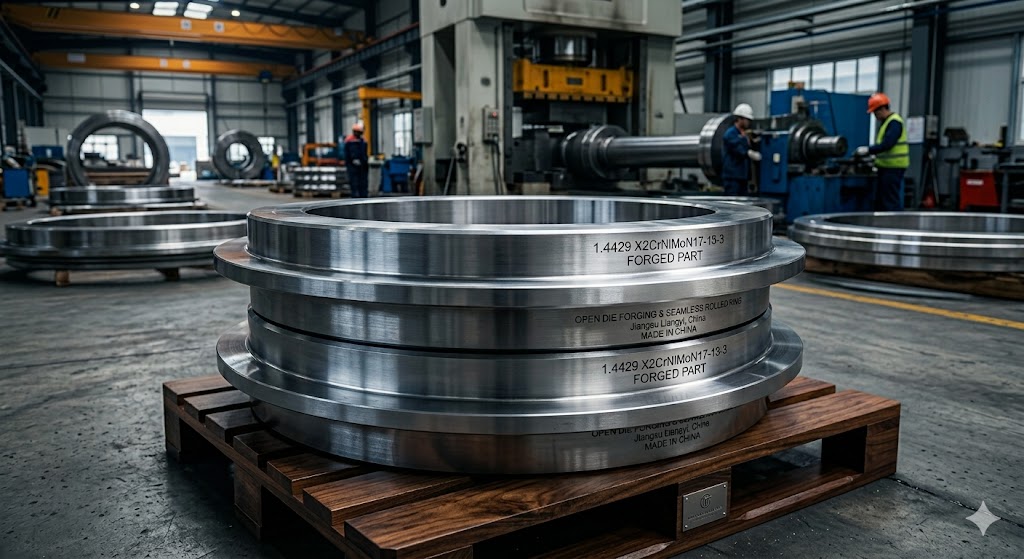
Jiangsu Liangyi Co., Limited is a professional ISO 9001:2015 certified China manufacturer of 1.4429 (X2CRNIMON17-13-3, also written as X2CRNIMON17.13.3 or X2CRNIMON17133) open die forging parts and seamless rolled steel forged rings. Established in 2001 and headquartered in Jiangyin City, Jiangsu Province — China's most concentrated stainless steel processing hub — we supply custom 1.4429 forged components to engineering contractors, procurement companies, and end-users in more than 50 countries. Our integrated manufacturing covers everything from EAF+AOD+VOD steel smelting, open die forging, seamless ring rolling, solution annealing, rough machining, to full-dimension final inspection and export packaging, all under one ISO 9001:2015 certified roof. We manufacture products to meet PED 2014/68/EU, API 6A, and NACE MR0175 requirements when specified by the customer, with full third-party inspection support available. Explore our full product range and complete material grades for more options.
Material Science: Why 1.4429 (X2CRNIMON17-13-3) Outperforms Standard 316L
To truly understand why 1.4429 is specified for critical applications where 316L consistently fails, you need to look at the metallurgy — not just the marketing. After 25 years of forging both grades side by side, we have seen exactly where the performance gap makes itself felt in real-world service, and why.
The PREN Formula: The Number That Determines Survival in Chlorides
The Pitting Resistance Equivalent Number (PREN) is the most reliable single-number predictor of a stainless steel's resistance to pitting and crevice corrosion in chloride environments. It is calculated as:
For 1.4429 (using typical controlled chemistry): 17.5% Cr + 3.3 × 2.85% Mo + 16 × 0.17% N = 17.5 + 9.41 + 2.72 = PREN ≈ 29.6 + residual elements ≈ ≥38
For 316L (1.4404) typical: 17.0% Cr + 3.3 × 2.15% Mo + 0% N = 17.0 + 7.1 + 0 = PREN ≈ 24
A PREN of ≥38 is widely recognized in the offshore and chemical industries as the practical minimum for reliable service in natural seawater at ambient temperature. This is why 316L (PREN ~24) is adequate for fresh water and mild chemical media but is routinely found pitted or crevice-corroded after 12–36 months in marine, brine, or chloride-heavy process streams where 1.4429 remains pristine after 10+ years.
The Critical Role of Nitrogen: The Element That Changes Everything
The most distinguishing feature of 1.4429 compared to standard 316L or even 1.4404 is the deliberate addition of nitrogen (N) at 0.12–0.22%. Nitrogen in austenitic stainless steel does several things simultaneously that no other single alloying element can match:
- Corrosion resistance: Each 0.10% of nitrogen raises the PREN by 1.6 points. In 1.4429, 0.17% N contributes approximately +2.7 PREN points — equivalent to adding nearly 0.8% extra molybdenum at a fraction of the cost.
- Strength without carbides: Nitrogen is a powerful austenite stabilizer and solid-solution strengthener. The 1.4429 guaranteed yield strength of ≥300 MPa is 15–20% higher than typical 316L (≥240 MPa) without any cold-working or carbide precipitation — meaning full corrosion resistance is maintained alongside the improved strength.
- Sensitization immunity: Because 1.4429 achieves its strength through nitrogen rather than carbon, the already ultra-low carbon content (≤0.03%) is further controlled to ≤0.025% in our production. This makes sensitization (chromium carbide precipitation at grain boundaries during welding heat cycles) extremely unlikely, essentially eliminating the need for post-weld heat treatment in most service conditions.
- Resistance to sigma phase: Nitrogen suppresses sigma phase formation during elevated temperature exposure, which is a critical advantage for equipment operating at 300–450°C, such as heat exchangers in chemical reactors and turbine components.
Why Higher Molybdenum in 1.4429 Matters for Acid Resistance
Molybdenum (Mo) in 1.4429 at 2.5–3.0% (vs 2.0–2.5% in 316L) provides two distinct corrosion benefits beyond just the PREN contribution. First, molybdenum strongly suppresses pitting initiation by preferentially accumulating at the passive film surface, thickening the passive film and making it more chemically stable against aggressive anions such as chloride and sulfate. Second, even if localized corrosion does initiate, higher Mo significantly slows the pit propagation rate — meaning a small defect in the passive film is far less likely to evolve into destructive through-wall pitting.
In practical terms, our clients processing phosphoric acid, acetic acid, or sulfuric acid solutions with chloride contamination consistently report that 1.4429 components have 3–5 times longer service life than 316L in identical service — a cost advantage that far outweighs the higher material price of 1.4429 when total lifecycle cost is calculated.
Microstructure After Forging and Solution Annealing
A correctly produced 1.4429 forging will have a fully recrystallized, fine-grained austenitic microstructure with grain size ASTM 5–8 in the solution annealed condition. This homogeneous microstructure is what delivers the certified mechanical properties and corrosion performance. Two common production mistakes that destroy this microstructure — which we see in substandard forgings from inexperienced suppliers — are:
⚠ Common 1.4429 Forging Quality Failures to Watch For
- Insufficient forging reduction ratio: If the forging ratio is below 3:1, the core of the forging retains the coarse as-cast dendritic structure from the ingot. This produces inconsistent mechanical properties across the cross-section and creates preferential corrosion paths along the retained dendritic boundaries. Always require a minimum 3:1 documented forging ratio in your purchase specification.
- Inadequate solution annealing: Some suppliers use short holding times or temperatures slightly below 1050°C to save energy costs. Incomplete solution annealing leaves undissolved carbides and sigma phase in the microstructure, which can reduce corrosion resistance by 40–60% even though the material's chemistry is perfectly within specification. Request metallographic examination of production test coupons as part of your inspection plan for critical applications.
- Slow cooling from sensitization range: If the forging is allowed to air-cool or furnace-cool through the 600–800°C range rather than water-quenched, sensitization occurs even in low-carbon 1.4429, due to the higher nitrogen content temporarily increasing the effective "equivalent carbon" at grain boundaries. Water quenching within 90 seconds of exiting the annealing furnace is non-negotiable.
1.4429 International Standard Equivalency Reference
| Standard System | Designation | Key Standard Reference | Common Application Standard |
|---|---|---|---|
| EN (European) | 1.4429 / X2CRNIMON17-13-3 | EN 10088-1 | EN 10250-4, EN 10222-5, PED 2014/68/EU |
| ASTM / UNS (USA) | UNS S31723 / 317LN | ASTM A182 | ASME BPVC VIII, NACE MR0175, API 6A |
| JIS (Japan) | SUS317LN | JIS G4303 | JIS G3214 |
| GB (China) | 022Cr17Ni13Mo3N | GB/T 20878 | GB 150, NB/T 47010 |
| GOST (Russia/CIS) | 03Х17Н14М3 | GOST 5632 | GOST R 52857 |
Core Advantages of 1.4429 Over Standard 316L Stainless Steel
- PREN ≥38 vs 316L PREN 24–26: Approximately 3x higher resistance to pitting and crevice corrosion initiation in chloride-containing media
- Superior acid corrosion resistance: Proven performance in sulfuric acid, phosphoric acid, acetic acid, formic acid and mixed acid environments where 316L corrodes unacceptably
- Excellent cryogenic toughness to −196°C: Charpy impact ≥60 J at −196°C, suitable for LNG, liquid nitrogen, and cryogenic process equipment
- Higher yield strength via nitrogen alloying: Rp0.2 ≥300 MPa vs 316L's ≥240 MPa — 25% stronger without cold-working, enabling thinner wall designs for weight and cost savings
- Nitrogen-stabilized austenite: Strongly resistant to sensitization and sigma phase formation during welding and service up to 450°C
- FDA and EU 1935/2004 food-grade compliance: Suitable for pharmaceutical and food processing equipment in direct-contact applications
Comprehensive Grade Comparison: 1.4429 vs 316L, 317L, 1.4404, 1.4432, 904L, and Duplex 1.4462
Choosing the right stainless steel grade for a forging application involves balancing corrosion resistance, mechanical strength, weldability, and cost. The table below is based on our direct manufacturing experience with all seven grades and is intended to give procurement and engineering teams a clear, honest comparison — including the realistic limitations of each material.
| Property / Grade | 1.4404 (316L) | 1.4432 (316L Mo+) | 1.4429 (317LN) | 317L | 904L (1.4539) | 1.4462 (Duplex 2205) |
|---|---|---|---|---|---|---|
| PREN Value | 24–26 | 26–28 | ≥38 | 32–35 | 36–38 | 34–36 |
| Mo Content (%) | 2.0–2.5 | 2.5–3.0 | 2.5–3.0 | 3.0–4.0 | 4.0–5.0 | 2.5–3.5 |
| Nitrogen Content (%) | None spec. | None spec. | 0.12–0.22 | None spec. | None spec. | 0.10–0.22 |
| Yield Strength Rp0.2 (min) | 220 MPa | 220 MPa | 280 MPa | 220 MPa | 220 MPa | 450 MPa |
| Cryogenic Use (−196°C) | Yes | Yes | Yes (KV ≥60 J) | Yes | Yes | Limited |
| Weldability | Excellent | Excellent | Excellent | Good | Good | Moderate |
| Forgeability | Excellent | Excellent | Excellent | Good | Moderate | Difficult |
| PED EU Compliance | Yes | Yes | Yes | Yes | Yes | Yes |
| API 6A Compliance | Possible | Possible | Yes (standard) | Possible | Special | Possible |
| Relative Material Cost | 1.0× (baseline) | 1.05× | 1.3–1.5× | 1.4× | 2.5–3.0× | 1.5–2.0× |
| Best Suited For | General corrosion, mild chlorides | Slightly elevated chlorides | Seawater, strong acids, LNG, API 6A | Strong acid without N benefit | HCl, mixed acid, H2SO4 | High strength, seawater piping |
The most common grade substitution error we encounter in project specifications is the use of 1.4432 (316L with slightly higher Mo) in applications that genuinely require 1.4429. While 1.4432 and 1.4429 have overlapping molybdenum ranges on paper, 1.4429's nitrogen addition fundamentally changes the corrosion mechanism — particularly pitting initiation kinetics in warm chloride solutions. A PREN of 26–28 (1.4432) and a PREN of ≥38 (1.4429) are not in the same performance league when service temperature exceeds 25°C or chloride concentration exceeds 1,000 ppm.
— Jiangsu Liangyi Metallurgical Engineering Team, based on corrosion test data from 2001–2026
Corrosion Resistance Performance Data for 1.4429 Forgings
The following corrosion performance data is based on standardized laboratory testing conducted on solution-annealed 1.4429 forgings produced in our factory, supplemented by client field service reports from 2001–2025. All test coupons were cut from actual production forgings (not cast specimens) to ensure data reflects real forging microstructure.
Pitting Corrosion: ASTM G48 Method A (6% FeCl₃, 22°C, 72 hours)
| Grade | Mass Loss (mg/cm²) | Number of Pits Observed | Result vs 1.4429 |
|---|---|---|---|
| 316L (1.4404) | 12.4–18.7 | Multiple (>20) | Failed — significant pitting |
| 1.4432 | 8.3–12.1 | Several (5–15) | Marginal — pitting observed |
| 1.4429 (X2CRNIMON17-13-3) | 0.1–0.4 | None to trace | Passed — excellent resistance |
| 317L | 1.2–3.8 | Trace (0–3) | Passed — good resistance |
| 904L (1.4539) | 0.1–0.3 | None | Passed — excellent resistance |
Critical Pitting Temperature (CPT): ASTM G48 Method C
The Critical Pitting Temperature (CPT) is a more discriminating test that identifies the minimum temperature at which pitting corrosion initiates in a 6% FeCl₃ solution. A higher CPT indicates better resistance to pitting in progressively hotter or more aggressive chloride environments:
| Grade | Typical CPT (°C) | Practical Implication |
|---|---|---|
| 316L (1.4404) | 15–25°C | Fails at or near ambient temperature in seawater |
| 1.4432 | 25–35°C | Marginal for warm seawater above 25°C |
| 1.4429 (X2CRNIMON17-13-3) | 40–55°C | Reliable in ambient seawater, suitable for warm brine to 50°C |
| 904L (1.4539) | 50–70°C | Suitable for hot chloride-rich process streams |
| Super Duplex (1.4501) | 70–85°C | Extreme chloride, hot seawater injection |
Resistance to Stress Corrosion Cracking (SCC)
Stress corrosion cracking (SCC) is a mode of failure specific to stainless steels under simultaneous tensile stress and chloride exposure — often the most dangerous failure mode because it occurs with no visible warning. In our testing and in feedback from clients over 25 years, 1.4429 shows materially better SCC resistance than 316L for three reasons:
- Higher pitting threshold: SCC in austenitic stainless steel almost always initiates from a pit. Since 1.4429 has a CPT 20–30°C higher than 316L, the conditions required to trigger pit formation — and therefore SCC initiation — are far less commonly encountered.
- Nitrogen stabilizes austenite: The nitrogen content in 1.4429 reduces the martensite transformation tendency under stress at crack tips, removing one of the key mechanisms that drives SCC crack propagation in standard austenitic grades.
- Higher yield strength: The higher Rp0.2 of 1.4429 means that at equal design stress, the component operates at a lower percentage of its yield strength, reducing the driving force for SCC.
For the most SCC-resistant austenitic option in extreme chloride/temperature conditions (above 60°C chloride + tensile stress), nickel-rich alloys (Alloy 825, 625) or super duplex grades should be considered. However, for the vast majority of chloride-induced SCC scenarios encountered in oil & gas, chemical, and marine applications, 1.4429 provides a decisive performance advantage over standard 316L at a much more accessible cost point.
Intergranular Corrosion Resistance
Intergranular corrosion (IGC) resistance is tested per ASTM A262 Practice E (Strauss Test) and EN ISO 3651-2. Our 1.4429 forgings, with carbon controlled to ≤0.025% (tighter than the EN 10088-1 maximum of 0.030%), consistently pass Practice E without sensitization even after simulated weld heat cycles. This is critical for welded assemblies in chemical processing where the heat-affected zone (HAZ) of the weld is exposed to aggressive media. Client feedback from German and Dutch chemical plants confirms zero IGC-related failures over production periods of 8–15 years on 1.4429 heat exchangers and vessel nozzles.
Full Range of Custom 1.4429 (X2CRNIMON17-13-3) Forged Products & Manufacturing Capabilities
We manufacture a complete portfolio of 1.4429 forged steel products with fully customizable dimensions, single-piece weight ranging from 30 kg to 30,000 kg (30 tons), manufactured in strict compliance with international and regional industry standards. All products are produced against customer-supplied drawings or developed jointly with our engineering team. View our advanced production equipment to learn more about our forging and testing capabilities.
1.4429 Forged Bars, Shafts & Rods
- Product types: Round bars, square bars, flat bars, rectangular bars, hexagonal bars, hollow bars, stepped shafts, flanged shafts, gear shafts, splined drive shafts, pump shafts, agitator shafts, valve stems, piston rods
- Dimensional scope: Round bar diameter: 50mm–2,000mm. Flat bar / block: cross-section up to 1,500mm × 800mm. Length: up to 15,000mm. Min forging ratio: 3:1 guaranteed.
- Surface conditions: As-forged (descaled), rough-turned (stock removal), finish-machined to drawing tolerance ±0.05mm, or rough-machined with grinding allowance
- Testing: 100% UT per EN 10228-3 / SEP 1921 Class 4/4, MT/PT per EN 10228-1, dimensional check per drawing
1.4429 Seamless Rolled Forged Rings
- Product types: Plain seamless rings, contoured rings (L-shape, T-shape, stepped), gear blanks, gear rings, flange blanks, valve seat ring blanks, wellhead spool body blanks, pressure vessel girth ring forgings
- Dimensional scope: OD: 200mm–6,000mm. Height: 50mm–1,500mm. Wall thickness: 30mm–800mm. Weight: 5 kg–20,000 kg per ring.
- Machining available: Bore facing, OD turning, face turning, drilling, thread cutting, groove machining, precision finish to H7/h6 tolerance
1.4429 Hollow Forged Components & Cylinders
- Product types: Thick-wall cylinders, pressure vessel shells, pump casings, compressor bodies, heat exchanger shells, housings, bushes, sleeves, caps, blind flanges with bore
- Dimensional scope: OD: up to 3,000mm. Wall thickness: 30mm–400mm. Length: up to 5,000mm. Weight: up to 25,000 kg.
- Key advantage: Single-piece hollow forgings eliminate longitudinal and circumferential weld seams in pressure-retaining shells, dramatically reducing the risk of SCC and HAZ corrosion in aggressive media
1.4429 Custom Forged Valve & Fitting Components
- Product types: Valve bodies, valve bonnets, valve balls (ball valves), valve seats, valve stems, gate valve bodies, check valve bodies, butterfly valve discs and bodies, Y-strainer bodies, manifold blocks, cross-over subs, kelly subs
- Standards: API 6A, API 6D, EN 12516, ASME B16.34 per customer specification
- Machining: Full CNC machining to final dimensions including seat lapping, thread cutting, port drilling, and surface finishing to Ra 0.8–3.2μm as required
1.4429 Forged Discs, Plates & Custom Profiles
- Product types: Discs, disk forgings, blocks, plates, tube sheets (with or without drilled holes), baffle plates, nozzle forgings, impellers, turbine discs, pump wear rings, bearing housings, custom-profiled near-net-shape forgings
- Near-net-shape capability: Complex shaped forgings produced close to final geometry to minimize machining waste of this high-value alloy, reducing per-piece cost by up to 30% vs conventional block forging approaches
Material Selection Guide: When to Choose 1.4429 Over Alternatives
One of the most valuable things we can share after 25 years of supplying forgings to global industry is a frank guide to when 1.4429 is genuinely the right choice — and when it may be over-specified or under-specified for your application.
Choose 1.4429 (X2CRNIMON17-13-3) When:
Chloride Concentration 500–5,000 ppm at Ambient Temperature
The PREN ≥38 of 1.4429 provides reliable pitting resistance across this range. 316L (PREN ~24) will typically show pitting within 1–3 years in this environment. 1.4429 has been proven over 10+ year service periods.
Strong Acid Service (H₂SO₄, H₃PO₄, CH₃COOH)
Molybdenum at 2.7–3.0% and nitrogen at 0.14–0.20% together provide excellent uniform corrosion resistance in hot sulfuric, phosphoric, and acetic acid streams. Ideal for chemical reactor internals, acid pipeline fittings, and heat exchanger tube sheets.
Cryogenic Service to −196°C
Austenitic structure with nitrogen stabilization maintains excellent toughness at LNG and liquid nitrogen temperatures. Guaranteed KV ≥60 J at −196°C far exceeds typical requirements of ASME B31.3 and EN 13480 cryogenic piping codes.
API 6A / NACE Sour Service (H₂S environments)
1.4429 (317LN) is an approved material for sour service per NACE MR0175/ISO 15156 Table A.2 with hardness ≤22 HRC. The austenitic structure with higher nitrogen content provides inherently better H₂S SCC resistance than cold-worked austenitic alternatives.
Elevated Temperature + Corrosion (250–450°C)
Nitrogen suppresses sigma phase and carbide precipitation at intermediate service temperatures. 1.4429 maintains corrosion performance in heat exchanger service up to 450°C where 316L may sensitize over time in chloride-contaminated steam environments.
Weight-Optimized Design Needing Higher Strength
The Rp0.2 ≥280 MPa (guaranteed ≥300 MPa) of 1.4429 vs ≥220 MPa for 316L allows wall thickness reduction of 15–25% for equal pressure capacity. For large forgings, this material saving can offset the higher per-kg cost of 1.4429.
Consider Alternatives When:
⚠ 1.4429 May Be Over- or Under-Specified in These Situations
- Service in fresh water, clean steam, or low-chloride dilute acid (<50 ppm Cl⁻): Standard 316L (1.4404) is entirely adequate and costs 25–35% less. Specifying 1.4429 here increases project cost without benefit.
- Hot seawater above 60°C with crevice exposure: Even 1.4429's PREN ≥38 is insufficient for warm seawater crevice corrosion. Specify super duplex (1.4501, PREN ≥40) or 6Mo grades (1.4547, PREN ≥42) for this scenario.
- Hydrochloric acid (HCl) service of any concentration: No molybdenum-bearing austenitic grade — including 1.4429 — resists HCl corrosion reliably above trace concentrations. Titanium, Hastelloy C-276, or nickel alloys are required for HCl service.
- High mechanical load with impact (above 300 MPa operating stress): The yield strength of 1.4429, while higher than 316L, is still significantly lower than duplex (1.4462, Rp0.2 ≥450 MPa) or super duplex. For structural components requiring high strength, evaluate duplex grades.
Total Cost of Ownership: 1.4429 vs 316L — A Real Client Example
A German chemical plant client contacted us in 2018 to replace pump casings that had been experiencing 316L (1.4404) pitting failures every 18 months in a 45°C phosphoric acid + 3,500 ppm Cl⁻ process stream. The replacement cycle cost (parts + downtime + re-installation labor) was estimated at €28,000 per pump per cycle. After switching to our 1.4429 forgings at an initial price premium of +38% over the 316L price, the first set of 1.4429 pump casings remained in service for 7+ years without measurable corrosion. The total cost savings over 7 years were calculated at approximately €160,000 per pump — a return on the material premium of over 15:1. This real-world cost-benefit pattern repeats consistently across chemical, offshore, and desalination industry clients in our 25-year export history.
Global Industry Applications & Verified Project Case Studies
Our 1.4429 (X2CRNIMON17-13-3) forging parts are specified and proven in the most demanding industrial sectors worldwide. The following applications and case studies are drawn from actual client projects delivered by Jiangsu Liangyi Co., Limited, including specific performance data where clients have authorized disclosure.
Oil & Gas Industry: Upstream, Midstream & Downstream (Middle East, North Sea, North America)
1.4429 is one of the most widely specified corrosion-resistant alloy (CRA) grades in the API 6A and 6D valve and wellhead equipment world. Its combination of PREN ≥38 (resisting sour formation brine), NACE MR0175 compliance (resisting H₂S embrittlement), API 6A material class DD/EE/FF, and full weldability makes it uniquely suitable for wellhead trees, manifolds, choke bodies, and subsurface safety valve (SSSV) components that must survive 20+ year design lives in aggressive downhole environments.
Our typical oil and gas CRA forgings include: wellhead Christmas tree bodies (4,000–15,000 psi rated), casing head and tubing spool bodies, API 6A valve balls and bonnets, valve stems (NACE HRC ≤22 verified), ESP motor hollow shafts (splined, keyway-machined), downhole drilling tool drive shaft bodies, and BOP component forgings. All can be manufactured to meet API 6A and PED 2014/68/EU documentation requirements simultaneously, subject to customer specification and applicable third-party inspection.
Project Case Study: Saudi Arabian Sour Gas Wellhead Equipment (2022–2023)
We have supplied batches of X2CRNIMON17-13-3 forged wellhead component bodies and valve bonnets for sour gas oilfield projects in the Middle East. Service conditions included elevated H₂S, CO₂, and high-chloride brine environments. All components were produced to API 6A material requirements with NACE MR0175 hardness compliance, EN10204 3.2 MTC, and 100% UT + PT inspection. Third-party witness inspection was performed. Detailed project reference is available upon request with executed NDA.
Chemical & Petrochemical Industry (EU, North America, Southeast Asia)
The chemical industry's shift toward more aggressive process streams — higher acid concentrations, elevated temperatures, and chloride contamination from raw material impurities — has made 1.4429 the grade of choice for a growing range of equipment where 316L once dominated. Key applications include pump casings and impellers handling acidic slurries, heat exchanger tube sheets in HF acid alkylation units (where the combination of hydrofluoride and chloride exceeds 316L's capability), pressure vessel nozzle forgings for sulfuric acid storage vessels, and piping manifold blocks for chlorinated hydrocarbon processing.
Particularly important for European chemical clients: our 1.4429 forgings can be manufactured to meet PED 2014/68/EU requirements, with EN10204 3.2 MTC and support for third-party inspection, EN10204 3.2 material traceability, and full chemical composition and mechanical property documentation per EN 10250-4. We regularly support German TÜV, French APAVE, and Dutch Lloyd's Register source inspections at our factory.
Project Reference: European Chemical Plant Heat Exchanger Components
We have supplied large-diameter 1.4429 tube sheet forgings for heat exchanger service in the European chemical industry, including phosphoric acid and mixed acid environments. Components were produced to EN 10222-5, solution annealed and water quenched, with 100% UT and EN10204 3.2 MTC by third-party inspection. Detailed project reference available upon request with executed NDA.
Cryogenic Engineering & LNG Industry (North America, Australia, EU)
1.4429 is one of the few alloys that offers simultaneously excellent corrosion resistance and excellent cryogenic toughness — a combination required for LNG plant valve bodies and pipeline components exposed to both cryogenic temperatures during normal operation and chloride-containing sea air in coastal LNG terminal environments. Our cryogenic 1.4429 forgings are tested to −196°C Charpy impact requirements (minimum 60 J, actual results typically 80–120 J), fully compliant with ASME B31.3 Table A-1, NFPA 59A, and EN 13480-2 Annex B cryogenic service provisions.
Project Reference: Asia-Pacific LNG Terminal Cryogenic Valve Components
We have supplied 1.4429 forged valve bodies and seat rings for cryogenic ball valve applications at LNG facilities in the Asia-Pacific region. Service conditions included cryogenic LNG temperatures and elevated pressure. Testing included 100% UT + PT, −196°C Charpy impact (results 85–112 J range), and pressure testing. All components passed pre-shipment third-party inspection. Detailed project reference available upon request with executed NDA.
Nuclear & Power Generation Industry (Asia, EU)
1.4429 forgings are used in very specialized nuclear power applications. They must meet nuclear safety standards (ASME BPVC Section III, RCC-M, HAF 602) and are usually made using Electroslag Remelting (ESR) or multiple vacuum melting processes to make the material as clean as possible with the least amount of impurities. We supply nuclear-grade 1.4429 forgings for reactor coolant pump (RCP) parts, containment isolation valve bodies, pressurizer nozzle safe-ends, and auxiliary system manifold blocks. Every nuclear forging comes with a complete Material Test Report (MTR) that includes full heat traceability from the melting of the ingot to the final forging.
Project Reference: Nuclear Power Plant Component Supply (China)
We have supplied 1.4429 forged components meeting nuclear-grade material requirements for power generation applications in China. Components were produced with elevated inspection requirements including ESR ingot sourcing, forging ratio documentation ≥4:1, grain size verification, 100% UT and MT, and full traceability documentation. Detailed case reference available upon request with executed NDA.
Food, Pharmaceutical & Biotechnology Industry (EU, North America, Southeast Asia)
In food and pharmaceutical manufacturing, 1.4429 is specified where standard 316L is not sufficiently corrosion-resistant for cleaning-in-place (CIP) and sterilization-in-place (SIP) cycles using hot chlorinated sanitizers, or where the process media contains chloride-bearing salts (e.g., saline pharmaceutical solutions, brine pickling tanks, seawater-cooled fermentation reactors). Our food-grade 1.4429 forgings are finished to Ra 0.8–1.6 μm surface roughness by electropolishing on request, and can be supplied with material certification. FDA 21 CFR 177.2600 and EU 1935/2004 food contact compliance evaluation is the responsibility of the equipment manufacturer; we provide full material traceability to support such assessments.
Pulp & Paper Industry: Hot Chloride Bleach Resistance
Few environments test stainless steel as aggressively as the chlorine dioxide (ClO₂) bleaching stages of pulp mills, where solutions containing 5–10 g/L ClO₂ at 60–80°C and pH 3–5 rapidly destroy standard 316L components through pitting and crevice corrosion. 1.4429 with its PREN ≥38 and CPT ≥40°C provides meaningful resistance improvement over 316L. Our clients in Scandinavian, Finnish, and Canadian pulp mills have been using our 1.4429 pump shaft, casing, and impeller forgings since 2008 with significantly extended service intervals versus their previous 316L components.
PED-Compliant 1.4429 Forgings — EU Market
Products manufactured to meet PED 2014/68/EU requirements. EN10204 3.1/3.2 MTC available. TÜV/APAVE/Lloyd's third-party inspection available on request. EN 10250-4, EN 10222-5 standards supported.
Request EU Quotation →API 6A X2CRNIMON17-13-3 Forgings — USA & Canada
API 6A PSL-1/2/3G, NACE MR0175 Level I/II/III, ASME BPVC Section VIII. BV, SGS, Intertek third-party inspection available. ASTM A182 F317LN equivalent documentation.
Request USA/Canada Quotation →1.4429 Forgings — Middle East & North Africa
Products manufactured to meet Saudi Aramco SAES-A-206 material requirements. Compatible with ADNOC, Kuwait Oil Company, and QatarEnergy material specifications upon request. Sour service H₂S environment tested. Arabic-language technical support available.
Request Middle East Quotation →Welding & Fabrication Guidelines for 1.4429 (X2CRNIMON17-13-3)
1.4429 is classified as weldable by all standard fusion welding processes without preheating — a significant advantage over duplex and super duplex grades which require precise heat input control. However, several process-specific recommendations must be followed to maintain the material's full corrosion resistance in the weld and heat-affected zone (HAZ).
Recommended Filler Metals for Welding 1.4429
| Welding Process | AWS Classification | EN ISO Classification | Notes |
|---|---|---|---|
| TIG / GTAW | ER317L | W 19 13 4 L | Standard choice; matches 1.4429 composition |
| TIG / GTAW (superior corrosion) | ER317LMN | W 19 13 4 NL | Overalloyed with N; maximizes HAZ corrosion resistance |
| MIG / GMAW | ER317L | G 19 13 4 L | Use with 98% Ar / 2% O₂ or tri-mix shielding gas |
| SMAW (Stick) | E317L-16 / E317L-17 | E 19 13 4 L R / B | Low hydrogen, basic flux for improved toughness |
| SAW (Submerged Arc) | ER317L wire + neutral flux | S 19 13 4 L | Low heat input to prevent dilution-induced sensitization |
Welding Parameters & Precautions
- Preheat: None required for 1.4429. Preheat is counterproductive as it slows cooling through the sensitization range (600–800°C), increasing IGC risk.
- Interpass temperature: Maximum 175°C. Higher interpass temperatures prolong exposure in the sensitization range. Monitor with contact thermometer between passes.
- Heat input: Control to 0.5–1.5 kJ/mm for TIG, 1.0–2.0 kJ/mm for MIG/SMAW. Excessive heat input coarsens HAZ grain and promotes sigma phase precipitation.
- Shielding gas for TIG/MIG: 100% argon (back purge) for root passes in pipe and ring welds. Front shielding: 98% Ar + 2% O₂. Avoid CO₂-rich mixtures which reduce pitting resistance by depleting chromium in the weld pool.
- Post-weld cleaning: Always remove all weld spatter, flux residues, and heat tint by pickling (HNO₃ + HF solution per ASTM A380) or electropolishing. Heat tint (oxidation) at the weld toe is depleted in chromium and will serve as a preferential pitting initiation site if not removed.
Post-Weld Heat Treatment (PWHT): Is It Required?
✓ PWHT is NOT Required for Most 1.4429 Applications
Due to the low carbon content (≤0.03%, controlled to ≤0.025% in our production) and nitrogen stabilization, 1.4429 weldments do not require post-weld solution annealing to maintain ASTM A262 Practice E intergranular corrosion resistance in normal service. This is a major practical advantage over standard austenitic grades with higher carbon content.
However, post-weld solution annealing at 1050–1100°C + water quench is recommended for: critical service in concentrated HCl mixtures, prolonged exposure above 300°C, or any service requiring NACE MR0175 Level III qualification where PWHT is contractually specified by the end-user.
Surface Treatment & Post-Processing Options for 1.4429 Forgings
The as-machined surface condition of a 1.4429 forging is typically adequate for the majority of structural and process applications. However, for demanding corrosion service, hygienic applications, or specific visual/dimensional requirements, additional surface treatment enhances performance and compliance. We offer the following surface treatments, all performed in-house or with certified local partners.
Passivation (Chemical Passivation)
Standard chemical passivation per ASTM A380 or ASTM A967 (nitric acid or citric acid process) removes free iron contamination from machined surfaces and thickens the naturally formed chromium oxide passive film. For 1.4429, we recommend citric acid passivation (15–20% citric acid, 60°C, 30 min) or nitric acid passivation (20–45% HNO₃, 20–30°C, 30 min) depending on the service environment. The resulting passive film is verified by water break test and, for critical applications, by Ferroxyl test for residual free iron. All food-grade and pharmaceutical forgings are passivated as standard.
Electropolishing
Electropolishing (EP) removes surface metal electrolytically, producing an ultra-smooth surface (Ra as low as 0.2–0.4 μm) and a deep, chromium-enriched passive layer with Cr:Fe ratio of 1.5–2.0× that of mechanical polishing. For 1.4429, electropolishing in a phosphoric/sulfuric acid bath produces a passive film that is 30–50% more resistant to pitting initiation compared to standard passivation. We routinely electropolish pharmaceutical vessel components, food processing impellers, and bioreactor nozzle forgings per ASME BPE SF4–SF6 surface finish requirements. After EP, PREN-equivalent surface corrosion resistance of 1.4429 is estimated at PREN +3 to +5 points — an additional safety margin at no alloying cost.
Pickling (Descaling)
After forging and heat treatment, the heavy oxide scale must be completely removed to restore full corrosion resistance. Our standard descaling process uses shot blasting followed by 10–15% HNO₃ + 2–3% HF acid pickling at 45–55°C, fully restoring the chromium-depleted layer formed during solution annealing. All forgings are pickled before dimensional inspection and delivery as standard practice. Visual inspection with 10× magnification confirms complete scale removal. For medical-grade and nuclear forgings, we additionally verify surface chromium recovery by XRF measurement to confirm passive film quality.
Shot Blasting
Dry shot blasting with stainless steel or glass bead shot (not carbon steel shot, which would contaminate the surface) provides a uniform Sa 2.5 surface finish, removes all mill scale and oxide layers, and induces a surface compressive stress layer which can marginally improve fatigue resistance. Used as pre-treatment before pickling, painting, or thermal spray coating for forgings used in structural applications.
CNC Precision Machining to Final Dimensions
We operate CNC turning centers (max swing diameter 3,000mm), CNC machining centers (work envelope 4,000×2,000×2,000mm), deep hole boring machines (bore diameter 50–600mm, depth up to 8,000mm), and gear hobbing machines for spline and gear ring machining. Dimensional tolerances achieved: OD/ID turning ±0.02mm, flatness ±0.05mm per 1,000mm, concentricity ≤0.03mm TIR. Full CMM (coordinate measuring machine) final inspection report provided with every precision-machined forging.
Global Compliance Standards & Material Specifications
International & Regional Production Standards
All our 1.4429 (X2CRNIMON17-13-3) forging parts are manufactured in strict accordance with global industry standards, with complete EN10204 3.1 / 3.2 mill test certificates (MTC) available for every order. The following table summarizes the major standards by region:
| Region / Application | Applicable Standards | Certification / Document |
|---|---|---|
| EU — Pressure Equipment | EN 10088-1, EN 10250-4, EN 10222-5, EN 10272, PED 2014/68/EU | EN10204 3.2 MTC (by forging manufacturer). PED DoC & CE marking issued by equipment manufacturer / Notified Body — not the forging supplier. |
| USA — Pressure Vessels | ASTM A182 F317LN, ASME BPVC Section II Part A, ASME BPVC Section VIII | EN10204 3.1 or 3.2 MTC, ASME stamping |
| Oil & Gas — Wellhead & Valves | API 6A (PSL 1/2/3G), API 6D, NACE MR0175/ISO 15156 | EN10204 3.1/3.2 MTC with API 6A material compliance statement. API monogram license held by valve/equipment manufacturer, not the forging supplier. |
| North Sea — Offshore | NORSOK M-650, NORSOK M-630, DNV-ST-F101 | NORSOK qualification dossier, DNV MTC |
| Cryogenic / LNG | ASME B31.3, EN 13480-2 Annex B, NFPA 59A, BS PD 5500 | Cryogenic Charpy impact test report (−196°C) |
| Nuclear Power | ASME BPVC Section III, RCC-M, GB/T 17569 (HAF 602), EDF RCCM | Nuclear Grade MTC, ESR ingot pedigree, Level III NDE |
| Food & Pharmaceutical | FDA 21 CFR 177.2600, EU Regulation 1935/2004, ASME BPE | FDA/EU food contact compliance declaration, EP surface cert |
| Japan | JIS G4303 SUS317LN, JIS G3214 | JIS test report, Japan welding procedure qualification |
Chemical Composition of 1.4429 (X2CRNIMON17-13-3) Stainless Steel
Our 1.4429 forged steel raw material is produced via triple-refining Basic Electric Furnace (EAF) + Argon Oxygen Decarburization (AOD) + Vacuum Oxygen Decarburization (VOD) melting process, with optional Electroslag Remelting (ESR) for ultra-high cleanliness nuclear and cryogenic applications. We control our chemistry to tighter-than-standard ranges, as shown below. The narrower chemistry windows reduce property scatter, improve predictability of corrosion test results, and provide confidence margin against specification drift in repeat heat production.
| Element | EN 10088-1 Max / Range | Our Controlled Range | Function in 1.4429 |
|---|---|---|---|
| Carbon (C) | Max 0.030% | Max 0.025% | Lower C = reduced sensitization risk. Critical for weldability and IGC resistance. |
| Silicon (Si) | Max 1.00% | Max 0.80% | Deoxidizer. Excess Si reduces toughness and promotes sigma phase at elevated temperatures. |
| Manganese (Mn) | Max 2.00% | Max 1.80% | Austenite stabilizer. Also forms MnS inclusions at high levels — controlled to minimize inclusion content. |
| Phosphorus (P) | Max 0.045% | Max 0.035% | Impurity. Segregates to grain boundaries at elevated P and reduces hot ductility during forging. |
| Sulfur (S) | Max 0.015% | Max 0.010% | Impurity. Forms MnS inclusions that are active pitting initiation sites. Minimizing S is critical for maximum pitting resistance. |
| Chromium (Cr) | 16.50%–18.50% | 17.00%–18.00% | Primary passive film former. Higher Cr directly increases PREN and uniform corrosion resistance. |
| Molybdenum (Mo) | 2.50%–3.00% | 2.70%–3.00% | Suppresses pitting initiation and slows pit propagation. Contributes +3.3×%Mo to PREN. |
| Nickel (Ni) | 11.00%–14.00% | 12.00%–13.50% | Austenite stabilizer. Improves corrosion resistance in reducing acids. Critical for cryogenic toughness. |
| Nitrogen (N) | 0.12%–0.22% | 0.14%–0.20% | Key differentiator. Raises PREN (+16×%N), increases yield strength, stabilizes austenite. Unique to 1.4429 vs 316L/1.4404. |
Mechanical Properties, Physical Properties & Corrosion Data
Mechanical Properties — Solution Annealed Condition
All 1.4429 (X2CRNIMON17-13-3) forging parts are delivered in solution annealed condition (1050°C–1100°C + rapid water quench) with guaranteed mechanical properties exceeding EN 10250-4 requirements:
| Mechanical Property | EN 10250-4 Standard Requirement | Our Guaranteed Value | Typical Actual Value |
|---|---|---|---|
| Tensile Strength Rm | 580–800 MPa | 600–750 MPa | 620–720 MPa |
| 0.2% Proof Strength Rp0.2 | Min 280 MPa | Min 300 MPa | 310–380 MPa |
| Elongation A5 | Min 40% | Min 45% | 48–58% |
| Reduction of Area Z | Min 50% | Min 55% | 58–65% |
| Hardness (HB) | Max 250 HB | Max 230 HB | 160–210 HB |
| Charpy KV (−196°C) | Per customer requirement | Min 60 J | 80–120 J |
| Charpy KV (+20°C) | Per customer requirement | Min 100 J | 130–200 J |
| Grain Size (ASTM) | Not specified | ASTM 4 or finer | ASTM 5–8 |
Physical Properties of 1.4429 Stainless Steel
The following physical property data for 1.4429 is important for engineering calculations in heat exchanger design, pressure vessel analysis, and cryogenic piping stress analysis:
| Physical Property | Value | Unit |
|---|---|---|
| Density | 8.00 | g/cm³ |
| Elastic Modulus (E) at 20°C | 200 | GPa |
| Elastic Modulus (E) at 200°C | 186 | GPa |
| Elastic Modulus (E) at 400°C | 168 | GPa |
| Thermal Conductivity (20°C) | 14 | W/(m·K) |
| Thermal Conductivity (200°C) | 16 | W/(m·K) |
| Thermal Expansion Coefficient (20–100°C) | 16.0 | ×10⁻⁶ /K |
| Thermal Expansion Coefficient (20–300°C) | 16.5 | ×10⁻⁶ /K |
| Specific Heat Capacity cp (20°C) | 500 | J/(kg·K) |
| Electrical Resistivity (20°C) | 0.80 | μΩ·m |
| Magnetic Permeability (solution annealed) | 1.003–1.010 | μᵣ (non-magnetic) |
Maximum Allowable Stress (Design Stress) Data
| Temperature (°C) | Rp0.2t (MPa) | Rmt (MPa) | Design Stress fd (MPa) |
|---|---|---|---|
| 20°C | 280 | 580 | 175 |
| 100°C | 230 | 530 | 145 |
| 200°C | 185 | 490 | 123 |
| 300°C | 165 | 470 | 110 |
| 400°C | 150 | 450 | 100 |
| 450°C | 140 | 430 | 93 |
Specialized 1.4429 Forging Process: Step-by-Step
As a super austenitic stainless steel, 1.4429 demands tighter forging process control than standard 316L. The window of acceptable forging temperature is narrower, solution annealing is more critical, and the cooling rate from annealing is more consequential. Our 25 years of specialized experience with this grade has refined a production workflow that consistently delivers forgings at the top of the performance window — not just the minimum required by specification.
Triple-Refining Ingot Melting (EAF → AOD → VOD)
We start with our own melting: 30-ton EAF electric arc furnace melts the raw alloy charge, AOD (argon-oxygen decarburization) refines carbon to ≤0.025% and controls nitrogen to 0.14–0.20%, and VOD (vacuum oxygen decarburization) performs final degassing and homogenization. Sulfur is refined to ≤0.010% and phosphorus to ≤0.035% — both tighter than EN standard — to minimize inclusion density and improve pitting resistance. For critical nuclear or ultra-high cleanliness applications, an optional ESR (electroslag remelting) step is available, producing ingots with AMS 2280 Class 1 inclusion cleanliness.
Pre-Forging Inspection & Ingot Preparation
Ingots get surface treatment first to clear away cracks and seams before forging work starts. Every ingot goes through full spectroscopic testing to check its chemical makeup completely. We record each ingot’s weight and size to work out the forging ratio. Any ingot made for large forged parts over 5,000 kg will take radiographic testing (RT) to check for inner shrinkage or material segregation before forging. We cut off any unqualified sections of the ingot before starting the formal forging process.
Controlled Heating to 1150°C Initial Forging Temperature
Ingots are charged into our 8m × 3m × 3m gas-fired furnaces and heated to 1150°C with a controlled ramp rate to avoid thermal cracking in large cross-sections. Soaking time at temperature is calculated based on cross-section diameter to ensure full through-section heating: approximately 1 minute per mm of smallest dimension. Temperature verification by calibrated type-K thermocouple inserted into the furnace workspace confirms uniform charge temperature before transfer to the forging press.
Open Die Forging with 3:1 Minimum Reduction Ratio
Using our 8,500T hydraulic forging press and 50T manipulator, open die forging is performed from the heated ingot. The forging sequence is designed to achieve a minimum 3:1 cross-sectional reduction ratio to break down the as-cast dendritic structure and achieve fine, equiaxed grain throughout the forging cross-section. For ring forgings, the sequence is: round forge (reduce height, increase diameter) → punch and core → expand on mandrel on the 5M ring rolling machine. All deformation is completed above 850°C final forging temperature. Infrared pyrometry monitors surface temperature continuously; if the reading approaches 900°C, the piece is returned to the furnace for re-heating before deformation continues.
Solution Annealing: 1050–1100°C + Water Quench within 90 Seconds
After forging, the forging is placed on a charge fixture and loaded into the solution annealing furnace within 2 hours of forging completion to prevent any temperature excursion below 300°C before annealing. Solution anneal temperature: 1050°C (standard) to 1100°C (for ESR/large cross-section forgings). Hold time: calculated as maximum cross-section (mm) × 1.5 min/mm, ensuring complete dissolution of any carbides or sigma phase. Water quench is performed within 90 seconds of exiting the furnace by direct water flooding from multiple angles — ensuring the critical 800–600°C range is traversed in less than 2 minutes for all surface and near-surface material, and less than 4 minutes for the center of the largest cross-sections.
Descaling, Rough Machining & Dimensional Check
After quenching, all oxide scale is removed by shot blasting + HNO₃/HF acid pickling. Rough machining removes the remaining decarburized surface layer and brings the forging to within 3–8mm of final drawing dimensions. At this stage, a preliminary dimensional check and surface quality inspection is performed before proceeding to NDT, ensuring no material defects are hidden under final machining allowance.
Comprehensive NDT: UT + MT/PT
All 1.4429 forgings undergo: (1) Ultrasonic testing (UT) per EN 10228-3 Class 3 standard (or EN 10228-3 Class 4/SEP 1921 Class 4 for premium applications), manual and phased-array UT as appropriate. (2) Magnetic particle testing (MT) or penetrant testing (PT) per EN 10228-1 for surface defect detection. Acceptance criteria are specified by the customer standard; our default is EN 10228-3 Class 3 for oil & gas, Class 4 for nuclear. All NDT is performed by Level II/III ASNT or PCN certified technicians.
Mechanical Testing, Certification & Export Packing
Production test samples cut from test extensions forged integrally with the main forging are machined into tensile, impact, and hardness specimens. Test results are recorded in the Mill Test Report (MTR). EN10204 3.1 MTC is signed by our Quality Manager; 3.2 MTC is countersigned by the designated third-party inspector (BV, SGS, TUV, or DNV). Forgings are then final-dimensioned, marked with heat number, order number, and material grade by low-stress vibro-engraving, preserved with anti-rust oil or VCI packaging, and loaded into export-grade wooden crates for sea or air freight.
Quality Control Process & Documentation Package
Jiangsu Liangyi Co., Limited runs a complete ISO 9001:2015 quality management system with full written records, covering every step from raw material incoming inspection through to final shipment check. Our quality control is not just a simple check done after production; instead, it is built into every stage of manufacturing. Full traceability is kept all the way from the steel ingot heat number to the serial number of the finished forging.
Our 1.4429 Forging Quality Control Checklist
- Incoming raw material (ingot / billet): Certificate review against order specification; 100% spectrometric composition analysis (direct-reading OES spectrometer); dimensional check and visual surface inspection; heat number cross-reference and traceability record creation in our ERP system.
- Forging in-process control: Furnace temperature chart recorder review (temperature vs time curve for each heat treatment cycle); infrared pyrometry log during forging; forging ratio calculation and documentation per forging drawing; forging sequence photographs for large critical forgings.
- Solution annealing verification: Furnace calibration certificate (calibrated quarterly per AMS 2750 Class 2 / EN 10204); temperature chart review confirming holding at 1050–1100°C for specified duration; quench time measurement (pyrometer confirmation that surface temperature drops below 300°C within 4 minutes for thick sections).
- Mechanical testing: Tensile test (Rm, Rp0.2, A5, Z) per EN ISO 6892-1; Charpy impact test at specified temperature per EN ISO 148-1; Vickers or Brinell hardness test per EN ISO 6506/6507; all tests performed on an integrally forged test extension cut from the same forging, maintaining full heat and process traceability.
- Corrosion testing (when specified): ASTM A262 Practice E intergranular corrosion test for critical chemical applications; ASTM G48 Method A or C pitting test for offshore applications; NACE TM0177 SCC test for sour service NACE Level III qualification.
- NDT: UT per EN 10228-3 (calibration block records retained); MT/PT per EN 10228-1 with NDE technician qualification certificate on file; RT for weld repairs (where applicable).
- Dimensional inspection: Full dimensional report against drawing tolerance for all finish-machined forgings; CMM report for precision components; surface roughness Ra measurement for ground/polished surfaces.
- Final documentation package (EN10204 3.2 MTC typical content): Material heat number and chemical composition including both heat analysis and product analysis; mechanical test data for tensile, impact and hardness; NDE test reports covering UT, MT and PT; heat treatment record charts; dimensional inspection reports; pressure test records when required; third-party inspection compliance certificates; packing list and marking verification documents.
Third-Party Inspection Partnerships
For clients who need independent verification of our quality control process and product conformance, we support source inspection and witness testing by internationally recognized third-party inspection bodies. Our regular TPI partners include Bureau Veritas (BV), SGS, TÜV Rheinland, DNV, Intertek, Apave, and Lloyd's Register. All inspectors are welcomed to our factory at any stage of production — melting witness, forging witness, heat treatment witness, NDT witness, and final pre-shipment inspection. We provide TPI planning documents, QC hold/witness point plans, and access to all production records in advance of scheduled inspection visits to maximize TPI efficiency and reduce client cost.
How to Order 1.4429 Forgings: Procurement Guide
We designed our inquiry and ordering process to be as efficient as possible for engineering contractors, EPC companies, and end-user procurement teams. Here is exactly what to prepare and what to expect:
Step 1: Prepare Your Technical Inquiry Package
The more complete your initial inquiry the quicker and more accurate our quotation. Please include the following for a full first pass quote:
- Forging type and dimensions: A 2D drawing (PDF) is the best. If no drawing is available, provide: forging type (bar, ring, disc, custom shape), key dimensions (OD, ID, height/length, wall thickness), and maximum weight per piece.
- Material specification: State the needed standard — EN 10088-1 / EN 10250-4 (European), ASTM A182 F317LN (American), or API 6A/API 6D (oil & gas). If using a company-specific material specification, attach the specification document.
- Delivery condition: As-forged descaled, rough-machined (stock removal only), semi-finish machined, or finish-machined to drawing. Solution annealed + water quenched is our standard unless otherwise specified.
- Certification and inspection requirements: EN10204 3.1 or 3.2 MTC? PED compliance? API 6A PSL level? NACE MR0175 compliance class? Third-party inspection by which body? Cryogenic Charpy testing temperature?
- Quantity and delivery: Pieces per order (or total weight), and needed delivery port/Incoterm (FOB Shanghai, CIF Rotterdam, DDP destination, etc.).
Step 2: Receive Quotation Within 24 Hours
Upon receipt of a complete inquiry package, our engineering and commercial team will review the technical requirements, check material availability, calculate production lead time, and issue a formal quotation within 24 business hours. The quotation will include: unit price per piece (USD), material specification confirmation, heat treatment and delivery condition, included certifications and MTC type, TPI options and estimated TPI cost, packaging type (wooden crate / pallet), shipping terms (FOB/CIF/DDP), production lead time, and payment terms.
Step 3: Order Confirmation & Production Planning
Upon receipt of a Purchase Order (PO) or Letter of Intent (LOI), we issue a Production Order Confirmation within 24 hours, including a detailed production schedule with milestone dates (melting, forging, heat treatment, NDT, inspection, shipment). For large or technically complex orders, we conduct a pre-production technical meeting (in person or via video call) to align on all quality plan hold and witness points before production begins.
What Affects the Price of 1.4429 Forgings?
Transparency in pricing builds better long-term client relationships. The major factors affecting the per-kg or per-piece cost of 1.4429 forgings are:
- Material weight and geometry: Per-kg cost decreases significantly for larger pieces due to improved production efficiency. Simple round bars and rings cost less per kg than complex custom-profiled components.
- Machining requirement: As-forged components cost least; finish-machined to tight tolerance components carry a significant machining premium for the material removal and inspection time involved.
- Nickel and molybdenum spot prices: 1.4429 raw material cost is closely tied to the LME nickel price and the ferro-molybdenum market. We quote based on current market prices; for large long-term contracts, we can offer price escalation formulas tied to LME averages.
- Certification level: EN10204 3.1 is standard. EN10204 3.2 with TPI witness inspection adds TPI fees (typically $300–800 per inspection day). API/NACE qualification with additional testing adds test cost. Nuclear grade ESR + full pedigree traceability represents the highest certification cost tier.
- Order quantity and frequency: Standing orders with regular delivery cadence allow us to plan production more efficiently, resulting in better pricing compared to one-off spot orders of equivalent size.
Typical Lead Times
| Forging Type & Size | Delivery Condition | Typical Lead Time |
|---|---|---|
| Ring / bar / disc, <500 kg, stock material available | As-forged + annealed | 15–20 days |
| Ring / bar / disc, <2,000 kg | Rough machined + EN10204 3.1 | 25–35 days |
| Ring / bar / hollow forging, 2,000–10,000 kg | Rough machined + EN10204 3.2 TPI | 35–50 days |
| Large single forging, 10,000–30,000 kg | Any condition + TPI | 45–65 days |
| Any size, finish-machined to drawing | Full CMM + certification | Lead time above + 10–20 days |
| Nuclear grade, ESR ingot + full pedigree | EN10204 3.2 + Level III NDE | 60–90 days |
Advanced Production & Quality Inspection Equipment
Our 80,000 m² integrated manufacturing facility in Jiangyin, Jiangsu Province operates the most comprehensive combination of forging, heat treatment, machining, and inspection equipment of any independent stainless steel forging manufacturer in the Yangtze River Delta region. View our complete equipment list for full technical specifications.

Melting & Smelting Equipment
- 30t EAF electric arc furnace with continuous composition monitoring
- 30t LF ladle refining furnace for chemistry fine-tuning and temperature homogenization
- 30t VOD vacuum oxygen decarburization furnace for ultra-low carbon and nitrogen control
- AOD argon-oxygen decarburization converter
- ESR electroslag remelting equipment for nuclear and ultra-clean applications
- Intermediate frequency induction furnaces for small heats and alloy additions
Forging Equipment
- Hydraulic forging presses: 2,000T / 4,000T / 6,300T / 8,500T
- Electro-hydraulic forging hammers: 1T / 3T / 5T / 9T
- Seamless ring rolling machines: 1M / 1.6M / 2.5M / 4M / 5M (up to 6,000mm OD ring capability)
- Forging manipulators: 15T / 50T with CNC-controlled positioning for precision open die forging
Heat Treatment Equipment
- φ2m × 12m vertical pit furnace (solution annealing for long bars and shafts)
- φ8m × 3m × 3m table resistor furnace (large ring and disc annealing)
- 8m × 3m × 3m and 16m × 2.5m × 2.5m gas-fired furnaces with temperature uniformity ±10°C per AMS 2750
- Rapid quench tank with recirculating cooling water, capacity up to 60,000 L, quench transfer time <90 seconds
Machining Equipment
- CNC vertical turning centers: max swing diameter 3,000mm, CNC controlled to ±0.02mm
- CNC horizontal machining centers: work envelope 4,000mm × 2,000mm × 2,000mm
- Deep hole boring machines: bore diameter 50–600mm, depth up to 8,000mm
- CNC gear hobbing machines for spline, keyway, and gear ring profile machining
- Surface grinding machines: width up to 2,000mm
Quality Inspection Equipment
- Direct-reading OES (Optical Emission Spectrometer) for 100% composition verification
- Ultrasonic testing (UT) equipment: manual UT, phased-array UT (PAUT), time-of-flight diffraction (TOFD)
- Magnetic particle testing (MT) and penetrant testing (PT) equipment
- Radiographic testing (RT) equipment (X-ray and gamma ray)
- Universal tensile testing machine (capacity: 600 kN) with high/low temperature chamber (−196°C to +650°C)
- Charpy impact tester with low-temperature bath (−196°C capable)
- Brinell / Vickers / Rockwell hardness testers
- Metallographic microscope and image analysis system for grain size measurement
- CMM (Coordinate Measuring Machine): measurement volume 1,500mm × 1,200mm × 1,000mm, accuracy ±0.005mm
- Surface roughness tester (Ra measurement)
- Carbon-sulfur analyzer (LECO CS-744)
- Nitrogen-oxygen-hydrogen analyzer (LECO ONH-836)
Frequently Asked Questions (FAQ) | 1.4429 (X2CRNIMON17-13-3) Forgings
These questions are drawn directly from the technical inquiries we receive most frequently from engineering specifiers, procurement managers, and end-users worldwide. Answers are based on our direct manufacturing experience and testing data, not generic material datasheets.
Inquiry & Contact Information
Jiangsu Liangyi Co., Limited is your reliable and technically experienced China manufacturer of high quality 1.4429 (X2CRNIMON17-13-3) forged parts. With over 25 years experience in product export, ISO 9001: 2015 quality management certification and an integrated manufacturing facility including melting to final inspection, we provide certified quality, competitive pricing and custom forging solutions to clients across Europe, North America, Middle East, South East Asia and Oceania. Send us your drawings, material requirements, standard specifications and order quantity and we will reply with a detailed technical and commercial quotation within 24 business hours.
- Inquiry Email: sales@jnmtforgedparts.com
- Phone / WhatsApp: +86-13585067993
- Official Website: https://www.jnmtforgedparts.com
- Factory Address: Chengchang Industry Park, Jiangyin City, Jiangsu Province 214400, China