1.4362 (X2CrNiN23-4) Forged Parts — Complete Technical Guide & China Manufacturer
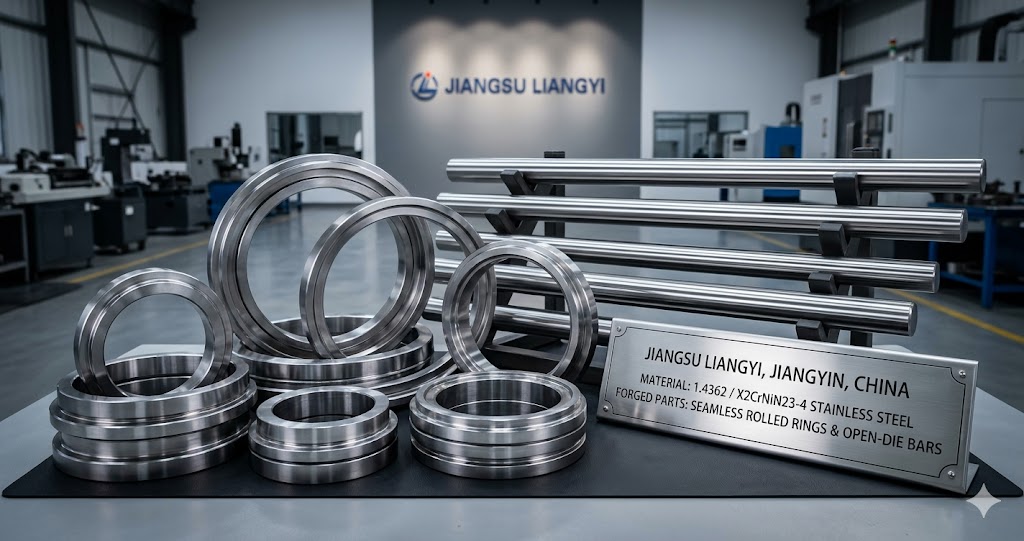
What Is 1.4362 (X2CrNiN23-4) Stainless Steel?
In the mid-20th century, the global fertilizer industry confronted a persistent materials failure problem: conventional austenitic stainless steels — predominantly AISI 304 and 316 — were corroding rapidly inside urea synthesis reactors, carbamate condensers, and strippers operating in the presence of hot, concentrated ammonium carbamate (NH₄COONH₂) solutions at temperatures between 150 °C and 200 °C and pressures up to 250 bar. The corrosion mechanism was twofold: general dissolution of the passive film in the oxidising yet ammoniated environment, and intergranular attack at grain boundaries where chromium carbides had precipitated during welding — a phenomenon known as sensitisation.
Grade 1.4362 (EN designation X2CrNiN23-4) was developed as a direct engineering response to this challenge. The alloying strategy centres on three key changes from conventional 304-series grades: (1) raising chromium to 22–24 % to build a more robust passive film; (2) adding 0.05–0.2 % nitrogen to enhance both corrosion resistance and mechanical strength without requiring additional expensive nickel; and (3) reducing carbon to a maximum of 0.03 % to eliminate sensitisation risk after welding. The result is a material that consistently outperforms 304 and often 316L in urea-service corrosion testing, while remaining more economical than super-austenitic grades such as 904L or 254SMO.
Jiangsu Liangyi Co., Limited has been forging 1.4362 components since the early 2000s, accumulating direct production knowledge that is not found in textbooks: optimal forging temperature ranges that avoid delta-ferrite formation, the precise water-quench rates needed after solution annealing to suppress sigma-phase precipitation, and the dimensional tolerances achievable on large-diameter rings without sacrificing mechanical property uniformity. This page shares that knowledge openly, because we believe that engineers who fully understand the material choose it — and choose us — with confidence.
Key Facts at a Glance
Material Science: Why 1.4362 Works — The Metallurgy Explained
The PREN Number and What It Means in Practice
The Pitting Resistance Equivalent Number (PREN) is the single most widely used index for comparing the pitting corrosion resistance of stainless steels in chloride-containing media. It is calculated from the alloy's bulk composition using the formula:
— where element percentages are taken from the actual heat analysis
For 1.4362 at mid-range composition (23 % Cr, 0.35 % Mo, 0.12 % N):
Compare: 304 ≈ 18 | 316L ≈ 24 | 2205 duplex ≈ 34
An important nuance: PREN was developed primarily for chloride pitting. In the urea industry, the dominant corrosion risk is not pitting in chloride media but rather active dissolution and intergranular corrosion in hot ammonium carbamate. In this environment, the high chromium and low carbon of 1.4362 are decisive — not the molybdenum term. This is why 1.4362 outperforms 316L in urea service despite having a similar PREN: the chromium-to-nickel ratio and the complete absence of sensitisation are the critical factors.
The Role of Nitrogen: Dual-Benefit Alloying
The addition of 0.05–0.2 % nitrogen to 1.4362 is one of the cleverest aspects of its alloy design because nitrogen simultaneously delivers two engineering benefits that typically require separate alloying additions:
- Corrosion resistance: Nitrogen stabilises the passive film and raises the critical pitting potential by preferentially segregating to the passive film/metal interface, where it forms ammonia (NH₃) locally, which raises the local pH and suppresses anodic dissolution. The coefficient of 16 in the PREN formula reflects this potency — nitrogen is 16 times more effective than chromium per weight percent in resisting pitting.
- Mechanical strength: Nitrogen is a powerful interstitial solid-solution strengthener in austenite. Each 0.1 % increase in nitrogen raises the 0.2% proof strength by approximately 60–80 MPa without reducing ductility — a strengthening efficiency far exceeding most substitutional elements. This is why 1.4362 achieves a minimum Rp0.2 of 400 MPa, roughly double that of 304, while still exceeding 20 % elongation.
The practical consequence: design engineers can use thinner wall sections when specifying 1.4362 compared to 304, reducing weight and material cost in large pressure vessel and heat exchanger applications — a direct economic benefit that partly offsets the slightly higher base alloy cost of the grade.
Low Carbon: Eliminating Sensitisation
Sensitisation — the precipitation of chromium-rich carbides (primarily Cr₂₃C₆) at grain boundaries during thermal cycles between approximately 450 °C and 850 °C — is the primary failure mechanism of standard austenitic stainless steels in welded fabrications. When carbides precipitate, they consume chromium from the surrounding matrix, creating chromium-depleted zones where the local chromium falls below the ~12 % passivation threshold. These zones corrode preferentially, causing intergranular cracking that can propagate with no visible external warning.
1.4362's carbon limit of max 0.03 % (the "L" equivalent in American notation) means that even during multi-pass welding or slow post-weld cooling through the sensitisation temperature range, insufficient carbon is available to form significant carbide precipitates. In our testing using the Huey test (boiling 65 % nitric acid, ASTM A262 Practice C), 1.4362 weldments consistently show corrosion rates below 0.05 mm/year even in the as-welded condition — compared to 0.5–2.0 mm/year for sensitised 304 in the same test.
The Austenite Stability Requirement
Because 1.4362 has lower nickel content (3.5–5.5 %) than standard 304 (8–10.5 %), forgers must pay careful attention to austenite stability during processing. If the forging temperature drops below approximately 900 °C, deformation-induced martensite can form, which is unacceptable for corrosion service. At Jiangsu Liangyi, we monitor in-process forging temperatures using calibrated contact pyrometers and never reheat below 1,050 °C to maintain a fully austenitic microstructure throughout deformation. Solution annealing at 1,050–1,100 °C with subsequent rapid water quenching then dissolves any residual secondary phases before the part enters service.
- 1.4362 is fully austenitic — no ferrite, no martensite in the solution-annealed condition
- PREN ≈ 25–26 at mid-range composition (better than 304, comparable to 316L)
- Nitrogen doubles the strengthening efficiency of the alloy without sacrificing ductility
- Max 0.03 % carbon prevents sensitisation: compliant even in the as-welded condition
- No delta-ferrite: the alloy is fully austenitic, making it non-magnetic in all conditions
- Sigma phase can form if held between 600–900 °C: always solution anneal after heavy section welding
Advantages of 1.4362 Over Alternative Materials
Specifying 1.4362 (X2CrNiN23-4) over competing grades involves a structured trade-off analysis. From our 25 years of supplying forged components across industries, here is how engineers consistently frame the decision:
vs. AISI 304 / 1.4301
304 remains the world's most produced stainless steel for good reason — it is adequate for a vast range of applications. But in urea synthesis, carbamate condensers, and any environment requiring post-weld corrosion resistance, 304 fails mechanically and economically. Corrosion rates in ammonium carbamate service at 180 °C can reach 3–5 mm/year for 304, meaning a component designed for 20 years of service needs replacement in 4–5 years. The upgrade cost to 1.4362 is typically 15–25 % on material alone, but the total lifecycle cost — including shutdown loss, replacement labour, and process contamination — makes 1.4362 the clear economic choice.
vs. 316L / 1.4404
316L is the most common upgrade path from 304. It adds 2–3 % molybdenum, which raises its PREN to approximately 24–26 and significantly improves chloride pitting resistance. However, 316L's chromium (16–18 %) is lower than 1.4362's (22–24 %), and its nitrogen content is essentially zero. In urea environments, where chromium content and low carbon are the dominant corrosion resistance drivers, 1.4362 consistently outperforms 316L. A further advantage: 1.4362 contains less nickel (3.5–5.5 % vs 10–14 %), making it less sensitive to the nickel price volatility that has historically caused significant cost uncertainty in 316L procurement.
vs. 2205 Duplex / 1.4462
2205 duplex has a PREN of approximately 34–36 and offers excellent stress corrosion cracking resistance. However, its duplex (austenite + ferrite) microstructure requires more careful welding procedures, limits service to above −50 °C without special qualification, and adds intermetallic phase risk during heat treatment or hot working. For urea plant equipment where full austenitic microstructure is specified by most process licensors, 1.4362 is compliant without additional justification. The cost premium for 2205 over 1.4362 is typically 20–35 %, which is only justified where chloride pitting or stress corrosion resistance is the primary failure risk.
vs. 904L / 1.4539
904L is a super-austenitic grade (19–23 % Cr, 23–28 % Ni, 4–5 % Mo) offering exceptional resistance to sulphuric acid and chlorides. Its PREN exceeds 36. However, the material cost is typically 3–5 times that of 1.4362, and its high nickel content makes procurement cost highly volatile. For standard urea plant service, 904L is significantly overspecified — process licensors rarely require it unless the process contains additional contaminants such as high chlorides or sulphur compounds.
Complete 1.4362 Forged Product Range
Jiangsu Liangyi manufactures the following 1.4362 forged product forms. All dimensions listed are indicative maximums; intermediate and custom sizes are our standard:
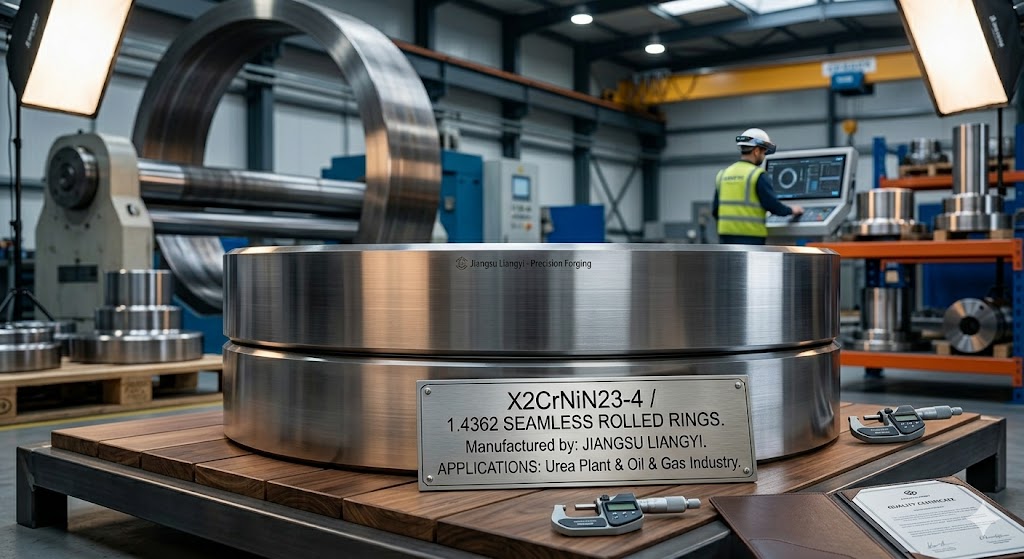
1. Seamless Rolled Rings
Produced on our 5M radial-axial ring rolling machine, 1.4362 seamless rings eliminate the stress concentration, porosity, and corrosion risk of weld seams present in fabricated rings. The ring rolling process continuously refines grain structure along the circumferential direction, delivering a fibre flow that aligns with operational hoop stresses — ideal for rotating equipment and pressure vessel flanges.
- Flanges, pressure vessel shell rings, and heat exchanger shell rings
- Pump volute rings, bearing races, and mechanical seal seats
- Turbine diaphragms, compressor labyrinth rings, and shaft seal rings
- Reactor vessel rings and head flanges for urea synthesis equipment
- Contoured rings (T-section, L-section, or custom profiles) to reduce machining stock
2. Open-Die Forged Bars, Shafts & Rods
Open-die forging with our 2,000T–6,300T hydraulic presses produces a worked microstructure with significantly improved mechanical properties compared to cast or hot-rolled bar — particularly in fatigue resistance and impact toughness, which are critical for rotating shafts and pump components. Forging ratio (reduction ratio) is tracked for every heat and documented in the mill test certificate.
- Straight bars: round, square, flat, hexagonal in customer-specified dimensions
- Step shafts, multi-diameter shafts, and splined drive shafts for pumps and compressors
- Valve spindles, stems, and operating shafts for gate, ball, and butterfly valves
- Pump shafts for centrifugal, axial, and positive-displacement pumps
- Tie rods, anchor bolts, and studs for high-pressure flanged connections
3. Hollow Forgings, Sleeves & Cylinders
Produced by piercing and drawing solid ingots on our press-and-mandrel equipment, hollow forgings provide superior integrity versus machined solid bar for thick-wall applications. The absence of a central void eliminates the risk of centreline segregation — a material defect that is inherent to cast products and can initiate stress corrosion cracking in service.
- Thick-wall cylinders and vessels for pressure service
- Pump barrels, casing halves, and lantern rings
- Reactor liners, sleeve seals, and containment vessels
- Bushings and bearing housings for valve bonnets
4. Discs, Blanks, Plates & Blocks
- Heat exchanger tube sheets — the highest-volume application of 1.4362 disc forgings
- Baffle plates, support plates, and impingement plates
- Valve bodies (block form for CNC machining)
- Nozzle forgings and manway flanges for pressure vessels
- Forged pump impeller blanks for precision balancing
Chemical Composition of 1.4362 (X2CrNiN23-4)
The following composition limits are defined in EN 10088-3 and EN 10250-4. In our production, actual heat analysis reports (included in the EN10204 3.1 certificate) consistently target the mid-range of each element to maximise both corrosion resistance and mechanical performance:
| Element | Symbol | Limit (% by mass) | Typical Aim | Engineering Role |
|---|---|---|---|---|
| Carbon | C | Max 0.030 | 0.018–0.025 | Kept as low as possible to eliminate sensitisation risk during and after welding. The VOD (Vacuum Oxygen Decarburisation) step in our steelmaking achieves consistently low carbon. |
| Silicon | Si | Max 1.00 | 0.40–0.65 | Deoxidiser during steelmaking; improves oxidation resistance at elevated temperatures. Kept moderate to avoid embrittlement. |
| Manganese | Mn | Max 2.00 | 1.00–1.50 | Austenite stabiliser (substitutes for nickel at lower cost); improves hot workability and nitrogen solubility during steelmaking — critical for achieving the target N range. |
| Chromium | Cr | 22.0 – 24.0 | 22.8 – 23.5 | The primary passive film former. Every 1 % increase above 18 % raises corrosion resistance non-linearly. At 22–24 %, 1.4362 develops a passive film stable even in boiling nitric acid and ammonium carbamate environments. |
| Nickel | Ni | 3.5 – 5.5 | 4.0 – 5.0 | Stabilises the austenite phase. The deliberately lower Ni range (vs 304's 8–10.5 %) reduces alloy cost and sensitivity to nickel price fluctuations, while nitrogen compensates for the reduction in austenite stability. |
| Molybdenum | Mo | 0.10 – 0.60 | 0.25 – 0.45 | Synergistic with chromium in passive film stability; raises PREN by 3.3 × its weight %. Kept moderate because high Mo can promote sigma-phase formation on slow cooling. |
| Nitrogen | N | 0.05 – 0.20 | 0.10 – 0.16 | Dual role: solid-solution strengthener (raises Rp0.2 by ~70 MPa per 0.1 % N) and corrosion resistance enhancer (raises PREN by 16 × its weight %). Controlled by adjusting nitrogen partial pressure during VOD refining. |
| Copper | Cu | 0.10 – 0.60 | 0.20 – 0.40 | Improves corrosion resistance in sulphuric acid and reducing acid environments. Also reduces work-hardening rate, improving machinability of the forged product. |
| Phosphorus | P | Max 0.035 | < 0.025 | Controlled to the lowest practical level to prevent hot cracking during welding and to maintain toughness at low temperatures. |
| Sulfur | S | Max 0.015 | < 0.008 | Kept minimal; MnS inclusions are initiation sites for pitting corrosion. Our ladle refining achieves S levels well below the standard maximum. |
Our steelmaking route — EAF → LF → VOD → VD (optional) — allows precise control of carbon and nitrogen simultaneously, which is the most technically challenging aspect of producing 1.4362 to specification. Our optical emission spectrometer provides melt analysis within 90 seconds, enabling real-time composition adjustment before casting.
Mechanical Properties of 1.4362 Forgings
The table below shows minimum values per EN 10250-4: 2000 for open-die forgings, applicable to the solution-annealed (+A) and annealed-and-tempered (+AT) delivery conditions. Values shown are for forgings with section thickness ≤ 160 mm; for larger sections, individual quotation is required.
| Property | Symbol | Unit | +A Condition | +AT Condition | Comparison: 304 (+A) |
|---|---|---|---|---|---|
| Tensile Strength | Rm | MPa | 600 – 850 | 600 – 820 | 500 – 700 |
| 0.2% Proof Strength | Rp0.2 | MPa | ≥ 400 | ≥ 400 | ≥ 205 |
| 1.0% Proof Strength | Rp1.0 | MPa | ≥ 450 | ≥ 450 | ≥ 250 |
| Elongation (Longitudinal) | AL | % | ≥ 20 | ≥ 25 | ≥ 30 |
| Elongation (Transverse) | AT | % | ≥ 18 | ≥ 20 | ≥ 25 |
| Reduction in Area | Z | % | ≥ 40 | ≥ 50 | ≥ 50 |
| Charpy Impact Energy (RT) | KV | J | ≥ 60 | ≥ 60 | ≥ 60 |
| Charpy Impact Energy (−60 °C) | KV | J | ≥ 40* | ≥ 40* | ≥ 40* |
| Brinell Hardness | HBW | — | Max 260 | Max 290 | Max 215 |
* Low-temperature impact is not a standard requirement under EN 10250-4 but can be specified by the customer. Our Charpy testers are qualified down to −90 °C. Mark * indicates typical achievable values based on our production history; formal low-temperature qualification requires order-time agreement.
For pressure vessel design to EN 13445, the allowable design stress f at 20 °C for 1.4362 in the +A condition is typically f = min(Rm/2.4 ; Rp0.2/1.5) = min(250 ; 267) = 250 MPa at minimum specified values. This is approximately 56 % higher than for 304 (f ≈ 160 MPa at minimum values), allowing direct wall-thickness reduction or higher design pressure for the same geometry.
Effect of Section Size on Mechanical Properties
Unlike cast products, forged 1.4362 components show a relatively modest reduction in properties with increasing section size, because the thermomechanical working breaks up the cast dendritic structure and produces a fine-grained, homogeneous austenite. In our production experience, forgings up to 400 mm equivalent diameter consistently achieve the EN 10250-4 minimums at the test location defined in the standard (quarter-thickness position). For sections above 400 mm, we recommend agreeing on specific test locations and acceptance criteria with our engineering team at the quotation stage.
1.4362 vs. Other Grades — Comprehensive Comparison
The table below compares 1.4362 against the six grades most commonly evaluated as alternatives, covering composition, corrosion resistance, mechanical properties, weldability, and relative cost:
| Criterion | 1.4362 / X2CrNiN23-4 | 304 / 1.4301 | 316L / 1.4404 | 317L / 1.4449 | 2205 Duplex / 1.4462 | 904L / 1.4539 | 254 SMO / 1.4547 |
|---|---|---|---|---|---|---|---|
| Steel Type | Austenitic | Austenitic | Austenitic | Austenitic | Duplex | Super-Austenitic | Super-Austenitic |
| Cr (%) | 22 – 24 | 18 – 20 | 16 – 18 | 18 – 20 | 21 – 23 | 19 – 21 | 19.5 – 20.5 |
| Ni (%) | 3.5 – 5.5 | 8 – 10.5 | 10 – 14 | 11 – 15 | 4.5 – 6.5 | 23 – 28 | 17.5 – 18.5 |
| Mo (%) | 0.1 – 0.6 | None | 2 – 3 | 3 – 4 | 2.5 – 3.5 | 4 – 5 | 6 – 6.5 |
| N (%) | 0.05 – 0.20 | None | None | None | 0.08 – 0.20 | None | 0.18 – 0.22 |
| Max C (%) | 0.030 | 0.080 | 0.030 | 0.030 | 0.030 | 0.020 | 0.020 |
| PREN (approx.) | 25 – 26 | 18 | 24 – 26 | 28 – 30 | 34 – 36 | 36 – 38 | 42 – 44 |
| Min Rp0.2 (MPa) | 400 | 205 | 170 | 205 | 450 | 220 | 300 |
| Urea / Carbamate | Excellent | Poor | Moderate | Moderate | Good | Good | Excellent |
| Intergranular (as-welded) | Excellent | Poor | Good | Good | Good | Excellent | Excellent |
| SCC Resistance | Moderate | Poor | Moderate | Moderate | Excellent | Good | Excellent |
| Cryogenic (≤ −60 °C) | Good | Good | Good | Good | Limited (≥−50°C) | Good | Good |
| Relative Material Cost | 1.0× (baseline) | 0.75× | 0.95× | 1.15× | 1.3× | 3.5× | 4.5× |
Relative cost values are illustrative based on market data and will vary with raw material indices. Contact us for current pricing on your specific project.
Welding Guide for 1.4362 (X2CrNiN23-4)
While welding is a fabrication activity rather than a forging service, our customers frequently ask for welding guidance because many of our forged components are welded into assemblies before entering service. The following information reflects best practice for 1.4362 weldments:
Recommended Filler Metals
| Welding Process | AWS Classification | EN ISO Classification | Notes |
|---|---|---|---|
| GTAW (TIG) | ER309LN | W 23 12 2 N L | Preferred: matching nitrogen content preserves corrosion resistance at the weld fusion line. Use with 100% Ar shielding gas. |
| GMAW (MIG) | ER309LN | W 23 12 2 N L | Use Ar + 2% CO₂ shielding. Avoid CO₂-rich gases that reduce nitrogen in the weld pool. |
| SMAW (Stick) | E309LMoN-16 | E 23 12 2 N L R 1 2 | For site welding; ensure low hydrogen electrodes, stored per manufacturer's specification to prevent moisture absorption. |
| SAW (Submerged Arc) | ER309LN + neutral flux | W 23 12 2 N L | Flux selection critical: basic or neutral fluxes that do not significantly dilute nitrogen. Avoid acidic fluxes. |
| Dissimilar to carbon steel | ER309L or ER309LMo | W 23 12 L or W 23 12 2 L | Use over-alloyed austenitic filler; butter the carbon steel side with two layers before joining to 1.4362. |
Preheat, Interpass Temperature, and Post-Weld Treatment
- Preheat: Not required for thicknesses up to 50 mm at ambient temperatures above +5 °C. For very thick sections (>75 mm) or in cold environments, a modest preheat to 50–75 °C may be beneficial to prevent moisture condensation and reduce risk of underbead cracking.
- Interpass temperature: Maximum 150 °C. Controlling interpass temperature limits sensitisation risk and prevents the segregation of alloying elements in the heat-affected zone.
- Post-weld treatment for standard service: Pickling and passivation of weld areas to remove heat tint (oxide scale) and restore the passive chromium oxide film. Use 10–15 % nitric acid + 1–2 % hydrofluoric acid solution at 40–60 °C; rinse thoroughly with deionised water.
- Post-weld solution annealing for critical urea service: Heat entire fabrication to 1,050–1,100 °C, hold for 1 hour per 25 mm of thickness (minimum 2 hours), then rapid water quench to below 350 °C within 3 minutes. This fully restores the solution-annealed microstructure and corrosion resistance. For many process licensors (Stamicarbon, Snamprogetti/Saipem), post-weld solution annealing is a contractual requirement for urea plant pressure parts.
Unlike conventional 304/316 weldments where a few percent of delta ferrite is intentionally maintained to prevent hot cracking, 1.4362 weld metal should target a fully austenitic deposit (0% ferrite). The ER309LN filler achieves this. If inadvertently high ferrite forms in the weld (visible as magnetic response in the austenitic zone), the weld must be rejected and re-welded, as ferrite phases corrode preferentially in urea/carbamate service.
Heat Treatment of 1.4362 Forgings
Correct heat treatment is inseparable from 1.4362's corrosion performance. The following conditions apply to our forged products:
Solution Annealing (+A Condition)
Temperature range: 1,050–1,100 °C — This temperature window is chosen to fully dissolve any chromium carbides (which precipitate during forging at lower temperatures), sigma phase (which can form between 600–900 °C), and chi phase, returning all alloying elements to solid solution in the austenitic matrix. Holding time is a minimum of 30 minutes per 25 mm of section thickness at temperature, measured from the moment the thermocouple in the thickest part of the load confirms target temperature has been reached.
Quenching: Water quench to < 350 °C within 3 minutes. Rapid quenching is non-negotiable: if cooling through the 600–850 °C sensitisation range takes more than approximately 6 minutes for typical section sizes, chromium carbides will begin to reprecipitate, destroying the very corrosion resistance that the solution annealing was intended to restore. Our heat treatment furnaces are designed with water quench tanks positioned immediately adjacent to the charge door, minimising transfer time.
Solution Annealing + Tempering (+AT Condition)
The +AT condition involves solution annealing as above, followed by a low-temperature stabilising temper at 300–400 °C for 2–4 hours. This condition is sometimes specified for large, complex forgings where the combination of slightly higher hardness (up to 290 HBW) and improved toughness is required. The temper does not re-sensitise the steel because the temperature is below the carbide precipitation range.
Furnace Documentation
All ten of our computer-controlled heat treatment furnaces record furnace temperature, charge temperature (via inserted contact thermocouple), atmosphere, and time on calibrated data loggers. These records are retained for a minimum of 10 years and copies are available on request. Furnace temperature uniformity and instrumentation are calibrated on a scheduled basis in accordance with our documented heat treatment quality procedure, which is available for customer review under NDA.
- +A: 1,050–1,100 °C → water quench. Standard for most applications.
- +AT: 1,050–1,100 °C → water quench → 300–400 °C temper. For specific applications requiring higher hardness ceiling.
- Never stress-relief anneal at 400–900 °C without re-solution annealing: this range causes sensitisation and/or sigma phase.
- Maximum service temperature for 1.4362 in continuous service: approximately 400 °C. Above this, creep and oxidation become limiting factors; consult our engineering team.
Surface Finish Options for 1.4362 Forged Parts
The surface condition of a 1.4362 component directly affects its corrosion resistance in service — a rough, contaminated, or oxidised surface corrodes faster than a smooth, passivated one. We offer the following surface conditions:
| Condition | Description | Typical Ra (μm) | Best For |
|---|---|---|---|
| As-Forged / As-Rolled | Oxide scale from forging and heat treatment still present. Rough surface. | 50 – 200 | Further machining by customer; rough stock supply |
| Pickled & Passivated | Immersion in HNO₃/HF bath removes oxide scale and free iron. Matte, uniform grey surface. Full passive film restored. | 10 – 40 | Pressure vessels, flanges, rings not requiring machining; recommended for corrosion service |
| Rough Machined | Excess material removed by turning/milling to near-net shape. Allows customer to finish-machine to final dimensions. | 6.3 – 25 | Semi-finished stock; reduces customer machining time |
| Finish Machined | Machined to final drawing dimensions. Tolerance class h8–h11 standard; tighter tolerances (h6, H7) available on request. | 1.6 – 6.3 | Ready-to-install components; valve seats, shaft journals, flanges |
| Ground | Precision surface grinding to tight tolerances. Typical tolerance h6 or better. | 0.4 – 1.6 | Bearing seats, sealing surfaces, precision shafts |
| Electro-Polished | Electrochemical removal of surface material, enriching the passive Cr₂O₃ film and producing a mirror-like surface. Reduces Ra by ~50%. | 0.1 – 0.8 | Pharmaceutical, food contact, ultra-high-purity process equipment; urea service where zero contamination is critical |
All machining of 1.4362 at our facility uses carbide tooling with appropriate cutting parameters. Austenitic stainless steels work-harden rapidly: we programme light, consistent cuts and avoid dwelling, which prevents localised work-hardening that causes tool chatter and poor surface finish. Cutting speeds, feeds, and lubricant specifications are documented in our CNC programme sheets and available for customer review on request.
International Production Standards Applicable to 1.4362
The following standards govern the specification, testing, and certification of 1.4362 forged products. Understanding which standard applies to your application is the first step to a successful procurement:
| Standard | Scope | Application |
|---|---|---|
| EN 10088-1: 2014 | List of stainless steels — defines 1.4362 material number and designation | Material identification and grade cross-reference |
| EN 10088-3: 2014 | Technical delivery conditions for semi-finished products, bars, rods for general purposes | Forged bars, rods, and sections for general engineering |
| EN 10250-4: 2000 | Open steel die forgings for general engineering — stainless steels | Standard for all our 1.4362 open-die forged products including rings, discs, and bars |
| EN 10028-7: 2016 | Flat products for pressure purposes — stainless steels | Disc forgings and plate forgings for pressure vessel applications |
| EN 10272: 2016 | Stainless steel bars for pressure purposes | Forged bars used in pressure system applications (valves, flanges, fittings) |
| ASTM A182 / A182M | Forged or rolled alloy and stainless steel pipe flanges, fittings, and valves | Flanges and fittings for US and international projects following ASME/ANSI standards |
| ASTM A479 / A479M | Stainless steel bars and shapes for use in boilers and pressure vessels | Bars for ASME-code pressure equipment |
| NORSOK MDS D47 | Material Data Sheet for austenitic stainless steel forgings — offshore Norway | Forgings for Norwegian oil & gas platforms and subsea equipment. Project-specific qualification required; confirm applicability at enquiry stage. |
| PED 2014/68/EU | Pressure Equipment Directive — requirements for CE-marked pressure parts sold into the EU market | Our forgings can be used as pressure-bearing components in PED-compliant assemblies. CE marking of the finished pressure equipment is the responsibility of the assembler/manufacturer in the EU, who engages a Notified Body. Confirm PED module requirements at enquiry stage. |
We can manufacture 1.4362 forgings to customer-supplied specifications or process licensor requirements (Stamicarbon, Saipem, Toyo, KBR, etc.) in addition to the standards listed above. Our engineering team has experience reviewing and aligning production to various licensor material specifications for urea plant components. Please share the applicable specification at enquiry stage for confirmation.
Industrial Applications of 1.4362 Forged Parts
Urea Plant Equipment — The Core Application
The urea synthesis process operates in one of the most corrosive environments encountered in industrial chemistry: concentrated ammonium carbamate (up to 90 % by weight) at temperatures of 170–200 °C and pressures of 130–250 bar. The synthesis loop contains: the high-pressure reactor, where CO₂ and liquid ammonia react to form ammonium carbamate and subsequently dehydrate to urea; the high-pressure stripper, where excess ammonia and CO₂ are stripped from the urea solution; and the carbamate condenser, where stripped gases are recombined and the condensation heat is recovered.
In all three vessels, 1.4362 is the standard material of construction for internal components that contact the corrosive process fluid. Specific forged components we supply for urea plants include:
- HP Reactor internals: Tube sheet forgings (typically 500–2,500 mm diameter, 80–250 mm thick), inlet nozzle forgings, and outlet nozzle flanges. The tube sheet is the most critical and highest-value single forging in a urea plant — it must remain dimensionally stable under differential thermal expansion and resist the highest carbamate concentration in the plant.
- HP Stripper: Top and bottom tube sheet discs, shell rings, and manway flanges. The stripper operates at the highest temperatures (up to 200 °C) and sees the most concentrated carbamate, making 1.4362 the only austenitic grade that consistently achieves the required 20+ year service life without replacement.
- Carbamate condenser: Shell rings, tube sheets, and channel head flanges.
- HP loop valves: Valve bodies and bonnets in sizes from DN50 to DN400 for high-pressure control and isolation valves throughout the synthesis loop.
Typical Supply Scope: We regularly supply 1.4362 forged tube sheets (500–2,500 mm diameter), nozzle forgings, shell rings, and HP loop valve bodies for urea plant projects across the Middle East, Southeast Asia, and South Asia. All components are produced to process licensor material specifications, supplied with EN10204 3.1 or 3.2 certificates, and are available with third-party witness inspection by customer-nominated bodies such as SGS or Bureau Veritas.
Oil & Gas — Upstream, Midstream, and Downstream
The oil and gas industry's move toward deeper, higher-pressure, and more sour reservoirs has created sustained demand for corrosion-resistant alloy forgings in applications where carbon steel has reached its performance limits. 1.4362 occupies the "sweet spot" between carbon steel (inadequate) and expensive nickel alloys (overspecified) for many wellhead and surface processing applications:
- Wellhead Christmas trees: Gate valve bodies and bonnets in 1.4362 where produced fluids contain CO₂ partial pressures exceeding the corrosion threshold for 13Cr steel
- Subsea production systems: Flowline connector bodies, pig receiver closure heads, and choke valve bodies for moderately sour service
- Gas processing: Amine contactor internals, absorber trays, and reboiler tube sheets where CO₂ and H₂S absorption creates a mildly corrosive aqueous environment
- LNG facilities: Cryogenic valve body forgings and pump internals for -160 °C LNG transfer systems, where 1.4362's fully austenitic structure ensures retained toughness
- Seawater injection systems: Pump casings and impeller housings for filtered seawater injection, where biocide concentrations and oxygen entrainment create pitting risk for lower-PREN grades
Typical Supply Scope: We supply 1.4362 forged valve bodies, wellhead components, and pump casings to oil & gas EPC contractors and end-users across the Middle East, Central Asia, and Europe. Components are supplied with EN10204 3.1 or EN10204 3.2 certificates per customer specification. Third-party inspection by customer-nominated bodies is accommodated within our standard production schedule.
Valve Manufacturing
The valve industry is the second-largest consumer of 1.4362 forged stock after the urea plant sector. Valve OEMs choose 1.4362 for the following components:
- Gate valve bodies (DN50–DN600, ASME Class 150–1500): Where process fluid is a dilute acid, fertilizer stream, or amine solution. The high chromium of 1.4362 resists the crevice corrosion that plagues 316L in these services.
- Ball valve bodies and balls: For urea, ammonium nitrate, and corrosive chemical service. We supply both the body forgings and, where requested, the precision-machined ball blanks.
- Butterfly valve discs and shafts: High-performance butterfly valves (HPBV) for aggressive service require shaft materials that combine corrosion resistance with adequate tensile strength — 1.4362's Rp0.2 of 400+ MPa makes it superior to 316L for slender shaft designs.
- Globe and check valve internals: Seat rings, discs, and piston guides for corrosive service applications
Power Generation — Conventional
Power generation plants present demanding service conditions: high temperatures, cyclic loading, and exposure to steam condensates that create mild but continuous corrosion attack. 1.4362 is specified in the following conventional power generation applications:
- Steam turbine components: Labyrinth seal rings and diaphragm rings where condensate creates mild acid corrosion. 1.4362's combination of corrosion resistance and adequate creep strength up to approximately 350–400 °C makes it preferred over 304 for these applications.
- Feed water heater tube sheets: For conventional steam cycle heat exchangers where mixed condensates — including dissolved CO₂ and oxygen — create selective corrosion risk for lower-chromium grades.
- Condenser and cooler components: Shell rings, support plates, and nozzle flanges for surface condensers and auxiliary coolers in power station balance-of-plant systems.
- Pump and valve components: Casings and internals for auxiliary cooling water and condensate extraction systems within conventional power plants.
Nuclear island equipment (primary and secondary circuits of nuclear power plants) is subject to jurisdiction-specific nuclear safety regulations and quality assurance codes (e.g., HAF003 in China, ASME NQA-1, RCC-M) that go significantly beyond ISO 9001:2015. Please contact us to discuss specific nuclear balance-of-plant (BOP) or conventional island enquiries, and we will confirm the applicable qualification scope.
Pump Manufacturing
Centrifugal pumps handling corrosive process fluids in fertilizer, petrochemical, and chemical industries frequently specify 1.4362 for wetted components. The material's higher yield strength compared to 316L allows thinner wall sections and lighter impeller designs without sacrificing pressure integrity:
- Pump casings (volute shells) for multi-stage centrifugal pumps handling urea solutions, ammonium nitrate, and fertilizer slurries
- Pump impeller blanks — precision forged and balanced in our facility
- Shaft forgings for wet-end shaft sections in contact with process fluid
- Mechanical seal housings and gland follower rings
- Column pipes and discharge heads for vertical turbine pumps in seawater or corrosive brine service
Engineer's Selection Guide: When to Specify 1.4362
Based on our experience reviewing hundreds of material selection enquiries over 25 years, the following flowchart-style guidance captures the decision points that consistently lead engineers to 1.4362:
- Service temperature: −60 °C to +400 °C continuous (with caveats above 300 °C)
- Corrosive medium: urea, ammonium carbamate, ammonium nitrate, dilute nitric acid, amine solutions, or moderately aggressive process fluids
- Welding is required and post-weld solution annealing is not always practical
- Budget: you need better corrosion resistance than 316L without the cost of 904L or duplex
- Design pressure allows use of yield-limited design (Rp0.2 ≥ 400 MPa advantage over 316L)
- Non-magnetic component required (fully austenitic — no ferrite, no martensite)
- Primary failure risk is chloride stress corrosion cracking (SCC) at temperatures above 60 °C → consider 2205 duplex or super-austenitic grades
- Service involves concentrated sulphuric acid (>85 % H₂SO₄) at elevated temperature → consider 904L or alloy 20
- Maximum service temperature exceeds 500 °C continuously → consider 310S or heat-resistant alloys
- Very deep cryogenic service below −100 °C → consider 9 % Ni steel or austenitic grades with specific low-temperature qualification
- Radiation exposure in nuclear applications where cobalt content must be <0.05 % → require chemistry certification and consider nuclear-grade 316L
Pressure Rating Guidance
The higher yield strength of 1.4362 vs 316L directly impacts allowable stress in pressure design codes. In ASME Section VIII Div 1 design, the allowable stress for 1.4362 at 100 °F (38 °C) is approximately 28–30 ksi (193–207 MPa), versus approximately 16–17 ksi (110–117 MPa) for 316L. This means a 1.4362 vessel designed to the same pressure rating as a 316L vessel can use approximately 40 % thinner walls, with corresponding material savings that often offset the higher alloy cost.
Jiangsu Liangyi's Manufacturing Process for 1.4362 Forgings
We control every step of the 1.4362 manufacturing chain in our 80,000 m² facility in Jiangyin, Jiangsu Province. There are no subcontractors in our production process for forged products. Here is what that means in practice:
-
Steelmaking — EAF + LF + VOD
Our 30-tonne Electric Arc Furnace (EAF) melts a blend of selected scrap and virgin ferro-alloys. The melt transfers to a 30-tonne Ladle Refining Furnace (LF) for slag desulphurisation, precise alloy addition, and temperature homogenisation. Critical for 1.4362: the VOD (Vacuum Oxygen Decarburisation) step simultaneously reduces carbon to below 0.030 % while injecting nitrogen to achieve the 0.05–0.20 % N target. The dual C-N requirement is technically the most demanding aspect of 1.4362 steelmaking — it requires carefully controlled vacuum level, nitrogen injection rate, and stirring power. Our operators have refined these parameters over hundreds of heats. -
Continuous Casting or Ingot Casting
Steel is cast to ingot (for large forgings) or continuous cast bloom/billet (for smaller bar and ring stock). Ingot sizes range from 1 tonne to 30 tonnes. Surface quality and internal soundness are evaluated visually and by magnetic flux leakage testing before dispatch to the forge shop. -
Homogenisation Soaking
Before forging, ingots are soaked in a gas-fired soaking pit at 1,150–1,200 °C for a minimum of 1 hour per 100 mm of section diameter (typically 8–16 hours total). This homogenises the as-cast dendritic segregation of chromium, nickel, and nitrogen — a critical step for 1.4362 because inhomogeneous nitrogen distribution would produce variable PREN across the finished forging section. -
Open-Die Forging — 2,000T to 6,300T Hydraulic Presses
Forging is performed in the range 1,050–1,200 °C. Our press operators monitor surface temperature by pyrometer and return the billet to the furnace for reheat whenever it drops below 950 °C, preventing deformation-induced martensite formation. For large discs and tube sheet blanks, we use manipulators and automated press programmes to ensure a controlled, symmetrical reduction ratio across the full cross-section. Minimum forging reduction ratio for 1.4362 is 3:1 (by cross-sectional area) to ensure adequate grain refinement. -
Seamless Ring Rolling — 1M and 5M Machines
For seamless rings, the forged preform (a pierced, upset disc) is loaded onto our radial-axial ring rolling machine. The 5M machine accommodates rings up to 6,000 mm OD with the main roll and cone rolls applying simultaneous radial and axial reduction, progressively growing the ring to its target diameter while refining grain structure. Roll speeds, reduction rates, and temperature are all automatically logged during rolling. Each ring is weighed before and after rolling to verify material yield. -
Heat Treatment — Solution Annealing + Water Quench
All 1.4362 forgings are solution annealed at 1,050–1,100 °C in our computer-controlled furnaces. Batch loading is managed to prevent thermal shadowing (cold spots caused by one forging shielding another). The water quench tank is positioned within 3 metres of the furnace door; door opening to first water contact is achieved in under 30 seconds for all but the largest loads. Quench water temperature is maintained below 40 °C by a chiller circuit. -
Dimensional Inspection — Rough Condition
Before machining, all forgings are dimensionally checked against the rough forging drawing. Ultrasonic testing (UT) is performed to EN 10228-3 or customer-specified acceptance class to confirm internal soundness. Any indications exceeding the acceptance criteria are dispositioned before machining commences — no defect is ever buried under machined stock. -
CNC Machining
Our machining centre is equipped with CNC horizontal boring mills (max capacity 3,000 mm diameter × 5,000 mm length), vertical turning lathes (max 4,000 mm diameter), gantry milling machines (max 6,000 × 3,000 × 1,500 mm table), and deep-hole boring machines for hollow components. All CNC programmes are prepared from customer 3D CAD models (STEP/IGES/Parasolid accepted) and verified with in-process inspection. -
Final Inspection & Testing
Every finished 1.4362 part undergoes: dimensional inspection to drawing (all critical dimensions recorded on an inspection report); hardness testing (Brinell, surface minimum 3 indentations); surface condition check (visual + PT or MT where specified); and review of all process records. Mechanical test results from coupon specimens (removed from the same heat and heat-treated in the same batch) are compared to specification minimums before the certificate is issued. -
Preservation, Packaging & Despatch
Finished machined surfaces are coated with a water-soluble rust preventative (VCI coating) compatible with 1.4362's subsequent pickling and passivation if required by the customer. Parts are packed in wooden crates or steel frames lined with foam or felt to prevent surface damage. Packing lists, material certificates (EN10204 3.1 or 3.2), NDT reports, dimensional inspection records, and heat treatment records are included in a waterproof envelope attached to the crate.
Quality Assurance & Inspection Capabilities
Our quality management system is certified to ISO 9001:2015 by an internationally accredited third-party certification body. The certification scope covers design assistance, manufacturing, heat treatment, machining, inspection, and testing of forged and ring-rolled products. A copy of our current ISO 9001:2015 certificate is available upon request. Our QMS procedures are available for customer review under NDA.
In-House Testing Equipment
| Equipment | Capability | Standards Covered |
|---|---|---|
| Optical Emission Spectrometer (OES) | Full elemental analysis of steel, including C, N, S, P; 90-second cycle time | ASTM E415, EN 10349 |
| Universal Tensile Testing Machine (1,000 kN) | Rm, Rp0.2, Rp1.0, elongation, reduction in area; specimen sizes to EN ISO 6892-1 | EN ISO 6892-1, ASTM E8 |
| Charpy Impact Testing Machine | Impact energy from +20 °C to −90 °C using liquid nitrogen bath; sub-sized specimens supported | EN ISO 148-1, ASTM E23 |
| Brinell Hardness Tester | HBW 10/3000 standard; surface tester for large components | EN ISO 6506-1, ASTM E10 |
| Rockwell & Vickers Hardness Testers | HRC, HRB, HV scales; micro-hardness available | EN ISO 6508, EN ISO 6507 |
| Phased-Array Ultrasonic Testing (PAUT) | Volumetric inspection to EN 10228-3, ASTM A388; sectorial and linear scan modes; data recording and image output | EN 10228-3, ASTM A388, ASME V |
| Conventional UT Equipment | Manual A-scan with calibrated probes for contact and immersion testing | EN 10228-3, EN 10307 |
| Magnetic Particle Testing (MT) | Yoke method and coil method; UV (fluorescent) and visible particle media | EN ISO 9934, ASTM E709 |
| Liquid Penetrant Inspection (PT/LPI) | Type II fluorescent and Type I colour contrast; all penetrant materials compatible with austenitic stainless steel (low-chloride formulation) | EN ISO 3452, ASTM E165 |
| Laser Tracker (Faro) | 3D dimensional inspection to 0.02 mm accuracy for components up to 6 m in any direction | ASME B89, customer drawing tolerances |
| CMM (Coordinate Measuring Machine) | Probe-based 3D inspection for machined features; bridge-type, max workpiece 2,500 × 1,500 × 1,000 mm | ISO 10360 |
| Surface Roughness Tester | Ra, Rz measurement; contact stylus type; portable for in-situ use | EN ISO 4287, ASME B46.1 |
| Metallurgical Microscope | Grain size (ASTM E112), microstructure evaluation, inclusions (ASTM E45); image analysis software | ASTM E112, EN ISO 643 |
| Ferrite Meter (Fischer) | Ferrite number measurement to WRC-1992 diagram; important for confirming fully austenitic condition of welds on 1.4362 fabrications | AWS D1.6, IIW |
Third-Party Inspection
We can accommodate witness inspection and certificate co-signing by the following third-party inspection bodies, and can schedule their attendance within our standard production programme: SGS, Bureau Veritas (BV), TÜV Rheinland, TÜV SÜD, Intertek, Lloyd's Register, DNV, and other customer-nominated surveyors. For EN10204 3.2 certification, the inspection body co-signs the final test report after witnessing: chemical analysis verification, mechanical test specimen extraction (or sampling), mechanical testing, NDT, dimensional inspection, and final visual inspection. Please specify your preferred inspection body and the 3.2 requirement at order placement to allow scheduling into our production flow without delay.
Packaging, Storage & Logistics
Standard Packaging
All 1.4362 forged parts are preserved and packed to prevent both corrosion damage during storage and transport and mechanical damage to machined surfaces. Our standard packaging approach is:
- Preservation: All machined or ground surfaces receive a coating of water-soluble VCI (Vapour Corrosion Inhibitor) rust preventative. Threaded surfaces receive additional grease protection. Flanges and bore openings are covered with plywood discs bolted through the bolt holes.
- Internal packaging: Parts wrapped in VCI-impregnated polyethylene film; critical surfaces padded with foam sheet or anti-tarnish tissue.
- External crating: Wooden export crate (heat-treated timber, ISPM 15 compliant for phytosanitary requirements) or steel stillage for heavy items. All crates are marked with part number, purchase order number, weight, country of origin, and handling instructions.
- Documentation: Complete documentation package (material certificate, inspection reports, packing list, shipping declaration) in a waterproof pouch attached to the crate interior. Electronic copies emailed to the customer simultaneously with shipment.
Storage at Our Facility
Finished 1.4362 forgings awaiting shipment are stored in our covered, clean warehouse on timber-blocked or rubber-padded steel racks. Stainless steel components are segregated from carbon steel to prevent ferrous contamination. If customer-requested hold for inspection requires storage beyond 30 days, we re-inspect preservation and re-apply VCI coating if necessary at no additional charge.
Shipping Modes and Incoterms
We export worldwide using the following Incoterms and modes:
- Sea freight (FCL or LCL): Port of loading: Shanghai (SHA) or Guangzhou (CAN). Transit time: 18–28 days to European ports; 25–35 days to North American ports; 7–12 days to Middle East ports.
- Air freight: For urgent small components (<150 kg) via Shanghai Pudong International Airport. Transit 3–7 days worldwide.
- Available Incoterms: EXW, FOB Shanghai, CFR, CIF, DAP — all at your specification. We work with global freight forwarders and can provide competitive freight quotations as part of our commercial proposal.
Export documentation for 1.4362 forged parts typically includes: commercial invoice, packing list, Bill of Lading (sea) or Air Waybill, Certificate of Origin (China), and Material Test Certificates. We can also provide Form A (GSP) or EUR.1 certificates where applicable for tariff preference.
Why Choose Jiangsu Liangyi as Your 1.4362 Forging Partner?
There are dozens of Chinese forging factories that claim to produce 1.4362. The differences that matter to your project are:
1. Complete Vertical Integration — No Material Risk
Many Chinese forging suppliers source their stainless steel ingot or bar from third-party steel mills, which introduces a supply chain weak link: the steel mill's process control, not the forger's, determines whether the material actually meets the 1.4362 specification. Jiangsu Liangyi operates its own 30t EAF + 30t LF + 30t VOD steelmaking plant. We know the exact composition, melting history, and processing conditions of every heat we forge. When you receive our EN10204 3.1 certificate, every data point on it — from carbon to nitrogen to PREN-relevant elements — was measured and controlled by our own team.
2. Demonstrated Large-Ring Capability
Our 5M radial-axial ring rolling machine is one of only a limited number in China capable of producing fully certified stainless steel rings above 4,000 mm OD to tight dimensional tolerances. We have produced rings up to 5,800 mm OD in 1.4362, with wall thicknesses from 60 mm to 450 mm, and heights up to 1,200 mm in a single ring. This capability eliminates the costly alternative of welding multiple smaller rings together to achieve large diameters — with all the associated inspection, weld procedure qualification, and post-weld treatment costs.
3. Process Licensor Familiarity
Urea plant process licensors (Stamicarbon, Saipem/Snamprogetti, Toyo Engineering, KBR) each publish proprietary material specifications for 1.4362 components in their process equipment. These specifications typically add requirements beyond EN 10250-4: corrosion testing (Huey test, ASTM A262 Practice C), specific ferrite number limits in weld metal, tighter carbon maxima, and additional chemical element restrictions. Our engineering team is familiar with the requirements of major licensor specifications and is experienced in aligning our production documentation to meet them. We recommend sharing the applicable licensor spec at enquiry stage so we can confirm full compliance before order placement.
4. Genuine 25+ Years Production History
Jiangsu Liangyi was established in 1997. Our current senior production engineers and metallurgists have been with the company for 15–20 years and have built a process knowledge base for 1.4362 that cannot be replicated by newer facilities. When you face an unusual application, an unusual inspection finding, or a tight deadline, you are dealing with engineers who have seen it before.
5. English-Language Technical Engineering Team
All customer-facing technical communication — including drawing review, deviation discussions, inspection report interpretation, and welding procedure recommendations — is handled in fluent English by our engineering team. We do not relay technical questions through a non-technical salesperson. This eliminates misunderstandings that cause costly errors in high-specification forgings.
Our Capabilities at a Glance
- Factory area: 80,000 m², Jiangyin, Jiangsu Province, China
- Forging presses: 2,000T, 3,150T, 5,000T, 6,300T hydraulic; 1T–5T electro-hydraulic hammers
- Ring rolling: 1M and 5M radial-axial machines; max ring OD 6,000 mm
- Steelmaking: 30t EAF + 30t LF + 30t VOD
- Heat treatment: 10 × computer-controlled furnaces; max charge dimensions 6,000 × 3,000 × 1,500 mm
- CNC machining: Vertical turning lathes to 4,000 mm, horizontal boring mills to 3,000 mm, gantry mills to 6,000 × 3,000 mm
- Annual production capacity: 120,000 tonnes
- Single-piece max weight: 30 tonnes
- Established: 1997 | Certified: ISO 9001:2015 | Exported to: 50+ countries
Frequently Asked Questions about 1.4362 (X2CrNiN23-4) Forgings
Related Stainless Steel Forging Products
Request a Quotation for 1.4362 (X2CrNiN23-4) Forged Parts
Jiangsu Liangyi is ready to review your 1.4362 project — from single prototype forgings to large-volume production contracts. Send us your drawings and specification and we will respond with a complete commercial and technical proposal within 24 hours on business days.
Our engineering team can assist with: material grade confirmation, delivery condition selection (+A vs +AT), surface finish requirements, NDT scope, test certificate type, and logistics.
📧 Request a Free Quotation