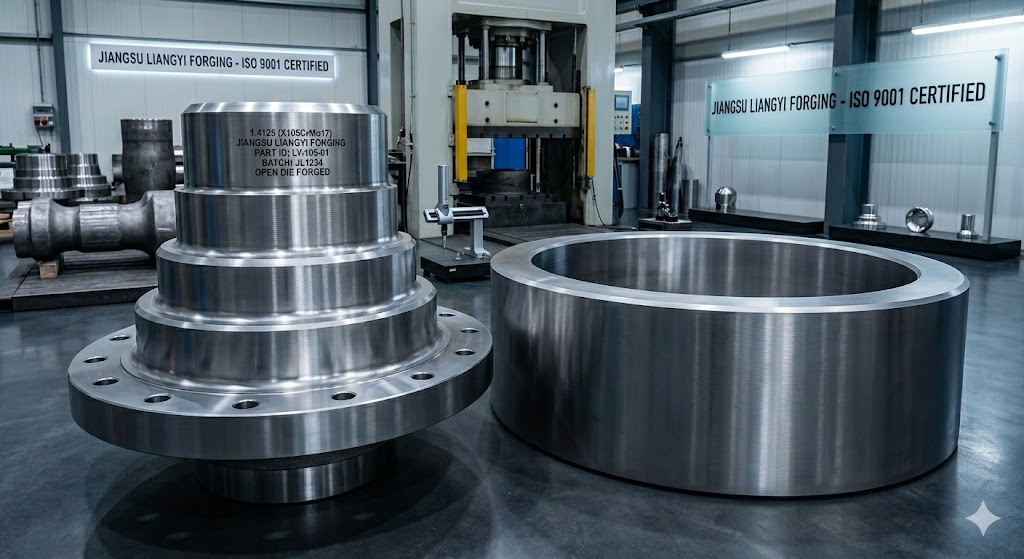
1.4125 (X105CrMo17) Forging Product Overview & Manufacturer Credentials
Jiangsu Liangyi Co., Limited is an ISO 9001:2015 certified professional manufacturer of 1.4125 (X105CrMo17) open die forging parts and seamless rolled steel forged rings in Jiangyin City, Jiangsu Province, China. With over 25 years of industry experience in high-alloy stainless steel forgings, we specialize in custom 1.4125 stainless steel forgings, covering the complete production chain from EAF steel melting, ladle refining, VD-VOD vacuum degassing, open die forging, ring rolling, precision heat treatment to CNC machining, fully compliant with EN 10088-3, ASTM A276, and client custom drawings. Our forgings can be produced to meet the technical requirements of API 6A, PED 2014/68/EU, and NACE MR0175 standards upon customer specification.
Our X105CrMo17 forging products are exported globally, including to the European Union, North America, the Middle East, Australia, and Southeast Asia, serving critical industrial sectors such as oil & gas, mining, power generation, tool & die manufacturing, and medical equipment. We support single-piece forging weight from 30 KGS to 30,000 KGS, with an annual manufacturing capacity of 120,000 tons.
What differentiates our 1.4125 forgings from standard market supply is our in-house full process control: we control the steel chemistry from the melting furnace, not just from purchased billets. This means we can fine-tune the carbon content to the upper or lower end of the 0.95–1.20% specification range depending on whether your application prioritizes maximum hardness or toughness — a capability most forging shops without melting facilities simply cannot offer. Contact our engineering team today to discuss your custom 1.4125 (X105CrMo17) forging requirements.
Full Range of 1.4125 (X105CrMo17) Forged Product Forms
We manufacture a complete portfolio of custom 1.4125 (X105CrMo17) forging products in various shapes and dimensions, with a minimum forging reduction ratio of 4:1 for all forms to ensure complete breakdown of the as-cast dendritic structure. This ratio is a non-negotiable internal standard that we apply regardless of customer specification — it is the metallurgical foundation of the superior mechanical properties our clients rely on. Explore our full product range or our material catalog for alternative grades.
1.4125 Forged Steel Bars & Rods
We produce X105CrMo17 forged round bars, square bars, flat bars, rectangular bars, and custom step rods with maximum forging diameter up to 2,000 mm and single-piece weight up to 30 tons. All round bars with diameter ≥100 mm are subject to 100% volumetric ultrasonic testing per EN 10228-3 Class 3 or ASTM A388. A key advantage of our forged bars over hot-rolled bars is the forging deformation pattern: our hydraulic press applies compressive force from multiple directions in successive steps, producing equiaxed grains rather than the elongated, directional grain structure of rolled bars. This results in more isotropic hardness distribution after heat treatment — critical for components that are subsequently machined into complex shapes such as valve balls and tool blanks.
X105CrMo17 Seamless Rolled Forged Rings
Our 1.4125 seamless rolled rings are available from 300 mm to 6,000 mm outer diameter, from 50 mm to 1,500 mm height, and with wall thickness from 30 mm to 800 mm. The ring rolling process applies both radial and axial deformation simultaneously on our 5-meter rolling mill, producing a circumferentially oriented grain flow that directly mirrors the stress distribution in service — this is why our rolled rings consistently outperform machined-from-solid discs in fatigue testing. We produce custom profiles including L-shaped, T-shaped, and contoured cross-sections, eliminating material waste and reducing downstream machining cost for complex flange and gear ring geometries.
1.4125 Forged Sleeves & Hollow Components
We supply custom X105CrMo17 forged hubs, housings, shells, sleeves, bushes, casings, and hollow bars using the mandrel forging technique, which applies progressive deformation over a central mandrel to produce a hollow preform. Unlike machined-from-solid cylinders that cut across the grain flow, our forged hollow components maintain continuous grain flow parallel to the component wall — critical for components such as bearing housings and pump sleeves that experience radial loading in service. Wall thickness tolerance is controlled to ±2 mm as-forged and ±0.5 mm after rough turning.
X105CrMo17 Forged Discs, Blocks & Plates
Our 1.4125 forged discs, disks, blocks, and plates are manufactured with our proprietary multi-directional forging sequence: each billet undergoes at least three perpendicular deformation axes before reaching final dimensions. This tri-axial deformation breaks up carbide networks in all three planes, producing a genuinely isotropic carbide distribution — measurable by metallographic examination showing carbide aspect ratio ≤ 2:1 in any cross-section direction. For tool steel dies and stamping dies, this isotropy is critical: anisotropic carbide distributions cause preferential crack propagation along carbide bands under cyclic loading, leading to premature die failure that the customer often incorrectly attributes to insufficient hardness.
1.4125 Forged Pipes, Casings & Tubular Components
We produce X105CrMo17 forged steel pipes, tubes, shells, casings, barrels, and custom tubular components using seamless forging-piercing technology. The process begins with a solid billet forged to a near-net shape disc, followed by hot piercing on our 6,300-ton press, then elongation forging over a mandrel. This fully seamless route ensures there are no weld seams or heat-affected zones — a critical requirement for pressure components needing to meet API 6A or PED 2014/68/EU technical requirements. Hydrostatic pressure testing to 1.5× design pressure is available as a standard delivery test.
Material Science Deep Dive: 1.4125 (X105CrMo17) Composition, Microstructure & Properties
Understanding the metallurgy of 1.4125 is essential for making the right design and procurement decisions. This section provides technical depth not commonly found in standard product datasheets — drawing on our 25+ years of direct production experience with this grade and our in-house metallographic laboratory analysis.
Chemical Composition & the Role of Each Alloying Element
1.4125 (X105CrMo17) sits at a deliberate metallurgical compromise: the carbon content is maximized to form chromium carbides that contribute to wear resistance, while the chromium is high enough to maintain the stainless classification (≥10.5% Cr). The molybdenum addition is critical — it segregates to the matrix and carbide boundaries, increasing both hardenability and resistance to pitting corrosion, particularly in chloride environments encountered in oil & gas valve applications.
| Element | Range (wt%) | Nominal Target | Metallurgical Effect & Engineering Implication |
|---|---|---|---|
| Carbon (C) | 0.95 – 1.20 | ~1.05% | Primary hardness driver. Forms M23C6 and M7C3 carbides during heat treatment. Higher C → harder but lower toughness and corrosion resistance. We target 1.00–1.08% for balanced performance. |
| Chromium (Cr) | 16.00 – 18.00 | ~17.0% | Passivation film former. ~30–40% of Cr is tied up in carbides, leaving ~10–11% free Cr for corrosion resistance. Also increases hardenability and depth of hardening in large sections. |
| Molybdenum (Mo) | 0.40 – 0.80 | ~0.60% | Enhances hardenability and secondary carbide hardness. Increases pitting resistance index (PREN) by ~3.3 per 1% Mo. Improves high-temperature tempering resistance, broadening the useful tempering window. |
| Manganese (Mn) | 0.0 – 1.00 | ≤ 0.50% | Deoxidizer and sulfide shape control agent. We control Mn to the lower end of the range to reduce retained austenite tendency after quenching — important for dimensional stability of precision components. |
| Silicon (Si) | 0.0 – 1.00 | ≤ 0.40% | Deoxidizer. High Si reduces hot ductility during forging. We control Si ≤ 0.40% to maximize forging workability in the narrow temperature window of this high-carbon grade. |
| Phosphorus (P) | ≤ 0.04 | ≤ 0.025% | Grain boundary embrittler. We target P ≤ 0.025% (tighter than EN standard) to improve impact toughness at the delivered hardness, particularly important for bearing applications. |
| Sulphur (S) | ≤ 0.03 | ≤ 0.010% | Inclusion former (MnS). We target S ≤ 0.010% via VD-VOD desulfurization to minimize elongated MnS inclusions that act as fatigue crack initiation sites in rotating components. |
| Iron (Fe) | Balance | Balance | Austenite/martensite matrix. The Fe-Cr-C ternary system determines the phase boundaries that govern heat treatment temperatures. |
Typical Mechanical Properties of 1.4125 (X105CrMo17) Forgings at Various Heat Treatment Conditions
The following mechanical property data is representative of typical results for 1.4125 (X105CrMo17) forgings produced under standard conditions, based on our accumulated production and testing experience. All tensile tests per EN ISO 6892-1; Charpy impact per EN ISO 148-1; hardness per EN ISO 6508. Actual values for your specific order will be provided in the EN 10204 3.1 material certificate.
| Heat Treatment Condition | Hardness (HRC) | Hardness (HBW) | Tensile Strength Rm (MPa) | Yield Strength Rp0.2 (MPa) | Elongation A5 (%) | Impact KV (J, RT) | Typical Applications |
|---|---|---|---|---|---|---|---|
| Annealed (780–840°C) | 22–27 | 220–280 | 750–850 | 450–550 | 14–18 | 35–55 | Machining stock, pre-machined blanks before final HT |
| Q + T 200°C (max hardness) | 57–60 | 600–710 | 1,950–2,200 | 1,650–1,900 | 1–2 | 5–10 | Wear plates, cutting edges, anti-scuffing valve seats |
| Q + T 300°C (balanced) | 54–58 | 555–640 | 1,750–2,000 | 1,500–1,700 | 2–4 | 10–18 | Bearing rings, pump shafts, valve balls, precision dies |
| Q + T 400°C (toughness priority) | 50–54 | 500–555 | 1,550–1,800 | 1,300–1,500 | 4–7 | 18–28 | Forged rolls, tool holders, components with impact loading |
| Tempered at 150°C + Cryo | 58–60 | 620–710 | 2,000–2,250 | 1,700–1,950 | 1–2 | 6–12 | Precision spindles, bearing rings (min retained austenite) |
⚠ Critical Note: Temper Brittleness Zone
Tempering 1.4125 (X105CrMo17) in the 400–600°C range causes precipitation of carbides along prior austenite grain boundaries, severely embrittling the steel (impact values can drop to ≤ 5 J). This phenomenon — called temper embrittlement — is irreversible without a full re-hardening cycle. We automatically flag any customer hardness specification that would require tempering in this zone and discuss the risk and alternatives before production begins. This is an area where many lower-tier suppliers fail their customers without either party being aware of the root cause.
Cross-Standard Equivalence: 1.4125 vs AISI 440C vs SUS440C
| Property | 1.4125 / X105CrMo17 (EN) | AISI 440C (US) | SUS440C (JIS) | Key Difference |
|---|---|---|---|---|
| C content (%) | 0.95–1.20 | 0.95–1.20 | 0.95–1.20 | Identical |
| Cr content (%) | 16.0–18.0 | 16.0–18.0 | 16.0–18.0 | Identical |
| Mo content (%) | 0.40–0.80 (mandatory) | 0.75 max (optional) | 0.75 max (optional) | EN mandates Mo minimum; AISI/JIS do not — verify with supplier |
| P max (%) | 0.040 | 0.040 | 0.040 | Identical (we target ≤ 0.025%) |
| Max hardness (HRC) | 57–60 | 57–60 | 57–60 | Identical |
| Standard | EN 10088-3 | ASTM A276 / A484 | JIS G4303 | Equivalent; our forgings include dual cert EN + ASTM on request |
One important practical note: while the three grades are compositionally equivalent, AISI 440C material sourced from the open market as bar stock may not have been produced via vacuum degassing. Our in-house VD-VOD process ensures hydrogen content ≤ 1.5 ppm and oxygen content ≤ 20 ppm — critical for avoiding hydrogen-induced flaking in large cross-section forgings exceeding 200 mm diameter.
Complete Heat Treatment Guide for 1.4125 (X105CrMo17) Forgings
Heat treatment is the stage where a 1.4125 forging is either transformed into a high-performance component or irreversibly damaged. The narrow temperature windows, the quench cracking risk from high carbon content, and the temper embrittlement zone all make this grade more demanding than standard martensitic stainless steels. Our heat treatment team has developed specific protocols refined over 25 years that address each of these risks systematically.
Step-by-Step Heat Treatment Protocol
Pre-heat Equalization (for sections > 100 mm)
Before entering the hardening furnace, all forgings with cross-section exceeding 100 mm are pre-heated at 500–550°C for 1 hour per 50 mm of maximum section thickness. This equalization step reduces the thermal gradient across the section during the subsequent rapid heating to austenitizing temperature, preventing surface-to-core temperature differentials that cause residual stresses and distortion — a step routinely skipped by suppliers treating 1.4125 as a "standard" grade.
Softening Annealing (780–840°C)
For forgings requiring significant machining before final hardening, we perform spheroidizing annealing at 780–840°C, holding for 2–4 hours, then furnace-cooling at ≤30°C/h to 600°C. This produces a microstructure of fine, spheroidized carbides in a ferritic matrix (≤280 HBW), which is the easiest condition for machining and the starting condition that produces the most uniform hardening response in the subsequent hardening cycle. Cooling faster than this rate risks producing a banded pearlitic structure that causes uneven hardness after quenching.
Austenitizing & Quenching (1000–1050°C → Oil)
Austenitizing temperature selection is critical and non-intuitive: the optimal temperature is 1010–1020°C for maximum hardness, not the higher end of the range. Above 1040°C, excess carbon dissolves into austenite, depressing the martensite start (Ms) temperature and increasing retained austenite content in the quenched structure — paradoxically reducing final hardness. We use continuous thermocouple monitoring and calibrated furnace load correction factors to ensure the actual component temperature matches the setpoint to within ±5°C. Quenching is performed in agitated oil at 50–70°C; we do not use polymer quenchants for this grade due to quench rate inconsistency with high-carbon steel.
Cryogenic Treatment (Optional: −70°C to −80°C)
For bearing rings, precision spindles, and any component where dimensional stability under thermal cycling is critical, we offer immediate cryogenic treatment within 2 hours of oil quenching (before any retained austenite can stabilize at room temperature). Components are cooled to −70°C to −80°C in a dry ice / ethanol bath or cryogenic chamber, held for 2–4 hours, then returned to room temperature before tempering. This step converts ≥95% of retained austenite to martensite, producing a measurable improvement in both hardness (+1 to +2 HRC) and dimensional stability over subsequent thermal cycling.
Tempering (100–300°C, within 2 hours of quenching)
Tempering must begin within 2 hours of reaching room temperature after quenching. Delay risks spontaneous cracking as martensite transformation stresses accumulate. Hold time is minimum 2 hours, with 1 additional hour per 25 mm of maximum section above 100 mm. We always perform two consecutive tempering cycles for large sections (≥300 mm), as the second temper relieves stresses introduced during the cooling from the first temper. All furnace temperature charts are archived and supplied with the EN 10204 3.1 material certificate.
| Tempering Temperature (°C) | Hardness (HRC) | Toughness (KV, J) | Dimensional Stability | Recommendation |
|---|---|---|---|---|
| 100–200°C | 57–60 | 5–10 | Moderate (some RA) | Cutting edges, wear surfaces only — very brittle |
| 200–300°C | 54–58 | 10–18 | Good | Optimal for most applications (bearings, valves, dies) |
| 300–400°C | 50–54 | 18–28 | Excellent | Where impact loading occurs alongside wear |
| 400–600°C | 38–50 (variable) | ≤ 5 (embrittled) | Poor | ⚠ AVOID — Temper embrittlement zone. Irreversible. |
| ≥ 600°C | 28–38 | 30–50 | Very good | Stress relief only — not for hardness-critical applications |
Why Forging is Superior to Casting & Rolling for 1.4125 High-Carbon Stainless Steel
The choice between forging, casting, and rolling for 1.4125 (X105CrMo17) components is not merely a manufacturing preference — it is a metallurgical decision with direct consequences for service life, failure mode, and component cost over the product's lifetime. This section explains exactly why forging is the technically superior and ultimately more economical choice for this specific grade.
The Fundamental Problem with 1.4125 Castings
1.4125 has a carbon content of 0.95–1.20% — among the highest of any stainless steel grade. During solidification from the melt in a casting process, this carbon precipitates as a continuous network of eutectic carbides along the dendrite boundaries. In metallographic cross-sections, this appears as a skeletal web of hard, brittle carbide chains surrounding islands of softer austenite — the classic "fish-bone" microstructure. This carbide network has three severely damaging effects on the service performance of cast 1.4125 components:
- Crack propagation highways: Cracks under load preferentially follow the continuous carbide network rather than propagating through the tougher matrix, causing brittle fracture at stress levels far below the theoretical material strength. Cast 1.4125 valve balls have been reported to crack catastrophically at pressures as low as 40% of design pressure in demanding oilfield applications.
- Hardness non-uniformity: The carbide-rich and carbide-poor zones respond differently to heat treatment. After quenching, hardness variation across a single casting cross-section can exceed ±5 HRC — meaning a casting specified at 58 HRC may contain zones at only 52–53 HRC, compromising the wear performance that was the entire reason for choosing this grade.
- Porosity and shrinkage voids: Solidification shrinkage is unavoidable in any casting, and in thick-section 1.4125 castings (where this material is most commonly needed), shrinkage cavities concentrate in the thermal center, providing nucleation sites for fatigue cracks that are invisible to visual inspection and difficult to detect even with ultrasonic testing due to the complex carbide background signal.
How the Forging Process Eliminates These Problems
| Performance Criterion | Open Die Forging | Investment Casting | Hot Rolling (Bar Stock) |
|---|---|---|---|
| Carbide distribution | Fine, uniformly dispersed (aspect ratio ≤ 2:1) | Coarse eutectic network (aspect ratio ≥ 5:1) | Fine but unidirectional (banded in rolling direction) |
| Internal porosity | Zero — welded closed by compressive deformation | Inherent shrinkage voids in thermal center | Low — eliminated by reduction ratio |
| Grain size (ASTM) | 5–8 (fine, equiaxed) | 1–3 (coarse, columnar) | 4–7 (fine, elongated) |
| Mechanical isotropy | Excellent (all directions ± 5%) | Excellent (isotropic) | Poor (transverse properties ≈ 30% lower) |
| Hardness uniformity (HRC) | ± 1 HRC across section | ± 5 HRC across section | ± 2 HRC across section |
| Fatigue life improvement vs casting | +40–60% | Baseline | +15–25% |
| Maximum size | Up to 30,000 KG | Typically ≤ 300 KG | Limited by rolling mill capacity |
| Relative unit cost | Medium-high (lowest lifecycle cost) | Low (highest lifecycle cost) | Low (limited to round bar forms) |
✓ Application Insight: Forged vs Cast Rolls in Mining Service
A common feedback pattern from mining equipment clients who have transitioned from cast X105CrMo17 rolling mill rolls to our forged equivalents is a significant extension in service life. Cast rolls frequently fail by surface spalling initiated at sub-surface shrinkage porosity, while forged rolls at the same delivered hardness eliminate this failure mode entirely. If you have existing cast roll data and would like a technical assessment of whether forged equivalents would improve your specific application economics, our engineering team can review your current wear data and provide a recommendation — contact us with your roll dimensions, hardness specification, and observed failure mode.
ESR vs Standard Melting: Decision Guide for Engineers Specifying 1.4125 Forgings
Electroslag Remelting (ESR) is an additional refining step applied to selected steel ingots after the primary Electric Arc Furnace (EAF) + Ladle Furnace (LF) + VD-VOD cycle. It involves remelting the solidified ingot through a slag layer using electrical resistance heating, producing a progressive directional solidification that significantly improves inclusion cleanliness and solidification structure. Our ESR plant can process ingots up to 32 tons — one of the largest capacities in China for this grade. However, ESR adds cost and lead time, and is not necessary for every application. The following guide explains when it is and is not worth specifying.
Specify ESR When Your Application Involves:
- Bearing rings and precision spindles requiring ASTM A295 inclusion cleanliness level ≤ 0.5 mm² per 1000 mm² cross-sectional area, or SEP 1571 cleanliness class K3 or better
- Medical surgical instruments, dental drills, and orthopedic device components requiring biocompatibility certification and extremely low inclusion content to prevent fatigue cracks in sterilization cycles
- High-cycle fatigue applications (design life > 10⁷ cycles) where initiation at inclusion clusters is the primary failure mode
- Aerospace and defense components with UT acceptance criteria stricter than EN 10228-3 Class 3 (e.g., Class 4 or customer-specific requirements)
- Critical oil & gas wellhead components where the consequence of in-service failure is catastrophic (loss of well control) and 100% UT to ASTM A388 Level 2 is specified
- Precision dies for medical device injection molding where surface finish after EDM or grinding must be Ra ≤ 0.2 μm — difficult to achieve over inclusion clusters in standard-grade material
Standard EAF + LF + VD-VOD is Sufficient For:
- Oil & gas valve balls, valve bodies, bonnets, and stems required to meet API 6A technical specifications
- Mining wear plates, roll sleeves, and shear blades where abrasion resistance (hardness) is the primary performance criterion
- Tool and die blanks for cold forming, stamping, and punching tools with section sizes under 200 mm
- Pump casings, impellers, and shaft sleeves for general petrochemical service
- Power generation components such as seal rings and valve discs not in primary coolant circuits
- General mechanical engineering parts where cost efficiency is a primary procurement criterion
Practical note: Requesting ESR for applications where it is not needed can add 15–25% to material cost and 2–3 weeks to lead time. We proactively discuss this with every customer who specifies ESR on their inquiry — our goal is to help you specify correctly, not to charge for processes you do not need. Conversely, if your application is in the "ESR required" list above and you are receiving quotations without ESR from suppliers at unusually low prices, ask explicitly whether ESR is included — this is one of the most common areas of hidden specification non-compliance in the forging supply chain.
Application Hardness Selection Guide for 1.4125 (X105CrMo17) Forgings
One of the most common specification errors we encounter is over-specifying hardness — requesting maximum hardness (58–60 HRC) for applications where a slightly lower hardness at significantly higher toughness would produce a longer service life and lower failure risk. The following guide, based on our application engineering experience, helps procurement engineers select the optimal hardness specification for their specific use case.
| Application | Recommended Hardness (HRC) | Tempering Temperature (°C) | Primary Performance Priority | Risk of Over-Specifying Higher Hardness |
|---|---|---|---|---|
| Wear plates, anti-scuffing surfaces | 58–60 | 150–200 | Surface wear resistance | Low (purely abrasive loading) |
| Ball bearings, roller bearings, inner/outer rings | 58–60 + cryo | 150–180 after cryo | Fatigue life, contact stress resistance | Low if cryo is included; without cryo, RA causes early fatigue |
| API 6A valve balls and seats | 55–58 | 250–300 | Wear + pressure seal integrity | Maximum hardness increases brittleness under shock pressure |
| Cold forming and stamping dies | 56–59 | 200–250 | Compressive strength + wear | Brittle failure at 60 HRC under high-cycle compressive fatigue |
| Mining rolls and roller sleeves | 54–58 | 280–350 | Wear + impact resistance | Spalling and edge chipping at maximum hardness under impact |
| Pump shafts and impellers | 50–55 | 350–400 | Fatigue + moderate wear | Shaft fatigue fracture risk increases sharply above 56 HRC |
| Surgical instruments and medical cutting tools | 55–58 | 200–280 | Edge retention + sterilization resistance | Instrument brittleness risk in steam autoclave thermal cycling |
| Turbine seal rings and steam-path components | 50–54 | 350–400 | Dimensional stability + moderate hardness | High hardness at high temperature leads to stress relaxation cracking |
Global Industry Applications & GEO-Targeted Project Cases
Our 1.4125 (X105CrMo17) forged parts are deployed in critical industrial sectors across six continents. What follows are not generic application descriptions, but application-specific technical explanations of why 1.4125 forging outperforms alternative materials in each sector — based on our engineering dialogue with clients and the specific failure analyses from field-returned components that we have reviewed. View our full project reference library for documented case studies.
Oil & Gas Industry — Middle East & Southeast Asia Focus
In oil & gas wellhead and pipeline systems, valve components face a uniquely demanding combination: high contact stress between ball and seat surfaces, exposure to crude oil and produced water with varying chloride concentrations, and occasional slug flow that creates sudden impact loads. 1.4125 (X105CrMo17) addresses this combination better than many alternatives: 316L stainless steel cannot reach adequate hardness for the ball-seat contact stress; AISI 17-4PH can reach 44 HRC but lacks the wear resistance at the contact surface; tungsten carbide-lined valves offer better wear but at 5–8× the cost and with brittleness that makes them unsuitable for slug flow conditions.
We have supplied precision 1.4125 forged valve balls, valve bodies, bonnets, stems, seat rings, valve cores, and discs to valve manufacturers serving the oil & gas sector in the Middle East and Southeast Asia. Our products are manufactured to meet the technical requirements of API 6A, with ESR refining process available for high-integrity requirements and NACE MR0175 material compatibility documentation available for sour service applications.
Mining & Rolling Mill Industry — Australia & South America Focus
Mining wear components face abrasive wear from ore particles, impact loading from ore feed variation, and thermal fatigue from cooling water contact in hot rolling applications. The critical material requirement is high hardness throughout the entire cross-section (not just the surface), which only forging can achieve consistently in large components. Surface hardening treatments like induction hardening or carburizing cannot produce the 30–50 mm deep hardened zone needed for components like rolling mill work rolls that must be redressed multiple times over their service life.
Our X105CrMo17 forged rolls, roller sleeves, shear blades, and wear plates are suited to the demanding abrasion and impact loading conditions of iron ore processing, copper smelting, and steel strip production. At 58 HRC across the entire cross-section, forged rolls provide substantially longer service life versus standard alloy steel rolls at 45–50 HRC — with more predictable, uniform wear behavior that enables planned maintenance scheduling rather than emergency replacement.
Tool & Die Manufacturing — European Union & North America Focus
Tool and die manufacturers choose 1.4125 over conventional tool steels like D2 (1.2379) for applications combining moderate corrosion exposure with high wear resistance — for example, forming dies for stainless steel sheet, where corrosion from the workpiece surface chemistry attacks D2 dies, or food processing cutting tools that must withstand both AISI 304 contact and frequent hot-water cleaning. The key technical advantage of our forged 1.4125 blanks over conventional D2 forging is the superior isotropy: D2's high vanadium content tends to form elongated vanadium carbide stringers that create directionality in wear behavior, while our 1.4125's lower vanadium and higher chromium produces a more isotropic wear surface.
We custom produce 1.4125 forged cold forming dies, stamping dies, file cutters, wood and paper cutting knives, taps, precision moulds, and cutting blade blanks for tool manufacturers in Europe, North America, and Asia, supplying semi-finished and finish-machined blanks with pre-hardening and post-hardening machining options.
Power Generation Industry — Asia & Eastern Europe Focus
Steam turbine internal components exposed to wet steam — particularly in the low-pressure stages where condensation creates a droplet erosion environment — require materials combining erosion resistance, creep resistance, and dimensional stability under thermal cycling. 1.4125 at 50–54 HRC delivers the surface hardness needed to resist water droplet erosion at steam velocities up to 400 m/s, while maintaining adequate creep resistance at operating temperatures up to 300°C. Our 1.4125 forged turbine blades, impellers, discs, rotors, and seal rings are manufactured to meet the dimensional accuracy and mechanical performance requirements of critical rotating components in thermal power plant wet-steam environments, following EN 12952 and ASME quality documentation standards.
Pump & Fluid Control Industry — Global Market
Pumps handling abrasive slurries — mineral processing slurries, produced water from oilfields, desalination plant brine — require impeller and casing materials that combine corrosion resistance with high hardness to resist erosive wear. 1.4125 at 55–58 HRC outperforms rubber-lined impellers (limited to operating temperature < 60°C), AISI 316L (too soft at ≤250 HBW for fine particle abrasion), and AISI 420 (insufficient chromium for moderate-salinity environments). Our 1.4125 forged pump casings, impellers, shafts, housings, wear rings, and bodies serve petrochemical, desalination, and mineral processing applications globally where abrasive fluid handling demands both corrosion resistance and high surface hardness.
Surgical & Precision Instrument Industry — North America & EU Focus
The medical device industry's selection of 1.4125 (X105CrMo17 / AISI 440C) for surgical instruments is based on a specific combination not achievable with any other stainless grade: the ability to be steam autoclave sterilized repeatedly (requiring stainless classification, Cr ≥ 10.5%) while maintaining a cutting edge sharp enough for surgical-grade incision. The high carbide content provides the abrasion resistance needed to maintain edge sharpness through repeated sterilization cycles and patient contact. We supply ESR-refined forged semi-finished blanks to medical device manufacturers, with full material traceability documentation, RoHS compliance certificates where required, and material test reports supporting biocompatibility assessment per ISO 10993. Our ISO 9001:2015 quality management system covers all production stages relevant to medical device component supply.
Bearing & Transmission Industry — Global Market
1.4125 (X105CrMo17) is one of the two standard materials for precision bearing rings (alongside AISI 52100 / 1.3505) for applications where the corrosion resistance of standard bearing steel is insufficient — food processing machinery, marine pumps, medical imaging equipment, and chemical processing instruments. The key difference versus 52100 (through-hardening carbon steel) is the 16–18% chromium content providing passivation in food-grade sanitizers and dilute chemical environments, while achieving nearly identical hardness (58–62 HRC for 52100 vs 57–60 HRC for 1.4125). Our X105CrMo17 forged bearing rings (ID 50 mm to OD 1,500 mm), gear shafts, and precision spindles are supplied with ESR grade material and cryogenic treatment as standard for all bearing ring orders, ensuring ≤ 1% retained austenite in the delivered microstructure.
Engineer's Design Checklist: Specifying 1.4125 Forgings Correctly
A complete and accurate specification saves both sides significant time and prevents costly misunderstandings. The following checklist is based on the most common specification gaps we identify when reviewing incoming RFQs — gaps that, if unaddressed, lead to either inadequate components or unnecessary cost.
Specification Elements We Need for an Accurate Quotation
- Material standard: EN 10088-3 / ASTM A276 / dual certification — specify which is the governing standard for your purchase order and inspection
- Melting route: Standard EAF+LF+VD or ESR required — see the ESR decision guide above
- Product form and dimensions: Diameter/OD/ID, length/height, weight — all dimensions with tolerances if possible, or provide a 2D drawing
- Delivery condition: As-forged (black), rough-turned (3–6 mm allowance), semi-finished (1–2 mm allowance), or fully machined to drawing
- Heat treatment: Annealed (≤280 HBW) or quenched + tempered — if Q+T, specify target hardness range in HRC or HBW (not just "maximum hardness")
- Hardness test location: Surface only, or section hardness at specified depth — important for large section forgings
- Cryogenic treatment: Required or not — specify if retained austenite content limit is critical (e.g., ≤ 5% for bearing applications)
- UT acceptance standard: EN 10228-3 Class 3 / ASTM A388 Level 2 / customer-specific — specify the standard, not just "UT required"
- Material certificate type: EN 10204 Type 3.1 (standard) or 3.2 (third-party inspection) — 3.2 adds lead time, specify only if required by your end customer
- Surface finish: As-machined (Ra 3.2 μm standard), ground (Ra 0.8 μm), or polished (Ra 0.4 μm or better) — specify if critical
- Quantity and delivery schedule: Prototype sample (1–3 pieces) or production quantity — affects production scheduling and unit pricing significantly
- Application description: Brief description of how the component is used — helps our engineering team flag potential specification issues before production
1.4125 Forging Process Capability & Quality Control System
1.4125 (X105CrMo17) has a narrow forging temperature window of approximately 980–1,150°C — tighter than most martensitic stainless steels — because the high carbon and chromium content means that forging below 980°C risks incomplete carbide dissolution leading to inhomogeneous microstructure, while forging above 1,150°C risks incipient melting at carbide-matrix interfaces and hot tearing. Our forging process protocol automatically adjusts the reheating schedule and inter-pass timing based on section size and real-time surface temperature monitoring, ensuring we stay within this window throughout the entire deformation sequence. View our advanced forging and inspection equipment for full equipment details.
Advanced Steel Melting & Forging Equipment
- Steel Melting: 60 t Electric Arc Furnace (EAF), 2 sets of Ladle Furnaces (LF) for secondary metallurgy and composition fine-tuning, 2 sets of VD-VOD vacuum degassing systems (H₂ ≤ 1.5 ppm, O₂ ≤ 20 ppm), bottom pouring ingot casting pits, and ESR plant with maximum single ingot weight up to 32 t
- Forging Presses: 2,000T, 4,000T, and 6,300T hydraulic forging presses with programmable reduction sequences; 0.75T–9T electro-hydraulic forging hammers for smaller components and finish forging
- Ring Rolling: 1 m and 5 m seamless ring rolling machines with both radial and axial rolls for profiled ring cross-sections
- Heat Treatment: 10 sets of fully automatic sealed atmosphere heat treatment furnaces with temperature uniformity ±5°C and continuous electronic data logging from multiple thermocouples per furnace load
- CNC Machining: CNC lathes (swing up to 3 m), horizontal and vertical milling centers, floor-type boring machines, and CNC machining centers for complex geometry components
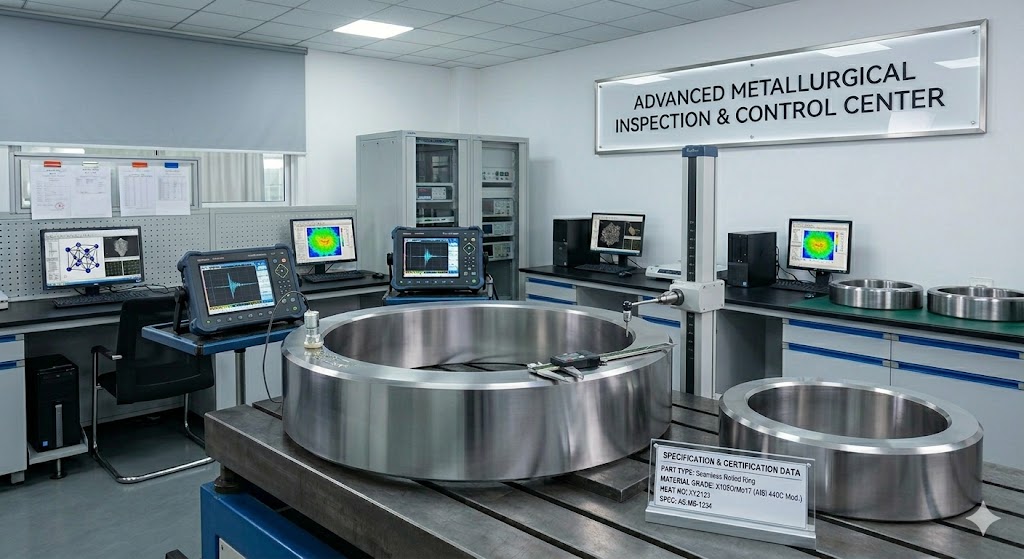
X105CrMo17 seamless rolled rings — ultrasonic testing and dimensional inspection at Jiangsu Liangyi quality control laboratory
Full-Process Quality Control & Inspection System
- Chemical Composition: Direct-reading optical emission spectrometer for full 19-element verification from every heat. Certification issued against both EN 10088-3 and ASTM A276 composition limits where dual certification is required
- Mechanical Property Testing: Universal tensile testing machine (500 kN), Charpy impact pendulum (up to −90°C for low-temperature testing), Brinell/Rockwell/Vickers hardness testers, and high-temperature tensile testing machine (up to 900°C)
- Non-Destructive Testing (NDT): Phased-array ultrasonic testing (PAUT) equipment with automated scanning for large forgings, magnetic particle testing (MT), liquid penetrant testing (PT), and conventional pulse-echo UT — all per EN 10228-3, ASTM A388, or customer-specific procedures
- Dimensional Inspection: Laser tracker (accuracy ±0.025 mm), CMM (coordinate measuring machine) for complex profiles, precision bore gauges, micrometres, surface roughness testers
- Metallographic Analysis: Metallographic microscope and image analysis system for grain size measurement (ASTM E112), carbide distribution assessment, and retained austenite estimation (quantitative metallography)
- Full Traceability: Every forging carries a unique heat number traceable through all production stages: melt chemistry → ingot casting → forging parameters → heat treatment records → inspection results → delivery certificate. Records are archived for a minimum of 15 years.
Quality Certification & Standards Capability
Our quality and compliance framework is structured at two levels: held certifications (audited and issued by accredited third-party bodies) and standards capability (technical and documentation ability to produce forgings meeting specific standard requirements, incorporated into individual customer purchase orders). We believe in clear transparency on this distinction — it is the foundation of trust with our global clients.
Held Certification
- ISO 9001:2015 Quality Management System — Third-party certified quality management system covering the complete production chain from raw material procurement through final delivery and documentation. Certificate available for customer review upon request.
Standards Capability (Incorporated into Customer Purchase Orders)
- Material Standards — EN 10088-1/3, ASTM A276, ASTM A484, DIN 17224, JIS G4303. Dual certification (EN + ASTM composition and property limits) available on most grades.
- EN 10204 3.1 Material Certificate — Issued by our quality department for every production batch, covering chemical composition, mechanical properties, heat treatment records, and NDT results. EN 10204 3.2 (third-party witness inspection) can be arranged with customer-nominated bodies such as Bureau Veritas, SGS, or Lloyd's Register — add-on service, available upon request.
- API 6A Technical Requirements — We manufacture forgings to meet the dimensional, material, and NDE requirements of API Spec 6A for wellhead and Christmas tree equipment. Customers who hold API 6A manufacturer licensing can incorporate our forgings into their qualified product lines. We do not ourselves hold an API 6A manufacturer license.
- PED 2014/68/EU Technical Requirements — We produce pressure equipment forgings to the material, NDE, and documentation requirements of PED 2014/68/EU. EU-based customers with notified body approval can incorporate our forgings into their CE-marked products. We do not ourselves hold a PED notified body certification.
- NACE MR0175 / ISO 15156 Material Compatibility — Our 1.4125 forgings in the annealed condition (≤280 HBW) meet the material requirements of NACE MR0175 for sour service. Material test documentation supporting NACE compliance review is available.
- EN 10228-3 / ASTM A388 Ultrasonic Testing — Full volumetric UT performed by Level II and Level III certified operators, with written procedures and reports per customer-specified acceptance class.
Common Pitfalls When Sourcing 1.4125 (X105CrMo17) Forgings
After 25 years of production and thousands of engineering conversations with global procurement teams, we have identified the most frequent mistakes buyers make when sourcing 1.4125 forgings. This section is intended to help you avoid these pitfalls regardless of whether you purchase from us — accurate specifications protect both buyer and supplier.
⚠ Pitfall 1: Accepting Hot-Rolled Bar Stock Described as "Forged"
In trade practice, hot-rolled bar stock is sometimes described as "forged" because rolling is technically a form of hot deformation. However, rolled bar and open-die forging are metallurgically very different products. Rolled bar has unidirectional grain flow and banded carbide distribution — acceptable for shaft applications loaded in the rolling direction, but problematic for components machined into complex 3D shapes where the finished component loading does not align with the bar rolling direction. Always request the forging reduction ratio certificate and verify that the forging was performed on a hydraulic press or hammer, not a rolling mill.
⚠ Pitfall 2: Specifying "440C" Without Verifying Mo Content
The AISI 440C designation technically allows Mo content from 0% to 0.75% — Mo is not mandated. Low-cost 440C material produced without molybdenum has significantly lower hardenability in thick sections and reduced pitting corrosion resistance in chloride environments. EN 1.4125 mandates Mo 0.40–0.80%, ensuring consistent behavior. If you need 440C material for oil & gas or marine applications, either specify EN 1.4125 as the governing standard, or add a supplementary requirement "Mo 0.40% minimum" to your AISI 440C specification.
⚠ Pitfall 3: Requesting Tempering in the 400–600°C "Embrittlement Zone"
We occasionally receive RFQs specifying hardness requirements in the range 38–48 HRC for 1.4125 — a hardness that can only be achieved by tempering in the 400–600°C temper embrittlement zone. Components tempered in this range pass all standard hardness tests but have Charpy impact values that can be as low as 3–5 J at room temperature, creating a catastrophic brittle fracture risk in service. If you need 1.4125 at 38–48 HRC, there are two safe routes: either use high tempering (≥600°C, which exits the embrittlement zone), or use a different grade such as AISI 420 (1.4021) or AISI 431 (1.4057) that achieves this hardness range without passing through the embrittlement zone.
⚠ Pitfall 4: Machining Before Final Heat Treatment
Some buyers request forgings delivered in the annealed condition (≤280 HBW) to allow their own machine shop to finish-machine the component, planning to send it out for heat treatment afterwards. For simple shapes (bars, rings) this is acceptable, but for complex machined shapes with varying cross-sections, thin walls, or sharp internal corners, post-machining heat treatment introduces serious distortion and cracking risk: the high carbon content makes 1.4125 extremely sensitive to quench gradient differences between thick and thin sections in the quenched part. Our recommendation is to rough-machine (leave 2–3 mm allowance), heat treat, then finish-machine. This sequence is more cost-efficient over the component lifecycle even if it requires an additional machine shop step.
✓ Best Practice: Request a Pre-Production Material Review
For critical or high-volume applications, we offer a no-cost pre-production material and process review: send us your drawing, application description, and existing specification, and our engineering team will review it for completeness, flag any potential metallurgical conflicts between requirements, and suggest any simplifications that could reduce cost or lead time without compromising performance. This service reflects our philosophy: the best client relationships are built on helping you specify correctly, not on discovering problems after production has started.
Order Process & Lead Times for 1.4125 (X105CrMo17) Forgings
Our order process is designed to provide maximum transparency and technical support at each stage. The following describes our standard workflow from first inquiry to delivery.
Inquiry & Technical Review (24 hours)
Submit your inquiry by email with drawing, specification, and quantity. Our engineering team reviews and provides a detailed technical quotation — including recommended hardness range, heat treatment specification, delivery condition, and UT standard — within 24 hours on business days. If your specification has any of the pitfalls described above, we will flag them with explanations before pricing.
Order Confirmation & Production Planning (3–5 days)
Upon order confirmation, we issue a Production Process Card (PPC) that specifies: melt chemistry target, forging sequence, heat treatment parameters, and inspection plan. We share this document with the client for review and approval before production begins — a transparency practice that distinguishes us from most forging manufacturers, who treat process parameters as proprietary.
Steel Melting & Ingot Casting (5–10 days)
For standard EAF+LF+VD orders: 5–7 days from casting to ingot ready. For ESR orders: add 7–10 additional days for the remelting and directional solidification process. Ingot chemistry certificate issued after casting and before forging begins; sent to client for approval if stipulated in the purchase order.
Forging & Initial Heat Treatment (7–15 days)
Forging cycle duration depends on piece weight and geometry complexity: small pieces (≤500 KG) 2–5 days; medium pieces (500–5,000 KG) 5–10 days; large pieces (5,000–30,000 KG) 10–20 days. Post-forging annealing or normalization follows immediately to prepare for final heat treatment or machining.
Machining, Final Heat Treatment & Inspection (7–15 days)
Final Q+T heat treatment performed in our sealed-atmosphere furnaces with full electronic logging. Hardness verified at minimum 3 test points per piece. NDT (UT, MT, PT as specified) performed by Level II and Level III certified operators. Full inspection report and EN 10204 3.1 certificate issued. Third-party (3.2) inspection arranged with client-specified body if required; this adds 3–7 days depending on inspector availability.
Packaging & Delivery (3–7 days from inspection release)
All forgings are individually rust-inhibited with VCI (Volatile Corrosion Inhibitor) film wrap, protected with wooden or steel frame crating, and sea-freight shipped from Jiangyin port. Export packing designed to withstand 20 ft or 40 ft container loading for LCL or FCL shipment. Lead times from order confirmation: standard (non-ESR) forgings ≤500 KG: 30–45 days; standard forgings 500–5,000 KG: 45–60 days; ESR or large forgings ≥5,000 KG: 60–90 days. Expedited scheduling available for urgent orders — contact us to discuss.
Frequently Asked Questions (FAQ) About 1.4125 (X105CrMo17) Forgings
1.4125 is the EN numeric designation for this steel, while X105CrMo17 is its EN chemical symbol designation. Breaking down X105CrMo17: "X" indicates stainless steel (Cr ≥ 10.5%); "105" indicates nominal carbon content of 1.05% (×100); "Cr" indicates chromium as a primary alloying element; "Mo" indicates molybdenum as secondary alloying element; "17" indicates approximately 17% nominal chromium. It is the direct equivalent of AISI 440C (US) and JIS SUS440C (Japan), all sharing 0.95–1.20% C and 16–18% Cr. The practical difference: EN 1.4125 mandates Mo 0.40–0.80% as a minimum, while AISI 440C/SUS440C only set a maximum (0.75%) — meaning some 440C material may contain little or no Mo. This matters in chloride environments where Mo significantly improves pitting resistance.
X105CrMo17 (1.4125) achieves 57–60 HRC after oil quenching from 1010–1020°C and low-temperature tempering at 150–200°C. This is the highest hardness achievable in any stainless steel. However, maximum hardness corresponds to minimum toughness — impact values at 60 HRC can be as low as 5 J, meaning the material is genuinely brittle. For applications involving cyclic loading, impact, or shock (valve balls under slug flow, rolling mill rolls, pump shafts), a tempered condition of 54–58 HRC (tempering at 250–300°C) produces 2–3× higher impact values while only sacrificing 2–3 HRC — a trade-off that dramatically extends service life. Always select hardness based on your application loading type, not on the maximum the material can achieve.
X105CrMo17 (1.4125) is classified as having very poor weldability due to three simultaneous problems: (1) High carbon content (0.95–1.20%) causes rapid martensite formation in the heat-affected zone (HAZ) during cooling, creating massive hardness gradients (base metal at 58 HRC, HAZ martensite at 60+ HRC, weld fusion zone varying widely) that drive cracking; (2) High chromium content promotes sensitization (carbide precipitation at grain boundaries) if the weld area is held in the 450–850°C sensitization range during cooling; (3) The combination of high C and high Cr makes hydrogen-induced cracking almost inevitable without strict preheat and post-weld heat treatment. If welding is unavoidable: preheat to 250–300°C, use E/ER309L filler metal (over-alloyed austenitic), maintain interpass temperature ≤350°C, and perform immediate post-weld stress relief at 700°C within 1 hour of welding completion. Accept that the weld joint will have lower corrosion resistance and unpredictable mechanical properties — weld area hardness can range from 25 HRC to 65 HRC across the fusion boundary.
1.4125 (X105CrMo17) has a PREN (Pitting Resistance Equivalent Number) of approximately 17–19 in the hardened and tempered condition, calculated as PREN = %Cr + 3.3×%Mo + 16×%N. For context: AISI 316L has PREN ≈ 24–26; 2205 duplex has PREN ≈ 34–36; super duplex has PREN ≈ 40+. What this means in practice: 1.4125 resists mild atmospheric corrosion (indoor, outdoor in non-marine climate), fresh water, steam condensate, dilute organic acids (citric, acetic at <50°C and <5%), and food contact environments. It will corrode in: seawater and coastal marine atmospheres; concentrated inorganic acids (HCl, H₂SO₄, HNO₃); high-chloride environments (swimming pool water, produced water with Cl⁻ > 200 ppm at elevated temperature); and any environment above pH 12 or below pH 4. If your application involves chloride exposure and you are uncertain whether 1.4125 is adequate, we recommend sending your process fluid chemistry for a corrosion compatibility assessment — this is a free service our engineering team provides for serious inquiries.
For standard EAF+LF+VD grade 1.4125: single-piece weight from 30 KG to 30,000 KG; forged bars up to 2,000 mm diameter; seamless rolled rings up to 6,000 mm outer diameter; forged shafts up to 15,000 mm length; forged discs up to 3,000 mm diameter. For ESR grade 1.4125: our ESR facility processes ingots up to 32 tons, enabling ESR forgings up to approximately 5,000 KG — sufficient for most bearing ring and precision tooling applications where ESR is typically needed. Larger ESR components (5,000–30,000 KG) can be produced using multiple ESR ingots consolidated by forge welding in the high-temperature austenite range — contact us to discuss feasibility and process certification for specific sizes.
1.4125 casting produces a continuous eutectic carbide network along dendrite boundaries — a skeletal microstructure of brittle carbide chains that act as pre-existing crack paths under load. Forging mechanically breaks up this network into discrete, uniformly distributed carbide particles (measured carbide aspect ratio ≤ 2:1 vs ≥ 5:1 in castings), eliminates solidification porosity and shrinkage voids, refines grain size from ASTM 1–3 (cast) to ASTM 5–8 (forged), and creates favorable compressive residual stresses at the surface. In service, forged 1.4125 components consistently show 40–60% longer fatigue life, 3–5× higher impact resistance, and significantly more uniform hardness distribution (±1 HRC forged vs ±5 HRC cast) compared to equivalent cast components. The initial cost premium of forging is recovered through reduced in-service failure rate and longer replacement intervals.
Specify ESR grade 1.4125 when your application requires: inclusion cleanliness better than ASTM A295 Grade 1; Charpy impact values above 15 J at delivered hardness; UT acceptance stricter than EN 10228-3 Class 3; bearing ring applications where retained austenite must be ≤1% (ESR's cleaner chemistry enables more controlled cryogenic treatment response); medical device applications requiring ISO 10993 biocompatibility documentation; or aerospace/defense components with fracture mechanics-based design life calculations. Standard EAF+LF+VD is sufficient for valve components, wear applications, tool dies, and general industrial forgings. ESR adds approximately 15–25% to material cost and 2–3 weeks to lead time — worth it for the applications listed, unnecessary and wasteful for others.
We offer four delivery conditions: (1) Black forging with scale — as-forged, for customers performing complete machining; (2) Rough-turned — 3–6 mm machining allowance per side, scale removed; (3) Semi-finished — 1–2 mm allowance, ready for final machining after heat treatment; (4) Fully machined to drawing — Ra 0.8–3.2 μm standard. Regarding sequence: for all components, we recommend the sequence rough machine → heat treat → finish machine. Machining in the annealed condition (before hardening) is easy due to ≤280 HBW hardness, leaving stock for post-HT finish machining compensates for the minor distortion and decarburization layer from heat treatment, and final machining in the hardened condition produces the best dimensional accuracy. Finish-machining before heat treatment and then hardening a complex shape is the most common cause of distortion-related field returns we receive — the quench gradient in uneven cross-sections causes unpredictable shape change that cannot be corrected without re-annealing and restarting the heat treatment cycle.
Get Your Custom 1.4125 (X105CrMo17) Forging Quotation
Jiangsu Liangyi is your technically capable and commercially reliable China-based manufacturer for 1.4125 (X105CrMo17) forging parts. With over 25 years of in-house full-chain production — one of China's experienced open die forging manufacturers for stainless steels — from steel melting through final inspection — we are uniquely positioned to provide global clients with superior quality forgings backed by genuine metallurgical expertise, not just manufacturing capacity.
Send your drawings, material specifications, required hardness, application description, order quantity, and delivery schedule to sales@jnmtforgedparts.com. Our engineering team will provide a complete technical review and competitive quotation within 24 hours — including any specification recommendations that could improve performance or reduce cost for your specific application.
Inquiry Email: sales@jnmtforgedparts.com
Phone / WhatsApp: +86-13585067993
Official Website: https://www.jnmtforgedparts.com
Factory Address: Chengchang Industry Park, Jiangyin City, Jiangsu Province, China 214400