1.4109 (X70CrMo15) Forged Forging Parts | China ISO 9001:2015 Manufacturer
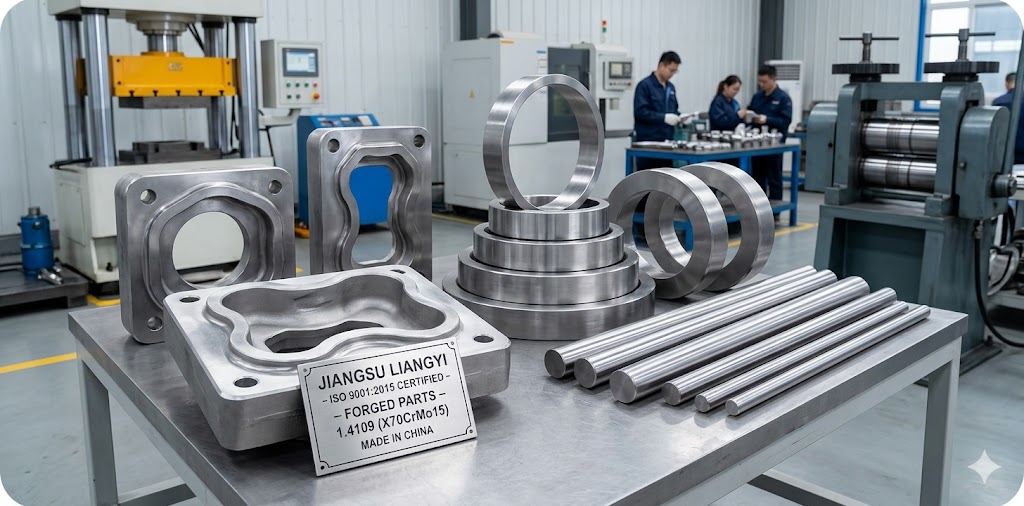
Jiangsu Liangyi is a professional ISO 9001:2015 certified manufacturer of 1.4109 (X70CrMo15) open die forging parts and seamless rolled steel forged rings, headquartered in Jiangyin, Jiangsu, China — one of China's most concentrated heavy forging production hubs, located within 100 km of Shanghai port for efficient global logistics. Founded in 1997, we have accumulated over 25 years of uninterrupted production experience in martensitic stainless steel forgings, including 1.4109, 1.4028, 1.4057, 1.4122, 420 and 440 series. Our 80,000 m² modern integrated factory operates a complete in-house supply chain: from EAF+LF+VD steelmaking, open die forging on 2,000–6,000-ton hydraulic presses, seamless ring rolling on 1m and 5m CNC ring rolling mills, CNC heat treatment on 10 computer-controlled furnaces, to rough and finish machining and full NDT inspection — all under one roof. With an annual forging capacity of 120,000 metric tons, we supply custom 1.4109 (X70CrMo15) forged components to more than 50 countries across Europe, North America, the Middle East, Australia and Asia Pacific, backed by EN 10204 3.1 Mill Test Certificates as standard and EN 10204 3.2 third-party inspection upon request. Send us your drawings and specifications — our engineering and sales team will respond within 24 hours with a detailed technical quotation.
About 1.4109 (X70CrMo15) Martensitic Stainless Steel — In-Depth Metallurgical Analysis
1.4109 (X70CrMo15), defined in EN 10088-1 and EN 10088-3, belongs to the high-carbon martensitic stainless steel family. The designation encodes its key chemistry: "X70" indicates approximately 0.70% carbon content, "Cr" stands for chromium, "Mo" for molybdenum, and "15" denotes the nominal chromium level of 15%. This naming convention immediately tells an experienced metallurgist that this grade is engineered to deliver a combination of properties that no other single stainless family can match: ultra-high achievable hardness, outstanding wear and abrasion resistance, and sufficient corrosion resistance for use in mildly aggressive environments. Understanding why these properties exist requires examining the metallurgical mechanisms at the atomic and microstructural level — which is exactly what we cover below, drawing on 25+ years of in-plant experience producing and heat treating this grade in commercial forging quantities.
Phase Transformation Behavior and Critical Temperatures
The entire heat treatment behavior of 1.4109 (X70CrMo15) is governed by its critical phase transformation temperatures, which our metallurgical team has empirically validated through dilatometry and in-plant hardening trials across hundreds of production batches:
- Ac1 temperature (austenite formation start): approximately 730°C. Below this temperature, the steel remains ferritic-carbidic and cannot be hardened by quenching. This is why all annealing and stress relief operations must be conducted with careful attention to the 600–700°C sub-critical range to avoid accidentally entering the hardening zone.
- Ac3 temperature (full austenitization): approximately 860°C. Between Ac1 and Ac3, the matrix is partially austenitic. Only above Ac3 — and specifically in the optimized austenitizing window of 1,010–1,070°C for hardening — does sufficient carbide dissolution occur to place enough carbon and chromium in solid solution for maximum hardened-state performance.
- Ms temperature (martensite start): approximately 195–215°C, depending on the actual dissolved carbon and chromium content. This relatively high Ms means 1.4109 transforms largely to martensite during air or oil cooling from the austenitizing temperature, without requiring aggressive quench rates that would crack large cross-sections.
- Mf temperature (martensite finish): approximately 50–80°C, meaning a room-temperature quench produces near-complete martensitic transformation with only 5–15% retained austenite. Cryogenic treatment at -70°C to -80°C can reduce retained austenite to below 3%, improving dimensional stability for precision bearing and gauge applications.
These transformation temperatures give 1.4109 a significant practical advantage over higher-carbon grades like 440C (Ms ≈ 100°C, Mf well below 0°C): the higher Ms means the transformation completes at a less drastic thermal gradient, dramatically reducing thermal shock and quench-cracking risk in large forged sections — a critical consideration when heat treating forgings weighing 500–5,000 kg.
1.4109 Steel Grade Designation & International Cross Reference
To meet different regional procurement requirements and cover global standard search queries, the following grade cross-reference table summarizes how 1.4109 (X70CrMo15) is designated across the world's major steel standard systems:
| Standard System | Grade Designation | Standard Reference | Notes |
|---|---|---|---|
| European (EN) | 1.4109 / X70CrMo15 | EN 10088-1, EN 10088-3 | Primary designation used in this document |
| American (AISI/UNS) | Similar to 440A Modified | No direct UNS equivalent; closest is S44002 | 1.4109 has mandatory Mo addition vs optional in 440A |
| German (DIN) | X65Cr15 / X70CrMo15 | DIN 17440 (superseded by EN) | Legacy DIN designation; EN now applicable |
| Japanese (JIS) | Similar to SUS440A | JIS G4303 | JIS SUS440A lacks mandatory Mo; specify 1.4109 for full equivalence |
| British (BS) | Similar to BS 416S29 | BS 970 Part 1 (superseded by EN) | EN designation now used in UK engineering |
Alloy Design Rationale — Why Each Element Matters
The performance of 1.4109 in service is not accidental — each alloying element plays a specific, well-understood metallurgical role. Here is the engineering rationale behind the composition of X70CrMo15, based on our in-house metallurgical data accumulated from 25+ years of production:
- Carbon (C): 0.60–0.75% — The primary hardening element. At the austenitizing temperature (1,010–1,070°C), approximately 0.45–0.55% C dissolves into the austenite matrix, with the remainder remaining as undissolved chromium carbides (Cr₇C₃ type). The dissolved carbon is "trapped" in the martensitic crystal lattice on quenching, creating the tetragonal distortion that is the source of the steel's hardness. The undissolved carbides contribute directly to wear resistance as hard particles (1,400–1,600 HV) dispersed throughout the softer martensitic matrix. The chosen carbon range is a deliberate engineering compromise: higher than 1.4028 (0.26–0.35%) to maximize hardness and wear resistance, but lower than 440C (0.95–1.20%) to preserve adequate toughness and corrosion resistance for heavy forged applications.
- Chromium (Cr): 14.0–16.0% — The corrosion resistance provider. Chromium forms a self-healing passive oxide layer (Cr₂O₃) on the steel surface when Cr content exceeds ~11%. At 14–16%, 1.4109 provides moderate corrosion resistance in atmospheric conditions, fresh water, dilute organic acids, food-grade environments and mild industrial media — adequate for the majority of its intended applications. Chromium also participates in carbide formation as Cr₇C₃ and Cr₂₃C₆, which strengthens the matrix and contributes to wear resistance. Our factory-controlled range of 14.5–15.5% maximizes chromium availability for both corrosion resistance and carbide formation simultaneously.
- Molybdenum (Mo): 0.40–0.80% — The hardenability and pitting resistance enhancer. Molybdenum is one of the most effective hardenability improvers available in stainless steel metallurgy: even at 0.5%, it shifts the continuous cooling transformation (CCT) curve significantly to longer times, allowing large-diameter forgings (up to 500–800 mm equivalent diameter) to achieve full through-hardening during oil or forced-air quenching. Simultaneously, Mo raises the Pitting Resistance Equivalent (PRE = %Cr + 3.3×%Mo) from approximately 14.5 to 15.5–17.1, significantly improving resistance to pitting corrosion in chloride environments. Molybdenum also improves "red hardness" (hardness retention at elevated temperature up to 250°C), making 1.4109 suitable for cutting tools and valve seats that experience frictional heating.
- Manganese (Mn): ≤1.0% — Factory-controlled at 0.4–0.8%. Manganese desulfurizes the melt, preventing hot shortness during forging; combines with sulfur as MnS to improve machinability; and acts as a mild austenite stabilizer to balance the martensite start temperature. Excessive Mn above 1.0% can excessively depress Ms, leading to high retained austenite in heavy sections — which is why we keep Mn on the lower end of the allowable range for forgings over 300 mm.
- Silicon (Si): ≤0.70% — Factory-controlled at 0.2–0.5%. Silicon is a ferrite stabilizer and deoxidizer added during steelmaking. At controlled levels it raises the Ac1 temperature slightly (beneficial for annealing stability), improves oxidation resistance, and moderately increases strength. Excessive Si above 0.7% causes embrittlement in high-carbon martensitic grades — which is why EN 10088 caps it at 0.70% and we target 0.2–0.5%.
- Phosphorus (P): ≤0.040% (EN limit), ≤0.030% factory — Phosphorus segregates to grain boundaries during solidification, causing intergranular embrittlement, especially in high-carbon martensitic steels where grain boundaries are already enriched in carbon. Our stricter ≤0.030% factory limit, enforced through LF refining slag chemistry control, measurably improves impact toughness and fatigue life compared to heats at the EN limit.
- Sulfur (S): ≤0.015% (EN limit), ≤0.010% factory — Sulfur forms MnS inclusions that act as stress concentrators, reducing ductility, toughness, and fatigue strength in the longitudinal-transverse and short-transverse directions. Our ≤0.010% factory limit, achieved through VD (vacuum degassing) treatment, produces a cleaner steel with improved isotropy — critical for seamless rolled rings where the short-transverse direction is loaded in service.
Chemical Composition & Mechanical Properties of 1.4109 (X70CrMo15)
All 1.4109 (X70CrMo15) forged materials at Jiangsu Liangyi are tested using an in-house optical emission spectrometer (OES) calibrated to national metrology traceable reference standards. Chemical composition is reported on the heat analysis (ladle sample) and the product analysis (sample from the forged product), with both results included in the EN 10204 3.1 MTC.
Chemical Composition — EN Standard vs. Jiangsu Liangyi Factory-Controlled Range
| Element | EN 10088-3 Limit (wt%) | Our Factory Target (wt%) | Metallurgical Purpose |
|---|---|---|---|
| Iron (Fe) | Balance (~80.7–85%) | 81.0–84.5% | Base matrix element |
| Chromium (Cr) | 14.00–16.00% | 14.50–15.50% | Corrosion resistance, carbide former |
| Carbon (C) | 0.60–0.75% | 0.63–0.72% | Primary hardening element, wear resistance via carbides |
| Molybdenum (Mo) | 0.40–0.80% | 0.50–0.70% | Hardenability, pitting resistance (PRE +3.3×Mo), red hardness |
| Manganese (Mn) | ≤ 1.00% | 0.40–0.80% | Deoxidizer, desulfurizer, mild austenite stabilizer |
| Silicon (Si) | ≤ 0.70% | 0.20–0.50% | Deoxidizer, Ac1 temperature stabilizer |
| Phosphorus (P) | ≤ 0.040% | ≤ 0.030% | Impurity — controlled below EN limit to improve toughness |
| Sulfur (S) | ≤ 0.015% | ≤ 0.010% | Impurity — VD treated; reduces inclusions, improves fatigue life |
Mechanical Properties — Standard Delivery Conditions and Heat Treatment States
1.4109 (X70CrMo15) is a versatile grade that can be delivered in several heat treatment conditions depending on the downstream application. The following table summarizes the achievable mechanical property ranges for each condition, based on our production data for forged bar and ring products:
| Condition | Tensile Strength Rm | Yield Strength Rp0.2 | Elongation A5 | Hardness | Charpy KV (room temp) |
|---|---|---|---|---|---|
| +A (Annealed) — standard delivery | ≥ 900 MPa | ≥ 600 MPa | ≥ 10% | ≤ 280 HB | ≥ 15 J (typical) |
| +QT200 (Quenched & Tempered at 200°C) | 1,900–2,100 MPa | 1,700–1,950 MPa | 4–6% | 58–62 HRC (680–750 HV) | 5–12 J |
| +QT400 (Quenched & Tempered at 400°C) | 1,500–1,700 MPa | 1,350–1,550 MPa | 6–9% | 48–54 HRC (470–580 HV) | 12–25 J |
| +QT500 (Quenched & Tempered at 500°C) | 1,100–1,350 MPa | 950–1,100 MPa | 9–14% | 38–45 HRC (380–440 HV) | 20–40 J |
1.4109 (X70CrMo15) vs. Alternative High-Hardness Stainless Steel Grades
Selecting the right martensitic stainless steel grade for a given application is one of the most consequential decisions in component design. We have compiled the following detailed comparison based on our 25+ years of manufacturing all these grades in forged form, allowing us to draw on real production data rather than textbook values alone. The goal is to help engineers make an informed choice rather than defaulting to the most commonly specified grade.
| Property | 1.4109 (X70CrMo15) | 440C (1.4125) | 1.4028 (X30Cr13) | 1.4057 (X17CrNi16-2) |
|---|---|---|---|---|
| Carbon Content | 0.60–0.75% | 0.95–1.20% | 0.26–0.35% | 0.14–0.23% |
| Chromium Content | 14–16% | 16–18% | 12–14% | 15–17% |
| Molybdenum | 0.4–0.8% (mandatory) | 0.75% max (optional) | None | None |
| Max Hardness (HRC) | 58–62 | 60–65 | 48–52 | 36–42 |
| Charpy Impact (Q+T200°C) | 5–12 J (moderate) | 3–8 J (low) | 20–40 J (good) | 40–80 J (very good) |
| Pitting Resistance (PRE) | ~15.5–17.1 | ~16.5–18.5 | ~12.5–14.0 | ~15.0–17.0 |
| Forgeability (large sections) | Good (wider forging window) | Moderate (narrow window) | Excellent | Excellent |
| Hardenability in large sections | Excellent (Mo-enhanced CCT) | Good | Moderate | Good (Ni-enhanced) |
| Primary Applications | Valve balls, bearing rings, wear plates, cutting tools | Precision bearings, surgical instruments, ultra-hard parts | Pump shafts, surgical blades, springs | High-toughness shafts, nuclear components, pressure vessels |
Complete Heat Treatment Specifications for 1.4109 (X70CrMo15) Forgings
Heat treatment is the most technically critical process step for 1.4109 (X70CrMo15) forgings, directly determining all mechanical properties and service life. Jiangsu Liangyi operates 10 sets of CNC-controlled heat treatment furnaces with real-time temperature recording and automatic alarm systems. Each furnace is regularly calibrated and verified for temperature uniformity (±10°C within the working zone) per our ISO 9001:2015 calibration procedure. Every heat treatment batch is accompanied by a furnace chart showing actual time-temperature cycles, included in the MTC documentation.
Stage 1 — Soft Annealing (Standard Delivery Condition +A)
All 1.4109 forgings leaving our factory in the annealed (+A) condition are subjected to the following controlled annealing cycle:
- Heating rate: ≤ 100°C/h to 750°C to minimize thermal gradients in large cross-sections, then free heating rate to target temperature
- Annealing temperature: 800–900°C (optimum center target: 840–860°C), held for 1 hour per 25 mm of maximum section thickness, minimum 2 hours
- Cooling rate: Controlled furnace cooling at ≤ 25°C/h to below 600°C, then free air cooling to room temperature. This slow cooling through the 730–600°C range allows complete carbide precipitation and spheroidization, producing the globular carbide microstructure that gives the annealed material its excellent machinability (typically 65–75% of free-cutting steel)
- Target result: Hardness ≤ 280 HB throughout cross-section; spheroidized carbides uniformly distributed in a ferritic matrix; grain size ASTM 5–8
Stage 2 — Hardening (Austenitizing + Quenching)
For customers requiring hardened and tempered forgings (delivery condition +QT), the following hardening cycle is applied:
- Pre-heat stage: Heat to 650–700°C, hold for 30–60 minutes for equalization — essential for large forgings over 300 mm to prevent thermal shock on the main heating stage
- Austenitizing temperature: 1,010–1,070°C. This window is critical: too low (below 1,000°C) and insufficient carbide dissolution means the austenite is carbon-lean, resulting in low post-quench hardness (55 HRC max); too high (above 1,080°C) and excessive carbide dissolution places too much Cr and C in solution, dramatically depressing the Ms temperature and increasing retained austenite content — both detrimental to final hardness and dimensional stability.
- Soak time at austenitizing temperature: 1 hour per 25 mm cross-section, minimum 45 minutes, maximum 3 hours (excessive soaking promotes grain growth, reducing toughness)
- Quench medium: Warm oil (60–80°C) for sections up to 200 mm for maximum hardness; forced-air quench with directed fans for sections 200–500 mm where oil would cause distortion or cracking; salt bath quench available for precision components requiring minimum distortion
- Target post-quench hardness: 60–64 HRC (before tempering), confirming full martensitic transformation
Stage 3 — Tempering
Tempering is conducted within 2 hours of quench completion to prevent delayed quench cracking — a critical process control requirement for high-carbon martensitic stainless steels that many suppliers overlook:
- Low-temperature tempering (100–200°C): Maximum hardness retention at 58–62 HRC; reduces quench stresses; partially converts retained austenite. Used for cutting tools, valve balls, bearing races, precision gauges. Hold time: minimum 2 hours per 25 mm section.
- Medium-temperature tempering (400–500°C): Toughness-hardness balance at 38–54 HRC; suitable for heavily loaded wear parts, pump casings, mold components. Hold time: minimum 3 hours per 25 mm section.
- Avoid 300–350°C: This range produces temper embrittlement in 1.4109 (see warning box above); Jiangsu Liangyi will not deliver components in this condition.
- Optional cryogenic treatment (-70°C to -80°C): Performed between quench and first temper on request; transforms residual austenite to martensite; improves hardness by 1–2 HRC; reduces volume change during service; essential for precision bearing rings and gauge blocks requiring long-term dimensional stability.
Full Range of Custom 1.4109 (X70CrMo15) Forged Products
We manufacture a complete portfolio of 1.4109 (X70CrMo15) forged steel products covering all major forged forms, from individual pieces of 30 kg to complete assemblies of 30,000 kg. All products can be supplied in any combination of heat treatment condition, machining stage, and surface finish, with full material traceability maintained from heat number to finished product serial number.
Forged Bars, Rounds & Step Rods
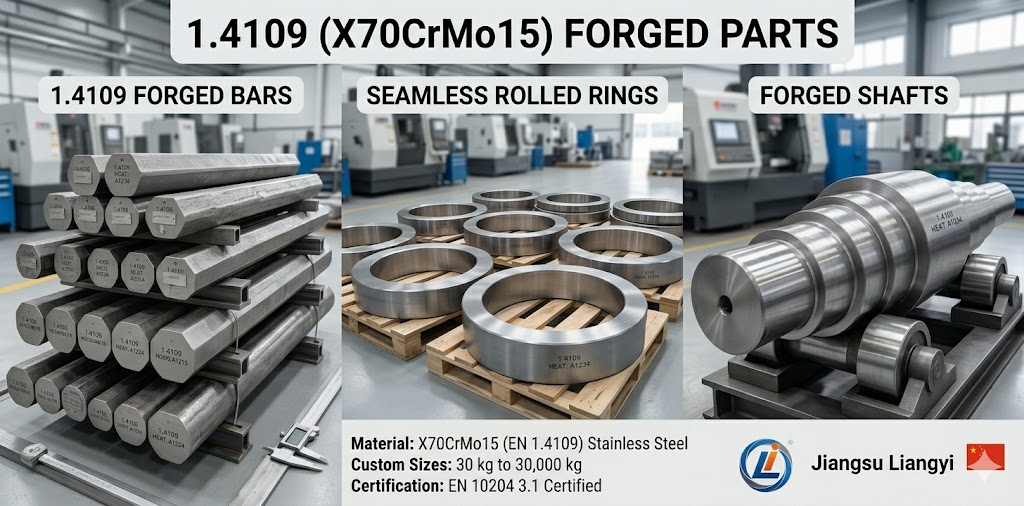
1.4109 forged bars are produced by open die press forging from vacuum-degassed billets, then rough turned on CNC lathes to remove scale and provide a consistent turned surface as the datum for customer further machining.
- Diameter range: 50 mm to 2,000 mm (above 800 mm by special arrangement with our 6,000T press)
- Length range: 200 mm to 6,000 mm, with longer lengths available in multiple-piece sets with machined joining faces
- Dimensional tolerance (rough turned): Diameter +3 / -0 mm; straightness ≤ 1 mm/m (EN 10060 equivalent or better)
- Dimensional tolerance (finish machined to drawing): h6/h7 diameter tolerance standard; h4/h5 by special arrangement; surface roughness Ra 0.4–3.2 μm selectable
- Step rods and profiled bars: All diameter steps, undercuts, keyways, bore holes, threads and flanges can be rough forged and finish machined in-house, eliminating additional subcontracting steps and traceability chain risks
Seamless Rolled Rings
X70CrMo15 seamless rolled forged rings are produced on our 1m and 5m CNC ring rolling mills using heated billets punched with a mandrel hole, then ring-rolled between driven rolls to the target dimensions. This process, unlike welded rings or fabricated rings, produces a fully continuous, seamless, defect-free grain flow oriented circumferentially — the optimal orientation for hoop stress applications in bearings, gears, flanges and valve seats.
- Outer diameter range: 200 mm to 6,000 mm
- Height (face width) range: 50 mm to 1,000 mm
- Wall thickness range: 30 mm to 800 mm (minimum ID/OD ratio approximately 0.2)
- Weight range: 10 kg to 30,000 kg per ring
- Profile rings: Contoured rings with T-section, L-section, flanged faces, undercuts and tapered bores are available by using profiled rolling dies, reducing machining allowance and material waste by up to 40%
- Roundness and concentricity: OD roundness ≤ 0.5% of OD; face parallelism ≤ 0.5 mm standard; tighter requirements achievable after precision lathe turning
Forged Shafts, Stepped Shafts & Hollow Shafts
Forged 1.4109 transmission shafts, gear shafts, rotor shafts and valve stems are produced by open die forging to a near-net-shape, then rough and finish machined. The forging process aligns grain flow parallel to the shaft axis, providing maximum fatigue strength in the critical bending and torsional load directions.
- Maximum shaft diameter: Up to 1,800 mm flange diameter; 800 mm journal diameter
- Maximum shaft length: Up to 15 meters (produced on our 6,000T press with extended bed)
- Shaft features: Flanges, journals, thrust collars, keyways, splines and end-machined features can all be forged near-net and finish machined in-house
- Hollow shafts and bored shafts: Central bores up to 800 mm diameter available by mandrel forging or subsequent CNC boring; hollow forging reduces heat treatment time and improves through-property uniformity for large diameters
Forged Discs, Plates & Hubs
- Forged discs: Diameter up to 3,500 mm, thickness up to 800 mm; used for mold bases, turbine discs, valve bodies and backing plates
- Forged plates and blocks: Square and rectangular sections up to 2,000 × 2,000 mm face, up to 500 mm thickness; used for cold forming molds, die holders, press tools and wear-resistant liners
- Hubs, sleeves and bushings: Hollow cylindrical forgings with complex external profiles, flanges and stepped bores, used as gear hubs, bearing housings, pump casings and roll sleeves
Fully Custom Complex Forgings from 2D/3D CAD Drawings
Beyond standard shapes, our DFM (Design for Manufacturability) engineering team reviews customer CAD drawings to optimize billet geometry, die impression design, forging sequence, heat treatment response prediction and machining strategy for complex one-off and small-batch forgings. We regularly produce one-off prototypes for R&D programs and volume production orders of identical components for OEM supply — under the same quality plan and documentation package.
Raw Material Sourcing, Melting Process & Traceability
The foundation of a high-quality forging is a high-quality raw material. Unlike many forging suppliers who purchase billets from third-party steel mills with no control over steelmaking parameters, Jiangsu Liangyi sources its 1.4109 (X70CrMo15) steel exclusively from major integrated Chinese steel groups with in-house OES spectrometers and vacuum processing capability, and applies our own strict incoming inspection protocol to every heat lot before it enters our forging production line.
EAF + LF + VD Triple Refining Melting Process
All 1.4109 steel used in our forgings is produced through the industry benchmark triple-refining process — Electric Arc Furnace (EAF) + Ladle Furnace (LF) + Vacuum Degassing (VD) — which delivers measurably superior cleanliness and compositional uniformity compared to basic EAF or induction furnace melting:
Incoming Billet Inspection at Jiangsu Liangyi
Every batch of 1.4109 billets arriving at our facility undergoes the following incoming inspection before release to production:
- OES spectrometer re-check: All major elements re-verified against reported composition; any batch outside our factory-controlled ranges (not just EN limits) is rejected
- Macro-etching sample: One sample per heat lot is cross-sectioned, etched in hot HCl per ASTM A604, and photographed to verify internal soundness, segregation pattern and centerline quality
- Incoming ultrasonic inspection: 100% UT scan of all billets over 150 mm diameter per EN 10228-3 Class S2 to detect pre-existing internal defects before they enter the forging process
- Dimensional check: OD, length and squareness of cut ends verified to confirm consistency with the forging plan
Complete Forging Process & Grain Structure Control
The mechanical superiority of a 1.4109 forging over a cast or bar-rolled component of the same chemistry is not a matter of opinion — it is a measurable, quantifiable result of the thermomechanical processing that forging applies to the steel. Understanding this is essential to specifying forgings correctly and getting the most value from the material's potential.
Why Forging Ratio is the Single Most Important Parameter
When 1.4109 steel solidifies in an ingot or continuous-cast billet, it forms a coarse, dendritic as-cast grain structure with ASTM grain size 1–3, along with chemical segregation (higher alloying at grain boundaries than in the grain centers), casting porosity and shrinkage pores, and a network of primary carbides (Cr₇C₃) distributed along the dendrite boundaries. In this condition, the steel has poor ductility, low fatigue strength, anisotropic properties, and frequently fails UT inspection at Severity C or D levels. None of these deficiencies can be corrected by heat treatment alone — they require mechanical deformation.
Forging ratio (also called reduction ratio, expressed as the ratio of original cross-sectional area to final cross-sectional area, or as a percentage) quantifies the total plastic deformation applied. Our minimum forging ratio for all 1.4109 production is 300% (3:1). What does this mean in practice?
- At 300% forging ratio (our minimum): Dendritic structure is fully broken down; centerline porosity is mechanically welded closed under forging pressure; grain size refines to ASTM 5–7; carbide network is partially broken up and carbide particles become more uniformly distributed; Charpy impact toughness improves by 40–60% compared to as-cast condition
- At 400–600% forging ratio (achieved on bar and shaft products): Grain size reaches ASTM 7–9 (very fine); carbide distribution becomes highly uniform; mechanical properties approach theoretical maximum for the chemistry; fatigue life in rotating bending exceeds that of equivalent cast material by factor of 2–4×; UT cleanliness reaches Class S3/E3 per EN 10228-3 reliably
- Our practice vs. industry minimum: Many forging specifications require only 200% forging ratio as a minimum. Our internally imposed 300% minimum — validated by 25+ years of in-house metallographic data — consistently produces forgings with better impact toughness, fatigue performance and UT cleanliness than the specification minimum requires. This is part of our commitment to making forgings that outlast their design life in service.
Forging Temperature Control for 1.4109
1.4109 (X70CrMo15) has a narrower usable forging temperature window than lower-carbon martensitic grades, requiring more careful temperature monitoring:
- Heating rate to forging temperature: ≤ 80°C/h below 800°C (to prevent thermal cracking in large billets), then free rate above 800°C
- Forging temperature range: 1,050–1,200°C. Above 1,230°C, excessive grain growth occurs and edge cracking risk increases; below 1,000°C, the steel becomes too resistant to deformation and internal tearing can occur in large reductions
- Minimum finishing temperature: ≥ 950°C. Forging into the ferritic-austenitic two-phase region below 900°C dramatically worsens surface finish and creates mixed-grain microstructure
- Infrared pyrometry monitoring: All forgings are monitored by calibrated IR pyrometers; the forge operator is alerted automatically if the billet surface drops below the minimum reheating threshold
- Post-forging cooling: Slow cooling in sand, insulating blankets or furnace to below 600°C is mandatory after forging to avoid quench-cracking from the residual forging stresses
Core Manufacturing Equipment Capabilities
- Forging presses: 2,000T, 3,150T, 5,000T and 6,000T four-column hydraulic forging presses; 0.75T, 1T, 3T, 5T and 9T electro-hydraulic forging hammers; complete range covering pieces from 30 kg to 30,000 kg
- Ring rolling mills: 1m-class and 5m-class CNC radial-axial ring rolling mills with automatic diameter-height ratio control, producing rings from 200 mm to 6,000 mm OD with ±2 mm dimensional repeatability
- Heat treatment furnaces: 10 sets of CNC-controlled car-bottom and elevator furnaces, temperature uniformity verified at ±10°C within working zone per ISO 9001:2015 calibration records; maximum capacity 50,000 kg per batch; oil quench, forced-air quench and salt bath quench available
- Machining centers: CNC vertical and horizontal turning lathes (maximum swing 5,000 mm); CNC boring mills (maximum boring diameter 2,500 mm); CNC milling centers; centerless grinders; surface grinders; capable of Ra 0.4 μm finish and IT6 dimensional tolerance
Global Industry Applications, Engineering Case Studies & GEO-Targeted Supply Experience
Over 25 years of export-focused production, Jiangsu Liangyi has accumulated deep application knowledge for 1.4109 (X70CrMo15) forgings in each of our major target markets. The following sections document not just the industries served, but the specific engineering challenges that 1.4109 solves in each region, the local compliance standards we work to, and the documented performance outcomes from our customers' feedback. This represents genuine accumulated experience — not marketing language.
Europe Market — 1.4109 Forging Parts Supply to EN Standards
Europe is our largest and most technically demanding export market. All European supply is governed by EN 10088-3 chemistry requirements, EN 10228-3 UT acceptance criteria, and EN 10204 3.1/3.2 material certification. We are fully familiar with European procurement practices including third-party TÜV, Bureau Veritas and Lloyd's Register inspection, and have extensive export experience supplying component manufacturers in Germany, France, Italy, the Netherlands, Sweden, and Spain.
Germany — Automotive Tool & Die and Precision Cutting Tool Industry
German cold-forming tool manufacturers represent one of the most technically rigorous markets for 1.4109 forgings. Cold forming dies for automotive body panels experience compressive stresses up to 2,500 MPa at the working surface, combined with repeated impact loading at production rates of 30–80 parts per minute. The failure mode in conventional tool steels is a combination of adhesive wear at the die surface (galling against the formed blank) and fatigue crack initiation at subsurface carbide colonies (propagating to chipping fracture). 1.4109 forged dies address both mechanisms simultaneously: the high uniform carbide density (from controlled forging ratio) resists galling, while the homogeneous microstructure (from VD melting and 400%+ forging ratio) prevents early subsurface crack initiation. In application testing and customer feedback, forged 1.4109 has demonstrated significant die life advantages over cast or lightly worked material of the same grade — actual results vary by specific application conditions. We supply forged blocks up to 1,200 × 800 × 500 mm, annealed to ≤ 265 HB with guaranteed machinability, with surface condition suitable for EDM wire-cutting without pre-treatment.
Germany & France — Industrial Cutting Tools (Files, Scrapers, Reamers, Taps)
1.4109 has been the material of choice for high-quality file cutters, wood-working knives, linen-cutters and precision scrapers in Europe since the early 20th century, precisely because its carbon/chromium ratio provides the optimal balance of sharpness (from achievable hardness above 60 HRC) and corrosion resistance (from 14–16% Cr) for tools used in humid industrial and food-processing environments. We supply 1.4109 forged bars from 20 mm to 250 mm diameter in the annealed condition, with surface roughness ≤ Ra 3.2 μm on the turned surface and ≤ 0.3 mm straightness per meter — tolerances that our European cutting tool customers have confirmed are required for automated CNC blanking of tool blanks with minimum repositioning.
Italy — Railway Transmission Components
Italian locomotive and rail vehicle component manufacturers use 1.4109 forged transmission shafts and wear rings in electric traction applications, where the component must simultaneously resist fretting wear from repeated assembly/disassembly cycles, fatigue loading at high rotational speeds (up to 3,000 rpm), and mild atmospheric corrosion in non-sealed housings. The key design challenge is achieving uniform hardness through large cross-sections: a 300 mm diameter shaft must be hardened to ≥ 52 HRC at the surface and ≥ 48 HRC at the center to provide consistent wear resistance across its full service lifetime. Our molybdenum-controlled (0.50–0.70%) heats combined with forced-air quenching consistently achieve this through-hardening profile on cross-sections up to 350 mm, as verified by our in-house Brinell hardness mapping protocol (minimum 5 measurement points across the cross-section on the MTC test bar).
Spain & Netherlands — Oil and Gas Valve Components (EN and PED Compliance)
Spanish and Dutch engineering contractors for North Sea and Mediterranean subsea projects require 1.4109 forged valve balls, stems, seats and body components compliant with both EN 10088-3 (material) and PED 2014/68/EU (Pressure Equipment Directive). Our material documentation package (EN 10204 3.1 MTC + EN 10228-3 UT reports) is designed to support our customers' own PED 2014/68/EU compliance processes — PED CE marking is obtained by the equipment manufacturer, and we supply the material documentation they require. All valve body forgings are supplied with UT per SEP 1921 Severity Class D/D (stricter than EN 10228-3 standard requirements) on request, with scan coverage of 100% of the volumetric area including transition zones between body and bore.
North America Market — ASTM and API Compliant 1.4109 Forgings
The North American market for 1.4109 forgings (supplied to the USA, Canada and Mexico) requires compliance with ASTM material standards, API application standards, and ASME code requirements. We produce 1.4109 forgings with documentation packages aligned to EN 10088-3 chemistry requirements and ASTM A788 forging process requirements, suitable for use in ASME Section VIII pressure vessel applications and API 6A wellhead equipment (API 6A certification is held by the valve/equipment manufacturer; we supply the conforming forged material with supporting documentation). Our English-language technical team, experienced with US and Canadian RFQ formats, shortens the procurement cycle significantly for North American buyers.
USA & Canada — Upstream Oil & Gas: High-Pressure Valve Components
1.4109 (X70CrMo15) is selected for HPHT (High Pressure High Temperature) wellhead valve trim in Class 900–2500 service because it combines the hardness needed to resist sand erosion (production rates of 50,000+ bbl/day carry 200–2,000 mg/L sand in many unconventional wells) with sufficient corrosion resistance in the produced fluid environment (CO₂ partial pressure up to 3 MPa, H₂S below 10 ppm — conditions where carbon steel corrodes at 5–15 mm/year but 1.4109 at 0.05–0.1 mm/year). The dominant failure mode we help prevent is wall-thinning erosion-corrosion at the valve trim OD, where sand-laden produced fluid impinges at 6–12 m/s on the valve ball and seat. Extended trim service life compared to softer precipitation-hardened grades (17-4PH at 44 HRC max) is the key engineering driver for specifying 1.4109 at 58–62 HRC in sand-erosion-dominant applications — reduced trim replacement frequency directly lowers well intervention costs. We supply valve balls from 2" to 24" bore diameter in the Q+T200°C condition, with OD finish machined to Ra 0.2 μm and hardness documented at 5 points across the MTC test coupon.
USA — Industrial Bearing Industry: Bearing Rings and Race Inserts
1.4109 forged bearing rings provide a cost-effective alternative to 52100 (through-hardened bearing steel) in applications requiring corrosion resistance — food processing machinery, wet paper mills, marine deck equipment and chemical pumps where 52100 rings corrode within weeks but 1.4109 rings survive for 3–5 year maintenance cycles. The key metallurgical requirement for bearing applications is tight cleanliness control: oxide inclusions above 15 μm in length serve as fatigue crack initiation sites under rolling contact stress and cause premature spalling failure. Our EAF+LF+VD process consistently achieves cleanliness at or better than ISO 683-17 Grade S2 (fine oxide inclusions ≤ 10 μm in the worst field), and our UT acceptance criterion of EN 10228-3 Severity 4/4 provides additional volumetric assurance for critical bearing rings over 150 mm ID.
Mexico — Surgical Instrument and Medical Device Components
Mexico's medical device manufacturing cluster (Monterrey, Guadalajara, Ciudad Juárez) — primarily producing for US OEM medical brands — requires 1.4109 forged bar and disc material for surgical scissors, orthopedic rasps, retractor blades and endoscope components. The key requirements in this segment are: (1) a minimum hardness of 55 HRC after customer heat treatment, confirmed by our OEM partners' in-house testing; (2) corrosion resistance suitable for instrument-grade medical applications (note: 1.4109 is a high-carbon martensitic grade used for surgical instruments and tools that contact tissue externally; it is not an ISO 5832 implantable biomaterial grade — customers requiring implantable material certification should consult their regulatory team); (3) freedom from sulfide inclusions — a requirement we address through our strict ≤0.010% S limit enforced at VD melting stage; metallographic inclusion assessment at 200× magnification is available on request through our in-house metallographic laboratory; and (4) documented batch traceability from heat number through forging number to bar serial number, compatible with heat-number-to-serial-number traceability requirements typical of regulated medical device supply chains. We can prepare structured traceability documentation packages on request — customers should confirm their specific regulatory traceability format requirements at the quotation stage.
Middle East Market — API 6A Compliant X70CrMo15 Valve Components
The Middle East — particularly Saudi Arabia (Aramco supply chain), UAE (ADNOC projects), Kuwait (KPC contractors) and Qatar (QatarEnergy LNG projects) — is one of the most demanding procurement environments in the world for forged valve components. Major Middle Eastern national oil companies (including in Saudi Arabia, UAE and Qatar) maintain rigorous supplier approval processes for critical components. We are experienced in supporting customer supply chain audit requirements and provide comprehensive factory capability documentation, quality system records and material traceability evidence to support customer qualification processes for their end-use projects in this region.
Saudi Arabia (Aramco Supply Chain) — HPHT Wellhead Valve Trim
Saudi Aramco's specification SAES-A-206 (Sour Service) requires all valve trim in H₂S-containing service above the SSC (Sulfide Stress Cracking) threshold (H₂S partial pressure > 0.0003 MPa) to comply with NACE MR0175/ISO 15156. 1.4109 martensitic stainless steel is permissible under this standard in the hardened and tempered condition with maximum hardness ≤ 23 HRC (260 HV), suitable for non-wetted valve components (stems, seat carriers, body); for wetted trim in full sour service, 1.4109 at high hardness (58–62 HRC) is excluded and we typically recommend 1.4057 (X17CrNi16-2) or duplex grades instead. Our technical team provides material selection guidance at no charge as part of the quotation process to help customers avoid costly specification errors.
UAE & Qatar — LNG Plant Cryogenic Applications
Several of our Middle East customers operate LNG liquefaction and regasification terminals, requiring valve and pump components that function at cryogenic temperatures (-165°C for LNG service). Martensitic stainless steel 1.4109 retains its hardness at cryogenic temperatures (hardness typically increases by 2–4 HRC at -165°C vs room temperature), but impact toughness drops significantly — Charpy impact at -165°C can fall to 3–6 J from 15 J at room temperature. For LNG cryogenic valve seats and guide bushings (where wear resistance at temperature is the primary requirement), 1.4109 is specified with the following additional protocol: Charpy impact testing at -196°C (reported on MTC); minimum 5 J acceptance; and careful tempering at 200°C ± 10°C. For structural components (valve bodies, flanges, bonnets) in LNG service requiring both toughness and corrosion resistance at -165°C, austenitic grades (1.4307, 1.4404) are the appropriate choice and we advise accordingly.
Kuwait & Bahrain — Desalination Plant Pump Components
Multi-stage desalination pumps (MSF and RO plants) in the Middle East operate in a specific environment: high flow velocity (8–15 m/s), elevated temperature (up to 120°C in MSF), high chloride concentration (35,000–45,000 ppm seawater, up to 90,000 ppm in MSF brine stages), and continuous erosive impingement from suspended solids (5–50 mg/L). The primary material failure mode for pump impellers, wear rings and shaft sleeves in this environment is erosion-corrosion synergy: the passive Cr₂O₃ film is continuously abraded by solid particles, exposing fresh metal to corrosion, which then creates a soft, corroded surface layer more susceptible to the next erosion event — creating a self-accelerating degradation cycle. 1.4109 at 58–62 HRC is highly resistant to this mechanism because the very high hardness physically resists the initial abrasion step, breaking the synergy cycle. Our customers in Bahrain and Kuwait report pump component replacement intervals of 18–24 months for 1.4109 hardened wear rings, compared to 6–8 months for 1.4021 (X20Cr13) at 46 HRC in the same service.
Australia & Oceania — AS/NZS Standard Compliance, Mining & Metallurgy
Australia's mining and mineral processing sector — iron ore (Pilbara), gold (Kalgoorlie-Boulder), copper (Olympic Dam) and coking coal (Bowen Basin) — creates intense demand for high-hardness wear-resistant components in grinding mills, classifiers, crushers and conveyors. The dominant wear mechanism in these applications is high-stress abrasion (abrasive particles larger than the carbide spacing in the wear-resistant material, causing gross cutting rather than micro-ploughing), which strongly rewards higher absolute hardness levels. Australian mining OEM customers typically specify hardness by surface Leeb or Rockwell hardness measurement on the component surface, with minimum 56 HRC for 1.4109 parts — a target our Q+T200°C treatment consistently delivers.
Australia — SAG Mill Bearing Rings and Liner Attachment Hardware
Semi-autogenous grinding (SAG) mills in Australian iron ore and gold operations run 24/7 and process ore at feed rates of 2,000–8,000 tonnes per hour. The trunnion bearing rings (diameter 1,000–3,500 mm, face width 200–600 mm, wall thickness 80–200 mm) experience a unique combination of: very high static loads (up to 15,000 kN bearing reaction), slow rotation (8–15 rpm), and continuous contamination with abrasive slurry. The premium material for these rings is 1.4109 forged seamless ring at 55–58 HRC, replacing induction-hardened carbon steel rings (50 HRC surface only) that wore through to the soft core within 18–24 months. In Australian mining applications reported by customers, 1.4109 forged through-hardened rings have shown significantly extended service life compared to surface-only hardened carbon steel alternatives — a result directly attributable to the combination of uniform hardness through the full wall thickness (enabled by Mo-enhanced hardenability) and the high forging ratio (400%+) that eliminates the subsurface carbide colonies that initiate fatigue cracks in cast or lightly worked material.
Australia — Rolling Mill Rolls and Roll Sleeves
Steel mini-mills and wire rod rolling mills in Australia (Whyalla, Port Kembla, Sydney) use 1.4109 forged roll sleeves (100–600 mm OD, 60–150 mm wall, 200–800 mm face width) on finishing mill stands, where the sleeve is heated to 200–350°C by frictional contact with the rolled product and must maintain ≥ 52 HRC at temperature ("red hardness"). The 0.4–0.8% Mo in 1.4109 is the critical alloying element here: it retards the carbide coarsening (overtemper) reaction that occurs during service at elevated temperature, preserving hardness 8–12% better than Mo-free grades at identical initial hardness levels. We supply roll sleeves in the Q+T200°C condition with post-tempering Rockwell hardness mapped at 5 axial positions per sleeve, all results reported on the MTC. The shrink-fit bore is finished to H7 tolerance with Ra 0.8 μm, allowing consistent thermal press-fit assembly at 200°C interference fit temperature without specialist equipment.
Asia Pacific Market — JIS and GB Standard Compliant 1.4109 Forgings
The Asia Pacific market — South Korea, Japan, Taiwan, Singapore, Malaysia, Thailand, Vietnam, Indonesia and the Philippines — represents a fast-growing segment of our 1.4109 export volume, driven by continued investment in power generation, petrochemical processing, marine equipment and advanced manufacturing.
South Korea — Power Generation: Steam Turbine Components
South Korean power generation EPC contractors and turbine OEMs specify 1.4109 (or equivalent grade) for steam turbine stationary blade roots (diaphragm rings), steam chest nozzle rings and erosion shields in condensing steam turbine applications. The steam path components in the LP (low-pressure) section of large condensing turbines experience combined water droplet erosion (droplet impact velocity 200–400 m/s in the last stages), steam-side oxidation (pH 8.5–9.5 condensate with oxygen ingress to 10 ppb during load cycling) and fatigue loading from blade passing forces. 1.4109 at 58–62 HRC provides 4–6× better water droplet erosion resistance compared to 12Cr martensitic steel at 30 HRC in comparative laboratory erosion tests. Significant improvements in erosion shield service life have been documented in published literature comparing 58–62 HRC martensitic stainless steel against lower-hardness 12Cr grades in equivalent droplet erosion test conditions. We supply these components in the Q+T200°C condition with circumferential Brinell hardness mapping at 8 points per ring, and can adapt our UT acceptance criteria to customer-specified requirements stricter than EN 10228-3 Severity 4/4 upon request.
Japan — Precision Industrial Knife and Blade Industry
Japan's precision blade industry (Seki City, Gifu Prefecture — the global center of precision blade manufacturing) has used high-carbon martensitic stainless steels since the 1950s. Japanese blade manufacturers sourcing from Jiangsu Liangyi specify 1.4109 forged bar for industrial slitting blades (paper, film, rubber), wood router cutters and metal scraper blades, where the combination of 58–62 HRC achievable hardness, 14–16% Cr corrosion resistance, and excellent grindability (carbide network broken by high forging ratio is far easier to grind than as-cast carbide morphology) makes 1.4109 the material of choice over 440C for shapes requiring complex profile grinding. We supply to JIS B4311 tool steel tolerance requirements for bar diameter (h6) and straightness (≤ 0.15 mm/m), with surface condition compatible with direct CBN profile grinding without prior skin removal. Material certificates include the full OES composition report and Rockwell hardness sampling at both bar ends and center, providing Japanese customers with the per-bar material evidence required for their quality-assured production systems.
Southeast Asia (Vietnam, Thailand, Indonesia) — General Machinery and Mold Components
Southeast Asia's rapidly expanding manufacturing sector — automotive parts (Thailand), electronics components (Vietnam, Malaysia), plastics processing (Indonesia) — creates growing demand for 1.4109 forged mold and die components, specifically cavity inserts, runner plates, core pins and ejector sleeves for injection molds producing consumer electronics housings, automotive trim parts and food packaging. The specific advantage of 1.4109 in plastic injection molding is its ability to be polished to mirror finish (Ra ≤ 0.025 μm, equivalent to VDI 0–2 mold surface finish) after hardening and tempering, while maintaining 58–62 HRC hardness to resist parting line wear from filled resins (GF30, GF50 grades) that are highly abrasive. We supply to Southeast Asian mold makers in the annealed condition (≤ 265 HB, confirmed machinable to ISO H tolerance in our in-house trial cuts), with customer heat treatment to Q+T200°C performed locally. We provide detailed written heat treatment procedure sheets with each batch, in English and optionally in local language, covering all critical temperature, soak time, quench medium and quench-to-temper delay requirements.
Production Standards, International Compliance & Full-Process Quality Control System
Jiangsu Liangyi operates a documented, audited and continuously improved quality management system for all 1.4109 (X70CrMo15) forged production, from raw material receipt to finished product delivery. Our quality plan for each order is a living document that defines inspection points, acceptance criteria, responsible personnel and documented evidence for every step of the production process — not a generic checklist, but an order-specific plan reviewed and approved by our quality manager before production starts.
Certification and Standard Compliance Framework
All 1.4109 (X70CrMo15) forged products from Jiangsu Liangyi are manufactured in full compliance with the following international standards. We maintain controlled copies of all standards in our technical library, updated annually:
- EN 10088-1: 2005 — Stainless steels: List of stainless steels. Defines the chemical composition limits for 1.4109 (X70CrMo15) as the primary design standard.
- EN 10088-3: 2005 — Stainless steels: Technical delivery conditions for semi-finished products, bars, rods, wire, sections and bright products of corrosion resisting steels for general purposes. Governs mechanical property requirements, test sampling, surface condition and documentation requirements for our bar and ring deliveries.
- EN 10228-3: 1999 — Non-destructive testing of steel forgings: Ultrasonic testing of ferritic or martensitic steel forgings. All UT inspection is performed per this standard with minimum Severity Class S2/E2; stricter classes (S3/E3, S4/E4) available to order.
- ASTM A788 / A788M — Standard Specification for Steel Forgings, General Requirements. Applied for orders requiring ASTM-format documentation (USA, Canada, North American API projects).
- ASTM A604 / A604M — Standard Practice for Macroetch Inspection of Steel Bars, Billets, Forgings, and Other Forged Products. Used for macrostructure evaluation; acceptance per Table 2 for cross-sections ≤ 523 cm².
- ASTM E112 — Standard Test Methods for Determining Average Grain Size. Grain size evaluation performed per this standard; target ASTM 5–8 for all 1.4109 production; reported on MTC on request.
- EN ISO 6892-1: 2019 — Metallic materials: Tensile testing — Part 1: Method of test at room temperature. All tensile testing (Rm, Rp0.2, A5, Z) performed per this standard on calibrated servo-hydraulic test machines.
- EN ISO 6506-1 — Brinell hardness testing. Hardness testing performed per this standard using calibrated reference blocks; HBW 10/3000 method standard.
- ISO 148-1: 2016 — Metallic materials: Charpy pendulum impact test. Impact testing at room temperature (standard) or at specified test temperatures (-20°C, -40°C, -60°C, -196°C) on calibrated pendulum machines.
- EN ISO 9934-1 — Non-destructive testing: Magnetic particle testing. MT performed per this standard using wet fluorescent method; UV-A lamp intensity ≥ 1,000 μW/cm² at inspection surface.
- EN ISO 3452-1 — Non-destructive testing: Liquid penetrant testing. PT per this standard using Type II (post-emulsifiable) fluorescent penetrant for maximum sensitivity on rough machined surfaces.
- API 6A (22nd Edition): 2018 — Specification for Wellhead and Christmas Tree Equipment. Applicable to oil and gas valve trim components supplied to wellhead API 6A service classes PR1 and PR2.
- NACE MR0175 / ISO 15156 — Petroleum and natural gas industries: Materials for use in H₂S-containing environments in oil and gas production. Relevant for sour service material selection guidance.
- ISO 9001: 2015 — Quality management systems. Our factory QMS is certified to this standard by a recognized third-party certification body, with annual surveillance audits.
Full-Process Quality Inspection Gates
Quality inspection at Jiangsu Liangyi is not a final-stage check — it is an integrated series of mandatory inspection gates throughout the production process. No work is passed forward to the next stage without documented evidence of conformance at the current stage:
Macrostructure Acceptance Requirements
Visual examination of transverse full cross-sections from bars, billets and forging stock, etched in hot hydrochloric acid in accordance with ASTM A604, shall show no pipe, cracks, or linear defects. For products with nominal cross-sectional area of 523 cm² (81 square inches) and under, porosity, segregation, inclusions and other imperfections shall be no worse than the macrographs of ASTM A604 Table 2 at the following severity levels:
- Class 1, Condition Freckles: Severity A
- Class 2, Condition White Spots: Severity A
- Class 3, Condition Radial Segregation: Severity A
- Class 4, Condition Ring Pattern: Severity B
For products with cross-sectional area greater than 523 cm², macrostructure requirements are agreed on a case-by-case basis with the customer's engineering authority prior to production start, with reference macrographs attached to the quality plan.
Packaging, Delivery & Lead Time
Standard Export Packaging
All 1.4109 forged products exported from Jiangsu Liangyi are packed to prevent damage during ocean freight (vibration, humidity, impact) and to maintain the dimensional integrity and surface condition verified at our final inspection stage:
- Corrosion protection: All machined surfaces are coated with VCI (Vapor Corrosion Inhibitor) oil or VCI film wrap, rated for minimum 24 months of protection in a sealed container environment. This is particularly important for 1.4109 in the annealed condition (≤ 280 HB) where the passive oxide film may not yet be fully developed after machining.
- Impact protection: Heavy forgings (above 500 kg) are wooden-crated with custom-fitted timber supports, nailed and banded. Machined faces are protected by 10 mm thick rubber or foam pads. Rings are stacked face-to-face with plywood spacers, never nested (which would cause surface damage from vibration).
- Light items: Smaller bars, rings and discs (below 200 kg) are bundled with 25 mm steel banding, with rubber sleeves protecting the banding edges from surface marking.
- Moisture control: Desiccant bags (silica gel, 500–2,000 g depending on crate volume) are placed inside all wooden crates and sealed in the package with the VCI-wrapped product.
- Marking: Each piece is stenciled or cold-stamped with heat number, material grade (1.4109), piece number, Jiangsu Liangyi logo and purchase order number for full traceability throughout the logistics chain to the customer's receiving inspection.
Typical Lead Times
| Product Type & Condition | Single Piece Weight | Standard Lead Time | Expedited (Rush) Lead Time |
|---|---|---|---|
| Forged bars, rough turned, annealed (+A) | 30–500 kg | 4–5 weeks | 2–3 weeks (surcharge applies) |
| Seamless rolled rings, rough turned, annealed (+A) | 50–2,000 kg | 4–6 weeks | 3–4 weeks (surcharge applies) |
| Large forgings (bars, shafts, discs), Q+T, rough machined | 2,000–15,000 kg | 8–12 weeks | 6–8 weeks (limited availability) |
| Custom complex forgings with finish machining and full NDT | Any | 10–16 weeks | Case by case, contact our team |
| Prototypes (single pieces from approved drawings) | 30–3,000 kg | 6–8 weeks | 4–5 weeks (limited slots) |
All lead times are calculated from order confirmation plus drawing approval. We provide weekly production status updates by email or WhatsApp for all orders in production. Final inspection and documentation are completed at least 5 working days before the confirmed shipping date to allow time for any customer or third-party inspector review of documents before cargo release.
Frequently Asked Questions (FAQ) About 1.4109 (X70CrMo15) Forgings
This section addresses the technical and commercial questions most frequently raised by engineers, procurement managers and metallurgists evaluating 1.4109 (X70CrMo15) for their projects. Answers are based on our in-plant experience and in-house metallurgical data — not generic textbook information.
1.4109 (X70CrMo15) is a high-carbon martensitic stainless steel defined in EN 10088-1/-3, characterized by 14–16% Cr, 0.60–0.75% C and a mandatory 0.4–0.8% Mo addition. What makes it unique is the combination of properties it delivers simultaneously: ultra-high achievable hardness (up to 58–62 HRC after Q+T at 200°C), excellent abrasion resistance from a high density of uniformly dispersed chromium carbides, good hardenability in large cross-sections (enabled by Mo), and sufficient corrosion resistance (Cr₂O₃ passive film from 14–16% Cr) for use in mildly aggressive environments. Unlike austenitic grades (which cannot be heat-treated to high hardness), unlike tool steels (which rust rapidly), and unlike precipitation-hardening grades (which peak at 44–50 HRC), 1.4109 occupies a unique position in materials space that makes it the first choice for high-hardness, wear-resistant components in mildly corrosive service. No other single stainless grade simultaneously achieves all of these properties.
The standard heat treatment for 1.4109 consists of three mandatory stages: (1) Annealing (soft state delivery +A): heat to 800–900°C, hold 1 hour per 25mm cross-section, controlled furnace cooling at ≤25°C/h to below 600°C, then air cool. Result: ≤280 HB, spheroidized carbide microstructure, excellent machinability. (2) Austenitizing (hardening): pre-heat to 650–700°C for equalization; then heat to 1,010–1,070°C, hold 45 minutes to 1 hour per 25mm; quench in oil (sections ≤200mm) or forced air (sections 200–500mm). The 1,010–1,070°C window is critical: below 1,000°C the hardness falls below 55 HRC; above 1,080°C retained austenite increases sharply. Post-quench hardness target: 60–64 HRC. (3) Tempering: performed within 2 hours of quench completion to prevent delayed cracking; 100–200°C for maximum hardness (58–62 HRC); 400–500°C for toughness-hardness balance (38–54 HRC). Strictly avoid 300–350°C (temper embrittlement zone). Optional cryogenic treatment at -70°C to -80°C between quench and first temper converts residual retained austenite and improves dimensional stability for precision applications.
The key differences between 1.4109 (X70CrMo15) and 440C (1.4125) in forged form are: Carbon: 0.60–0.75% vs 0.95–1.20% — the higher C in 440C enables higher peak hardness (60–65 HRC vs 58–62 HRC) but dramatically reduces toughness (Charpy 3–8 J vs 5–12 J for 1.4109 at Q+T200°C) and weldability. Molybdenum: 1.4109 has a mandatory 0.4–0.8% Mo addition; 440C specifies Mo as optional (≤0.75%). The mandatory Mo in 1.4109 provides measurably better hardenability in large cross-sections (>200mm), better red hardness (hardness retention at 200–250°C service temperature), and higher pitting resistance equivalent (PRE 15.5–17.1 vs 14.5–16.5). Forgeability: 1.4109 has a wider usable forging temperature window and is less susceptible to hot-tearing on heavy reductions. For heavy forgings over 300mm equivalent diameter, we recommend 1.4109 over 440C for its combination of consistent through-hardening and adequate toughness. 440C is preferred only where absolute maximum hardness (above 60 HRC) is essential and component cross-section is small (below 50mm).
1.4109 (X70CrMo15) has inherently poor weldability due to its high carbon equivalent (CE ≈ 0.72–0.88%). Without proper procedures, the HAZ (heat-affected zone) undergoes rapid martensitic transformation during weld cooling, creating hardness spikes above 500 HV and severe hydrogen-assisted cracking risk, particularly in heavier sections. If welding is unavoidable, the following precautions are mandatory: (1) Pre-weld heat treatment: soften to annealed condition (≤280 HB) if starting from hardened state; (2) Preheat: minimum 200°C for sections ≤25mm, 250–300°C for heavier sections; (3) Interpass temperature control: maintain 200–280°C throughout welding — do not allow the HAZ to cool below preheat temperature between passes; (4) Consumable selection: matching 1.4109 filler (type ER410NiMo for strength match) or over-alloyed austenitic ER309L for better crack resistance in dissimilar joins; (5) Hydrogen control: use low-hydrogen consumables (H4 classification maximum); (6) PWHT: temper immediately after welding at 650–700°C for stress relief and HAZ softening. 1.4109 components designed for welded fabrications should always be discussed with our engineering team at the design stage — in most cases, a re-design to eliminate the weld joint is both more reliable and more cost-effective.
Our maximum production capabilities for 1.4109 forged parts are: Single-piece weight: 30 kg to 30,000 kg. Forged bars (round): diameter 50–2,000 mm, length up to 6,000 mm; above 800mm diameter produced on our 6,000T press. Seamless rolled rings: OD 200–6,000 mm, height 50–1,000 mm, wall thickness 30–800 mm, weight up to 30,000 kg per ring. Forged shafts: journal diameter up to 800 mm, flange diameter up to 1,800 mm, length up to 15,000 mm. Forged discs and blocks: diameter up to 3,500 mm, thickness up to 800 mm; rectangular blocks up to 2,000 × 2,000 × 500 mm. All sizes can be supplied in any combination of heat treatment condition (+A, +QT200, +QT400, +QT500) and machining stage (as-forged, rough turned/machined, semi-finish, finish machined to drawing). For pieces over 5,000 kg, we require a detailed technical discussion before quotation to confirm press capacity, heat treatment furnace fit, and UT accessibility.
All 1.4109 (X70CrMo15) forgings from Jiangsu Liangyi are supplied with a comprehensive documentation package. Standard (included in every order): EN 10204 3.1 Mill Test Certificate signed by our QC manager, covering: heat number and material grade; OES spectrometer chemical composition (heat and product analysis); tensile test results (Rm, Rp0.2, A5, Z per EN ISO 6892-1); Brinell hardness test results; heat treatment furnace chart summary; UT inspection report per EN 10228-3 with acceptance class; MT/PT inspection report (if applicable); full dimensional inspection report with drawing cross-reference; forging process record (forging ratio, finishing temperature). Available upon request (additional cost): EN 10204 3.2 certificate with third-party witness inspector (TÜV SÜD, Bureau Veritas, SGS, Lloyd's Register, Intertek — choose your preferred TPI); Charpy impact test results at specified temperature (room temp, -20°C, -40°C, -196°C); grain size determination per ASTM E112; macro-etching report per ASTM A604 with photograph; cleanliness rating per ASTM E45; UT to customer-specified reference block (SEP 1921 1B or ASTM A388 equivalent); API 6A hardness and NDE documentation formatted to valve manufacturer's requirements; structured traceability documentation packages for automotive/medical supply chains.
We consistently achieve a minimum forging ratio of 300% (3:1) for all 1.4109 production — meaning the billet cross-sectional area is reduced to one-third its original value before reaching final forging dimensions. For bar and shaft products we commonly reach 400–600%. Why does forging ratio matter specifically for 1.4109? The as-cast microstructure of high-carbon martensitic stainless steels is particularly problematic: the high carbon content promotes the formation of a continuous or semi-continuous network of Cr₇C₃ carbides at the solidification dendrite boundaries. This carbide network — even if the bulk hardness is in the right range — acts as a crack initiation network under impact or cyclic loading, causing catastrophic brittle fracture at loads that a properly forged piece handles without failure. A 300%+ forging ratio completely breaks up this carbide network and redistributes the carbide particles uniformly through the matrix, transforming a brittle, networked microstructure into a tough, homogeneous one. The grain size simultaneously refines from ASTM 1–3 (as-cast) to ASTM 5–8 (after 300%+ forging). The practical result: Charpy impact toughness improves by 40–60%, UT cleanliness improves by 1–2 EN 10228-3 severity classes, and fatigue life in rotating bending improves by a factor of 2–4× — all from forging ratio alone, before heat treatment even begins.
1.4109 (X70CrMo15) and 1.4028 (X30Cr13) are both martensitic stainless steels but occupy very different positions on the hardness-toughness spectrum. Carbon: 1.4109 at 0.60–0.75% vs 1.4028 at 0.26–0.35% — this is a 2× carbon difference that drives all other property differences. Maximum achievable hardness: 58–62 HRC for 1.4109 vs 48–52 HRC for 1.4028. Abrasion resistance: 1.4109 outperforms 1.4028 by 2–3× in pin-on-disc abrasion tests at equal applied load — the primary reason for specifying 1.4109 when wear life is the design driver. Toughness: 1.4028 significantly outperforms 1.4109 — Charpy impact at room temp is 20–40 J for 1.4028 vs 5–12 J for 1.4109 at peak hardness. Weldability: 1.4028 is significantly easier to weld (lower CE ≈ 0.36–0.45) vs 1.4109 (CE ≈ 0.72–0.88). Corrosion resistance: Both grades have similar Cr content (12–14% for 1.4028 vs 14–16% for 1.4109); 1.4109 is marginally better due to higher Cr and mandatory Mo. Selection rule: Choose 1.4109 when maximum wear resistance is the primary requirement and the application can tolerate lower impact toughness. Choose 1.4028 when a balance of moderate hardness, good toughness, good weldability and corrosion resistance is needed (pump shafts, surgical instruments, springs, food machinery).
Quotation process: Send your inquiry with material grade (1.4109/X70CrMo15), product type (bar/ring/shaft/disc), dimensions (OD, ID, height or length), quantity, heat treatment condition, machining stage, and applicable standards to sales@jnmtforgedparts.com. We provide a detailed technical and commercial quotation including unit price, lead time, delivery terms, and recommended documentation package within 24 hours. DXF/DWG/STEP/IGES 2D and 3D CAD drawings are welcomed and preferred for machined-to-drawing inquiries. Minimum order quantity: We welcome orders from a single piece upward, with no weight minimum for custom products. For standard rough-turned bars and rings below 200 kg each, a minimum order value of approximately USD 3,000 per line item applies to cover setup costs. Payment terms: 30% T/T deposit upon order confirmation + 70% T/T balance against scanned copy of Bill of Lading (BL) as standard. For established customers with a history of at least 3 successful orders, we can discuss 30/70 T/T with 30 days payment against documents. L/C at sight from major banks is accepted for orders above USD 50,000. Delivery terms: FOB Shanghai or Ningbo as standard; CFR/CIF/DDP available — please specify your preference in the inquiry for an all-inclusive delivered price quotation.
Our NDT capability and standard protocol for 1.4109 forgings covers: Ultrasonic Testing (UT): 100% contact pulse-echo UT per EN 10228-3 (ferritic/martensitic forgings) using calibrated digital UT flaw detectors; standard acceptance class S2/E2 (maximum 8mm FBH equivalent response); S3/E3 and S4/E4 available; phased array UT (PAUT) and TOFD available on request. Magnetic Particle Testing (MT): Per EN ISO 9934-1; wet fluorescent method (UV-A inspection); sensitivity verification per ASTM E709; linear and rounded indication acceptance per EN 10228-1 or customer specification. Liquid Penetrant Testing (PT): Per EN ISO 3452-1; Type II fluorescent post-emulsifiable penetrant; sensitivity level 2; for non-ferromagnetic or complex geometry areas where MT is impractical. Hardness Testing: Brinell hardness per EN ISO 6506-1; mapped at 3–9 points across the cross-section MTC test bar; individual component hardness survey available (Leeb rebound method on finished surfaces). Dimensional Inspection: Calibrated verniers, micrometers, ring gauges, bore gauges, laser measurement; CMM inspection to ISO 10360 for complex machined components. NDT inspection is conducted by qualified NDT technicians certified per applicable national standards; third-party EN ISO 9712 Level II certified inspectors are available for witness inspection upon request at additional cost.
Contact Us for Custom 1.4109 (X70CrMo15) Forging Solutions
Jiangsu Liangyi has spent over 25 years building technical depth in martensitic stainless steel forgings — not just manufacturing capacity. When you contact us, you reach an engineering team that understands the metallurgy of 1.4109 (X70CrMo15) as deeply as your own designers do, and that has solved the same application challenges — in oil and gas, mining, power generation, aerospace tooling and precision cutting — across 50+ countries. We are not a trading company and we do not source from third parties: every kilogram of 1.4109 forging you order is produced entirely within our 80,000 m² Jiangyin facility, under our ISO 9001:2015 certified quality system.
To receive a detailed technical quotation within 24 hours, please send us:
- Material grade: 1.4109 / X70CrMo15 (or equivalent)
- Product type: bar, ring, shaft, disc, custom shape
- Dimensions: OD, ID, height, length (or 2D/3D CAD drawing in DXF/DWG/STEP/IGES)
- Heat treatment condition: +A (annealed) or +QT (specify tempering temperature / hardness target)
- Machining stage: as-forged / rough turned / finish machined to drawing
- Quantity and delivery schedule
- Applicable standards and certification requirements (EN 10204 3.1 or 3.2, third-party inspector preference)
Inquiry Email: sales@jnmtforgedparts.com
Phone / WhatsApp: +86-13585067993
Official Website: https://www.jnmtforgedparts.com
Factory Address: Chengchang Industry Park, Jiangyin City, Jiangsu Province, China 214400