1.4057 (X17CrNi16-2) Forged Steel Parts
Leading China Manufacturer — Jiangsu Liangyi, Jiangyin
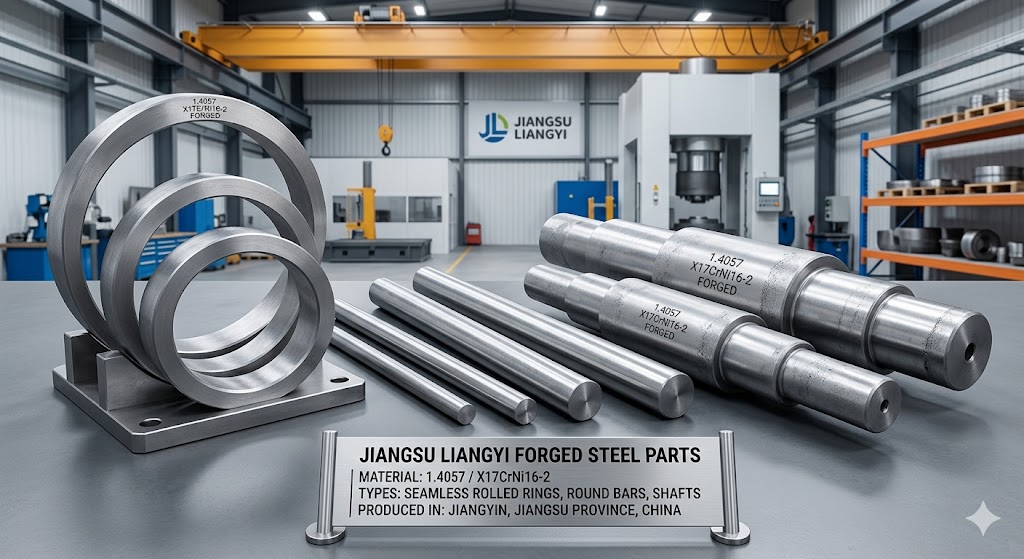
Jiangsu Liangyi Co., Limited has manufactured 1.4057 (X17CrNi16-2) forged steel parts continuously since 1997 — nearly three decades of accumulated process knowledge that no datasheet can replicate. Our Jiangyin, Jiangsu facility operates 2,000–6,300-ton hydraulic presses, a 5-meter seamless ring rolling machine, and ten computer-controlled heat treatment furnaces dedicated to producing open die forgings and seamless rolled rings for demanding global industries.
What distinguishes 1.4057 — the EN number for the DIN grade X17CrNi16-2, UNS S43100 — from simpler martensitic grades is its deliberate nickel addition of 1.5 to 2.5 wt%. That addition radically changes the metallurgical behavior: nickel suppresses the martensite start (Ms) temperature, retards diffusion-controlled pearlitic and bainitic transformations during quenching, and enables through-hardening in heavy cross-sections that grades like 410 or 420 cannot achieve. A pump shaft of 300 mm diameter in 1.4006 (AISI 410) will show significant hardness drop at the center after quench; the same shaft in 1.4057, quenched in oil or polymer, will exhibit essentially uniform hardness from surface to core.
With an annual forging capacity of 120,000 tons, the ability to produce single pieces weighing up to 30,000 kg, and export track record spanning 50+ countries, Jiangsu Liangyi is one of the most capable 1.4057 forging manufacturers in Asia. We hold ISO 9001:2015 certification and issue Mill Test Certificates to EN 10204 3.1 or 3.2 with every delivery.
Get Your Free 1.4057 Forging Quotation Today1.4057 (X17CrNi16-2) — Key Specifications at a Glance
1.4057 Metallurgy — Why Nickel Changes Everything
To specify 1.4057 (X17CrNi16-2) intelligently — and to understand why its forged condition is superior — you first need to understand what happens inside the alloy during heating, forging, and heat treatment. Most supplier pages repeat the same surface-level property tables. Here we explain the why behind the numbers, because engineers who understand the metallurgy make better procurement decisions.
The Martensitic Transformation and Why It Matters
Martensitic stainless steels achieve their high strength through a diffusionless solid-state phase transformation. When steel in the austenite phase is cooled rapidly below the martensite start (Ms) temperature, carbon atoms become trapped in a body-centered tetragonal (BCT) lattice, creating enormous compressive stresses in the crystal structure. The result is an extremely hard, high-strength phase — but one that is also inherently brittle until tempered. Tempering at controlled temperatures allows carbon to partially diffuse into small carbide precipitates, relieving distortion and restoring toughness. The higher the tempering temperature, the softer and tougher the result — which is why QT800 (tempered at 650–700°C) is tougher than QT900 (tempered at 600–650°C), even though QT900 is stronger.
The Role of Nickel in 1.4057
Pure martensitic grades such as 1.4006 (AISI 410) contain only chromium and carbon as intentional alloying elements. In heavy sections — anything beyond roughly 75 mm diameter — the time required for heat to diffuse from the center to the surface during quenching is long enough for diffusion-controlled transformations (pearlite, bainite) to partially occur before the martensite transformation can begin. The result is a mixed, inhomogeneous microstructure with substantially lower and non-uniform mechanical properties at the core.
Adding 1.5–2.5% nickel solves this through two mechanisms. First, nickel depresses the Ms temperature — but more importantly, it retards the kinetics of pearlite and bainite formation, pushing these transformation curves to longer times in the continuous cooling transformation (CCT) diagram. In practical terms, the steel has more time to be uniformly cooled into the martensitic field before any undesired transformation occurs. A well-designed quench of a 300 mm diameter 1.4057 shaft will produce a through-hardened, fully martensitic microstructure from surface to center. The same geometry in 1.4006 (AISI 410) cannot be reliably through-hardened at all.
The chromium content of 15–17% — higher than both 410 (11.5–13.5% Cr) and 420 (12–14% Cr) — provides superior corrosion resistance while still maintaining the ability to form martensite. This is the fundamental design compromise that makes 1.4057 the strongest corrosion-resistant martensitic grade in the EN standard range.
Grain Refinement During Forging
During forging at 1100–800°C, dynamic recrystallization continuously refines the austenite grain size. Unlike cast or rolled bar material — where grains can grow large and dendritic during solidification or hot rolling — the repeated deformation of open die forging or ring rolling breaks up grain boundaries, collapses porosity, and produces a fine, equiaxed grain structure. This refined microstructure transforms to fine-grained martensite on quenching, which has significantly higher toughness and fatigue resistance than coarse-grained martensite for the same hardness level. It is one of several reasons why a 1.4057 open die forging reliably outperforms a hot-rolled or turned-from-bar blank in high-cycle fatigue testing.
Global Standards Cross-Reference for 1.4057 (X17CrNi16-2)
Engineers and procurement professionals in different countries use different designation systems. The table below provides a comprehensive cross-reference for 1.4057 steel across all major international standards. Jiangsu Liangyi can certify forgings to multiple standards simultaneously on a single Mill Test Certificate.
| Standard System | Designation / Grade | Document Reference | Key Differences vs EN 10088-3 |
|---|---|---|---|
| European EN (DIN) | 1.4057 / X17CrNi16-2 | EN 10088-3 | — Reference standard — |
| American AISI/SAE | 431 | ASTM A276 / A564 | C ≤0.20% (vs EN 0.12–0.22%); otherwise equivalent |
| American UNS | S43100 | ASTM / SAE | UNS number used in US procurement specs |
| Japanese JIS | SUS 431 | JIS G4303 / G4311 | Cr 15–17%, Ni 1.25–2.50%; slightly lower Ni floor |
| Russian GOST | 20Х17Н2 (20X17N2) | GOST 5632 | C 0.17–0.25% (higher C); Cr 16–18%; Ni 1.5–2.5% |
| Chinese GB/T | 2Cr17Ni2 | GB/T 1220 | Near-identical to EN 1.4057; common in domestic projects |
| British BS | 431S29 | BS 970 Part 1 (superseded by EN) | Now aligned with EN 10088 |
| French AFNOR | Z15CN16-02 | NF A35-573 (superseded by EN) | Now aligned with EN 10088 |
| Swedish SS | 2321 | SS EN 10088 (now aligned) | Old SS number still appears in Swedish plant specs |
Our 1.4057 Forging Process — Step by Step
Understanding our manufacturing process helps procurement and engineering teams write better specifications and set realistic expectations. Below is a transparent account of how every 1.4057 forging moves through our Jiangyin facility.
Raw Material Sourcing
We source 1.4057 steel from certified domestic steel mills with full traceability. Every heat of steel arrives with a mill chemical analysis certificate. Incoming material is re-verified by our in-house optical emission spectrometer (OES) before any forging begins — composition drift between the mill certificate and the actual heat is a documented industry problem that our incoming inspection guards against.
Ingot / Billet Conditioning
Ingots or continuously cast billets are cropped to remove the primary pipe and segregation zone at the top and bottom. For critical applications, we can source steel produced by EAF + ladle refining furnace (LRF) + vacuum degassing (VD) to achieve lower sulfur and hydrogen content — please specify this requirement in your inquiry.
Heating for Forging
Billets are charged into gas-fired furnaces and heated uniformly to 1100–1150°C. Soak times are calculated per cross-section thickness — typically 1 hour per 100 mm of minimum dimension — to ensure thermal homogeneity before the press. Overheating above 1200°C risks grain boundary oxidation and is strictly controlled by thermocouple feedback.
Open Die Forging or Ring Rolling
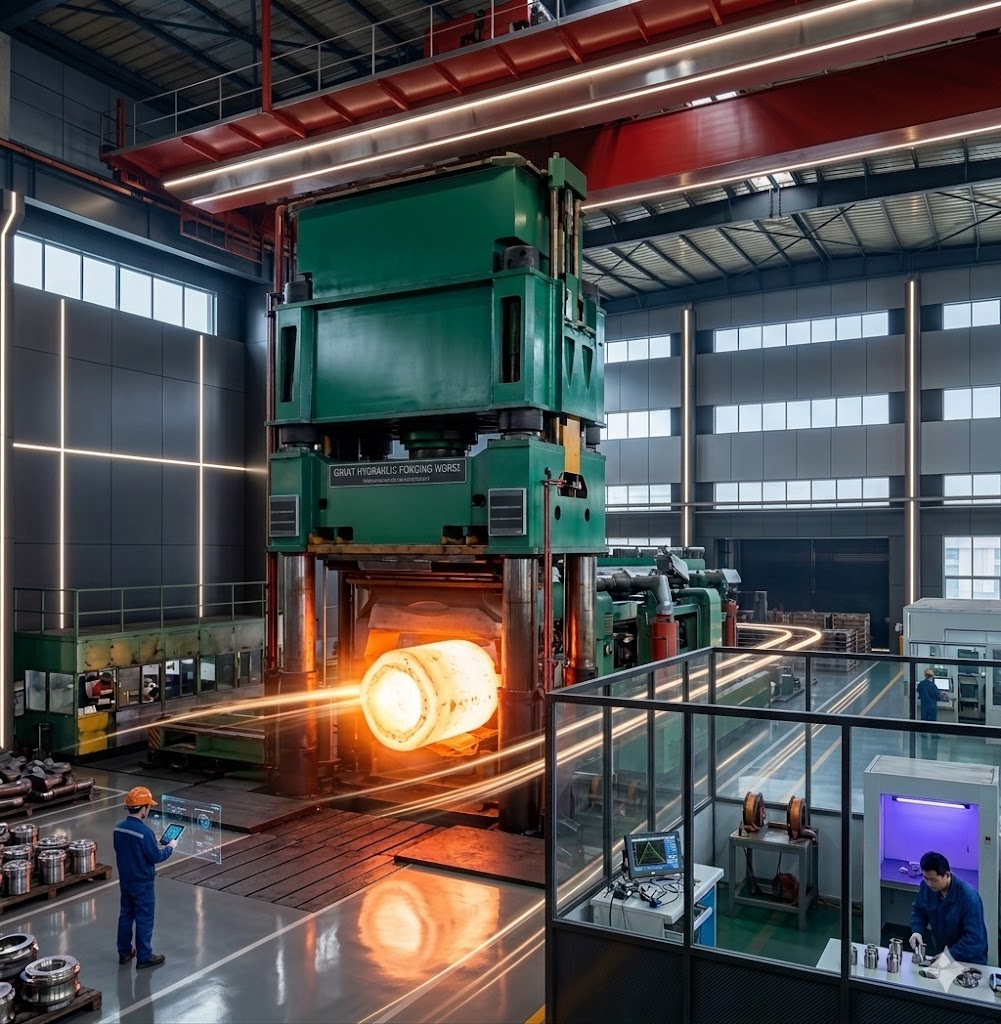
Bar, shaft, disc, and hollow forgings are produced on our 2,000–6,300 T hydraulic presses. Forging is completed above 850°C; billets are returned to the furnace if temperature drops below this point. For rings, the ring rolling machine produces seamless rings up to 6,000 mm OD. Our minimum forging reduction ratio is 3:1 for standard parts and higher for critical applications, ensuring closure of internal voids and a uniform fibrous grain flow.
Post-Forging Stress Relief
Immediately after forging, 1.4057 pieces are placed in a furnace at 700–750°C for controlled slow cooling. This sub-critical anneal relieves forging stresses and softens the martensitic structure (which forms on air cooling from forging temperatures) to allow safe handling, rough machining, and ultrasonic testing prior to final heat treatment. This step is mandatory in our process for sections >100 mm.
Rough Machining (if required)
Many customers request rough machining in the soft-annealed condition prior to final heat treatment. This reduces distortion risk, allows earlier UT inspection, and shortens post-HT machining time. Machining allowances for post-HT finish machining are typically 3–6 mm per surface depending on part geometry.
Final Heat Treatment
Parts are loaded into computer-controlled batch furnaces. The hardening cycle (950–1050°C, followed by oil, polymer, or air quench depending on section size) is tracked by multiple thermocouples per furnace zone with continuous data logging. Tempering immediately follows to prevent cracking of fresh martensite. Temperature uniformity across the load is maintained to ±10°C. Furnace charts are retained and available for customer audit upon request.
Final Machining (if required)
CNC turning centers, vertical lathes, horizontal machining centers, and cylindrical grinders produce finish-machined components to drawing tolerances. Dimensional inspection is performed on calibrated measuring equipment. Surface roughness is measured and documented for all ground or fine-turned surfaces.
Quality Inspection & Documentation
Every 1.4057 forging undergoes 100% visual and dimensional inspection. NDT (UT + MT or PT) is performed per the applicable code. Mechanical test coupons are cut from agreed locations. Chemical re-analysis by OES confirms conformance. All results are compiled into the MTC EN 10204 3.1 or 3.2 and reviewed by our Quality Manager before release.
1.4057 (X17CrNi16-2) Forged Product Shapes & Dimensional Capabilities
Our Jiangsu facility produces the following 1.4057 forged product forms in as-forged or machined condition to ASTM A276, EN 10088-3, or customer drawing tolerances.
Forged Bars, Rods & Shafts
- Round bars: diameter 50–2,000 mm, length up to 15,000 mm, weight up to 30,000 kg per piece
- Square bars, flat bars, and rectangular bars: custom cross-sections per drawing
- Step shafts and gear shafts with multiple diameter steps forged integrally — no welded joints
- Diameter tolerance (as-forged): typically ±4–8 mm per EN 10243-1
- All bars are forged from billet with minimum 3:1 reduction — not turned from rolled bar
Seamless Rolled Rings
- Outside diameter: 200 mm to 6,000 mm
- Face height: 50 mm to 1,500 mm
- Wall thickness: 40 mm minimum for standard rolling
- Weight: 5 kg to 30,000 kg per ring
- Contoured rings (flanged, T-section, L-section) produced by profile ring rolling
- Gear rings, slewing rings, pressure vessel rings, flanges: all standard profiles
Hollow Forgings, Sleeves & Casings
- Hollow bars and sleeves: OD up to 3,000 mm, wall thickness 60 mm and above
- Pump casings, turbine casings, pressure vessel shells with integral end forgings
- Heavy wall cylinders and pressure-containing shells
- Hollow forgings are produced by punching or mandrel forging — ensuring 100% forged soundness throughout the wall
Discs, Plates & Blocks
- Turbine discs and impeller blanks: diameter up to 2,500 mm, thickness up to 1,000 mm
- Valve discs, flange blanks, boss blanks: any shape per drawing
- Single and double bossed blanks and flanged bosses for pump housings
1.4057 (X17CrNi16-2) Chemical Composition per EN 10088-3
The chemical composition limits below are those of EN 10088-3. Our incoming material is verified by optical emission spectrometry (OES) against these limits; the actual heat analysis is reported on the MTC.
| Element | Symbol | EN 10088-3 (wt%) | ASTM A276 Gr.431 | Metallurgical Function |
|---|---|---|---|---|
| Carbon | C | 0.12 – 0.22 | ≤ 0.20 | Enables martensite formation; controls hardenability and strength |
| Chromium | Cr | 15.0 – 17.0 | 15.0 – 17.0 | Corrosion resistance via passive oxide layer; higher Cr than 410/420 gives better corrosion performance |
| Nickel | Ni | 1.50 – 2.50 | 1.25 – 2.50 | Suppresses Ms temperature; retards pearlite/bainite kinetics → enables through-hardening in heavy sections; improves toughness |
| Manganese | Mn | ≤ 1.00 | ≤ 1.00 | Deoxidizer; secondary hardenability contribution |
| Silicon | Si | ≤ 1.00 | ≤ 1.00 | Deoxidizer; slight strength contribution |
| Phosphorus | P | ≤ 0.040 | ≤ 0.040 | Residual impurity; segregates to grain boundaries — reduces toughness |
| Sulfur | S | ≤ 0.030 | ≤ 0.030 | Residual impurity; forms MnS inclusions; reduces transverse ductility and fatigue life |
Tighter Composition Control for Critical Applications
For high-specification applications — sour service, nuclear, offshore, or high-cycle fatigue — we can specify tighter internal limits on purchased steel, including lower sulfur (≤0.010%) and phosphorus (≤0.025%) targets. Please state your application requirements in your inquiry and our team will advise on what is achievable and at what additional cost.
Heat Treatment — QT800 vs QT900 Selection Guide
Heat treatment is where 1.4057's properties are determined. Choosing between QT800 and QT900 should be driven by the dominant failure mode your component must resist.
| Process Step | Temperature (°C) | Cooling Method | Result / Purpose |
|---|---|---|---|
| Hot Forming (forging) | 1100 – 800 | Furnace cool (slow) | Shape the material; grain refinement; must stay above 800°C to avoid brittle fracture risk |
| Post-forge stress relief | 700 – 750 | Furnace cool | Relieve forging stresses; soften as-forged martensite for safe handling and rough machining |
| Full soft anneal (+A) | 680 – 800 | Furnace or air | Maximum softness (HB 210–250); optimum machinability before final heat treatment |
| Austenitizing (hardening) | 950 – 1050 | Oil / polymer / air quench | Dissolve carbides; create homogeneous austenite; quench to martensite |
| Tempering — QT800 | 650 – 700 | Water or air cool | Rm 800–950 N/mm²; KV ≥34 J; preferred for dynamic loading, impact, vibration |
| Tempering — QT900 | 600 – 650 | Water or air cool | Rm 900–1050 N/mm²; KV ≥27 J; preferred for wear resistance and high static loads |
QT800 vs QT900 — Which Should You Specify?
- Specify QT800 if: your component experiences impact, shock loading, or high-cycle fatigue (pump shafts, marine shafts, drill tool components, fasteners under dynamic loads). The higher Charpy energy (≥34 J) and elongation (≥12%) translate directly to longer fatigue life and better resistance to brittle fracture.
- Specify QT900 if: your component is primarily loaded in static compression or Hertzian contact (valve stems, bearing seats, gear elements, wear-resistant surfaces). The higher hardness (284–331 HB) and tensile strength are directly beneficial.
- Mixed requirements: If both high strength and good toughness are needed simultaneously, specify a minimum impact energy AND minimum hardness. We will select the tempering temperature — typically 620–640°C — to satisfy both simultaneously. We can provide a test coupon result at your target conditions before committing the full production batch.
1.4057 (X17CrNi16-2) Mechanical Properties & Microstructure
The values below are minimum guaranteed values per EN 10088-3. Actual test values — not just "≥" statements — are reported on every MTC.
| Condition | Rm (N/mm²) | Rp0.2 (N/mm²) | A5 (%) | Z (%) | Hardness (HB) | Charpy KV (J) 20°C |
|---|---|---|---|---|---|---|
| QT800 | 800 – 950 | ≥ 600 | ≥ 12 | ≥ 50 | 251 – 299 | ≥ 34 |
| QT900 | 900 – 1050 | ≥ 700 | ≥ 10 | ≥ 40 | 284 – 331 | ≥ 27 |
Physical Properties
| Property | Value | Condition |
|---|---|---|
| Density | 7.70 g/cm³ | Room temperature |
| Elastic Modulus (E) | ~200 GPa | Room temperature |
| Thermal Expansion Coefficient | 10.5 × 10⁻⁶ K⁻¹ | 20–200°C range |
| Thermal Conductivity | ~25 W/(m·K) | Room temperature |
| Magnetic Properties | Ferromagnetic | In hardened condition |
| Max Continuous Service Temp. | ~400°C | Dry oxidizing environments |
Microstructure Requirements
- Grain size per EN ISO 643: bar products ≥ grain size 5; sheet/plate 2–6
- Carbide distribution: after QT tempering, carbides should be uniformly distributed within the martensitic matrix, not concentrated at grain boundaries
- Retained austenite: controlled quenching conditions minimize retained austenite, which can reduce hardness and long-term dimensional stability
- Freedom from detrimental phases (sigma phase, delta ferrite, grain boundary carbide films) evaluated by metallographic examination on witness coupons
Why Forging Outperforms Cast and Rolled Bar for 1.4057 Components
| Property / Feature | Open Die Forging | Hot-Rolled / Turned Bar | Investment / Sand Casting |
|---|---|---|---|
| Internal soundness | Excellent — porosity eliminated by forging compression | Good — centerline pipe possible in large diameters | Fair — shrinkage porosity inherent |
| Grain structure | Fine, uniform; grain flow follows part contour | Elongated along rolling direction | Coarse, dendritic, random orientation |
| Centerline segregation | Eliminated by forging deformation ≥3:1 | Present in large diameters | Severe solidification segregation |
| Fatigue life | Best — fine grain + oriented grain flow | Good in rolling direction; inferior transverse | Poor — inclusions act as crack initiators |
| Section property uniformity | Uniform Rm/Rp0.2/KV surface to core | Good in small bars; core drop in large diameters | Highly variable |
| Size capability | Bars to 2,000 mm OD; rings to 6,000 mm OD | Typically limited to 300–400 mm in stainless | Large castings possible |
1.4057 vs Other Martensitic Stainless Steels — When to Use Each
| Grade (EN / AISI) | Cr % | Ni % | Max Rm (N/mm²) | Corrosion Resistance | Through-hardenability | Best Application |
|---|---|---|---|---|---|---|
| 1.4057 (X17CrNi16-2) | 15–17 | 1.5–2.5 | 1050 | ★★★★☆ | ★★★★★ (large sections) | Heavy forgings needing high strength + corrosion + toughness |
| 1.4006 (AISI 410) | 11.5–13.5 | <0.5 | 850 | ★★☆☆☆ | ★★☆☆☆ (sections <75 mm) | Small components in mild environments where cost is priority |
| 1.4021 (AISI 420) | 12–14 | <0.5 | 950 | ★★★☆☆ | ★★★☆☆ (sections <100 mm) | High hardness in thin sections; cutlery, tools |
| 1.4122 (AISI 434) | 15.5–17.5 | <1.0 | 900 | ★★★★☆ | ★★★☆☆ | Where Mo addition gives slightly better pitting resistance |
| 1.4418 | 15–17 | 4.0–6.0 | 1100 | ★★★★☆ | ★★★★★ | Higher-strength alternative to 1.4057; higher Ni cost |
| 1.4542 (17-4PH) | 15–17.5 | 3.0–5.0 | 1310 (H900) | ★★★★☆ | ★★★★★ | Highest strength; for aerospace and oil tools; significant cost premium |
When to Choose 1.4057 Over Alternatives
Choose 1.4057 when all three conditions apply: (1) section size ≥100 mm where 410/420 cannot reliably through-harden; (2) tensile strength requirement 800–1050 N/mm²; (3) corrosion environment more demanding than AISI 410/420 can handle. Contact us with your operating conditions and we will provide a written material recommendation.
Application Engineering — 1.4057 Forgings Industry by Industry
The following section explains the engineering rationale behind each application — why 1.4057 forgings are specified, and what specific component requirements drive material selection. This is drawn from our application knowledge accumulated over 25+ years of supplying these industries globally.
Valve Industry
Valves represent the largest application segment for 1.4057 forgings. A valve stem or ball in a wellhead environment faces simultaneous high axial loads (actuation force), high torque (unseating against differential pressure), high-cycle fatigue (from flow-induced vibration), and a moderately corrosive environment (produced water, CO₂, H₂S). The combination of high yield strength (≥600–700 N/mm²), corrosion resistance superior to 410, adequate toughness (≥27–34 J), and through-section hardness uniformity that only 1.4057 in forged condition delivers reliably makes it the preferred valve material for heavy-duty service.
- Forged valve balls, bonnets, bodies, stems, closures, and seat rings for gate valves, ball valves, butterfly valves, check valves, and globe valves
- Valve cores and discs for H-type two-way, one-way, and back pressure valves
- Flowseal cryogenic and high-performance butterfly valve (HPBV) shafts
- Oil measurement valve spools and ultrasonic flow meter bodies
- Double studded adapter flanges for wellhead equipment
- For NACE MR0175 sour service: we produce 1.4057 valve components with hardness controlled to ≤22 HRC (238 HB) maximum by adjusting the tempering temperature to 700–720°C — please specify NACE compliance in your inquiry
Turbine & Compressor Industry
Steam and gas turbine components operate under high rotational speed, cyclic thermal loading, and steam or gas pressure. The dominant failure modes for turbine discs and impellers are low-cycle fatigue (LCF) driven by thermal start-stop cycles and high-cycle fatigue (HCF) from blade-passing vibration. The fine-grained forged microstructure of 1.4057 — with grain flow contoured to the disc/ring geometry — provides significantly better fatigue resistance than a blank machined from rolled bar, where the grain flow is perpendicular to the critical bore hoop stress direction.
- Gas and steam turbine discs, impellers, blisks, and wheel discs for power generation and process compression
- Turbine labyrinth shaft seals and seal rings
- Gas turbine casing rings and guide rings
- Gas and air compressor rotors and shrouded impellers
- Turbine diaphragm nozzle rings and casing segments
Nuclear Industry
Nuclear reactor coolant pump (RCP) components represent a demanding application for 1.4057 forgings — particularly because of the documentation, traceability, and inspection requirements. Every kilogram of steel in a nuclear safety-related component must be traceable to a specific heat, every furnace cycle must have recorded temperature charts, and the MTC must be countersigned by the appropriate third-party inspection body. Jiangsu Liangyi has the quality management procedures and document control systems to support these requirements. Customers with nuclear-specific supplier qualification requirements should discuss these with us before placing an order so we can confirm the applicable scope.
- Nuclear RCP rotor and impeller forgings
- RCP casing and containment seal chamber forgings
- Reactor vessel nozzle forgings and pressure boundary components
- Nuclear safety-related components — please contact us to discuss specific qualification and documentation requirements for your project
Pump Industry
Pumps in oil and gas, chemical, and water treatment service operate continuously. The shaft is the most failure-critical component: it carries torque from the motor to the impeller through an unsupported span, often in a corrosive environment. A pump shaft failure means the entire unit must be taken offline. The cost of a single failure event — including lost production — frequently exceeds the cost of the original pump. This context justifies specifying 1.4057 forged shafts even when alternatives appear cheaper.
- Downhole drilling tool mud motor splined drive shafts
- Electric submersible pump (ESP) motor splined shafts
- Pump casings, covers, barrels, impellers, and wear rings
- High-pressure boiler feed pump shafts and impellers for power plant service
Oil & Gas and Petrochemical
Oil and gas applications combine pressure-containment duty (requiring through-hardened thick walls), corrosive produced fluids (requiring stainless composition), and safety-critical standards (requiring certified, traceable material). For NACE MR0175 sour service, 1.4057 is permitted with hardness ≤22 HRC — we are experienced in producing and certifying hardness on individual pieces. For pressure equipment under PED 2014/68/EU, we supply material with EN 10204 3.1 or 3.2 documentation to support your compliance assessment.
- Wellhead equipment components: tubing head spools, casing heads, Christmas tree bodies, and adapters
- Venturi flowmeter bodies, cone meter bodies, and orifice plate holders
- Heat exchanger and boiler components: tube sheets, channel flanges, and nozzles
- Pressure vessel components — we supply material with appropriate EN 10204 documentation; PED conformity assessment is the responsibility of the pressure equipment manufacturer
Marine & Offshore
Marine applications combine continuous seawater exposure, mechanical loads, and the practical constraint that a ship cannot easily undergo component replacement at sea. Propeller shafts must survive decades of service without critical pitting corrosion that could initiate a fatigue crack. 1.4057 with its 15–17% Cr provides substantially better seawater resistance than 410 or 420 grades. Note: for severely aggressive offshore environments with crevice corrosion risk, duplex grades (e.g., 1.4462) may be more appropriate — our team can advise.
- Marine propeller shafts and intermediate shafts
- Stern tube liners and rudder pintles
- Offshore platform deck machinery components
- Subsea actuator shafts and valve stems in ROV-operated equipment
- Third-party inspection (BV, DNV, Lloyds, etc.) can be coordinated by the customer and arranged for any delivery upon request
Fasteners & General Industrial
- Gas and steam turbine double-headed studs and through-bolts requiring high-temperature strength and corrosion resistance
- Gas and steam turbine valve spindles, stems, and piston rods
- MSV/GV/CV/CRV valve seats, cores, sleeves, and spools for steam turbine governing valves
- Main steam valve covers, bonnets, and sleeves
Weldability & Fabrication Notes for 1.4057 (X17CrNi16-2)
1.4057 is weldable, but the martensitic microstructure and carbon content (0.12–0.22%) require careful procedure development to prevent hydrogen-induced cracking (HIC) and achieve acceptable post-weld toughness. The following guidance is for engineering reference — your specific welding procedure must be qualified per the applicable standard (AWS D1.6, EN ISO 15614, ASME IX, etc.).
Pre-Weld Requirements
- Preheat: 200–300°C minimum for sections ≥25 mm. Preheat prevents hydrogen diffusion and martensitic cracking in the heat-affected zone (HAZ).
- Interpass temperature: Maintain 200–300°C throughout. Allowing the workpiece to cool below 100°C between passes risks cold cracking in the HAZ.
- Joint preparation: Machine or grind to bright metal; degrease thoroughly. Oil or moisture contamination is the primary source of hydrogen — eliminate completely.
- Filler metal: Matching ER431 (if available) or ER309L / ER309LMo (austenitic filler) for dissimilar joints. Avoid high-carbon fillers if post-weld heat treatment is not possible.
Post-Weld Heat Treatment (PWHT)
- PWHT temperature: 650–700°C for a minimum of 1 hour per 25 mm of maximum section thickness. This tempers the hard, brittle HAZ martensite and restores toughness. Skipping PWHT can leave HAZ hardness exceeding 40 HRC — unacceptable for any dynamic or pressure-containing service.
- Cooling after PWHT: Furnace cool or air cool below 100°C. Rapid quenching from PWHT temperature would re-harden the HAZ.
- When PWHT is not possible: We can supply the forging in soft-annealed (+A) condition so welding produces a soft HAZ, and the entire assembly is then heat treated together after welding. This sequence is standard practice for complex welded assemblies incorporating 1.4057 forgings.
Quality Control & Testing Procedures
At Jiangsu Liangyi, quality control is integrated into every step of the production process — not only a final-stage gate.
Chemical Analysis
- Incoming material verification: Every heat of 1.4057 steel is analyzed by optical emission spectrometry (OES) against EN 10088-3 limits before forging. We have refused incoming material that failed incoming OES verification, even when accompanied by a mill certificate showing conformance.
- Product analysis: For EN 10204 3.2 or customer-specific requirements, a product analysis taken from the forging itself is performed and reported on the MTC.
Non-Destructive Testing (NDT)
- Ultrasonic testing (UT): Volumetric scanning per EN 10228-3 (bars) or EN 10228-4 (rings). Calibrated to flat-bottom hole (FBH) reference reflectors. Detects internal laps, seams, flakes, and hydrogen flakes.
- Magnetic particle testing (MT): Per EN ISO 17638 or ASTM E1444. Detects surface and near-surface linear indications including laps, seams, and grinding cracks.
- Liquid penetrant testing (PT): Per EN ISO 3452 or ASTM E165. Used as an alternative to MT where required.
- Dimensional inspection: 100% of all critical dimensions against drawing. CMM measurement for complex profiles.
- Visual inspection: 100% of all surfaces per EN ISO 10012.
Mechanical Testing
- Hardness testing: Every forging tested at agreed locations. Brinell (HB) using calibrated equipment. Full hardness traverse (surface to center) available for thick sections on request.
- Tensile testing: Per heat treatment lot, specimens from designated coupon locations per EN 10088-3 or customer drawing. Rm, Rp0.2, A%, Z% reported on MTC.
- Charpy V-notch impact testing: Per heat treatment lot, typically 3 specimens at 20°C (or customer-specified temperature). Mean value and individual minimum reported.
- Grain size determination: Per EN ISO 643, on metallographic section from production coupon.
- Microstructure examination: Optical microscopy on polished and etched section. Evaluates carbide distribution and freedom from detrimental phases.
Certification Options
- EN 10204 Type 3.1 (standard): MTC issued by Jiangsu Liangyi Quality Department, signed by our Quality Manager. Contains actual chemical analysis, mechanical test results, heat treatment record, and NDT results. Issued with every delivery at no additional charge.
- EN 10204 Type 3.2 (on request): The 3.1 MTC additionally countersigned by an independent third-party inspection body of the customer's choice. The customer arranges and pays for the inspection body; we coordinate access and scheduling. Additional lead time of 3–5 days for inspection coordination.
- Third-party witness inspections: Hold points at specific production stages (incoming material, post-forging, post-HT hardness, final inspection) can be arranged for customers who require witnessed inspection. Please specify required hold points in your inquiry.
- Supplementary documentation: PMI (positive material identification) by portable XRF, NACE MR0175 individual-piece hardness compliance records, and additional test locations are all available on request.
Why Choose Jiangsu Liangyi as Your 1.4057 Forging Supplier in China?
There are dozens of forging manufacturers in China. Here are concrete, verifiable differentiators — not marketing language.
- Process ownership, not subcontracting: Forging, heat treatment, machining, testing, and certification are all performed within our Jiangyin facility under our ISO 9001:2015 quality system. We do not send forgings to external heat treatment shops for standard work. This means full access to the actual production records for every step.
- Metallurgical depth in our engineering team: Our technical team is able to discuss forging reduction ratios, heat treatment cycle design, and microstructure requirements directly with your engineers. When you submit a drawing and ask whether QT800 or QT900 is correct, you will receive a reasoned technical answer. We have declined orders where the specified material was inappropriate for the application.
- Forging reduction ratio discipline: We forge 1.4057 at a minimum 3:1 reduction ratio for standard parts. We can document the reduction ratio calculation for each forging on request. Some suppliers offer "forged" bars at 1.5:1 reduction — barely distinguishable from rolled bar in microstructure. Our process is transparent and traceable.
- Heat treatment furnace capability: Ten computer-controlled batch furnaces with continuous thermocouple logging, temperature uniformity ±10°C across load per our ISO 9001:2015 quality procedures. Full furnace temperature charts are retained and available for customer audit.
- True large-format capability: Our 6,300-ton hydraulic press and 5-meter ring rolling machine are operational. We regularly produce 1.4057 rings exceeding 4,000 mm OD and bars exceeding 1,500 mm diameter in this grade.
- ISO 9001:2015 certified manufacturing: Our quality management system is certified to ISO 9001:2015 — this is our documented manufacturing quality certification. For applications requiring additional specific approvals or qualifications (nuclear, aerospace, etc.), please discuss requirements with us before ordering.
- 25+ year track record: Founded in 1997, Jiangsu Liangyi has been through multiple economic cycles. Long-term relationships with customers, particularly industrial customers in Europe and North America that periodically requalify suppliers, are a testament to our consistent product quality.
- Export documentation expertise: Exporting steel forgings under MTC to European and international requirements involves specific document formats and third-party witness arrangements. Our quality team is experienced in these requirements across all major markets.
Custom 1.4057 Forging Services & Order Process
Every 1.4057 forging we produce is custom — we do not stock standard sizes from inventory. Every piece is produced to your specific drawing, specification, and test requirements.
What to Include in Your Initial Inquiry
- Drawing: PDF or DWG of the component in as-forged or finish-machined condition. Include all critical dimensions with tolerances.
- Material specification: "1.4057 / X17CrNi16-2 per EN 10088-3" or equivalent (ASTM A276 Grade 431, JIS SUS431, etc.).
- Heat treatment condition: QT800, QT900, soft annealed (+A), or custom hardness range with target Rm/Rp0.2/KV.
- Supply condition: As-forged, rough machined, or finish machined to drawing.
- Certification required: EN 10204 3.1 (standard) or 3.2 (with third-party witness — please name the inspection body your project requires).
- Quantity and delivery schedule.
- Application notes: Brief description of service conditions (operating pressure, temperature, medium, any special requirements such as NACE MR0175), which helps us flag specification concerns before production begins.
Order Process
- Email your drawing and specification to sales@jnmtforgedparts.com
- Engineering review: our team assesses the drawing for manufacturability and flags any concerns within 24 hours
- Quotation: detailed written quotation typically within 2 business days
- Order confirmation and production scheduling begins
- Raw material sourcing and incoming OES inspection
- Forging (open die or ring rolling) at agreed reduction ratio
- Heat treatment per agreed specification with furnace chart documentation
- Quality testing and MTC compilation; Quality Manager review and release
- Machining (if required), ISPM-15 packing, and shipment
Standard Lead Times
- As-forged or annealed bars/rings: 3–4 weeks
- QT800/QT900 forgings without machining: 4–5 weeks
- QT800/QT900 forgings with in-house CNC machining: 5–7 weeks
- Complex or large orders (>50 tons): 6–9 weeks
- Expedited production available — contact us with your deadline
Shipping & Logistics from Jiangsu, China
Our factory in Jiangyin, Jiangsu Province is located approximately 40 km from Shanghai Port and 180 km from Ningbo-Zhoushan Port, giving customers both sea freight cost efficiency and routing flexibility.
Global Export Markets
- North America: USA, Canada, Mexico — transit 18–24 days to US West Coast, 25–32 days to East Coast
- Europe: Germany, France, UK, Italy, Spain, Netherlands, Belgium, Sweden, Norway, Denmark, Finland, Poland, Czech Republic, Austria, Switzerland — transit 25–35 days via Suez to Hamburg, Rotterdam, Antwerp
- Asia: Japan, South Korea, India, Thailand, Indonesia, Malaysia, Singapore, Vietnam, Philippines — 3–14 days
- Middle East: Saudi Arabia, UAE, Kuwait, Qatar, Oman, Bahrain — 18–25 days
- Oceania: Australia, New Zealand — 12–18 days
- South America: Brazil, Argentina, Chile, Colombia, Peru — 28–38 days
- Africa: South Africa, Egypt, Nigeria, Algeria, Morocco — 18–30 days
Shipping Options and Packing
- FCL sea freight: 20'GP, 40'GP, 40'HC, or flat rack for oversized forgings. Most economical for orders >5 tons.
- LCL sea freight: Consolidation service for smaller orders <5 tons.
- Breakbulk / project cargo: Very large single items over 20 tons or oversized dimensions.
- Air freight: For samples, small prototype batches, and urgent orders.
- Express courier: DHL, FedEx and UPS for express courier of drawings, samples and test pieces up to 30 kg.
- Export packing: ISPM-15 heat treated wooden cases or custom steel frames. We provide packing list, commercial invoice, certificate of origin, and all customs documentation.
Frequently Asked Questions — 1.4057 (X17CrNi16-2) Forgings
Related Forged Steel Products
Request a 1.4057 (X17CrNi16-2) Forging Quotation
Send your drawing, material specification, heat treatment condition, and quantity to our engineering sales team. We will respond with a detailed quotation and any technical observations within 24 hours.
We welcome complex, non-standard, and technically demanding inquiries. The more challenging the requirement, the more our 25+ years of specialized forging expertise adds value.
Email Us for a Free QuoteEmail: sales@jnmtforgedparts.com
Phone / WhatsApp: +86-13585067993
Website: www.jnmtforgedparts.com
Address: Chengchang Industry Park, Jiangyin City, Jiangsu Province, China 214400
Business Hours: Monday – Friday, 08:00 – 18:00 CST (UTC+8)