1.4005 (X12CrS13) Forging Parts | China Leading Manufacturer & Supplier
1.4005 (X12CrS13) — equivalent to AISI 416 and SUS416 — is a free-machining martensitic stainless steel whose controlled sulfur addition (0.15–0.35%) produces elongated manganese sulfide inclusions that act as chip breakers, achieving the highest machinability rating (85%) of any stainless steel grade. Jiangsu Liangyi, an ISO 9001:2015 certified China forging manufacturer in Jiangyin City, Jiangsu Province, has produced 1.4005 open die forgings, seamless rolled rings and custom components for over 25 years, delivering to 50+ countries in weights from 30 kg to 30,000 kg per piece.
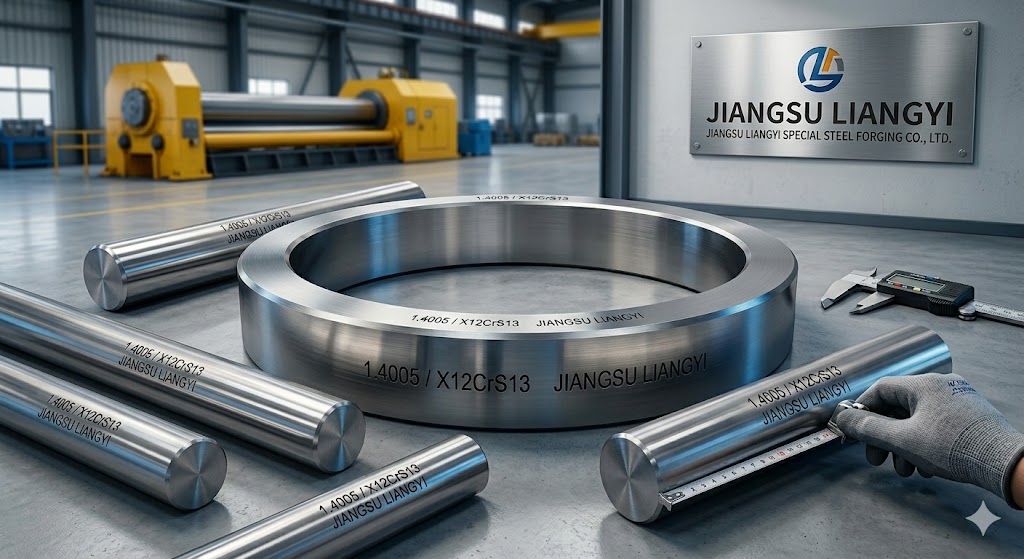
What Is 1.4005 (X12CrS13) and Why Is It Forged?
Jiangsu Liangyi is a professional ISO 9001:2015 certified manufacturer of 1.4005 (X12CrS13) open die forging parts and seamless rolled steel forged rings based in Jiangyin City, Jiangsu Province, China. With over 25 years of specialized manufacturing experience, we produce high-quality 1.4005 forged components ranging from 30 kg to 30,000 kg, serving customers in more than 50 countries across Europe, North America, Asia, the Middle East and beyond.
Grade 1.4005 (European EN designation), also written X12CrS13 in DIN notation and equivalent to AISI 416 / UNS S41600 / SUS416 / Z12CF13, is a free-machining martensitic stainless steel. It belongs to the 12–14% chromium martensitic family but is uniquely distinguished by deliberate sulfur enrichment (0.15–0.35%), which produces elongated manganese sulfide (MnS) inclusions throughout the microstructure. These inclusions are the key to an 85% machinability rating — the highest recorded among all stainless steel grades.
While the grade can be supplied as bar, plate or tube from a mill, the forged version of 1.4005 offers critical advantages over mill-rolled product. Forging refines the as-cast dendritic grain structure, closes internal shrinkage voids, aligns forging flow lines with part geometry and produces a wrought microstructure with superior fatigue strength (typically 15–25% higher than rolled bar of the same diameter). For valve stems, turbine spindles and drilling tool components — applications where fatigue and torsional strength dominate the failure mode — specified-direction forged 1.4005 is the standard engineering choice.
Grade Equivalents — All Names for the Same Steel
1.4005 (EN/DIN) = X12CrS13 (DIN) = AISI 416 (ASTM/SAE) = UNS S41600 = SUS416 (JIS) = Z12CF13 (AFNOR NF) = BS 416 S21. All designations refer to the same free-machining martensitic stainless steel composition defined by EN 10088-3. When specifying forgings, always confirm the governing standard with your supplier.
The Metallurgy of Sulfide Inclusions: Why 1.4005 Machines So Well
Understanding why 1.4005 (X12CrS13) machines more readily than any other stainless steel requires a look at what happens at the microscopic level during cutting. In standard grade 410 — which shares the same chromium and carbon range but contains only trace sulfur (≤0.03%) — the continuous, ductile metallic matrix causes chips to form long, stringy curls that create high tool contact pressure, generate heat and accelerate flank wear.
In 1.4005 (X12CrS13), the deliberate addition of 0.15–0.35% sulfur reacts with the manganese (Mn) already present in the steel to form manganese sulfide (MnS) inclusions during solidification. These inclusions have three critical properties that transform machinability:
- Low shear strength: MnS has a Vickers hardness of only ~150 HV — far softer than the steel matrix (~200 HV annealed, ~350 HV quenched and tempered). During cutting, cracks initiate preferentially at MnS particles, drastically reducing the energy needed to shear the workpiece.
- Lubricating effect at the tool-chip interface: MnS decomposes at the high temperatures present at the cutting zone (500–900°C), releasing sulfur compounds that act as solid lubricants, reducing friction between chip and tool face by 20–30% versus 410.
- Chip breaking geometry: During hot forging, MnS inclusions elongate in the primary flow direction into thin, disc-shaped platelets. Under a cutting edge, the chip contacts multiple platelets in sequence, causing it to break into short, manageable segments rather than the long stringy chips produced by standard stainless steels.
The net result is that production shops running 1.4005 forgings on CNC lathes consistently achieve 30–45% longer tool life, 15–25% faster cycle times, and significantly lower cutting forces compared to machining 410 forgings of identical size and heat treatment. For valve manufacturers producing tens of thousands of seats and stems annually, these savings are decisive.
The Anisotropy Trade-Off Engineers Must Understand
The same MnS inclusions that enable exceptional machinability also create directional (anisotropic) mechanical properties. Because inclusions elongate parallel to the forging direction, properties measured in the transverse direction — especially Charpy impact energy — are typically 20–35% lower than longitudinal properties. For rotating components or parts loaded primarily in the transverse direction (e.g., thick flanges, ring-shaped pressure-retaining parts), this must be accounted for in design. Jiangsu Liangyi's engineering team always aligns forging flow lines with the principal stress direction and can provide test coupons in both orientations on request.
Forging Capabilities: Shapes, Sizes & Production Capacity
As a leading China forging manufacturer, we offer a complete range of 1.4005 (X12CrS13) forged steel products manufactured to international standards including ASTM, AMS, DIN and EN. Our Jiangyin City facility houses 2000T–6300T hydraulic presses, 1–5T electro-hydraulic hammers and 5-meter seamless ring rolling machines — all connected to a single in-house production chain from steel melting through final inspection.
Available Forging Shapes & Dimensional Range
| Forging Shape | Dimensional Range | Weight Range | Typical Applications |
|---|---|---|---|
| Round Forged Bar | Ø20 mm – Ø2,000 mm, up to L=15 m | 1 kg – 20,000 kg | Valve stems, spindles, shafts, drilling tools |
| Seamless Rolled Ring | OD 500 mm – 6,000 mm, H up to 1,000 mm | 50 kg – 15,000 kg | Turbine seal rings, valve bodies, pump casings |
| Disc / Plate | Ø100 mm – Ø2,000 mm, T up to 500 mm | 5 kg – 10,000 kg | Turbine discs, valve discs, pump cover plates |
| Hollow Cylinder / Sleeve | OD up to 1,500 mm, custom bore, L up to 3 m | 30 kg – 8,000 kg | Pressure vessel nozzles, pump barrels, casings |
| Square / Flat Bar | Section 50×50 mm – 800×800 mm | 5 kg – 5,000 kg | Die blocks, tooling, custom machined components |
| Custom / Near-Net Shape | Per customer drawing | 30 kg – 30,000 kg | Flanges, impellers, yokes, crosses, tees |
Production Capacity & Delivery
- Annual forging capacity: 120,000 metric tons across all materials
- Standard lead time: 15–20 days for rough forgings; 25–30 days with machining
- Expedited production: 7–10 days for urgent orders (subject to availability)
- Minimum order: Single piece (no MOQ for prototypes and trials)
- Typical batch size: 1–500 pieces per order depending on part weight
Chemical Composition per EN 10088-3 & ASTM A276
The chemical composition of our 1.4005 (X12CrS13) forged steel is controlled at every stage — from EAF melting through AOD (Argon Oxygen Decarburization) refining — to guarantee compliance with EN 10088-3 and ASTM A276. The table below includes a column on the engineering purpose of each element, which goes beyond what a simple datasheet provides:
| Element | EN 10088-3 Range (%) | ASTM A276 Range (%) | Metallurgical Role |
|---|---|---|---|
| Carbon (C) | 0.06 – 0.15 | ≤ 0.15 | Controls hardness after quenching; higher C = higher hardness but lower toughness |
| Chromium (Cr) | 12.00 – 14.00 | 12.00 – 14.00 | Primary passivation element; forms Cr₂O₃ oxide film that confers stainless character |
| Manganese (Mn) | ≤ 1.50 | ≤ 1.25 | Deoxidizer; critical for MnS formation — must be in excess of stoichiometric ratio to S |
| Silicon (Si) | ≤ 1.00 | ≤ 1.00 | Deoxidizer and solid solution strengthener of ferrite; also aids scale resistance |
| Phosphorus (P) | ≤ 0.040 | ≤ 0.060 | Controlled residual; segregates to grain boundaries, reducing toughness if excessive |
| Sulfur (S) | 0.15 – 0.35 | ≥ 0.15 | Defining element: forms elongated MnS chip-breaking inclusions; raises machinability to 85% |
| Molybdenum (Mo) | ≤ 0.60 | ≤ 0.60 | Optional addition; raises PREN and strength; improves resistance to pitting and crevice corrosion |
| Nickel (Ni) | not specified | ≤ 0.75 (residual) | Residual from scrap; small amounts improve toughness; too much suppresses martensite formation |
| Iron (Fe) | Balance | Balance | Base metal; provides ferromagnetic properties useful for magnetic chuck clamping during machining |
Engineering Note: Controlling Sulfur Content within the 0.15–0.35% Range
Within the permitted sulfur range, chemistry can be tuned to bias toward either machinability or toughness. Material at the upper end of the sulfur range (0.28–0.35%) produces a higher density of MnS inclusions and maximum machinability but measurably lower transverse Charpy impact values. Material at the lower end (0.15–0.20%) retains better toughness while still outperforming grade 410 on machinability. Jiangsu Liangyi can target a specific sulfur subrange within EN 10088-3 if your application has strict toughness requirements alongside machinability. Discuss this with our engineers at the RFQ stage.
Mechanical Properties & Heat Treatment Variants
1.4005 (X12CrS13) is a hardenable grade. Unlike austenitic stainless steels, its mechanical properties are strongly influenced by the heat treatment condition. We supply forgings in the conditions listed below, with properties verified per ASTM A370-12 on test coupons cut from the same heat and forging batch:
Mechanical Properties by Heat Treatment Condition
| Condition | Yield Strength Rp0.2 (N/mm²) | Tensile Strength Rm (N/mm²) | Elongation A5 (%) | Hardness | Typical Use |
|---|---|---|---|---|---|
| Annealed (A) | ≥ 250 | 500 – 700 | ≥ 20 | ≤ 220 HB | Maximum machinability; supplied for customer machining |
| Q&T — Condition H | ≥ 450 | 650 – 850 | ≥ 12 | 180 – 240 HB | Standard engineering service; valve stems, pump shafts |
| Q&T — High Strength | ≥ 550 | 750 – 950 | ≥ 10 | 230 – 290 HB | Turbine spindles; downhole drilling tools |
| Q&T — Maximum Hardness | ≥ 700 | 900 – 1,100 | ≥ 8 | 28 – 34 HRC | Valve seat rings; wear surfaces; cutting components |
Heat Treatment Parameters in Detail
Route 1 — Full Anneal (Best Machinability, Lowest Strength)
Heat to 750–820°C, hold for 1–2 hours per 25 mm of section thickness, then furnace cool at a rate not exceeding 25°C/hour through the 600°C range. This allows complete dissolution of carbides followed by slow reprecipitation in a coarse, spheroidized form. Result: minimum residual stress, maximum machinability, hardness 180–220 HB. The annealed condition is typically specified when the customer will perform significant material removal before a subsequent in-house heat treatment.
Route 2 — Normalize and Temper (Balanced Properties)
Austenitize at 950–1,010°C, air cool to room temperature (normalizing), then temper at 620–700°C for a minimum of 2 hours. Air cooling from the austenitizing temperature creates a martensitic-ferritic microstructure with good toughness. Tempering relieves quench stresses and reduces hardness to a machineable range. This route is used when a press quench is not practical for large, complex forgings where oil or water quenching would cause distortion or cracking risk.
Route 3 — Quench and Temper (Highest Strength and Wear Resistance)
Austenitize at 950–1,050°C, hold for 30 min minimum per 25 mm cross-section, then oil quench or forced-air quench. Temper immediately — do not allow the part to cool fully to room temperature before tempering, as martensitic stainless steels are susceptible to quench cracking. Temper at 550–700°C for 2–4 hours (avoid the 430–580°C embrittlement range). Hardness achieved depends on carbon content and section size; typical range is 26–34 HRC.
Critical: Avoid Tempering in the 430–580°C Range (Temper Embrittlement Zone)
Tempering 1.4005 (X12CrS13) between 430°C and 580°C produces a condition known as 475°C embrittlement (related to alpha-prime phase precipitation in the residual ferrite) combined with carbide precipitation at prior austenite grain boundaries. Both mechanisms dramatically reduce Charpy impact energy — often to below 10 J — even though hardness remains acceptable. This is a well-documented but frequently overlooked failure mode. Always temper above 600°C or below 400°C. Jiangsu Liangyi's heat treatment records are included with every EN 10204 3.1 certificate to verify compliance.
Physical Properties of 1.4005 (X12CrS13)
| Property | Value | Condition / Temperature |
|---|---|---|
| Density | 7.73 g/cm³ | Room temperature |
| Elastic Modulus (E) | 215 GPa | Room temperature |
| Thermal Conductivity | 25 W/(m·K) | 100°C |
| Coefficient of Thermal Expansion | 10.2 × 10⁻⁶ /°C | 20–300°C |
| Specific Heat Capacity | 460 J/(kg·K) | Room temperature |
| Electrical Resistivity | 0.57 µΩ·m | Room temperature |
| Magnetic Permeability | Ferromagnetic (µr > 600) | Annealed condition |
| Max Service Temperature | 650°C (continuous); 750°C (intermittent) | Oxidizing atmosphere |
| Minimum Service Temperature | −20°C (impact-critical applications) | Charpy transition range |
Precision Forging Process: Step-by-Step
Forging 1.4005 (X12CrS13) presents specific challenges that distinguish it from forging standard 410 or 304 stainless. The high sulfur content (0.15–0.35%) that makes the grade easy to machine also makes it prone to hot shortness — a form of forging cracking caused by MnS melting at grain boundaries during hot working if the forging temperature exceeds the MnS liquidus (~1,182°C for typical compositions). Managing this risk is where 25 years of 1.4005-specific forging experience at Jiangsu Liangyi becomes critical.
- Billet Selection & Chemistry Verification: Raw material billets are purchased from certified electric arc furnace (EAF) + argon-oxygen decarburization (AOD) refined melt shops. Chemistry is verified by our in-house optical emission spectrometer (OES) against EN 10088-3 limits before any billet enters the forge. Particular attention is paid to the Mn:S ratio — a minimum Mn:S ratio of ≥3:1 is required to ensure complete sulfide formation and to prevent free sulfur segregation at grain boundaries.
- Charging and Preheating: Billets are charged cold or warm into a gas-fired furnace. Temperature is raised at a controlled rate of ≤100°C/hour to 750–800°C and soaked for 1 hour per 100 mm cross-section to equalize the billet core and surface temperature before final heating. Rapid temperature gradients in this phase cause surface hot-shortness cracking.
- Final Heating to Forging Temperature: After equalization, billets are rapidly raised to the forging temperature window of 1,150–1,170°C — deliberately kept below the 1,182°C MnS solidus temperature that governs hot-shortness risk. Temperature is verified by calibrated infrared pyrometer at furnace exit. Each billet has a maximum furnace time at temperature (typically ≤90 minutes for sections >300 mm) to prevent excessive grain growth.
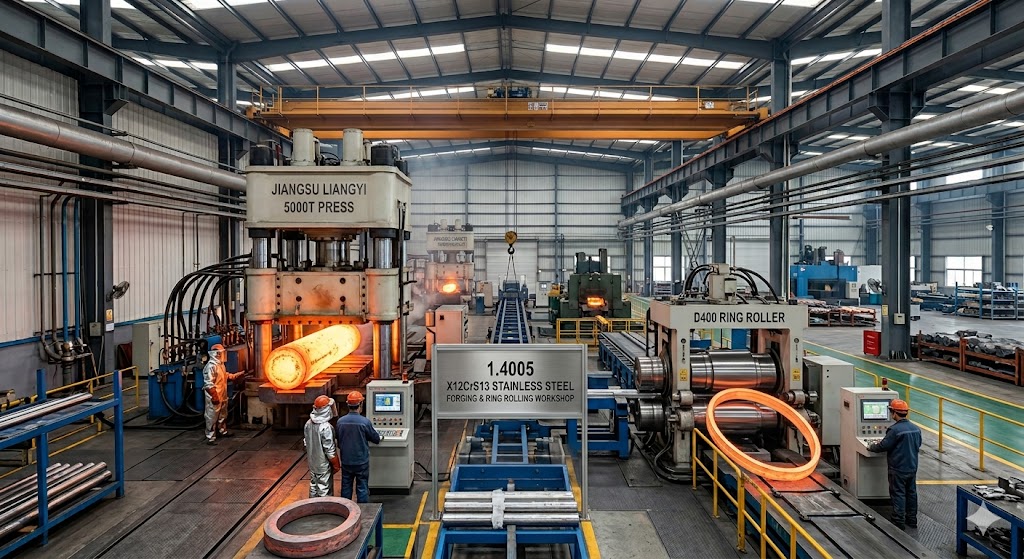
- Open Die Forging / Seamless Ring Rolling: For bar and disc shapes, open die forging on 2000T–6300T hydraulic presses achieves a minimum reduction ratio of 3:1 (typically 5:1 to 8:1) to break down the cast dendritic structure and produce a wrought grain refined microstructure. For ring shapes, billets are upset, punched and saddle-forged to a ring preform, then ring-rolled on our 5-meter radial-axial ring rolling mill. Finish forging temperature must remain above 950°C to prevent surface rupture in the martensitic transformation range (Mf ~250°C, Ms ~350°C).
- Controlled Slow Cooling After Forging: Immediately upon exiting the press, forgings are transferred to a pit furnace, dry ash, diatomite or vermiculite insulation. This is the most critical step: 1.4005 forgings that are allowed to air cool will experience a rapid martensitic transformation that generates internal stresses large enough to cause spontaneous cracking — particularly in sections over 100 mm. Target cooling rate through the 850–500°C range: ≤30°C/hour.
- Intermediate Inspection: After cooling, each forging is visually inspected for surface cracks. Dimensional check against forge plan tolerances is performed before heat treatment. Any forgings showing surface defects are either conditioned (surface grinding) or rejected — we do not proceed to heat treatment on suspect material.
- Heat Treatment: Full anneal, normalize-and-temper or quench-and-temper according to the customer's specification and the application requirements described in Section 5. Heat treatment cycles are recorded on calibrated paper chart recorders and the records are archived per EN 10204 requirements.
- Rough Machining (if required): For components requiring subsequent precision machining by the customer, we offer a rough machined condition with 3–5 mm stock on all machined surfaces. This removes forging scale and decarburization, verifies dimensional allowance and makes the part ready for finish machining at the customer's facility.
- Non-Destructive Testing & Final Inspection: 100% UT as per ASTM A388 / EN 10228-3, MT as per ASTM E709 / EN 10228-1 on all forgings. ASTM E10, Hardness survey. Dimensional inspection as per approved drawing or 3D Model.
- Documentation & Shipment: EN 10204 3.1 material certificate (or 3.2 with third-party co-signature), heat treatment records, UT/MT reports, dimensional inspection report and packing list. Export crating per ISPM 15 for wooden packaging.
Machining 1.4005 (X12CrS13) Forgings: Parameters & Practical Guidance
One of the primary reasons engineers specify 1.4005 (X12CrS13) forgings over other martensitic grades is the predictable, efficient machining behavior. The following guidance is based on our production experience machining 1.4005 forgings in-house and on feedback from our global customer base of valve and pump manufacturers.
Recommended CNC Turning Parameters for 1.4005 (X12CrS13)
| Tool Type | Condition | Cutting Speed Vc (m/min) | Feed f (mm/rev) | Depth of Cut ap (mm) | Coolant |
|---|---|---|---|---|---|
| Carbide Insert (CNMG/WNMG, PVD coated) | Annealed (≤220 HB) | 110 – 150 | 0.15 – 0.40 | 1.5 – 4.0 | Flood (emulsion) |
| Carbide Insert (CNMG/WNMG, PVD coated) | Q&T (220–280 HB) | 80 – 120 | 0.10 – 0.30 | 1.0 – 3.0 | Flood (emulsion) |
| Carbide Insert (hard turning grade) | Q&T (28–34 HRC) | 60 – 90 | 0.05 – 0.15 | 0.3 – 1.5 | Flood or dry |
| HSS (M42 or PM-HSS) | Annealed | 18 – 28 | 0.10 – 0.30 | 1.0 – 3.0 | Flood essential |
| CBN Insert | Q&T (>45 HRC) | 80 – 150 | 0.05 – 0.12 | 0.1 – 0.5 | Dry or MQL |
Drilling & Milling Guidance
- Drilling: Use solid carbide or carbide-tipped drills at 40–80 m/min cutting speed, 0.05–0.15 mm/rev feed. Apply generous flood coolant with through-spindle coolant preferred for deep holes (L/D >5). The MnS inclusions significantly reduce the tendency for built-up edge (BUE) formation compared to standard 410.
- Milling: Coated carbide end mills (TiAlN or AlCrN coating) at 80–130 m/min cutting speed, 0.05–0.15 mm/tooth. Climb milling preferred to minimize work hardening of the cut surface. Axial depth of cut 0.5–2×D, radial width 20–40% of D.
- Threading: 1.4005 threads cleanly with both cut taps (HSS-E, coated) and roll-forming taps in the annealed condition. Cut tapping speed: 6–12 m/min with sulfurized cutting oil. Roll-form tapping speed: 8–15 m/min — the MnS inclusions do not impede cold-forming as they would in harder steels.
- Grinding: Use aluminum oxide (Al₂O₃) or silicon carbide (SiC) wheels, avoiding excessive wheel pressure to prevent surface burning and the creation of untempered martensite on the machined surface. Keep wheel speed at 25–35 m/s with continuous flood coolant.
Tip: Maximize Tool Life by Exploiting the MnS Effect
Unlike austenitic stainless steels (304, 316) where interrupted cuts and re-entering a cold surface cause rapid built-up edge (BUE) formation, 1.4005 (X12CrS13) is forgiving of interrupted cutting thanks to the MnS lubrication effect. However, do not allow the insert to dwell at the same depth of cut on a stopped spindle — MnS decomposition deposits at standstill temperatures can cause diffusion wear. Always retract the tool before stopping the spindle.
Grade Comparison: 1.4005 vs 410 vs 17-4PH vs 1.4313 (F6NM)
Selecting the right stainless steel for a forged component is a multi-criteria decision. The table below provides an honest, engineering-focused comparison of 1.4005 (X12CrS13) against the three grades it most commonly competes with. We include grades where a different choice may be more appropriate — our goal is to help engineers make the right technical decision, not to oversell 1.4005 for every application.
| Property / Factor | 1.4005 (X12CrS13) / AISI 416 | 1.4006 (X12Cr13) / AISI 410 | 1.4542 (X5CrNiCuNb16-4) / 17-4PH | 1.4313 (X3CrNiMo13-4) / F6NM |
|---|---|---|---|---|
| Steel Type | Free-Machining Martensitic | Martensitic | Precipitation-Hardening Martensitic | Soft Martensitic (Ni-Mo alloyed) |
| Machinability Rating | 85% ★ Best | 50% ★★ | 45–55% | 50–60% |
| Tensile Strength (typical) | 650–850 N/mm² (Q&T) | 600–800 N/mm² | 1,000–1,170 N/mm² (H900) | 760–900 N/mm² |
| Yield Strength (typical) | 450–700 N/mm² | 400–600 N/mm² | 790–1,000 N/mm² | 600–700 N/mm² |
| Hardness Range | 180–340 HB (condition dependent) | 180–300 HB | Up to 400 HB (H900) | 230–270 HB |
| Toughness (Charpy V, long.) | Moderate (~30–60 J) | Moderate (~35–70 J) | Low (~20–40 J at H900) | High (>80 J typical) |
| Transverse Toughness | Low (MnS anisotropy) | Moderate | Moderate | High |
| Corrosion Resistance (PREN) | ~12 (lowest in group) | ~12–13 | ~15–16 (Cr + Mo) | ~14–15 (Cr + Mo + Ni) |
| Weldability | Difficult (high S, preheat 200–300°C) | Moderate (preheat 200°C) | Moderate (post-weld age required) | Good (low C, Ni) |
| Heat Resistance (max. °C) | 650°C continuous | 650°C continuous | 315°C (overaging above this) | 350°C continuous |
| Cryogenic Service (<−20°C) | Not recommended | Not recommended | Not recommended | Down to −60°C (H condition) |
| Raw Material Cost (relative) | $ (Low) | $ (Low) | $$$ (High — Cu, Nb addition) | $$ (Medium — Ni, Mo addition) |
| Lead Time for Forgings | 15–20 days | 15–20 days | 20–30 days | 20–30 days |
| Best Use Case | High-volume machined parts: valve stems, pump shafts | General corrosion-resistant service; welded assemblies | High-strength aerospace, oil & gas pressure parts | Hydraulic turbines, pumps, weldable components |
Corrosion Resistance & Media Compatibility of 1.4005 (X12CrS13)
1.4005 (X12CrS13) has moderate corrosion resistance — significantly better than carbon steels but inferior to austenitic grades (304, 316) and the higher-alloyed martensitic grades (17-4PH, 1.4313). Its Pitting Resistance Equivalent Number (PREN = %Cr + 3.3×%Mo + 16×%N) is approximately 12–14 depending on molybdenum content — the threshold for significant pitting in chloride environments is PREN >25, meaning 1.4005 should not be used in prolonged immersion in chloride-containing water without protective coatings.
The sulfur inclusions in 1.4005 are more susceptible to preferential corrosive attack than the surrounding matrix, creating initiation sites for pitting at the inclusion-matrix interface. This is why its corrosion resistance in certain media is measurably lower than standard 410 of identical chromium content.
Corrosion Media Compatibility Guide
| Corrosive Medium | Concentration / Condition | Compatibility Rating | Notes & Limitations |
|---|---|---|---|
| Atmospheric exposure (industrial) | Moderate SO₂, no salt spray | Excellent | Forms passive Cr₂O₃ film; no staining under moderate industrial atmosphere |
| Fresh water (potable) | Flowing, neutral pH | Good | Suitable for valves in water treatment; avoid stagnant conditions |
| Seawater / Brine | 3.5% NaCl | Poor | Pitting initiates at MnS inclusions; not suitable for immersion service — use 316L or duplex |
| Steam (dry or wet) | Up to 450°C | Good – Excellent | Major application; steam valve stems and seats; passive in steam up to 450°C |
| Nitric acid (HNO₃) | <20% concentration | Fair | Passive in dilute HNO₃; sulfide inclusions may dissolve, leaving pits; use cautiously |
| Sulfuric acid (H₂SO₄) | Any concentration | Not suitable | Active dissolution in H₂SO₄; use 316L, 904L or Alloy 20 for sulfuric acid service |
| Hydrochloric acid (HCl) | Any concentration | Not suitable | Rapid pitting and general corrosion; use higher-alloy grades (Hastelloy C-276) |
| Crude oil / Hydrocarbon | Sour (H₂S <10 ppm) | Acceptable | Suitable for low-H₂S crude service; check NACE MR0175/ISO 15156 for HRC <22 |
| Natural gas | Dry, low H₂S | Good | Widely used for gas valve components; check for chloride in condensate |
| Phosphoric acid (H₃PO₄) | <40%, room temperature | Fair | Marginal resistance; verify corrosion rate with immersion tests for specific application |
| Organic acids (acetic, citric) | Dilute, room temperature | Fair | Passive in dilute organic acids; concentrated acetic acid causes uniform corrosion |
| Alkalis (NaOH, KOH) | Dilute to concentrated | Good | Resistant to alkali attack; suitable for alkaline process services |
Surface Finish Improves Corrosion Resistance of 1.4005
Surface finish has a disproportionate effect on the corrosion resistance of 1.4005 compared to austenitic grades. A polished surface (Ra ≤ 0.8 µm) removes the near-surface MnS inclusions most susceptible to pitting initiation and allows a more uniform passive film to form. For 1.4005 components in moderate corrosive service (steam, dilute acids, industrial atmospheres), specifying a ground or polished finish — rather than a rough machined or forged surface — can extend service life by 3–5× compared to the same part with an as-machined Ra ≥ 3.2 µm surface.
Material Selection Guide: When to Choose 1.4005 (X12CrS13)
1.4005 (X12CrS13) is not the right choice for every application — and acknowledging that is part of being a trusted engineering supplier. Use the guide below to determine when 1.4005 forgings are the optimal selection versus when a different grade should be specified:
✅ Choose 1.4005 (X12CrS13) When:
- High-volume CNC machining — machinability is the primary cost driver
- Valve stems, balls, seats and bonnets in moderate corrosive service (steam, oil, gas)
- Moderate mechanical strength required (Rm 650–850 N/mm²) with good machinability
- Forged bars and rings that will be turned to close tolerances (<0.05 mm)
- Budgets favour a low-alloy stainless cost structure
- Service temperature between −20°C and 650°C
- Magnetic properties required (e.g., for magnetic chuck clamping during machining)
- AISI 416 / EN 1.4005 is explicitly specified in the customer's design drawing
⚠️ Consider Grade 410 Instead When:
- Weldability is critical — 410 welds with far less risk of hot cracking
- Transverse impact toughness is a key design criterion
- Prolonged service in moderately corrosive media (slightly better PREN than 1.4005)
- The part requires close-contour forming or bending after forging
⚠️ Consider 17-4PH Instead When:
- Very high strength is needed (Rm >1,000 N/mm²) with moderate toughness
- Better corrosion resistance required (PREN ~15–16)
- Aerospace or oil & gas pressure parts with high static load
- Note: significantly higher material cost and longer lead time than 1.4005
⚠️ Consider 1.4313 (F6NM) Instead When:
- Post-weld heat treatment (PWHT) will be applied
- High impact toughness (>80 J) is mandatory at operating temperature
- Cryogenic or low-temperature service (down to −60°C)
- Hydraulic turbine runners, pump impellers with fatigue-dominated loading
- Better corrosion resistance than 1.4005 is needed at similar cost
Global Industrial Applications of 1.4005 (X12CrS13) Forgings
1.4005 (X12CrS13) forging parts are specified in critical industrial applications worldwide where the combination of high machinability, moderate corrosion resistance, adequate mechanical strength and magnetic permeability is required. Our China-manufactured forgings have been deployed in projects across Europe, North America, the Middle East and Asia. The following applications draw on our 25 years of 1.4005-specific engineering experience:
Valve Industry Applications — The Dominant Market for 1.4005
The valve industry accounts for the largest share of global 1.4005 (X12CrS13) consumption. The reason is straightforward: valve manufacturing is machining-intensive. A typical ball valve requires 8–15 individual machining operations on the ball alone — facing, turning, boring, grooving, threading, lapping and polishing. At production volumes of tens of thousands of valves per year, the 35–45% reduction in cycle time that 1.4005 offers over 410 translates directly into cost and lead time advantage. Components supplied include:
- Valve balls, bonnets, bodies, stems, closures and seat rings for ball valves, gate valves, globe valves and check valves rated to ANSI Class 150–2500 and DN25–DN1,200
- Butterfly valve main shafts and spindles for industrial (ANSI B16.34) and cryogenic applications, including HPBV (High-Performance Butterfly Valve) shafts for LNG and industrial gas systems operating at ambient to −20°C service temperature
- Main steam valve (MSV), governor valve (GV), control valve (CV) and combined intercept valve (CIV) seats, cores, sleeves and discs for power plant steam turbine valve trains
- Forgings manufactured to API 6A and API 6D material and dimensional specifications, for use by licensed valve manufacturers in wellhead and pipeline valve assemblies
- Subsea valve body and bonnet forgings for H₂S-free service; hardness controlled to ≤22 HRC per NACE MR0175 / ISO 15156 requirements (NACE compliance is the responsibility of the end-product manufacturer)
Power Generation Applications
Power generation — both fossil fuel and nuclear — is the second major application sector for 1.4005 forgings. The grade's combination of machinability, adequate strength at temperatures up to 500°C and established long-term reliability in steam environments has made it a standard material in this sector for decades. Applications include:
- Gas and steam turbine blades, discs, impellers and blisks for power generation equipment in capacities from 50 MW to 1,200 MW units
- Turbine casings, guide rings, seal rings and labyrinth rings for steam and gas turbines in combined cycle and simple cycle power plants
- Turbine valve spindles, stems and rods for critical steam admission and control service up to 450°C / 100 bar steam conditions
- Reheat stop valve (RSV) and combined reheat valve (CRV) seats and discs for ultra-supercritical power plant turbine valve trains
- Nuclear power reactor coolant pump (RCP) rotors, impellers and casings where the controlled ferromagnetic properties are part of the pump design specification
Oil & Gas Industry Applications
We supply 1.4005 forged components to Tier 1 oil and gas equipment manufacturers serving operations in the Middle East, North Sea, Gulf of Mexico, Caspian Sea and Southeast Asia:
- Downhole drilling tool components for onshore and offshore rotary steerable systems (RSS) and measurement-while-drilling (MWD) tools
- Mud motor splined drive shafts, bearing mandrels and rotor housings for positive displacement motors (PDM) in directional drilling
- Electrical submersible pump (ESP) motor splined shafts, rotor mandrels and bearing housings for artificial lift in mature oil fields (L/D ratios up to 150:1 achieved with our long bar forging capability)
- Oil flow measurement components: ultrasonic flow meter bodies, Venturi cone meter bodies, orifice plate carriers and meter run spools
- Double studded adapter (DSA) flanges and wellhead equipment components to API 6A PSL-2 and PSL-3
Compressor & Pump Applications
- Centrifugal compressor 3D impellers and shrouded impellers for natural gas processing, petrochemical and fertilizer plants
- Reciprocating compressor piston rods, valve plates and cylinder liners for high-pressure (up to 350 bar) gas compression service
- Multi-stage centrifugal pump casings, covers, barrels, impellers, wear rings and shafts for water injection, crude oil transfer and process service
- Turbine pump labyrinth shaft seals, interstage bushings and bearing housings
- Submersible pump bowls, impellers and diffusers for municipal water supply and irrigation systems
Other Industrial Applications
- Venturi cone meter bodies and orifice flanges for natural gas measurement in custody transfer metering stations
- Pressure vessel and reactor nozzles, manholes and flanged connections for chemical and petrochemical plants
- Fasteners, studs, bolts and nuts for high-temperature applications in turbine casings and pressure vessels (typically supplied in Q&T condition, hardness 28–32 HRC)
- Transition cones, flanged bosses and speciality fittings for industrial piping systems
- Marine propeller shaft sleeves and stern tube sealing rings for commercial vessel applications in moderate corrosive service
Rigorous Quality Assurance & International Testing Standards
📋 Our Certifications — Stated Clearly
Jiangsu Liangyi holds: ISO 9001:2015 (Quality Management System), issued by an accredited certification body and subject to annual third-party surveillance audits. This is our sole institutional quality certification.
We do not hold: API Monogram license, AS9100D aerospace certification, PED (Pressure Equipment Directive) approval, or certification from SGS / Bureau Veritas / TÜV / Lloyd's Register. We can accommodate inspection by these agencies at the customer's nomination and cost, resulting in an EN 10204 3.2 co-signed certificate — but their attendance does not constitute certification of our facility by those bodies.
At Jiangsu Liangyi, quality control is integrated into every stage of the manufacturing process — not applied as a final inspection gate. Our ISO 9001:2015 certified quality management system covers the complete chain: incoming raw material, forging, heat treatment, machining and final inspection. Our in-house testing laboratory is equipped with advanced instruments that provide real-time feedback to production, not just post-production results.
In-House Testing Capabilities
| Test Type | Equipment / Method | Standard | Application to 1.4005 Forgings |
|---|---|---|---|
| Chemical Analysis | Optical Emission Spectrometer (OES) | ASTM E1086 / EN 10351 | Verify all 8 elements; confirm Mn:S ≥3:1 ratio |
| Tensile Testing | Servo-hydraulic Universal Testing Machine | ASTM A370-12 / EN ISO 6892-1 | Rp0.2, Rm, A5; coupons cut from each heat |
| Charpy Impact | Instrumented Charpy Pendulum | ASTM E23-07a / EN ISO 148-1 | CVN in longitudinal direction; transverse on request |
| Hardness Survey | Brinell, Rockwell, Vickers | ASTM E10 / E18 / E92 | Multiple readings per forging; full cross-section mapping on rings |
| Ultrasonic Testing (UT) | Phased Array UT (PAUT) and conventional UT probes | ASTM A388 / EN 10228-3 | 100% volumetric inspection; detect internal voids, laminations, segregation |
| Magnetic Particle Testing (MT) | Wet fluorescent MT with UV lamp | ASTM E709 / EN 10228-1 | 100% surface and near-surface defect detection; effective due to ferromagnetic nature of 1.4005 |
| Grain Size Determination | Optical Metallographic Microscope | ASTM E112-10 | Target ASTM grain size ≥5 (fine-grained); verified on production forgings |
| Inclusion Rating | Optical Metallographic Microscope | ASTM E45-05 | Quantify MnS inclusion type and density; verify against agreed acceptance criteria |
| Delta Ferrite Content | Feritscope / Metallographic image analysis | AMS 2315G | Control residual ferrite content; excessive delta ferrite reduces impact toughness |
| Dimensional Inspection | CMM (Coordinate Measuring Machine), caliper, bore gauge | Per approved drawing | Full dimensional report issued for each part or lot |
Material Certification
All finished 1.4005 (X12CrS13) forgings are supplied with EN 10204 3.1 certificates as standard — documents reviewed and signed by our in-house Quality Assurance representative under our ISO 9001:2015 quality management system. EN 10204 3.2 certificates (co-signed by a customer-nominated, accredited third-party inspector such as SGS, Bureau Veritas or TÜV, arranged and funded by the customer) are available upon request. Each certificate includes:
- Complete chemical composition with full element analysis (OES results)
- Mechanical test results (tensile, yield, elongation, reduction of area, Charpy impact energy) from coupons representing the same heat and heat treatment batch
- Hardness survey results with measurements from each forging or forging lot
- Non-destructive test reports (UT and MT) covering 100% of the forging volume and surface
- Heat treatment furnace records showing actual temperature-time curves (not just setpoint values)
- Full traceability chain from raw material heat number through each production operation to finished part serial number
- Dimensional inspection report against the approved drawing or customer-supplied 3D model
Why Choose Jiangsu Liangyi as Your China 1.4005 Forging Partner?
There are many Chinese forging suppliers offering 1.4005 (X12CrS13) components. The difference at Jiangsu Liangyi lies in what we have built over 25 years of focused practice: a deep, documented understanding of 1.4005 metallurgy and its specific forging challenges — not a generic capability applied generically to a specific order.
- Grade-Specific Expertise: 25 years of exclusive focus on stainless and alloy steel forgings, with 1.4005 (X12CrS13) and its closely related grades (410, 1.4313, 17-4PH) representing a core part of our production. We have solved the hot-shortness, anisotropy and embrittlement challenges described in this guide in practice, not just on paper.
- Vertically Integrated Production: From steel melting and AOD refining through forging, heat treatment, CNC machining, non-destructive testing and certification — all in Jiangyin. No subcontracting of critical process steps means full traceability and no accountability gaps.
- Advanced Equipment: 2,000T–6,300T hydraulic presses with closed-loop pressure control; 1–5T electro-hydraulic hammers; 5-meter radial-axial ring rolling mill; phased array UT (PAUT) inspection; CMM dimensional verification; OES chemistry verification.
- Large Capacity, Small Minimum Order: 120,000 metric tons annual capacity means we can handle large blanket orders — yet we also accept single-piece prototype orders. There is no minimum order quantity for engineering samples and trials.
- Global Track Record: Exported to 50+ countries including the United States, Germany, France, Italy, the UK, Norway, Saudi Arabia, UAE, Singapore, Australia and South Korea. Our forgings are certified to API, ASTM, EN and customer-specific standards including many OEM specifications.
- Engineering Support: Our technical team includes metallurgical engineers who will review your drawings, recommend heat treatment conditions, and give advice on forging orientation and identify potential design issues before production begins to reduce costly design iterations.
- Transparent Documentation: Each EN 10204 3.1 certificate we issue includes actual heat treatment furnace charts and not just nominal values. We keep production records for traceability for a minimum of 10 years.
- ISO 9001:2015 Certified: Our quality management system is audited annually by an accredited third-party certification body. Audit reports are available upon request for customer QA evaluation.
Frequently Asked Questions About 1.4005 (X12CrS13) Forgings
The fundamental difference is sulfur content. Grade 410 contains ≤0.03% sulfur (trace only); 1.4005 (X12CrS13) contains 0.15–0.35% sulfur, which forms elongated MnS chip-breaking inclusions that raise machinability from approximately 50% (for 410) to 85% (for 1.4005). In practice this means 30–45% longer tool life, faster cycle times and lower cutting forces — decisive advantages for high-volume valve and pump manufacturers. The trade-offs are: slightly lower pitting corrosion resistance (PREN ~12 vs ~13 for 410), significantly lower transverse impact toughness due to MnS anisotropy, and notably poorer weldability. Choose 1.4005 when machining volume and cost-efficiency dominate. Choose 410 when weldability, transverse toughness or marginally better corrosion resistance is the priority.
For 1.4005 (X12CrS13) in the annealed condition using PVD-coated carbide inserts (CNMG/WNMG grade): cutting speed Vc = 110–150 m/min, feed f = 0.15–0.40 mm/rev, depth of cut ap = 1.5–4.0 mm, with flood emulsion coolant. In the Q&T condition (220–280 HB): reduce speed to 80–120 m/min. In the maximum hardness Q&T condition (28–34 HRC): use 60–90 m/min. These parameters deliver tool life 30–40% longer than on equivalent-hardness grade 410 due to the MnS chip-breaking and lubrication mechanism. Always use flood coolant — the MnS lubrication effect is additive to, not a replacement for, proper coolant application.
Three main routes are standard: (1) Full Anneal — 750–820°C furnace cool; delivers ≤220 HB, maximum machinability, best for customer-machined supply condition. (2) Normalize & Temper — 950–1,010°C air cool then 620–700°C; delivers 210–260 HB, good toughness, practical for large forgings where press quench is impractical. (3) Quench & Temper — 950–1,050°C oil/air quench then 550–700°C; delivers 650–1,100 N/mm² tensile, 26–34 HRC, highest wear and fatigue resistance. Critical: never temper in the 430–580°C range (475°C embrittlement zone) — Charpy impact energy can drop to below 10 J in this range even though hardness appears acceptable. Always temper above 600°C or below 400°C.
MnS inclusions in 1.4005 (X12CrS13) elongate parallel to the forging direction during hot working, creating directional (anisotropic) properties. Longitudinal properties (parallel to forging direction) are comparable to grade 410 and meet all standard specification requirements. Transverse properties — especially Charpy impact energy — are typically 20–35% lower than longitudinal values. For rotating shafts loaded in bending (where the critical stress is longitudinal), this anisotropy is not critical. For flanged components or ring-shaped parts loaded primarily in the hoop or radial direction, the transverse impact toughness must be used in fatigue and fracture calculations. Jiangsu Liangyi always aligns forging flow lines with the principal stress direction for critical components and can provide test coupons in both orientations on request to verify actual anisotropy for your specific part geometry.
1.4005 (X12CrS13) is not a pre-qualified material for unrestricted sour service according to NACE MR0175 / ISO 15156 Part 3. It can be used in sour service under certain conditions if the hardness is controlled to ≤22 HRC (approx. 248 HB) and the partial pressure of H2S and temperature are within the limits defined in ISO 15156-3 Annex B. The 1.4005 grade has additional MnS inclusions which give rise to additional entry points for hydrogen and are prone to selective dissolution in H2S containing media. This makes the grade more risky for sour service than standard 410. To maintain sour service compliance, we recommend specifying 410 forgings with controlled hardness ≤22 HRC or 1.4313 (F6NM) which has documented qualification per ISO 15156-3 for many sour service conditions.
Maximum piece weight: 30,000 kg. Forged bars: up to 2,000 mm diameter, 15 m long. Seamless rolled rings: up to 6,000 mm OD, 1,000 mm height. Discs and blocks: up to 2,000 mm diameter, 500 mm thick. Hollow forged cylinders: up to 1,500 mm OD, custom bore, up to 3 m long. There is no minimum order quantity — we accept single-piece prototype and sample orders for qualification testing. For production runs, typical order sizes are 1–500 pieces depending on part weight. Please provide your drawing and specification when requesting a quotation and we will confirm feasibility and lead time within 24 hours.
Standard compliance: EN 10088-3 (European stainless bar, rod, section and wire), ASTM A276 (stainless steel bars and shapes), ASTM A479 (stainless steel bars for boilers and pressure vessels), AMS 5610 (chemical and mechanical requirements for 416 stainless steel bars and forgings — note: AMS supply requires customer-specified inspection levels; Jiangsu Liangyi holds ISO 9001:2015, not AS9100D aerospace certification). For inspection: ASTM A388 (UT of steel forgings), EN 10228-3, ASTM E709 and EN 10228-1 (MT). Material certification to EN 10204 3.1 standard; EN 10204 3.2 (co-signed by customer-nominated third-party inspector such as SGS, BV or TÜV, at customer's arrangement and cost) available upon request. Customer-specific standards and OEM specifications accommodated subject to technical review.
The MnS inclusions in 1.4005 are susceptible to preferential anodic dissolution in corrosive media — particularly in chloride environments — because the sulfide-matrix interface has a lower corrosion potential than the surrounding steel matrix. Pitting initiates at these interfaces and propagates into the steel matrix. This is absent in grade 410 which has only trace sulfur. To improve the corrosion resistance of 1.4005 in service: (1) Specify a polished surface finish (Ra ≤ 0.8 µm) to remove near-surface inclusions; (2) Apply a passivation treatment (citric acid 4–10% at 49°C, or nitric acid 20–25% per ASTM A967) to strengthen the Cr₂O₃ passive film; (3) Specify a Molybdenum-bearing variant (0.3–0.6% Mo within EN 10088-3 limits) — Mo increases PREN by approximately 1 unit per 0.3% Mo addition; (4) Consider protective coatings (electroless nickel, HVOF WC-Co) for particularly aggressive environments. If corrosion resistance is critical to the application, discuss the service medium, temperature and pH with our engineers before specifying 1.4005.
Contact Us for 1.4005 (X12CrS13) Forging Quotations
We are committed to providing the best price and superior quality 1.4005 (X12CrS13) forged steel parts for global clients. Whether you need standard components or custom forgings for demanding applications, we have the materials expertise, equipment and production capacity to meet your requirements.
To request a quotation, please send us your detailed drawings (PDF or DXF/DWG format), material specification, quantity requirements, required heat treatment condition, inspection and certification requirements, and any special instructions. Our engineering team will review your request and provide a competitive quotation within 24–48 hours.
📧 Email:
sales@jnmtforgedparts.com
📞 Phone / WhatsApp:
+86-13585067993
🌐 Website:
www.jnmtforgedparts.com
📍 Address:
Chengchang Industry Park, Jiangyin City, Jiangsu Province, China 214400