1.3980 (X5NiCrTiMoV26-15) Forging Parts
China Jiangsu Leading ISO 9001:2015 Certified Manufacturer Since 1997 | Exported to 50+ Countries
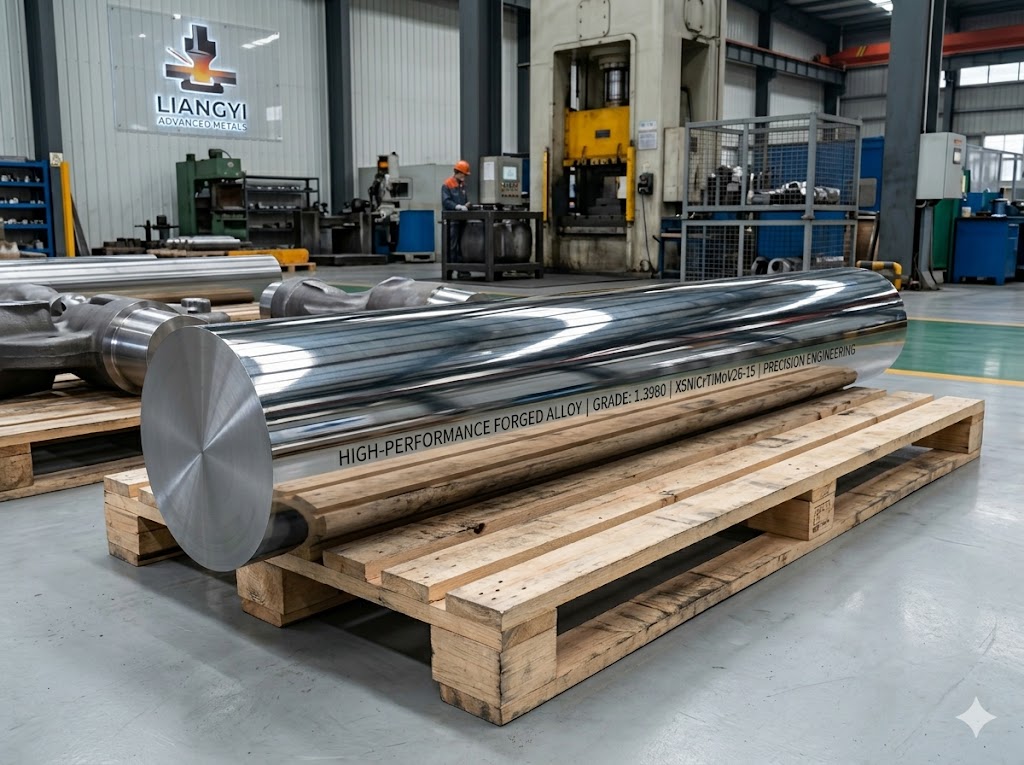

Quick Reference: What Is 1.3980 (X5NiCrTiMoV26-15)?
- Material standard: EN 10302:2008 — precipitation-hardening, austenitic, heat-resistant steel
- Equivalent designations: 1.3980 · X5NiCrTiMoV26-15 · X5NiCrTiMoV26.15
- Main alloying elements: Ni 24–27% · Cr 13.5–16% · Ti 1.9–2.3% · Mo 1.0–1.5% · V 0.1–0.5%
- Operating temperature: Up to 650°C with high creep resistance
- Main properties: High-temperature strength · Creep resistance · Low magnetic permeability · Oxidation resistance
- Typical tensile strength: 930–1180 MPa (after solution annealing + precipitation hardening)
- Primary applications: Turbine discs, valve components, retaining rings, compressor impellers, nuclear pump parts
- Manufacturer: Jiangsu Liangyi Co., Limited — ISO 9001:2015 certified, Jiangyin, Jiangsu, China (est. 1997)
About 1.3980 (X5NiCrTiMoV26-15) Steel & Our Manufacturing Expertise
Jiangsu Liangyi Co., Limited is a professional ISO 9001:2015 certified manufacturer of 1.3980 (X5NiCrTiMoV26-15) open die forging parts and seamless rolled steel forged rings. Our company was founded in 1997 and located in Jiangyin City, Jiangsu Province, China which is the heart of China's forging industry cluster, we have become a best supplier of high-performance 1.3980 forged components to customers in 50+ countries which including the United States, Germany, France, Italy, Spain, the United Kingdom, Australia, Japan, South Korea, and India.
1.3980, also known as X5NiCrTiMoV26-15, X5NiCrTiMoV26.15, and X 5 NiCrTiMoV 26-15, is a premium precipitation-hardening heat-resistant steel. This advanced alloy has exceptional high-temperature strength, great creep resistance, low magnetic permeability, and superior oxidation resistance at temperatures up to 650°C. These unique properties make these materials the best choice for critical applications in power generation, oil & gas, nuclear energy, and other industries that need reliability under harsh working conditions.
Why Choose Chinese 1.3980 Forgings from Jiangsu Liangyi?
- Complete in-house production from steel melting (30t EAF, LF, VOD) to final machining and testing
- Advanced manufacturing facilities including 6300T hydraulic press, 5M ring rolling machine, and 10 heat treatment furnaces
- Competitive pricing without compromising on international quality standards
- short lead times for both standard and custom forged components (4-6 weeks for raw, 6-8 weeks for machined)
- Comprehensive quality control with complete MTC 3.1/3.2 certification and third-party inspection support (SGS, BV, TÜV)
- Experienced engineering team to improve designs for manufacturability and performance
- Flexible shipping options to all major ports all over the world, including Shanghai Port, Ningbo Port, and Shenzhen Port
Available 1.3980 Forging Shapes & Custom Products
We produce different kinds of 1.3980 (X5NiCrTiMoV26-15) forging products in different shapes and sizes according to international standards (EN, ASTM, AMS, DIN, JIS) and customer drawings. We can produce the parts that single weight ranges from 30kg to 30,000kg, and we have an annual production capacity of 120,000 tons.
We make 1.3980 (X5NiCrTiMoV26-15) forging products in different shapes and sizes which can meet international standards (EN, ASTM, AMS, DIN, JIS) and customer drawings. We can make parts that weigh from 30 kg to 30,000 kg, and we can make 120,000 tons of them every year.
Standard Forging Shapes & Size & Weight
| Forging Shapes | Maximum Size | Maximum Weight | Available Finishes |
|---|---|---|---|
| Round Bars, Square Bars, Flat Bars, Rectangular Bars | Ø2000mm (round), 1500x1500mm (square/flat) | 30,000kg | Rough forged, turned, ground, polished |
| Seamless Rolled Rings, Open Die Forged Rings | Ø6000mm (OD) | 30,000kg | Rough forged, machined, contoured |
| Hollow Bars, Sleeves, Bushes, Heavy Wall Cylinders | Ø3000mm (OD) | 30,000kg | Rough forged, bored, honed |
| Discs, Disks, Plates, Blocks | Ø2000mm (disc), 2000x2000x500mm (plate) | 30,000kg | Rough forged, machined, heat treated |
| Shafts, Step Shafts, Gear Shafts, Turbine Shafts | Ø1800mm, 15m length | 30,000kg | Rough forged, turned, splined, keyed |
Custom 1.3980 Forged Parts
We make custom 1.3980 (X5NiCrTiMoV26-15) forged components according to your exact drawings and technical requirements. Here are the forged parts that we can make:
- Valve & Pump Components: 1.3980 forged valve bodies, bonnets, stems, seats, cores, discs, pump casings, impellers, shafts, wear rings, and housings for ball valves, check valves, gate valves, globe valves, and centrifugal pumps
- Turbine & Power Generation Components: X5NiCrTiMoV26-15 turbine blades, discs, blisks, wheel assemblies, labyrinth shaft seals, guide rings, shroud rings, and high-temperature fasteners
- Oil & Gas Components: 1.3980 wellhead equipment, subsea components, double studded adapter flanges, pressure vessel nozzles, heat exchanger tube sheets, baffles, and channel flanges
- Railway & Transportation Components: We can make X5NiCrTiMoV26-15 railway locomotive traction motors non-magnetic retaining rings, high-speed train critical components, and marine propulsion system shafts
MOQ: No MOQ limitation, we can accept small batch custom orders (1-5 pcs) upon request.
1.3980 Forging Parts Applications & Industry Success Cases
Our forged parts made of 1.3980 (X5NiCrTiMoV26-15) are used in many different industries where strength at high temperatures, resistance to creep, low magnetic permeability, and dependability are important. These are some of our most important success stories and use cases:
Power Generation Industry
Nuclear Power Plant Applications
- Nuclear power reactor coolant pumps rotors, impellers, and casings
- Nuclear reactor coolant pump containment seal chambers
- Nuclear power plant safety-related components
- Supplied to nuclear power projects in Asia
Thermal Power Plant Applications
- Gas and steam turbine blades, discs, blisks, and wheel assemblies
- Steam turbine control reheat valve discs and spindles
- MSV/GV/CV/CRV valve seats, cores, sleeves, and bonnets
- Turbine labyrinth shaft seals, guide rings, and shroud rings
- High-temperature turbine fasteners, studs, and bolts
- Supplied to thermal power plants in Asia, Europe, and the Middle East
Oil & Gas Industry
- High-pressure ball valves, check valves, and gate valves components
- Oil measurement valve spools and ultrasonic flow meter bodies
- Venturi cone meter bodies, blocks, and transition cones
- Double studded adapter flanges and pressure vessel nozzles
- Wellhead equipment and subsea components
- Heat exchanger tube sheets, baffles, and channel flanges
- Used in onshore and offshore oil and gas projects worldwide, including the US and Germany
Railway & Transportation
- Railway locomotive traction motors non-magnetic retaining rings
- High-speed train critical components and suspension parts
- Marine propulsion system shafts and turbine components
- Heavy-duty truck and construction equipment parts
- Supplied to major railway manufacturers in Europe and Asia
Metallurgical Industry
- Electromagnetic stirring rolls for continuous casting machines
- Steel mill equipment components and roll housings
- High-temperature processing furnace parts and fixtures
- Heat treatment equipment components
- Used in steel plants across China and Southeast Asia
General Industrial
- Turbo centrifugal compressor impellers, shrouds, and casings
- Industrial boiler and heat exchanger components
- High-temperature furnace and incinerator parts
- Chemical processing equipment and pressure vessels
- High-temperature fasteners and hardware
- Custom engineered components for specialized machinery
Chemical Composition of 1.3980 (X5NiCrTiMoV26-15)
The precise chemical composition of 1.3980 steel is carefully controlled during our steelmaking process to ensure consistent material properties and performance. Our 30-ton electric arc furnace (EAF), ladle refining furnace (LF), and vacuum degassing furnace (VOD) produce high-quality ingots with minimal impurities.
| Element | Composition Range | Key Function |
|---|---|---|
| Carbon (C) | 0.08% max | Controls hardness and strength, prevents carbide precipitation |
| Nickel (Ni) | 24.0 - 27.0% | Enhances toughness, corrosion resistance, and stabilizes austenite |
| Chromium (Cr) | 13.5 - 16.0% | Provides oxidation and corrosion resistance at high temperatures |
| Molybdenum (Mo) | 1.0 - 1.5% | Improves high-temperature strength, creep resistance, and hardenability |
| Titanium (Ti) | 1.9 - 2.3% | Primary precipitation hardening element, forms intermetallic compounds |
| Vanadium (V) | 0.1 - 0.5% | Refines grain structure, increases strength and toughness |
| Boron (B) | 0.003 - 0.01% | Enhances hardenability and creep resistance |
| Aluminium (Al) | 0.35% max | Deoxidizer and grain refiner, controls nitrogen content |
| Manganese (Mn) | 2.0% max | Improves strength and toughness, deoxidizer |
| Silicon (Si) | 1.0% max | Deoxidizer, improves strength and oxidation resistance |
| Phosphorus (P) | 0.03% max | Impurity element, controlled for toughness and weldability |
| Sulfur (S) | 0.015% max | Impurity element, controlled for ductility and fatigue resistance |
All our 1.3980 steel meets the requirements of EN 10302: 2008, EN 10269: 1999, and EN 10088-1: 2005 international standards.
Mechanical Properties & Heat Treatment Process
Our 1.3980 (X5NiCrTiMoV26-15) forging parts are processed with heat treatment process to get the improved balance of strength, toughness, and high-temperature performance. We operate ten heat treatment furnaces to make sure precise temperature control and uniform heating.
Standard Heat Treatment Process
- Solution Annealing: Heat to 980-1020°C, hold for sufficient time, then quench in water or oil
- Precipitation Hardening: Heat to 700-750°C, hold for 4-8 hours, then air cool
Typical Mechanical Properties After Heat Treatment
| Mechanical Property | Minimum Value (EN 10302) | Typical Range (Jiangsu Liangyi) | Test Standard |
|---|---|---|---|
| Tensile Strength (Rm) | 930 MPa | 930 - 1180 MPa | EN ISO 6892-1 |
| Yield Point (Re) | 635 MPa | 635 - 850 MPa | EN ISO 6892-1 |
| Elongation (A5) | 12% | 12 - 20% | EN ISO 6892-1 |
| Reduction of Area (Z) | 30% | 30 - 45% | EN ISO 6892-1 |
| Brinell Hardness (HB) | 270 | 270 - 350 HB | EN ISO 6506-1 |
| Charpy Impact Strength (KV) | 20 J | 20 - 40 J | EN ISO 148-1 |
Each ingot of 1.3980 forged material is machined with enough room to make sure that all shrinkage cavities are gone and that there is no more chemical and non-metallic segregation. We check all of the materials very carefully to make sure they don't have any internal or external flaws that could make them hard to make or use.
Production Standards & Comprehensive Quality Control
Our 1.3980 (X5NiCrTiMoV26-15) forging parts are manufactured in strict according to international standards and customer specifications. We have a complete quality management system which according to ISO 9001:2015, we also have non-destructive testing procedures which follow the methodology of EN ISO 9712.
Production Standards
- EN 10302: 2008 - Creep resisting steels, nickel and cobalt alloys
- EN 10269: 1999 - Steels and nickel alloys for fasteners with specified elevated and/or low temperature properties
- EN 10088-1: 2005 - Stainless steels. List of stainless steels
- EN 10204 - Metallic products - Types of inspection documents
- Customer-specific standards and technical requirements
Inspection & Testing Capabilities
We have a quality control laboratory with advanced testing equipment to make sure the highest quality of our 1.3980 forging parts:
- Chemical Composition Analysis: Spectrometry, carbon/sulfur analysis, oxygen/nitrogen analysis
- Mechanical Property Testing: Tensile testing (room and high temperature), hardness testing (Brinell, Rockwell, Vickers), impact testing (Charpy V-notch)
- Non-Destructive Testing (NDT): Ultrasonic testing (UT), magnetic particle testing (MT), liquid penetrant testing (PT), radiographic testing (RT)
- Metallographic Examination: Microstructure analysis, grain size determination (EN ISO 643), inclusion rating
- Dimension Verification: CMM (Coordinate Measuring Machine), precision measuring equipment
- Complete Mill Test Certificate (MTC): EN 10204 3.1 / 3.2 available
- Third-Party Inspection Services: SGS, BV, TÜV, and other international inspection agencies upon request
Manufacturing Qualification Process
Our detailed Manufacturing Process Plan (MPP) documents all aspects of production which including ingot type and supplier, forging process parameters, heat treatment cycles, and component testing procedures. We can provide first article dissection reports and qualification documentation upon client request. For repeat orders of similar components, we have detailed process records to make sure consistent quality.
Physical & Thermal Properties of 1.3980 (X5NiCrTiMoV26-15)
Understanding the physical and thermal characteristics of 1.3980 steel is essential for engineering calculations involving thermal expansion, heat flux management, and electromagnetic compatibility. The values below are representative figures for this alloy system, consistent with published data under EN 10302 and comparable industry references. Actual values for a specific heat or forging cross-section may vary; contact us for test certificates from your specific order.
| Property | Value | Condition / Temperature | Engineering Relevance |
|---|---|---|---|
| Density | 8.00 g/cm³ | 20°C | Component weight estimation; slightly higher than 304SS due to Ni content |
| Melting Range | 1,330 – 1,390°C | Solidus / Liquidus | Sets upper boundary for forging and heat treatment temperatures |
| Mean Coefficient of Thermal Expansion | 15.5 × 10⁻⁶ /K | 20 – 100°C | Thermal fatigue design, clearance calculations in turbine assemblies |
| Mean Coefficient of Thermal Expansion | 17.2 × 10⁻⁶ /K | 20 – 600°C | Operating-temperature clearance calculations for valves and discs |
| Thermal Conductivity | 13.0 W/(m·K) | 20°C | Heat dissipation in turbine discs; lower than carbon steel — factor into cooling design |
| Thermal Conductivity | 18.5 W/(m·K) | 600°C | Increases with temperature — beneficial for steady-state thermal gradients |
| Specific Heat Capacity | 460 J/(kg·K) | 20°C | Thermal mass calculations for heat treatment cycle planning |
| Electrical Resistivity | 1.02 × 10⁻⁶ Ω·m | 20°C | Relevant for electromagnetic stirring rolls and eddy-current applications |
| Relative Magnetic Permeability (µᵣ) | < 1.005 | 20°C, solution annealed | Effectively non-magnetic — critical for traction motor retaining rings and MRI-adjacent equipment |
| Modulus of Elasticity (E) | 196 GPa | 20°C | Structural stiffness calculations; decreases to ~155 GPa at 600°C |
| Poisson's Ratio | 0.30 | 20°C | FEA input for stress-strain modeling |
Practitioner Note: Magnetic Permeability in Service
The low magnetic permeability of 1.3980 is a function of its complete austenitic microstructure. However, heavy cold work — such as aggressive machining without adequate annealing — can induce strain-related martensite and raise µᵣ measurably. For applications with permeability specifications tighter than µᵣ < 1.01, we recommend specifying post-machining permeability verification and discussing the allowable machining stock with our engineering team before final drawing submission.
1.3980 vs. Similar Precipitation-Hardening Heat-Resistant Alloys
Engineers often compare 1.3980 (X5NiCrTiMoV26-15) to other iron-nickel precipitation-hardening alloys that are similar. The final choice depends on the maximum operating temperature, magnetic needs, budget, and supply chain needs. Based on our experience making all four alloys, the table below shows a direct comparison information.
| Property / Factor | 1.3980 (X5NiCrTiMoV26-15) | 1.4980 (A-286 / X6NiCrTiMoVB25-15) | Nimonic 90 (2.4632) | Incoloy 901 (N09901) |
|---|---|---|---|---|
| Base System | Fe–Ni (iron-based) | Fe–Ni (iron-based) | Ni–Cr–Co (nickel-based) | Ni–Fe (iron-nickel) |
| Ni Content | 24 – 27% | 24 – 27% | ~58% (balance) | 40 – 45% |
| Cr Content | 13.5 – 16% | 13.5 – 16% | 18 – 21% | 12 – 14% |
| Ti Content (hardening) | 1.9 – 2.3% | 1.9 – 2.3% | 2.0 – 3.0% | 2.5 – 3.1% |
| Tensile Strength (RT) | 930 – 1,180 MPa | 860 – 1,100 MPa | 1,100 – 1,350 MPa | 1,000 – 1,250 MPa |
| Max. Reliable Service Temp. | ~650°C | ~620°C | ~950°C | ~700°C |
| Magnetic Permeability (µᵣ) | < 1.005 | < 1.010 | < 1.003 | < 1.010 |
| Creep Resistance | Excellent | Very Good | Excellent | Excellent |
| Weldability | Limited (PWHT required) | Moderate (PWHT preferred) | Limited (matched filler only) | Limited (PWHT required) |
| Relative Material Cost | ★★★☆☆ (baseline) | ★★★☆☆ (similar) | ★★★★★ (3–5× higher) | ★★★★☆ (1.5–2× higher) |
| Typical Forged Applications | Turbine discs, valve seats, retaining rings, compressor impellers | Fasteners, bolts, small shaft sections | Aero turbine blades, high-temp rings | Gas turbine discs, compressor impellers |
| Jiangsu Liangyi Stock / Production | ✅ Standard production | ✅ Standard production | ✅ On order | ✅ On order |
Selection guidance: For most power generation valve and disc applications operating below 650°C, 1.3980 delivers the optimal cost-performance balance — higher strength ceiling than 1.4980, with no premium over nickel-based alternatives. If your application requires operation above 700°C or demands aero-grade fatigue life, pls contact us to discuss Incoloy 901 or Nimonic 90 forging options. We produce all four alloys and can provide comparative quotations on request.
Forging Process Window, Weldability & Machinability of 1.3980
This section is written for process engineers and procurement teams who need to understand the manufacturability constraints of 1.3980 (X5NiCrTiMoV26-15) before finalizing component design. Getting these parameters right during design review prevents costly rework downstream.
Forging Process Parameters
1.3980 is an austenitic alloy compared to carbon steels, which has a relatively small hot-working window. The temperature could not lower than below temperature limit because it could cause strain-induced precipitation hardening in the middle of the process, which could crack the surface of complex shapes.
| Process Parameter | Specification | Notes |
|---|---|---|
| Ingot Soaking Temperature | 1,100 – 1,180°C | Soak time: minimum 1 hr per 100mm of cross-section to ensure uniform temperature throughout |
| Hot Forging Start Temperature | 1,050 – 1,150°C (max) | Never exceed 1,200°C — risk of incipient melting at grain boundaries |
| Minimum Finish Forging Temperature | ≥ 870°C | Below 870°C, strain-induced precipitation of γ' phase accelerates; finish all deformation above this limit |
| Recommended Reduction Ratio | ≥ 4:1 (from ingot to finished forging) | Ensure breakdown of as-cast dendritic structure and uniform grain refinement |
| Intermediate Reheats | Required for sections > 400mm or complex geometry | Reheat to 1,050–1,100°C; avoid excessive reheats — each cycle adds surface oxidation scale |
| Post-Forging Cooling | Controlled air cool or furnace cool to below 300°C | Avoid rapid quench immediately post-forging — thermal shock risk on thick sections; solution anneal is performed as a separate subsequent step |
| Solution Annealing | 980 – 1,020°C, then water or oil quench | Duration: sufficient to dissolve all precipitates; typically 30 min minimum per 25mm of effective thickness |
| Precipitation Hardening (Aging) | 700 – 750°C, hold 4–8 hours, air cool | Longer hold times within this range increase strength marginally; temperature accuracy ±10°C critical for reproducibility |
Weldability of 1.3980
1.3980 is weldable but requires discipline. It is not a free-weld alloy — improper procedure leads to heat-affected zone (HAZ) cracking or loss of mechanical properties through uncontrolled precipitation. The following guidance is based on our practical experience of supplying weldable forgings for valve and turbine repair applications:
- Pre-weld condition: Weld in the solution-annealed (soft) condition where possible. Welding in the complete aged condition significantly increases HAZ cracking susceptibility.
- Pre-heat: Not required for thin sections (<25mm) in solution-annealed condition. For sections >50mm or in aged condition, pre-heat to 150–200°C.
- Recommended filler metals: Matching composition (ERNiFeCr-2 equivalent) for structural welds; Inconel 625 (ERNiCrMo-3) for overlay or dissimilar metal joints where dilution must be controlled.
- Post-weld heat treatment (PWHT): PWHT — including solution annealing and re-aging, it is highly recommended to restore mechanical properties after welding. If full PWHT isn't possible, a partial stabilization anneal at 700–720°C for at least 4 hours should be done.
- Avoid: Multi-pass welding without inter-pass temperature control (<150°C); grinding with aluminum oxide wheels (contamination risk); contact with copper or zinc-bearing materials during storage.
Machinability of 1.3980
1.3980 is classified as a difficult-to-machine alloy. Its high nickel content, combined with important work hardening during cutting, demands tooling and parameter choices that differ substantially from standard stainless steel practice. The machinability rating is approximately 20–25% relative to free-machining carbon steel (AISI 1212 = 100%).
- Tooling: Carbide inserts mandatory — TiAlN or TiCN-coated grades (e.g., ISO P20–P30 for roughing, P10 for finishing). High-speed steel tools are unsuitable for production runs.
- Feed rates: Light-to-moderate feeds (0.10–0.25 mm/rev for turning). Avoid rubbing — dwell causes rapid work hardening and accelerates tool wear exponentially.
- Cutting speeds: 40–80 m/min for carbide turning; reduce by 30–40% for interrupted cuts (milling, slotting).
- Coolant: High-pressure flood coolant is a must for machining. Dry machining is not acceptable because heat builds up at the cutting edge and speeds up the formation of built-up edge (BUE).
- Depth of cut: Maintain sufficient depth (≥0.5mm) to cut below the work-hardened surface layer from the previous pass. Shallow skim cuts accelerate tool wear and produce poor surface finish.
- Surface finish achievable: Ra 0.8–1.6 µm in finish turning; Ra 0.4 µm achievable with CBN grinding on hardened surfaces.
Jiangsu Liangyi provides 1.3980 forgings with generous machining allowances (typically 10–20mm per side depending on section size) to make sure customers can reach final dimensions without reverting to the problematic near-surface layer left by forging scale removal. If your drawing specifies a tight stock allowance, please discuss this with our engineering team before order confirmation.
Representative Project Case Studies
The following cases show the range and technical needs of Jiangsu Liangyi's 1.3980 (X5NiCrTiMoV26-15) forging projects. The names of the clients are kept confidential because of the NDA, but the industry sector, part type, and technical parameters are all correct.
Case 1 — Steam Turbine Control Valve Disc
Sector: Thermal Power Generation | End Market: Europe
- Part: Control reheat valve disc for 600 MW supercritical steam turbine unit
- Material: 1.3980, solution annealed + precipitation hardened to EN 10302
- Dimensions: OD 840mm × thickness 195mm, finished weight 850 kg
- Main challenge: Tight hardness band (HB 290–320) across the cross-section, required on customer PO — achieved through furnace temperature profiling across all 10 zones of our aging furnace
- Inspection: UT per EN 10228-3 Class 3, hardness mapping (9 points per face), tensile at RT and 600°C, Charpy at RT
- Certification: EN 10204 3.2 with independent third-party inspection witness at our facility (inspection agency can be arranged per customer requirement)
- Lead time: 7 weeks from PO to shipping, including 3.2 inspection scheduling
Case 2 — Non-Magnetic Retaining Ring for Locomotive Traction Motor
Sector: Railway Transportation | End Market: Asia-Pacific
- Part: Seamless rolled retaining ring for high-speed railway locomotive traction motor rotor
- Material: 1.3980, solution annealed — µᵣ < 1.003 specified
- Dimensions: OD 428mm × ID 388mm × L 285mm (ring form, finish machined)
- Main challenge: The magnetic permeability specification was the most strict we had seen: <1.003 after machining. Needed a review of the whole process: a log of the forging temperature, a record of the time and temperature of the solution anneal, and a map of the permeability at 12 points around the finished ring.
- Inspection: We had complete dimensional CMM, permeability (gaussmeter, each ring), UT, hardness
- Quantity: 48 rings per batch, quarterly delivery schedule
- Outcome: All 48 rings passed µᵣ < 1.003 on first inspection. Programme has been running for 3 years with no non-conformances.
Case 3 — Nuclear Coolant Pump Shaft Forging
Sector: Nuclear Power | End Market: Asia
- Part: Reactor coolant pump (RCP) shaft forging for a pressurized water reactor project
- Material: 1.3980, double vacuum melted ingot (VIM+VAR), solution annealed + aged
- Dimensions:OD 380mm × L 2,200mm step shaft, made from rough forged steel
- Main challenge: Customer required a nuclear-grade quality plan — every process step documented in a complete ITP (Inspection and Test Plan) signed off by the owner's engineer before production start.
- Inspection: We sent someone to watch the chemical analysis, UT, mechanical testing, and dimensional verification for EN 10204 3.2. We did radiographic tests on important cross-sections per the customer's NDE procedure.
- Documentation: We provided full quality dossier in both hard copy and digital format, including MTRs, heat treatment charts, NDE reports, and dimensional records.
- Lead time: Lead time is 14 weeks, which includes about 6 weeks for getting VIM+VAR ingots from a qualified mill.
Case 4 — Compressor Impeller Blank for Turbo Centrifugal Unit
Sector: General Industrial / Chemical Processing | End Market: Germany
- Part: Closed impeller forging blank for turbo centrifugal compressor handling corrosive process gas at 580°C
- Material: 1.3980, solution annealed + aged; customer specified tensile strength 1,050 MPa minimum
- Dimensions: OD 610mm × thickness 220mm disc blank, with 120mm centre bore pre-forged
- Main challenge: Customer's FEA showed that the standard minimum Rm of 930 MPa was not enough for the design burst speed — needed a guaranteed minimum of 1,050 MPa with Rp0.2 ≥ 720 MPa. Achieved by tightening the aging temperature to 710±5°C and extending hold time to 7 hours, validated on a trial forging before production run
- Inspection: EN 10204 3.1, tensile testing (both axial and tangential direction), ultrasonic testing per customer-specified UT acceptance standard
- Lead time: 6 weeks including trial forging qualification
What These Cases Have in Common
Every project involved a technical parameter that pushed beyond the published minimum specification — tighter hardness bands, lower permeability limits, higher guaranteed strength floors, or nuclear-grade documentation requirements. This is the nature of 1.3980 forging work at the critical-component level. Our engineering team's role is not just to meet EN 10302 minimums, but to understand your end-use constraint and design the manufacturing process according to your requests. If your requirement looks difficult on paper, send it to us before concluding it cannot be sourced.
Frequently Asked Questions About 1.3980 Forging Parts
We can produce 1.3980 (X5NiCrTiMoV26-15) forgings weighing up to 30 tons. We can produce round bars with maximum diameter of 2 meters and maximum length of 15 meters. For seamless rolled rings, maximum diameter is 6 meters. For hollow forgings, maximum outer diameter is 3000 mm.
The standard lead time for 1.3980 (X5NiCrTiMoV26-15) forgings is 4-6 weeks for raw forgings and 6-8 weeks for machined components. We can provide expedited production for urgent orders as per your request.
We provide complete Mill Test Certificates (MTC) according to EN 10204 3.1 standard for all orders. we can also provide EN 10204 3.2 certification with a third-party inspection which from SGS, BV, or TÜV.
We can make open die forgings and seamless rolled rings according to your drawings. We will look over your drawings and technical requirements and give you a detailed quote and suggestions for how to make the product better and cheaper.
1.3980 (X5NiCrTiMoV26-15) steel is commonly used in power generation (thermal and nuclear), oil & gas, railway, metallurgical, and general industrial applications which need high-temperature strength, creep resistance, low magnetic permeability, and oxidation resistance.
Contact us for a Free Quote
Jiangsu Liangyi Co., Limited is focused on high-quality 1.3980 (X5NiCrTiMoV26-15) forging parts. We are equipped with advanced facilities and we have strict quality control, so we can provide competitive prices, superior quality, and reliable delivery to customers all over the world.
Welcome to send your custom drawings, material requirements, quantity, and delivery schedule for a detailed quotation. Our sales team will reply you within 24 hours.
sales@jnmtforgedparts.com
+86-13585067993
www.jnmtforgedparts.com
Chengchang Industry Park, Jiangyin City, Jiangsu Province, China