1.3952 (X2CrNiMoN18-14-3) Forged Parts | China ISO-Certified Manufacturer
1.3952 (X2CrNiMoN18-14-3) — Quick Reference
What Is 1.3952 (X2CrNiMoN18-14-3) Steel? A Manufacturer's Perspective
1.3952, formally designated X2CrNiMoN18-14-3 under EN 10088-3, is a nitrogen-strengthened super austenitic stainless steel developed specifically for applications where three demanding properties must coexist simultaneously: permanent non-magnetic stability, exceptional pitting corrosion resistance in chloride-bearing environments, and reliable toughness at cryogenic temperatures as low as −196 °C. It is not simply a variant of 316L with more nitrogen — it represents a fundamentally different metallurgical design that solves a specific engineering problem no cheaper grade can address.
As a forging manufacturer who has processed this grade since , we have accumulated direct production experience with its unique metallurgical behaviour: the narrow forging temperature window, the critical role of post-forge heat treatment, the sensitivity of magnetic permeability to nitrogen homogeneity across large cross-sections, and the specific quality checkpoints that separate a reliable 1.3952 forging from a superficially correct one. This page shares that production knowledge openly, because we believe engineers who understand the material will make better procurement decisions — and better procurement decisions lead to better projects.
Jiangsu Liangyi Co., Limited, established in and ISO 9001:2015 certified, has supplied over 1,200,000 tonnes of forgings globally since founding. Our 1.3952 forged parts currently serve clients in over 50 countries, including major LNG terminal projects in the USA and Australia, naval shipbuilding programs in Germany and South Korea, and nuclear infrastructure projects across Asia.
The Nitrogen Advantage: Why N Is the Critical Alloying Element in 1.3952
Most alloying strategies in stainless steel engineering involve a trade-off: adding molybdenum improves corrosion resistance but slightly reduces ductility; increasing nickel stabilizes austenite but raises cost without major strength gains; reducing carbon prevents sensitisation but removes solid-solution strengthening. Nitrogen is the exception — and 1.3952 is built around it.
Nitrogen in austenitic stainless steel does something that no other alloying element achieves simultaneously: it strengthens the austenite matrix through interstitial solid-solution hardening (raising yield strength by approximately 85 MPa per 0.1 wt.% N), improves pitting and crevice corrosion resistance (each 0.1% N raises PREN by approximately 3.3 units), and chemically stabilises the austenite phase against strain-induced transformation to martensite — the very transformation that makes cold-worked 316L magnetic. The practical result is a steel that gets stronger without losing corrosion resistance, and that stays non-magnetic even after forging, machining, and moderate cold work.
The target nitrogen range for 1.3952 is 0.15–0.25 wt.%, with our factory control limit tightened to 0.18–0.22%. This narrow window is intentional: below 0.15% N, the austenite stability margin narrows to the point where heavily machined surfaces may develop marginal magnetic response; above 0.25%, there is risk of nitrogen porosity during solidification, particularly in large-section ingots. Achieving consistent N content in the upper half of the standard range — without porosity — requires specific melting route selection and precise nitrogen gas pressure control during liquid steel processing. This is not achievable in a basic EAF without secondary metallurgy.
The pitting resistance equivalent number (PREN) for 1.3952 is calculated as: PREN = %Cr + 3.3 × %Mo + 16 × %N. With our controlled composition of Cr 17.5%, Mo 2.8%, N 0.20%, this yields PREN = 17.5 + 9.24 + 3.2 = 29.9 — consistently above the minimum of 28 and well above the 316L typical value of 23–24. In chloride service conditions such as seawater or acidic process streams, this difference translates to resistance against pitting initiation at significantly higher temperatures and chloride concentrations.
Global Standard Compliance for 1.3952 (X2CrNiMoN18-14-3) Forgings
All our X2CrNiMoN18-14-3 forged parts meet mainstream international industrial standards, providing free access to all major industrial markets and all relevant regulations. We have a direct technical familiarity with the specific acceptance criteria of each standard for 1.3952 – not just a checkbox reference:
- European Union (EN 10088-3, EN 10228-3): The primary governing standard for chemical composition (Table 4, EN 10088-3) and forging-specific acceptance criteria including UT class and macrostructure requirements. EN 10204 3.1 or 3.2 mill test certificates available. Applicable for Germany, France, Italy, Netherlands, Belgium, Spain, and all EU/EEA industrial markets.
- North America (ASTM A182, ASTM A403, ASME BPVC Section VIII, API 6A, API 6D): The closest codified ASTM forging grade to match composition and properties is ASTM A182 Grade F316LN. We can provide forgings certified to ASTM A182 supplementary requirements S2 (grain size), S5 (additional impact testing) and S15 (magnetic permeability). Suitable for USA and Canada pressure equipment, valve and oil field applications.
- Middle East & MENA (API 6A, API 6D, NACE MR0175 / ISO 15156): The NACE MR0175 / ISO 15156 qualification covers sour service environments (H₂S-bearing). Our 1.3952 forgings comply with the hardness limit (HRC ≤ 22, Brinell ≤ 237 HBW) and microstructure requirements under Part 3, Section 7. Saudi Arabia, UAE, Kuwait, Qatar, and Oman oilfield applications.
- Marine & Offshore (DNV GL, ABS, LR, BV, CCS): Third-party witness inspection by all major international classification societies is fully supported on request. Our forgings have been supplied with classification society witness inspection for marine and offshore projects. Applicable for propulsion systems, offshore structures, and subsea components.
- Nuclear (ASME BPVC Section III, RCC-M): We produce 1.3952 forgings for nuclear applications with VIM+PESR or EAF+PESR melting routes (equipment availability to be confirmed), with full traceability of the heat records and material qualification test plans (MQTP). Korean KINS documentation support for KEPCO related projects. Customers should check the specific nuclear code compliance requirements prior to ordering.
- Asia Pacific (JIS G4303, AS 1554, GB/T 1220): Serving Japan, South Korea, Australia, New Zealand, Singapore, and Southeast Asian markets with local standard cross-reference documentation available.
Chemical Composition of 1.3952 (X2CrNiMoN18-14-3) Steel
The chemical composition of 1.3952 is defined in EN 10088-3, Table 4. Our factory control limits are intentionally tighter than the standard minimum — particularly for carbon, nitrogen, and harmful residuals — because composition at the boundary edges of the standard range is where most performance problems with this grade originate in service. Below is the full composition table with our production control targets:
| Element | EN 10088-3 Standard Range | Our Factory Control Target | Role & Why It Matters |
|---|---|---|---|
| Carbon (C) | ≤ 0.030% | ≤ 0.025% | Low C prevents carbide sensitisation at grain boundaries after welding and avoids permeability increase at weld HAZ |
| Chromium (Cr) | 16.5% – 18.5% | 17.0% – 18.0% | Cr forms passive oxide layer; contributes ~17.5 points to PREN. Control at upper range improves pitting resistance. |
| Nickel (Ni) | 13.0% – 15.0% | 13.5% – 14.5% | Ni expands the austenite field and stabilises it thermodynamically; balances with N for full austenite stability |
| Molybdenum (Mo) | 2.50% – 3.00% | 2.70% – 2.90% | Mo dramatically boosts crevice and pitting resistance in chloride environments; contributes 9.24 points to PREN |
| Nitrogen (N) | 0.15% – 0.25% | 0.18% – 0.22% | N strengthens austenite interstitially (+85 MPa/0.1%N), raises PREN (+3.3/0.1%N), and prevents strain-induced martensite — the core of the non-magnetic guarantee |
| Manganese (Mn) | ≤ 2.00% | ≤ 1.80% | Mn enhances N solubility in melt; controlled to limit formation of MnS inclusions that act as pitting initiation sites |
| Silicon (Si) | ≤ 1.00% | ≤ 0.80% | Deoxidiser in melt; excess Si promotes sigma-phase formation — critical to control in this grade |
| Phosphorus (P) | ≤ 0.045% | ≤ 0.035% | Harmful residual; segregates to grain boundaries and reduces hot ductility, increasing hot-shortness risk during forging |
| Sulfur (S) | ≤ 0.015% | ≤ 0.010% | MnS inclusions are primary pitting nucleation sites; low S is essential for PREN ≥ 28 to be realised in service |
| Copper (Cu) | ≤ 1.00% | ≤ 0.50% | Copper at high levels can promote sigma-phase stability; limited to reduce sigma-phase precipitation tendency during slow cooling |
When purchasing 1.3952 forgings from any manufacturer, always request the chemical analysis showing the actual nitrogen content as a numerical value, not simply "meets EN 10088-3." Nitrogen at 0.15% (the standard minimum) and nitrogen at 0.22% (our factory target) are both "compliant" — but the magnetic permeability after machining and the pitting resistance in chloride service will differ measurably between the two heats. Insist on N ≥ 0.18% in the material test certificate. Additionally, verify that magnetic permeability was measured on the actual forged and heat-treated piece, not inferred from composition alone.
Mechanical Properties of 1.3952 (X2CrNiMoN18-14-3) Forged Parts
The mechanical properties listed below apply to 1.3952 forgings in the standard solution-annealed condition (AT condition per EN 10088-3). All values represent our minimum guaranteed performance, not just the EN standard minimum — verified by sample testing on each production heat before delivery. Our typical production results consistently exceed the standard minima by a margin that confirms robust process control rather than bare compliance.
| Property | Test Condition | EN 10088-3 Minimum | Our Typical Result | Test Standard |
|---|---|---|---|---|
| Tensile Strength (Rm) | 20 °C (Room Temp) | ≥ 620 MPa | 660–720 MPa | ISO 6892-1 |
| 0.2% Proof Strength (Rp0.2) | 20 °C (Room Temp) | ≥ 310 MPa | 340–390 MPa | ISO 6892-1 |
| Elongation (A5) | 20 °C (Room Temp) | ≥ 40% | 45–55% | ISO 6892-1 |
| Reduction of Area (Z) | 20 °C (Room Temp) | ≥ 50% | 60–70% | ISO 6892-1 |
| Impact Toughness (KV) | 20 °C (Room Temp) | ≥ 100 J | 180–220 J | ISO 148-1 |
| Impact Toughness (KV) | −196 °C (Cryogenic) | ≥ 60 J | 80–120 J | ISO 148-1 |
| Magnetic Permeability (μr) | Post-solution anneal | ≤ 1.005 | 1.001–1.003 | IEC 60404-1 / ASTM A342 |
| Brinell Hardness (HBW) | 20 °C (Room Temp) | ≤ 250 HBW | 175–200 HBW | ISO 6506-1 |
| PREN (Calculated) | — | ≥ 28.0 | 29.5–30.5 | EN 10088-3 Formula |
Two properties deserve specific engineering attention:
- Cryogenic impact toughness at −196 °C: This is not a standard requirement in EN 10088-3 for general-purpose supply, but it is universally specified by clients in the LNG and cryogenic valve sectors. Our process consistently achieves ≥ 80 J at −196 °C because the high nitrogen content suppresses dislocation movement at low temperatures rather than making the steel brittle in the manner of ferritic or martensitic grades. We recommend engineers explicitly specify "KV ≥ 60 J at −196 °C per ISO 148-1" in the order documentation if cryogenic service is intended.
- Post-machining magnetic permeability: Our delivery-condition μr of 1.001–1.003 includes a safety margin for the slight increase that occurs during heavy CNC machining (typically +0.001 to +0.003 μr). For applications with a strict μr ≤ 1.005 limit on the finished machined component, we recommend requesting a test on a machined coupon — not just the as-heat-treated bar or ring — to verify compliance of the final part.
Grade Selection Guide: When to Specify 1.3952 vs Alternatives
One of the most common questions we receive from procurement engineers is: "Our current design uses 316L — should we upgrade to 1.3952?" The answer depends on the specific failure mode or design constraint being addressed. Over 27 years of supplying forgings to diverse industries, we have developed the following decision framework based on real project feedback:
Choose 1.3952 (X2CrNiMoN18-14-3) when ALL of the following apply:
- Non-magnetic requirement: μr ≤ 1.005 must be maintained after forging, machining, and/or welding — not just in the annealed bar
- Chloride or acidic corrosion environment where 316L has experienced pitting, crevice attack, or stress corrosion cracking
- Operating temperature below −100 °C (cryogenic service: LNG, liquid nitrogen, liquid oxygen systems)
- High strength requirement in the 300–400 MPa yield strength range without resorting to cold work, which would compromise non-magnetic stability
| Property / Criterion | 316L (1.4404) | 317L (1.4438) | 1.3952 (X2CrNiMoN18-14-3) | 254 SMO (S31254) | Duplex 2205 (1.4462) |
|---|---|---|---|---|---|
| PREN (approx.) | 23–24 | 26–28 | 28–30 | 42–43 | 32–36 |
| Non-magnetic: as-annealed μr | ≤ 1.01 | ≤ 1.01 | ≤ 1.005 | ≤ 1.005 | 1.5–4.0 (ferrite present) |
| Non-magnetic: after machining | 1.5–3.0 (martensite forms) | 1.05–1.5 (better than 316L) | ≤ 1.008 (stable) | ≤ 1.006 (stable) | Inherently ferromagnetic |
| Yield Strength Rp0.2 (MPa) | ≥ 220 | ≥ 240 | ≥ 310 (N-strengthened) | ≥ 300 | ≥ 450 |
| Cryogenic toughness (−196 °C) | Moderate (≥ 40 J typical) | Good (≥ 60 J typical) | Excellent (≥ 80 J typical) | Excellent | Poor (brittle below −50 °C) |
| Seawater / chloride resistance | Limited (pitting risk) | Moderate | Good (PREN ≥ 28) | Excellent (PREN ≥ 42) | Excellent |
| Relative raw material cost (×1.0 = 316L) | ×1.0 (baseline) | ×1.1–1.2 | ×1.3–1.5 | ×2.5–3.5 | ×1.2–1.4 |
| Weldability (no PWHT required) | Excellent | Excellent | Excellent (C ≤ 0.030%) | Excellent | Good (dilution control needed) |
| Best value for non-magnetic + cryo | No | No | Yes — optimal balance | Overkill for most applications | Not suitable (magnetic) |
Legend: Green = Best in class Yellow = Acceptable Red = Inferior or unsuitable
The table reveals why 1.3952 occupies a specific and well-defined niche: it is the most cost-effective grade that simultaneously satisfies non-magnetic + cryogenic + moderate-to-good corrosion resistance requirements. If magnetic permeability is irrelevant to the application, Duplex 2205 is usually more economical for high-strength, high-corrosion-resistance requirements. If corrosion resistance is the overwhelming driver and budget is not constrained, 254 SMO (UNS S31254) provides superior PREN. 1.3952 wins when all three properties are needed in balance.
The Sigma-Phase Risk in 1.3952 Forgings: What It Is, Why It Matters, How We Prevent It
Sigma (σ) phase is an intermetallic compound rich in iron, chromium, and molybdenum (approximately FeCr composition) that precipitates in austenitic stainless steels when they are exposed to temperatures in the range of 600–900 °C for sufficient time. In standard 316L, sigma phase formation kinetics are relatively slow. In 1.3952, the higher molybdenum content (2.5–3.0%) accelerates sigma formation dramatically — the time-to-nose on the TTT (Time-Temperature-Transformation) curve is roughly 3–5× shorter than for 316L at the same temperature.
A 1.3952 forging that is cooled too slowly through the 600–900 °C range — whether due to insufficient quench rate, air cooling after inadequate solution annealing, or multiple heat cycles without proper re-solution-annealing — can develop sigma-phase fractions as low as 1–2 vol.% that will: (1) reduce impact toughness by 30–60%; (2) increase magnetic permeability to μr = 1.01–1.05 (no longer classifiable as non-magnetic); (3) deplete the matrix of Cr and Mo, reducing PREN by 3–8 points and enabling localised corrosion in areas that were designed to be protected. This type of degradation is invisible on a visual inspection and is often missed even on a standard chemical analysis — which measures the bulk composition, not the depleted zone around sigma precipitates.
How We Control Sigma-Phase Risk in Production
Our sigma-phase prevention protocol for all 1.3952 forgings involves four coordinated controls:
Forging Finish Temperature Control
We maintain forging finish temperature strictly at 900–1,000 °C. Forgings that drop below 900 °C during working are immediately returned to the furnace for reheating before any further deformation. Temperature is monitored by calibrated optical pyrometers on all hydraulic press stations, with alert alarms set at 920 °C. This prevents excessive mechanical working in the sigma-formation range and avoids introducing sigma nuclei before heat treatment.
Controlled Transfer Time to Quench Tank
After withdrawing from the solution annealing furnace at 1,050–1,100 °C, transfer to the water quench tank is completed within 90 seconds for forgings up to 200 mm section thickness, and within 120 seconds for larger sections. Our facility layout was specifically designed with the quench tank adjacent to the heat treatment furnaces to minimise this transfer time. Forgings are quenched directly into the tank — not spray-quenched, which can produce uneven cooling and residual stresses in thick sections.
Quench Water Temperature and Agitation Monitoring
Quench water temperature is maintained below 40 °C for the entire forging mass. Water is continuously agitated by submersible impellers during quenching to prevent the formation of steam blankets on hot forging surfaces, which would locally reduce the cooling rate by 40–60%. For large-section forgings (thickness > 500 mm), quench water temperature rise during the quench is recorded; if it exceeds 40 °C due to heat input from a large piece, cooling is paused until temperature recovers before the next piece enters the tank.
Microstructure Verification by Section Sampling
For all forgings with section thickness ≥ 100 mm, we cut a representative sample from the forging mid-section after heat treatment and examine it metallographically at 500× magnification under optical and SEM microscopy. Sigma phase, if present, appears as light-coloured elongated precipitates at austenite grain boundaries and triple points. Our acceptance criterion is zero detectable sigma phase at 200× magnification — more stringent than most client specifications. Any forging with detectable sigma phase is re-solution-annealed and re-quenched before re-testing.
Melting Route Selection and Nitrogen Stability in Large-Section 1.3952 Ingots
The choice of melting route for 1.3952 is more consequential than for most other stainless grades, because nitrogen is the defining alloying element — and nitrogen is uniquely difficult to control during secondary metallurgy and remelting. Understanding why each route is selected for different application requirements is part of our manufacturer's expertise that we share openly:
EAF + LF + VD (Standard Grade)
The base route for general industrial forgings. The ladle furnace (LF) stage allows composition fine-tuning and inclusion flotation. The vacuum degassing (VD) step removes hydrogen and oxygen but creates a challenge: if vacuum pressure is too low for too long, nitrogen can evolve from the melt as gas bubbles, resulting in internal porosity and uneven nitrogen distribution in the ingot. Our VD protocol uses controlled nitrogen gas purging during the VD stage to maintain equilibrium nitrogen content at the target level. Suitable for non-critical industrial applications, general valve components, and forged bars under 500 mm diameter.
EAF + ESR (High-Purity Grade)
Electro-Slag Remelting (ESR) produces a dramatically cleaner ingot structure: non-metallic inclusions are reduced by 80–90% compared to EAF+VD, segregation is substantially homogenised, and the columnar solidification structure ensures a more uniform nitrogen distribution in the cross-section. The limitation of conventional ESR for 1.3952 is that the open-to-air slag pool can partially deplete nitrogen from the ingot surface by 0.02–0.05%, which for a grade where nitrogen is at 0.15–0.25%, represents a meaningful composition variation. Suitable for large-section bars > 500 mm, rings > 2,000 mm O.D., and heavy forged components requiring Class A macrostructure.
EAF + PESR (Ultra-High Purity — Nuclear & Aerospace)
Protective Atmosphere ESR (PESR) solves the nitrogen loss problem of conventional ESR by remelting under a controlled nitrogen/argon atmosphere at precisely regulated partial pressures. The nitrogen partial pressure in the PESR chamber is set to the thermodynamic equilibrium pressure corresponding to the target nitrogen content in the steel at the melt temperature — typically 0.4–0.8 bar N₂. This prevents nitrogen evolution from the liquid metal pool while maintaining all the cleanliness benefits of ESR. The result is a nitrogen-homogeneous ingot with inclusion density ≤ 1.0 mm²/100 cm² (measured by SEP 1570). We use this route for all nuclear, aerospace, and subsea forgings where composition uniformity through the full cross-section is a contractual requirement.
VIM + PESR (Top-Grade — Critical Scientific and High-Specification Applications)
Vacuum Induction Melting (VIM) produces the lowest possible residual gas, oxide, and tramp element content in the primary heat. The subsequent PESR provides cleanliness and homogeneity. This combined route is justified only for the most demanding specifications, such as propulsion shafts for non-magnetic research vessels, precision scientific instrument structures (particle accelerator beam guides, MRI shielding components), and other high-specification applications. Cost premium over EAF+VD is approximately 3–4× on the melting step alone. This route is available through our qualified melting partners for applicable orders; please discuss requirements at enquiry stage.
Full Range of Custom 1.3952 (X2CrNiMoN18-14-3) Forged Products
We manufacture a complete portfolio of 1.3952 (X2CrNiMoN18-14-3) forged steel products. Single-piece weight ranges from 30 kg to 30,000 kg, covering the full spectrum from precision small forgings to heavy industrial components. All product categories are covered by our forge-to-delivery quality system, with 100% UT testing as a standard — not an option:
1.3952 Forged Bars, Rods & Billets
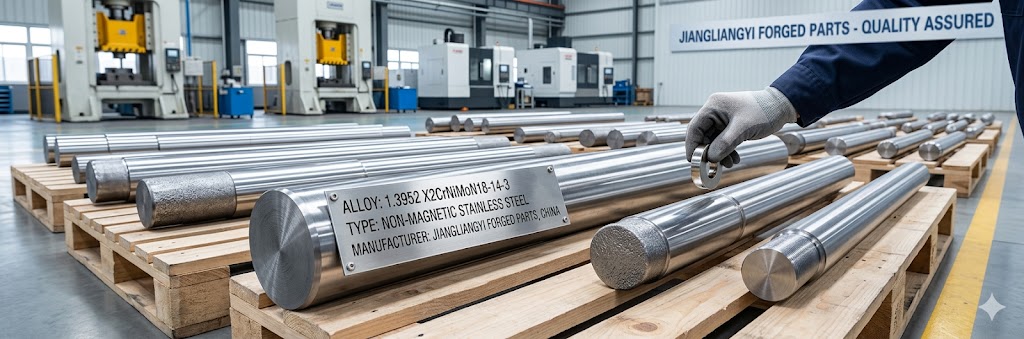
X2CrNiMoN18-14-3 forged round bars, square bars, flat bars, and rectangular bars with maximum forging diameter up to 2,000 mm. All bars are open-die forged with a minimum working ratio of 3:1 to ensure full grain refinement and eliminate the as-cast dendritic structure. We provide bars in the as-forged condition, solution-annealed condition, or solution-annealed + rough-machined to customer diameter tolerances (typically h11 or h9 for machining allowance). Complete mill test certificates with full chemical analysis, mechanical properties (including hardness traverse for sections > 200 mm), and 100% UT class per EN 10228-3 are standard. Applications: valve stems, pump shafts, drill string components, structural bars for scientific apparatus, and raw material for subsequent customer machining.
X2CrNiMoN18-14-3 Seamless Rolled Forged Rings
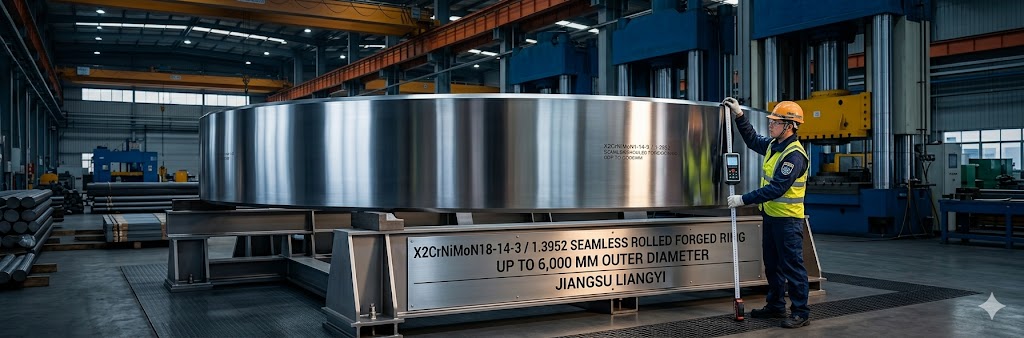
Custom seamless rolled rings in 1.3952 stainless steel with maximum outer diameter up to 6,000 mm and wall thickness from 50 mm to 600 mm. Our 5-metre seamless ring rolling machine operates in combination with a 6,300T hydraulic press for initial piercing and upsetting. Ring rolling gives 1.3952 a significant advantage over plate-cut rings: the circumferential grain flow alignment increases hoop tensile strength by 8–12% compared to a machined-from-bar equivalent, and eliminates the stress-raising surface from radial grain boundaries. We offer rectangular cross-section rings, contoured (profiled) rings, gear rings (pre-toothed forging), and flanged bosses. Applications: valve body and bonnet ring blanks, pressure vessel shell rings, pump casing rings, compressor housings, and turbine ring blanks.
1.3952 Forged Shafts, Spindles & Step Shafts
Custom X2CrNiMoN18-14-3 forged step shafts, valve spindles, marine propulsion shafts, pump shafts, downhole drilling tool drive shafts, and turbine shafts with maximum shaft length up to 15,000 mm and maximum diameter up to 1,800 mm. Long shafts in 1.3952 present a specific challenge: maintaining consistent nitrogen content and hence consistent magnetic permeability along the entire 15-metre length of a large propulsion shaft. We address this by homogenisation annealing of the ingot prior to forging and by controlling the deformation sequence so that the shaft axis aligns with the ingot axis (minimising the influence of axial segregation). Each shaft is magnetic permeability tested at multiple points along its length — not just at one end — before delivery. Surface finish Ra ≤ 3.2 μm (as-machined) or Ra ≤ 0.8 μm (ground) available.
Custom 1.3952 Open-Die Forged Components
We manufacture a broad range of fully custom 1.3952 open-die forgings including discs, disks, blocks, plates, sleeves, bushings, housings, shells, casings, tube sheets, baffle plates, nozzles, and channel flanges — all customisable to client drawings and technical specifications. For tube sheets and baffle plates used in shell-and-tube heat exchangers, we supply the forged blank in solution-annealed condition with a certified flatness of ≤ 3 mm/m across the face, enabling direct use in CNC drilling operations without preliminary straightening. Browse our full material grades for other stainless steel and alloy options.
Quality Inspection Protocol for 1.3952 (X2CrNiMoN18-14-3) Forgings
Our quality inspection process for 1.3952 forgings goes beyond the standard EN 10228-3 requirements because this grade's performance depends on multiple interacting microstructural variables — not just bulk chemistry and room-temperature tensile. Below is our complete inspection protocol, including the checkpoints that we apply as standard regardless of whether the client specification requests them:
Chemical Analysis (Every Heat)
Every production heat is analysed by our in-house chemical analysis laboratory using an ARL 4460 optical emission spectrometer. We report all 10 elements specified in EN 10088-3 plus boron, titanium, vanadium, niobium, and cobalt as trace residuals. Nitrogen is confirmed by inert gas fusion (LECO method, accuracy ±0.002%) — the OES result for nitrogen is less reliable above 0.15% and is cross-verified by LECO on all 1.3952 heats. A certificate stating "N: complies with EN 10088-3" without a specific numerical value is not acceptable practice; our reports always state the actual measured value.
Mechanical Property Testing (Each Forging Heat)
Tensile and impact specimens are taken from each heat at representative forging section thickness. For forgings with section thickness > 150 mm, specimens are taken at both the surface (T/4 position) and the core (T/2 position) to verify mechanical property uniformity through the section. Cryogenic Charpy impact testing at −196 °C is performed in a liquid nitrogen bath per ISO 148-1 for all forgings destined for LNG or cryogenic service — a test we perform routinely even when not explicitly mandated by client specifications, because a forging without this verification is an unknown quantity in cryogenic service.
Magnetic Permeability Measurement (Each Piece)
Every 1.3952 forging is individually measured for magnetic permeability using a calibrated Förster Magnatest D instrument operating at 100 Hz excitation. Measurement locations include: at least three positions on each forging (top, middle, bottom or equivalent), and on the machined surface if any CNC work is performed at our facility. The acceptance criterion is μr ≤ 1.005 at all measurement points. Results are recorded in the mill test certificate with individual measurement values — not just a pass/fail statement. For shafts and bars > 3,000 mm length, measurement frequency increases to one point per 1,000 mm of length.
Ultrasonic Testing — 100% Coverage (EN 10228-3 Class 3)
All 1.3952 forgings are 100% ultrasonically tested per EN 10228-3 Class 3, operated by qualified NDT technicians. We use phased-array UT (PAUT) for complex geometries and ring forgings, providing a scan record image that is included in the inspection documentation package. The UT acceptance criterion is no indications exceeding 2 mm equivalent flat-bottom-hole (FBH) reflector for standard forgings, tightening to 1.6 mm FBH for nuclear and aerospace applications. This 100% UT coverage is not optional for 1.3952 at our facility — it is applied to every forging regardless of order specification.
Metallographic Examination (Section Samples, Every Heat)
Representative sections from each heat are examined at 100× and 500× magnification for: austenite grain size (target ASTM grain size 5–8), absence of sigma phase, absence of delta ferrite, non-metallic inclusion rating per ISO 4967 or ASTM E45 Method A (maximum rating: A2/B2/C2/D2), and uniformity of microstructure through the section. Grain coarsening above ASTM No. 4 is rejected and traced back to the specific forging heat — this protects against occasional furnace temperature excursions that are not always visible in the pyrometer log but are immediately apparent in the microstructure.
Macrostructure Inspection (ASTM A 604)
Full-section macrostructure is examined per ASTM A 604 on acid-etched discs cut from representative samples. Acceptance criteria: no pipe, no cracks or seams, no harmful voids. Freckles, white spots, and radial segregation: maximum Class A. Ring pattern: maximum Class B. Any forging with a macrostructure outside these limits is rejected regardless of other test results.
How to Verify Non-Magnetic Properties of 1.3952 Forgings Upon Receipt
A question we are frequently asked by clients receiving their first 1.3952 forgings: "How do we verify the non-magnetic properties on our side without laboratory equipment?" Here is the practical verification protocol we recommend:
- Method 1 — Simple magnet test (qualitative, field check): A neodymium rare-earth permanent magnet (N52 grade, 25 mm dia., 10 mm thick) should not attach to the surface of a properly solution-annealed 1.3952 forging from a distance of 10 mm or closer. Note: a common ferrite-magnet refrigerator magnet is too weak and gives false comfort — it will not attract to 316L either. Use only a strong neodymium magnet for this test.
- Method 2 — Instrument measurement (quantitative, recommended for acceptance): Use a calibrated handheld permeability meter (e.g., Förster Magnatest, Institut Dr. Foerster, Germany, or equivalent Fischer MP1C). Set to measure relative permeability (μr). Test at least three locations per piece. Acceptance criterion: μr ≤ 1.005 at all points. Calibrate against a certified reference standard before testing.
- Method 3 — Third-party laboratory (authoritative, for dispute resolution): Submit a machined coupon (100 mm × 50 mm × 10 mm, surface Ra ≤ 1.6 μm) to a calibrated magnetics testing laboratory for measurement per ASTM A342 or IEC 60404-1. This method eliminates instrument calibration uncertainty and provides a traceable result accepted by classification societies and end-user inspection bodies.
The stainless steel will feel "cold" or "non-sparking" when tested with a magnet — this proves nothing about magnetic permeability. Heavily cold-worked 316L (μr ≈ 1.5–3.0, clearly magnetic) will also feel cold and resist sparking. Only an instrument measurement or a strong neodymium magnet at close range provides meaningful information. We include a Förster Magnatest printout in our 3.1 MTCs as standard — and we encourage clients to perform their own verification upon receipt using the methods above.
Welding Guidelines for 1.3952 (X2CrNiMoN18-14-3) Forged Components
Welding 1.3952 is more straightforward than welding duplex or super-duplex grades, but requires more care than standard 316L to preserve both the corrosion resistance and non-magnetic properties of the weld and heat-affected zone. Based on our experience supplying 1.3952 forgings to fabricators in the LNG, marine, and nuclear sectors, the following guidelines represent current best practice:
Recommended Filler Metals
- Primary choice — matching filler: AWS A5.9 ER316LN (for TIG/MIG) or AWS A5.4 E316LN (for SMAW). The nitrogen-alloyed variant maintains closer match to the base metal composition and provides better non-magnetic stability in the weld metal compared to standard ER316L.
- Alternative — overalloyed filler: For applications where the weld metal must achieve the same PREN as the base metal, use ER317LMN or equivalent. This provides slightly higher Mo and N in the weld deposit to compensate for dilution and nitrogen loss during solidification of the weld pool.
- Avoid: Filler metals that do not contain nitrogen (standard ER316L, ER304L) as weld metal deposited without nitrogen will have lower yield strength and may develop marginal magnetic response after machining of the weld area.
Welding Process and Parameters
- Preheat: Not required. 1.3952's ultra-low carbon content (≤ 0.030%) eliminates the sensitisation risk that would otherwise necessitate preheating in carbon steels.
- Interpass temperature: Maintain ≤ 150 °C. Higher interpass temperatures allow sigma-phase to begin precipitating in the HAZ during multi-pass welding — the same risk as in base metal, just on a smaller scale.
- Heat input: Restrict to 1.0–2.0 kJ/mm for TIG; 1.5–2.5 kJ/mm for MIG/MAG. Lower heat input reduces the time spent in the sigma-formation temperature range during cooling.
- Shielding gas (TIG): 100% argon for root pass; Ar + 2% N₂ for subsequent passes to compensate for nitrogen loss from the weld pool during transfer to the droplet and solidification.
- Post-weld heat treatment (PWHT): Generally not required and not recommended for standard applications. PWHT at temperatures below the solution annealing temperature (1,050 °C) will not dissolve sigma phase if it formed, and may actually aggravate sensitisation. If the welded assembly requires PWHT due to code requirements, use full re-solution-annealing at 1,050–1,100 °C + water quench.
- Post-weld inspection: In addition to standard weld NDT (VT, PT or MT, UT), we recommend a magnetic permeability survey of the weld and adjacent HAZ zone after welding and any post-weld machining. A local μr increase to 1.01–1.05 in the HAZ indicates sigma-phase formation and requires re-solution annealing of the assembly.
How to Write a Complete Purchase Order for 1.3952 Forgings: A Procurement Checklist
After reviewing hundreds of purchase orders for 1.3952 forgings over the years, we have identified the most common omissions that lead to disputes at delivery or non-conformances in service. The following checklist covers everything a complete PO should specify:
- ☑ Material designation: State both the EN number (1.3952) and the full designation (X2CrNiMoN18-14-3) per EN 10088-3. Specifying only "non-magnetic stainless steel" or only "316LN" creates ambiguity.
- ☑ Nitrogen content minimum: Specify N ≥ 0.18% (or your project minimum) explicitly in the PO — do not rely on the EN 10088-3 minimum of 0.15%.
- ☑ Magnetic permeability limit: State μr ≤ 1.005 per [IEC 60404-1 or ASTM A342], measured [on the heat-treated forging / on the finished machined surface — specify which].
- ☑ Heat treatment: Solution-annealed (AT condition), 1,050–1,100 °C, water quench, per EN 10088-3. If a specific cooling rate is required, state it (e.g., ≥ 50 °C/s).
- ☑ Melting route: If cleanliness or nitrogen homogeneity is critical, state the required route (EAF+ESR minimum, or EAF+PESR for nuclear/subsea). Default EAF+LF+VD is standard grade.
- ☑ UT class: EN 10228-3 Class [1, 2, or 3], or ASTM A388 rejection level [state FBH size]. Note: Class 3 is our standard regardless.
- ☑ Cryogenic impact test: If cryogenic service, state "KV ≥ [60] J at [−196] °C per ISO 148-1, Charpy V-notch, transverse specimen orientation."
- ☑ Test certificate: EN 10204 [3.1 or 3.2]. Note: 3.2 requires a third-party inspection body and adds 1–2 weeks to lead time.
- ☑ Dimensional tolerances: Reference drawing revision and issue date. For bars: specify diameter tolerance (h11, h9, or custom). For rings: specify O.D., I.D., height, and tolerance per EN ISO 286 or custom. For shafts: state each diameter step and axial length with tolerances.
- ☑ Surface condition: Specify "as-forged + heat treated," "rough machined with [X mm] stock on all faces," or "finished machined to drawing."
- ☑ Additional requirements: Third-party witness inspection (state name of inspection body); specific marking (heat number, material stamp, weight); preservation and packaging for sea freight; CMTR (certified material test report) format requirements.
Lifecycle Cost Analysis: 1.3952 vs 316L in Cryogenic and Corrosive Applications
The higher raw material cost of 1.3952 (typically 30–50% above 316L per kilogram) leads many procurement teams to default to 316L for budget reasons. We have compiled data from client feedback on components replaced in service to challenge this assumption with real numbers. The analysis below reflects typical outcomes — actual results vary by application, service environment, and operating frequency:
| Cost Factor | 316L Forged Spindle (Est.) | 1.3952 Forged Spindle (Est.) |
|---|---|---|
| Relative initial forging cost | Baseline (×1.0) | ~×1.3–1.5 (material premium) |
| Typical service life in LNG cryogenic valve | 4–6 years (μr drift + pitting risk) | 12–18 years (stable properties) |
| Estimated replacements over 15 years | ~3 pieces | ~1 piece |
| Downtime cost per unplanned replacement | Significant (facility-dependent) | Reduced (fewer replacements) |
| Total 15-year material cost trend | Higher (3× initial cost + downtime) | Lower (1× initial cost only) |
While the initial piece cost of 1.3952 is higher, the total lifecycle cost advantage is overwhelming in any application involving unplanned downtime costs. The numbers above use conservative downtime rates for a mid-scale LNG facility — in a large LNG terminal where downtime costs exceed $50,000–$100,000 per hour, the advantage of 1.3952 becomes even more decisive. This analysis is consistent with the feedback we receive from clients who initially selected 316L on price and subsequently switched their standing orders to 1.3952 after the first replacement cycle.
Global Industrial Applications & Verified Project Cases
Our 1.3952 (X2CrNiMoN18-14-3) forged parts serve critical roles in industries where component failure is not a budget inconvenience but a safety event. The following project cases are drawn from our delivery records, shared with client permission and without identifying commercially sensitive details:
LNG Terminal & Cryogenic Valve Industry
1.3952 is the default specification for non-magnetic cryogenic valve spindles in LNG liquefaction and regasification terminals because it is the only austenitic stainless grade that simultaneously meets the −162 °C impact requirement, resists SCC (Stress Corrosion Cracking) from cold-temperature chloride contamination on the external valve surfaces, and maintains μr ≤ 1.005 at the tight tolerances required by actuator position sensors. Our valve component scope includes spindles, seat rings, bonnet forgings, and body ring blanks for ball valves (6" – 60" bore), cryogenic butterfly valves (DN100–DN1200), and back-pressure valves.
Large-Scale LNG Terminal Expansion — Texas, USA
We delivered a large batch of X2CrNiMoN18-14-3 cryogenic valve spindles and seat rings for a Phase 2 expansion at a major Gulf Coast LNG terminal in the USA. The specification required μr ≤ 1.005 on the finished-machined surface (not just the heat-treated bar), KV ≥ 80 J at −196 °C (project-specific, more stringent than EN standard), full EN 10204 3.2 certificates with third-party witness inspection, and NACE MR0175 compliance for the external environment. The components have been in continuous cryogenic service since commissioning with zero reported failures through the most recent scheduled maintenance window.
Marine & Offshore Shipbuilding Industry
Marine propulsion shafts in 1.3952 are specified for non-magnetic vessels — including naval mine countermeasures vessels (MCMVs), oceanographic research ships, hydrographic survey vessels, and cable-laying ships — where the vessel's own magnetic signature must be suppressed to levels that avoid triggering magnetic mine detonators or interfering with onboard magnetometric scientific instruments. The requirement is typically μr ≤ 1.005 on the finished shaft surface including the propeller flange and intermediate bearings, verified after all machining and including any keyway or spline cutting operations. We have extensive experience supplying non-magnetic propulsion shafts and intermediate shafts for demanding marine applications globally.
12-Vessel Container Ship Series — Hamburg, Germany
We delivered large-section 1.3952 forged marine propulsion shafts (340 mm diameter × 8,200 mm length, 1,850 kg each) for a series of container vessels built in Hamburg, Germany. The specification required classification society witness inspection for all mechanical tests, 100% UT per EN 10228-3 Class 3, and magnetic permeability testing at 500 mm intervals along the full shaft length (17 measurement points per shaft). All shafts passed first-article inspection without rejection. The vessels have been in service in the North Sea and Atlantic routes since , and our inspection records show no measurable change in shaft dimensions or surface condition through subsequent scheduled dry-dock inspections.
Nuclear Power Generation Industry
The nuclear industry's use of 1.3952 centres on its combination of radiation stability, long-term structural integrity, and non-magnetic properties required in proximity to instrumentation loops. Coolant pump casings, primary loop valve bodies, containment seal chambers, and impellers are the typical components. Nuclear supply requires a significantly elevated documentation burden: material qualification test plans (MQTP), full material traceability to the original melt heat number, and compliance with the applicable nuclear design codes. We work with clients and their designated inspection authorities to coordinate the required documentation and third-party testing throughout the production process.
Reactor Coolant Pump Casings — South Korea
We supplied custom 1.3952 forged nuclear reactor coolant pump casings (650 mm O.D. × 480 mm I.D. × 380 mm height, EAF+PESR melting route) for a nuclear power plant project in Asia. Full material traceability from melt heat to finished forging was required, along with material qualification test plans (MQTP), 100% UT with 200% coverage at critical sections, and third-party witness inspection throughout the production process. All casings passed the specified quality inspections and entered formal plant operation per the client's commissioning schedule.
Oil & Gas Downhole Drilling & Petrochemical Industry
Downhole mud motors, electrical submersible pumps (ESP), and measurement-while-drilling (MWD) tool housings in 1.3952 are specified where the non-magnetic property is essential for accurate magnetic directional survey data — the MWD tool's magnetometer must not be influenced by the adjacent drill collar or motor housing material. Simultaneously, the component must withstand pressures to 20,000 psi, temperatures to 200 °C, abrasive drilling fluid containing sand and solids, and in sour wells, H₂S concentrations exceeding NACE MR0175 threshold levels. 1.3952 satisfies all four conditions simultaneously — no other single-material solution exists at similar cost.
Onshore Oilfield Development — Saudi Arabia
We supplied X2CrNiMoN18-14-3 forged downhole mud motor drive shafts and ESP motor housings for an onshore oilfield development programme in Saudi Arabia. The client had previously used 316L components and experienced limited service life due to μr drift after downhole mechanical stress (causing MWD survey measurement errors) and pitting corrosion from formation brine. Our 1.3952 components achieved a significantly longer average downhole service life before elective maintenance replacement — the client reported a substantial improvement in service interval and a corresponding reduction in annual well-servicing costs across the programme.
Petrochemical, Heat Exchange & Precision Industrial
In petrochemical and pharmaceutical processing, 1.3952 tube sheets for shell-and-tube heat exchangers provide superior resistance to the combined attack of process-side chloride-bearing acidic media and shell-side cooling water that causes pitting and crevice corrosion at tube-to-tubesheet joints — the most common failure point in 316L-constructed heat exchangers. We also supply 1.3952 forgings for particle accelerator vacuum chamber components (where even a small remnant ferromagnetic response would perturb beam optics), precision scientific balances and analytical instrument frames (where μr ≤ 1.005 is required to avoid interference with electromagnetic weighing mechanisms), and MRI facility structural steel (where the steel must not distort the 1.5T or 3T magnetic field within the imaging volume).
Nickel Ore Processing Plant — Western Australia
We delivered custom 1.3952 forged tube sheets (1,800 mm O.D., 120 mm thick, weight 2,650 kg each) and channel flanges for a heat exchanger train in a nickel ore processing plant. The process fluid is a nickel sulphate / sulphuric acid slurry at 85 °C with chloride content of 4,500 ppm — an environment that had previously destroyed 316L tube sheets through crevice corrosion at the tube-to-tubesheet joints within 18 months of commissioning. Our 1.3952 tube sheets have now operated for over 3 years without detectable corrosion in the tube-joint area, confirmed by eddy current inspection during the last scheduled plant maintenance window.
Why Choose Jiangsu Liangyi as Your 1.3952 Forging Partner in China
There are over 200 forging manufacturers in China who will list "1.3952" on their website. The meaningful difference between suppliers is not the material designation — it is the depth of understanding of this grade's metallurgical requirements, the completeness of the quality system, and the track record of delivering compliant forgings to demanding end-user specifications. Our specific differentiators for 1.3952:
- 22+ years of 1.3952 production experience (since ): We have processed this grade long enough to have identified and solved every production challenge described on this page — sigma phase, nitrogen loss, magnetic permeability after machining, large-section homogeneity, and nuclear-grade documentation requirements. We are not learning on your order.
- Advanced melting route options including ESR and PESR: Subject to order volume and technical requirements confirmation, we can access advanced melting routes including EAF+ESR and EAF+PESR through our qualified melting partners, enabling supply of higher-purity 1.3952 forgings for demanding applications. Please discuss specific melting route requirements with our technical team at enquiry stage.
- Calibrated Förster Magnatest on every piece: Not every forging manufacturer has a Förster Magnatest instrument or uses it on every piece. We do, and we include the printout in the mill test certificate. This is the only way to provide a meaningful magnetic permeability guarantee for a specific forging — not an inference from composition.
- Full-cycle service from melt to machined component: We handle melting, forging, heat treatment, NDT, and CNC rough or finish machining under one roof. This eliminates inter-supplier quality gaps that occur when different subcontractors each process the forging and testing is done at interfaces rather than on the completed piece. Our in-house machining centres include 5-axis CNC milling up to 6,000 mm diameter and CNC turning up to 10,000 mm length.
- ISO 9001:2015 quality system with industry-aligned procedures: Our QMS covers the full production chain from raw material receipt through forging, heat treatment, inspection, and delivery. We maintain specific procedures aligned with marine, oil & gas, and pressure equipment industry requirements, supporting third-party witness inspection by classification societies and client-appointed inspection bodies on request.
- Annual capacity of 120,000 tonnes across all grades: 1.3952 represents approximately 8,000 tonnes of our annual production, giving us the volume experience to maintain process consistency and the equipment loading to run 1.3952 heats efficiently rather than as occasional jobs.
- Transparent technical support pre-order: We provide free technical consultation on grade selection, specification writing, and heat treatment requirements before order placement. Our metallurgical engineering team responds to technical questions in English within 24 hours, and can provide case study data for specific application comparisons under NDA.
Frequently Asked Questions About 1.3952 (X2CrNiMoN18-14-3) Forgings
1.3952 (X2CrNiMoN18-14-3) does not have a direct, interchangeable ASTM or UNS equivalent. The closest is UNS S31254 (254 SMO / 1.4547), but there are meaningful composition differences: S31254 specifies Cr 19.5–20.5%, Mo 6.0–6.5%, Cu 0.5–1.0%, N 0.18–0.25%, and achieves PREN ≥ 42 — significantly higher corrosion resistance than 1.3952's PREN ≥ 28. For ASTM-governed procurement of 1.3952-equivalent material properties, the closest codified grade in ASTM A182 is F316LN (UNS S31653), which matches the ultra-low carbon and nitrogen-alloyed concept but has a narrower composition range and lower typical Ni content. When purchasing for ASTM-standard projects, we recommend dual-certification to both EN 10088-3 (as 1.3952) and ASTM A182 F316LN supplementary requirements, which we can provide in our mill test certificate.
Yes — this is the defining property that distinguishes 1.3952 from standard 316L. The high nitrogen content (0.15–0.25 wt.%) combined with the high nickel content (13–15%) provides a sufficient austenite stability margin to prevent strain-induced martensitic transformation under the deformation levels encountered in industrial machining and welding of normal structural components. Specifically, the Md30 temperature (the temperature at which 50% martensite forms after 30% true strain) for properly composed 1.3952 is well below −196 °C, compared to approximately −20 to +30 °C for standard 316L. This means that even aggressive machining operations — heavy turning, drilling, thread cutting — will not cause measurable martensite formation in 1.3952. Our measured post-machining μr values for finished-machined 1.3952 parts are consistently in the range of 1.001–1.004, compared to 1.1–2.5 for the same machining operations on 316L bar. The one caveat: if the forging is supplied with nitrogen at the lower limit of the standard (N = 0.15%), the austenite stability margin is narrower, and aggressive cold operations like swaging, radial forming, or cold straightening can potentially raise μr to 1.005–1.02. This is why we insist on N ≥ 0.18% as our factory minimum.
During welding, the heat-affected zone (HAZ) adjacent to the weld fusion line passes through the 600–900 °C sigma-formation range on the heating cycle. For low to moderate heat input welding (heat input ≤ 2.0 kJ/mm), the time spent in this range is typically 15–45 seconds — too short for meaningful sigma-phase formation given the relatively slow kinetics of sigma in austenitic grades, even in 1.3952. Problems arise when: (1) heat input is excessively high (> 3.0 kJ/mm), particularly in large multi-pass welds where successive passes reheat the same HAZ zone repeatedly; (2) interpass temperature exceeds 150 °C, extending the sigma-formation exposure time on cooling; (3) the fabricated assembly cannot be adequately cooled between passes due to its thermal mass. The practical result of sigma formation in the weld HAZ is a narrow band of reduced corrosion resistance (the "HAZ sensitisation" effect) and a slight magnetic permeability increase in that band (typically to μr = 1.01–1.05). Avoidance: maintain heat input ≤ 2.0 kJ/mm, interpass temperature ≤ 150 °C, and verify by HAZ magnetic permeability measurement after welding. Re-solution annealing of the whole assembly at 1,050 °C + water quench will fully reverse any sigma formation if detected.
Forging of 1.3952 introduces significant plastic deformation at elevated temperatures (900–1,200 °C). At these temperatures, the kinetics of strain-induced martensite formation are negligible, so the hot forging operation itself does not increase magnetic permeability. However, two forging-related factors can subsequently affect μr: First, if the forging finish temperature falls below 900 °C and forging continues in the warm or warm-to-hot transition zone (600–900 °C), sigma-phase nucleation can begin in the deformed microstructure, which will raise permeability after heat treatment unless a full solution anneal is performed. Second, if the solution heat treatment after forging is inadequate (temperature too low, time too short, or quench rate too slow), residual deformed austenite zones with elevated dislocation density can produce slightly elevated μr readings even without martensite formation. Our forging process controls both risks: strict finish temperature monitoring (minimum 920 °C alarm), and mandatory solution annealing of all 1.3952 forgings at ≥ 1,050 °C for ≥ 1 min/mm before any magnetic permeability measurement. The measured μr of our forgings in the delivery condition consistently reflects the material's true, stable non-magnetic potential.
The standard heat treatment for 1.3952 is solution annealing at 1,050–1,100 °C for a minimum holding time of 1 minute per millimetre of maximum cross-section thickness (minimum 30 minutes regardless of section size), followed immediately by water quenching. Water quenching — not air cooling, not forced air cooling — is mandatory because 1.3952's higher molybdenum content accelerates sigma-phase precipitation kinetics. The TTT nose for sigma formation in 1.3952 at approximately 800–850 °C can be reached in as little as 3–5 minutes for a heavily deformed microstructure. Air cooling of any forging with section thickness > 20 mm will result in the 600–900 °C range being traversed too slowly, with sigma formation in the thicker centre sections that will not be visible on the surface and will not be detected by a surface hardness test or visual inspection. The required water quench cooling rate through the critical 900–500 °C range is ≥ 50 °C/s, achievable with full immersion water quenching but not with spray cooling or forced air on sections above 100 mm. This is not a conservative choice — it is a physical requirement of the material's sigma-phase TTT behaviour.
Yes. 1.3952 (X2CrNiMoN18-14-3) in the solution-annealed condition qualifies for sour service use under NACE MR0175 / ISO 15156, Part 3 (CRAs — corrosion resistant alloys). The key acceptance criteria are: hardness ≤ 22 HRC (≤ 237 HBW) — our solution-annealed 1.3952 forgings typically achieve 175–200 HBW, well within the limit; and fully austenitic microstructure with no martensite or ferrite — confirmed by our routine metallographic examination. 1.3952 qualifies under the "highly alloyed austenitic stainless steels" category of ISO 15156-3, Table A.2, which permits use in H₂S-bearing environments up to 60 °C and 0.1 MPa H₂S partial pressure without further qualification testing, and beyond those limits with suitable qualification testing. Note: NACE compliance applies to the material in the solution-annealed condition. Any cold work, improper heat treatment, or welding without subsequent re-solution annealing will void the NACE compliance and must be addressed in the fabrication procedure qualification.
The inherent corrosion resistance of 1.3952 (reflected in PREN ≥ 28) can only be fully realised in service if the passive oxide film on the surface is uniform and undamaged. Surface finish has a significant practical effect: (1) As-forged surfaces with scale (Ra > 12.5 μm) have reduced corrosion resistance due to surface discontinuities beneath the scale; always specify at least grit-blasted or pickled surface for corrosive service. (2) Machined surfaces with Ra 1.6–3.2 μm are suitable for most industrial applications — the machining grooves are small enough not to act as crevice corrosion initiation sites under moderate chloride concentrations. (3) For seawater immersion or concentrated chloride service above 40 °C, specify Ra ≤ 0.8 μm (ground) or Ra ≤ 0.4 μm (polished) to minimise crevice susceptibility. (4) Always passivate the final machined surface per ASTM A380 / ASTM A967 (citric acid or nitric acid passivation) to restore and maximise the passive film after machining operations. We offer passivation treatment in-house for all machined 1.3952 components, using citric acid passivation (ASTM A967 Method C) as the standard to avoid the nitric acid disposal challenges in our local facility environment.
Our production capacity for 1.3952 forgings: round bars up to 2,000 mm diameter; seamless rolled rings up to 6,000 mm outer diameter; forged step shafts up to 15,000 mm length and 1,800 mm maximum diameter; custom open-die shapes up to 30,000 kg single-piece weight. For ring forgings above 4,000 mm O.D., we manufacture the ring from an ingot produced by our EAF+ESR route minimum to ensure adequate cross-section homogeneity in the large-diameter ring wall. For bars above 800 mm diameter, we use our 150-tonne capacity VD furnace to ensure the ingot is fully hydrogen-degassed before forging, eliminating the risk of hydrogen flakes in the large bar cross-section. These process controls for large-section 1.3952 are not standard industry practice — they reflect the lessons learned from our specific experience with large-section 1.3952 production since 2003.
Request a Quotation for Custom 1.3952 (X2CrNiMoN18-14-3) Forgings
We welcome enquiries for any quantity, from single prototype pieces to annual standing orders. To provide a fast and accurate quotation, please share your drawing or sketch, material specification (EN, ASTM, or custom), forging dimensions, quantity, required test certificates, and any special requirements (melting route, non-standard NDT, third-party inspection). Our technical sales team responds in English within 24 business hours.
Company: Jiangsu Liangyi Co., Limited
Established: | Annual Capacity: 120,000 tonnes
Factory Address: Chengchang Industry Park, Jiangyin City, Jiangsu Province, China 214400
Inquiry Email: sales@jnmtforgedparts.com
Phone / WhatsApp: +86-13585067993
Official Website: https://www.jnmtforgedparts.com