1.3817 (X40MnCrN18) Forged Steel Parts | China Professional Forging Manufacturer for Global Markets
Last Updated: | Published: | By: Jiangsu Liangyi Co., Limited
→ Get Your Free 24h Technical Quotation
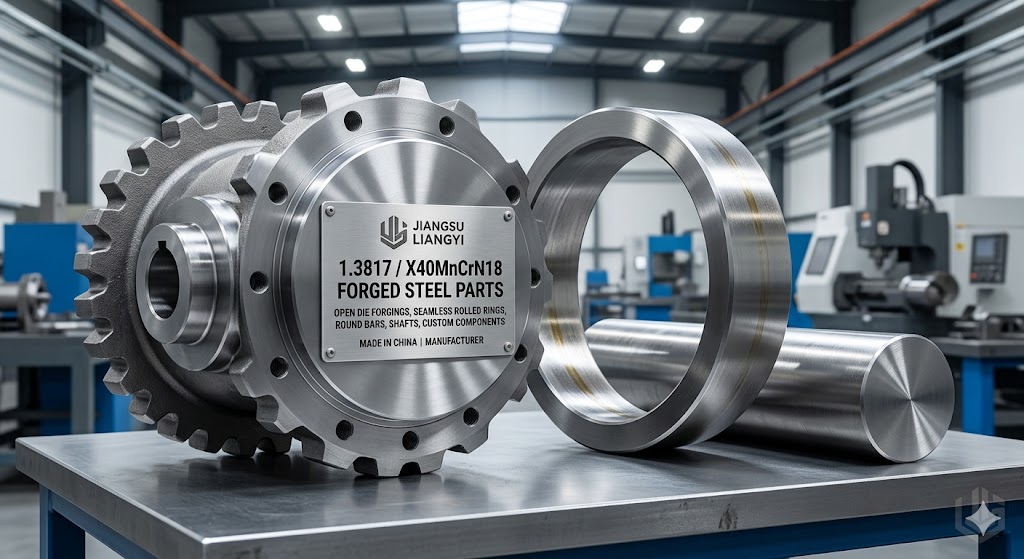
📌 Technical Definition: What Is 1.3817 (X40MnCrN18) Steel?
- EN Material Number:
- 1.3817
- EN Grade Designation:
- X40MnCrN18 (per EN 10088-3)
- Steel Family:
- High-manganese fully austenitic, non-magnetic alloy steel (TWIP-type)
- Key Composition:
- C: 0.30–0.50% | Mn: 17.0–19.0% | Cr: 3.0–5.0% | N: max. 0.10% | Ni: max. 1.0%
- Tensile Strength (Rm):
- 750–950 MPa (solution annealed, +AT condition)
- 0.2% Proof Strength:
- Min. 280 MPa
- Elongation:
- ≥ 35% longitudinal (EN ISO 6892-1)
- Hardness:
- 220–280 HB (EN ISO 6506-1)
- Magnetic Permeability:
- ≤ 1.01 H/m — fully non-magnetic in +AT condition
- Max. Service Temperature:
- 450°C continuous operation
- Governing Standard:
- EN 10088-3
- AISI/ASTM Equivalent:
- No direct equivalent; functionally comparable to 200-series austenitic steels
- Primary Applications:
- Nuclear reactor coolant pump casings, ESP motor shafts, API valve forgings, marine propulsion shafts, downhole drilling tools
Jiangsu Liangyi Co., Limited is an ISO 9001:2015 certified China-based professional manufacturer of 1.3817 (X40MnCrN18) open die forgings and seamless rolled forged rings. With over 25 years of hands-on experience in high-manganese austenitic steel forging, we have built a deep, first-hand understanding of this grade's unique metallurgical behaviour — from its work-hardening sensitivity during hot forging to the critical importance of water-quench solution annealing for non-magnetic performance. Our end-to-end capabilities span steel melting (EF, VIM, ESR, VAR), precision forging, standardized heat treatment, non-destructive testing, and finish machining, all fully documented with EN 10204 3.1/3.2 Mill Test Certificates and available with third-party inspection by BV, SGS, TÜV, or Lloyd's Register.
Why Choose 1.3817 (X40MnCrN18) Steel For Your Industrial Project?
1.3817 (X40MnCrN18) stands out among common industrial alloy steels. It has great wear resistance, high strength and stable non-magnetic performance all at the same time, and regular 300-series stainless steel, carbon steel and low-alloy steel cannot reach this balanced performance. That is why this material is the first pick for working conditions needing all three features, such as nuclear reactor coolant system parts, oil-well electrical submersible pump (ESP) motor shafts and precise downhole drilling tools.
Five Main Performance Advantages of X40MnCrN18 (1.3817)
- Excellent Work Hardening & Wear Resistance: With 17.0–19.0% Mn, X40MnCrN18 deforms via a TWIP (Twinning-Induced Plasticity) mechanism under contact stress, generating mechanical twins that rapidly harden the surface layer. The result is a work-hardening exponent (n) in the range of 0.45–0.55 — roughly twice that of 316L stainless steel (~0.25). In abrasive sliding wear tests, X40MnCrN18 typically outlasts 316L by a factor of 3–4×, so that it is the best choice material for valve seats, pump wear rings, and downhole tools.
- Stable Non-Magnetic Properties: The high-Mn, high-C austenitic matrix keeps the steel's Néel temperature well below operating temperature, guaranteeing a magnetic permeability of ≤ 1.01 H/m in the solution annealed condition — and critically, this stability is kept even after moderate cold working or machining. In contrast, standard 304/316 stainless can develop detectable ferromagnetism after cold deformation. For nuclear instrumentation, ESP systems, and magnetic-sensitive downhole tools, this stability is non-negotiable.
- High Strength with Excellent Ductility:Solution-annealed 1.3817 provides tensile strength of 750–950 MPa and elongation ≥ 35%, which is significantly higher than the toughness and ductility of lower-alloy high-strength steels at similar strength levels. The combination is resistant to dynamic fatigue loading in rotating pump shafts and marine propulsion applications where crack initiation must be suppressed.
- Corrosion Resistance in Mild Industrial Environments: While 1.3817 is not a high-performance corrosion-resistant alloy in the sense of 316L or duplex steels, its 3.0–5.0% Cr and nitrogen content provide reliable protection in mild industrial media: fresh water, oil-field brine (low chloride), high-temperature steam up to 300°C, and dilute industrial acid contact. Chromium content is deliberately limited to avoid ferrite stabilization that would compromise the austenitic (non-magnetic) structure.
- Universal Global Certification Compliance: 1.3817 forgings from Jiangsu Liangyi carry full EN 10204 3.1/3.2 traceability and are regularly supplied under PED 2014/68/EU (Europe), API 6A (North America/Middle East), ASME Section IX (North America), NACE MR0175 (sour service), and third-party certification by BV, SGS, TÜV, and Lloyd's Register.
The Metallurgical Science Behind X40MnCrN18 (1.3817) — Why This Composition Works
Understanding why 1.3817 performs the way it does requires a brief look at the metallurgical design logic behind its specific composition. This is knowledge we have built through 25+ years of first-hand production experience with this grade, and it is the foundation of why our forgings consistently pass magnetic permeability and mechanical property testing on first submission.
Why 17–19% Manganese? The Austenite Stabilization and TWIP Mechanism
Manganese at concentrations above approximately 12% is a powerful austenite stabilizer. By raising the Ms (martensite start) temperature far below room temperature and even below cryogenic temperatures in X40MnCrN18, the 17–19% Mn content ensures that the austenitic (FCC, face-centred cubic) crystal structure is fully stable at all service temperatures — even after significant deformation. This is the direct source of the material's non-magnetic behaviour.
At the same time, the high Mn content reduces the material's stacking fault energy (SFE) to the range of approximately 15–35 mJ/m², which is low enough to promote both planar dislocation slip and mechanical twinning under stress. This TWIP (Twinning-Induced Plasticity) effect is what creates the remarkable combination of high strength and high ductility — deformation twins act as barriers to further dislocation motion, rapidly increasing flow stress (work hardening) while twin boundaries themselves remain ductile. In practical terms: the harder you push X40MnCrN18 in service, the stronger its surface becomes. This is why valve seats and wear rings made from this material outperform alternatives in abrasive environments.
Why 3–5% Chromium? Calibrated for Corrosion and Non-Magnetism
Chromium is a ferrite stabilizer: too much Cr in a high-Mn matrix would pull the structure toward a mixed austenite-ferrite microstructure, immediately degrading magnetic permeability. The EN 10088-3 specification for X40MnCrN18 caps Cr at 5.0% maximum — just enough to form a coherent chromium oxide passive film on the surface (providing moderate corrosion and oxidation resistance in mild environments) without introducing the risk of delta ferrite or sigma phase formation during solution annealing. From our production experience, Cr heats closer to the lower limit (3.0–3.5%) consistently achieve better magnetic permeability readings, while Cr at 4.5–5.0% provides better oxidation resistance at elevated temperatures.
Why High Carbon (0.30–0.50%)? Strength, Stability, and a Trade-Off
Carbon is the strongest austenite-stabilizing element per unit weight, far more potent than Mn or Ni. In X40MnCrN18, the deliberate use of high C (0.30–0.50%) — far above the "low carbon" approach used in grades like 316L — serves two functions: it maximises austenite stability under all conditions, and it provides solid solution strengthening that contributes significantly to the high tensile strength (750–950 MPa) and hardness (220–280 HB). The trade-off is important: high carbon means high sensitivity to sensitization (chromium carbide precipitation at grain boundaries when cooled slowly from austenitizing temperature). This is why water quenching after solution annealing is not optional for X40MnCrN18 — it is mandatory. Any deviation toward air cooling, particularly in sections thicker than 25 mm, risks carbide precipitation and a measurable drop in corrosion resistance and toughness.
Why Nitrogen (max. 0.10%)? A Supplementary Strengthening Lever
Nitrogen in solid solution is a potent strengthener (approximately 10× the strengthening effect of carbon per unit weight in austenitic steels) and a strong austenite stabilizer, contributing to the stability of the non-magnetic structure without sacrificing ductility. The EN 10088-3 limit of max. 0.10% N in X40MnCrN18 reflects the solubility ceiling at atmospheric melting pressure — exceeding this would risk gas porosity during solidification. In heats melted via Vacuum Induction Melting (VIM) with controlled N₂ addition, we can target N in the range of 0.05–0.09% to optimize the strength-ductility balance for nuclear and HPHT applications.
Full Range of Custom 1.3817 (X40MnCrN18) Forged Steel Products
We produce a complete portfolio of X40MnCrN18 forged steel shapes and finished components with flexible customisation covering all dimensions, tolerances, and technical requirements. Single-piece weights range from 30 kg to 30,000 kg. All products are available in the standard solution annealed (+AT) condition per EN 10088-3, with optional roughing or finish machining to your CAD drawings.
1.3817 Forged Round Bars, Flat Bars & Rods
We supply X40MnCrN18 forged round bars (Ø25 mm to Ø2,000 mm), square bars, flat bars, rectangular bars, and hexagonal rods. Maximum forging length is 15 metres for straight bars. All forged bars are 100% ultrasonically tested per EN 10228-3 with standard acceptance criteria of Class 3 or better, and dimensional tolerance is held to EN 10060/10058 standard or tighter per drawing. Typical applications include valve stem blanks (rough machined to drawing), pump shaft blanks, and structural components for European OEM machinery and North American oil & gas wellhead equipment.
X40MnCrN18 Seamless Rolled Forged Rings
We manufacture 1.3817 seamless rolled rings (plain rings, contoured rings, flanged rings, valve seat rings, and gear rings) with outer diameters from Ø200 mm to Ø6,000 mm and single-piece weights up to 30 tonnes. Our 5-metre ring rolling machine produces continuous circumferential grain flow — the defining metallurgical advantage of ring rolling over flame-cut plate, dramatically improving fatigue life in cyclic pressure applications. Radial wall thickness tolerance is maintained at ±1.5% or ±2.0 mm (whichever is greater) as standard. These rings serve high-pressure valve bodies, pressure vessel flanges, turbine diaphragm rings, and bearing housings for Middle East oil & gas and European power generation clients.
1.3817 Forged Sleeves, Hollow Bars & Casings
Precision-forged 1.3817 sleeves, bushings, hollow bars, seamless tubes, pump barrels, nuclear reactor containment housings, and casing sections. We manufacture bore diameters from Ø50 mm upward, with bore eccentricity ≤ 1.0 mm as standard. All hollow forgings are mandrel-forged to ensure proper grain flow in the bore wall — a critical quality attribute for pressure-retaining nuclear and petrochemical components that is not achievable with drilled solid bar. Applications include nuclear pump casings, petrochemical heat exchanger shells, and downhole drilling tool bodies.
X40MnCrN18 Forged Discs, Plates & Custom Blanks
X40MnCrN18 forged discs (Ø150 mm to Ø4,000 mm), forged blocks and plates, flanged disc blanks, and custom machined near-net-shape forging blanks. We provide near-net-shape forgings with machining allowances as low as 3–5 mm per face, minimising your in-house machining waste on this expensive material. Common applications: valve disc blanks, pump impeller blanks, pressure vessel blind flanges and end caps, and turbomachinery blade carrier discs.
1.3817 Forged Shafts, Step Shafts & Spindles
Custom 1.3817 forged shafts (straight shafts, multi-step shafts, splined shafts, eccentric shafts, and turbine rotor shafts) with maximum length of 15 metres and maximum diameter of 1,800 mm. Single-piece shaft weights up to 30 tonnes are routinely produced. Runout tolerance of finished rough-machined shafts is held to ≤ 0.5 mm TIR as standard. All shafts receive full-length ultrasonic testing and 100% hardness mapping. Key markets: marine propulsion shafts for Southeast Asian shipbuilders, turbine rotor shafts for Asian power generation plants, and non-magnetic ESP motor shafts for North American and Middle East oilfield operators.
1.3817 (X40MnCrN18) vs. 316L, Duplex 2205, Nitronic® 60 & Other Alternatives — A Forging Engineer's Comparison
One of the most common questions we receive from engineers and procurement specialists is: "Why specify 1.3817 when 316L is easier to source and process?" The answer depends entirely on which performance properties are critical for your application. Below is an honest, technically grounded comparison based on our first-hand forging and field experience with all five grades:
Table 1: Material Comparison — 1.3817 (X40MnCrN18) vs. Common Industrial Alternatives
| Property / Criterion | 1.3817 X40MnCrN18 | 316L (1.4404) | 304 (1.4301) | Duplex 2205 (1.4462) | Nitronic® 60 (UNS S21800) |
|---|---|---|---|---|---|
| Tensile Strength (MPa) | 750–950 | 485–690 | 485–690 | 620–860 | 655–860 |
| 0.2% Proof Strength (MPa) | ≥ 280 | ≥ 170 | ≥ 170 | ≥ 450 | ≥ 310 |
| Work Hardening Rate | Very High (TWIP, n≈0.50) | Moderate (n≈0.25) | Moderate (n≈0.25) | Low (n≈0.18) | High (n≈0.40) |
| Non-Magnetic Stability | Excellent (≤ 1.01 H/m, stable after deformation) | Moderate (degrades after cold work) | Poor (significant ferromagnetism after cold work) | Poor (inherently magnetic, dual-phase) | Excellent (≤ 1.02 H/m) |
| Wear Resistance | Excellent | Fair | Fair | Good | Excellent |
| Pitting Corrosion Resistance (PRE) | Moderate (PRE ≈ 5–8) | Good (PRE ≈ 24–26) | Fair (PRE ≈ 18–20) | Excellent (PRE ≈ 35–40) | Good (PRE ≈ 18–22) |
| Max. Service Temperature | 450°C | 800°C (oxidation limit) | 870°C (oxidation limit) | 300°C (phase stability) | 650°C |
| Forgeability | Moderate (requires controlled temp window) | Good | Good | Good | Moderate |
| Machinability | Challenging (rapid work hardening) | Good | Good | Moderate | Challenging |
| Weldability | Limited (high C; avoid or anneal post-weld) | Excellent | Good | Good (with PWHT) | Moderate |
| Relative Material Cost | Moderate | Moderate | Low–Moderate | High | High |
| EN / ASTM Standard | EN 10088-3 (1.3817) | EN 10088-3 / ASTM A276 | EN 10088-3 / ASTM A276 | EN 10088-3 / ASTM A276 | ASTM A276 (S21800) |
Decision Guide: When to Specify 1.3817 vs. Its Alternatives
Global Industrial Applications & GEO-Targeted Project Cases
Our X40MnCrN18 forged parts are engineered for the most demanding industrial sectors, with measurable project experience across all major global markets.
Valve & Oil & Gas Industry — Middle East, North America
We are a leading supplier of 1.3817 valve forgings for the global oil & gas industry, producing custom forged valve balls, bonnets, bodies, stems, seat rings, cores, and discs. Our components are designed for H-type two-way valves, one-way back-pressure valves, ball valves, check valves, gate valves, and high-performance butterfly valves (HPBV), fully compliant with API 6A, NACE MR0175, and ASME B16.34 where applicable. The high carbon content of X40MnCrN18 gives our valve seat forgings a surface hardness of 220–280 HB that resists erosion from sand-laden wellhead flows — a failure mode that frequently limits the life of standard 316L valve components.
GEO Project Case — UAE & Saudi Arabia: We have supplied over 5,000 sets of 1.3817 valve seat rings and stems for major onshore and offshore wellhead projects operated by major NOCs in the UAE and Saudi Arabia. All components underwent third-party BV inspection and NACE MR0175 compliance verification before deployment in HPHT sour gas environments (H₂S partial pressure up to 0.05 MPa, total pressure up to 103 MPa). Field service life has exceeded the specified 5-year maintenance interval in all reported cases.
GEO Project Case — US & Canada: For Permian Basin and Montney Formation shale operators in the US and Canada, our X40MnCrN18 forged valve components have passed strict third-party SGS inspection and delivered service lives 30% longer than standard 316L valve seats in the same abrasive frac-sand-laden flow environments.
Nuclear Energy & Power Generation — Europe, Asia
All nuclear-grade 1.3817 forgings we manufacture are produced via the premium VIM+ESR or VIM+VAR double-melting route, with full chemical composition and inclusion analysis documentation. Non-magnetic performance is verified to ≤ 1.01 H/m per IEC 60404-4. Our nuclear forgings include reactor coolant pump (RCP) casings, primary circuit valve bodies, containment penetration sleeves, and shutdown system components. The fully austenitic, non-magnetic structure of X40MnCrN18 ensures zero interference with the magnetic flux sensors and electromagnetic actuators used in reactor instrumentation and control systems.
GEO Project Case — France & Germany: Our non-magnetic X40MnCrN18 forged pump parts come with complete documents that meet PED 2014/68/EU rules, and have passed full nuclear-grade NDT checks including VT, PT and UT to EN 10228-3 Class 4 for European nuclear energy projects. Every pump part is delivered with a full technical file containing VIM+VAR melting records, complete material test reports, heat treatment curves and third-party magnetic permeability test certificates, meeting the strictest nuclear purchasing standards in Europe.
GEO Project Case — Vietnam, Thailand, Indonesia: We supplied custom 1.3817 turbine rotor shafts and auxiliary parts for six thermal power plants in Southeast Asia, with every item passing high-temperature mechanical tests on the first try following EN ISO 6892-2. These forged shafts show steady tensile strength, hardness and impact values in all four testing areas of each piece, which proves the heat treatment is evenly applied all the way through. This stable result is only possible with our computer-controlled furnaces that run separate monitoring for every batch.
Marine & Shipbuilding — Southeast Asia, Europe
We manufacture 1.3817 marine propulsion shafts, propeller shafts, rudder stocks, and marine valve components for international shipbuilding companies. X40MnCrN18 marine propulsion shafts offer superior fatigue resistance compared to standard carbon steel alternatives (owing to the higher tensile strength and elongation combination), along with proven resistance to seawater corrosion in splash zone conditions. All marine forgings can be supplied with DNV, Lloyd's Register, ABS, or Bureau Veritas third-party inspection as required by the shipyard.
GEO Project Case — Singapore, Malaysia, Philippines: We have supplied over 200 sets of 1.3817 marine propulsion shafts for commercial shipbuilding projects of Singapore, Malaysia, and the Philippines. A post-delivery audit conducted by a big Singapore-based shipbuilder after five years of service found zero corrosion-related defects on our shafts in vessels operating in tropical seawater conditions — a result attributed to the superior surface hardness (220–280 HB) resisting cavitation erosion on shaft seal contact surfaces.
GEO Project Case — Germany & Netherlands: For European inland waterway and offshore support vessel projects, our custom X40MnCrN18 forged marine valve components — stern tube bearing housings and stern seal sleeves — have been deployed across 40+ vessels, with zero warranty claims reported during the 24-month post-delivery warranty period.
Downhole Drilling & Petrochemical — North America, Australia
Our X40MnCrN18 downhole components include mud motor splined drive shafts, ESP motor splined shafts (where non-magnetic performance is critical for accurate downhole instrument readings), venturi cone meter bodies, and directional drilling tool housings. For petrochemical applications, we supply forged tube sheets, baffle plates, nozzle forgings, channel flanges, and pressure vessel reactor nozzles.
GEO Project Case — Western Australia: For mining and oilfield projects in the Pilbara region of Western Australia, our 1.3817 forged downhole drive shafts have delivered service lives exceeding 40% above the original design specification in abrasive iron-ore slurry drilling environments. The TWIP-effect surface hardening under abrasive contact proved decisive in eliminating the spline wear that had previously caused premature shaft retirement on competing 316L components.
GEO Project Case — US Gulf Coast: For a major petrochemical refinery expansion project in the US Gulf Coast, our X40MnCrN18 forged heat exchanger tube sheets (Ø1,400 mm, 220 mm thick, 3,200 holes) passed full ASME Section VIII Division 1 third-party verification and pressure testing at 1.5× design pressure, with zero leakage. All tube sheet forgings were UT-tested to ASME SA-388 acceptance criteria with zero rejections.
Pump & Turbomachinery — Europe, North America
We manufacture a full range of X40MnCrN18 pump and compressor components: pump casings, impeller blanks, wear rings, shaft sleeves, bearing housings, turbocompressor impellers, and shrouded centrifugal impellers. For industrial pump OEMs, the key advantage of 1.3817 over 316L in wear ring and shaft sleeve applications is the dramatically lower wear rate — in our clients' documented field tests, X40MnCrN18 wear rings running against 316L shafts reduced annual wear from ~1.2 mm/year to ~0.3 mm/year, extending rebuild intervals from 8 months to 36+ months.
GEO Project Case — Germany, Italy, USA: We supply custom 1.3817 pump shaft blanks and impeller forgings to leading industrial pump OEMs in Germany and Italy, and a major centrifugal pump manufacturer in the US. All forgings meet ISO 9905 industrial pump standards and are delivered with complete CMM dimensional reports. For non-magnetic ESP components destined for North American oilfields, our forged X40MnCrN18 motor shaft sleeves consistently achieve magnetic permeability ≤ 1.005 H/m — tighter than the ≤ 1.01 H/m specification — attributable to our controlled VIM melting and optimised solution annealing protocol.
Forging Engineering Details for 1.3817 (X40MnCrN18) — What Makes This Grade Technically Challenging
Not every forge shop that claims to produce X40MnCrN18 forgings fully understands the specific engineering challenges this grade presents. Based on our 25+ years of production experience, here is a transparent account of what makes this material technically demanding — and how we address each challenge in our process.
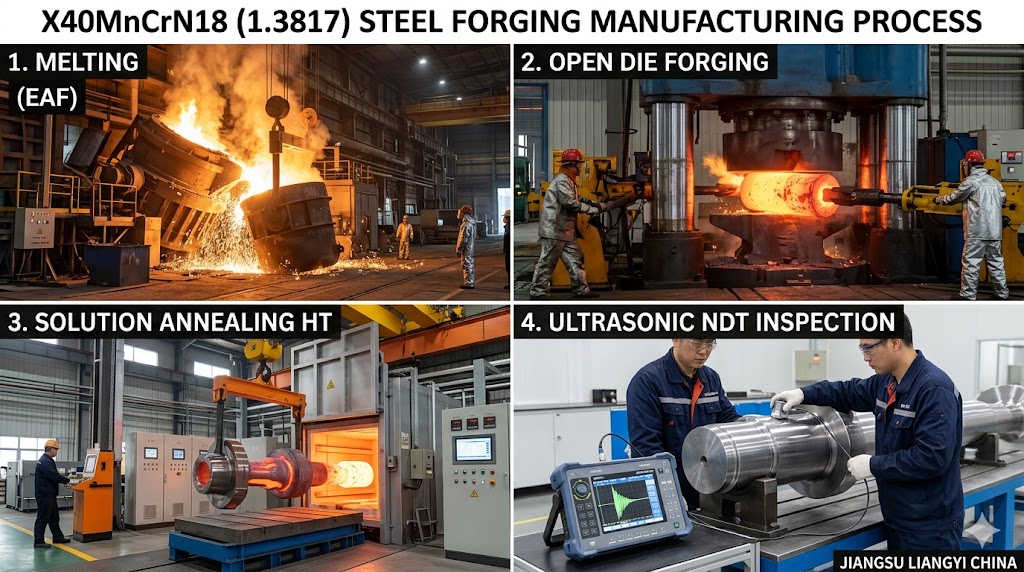
Forging Temperature Window: Narrow and Non-Negotiable
X40MnCrN18 has a narrower workable forging temperature window than most stainless or alloy steels. Based on our process data, the optimal range is start temperature: 1,050°C – 1,150°C; minimum finish temperature: 900°C. Exceeding 1,180°C risks incipient grain boundary melting (hot shortness) due to the high Mn content, which significantly lowers the effective solidus temperature compared to Ni-stabilised austenitic grades. Dropping below 900°C during forging — particularly in large cross-sections where temperature gradients are steep — risks introducing surface cracking from the material's rapid work hardening response at lower temperatures. Our 6,300T hydraulic presses and 9T electro-hydraulic hammers allow us to complete multi-step forging sequences within the safe temperature window before reheating is required.
Higher Forging Press Force Requirement
Because X40MnCrN18 work-hardens so rapidly (n ≈ 0.45–0.55), its hot flow stress is approximately 15–25% higher than equivalent 316L heats at the same forging temperature. In practical terms, a forging that could be produced on a 2,000T press in 316L will typically require a 2,500T or 3,000T press in X40MnCrN18. Our 6,300T press is equipped with a precise stroke-force monitoring system that allows our operators to track material flow stress in real time and adjust stroke rate to avoid over-stressing die tooling. For thin-section near-net-shape forgings, we use multi-step sequential forging with intermediate reheats rather than attempting to achieve net shape in a single press sequence.
Minimum Forging Reduction Ratio
To achieve the EN 10088-3 minimum mechanical properties (particularly elongation ≥ 35% and impact toughness), we apply a minimum forging reduction ratio of 3:1 (i.e., the forged cross-section area is no more than one-third of the starting ingot cross-section). For rotating components such as shafts and turbine discs where ultrasonic cleanliness and grain uniformity are paramount, we target 4:1 or higher. Ingots that were directly cast without adequate reduction are detectably inferior in UT cleanliness — an outcome we have documented in comparative testing and eliminated from our standard process.
Grain Flow Control for Non-Destructive Testing Compliance
For seamless rolled rings, the circumferential forging inherent to ring rolling aligns the austenitic grain structure tangentially — meaning that ultrasonic beam propagation in the radial direction (the most critical inspection axis for detecting mid-wall defects) is perpendicular to grain elongation. This orientation maximises UT signal response from any embedded defects, making inspection more reliable. We calibrate all ring rolling campaigns with forging simulation software to predict final grain flow orientation and confirm that the planned UT inspection angles are optimised before production begins. This forward-planning approach eliminates the scenario where a technically sound forging fails UT acceptance not due to actual defects but due to unfavourable grain flow relative to the inspection direction.
Raw Material Melting
EF+AOD/VOD (commercial grade) or VIM+ESR/VAR (nuclear/HPHT grade). Precise Mn control at 17.5–18.5% target for optimal TWIP response.
Ingot Inspection & Prep
Hot-top cropping (≥ 15% of ingot height), surface conditioning, ultrasonic pre-inspection. Premium grades: additional ESR/VAR re-melt.
Controlled Heating
Slow ramp (≤ 80°C/h below 600°C) to prevent thermal shock in heavy sections. Soak at 1,100°C min. 2h/300mm section thickness.
Precision Forging / Ring Rolling
Temperature window: 1,050–1,150°C start, ≥ 900°C finish. Min. 3:1 reduction ratio. Multi-step with reheats for complex shapes.
Solution Annealing (+AT)
1,020–1,080°C (soak min. 1h per 25mm section). Immediate water quench — no air cooling permitted. Verified by furnace chart and thermocouple records.
Rough Machining
Carbide tooling at 50–70% of 316L cutting parameters. Flood coolant mandatory. Dedicated fixtures to prevent magnetisation from magnetic chuck contact.
Full NDT
100% UT (EN 10228-3), PT/MT, hardness mapping, magnetic permeability test (IEC 60404-4). Chemical and mechanical properties from same-furnace batch.
Finish Machining & Dispatch
CNC finish machining to drawing tolerances. Final CMM dimensional report. EN 10204 3.1/3.2 MTC compilation. Third-party inspection (BV/SGS/TÜV/LR). Packing & shipment.
Heat Treatment Science for 1.3817 (X40MnCrN18) — Why the Details Matter
Solution Annealing Temperature: 1,020°C – 1,080°C
The solution annealing temperature for X40MnCrN18 is a deliberate compromise between two competing metallurgical objectives. Heating above 1,080°C promotes grain growth: austenite grain size increases rapidly above this temperature due to the absence of grain-boundary pinning phases, degrading impact toughness and reducing ultrasonic testing resolution. Heating below 1,020°C risks incomplete dissolution of any chromium carbides (Cr₂₃C₆) that may have precipitated during forging cool-down — incomplete dissolution means residual carbides at grain boundaries that reduce corrosion resistance and toughness. For section thicknesses above 200 mm, we use the lower end of the range (1,020–1,040°C) with an extended soak time (2h minimum per 25mm section) to ensure uniform temperature throughout the cross-section before quenching begins.
Water Quench: The Non-Negotiable Step
The single most important quality decision in processing X40MnCrN18 is the method of cooling after solution annealing. Because the carbon content is 0.30–0.50% — very high for an austenitic steel — the risk of Cr₂₃C₆ carbide precipitation at grain boundaries during slow cooling is significant. The time-temperature-precipitation (TTP) curve for X40MnCrN18 shows that significant carbide precipitation begins within 2–5 minutes of entering the temperature range 550–850°C during slow cooling. Water quenching — transferring the forging from the furnace to a water tank within 60 seconds and achieving surface temperature below 100°C within 3 minutes — bypasses this precipitation window entirely. Air cooling (even forced-air cooling) in sections above 30 mm is fundamentally insufficient for this grade and should be rejected as non-conforming by any informed receiving inspection.
No Age Hardening or Stress Relieving After Quench
Unlike some precipitation-hardening grades, X40MnCrN18 is not amenable to age hardening. Its strength comes from solid solution strengthening and the work-hardening TWIP response in service — not from precipitate formation. Applying any thermal treatment below the solution annealing temperature (including stress-relieving at 400–700°C) will promote carbide precipitation and is not recommended. If dimensional distortion during machining is a concern, the correct approach is vibration stress relief (VSR) rather than thermal stress relief — VSR imposes no thermal cycle and thus creates no risk of microstructural degradation.
Machining Recommendations for 1.3817 (X40MnCrN18) Forged Parts
X40MnCrN18 is not a difficult material to machine if the operator understands its work-hardening behaviour. It is a difficult material to machine incorrectly — specifically, the rapid work hardening at the cutting interface punishes any technique that allows rubbing instead of cutting. The following recommendations are drawn from our in-house machining workshop's standard operating procedures for this grade:
Machining Parameter Guidelines for X40MnCrN18 (1.3817)
- Cutting Speed: Use 50–70% of your standard 316L cutting parameters as a starting point. For carbide inserts (ISO P15–P25 grade), a surface cutting speed of 80–120 m/min is appropriate for roughing; 60–90 m/min for finishing. High-speed steel (HSS) tooling should be limited to 30–50 m/min roughing passes only.
- Feed Rate: Use moderate-to-high feed rates to maintain a chip that actually cuts rather than rubs. A chip thickness below 0.05 mm (per-tooth) causes rubbing, which work-hardens the next surface layer before the cutting edge engages it — a self-defeating cycle that rapidly ruins tooling and degrades surface finish. Recommended: 0.15–0.30 mm/rev for turning roughing; 0.10–0.20 mm/rev for turning finishing.
- Depth of Cut: Take meaningful depths of cut. Shallow "skimming" passes on X40MnCrN18 are particularly harmful because they always contact the work-hardened skin created by the previous pass. Minimum recommended DOC for roughing: 2.0–3.0 mm. For finishing, 0.5–1.0 mm DOC is typically necessary to cut below any work-hardened layer from the previous pass.
- Tooling: Cemented carbide inserts are strongly preferred. Choose sharp, positive-rake geometries (positive rake angle ≥ +5° recommended) to minimise cutting force and associated work hardening. Avoid brazed tooling for anything beyond preliminary rough cuts. For boring operations in deep bores (length-to-diameter ratio > 4:1), use vibration-damping boring bars to prevent chatter — chatter generates heat and rubbing that rapidly work-hardens the bore surface.
- Coolant: Flood coolant is mandatory — not optional — for all turning, milling, and drilling operations. Use water-soluble cutting oil at minimum 7% concentration. Coolant serves two functions in X40MnCrN18: thermal management (reducing the heat that drives work hardening) and chip clearance (preventing re-cutting of chips, which is a major source of work hardening and tool damage).
- Magnetic Fixture Precaution: Never use magnetic chucks or magnetic V-blocks to fixture X40MnCrN18 parts that are destined for non-magnetic applications. Residual magnetisation from magnetic fixturing can raise apparent magnetic permeability readings above the 1.01 H/m specification limit. Use non-magnetic fixtures (aluminium, brass, or non-magnetic stainless) throughout.
- Thread Cutting: For threaded connections in X40MnCrN18 valve stems and shafts, single-point threading at low speed (20–35 m/min) with sharp, freshly honed inserts is preferred over self-opening die heads. Thread grinding after rough threading is recommended for API-standard threads where tolerance and surface finish are critical.
Weldability of 1.3817 (X40MnCrN18) — An Honest Assessment
X40MnCrN18 is not a weld-friendly material, and any supplier who claims otherwise is either not familiar with this grade or is not being transparent. The high carbon content (0.30–0.50%) — far above the 0.03% limit of 316L — creates two significant welding risks:
- Hot Cracking (Solidification Cracking): The high carbon and manganese content expands the solidification temperature range of the weld pool, increasing the risk of liquid films remaining at grain boundaries during weld solidification. Under the thermal contraction stresses of welding, these films can crack — a defect mode known as hot cracking or solidification cracking. This risk is highest in multi-pass welds and in restrained joint configurations.
- Heat-Affected Zone (HAZ) Sensitization: Even if the weld pool itself is sound, the slow cooling of the HAZ through the sensitization temperature range (550–850°C) precipitates Cr₂₃C₆ at grain boundaries — a process that depletes the chromium from the grain boundary region ("chromium-depleted zones") and makes the material susceptible to intergranular corrosion and reduced toughness in that zone. In non-magnetic applications, HAZ sensitization also introduces the risk of localised magnetic anomalies in the weld zone that can cause magnetic permeability to exceed the ≤ 1.01 H/m specification.
If welding of 1.3817 is unavoidable in a repair or prototype situation, the following precautions are essential:
- Use TIG (GTAW) welding process with minimum heat input (stringer beads, no weave).
- Filler metal: ENiCrFe-type (Inconel-type) filler is the most practical choice; it is not compositionally matched to X40MnCrN18 but avoids the hot cracking risks of Mn-based fillers. Accept that the weld zone will differ from the parent material in composition and properties.
- Do NOT preheat X40MnCrN18 — preheating increases HAZ dwell time in the sensitization range, worsening carbide precipitation.
- Post-weld solution anneal (1,040–1,060°C, water quench) is required for any corrosion-critical or non-magnetic application. This fully re-dissolves sensitization carbides and restores non-magnetic properties.
- Post-weld anneal is not always practical for large assemblies — another reason to design for near-net-shape forging rather than welded fabrication.
Chemical Composition & Mechanical Properties of 1.3817 (X40MnCrN18)
EN Standard Chemical Composition — EN 10088-3
Our 1.3817 steel strictly complies with EN 10088-3 chemical composition requirements, with precise element control to guarantee consistent material performance for every heat. The table below includes internal Jiangsu Liangyi aim targets (where our process is tighter than the EN minimum/maximum), shown in parentheses:
Table 2: 1.3817 (X40MnCrN18) Chemical Composition — EN 10088-3 Limits & JL Internal Targets
| Element | EN 10088-3 Limit | JL Internal Target | Metallurgical Role |
|---|---|---|---|
| Carbon (C) | 0.30 – 0.50 % | 0.38 – 0.45 % | Austenite stabiliser; solid solution strengthener; drives TWIP hardening response |
| Manganese (Mn) | 17.0 – 19.0 % | 17.5 – 18.5 % | Primary austenite stabiliser; lowers stacking fault energy → TWIP mechanism; non-magnetic structure foundation |
| Chromium (Cr) | 3.0 – 5.0 % | 3.5 – 4.5 % | Corrosion resistance, oxidation resistance; capped to prevent ferrite formation and preserve non-magnetic properties |
| Silicon (Si) | Max. 1.0 % | 0.3 – 0.6 % | Deoxidiser; too high increases magnetic permeability risk |
| Nickel (Ni) | Max. 1.0 % | Max. 0.5 % | Supplementary austenite stabiliser; toughness improver; kept low to control cost |
| Nitrogen (N) | Max. 0.10 % | 0.05 – 0.09 % | Strong austenite stabiliser and solid solution strengthener; enhances corrosion resistance without reducing ductility |
| Phosphorus (P) | Max. 0.05 % | Max. 0.030 % | Strictly controlled — promotes grain boundary embrittlement and hot shortness at elevated P levels |
| Sulfur (S) | Max. 0.030 % | Max. 0.015 % | Strictly controlled — forms MnS inclusions that degrade toughness and corrosion resistance; controlled during secondary refining |
Guaranteed Mechanical Properties — +AT (Solution Annealed) Condition
All X40MnCrN18 forged parts are delivered in solution annealed (+AT) condition with water quench. Mechanical properties are tested from specimens cut from the same heat and heat treatment batch as the production parts:
Table 3: 1.3817 (X40MnCrN18) Mechanical Properties — +AT Condition, EN ISO 6892-1
| Property | EN 10088-3 Minimum | Typical JL Test Value | Test Standard |
|---|---|---|---|
| Tensile Strength (Rm) | 750 – 950 MPa | 800 – 900 MPa | EN ISO 6892-1 |
| 0.2% Proof Strength (Rp0.2) | Min. 280 MPa | 300 – 380 MPa | EN ISO 6892-1 |
| Elongation at Fracture (A, longitudinal) | Min. 35 % | 40 – 55 % | EN ISO 6892-1 |
| Brinell Hardness | 220 – 280 HB | 230 – 260 HB | EN ISO 6506-1 |
| Charpy Impact Energy (KV, +20°C) | Not specified in EN 10088-3 | Typically 80 – 150 J (longitudinal) | EN ISO 148-1 |
| Magnetic Permeability | Not specified in EN 10088-3 | ≤ 1.005 H/m (JL standard) | IEC 60404-4 |
| Max. Continuous Service Temperature | 450°C | — | EN 10088-3 / Engineering practice |
Available Melting Routes by Application Grade
Table 4: 1.3817 Melting Route Selection — Application Grade vs. Process Route
| Application Grade | Melting Route | Typical Markets |
|---|---|---|
| Commercial Grade | EF → AOD/VOD → (optional ESR) | General industrial, marine, pump OEM, petrochemical |
| High-Cleanliness Grade | EF → AOD → ESR | Oil & gas wellhead (API 6A), power generation turbines |
| Premium / Nuclear Grade | VIM → ESR or VIM → VAR | Nuclear reactor components, HPHT sour service, critical aerospace |
| Ultra-Premium Grade | VIM → ESR → VAR (triple melt) | Nuclear safety systems, defence, highest-criticality downhole tools |
GEO-Targeted Localization Services for Global Clients
We do not operate as a generic exporter. For each of our five core market regions, we maintain dedicated technical documentation templates, localised compliance support, and established relationships with regional third-party inspection agencies:
🇪🇺 Europe — CE/PED Compliance
- PED 2014/68/EU compatible — full EN 10204 3.1/3.2 material documentation available for PED equipment manufacturers
- EN 10204 3.2 MTC (third-party countersigned)
- Full EN 10088-3 composition compliance documentation
- TÜV, Bureau Veritas (BV) inspection accepted
- Incoterms: CIF Hamburg/Rotterdam, DAP
🇺🇸🇨🇦 North America — API/ASME
- API 6A Annex F-compliant material documentation for wellhead equipment manufacturers
- ASME Section VIII Division 1 material compliance
- NACE MR0175 / ISO 15156 compliance statements
- SGS, Intertek inspection accepted
- Incoterms: FOB Shanghai, CIF Houston/Vancouver
🇦🇪 Middle East — ADNOC/ARAMCO
- ADNOC / Saudi Aramco vendor documentation assistance (material traceability & MTC packages)
- NACE MR0175 sour service compliance
- Arabic-language shipping documentation available on request
- Bureau Veritas (BV) Dubai inspection accepted
- Incoterms: CIF Dubai, CFR Dammam/Jebel Ali
🇦🇺 Australia — AS/NZS Compliance
- AS/NZS 4037 and AS 1548 compatible documentation
- AMCA membership and Australian customs HS code guidance
- SGS Sydney or Melbourne inspection accepted
- Air freight options for urgent components: 3–5 days delivery
- Incoterms: FOB Shanghai, CIF Perth/Melbourne
🌏 Southeast Asia — DNV/LR Marine
- DNV, Lloyd's Register (LR), ABS class survey accepted
- IACS unified rules compliance documentation
- Marine classification society factory survey history
- Incoterms: FOB Shanghai, CIF Singapore/Port Klang
- Local agent support in Singapore and Malaysia
🌐 Global Service Standards
- 24/7 English technical support (WhatsApp/email)
- Free 24h technical quotation from drawing submission
- 12-month warranty from delivery date
- On-site factory inspection visits welcome
- Flexible Incoterms: EXW, FOB, CIF, CFR, DAP, DDP
Full-Process Quality Assurance & Global Compliance
Every batch of 1.3817 (X40MnCrN18) forged parts we deliver is accompanied by a complete inspection and documentation package. Our quality system is not a formality — it is the commercial foundation on which 50+ countries of clients have built long-term sourcing relationships with Jiangsu Liangyi.
Complete Inspection Scope — Standard for Every Order
- Heat Chemistry Verification: Spectroscopic chemical analysis from the same furnace charge, with all 8 elements per EN 10088-3 reported against specification limits. For nuclear and HPHT grades: additional trace element analysis (Co, Cu, B, Pb, Bi, As) on request.
- Mechanical Property Testing: Tensile (Rm, Rp0.2, A), Brinell hardness, and Charpy impact (if specified) from the same heat and heat treatment batch. Test specimens cut and prepared per EN ISO 6892-1 and EN ISO 148-1. Results reported with calibrated laboratory instrument certificates.
- 100% Hardness Survey: Every forging individually hardness-tested (Brinell or portable UCI method for large forgings). No sample-based hardness acceptance — every piece.
- 100% Dimension Test: Full dimensional verification against drawing using calibrated measuring equipment (micrometers, CMM for complicate geometries). CMM reports provided for machined components with GD&T callouts.
- 100% Visual Inspection: Full surface visual examination under adequate lighting. Laps, seams, cracks, cold shuts, and underfill all constitute automatic rejection. Surface condition reported per EN ISO 9000 criteria.
- 100% Ultrasonic Testing (UT): Full volumetric UT per EN 10228-3. Standard acceptance criteria: Class 3 for commercial grade, Class 4 for premium and nuclear grade. Immersion UT available for complex geometries.
- Penetrant Testing (PT) / Magnetic Particle Testing (MT): Surface flaw detection performed per EN ISO 3452-1 (PT) as standard; MT per EN ISO 17638 where specified. Note: MT is typically not applicable to non-magnetic 1.3817 — PT is the correct surface NDT method for this grade.
- Magnetic Permeability Testing: Per IEC 60404-4, using calibrated magnetic permeability meter. Provided with calibration certificates for all orders with non-magnetic specification. We report individual reading, not batch average — every part tested.
- Metallographic Analysis & Grain Size: Grain size evaluation per EN ISO 643 available as an additional option. Particularly valuable for nuclear and fatigue-critical applications where maximum grain size limits are specified.
Certifications & Global Compliance
- ISO 9001:2015 Quality Management System Certification (scope: forging, machining, inspection)
- EN 10204 3.1 Mill Test Certificate (standard for all orders)
- EN 10204 3.2 Mill Test Certificate with independent third-party countersignature (available on request)
- PED 2014/68/EU compatible material documentation — for use by European PED-certified equipment manufacturers
- API 6A Annex F-format material documentation — for use by API-licensed wellhead equipment manufacturers
- ASME Section II Part A material compliance documentation for North American pressure equipment
- NACE MR0175 / ISO 15156 sour service compliance statement
- Third-party inspection accepted: BV, SGS, Intertek, TÜV, Lloyd's Register, DNV, ABS
Engineer's Procurement Checklist for 1.3817 (X40MnCrN18) Forged Parts
To help your engineering and procurement team specify and receive 1.3817 forgings correctly, we have compiled the following checklist based on the most common specification gaps and receiving inspection failures we have seen in our 25 years of supplying this grade globally. This checklist is offered as a free resource — use it in your purchase orders and incoming inspection procedures regardless of who you source from.
📋 Section A: Purchase Order Specification Requirements
📋 Section B: Incoming Inspection & Receiving Checklist
Frequently Asked Questions (FAQs) About 1.3817 (X40MnCrN18) Forged Parts
There is no direct AISI or ASTM equivalent for 1.3817 (X40MnCrN18). It is governed by EN 10088-3 as a European standard high-manganese austenitic steel. In terms of properties, it is most comparable to the ASTM Nitronic® family (200-series austenitic steels with high Mn), particularly Nitronic® 60 (UNS S21800), but differs in having higher carbon content (0.30–0.50% vs. ~0.10% in Nitronic® 60), which gives X40MnCrN18 higher hardness and wear resistance but limits its weldability. Engineers working with ASTM standards who need to qualify 1.3817 forgings for North American projects typically do so under ASME Section II material approval provisions, supported by full EN 10204 3.1/3.2 Mill Test Certificates and chemical/mechanical property compliance statements.
No — X40MnCrN18 (1.3817) in its solution annealed (+AT) condition is fully austenitic (FCC crystal structure), which is paramagnetic by nature. Its magnetic permeability is ≤ 1.01 H/m (typically ≤ 1.005 H/m in our production) when properly heat treated. The non-magnetic stability is maintained even after moderate cold working, because the high Mn content (17–19%) keeps the Ms (martensite start) temperature far below ambient, preventing the strain-induced martensite transformation that causes standard 304/316 stainless steel to become measurably magnetic after cold deformation. The mechanism is thermodynamic: high Mn and C content raise the austenite stability to such a degree that no phase transformation toward ferromagnetic martensite or ferrite is possible under normal service conditions. We provide individual magnetic permeability test certificates per IEC 60404-4 for all orders with non-magnetic specifications.
Our minimum order weight is 30 kg for custom 1.3817 forged parts — this accommodates single prototype components and small-batch development orders. For standard shapes (round bars, rings, discs), we maintain a limited consignment stock of solution-annealed 1.3817 forged bar in Ø50–Ø300 mm diameters for urgent small-batch orders, with delivery available within 5–7 business days from stock. For large-volume production orders (above 5,000 kg per single delivery), we offer volume pricing and dedicated production scheduling to ensure consistent lead times regardless of order size.
For standard custom X40MnCrN18 forgings made with the common EF+AOD melting process, our usual delivery time is 3–4 weeks from order confirmation and drawing approval to factory shipment. This timeline includes the procurement of raw material, melting, forging, heat treatment, complete NDT inspection and the preparation of the material test certificates. The lead time for high grade forged parts produced by VIM+ESR or VIM+VAR melting methods is 5-8 weeks, because of longer vacuum melting cycles and additional material qualification steps. We also have rush production with 2 weeks lead time for commercial grade only, depending on raw material stock, for eligible urgent orders. You may contact our sales team to check your project schedule. Usually the inspection by third party (BV, SGS or TüV) takes 3-5 more working days on top of the delivery period, and we will arrange the inspection schedule proactively to avoid delays.
Yes. Our in-house machining workshop is equipped with 5-axis CNC machining centres, CNC lathes up to Ø2,000 mm swing, deep-hole boring machines, surface and cylindrical grinders, and a CMM for final dimensional verification. We machine X40MnCrN18 using carbide tooling at optimised cutting parameters (50–70% of standard 316L speeds, with flood coolant throughout) to manage work hardening. For non-magnetic components, all machining fixtures are non-magnetic (aluminium/brass) to prevent residual magnetisation. We can produce finish-machined parts to IT7 tolerance class as standard, and IT6 for precision fits on request. All machined deliveries include a CMM dimensional report verifying compliance with your drawing.
According to EN 10088-3 design guidelines and our first-hand field data from thermal power and nuclear energy clients, X40MnCrN18 maintains stable mechanical properties at continuous service temperatures up to 450°C. Above 450°C, two degradation mechanisms begin to become relevant: (1) the onset of sigma phase precipitation — a brittle intermetallic phase that forms slowly in Cr-Mn steels above ~450°C and progressively embrittles the microstructure — and (2) accelerated chromium carbide precipitation that reduces toughness and corrosion resistance. Neither mechanism is immediately catastrophic (they develop over thousands of hours of exposure), but components designed for continuous service above 450°C should specify an alternative grade such as 310S (1.4845), Alloy 800H (1.4876), or a proprietary high-temperature austenitic alloy. For short-duration excursions above 450°C (such as fire-condition scenarios for valve bodies), 1.3817 is generally acceptable. Always consult our technical team for high-temperature application assessments.
1.3817 (X40MnCrN18) follows EN 10088-3 as the main standard for chemical makeup, delivery state and mechanical performance. For full manufacturing compliance, Jiangsu Liangyi provides 1.3817 forged parts with complete paperwork covering EN 10204 3.1/3.2 mill test reports, documents that meet PED 2014/68/EU for the European market, API 6A Annex F material files for wellhead projects in North America and the Middle East, ASME Section II material rules for North America, NACE MR0175 / ISO 15156 qualification for sour working conditions, and AS/NZS standard documents for Australia. All NDT testing is carried out according to EN 10228-3 for UT, EN ISO 3452-1 for PT, and IEC 60404-4 for magnetic permeability checks. We also accept third-party inspection and witness from BV, SGS, Intertek, TÜV, Lloyd's Register, DNV and ABS.
X40MnCrN18 can be welded, but it is not a welding-friendly grade due to its high carbon content (0.30–0.50%). The primary risks are hot cracking in the weld pool (from a wide solidification range caused by high C and Mn) and heat-affected zone (HAZ) sensitization — grain boundary chromium carbide precipitation during the welding thermal cycle that reduces corrosion resistance and toughness in the HAZ. For non-magnetic applications, HAZ sensitization can also cause localised magnetic anomalies near the weld. If welding is required: use TIG (GTAW) with minimum heat input, ENiCrFe filler metal, no preheat, and a mandatory post-weld solution anneal (1,040–1,060°C, water quench) for any corrosion-critical or non-magnetic application. Our strong recommendation for 1.3817 engineering is to design components as single near-net-shape forgings wherever possible, eliminating the weld joint entirely — our precision forging and machining capabilities support this design approach for virtually all common component geometries.
For non-magnetic applications, X40MnCrN18 (1.3817) is significantly superior to 316L (1.4404) in two respects: (1) Wear resistance — X40MnCrN18 has a wear resistance approximately 3–4× higher than 316L in abrasive sliding conditions, due to its TWIP work-hardening mechanism; this is decisive for valve seats, ESP shaft sleeves, and drilling tool components. (2) Non-magnetic stability after deformation — 316L's austenite can transform to martensite under cold working or machining, raising magnetic permeability above 1.05–1.10 H/m in worked areas; X40MnCrN18's higher austenite stability keeps permeability below 1.01 H/m even after significant machining operations. Where 316L is superior to X40MnCrN18: pitting corrosion resistance (316L has PRE ≈ 24–26 vs. ≈ 5–8 for 1.3817); maximum service temperature (316L suitable to 800°C oxidation limit vs. 450°C for X40MnCrN18); and weldability (316L is readily weldable; X40MnCrN18 is not). Choose X40MnCrN18 over 316L when wear resistance AND non-magnetic stability are both primary requirements; choose 316L when corrosion resistance in chloride environments is the primary concern.
Three specific machining precautions are critical for maintaining non-magnetic performance after machining: (1) Non-magnetic fixturing: Never use magnetic chucks, magnetic V-blocks, or any ferromagnetic clamping device for X40MnCrN18 parts destined for non-magnetic service. Residual magnetic field from magnetic chucks can induce sufficient magnetisation in even a fully austenitic steel to push magnetic permeability readings above the 1.01 H/m acceptance limit. Use aluminium, brass, or non-magnetic stainless steel fixtures throughout. (2) Controlled cutting conditions: Excessive heat at the cutting interface — from incorrect cutting speeds, insufficient coolant, or rubbing (too-shallow depth of cut) — can induce localised stress-assisted austenite-to-martensite transformation in the surface layer, creating a thin but measurable ferromagnetic skin. Correct tooling, flood coolant, and adequate depth of cut (≥ 0.5 mm for finishing passes) prevent this. (3) Post-machining magnetic permeability test: Always perform an IEC 60404-4 magnetic permeability test on the finished surface of machined components before dispatch. If local readings above 1.01 H/m are found, they can usually be resolved by a brief "demagnetising" process (passing the component through a demagnetiser coil) or in worst cases by a brief re-solution anneal — both far less costly than a field failure.
Based on our experience investigating field failures in 1.3817 components (including those originally supplied by other manufacturers), the four most common root causes are: (1) Air-cooled heat treatment instead of water quench — causes HAZ-like grain boundary sensitization throughout the forging, leading to intergranular corrosion attack in environments that otherwise should not affect 1.3817. (2) Insufficient forging reduction ratio — forgings produced directly from ingots with less than 3:1 reduction retain a coarse, dendritic as-cast grain structure that reduces impact toughness by 30–50% and degrades UT cleanliness ratings. (3) Out-of-specification chemical composition — particularly Mn below 17.0% (which reduces austenite stability, allowing martensite formation under service stress) or Cr above 5.0% (which risks delta ferrite formation and raises magnetic permeability). (4) Magnetic contamination during machining or assembly — as described above, the use of ferromagnetic tooling or fixtures creates localised magnetic anomalies that cause instrument failures in non-magnetic applications. All four failure modes are fully preventable through proper process control and incoming inspection.
Inquire About Custom 1.3817 (X40MnCrN18) Forged Steel Parts
As your trusted China-based specialist manufacturer of 1.3817 (X40MnCrN18) forged steel parts, Jiangsu Liangyi is committed to delivering technically superior, fully documented forging solutions for the most demanding global applications. Our 25-year track record in X40MnCrN18 forging — covering nuclear, oil & gas, marine, power generation, and petrochemical sectors across 50+ countries — means we bring genuine manufacturing expertise and deep material knowledge to every order, not just forging capacity.
To receive a detailed technical quotation within 24 hours, please send us your CAD drawings, material specification, required delivery condition, order quantity, required certifications, and project timeline. Our engineers will review your requirements and respond with a complete technical and commercial proposal.
Inquiry Email: sales@jnmtforgedparts.com
Phone / WhatsApp: +86-13585067993
Official Website: https://www.jnmtforgedparts.com
Factory Address: Chengchang Industry Park, Jiangyin City, Jiangsu Province, 214400, China