1.3505 (100Cr6) Forged Forging Parts | China Experienced Bearing Steel Forging Manufacturer — 25+ Years
What Is 1.3505 (100Cr6) Bearing Steel — A Manufacturer's Perspective
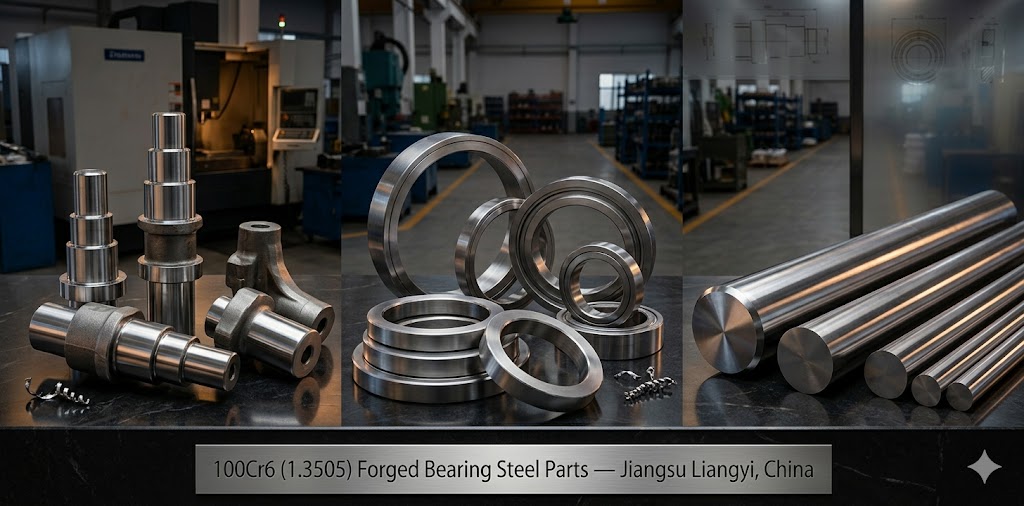
Jiangsu Liangyi has been manufacturing 1.3505 (100Cr6) forged forging parts since the late 1990s, giving our engineering team a hands-on understanding of this material that goes far beyond textbook definitions. As an ISO 9001:2015 certified China forging manufacturer supplying more than 50 countries, we consider 1.3505 the most metallurgically exacting alloy in our regular production portfolio — not the most difficult to source, but the most demanding to forge correctly.
The designation "1.3505" follows the German DIN numbering system, where "1.3" identifies a group of high-carbon steels with special properties and "505" is the sequential number within that family. The common name "100Cr6" directly encodes its two defining features: approximately 1.00% carbon (the "100") and 1.5% chromium (the "Cr6", where 6 ÷ 4 = 1.5%). This naming logic immediately tells an experienced metallurgist that the steel is designed to be fully hardened through its cross-section by the carbon content, while the chromium forms fine, uniformly distributed carbides that resist wear far beyond what carbon alone could achieve.
What separates a premium 1.3505 forged part from an average one is not the chemistry on the mill certificate — it is the history of the steel before and during forging. Every step from the electric arc furnace through vacuum degassing, ingot casting, heating, deformation, and heat treatment creates a microstructural history that either enhances or degrades the steel's inherent potential. At Jiangsu Liangyi, our 25 years of continuous production have allowed us to develop and refine proprietary process controls at each of these stages that are not published in any standard and are not replicated by general-purpose forging shops.
Explore our full range of forged products and material grades to find the ideal solution for your application.
Why Open Die Forging Is the Superior Manufacturing Route for 1.3505 (100Cr6) Components
Engineers sourcing 100Cr6 bearing steel components frequently ask whether a precision-machined bar or a forged part is the better choice. After producing hundreds of thousands of 100Cr6 components over 25 years, our position is unambiguous: for any critical load-bearing, wear-resistant, or fatigue-sensitive application, the open die forged route delivers measurably better performance. Here is why.
The Carbide Segregation Problem in As-Cast 100Cr6
Because 1.3505 contains approximately 1.0% carbon and 1.5% chromium, solidification from the molten state inevitably produces carbide segregation — regions of concentrated chromium carbide (Cr₇C₃) that form during dendritic solidification. In a rolled bar cut from a large ingot, this segregation manifests as coarse carbide bands running parallel to the rolling direction. Components machined from such bars carry these carbide bands with a fixed orientation. Under cyclic contact stress — as in a bearing race or a valve seat — these carbide bands act as fracture initiation sites when they are aligned perpendicular to the principal stress, reducing fatigue life by up to 30% compared to a properly forged equivalent.
Open die forging breaks up and redistributes this carbide network. The repeated deformation under our 4000T and 6000T hydraulic presses fragments the coarse carbide clusters into fine, uniformly dispersed particles, which is precisely the microstructure required for optimum rolling contact fatigue (RCF) performance. Our minimum required forging reduction ratio for 100Cr6 is 4:1 from ingot to finished shape; for critical bearing ring applications, we routinely use ratios of 6:1 to 8:1.
Forging Flow Lines That Follow Component Geometry
When a bearing ring or a valve body is machined from a straight bar, the forging flow lines (deformation streamlines) from the original rolling pass are cut through by the machining operation. The finished surface of the component therefore exposes the ends of flow lines to the contact surface — a condition known as "end-grain exposure" — which accelerates corrosion and fatigue crack initiation.
In a properly designed open die forging or seamless rolled ring, we control the deformation sequence so that the flow lines wrap continuously around the component geometry, parallel to the functional surfaces. This means the contact surface of a bearing ring sees only the long axis of the flow lines, dramatically improving resistance to pitting and spalling under rolling contact.
Grain Refinement and Through-Hardening Depth
Forging at controlled temperatures within the austenite range (for 100Cr6: 1050-1150°C for initial breakdown, 900-980°C for finishing) recrystallizes the coarse cast grain structure into fine, equiaxed austenite grains. After heat treatment, these fine prior-austenite grains translate into a finer martensite lath structure with more uniform hardness distribution. For heavy cross-section 100Cr6 forgings (diameter > 150mm), where through-hardening is inherently limited by the low chromium hardenability, our controlled forging geometry — combined with ESR refining to reduce oxygen below 15 ppm — achieves significantly deeper hardening than equivalent machined bar stock.
Jiangsu Liangyi Internal Data (25-Year Production Records): For 100Cr6 forged rings with OD 300-600mm quenched in oil at 860°C, we consistently achieve case depth (≥58 HRC zone) of 18-28mm from the surface, versus 12-18mm typically reported for machined ring stock of equivalent size. This difference is attributable to our ESR refining process and optimized forging reduction ratios.
Global Equivalent Grades of 1.3505 (100Cr6) — Complete International Cross-Reference
One of the persistent challenges our international customers face is confirming that the grade they specify in their standard system corresponds exactly to what we produce. The following table is compiled from our direct experience supplying to these markets, not from secondary sources. For each equivalent, we note the key specification differences our quality team monitors.
| Standard System | Grade Designation | GEO Market | Key Specification Notes |
|---|---|---|---|
| DIN EN ISO 683-17 | 1.3505 / 100Cr6 | EU, Russia, Eastern Europe, Turkey | Reference standard. O ≤ 15 ppm for premium grade; EN 10204 3.1/3.2 MTC required |
| ASTM A295 / AISI / SAE | 52100 / G52986 | USA, Canada, Mexico, Brazil | Cr range slightly wider (1.30-1.60%); we report both DIN and ASTM on MTC for North American orders |
| JIS G4805 | SUJ2 | Japan, South Korea, Taiwan, SE Asia | P ≤ 0.025%, S ≤ 0.025%; JIS requires stricter non-metallic inclusion rating (max A1.5 / B1.5 / C1.0 / D1.0) |
| GB/T 18254 | GCr15 | China (domestic supply) | Nominally equivalent; Chinese standard allows slightly wider O tolerance on non-ESR heat |
| UNS | G52986 | Global UNS database | Unified Numbering System identifier; same composition as AISI 52100 |
| BS 970 (obsolete, still referenced) | 535A99 | United Kingdom, Commonwealth | Superseded by BS EN ISO 683-17; UK buyers now specify EN equivalent but may reference old BS number on drawings |
| GOST 801-78 | ШХ15 (ShKh15) | Russia, CIS countries | Close equivalent; Mn range slightly different (0.20-0.40%). We supply with GOST-format MTC on request |
When your drawing specifies any of the above grades, please share it with our technical team. We will confirm the exact compositional requirements, applicable test standards, and MTC format before issuing a quotation — a step that prevents grade mismatches that can cause costly production delays downstream.
1.3505 (100Cr6) vs Other Bearing Steels — When to Choose and When to Upgrade
A common question from our engineering customers is: "Is 100Cr6 the right material for my application, or should I consider an alternative?" Our technical team answers this question several times every week. The following comparison is built from 25 years of real application data, not marketing literature.
| Property / Factor | 1.3505 / 100Cr6 | M50 (1.3551) | 440C Stainless | 100CrMo7 (1.3537) | 52100 (ASTM) |
|---|---|---|---|---|---|
| Max Continuous Service Temp. | 120°C | 320°C | 200°C | 150°C | 120°C (same) |
| Rolling Contact Fatigue Life | Excellent (ESR grade) | Excellent | Good | Excellent | Excellent (same) |
| Corrosion Resistance | Low — needs protection | Low | High | Low | Low |
| Achievable Surface Hardness | 61–66 HRC | 60–65 HRC | 57–60 HRC | 61–65 HRC | 61–66 HRC (same) |
| Machinability (Annealed) | Good (170–210 HB) | Moderate | Moderate | Good | Good (same) |
| Heavy Section Through-Hardening | Limited >150mm dia | Good to 250mm | Moderate | Better — Mo improves | Limited (same) |
| Relative Material Cost | Lowest | High (4–6×) | Moderate (1.8–2.5×) | Low-Moderate (1.2–1.5×) | Lowest (same) |
| Best Applications | Standard bearings, dies, valves <120°C | Aerospace bearings, turbine engines | Marine bearings, food/pharma | Large heavy bearings, wind turbines | North American standard bearings |
Application Engineering Note: If your bearing or component operates above 120°C continuously, do not specify 100Cr6/1.3505. At temperatures above this threshold, the tempered martensite structure begins to revert, causing dimensional instability and hardness drop. We have seen field failures caused by this exact issue when customers upgraded a motor speed (increasing operating temperature) without re-qualifying the bearing steel. For applications in the 120-250°C range, we recommend our 100CrMo7-3 (1.3537) or M50 forgings. Contact our technical team for a material selection consultation at no charge.
Full Range of Custom 1.3505 (100Cr6) Forged Shapes & Specifications
We manufacture a complete portfolio of custom 1.3505 (100Cr6) forging steel products in virtually any shape, dimension, and tolerance. Every product is backed by our in-house machining, heat treatment, and testing — you deal with a single supplier from raw steel ingot to finished, inspected, and certified part.
Core 100Cr6 Forged Product Categories & Dimensional Capabilities
- 100Cr6 Open Die Forged Bars & Rods: Round, square, flat, rectangular, and hexagonal profiles. Maximum forged round diameter: 2000mm. Maximum length: 12 meters. Weight per piece: 30kg to 30 tons. Standard delivery: hot forged + spheroidizing annealed. Optional: rough machined to OD tolerance ±2mm, or precision turned to drawing.
- 1.3505 Seamless Rolled Forged Rings: Seamless rolled rings, open die forged rings, gear rings, bearing races, ring flanges, and custom profile rings. Maximum OD: 6000mm. Maximum height: 1500mm. Minimum wall thickness: 40mm. Fully compliant with EN 10228-3. Available with rectangular, T-, L-, or custom cross-section profiles upon request.
- 100Cr6 Forged Shafts & Stepped Shafts: Solid shafts, step shafts, gear shafts, transmission shafts, spindle shafts, and eccentric shafts. Maximum diameter: 1800mm. Maximum length: 15 meters. Weight: up to 30 tons. All forged shafts receive 100% ultrasonic testing (UT) to EN 10228-3 Class 3 or better as standard.
- 1.3505 Forged Hollow Forgings (Shells, Sleeves, Bushes): Hollow bars, thick-wall tubes, sleeves, bushes, housings, and bearing shells. ID bored in-house to eliminate laminations. Ideal for valve bodies, pump casings, and bearing housing applications. Available with rough-bored or precision-bored ID.
- 100Cr6 Forged Discs, Blocks & Plates: Discs, disks, blocks, plates, flanges, and tube sheets. Maximum diameter: 2500mm. Thickness: 20mm to 800mm. Used extensively for tool and die blanks, rolling mill backing plates, and heavy industrial equipment components.
- Custom Profile & Near-Net-Shape Forgings: For high-volume orders, we offer near-net-shape open die forging that reduces machining allowance and material waste by 15-30% versus standard over-sized forgings. Our engineering team will review your finished-part drawing and propose the optimal forging envelope.
| Product Form | Max Dimension | Max Weight | Standard Tolerance | Applicable Standard |
|---|---|---|---|---|
| Forged Round Bar | OD ≤ 2000mm, L ≤ 12m | 30 tons | EN 10243-1 Class D | EN 10228-1 / ASTM A788 |
| Seamless Rolled Ring | OD ≤ 6000mm, H ≤ 1500mm | 30 tons | EN 10243-1 Class D | EN 10228-3 / ASTM A788 |
| Forged Shaft | OD ≤ 1800mm, L ≤ 15m | 30 tons | Drawing ± as agreed | EN 10228-3 UT Class 3 |
| Forged Disc / Plate | OD ≤ 2500mm, T: 20–800mm | 30 tons | EN 10243-1 Class D | EN 10228-3 |
| Hollow Forging | OD ≤ 2000mm, custom wall | 25 tons | Drawing ± as agreed | EN 10228-3 |
| CNC Machined Finished Part | Subject to forging envelope | 30 tons | IT6 – IT9 achievable | Customer drawing |
Jiangsu Liangyi's Proprietary Forging Process for 1.3505 (100Cr6) — Step by Step
The following production sequence is our actual process for 1.3505 (100Cr6) forged parts. We publish it in detail because we believe transparency builds trust — and because every step reflects decisions that cannot be made correctly without deep material knowledge and well-maintained equipment.
Step 1 — Electric Arc Furnace (EAF) Melting: Controlling the Starting Chemistry
Our 60-ton EAF operates at 40 MVA. For 100Cr6 heats, we begin with carefully selected scrap with known composition history supplemented by pig iron to control residual tramp element levels. Carbon and chromium are targeted at the upper end of the specification range at this stage, because both are partially lost in subsequent refining steps. Phosphorus is brought below 0.020% in the EAF — lower than the finished specification — because phosphorus cannot be removed in later steps and must be controlled at source.
Step 2 — Ladle Furnace (LF) Refining: Precision Chemistry Control
Our two LF units fine-tune the chemical composition to within ±0.02% on carbon and ±0.03% on chromium of the center of the target range. This precision is critical for 100Cr6 because both elements directly control the quantity and distribution of carbides in the final microstructure. We also add calcium wire treatment during LF to spheroidize sulfide inclusions — transforming sharp-edged MnS stringers into rounded CaS inclusions that have a far lower notch effect on fatigue performance.
Step 3 — VD/VOD Vacuum Degassing: Oxygen Below 15 ppm
This step is where our 100Cr6 production diverges most sharply from lower-quality alternatives. Our two VD/VOD units degas the steel to oxygen content below 15 ppm (standard commercial 100Cr6 often contains 20-30 ppm oxygen). Oxygen in bearing steel forms Al₂O₃ and other hard oxide inclusions that are the primary sites for rolling contact fatigue crack initiation. Reducing oxygen from 25 ppm to 12 ppm can significantly increase L10 bearing life — a relationship well-established in the Lundberg-Palmgren bearing fatigue model and consistent with our long-term customer field feedback on our ESR-grade production. Hydrogen is simultaneously degassed to below 1.5 ppm, eliminating the risk of hydrogen-induced flaking in heavy forgings.
Step 4 — Ingot Casting & Optional ESR (Electroslag Remelting)
Standard 100Cr6 heats are bottom-poured into ingot molds with controlled filling rate to minimize turbulence and macro-segregation. For premium applications — large bearing rings above 1000mm OD, precision valve seats, or any part where the customer specifies DIN 100Cr6 "premium quality" — we apply ESR remelting using our ESR plant with capacity up to 32-ton single electrode. ESR passes the solidifying steel through a liquid slag layer that: (a) further reduces oxide inclusions, (b) refines the solidification structure, and (c) produces near-zero macro-segregation in the ingot. The result is a starting material whose composition and cleanliness are essentially uniform from surface to center — the foundation for uniform properties in the finished forging.
Step 5 — Ingot Heating & Soaking: The Most Critical Temperature Step
100Cr6 is one of the steels most susceptible to what metallurgists call "carbide necklace" — a continuous network of carbides along prior austenite grain boundaries that forms if the steel is held too long above the carbide dissolution temperature (~1050°C) or forged at too high a temperature. We heat our 100Cr6 ingots to 1150-1180°C for initial breakdown, with a carefully controlled soak time calculated from the ingot cross-section to ensure temperature uniformity without excessive carbide dissolution. Our heating furnace controllers are calibrated to ±5°C with independent thermocouple verification.
The finishing forging temperature for 100Cr6 is deliberately kept between 900-970°C — well above the Ar₃ (ferrite formation) temperature to prevent "cold working" the austenite, but low enough to produce maximum grain refinement through recrystallization. Our forge operators are trained to monitor and respect this temperature window; a part finished below 860°C is rejected and re-heated rather than allowed to proceed with a degraded microstructure.
Step 6 — Open Die Forging / Seamless Ring Rolling
Our forging press selection for 100Cr6 is driven by the required reduction ratio and finished dimensions. For heavy bars and shafts, our 6000T hydraulic press applies sufficient force per blow to penetrate and deform the core of large sections — a capability that smaller presses cannot achieve, resulting in inadequately worked centers. For rings up to 6000mm OD, our 5m ring rolling machine produces seamless rolled rings with circumferentially oriented flow lines and uniform wall thickness within ±3mm before machining.
Our minimum forging reduction ratio policy for 100Cr6: 4:1 from ESR ingot, or 6:1 from standard ingot, measured from ingot cross-sectional area to finished forging cross-sectional area. This ratio ensures complete breakdown of the as-cast structure and is documented in our forge process records for every heat.
Step 7 — Post-Forging Slow Cooling & Softening Anneal
Immediately after forging, 100Cr6 parts must not be allowed to air cool rapidly — rapid cooling through the Ar₁ temperature (~720°C) can produce a hard, brittle martensite skin on the surface of the hot forging, which can crack during subsequent handling or machining. Our standard post-forging treatment is sand burial (for smaller parts) or pit cooling in our insulated slow-cooling pits (for larger pieces), reducing cooling rate to below 30°C/hour through the transformation range. This produces a softened, workable structure (typically 220-250 HB) suitable for straightening if needed and safe for transport to our heat treatment workshop.
Step 8 — Heat Treatment: Three Options, All In-House
See the detailed heat treatment section below for full technical parameters. All heat treatment is performed in-house in our 10-furnace workshop, with ±5°C temperature uniformity verified by calibrated thermocouples and independent pyrometry. This in-house capability eliminates the lot traceability gaps and temperature uncertainty that arise when forgings are sent to external heat treaters.
Step 9 — CNC Machining (Where Required)
Our in-house CNC turning and milling centers handle rough machining to leave a machining allowance of 3-8mm per surface, or precision finishing to IT6 tolerances. All machined parts are dimensionally inspected on our CMM (Coordinate Measuring Machine) with report issued. We do not outsource machining — this ensures dimensional quality and lot integrity are maintained under our ISO 9001:2015 quality system throughout.
Global Industry Applications & GEO-Targeted Project Cases of 1.3505 (100Cr6) Forgings
The following project cases are drawn from our actual delivery records. Where customer confidentiality applies, we describe the application and technical challenge without identifying the end customer. Each case illustrates a specific technical problem solved through our materials and process expertise — not simply "we supplied a part."
Case 1 — Large-Diameter Bearing Rings for Wind Power Gear Boxes | Germany, 2019–Present
Application Context: A top German wind turbine gearbox maker needed seamless rolled bearing rings made of 1.3505 (100Cr6). The outer diameter is 820mm, inner diameter is 680mm and height is 120mm, and all parts are made to DIN EN ISO 683-17 ESR quality grade and supplied with EN 10204 3.2 certificate. Third-party inspection must be available. The customer specified oxygen content no more than 12 ppm, carbide banding grade within 1.5 following ASTM E45, and ultrasonic testing compliant with EN 10228-3 Class 3.
Technical Challenge Overcome: Uniform through-hardening to ≥58 HRC throughout the 70mm wall thickness at 820mm OD required a combination of ESR refining (to maximize hardenability through uniformity of chemistry), controlled forging reduction (achieved 6.8:1), and careful management of the quench rate. Prior to production lots, our metallurgical team conducted three trial heats to validate the quench parameters. The resulting hardness profile — measured on cross-section coupon samples taken from each ring — showed ≤3 HRC variation through the full wall thickness.
Ongoing Supply Relationship: We have been supplying this customer in quarterly lots since 2019. No bearing ring failures attributable to material or forging quality have been reported through our ongoing supply relationship. Our on-time delivery record for this customer is excellent, contributing to a multi-year approved supplier status.
Case 2 — Valve Ball Forgings for Sour Gas Wells | Middle East Market, 2021
Application Context: Forged valve balls 100Cr6 with 4” through-bore for wellhead assemblies in H2S containing environments at 10,000 PSI working pressure. An oil & gas engineering contractor was in need of: The customer’s material specification defined the chemical, mechanical and dimensional requirements of API 6A (as a material reference standard), hardness limits of NACE MR0175 for sour service (≤22 HRC), Charpy impact energy ≥60J at -46°C and hydrostatic pressure testing at 1.5× working pressure.
Note: We supplied the forged material components to these material specifications — the final valve assembly API certification was performed by the valve OEM as the licensed API manufacturer.
Technical Challenge Overcome: The NACE MR0175 requirement of ≤22 HRC for SSC resistance directly conflicts with the typical 100Cr6 application hardness of 61-65 HRC. The solution was to supply the forged balls in the quenched + high-temperature tempered condition (650-680°C temper), achieving 20-22 HRC — within the NACE limit — while still delivering the required yield strength (>620 MPa) and dimensional stability for the valve sealing function. Test specimens from each heat were tested in SSC per NACE TM0177 Method A and the results were confirmed to be satisfactory by the customer’s third party laboratory.
Case 3 — Cold Rolling Mill Work Rolls | Germany and China, Ongoing
Application Context: We supply forged rolls and roll sleeves in 1.3505 (100Cr6) to two rolling mill OEMs – one in Germany, one in China – for 4-high and 6-high cold rolling mills for stainless steel strip and electrical steel sheet. Rolls should have surface hardness of 62-65 HRC, surface roughness Ra ≤ 0.4μm after superfinishing and flatness of roll barrel within 0.03mm along the full 1800mm barrel length.
Technical Challenge Overcome: Achieving uniform surface hardness across a long roll body is complicated by the thermal mass of the roll — the ends cool faster during quenching than the center, potentially creating hardness differentials of 4-6 HRC along the barrel length. We address this through differential pre-heating of the ends before quench and spray quenching with variable nozzle distribution optimized for each roll diameter and L/D ratio. Our production data shows ≤2 HRC variation along the barrel for rolls up to 1200mm barrel length, and ≤3 HRC for lengths up to 1800mm.
Case 4 — High-Pressure Pump Shaft Forgings | USA, 2022–Present
Application Context: A North American manufacturer of multistage centrifugal pumps for high pressure water injection (oil & gas secondary recovery) needed 100Cr6 forged pump shafts following ASTM A295 rules. The shafts have an outer diameter of 180mm and a length of 3400mm, treated with quenching plus high temperature tempering. The straightness must stay within 0.5mm along the full length, and ultrasonic testing must meet ASTM A388 Level C. The customer’s former European forging supplier kept having straightness quality problems and offered a 6-week production lead time.
Technical Challenge Overcome: Achieving ≤ 0.5mm/3400mm straightness on a quenched-and-tempered 100Cr6 shaft requires both precision forging geometry (to minimize residual stress asymmetry) and controlled stress-relief straightening after rough machining. Our CNC hot-straightening press, combined with a post-straightening low-temperature stress relief at 180°C for 8 hours, consistently delivers straightness within 0.3mm across this length. Our lead time from order to shipment averages 28 days for this part.
Case 5 — Cold Forging Die Blanks | European Tool & Die Industry, Ongoing
Application Context: We supply1.3505 (100Cr6) forged die blanks to a number of European tool and die makers for cold forming dies, thread rolling dies and stamping punches. The secret is carbide banding. If the carbide band rating is higher than Grade 3 in ASTM E45, the die face has differential hardness, which causes preferential wear and reduced die life. These customers require the maximum Grade 2 carbide banding based on a metallographic examination of a cross-section sample of each bar.
Technical Challenge Overcome: Achieving consistently low carbide banding requires high forging reduction ratios and careful management of the Carbide Network Index (CNI) — a proprietary parameter we track on each heat based on the combination of initial carbide segregation in the ingot (measured by EDS mapping) and the forging reduction ratio applied. For this application, we specify ESR ingots and minimum 6:1 reduction ratio, with metallographic verification on each bar as part of the inspection plan.
Case 6 — Railway Traction Motor Bearing Rings | China and Europe
Application Context: The bearing application of the traction motors of electric locomotives is one of the most demanding, in terms of load, speed and vibration combinations. For this application we supply 100Cr6 seamless rolled bearing rings in the OD range of 160mm to 380mm with a requirement of L10 fatigue life >20,000 hours at rated motor speed.
Technical Challenge Overcome: At these life requirements, oxygen content is the controlling variable. Our ESR-grade 100Cr6, with oxygen ≤12 ppm and inclusion rating per ISO 4967 ≤ A0.5/B0.5/C0.5/D0.5, has consistently achieved L10 fatigue performance substantially exceeding the 20,000-hour specification in our customers' own qualification testing programs. This performance margin gives our customers confidence that production-to-production variability will not produce underperforming parts in service.
Chemical Composition of 1.3505 (100Cr6) Forged Steel — Full Element Analysis with Functional Explanation
We control the chemistry of every 100Cr6 heat through a combination of EAF primary melting, LF fine adjustment, and optical emission spectrometry (OES) verification at tapping and at the finished ingot. The following table presents not just the compositional limits but the engineering reason each element is controlled to these specific ranges — knowledge that helps you understand why our mill certificates contain the numbers they do.
| Element | DIN EN Spec. Range | Jiangsu Liangyi Aim Value | Metallurgical Function & Control Rationale |
|---|---|---|---|
| Carbon (C) | 0.93 – 1.10% | 0.97 – 1.05% | The primary hardener. Combined with chromium to form Cr₇C₃ carbides that provide wear resistance. Above 1.10%, excessive carbide formation causes brittleness; below 0.93%, insufficient hardness is achieved. We target the center to ensure process capability across the full specification. |
| Chromium (Cr) | 1.40 – 1.65% | 1.45 – 1.58% | Enhances hardenability depth, forms stable Cr₇C₃ carbides, and provides modest corrosion resistance. The 1.5% level (midpoint) is the established optimum: more Cr increases carbide volume fraction but reduces toughness; less Cr inadequately supports hardenability in heavy sections. |
| Manganese (Mn) | 0.25 – 0.45% | 0.30 – 0.40% | Deoxidizes and desulfurizes the melt, combines with sulfur to form MnS (rather than FeS grain boundary films), and slightly increases hardenability. The narrow range prevents Mn from significantly increasing retained austenite after quenching (a problem at higher Mn levels in this carbon range). |
| Silicon (Si) | 0.15 – 0.35% | 0.20 – 0.30% | Secondary deoxidizer, strengthens the ferrite matrix, and slightly improves tempering resistance. Controlled below 0.35% to prevent Si-assisted carbide precipitation at grain boundaries during slow cooling after forging, which would degrade toughness. |
| Sulfur (S) | ≤ 0.030% | ≤ 0.010% (ESR: ≤ 0.005%) | Primary toughness degrader. MnS inclusions, even in their calcium-modified form, reduce fatigue life proportionally with their number and size. Our standard production targets ≤ 0.010%; ESR grade achieves ≤ 0.005% through slag-phase desulfurization during ESR. |
| Phosphorus (P) | ≤ 0.025% | ≤ 0.015% | Strong embrittler via phosphorus segregation to prior austenite grain boundaries (temper embrittlement). Controlled at source in the EAF — cannot be removed in subsequent processing. Our aim of ≤ 0.015% provides 40% margin below the specification limit. |
| Oxygen (O) | ≤ 0.0015% (15 ppm) | ≤ 0.0012% (12 ppm) via VD/VOD; ≤ 0.0008% (8 ppm) via ESR | The single most critical parameter for rolling contact fatigue life. Oxygen forms hard, brittle Al₂O₃ and SiO₂ inclusions that act as fatigue crack nucleation sites. Reducing O from 25 ppm to 10 ppm increases theoretical L10 life by a factor of 4-6 according to Lundberg-Palmgren analysis. This is why ESR grade costs more and why it is worth every penny in critical bearing applications. |
| Aluminum (Al) | ≤ 0.050% | 0.015 – 0.035% | Added for deoxidation and grain size control (AlN pinning of austenite grain boundaries during heat treatment). Controlled below 0.050% to prevent excessive Al₂O₃ inclusion formation. We target the midrange to achieve ASTM grain size ≥ 7 after normalizing. |
| Copper (Cu) | ≤ 0.30% | ≤ 0.15% | Residual tramp element from scrap. Above 0.30%, Cu precipitates during quenching and can cause surface hot cracking during forging ("hot shortness"). We target ≤ 0.15% — half the specification limit — by careful scrap selection, providing additional process safety margin. |
| Molybdenum (Mo) | ≤ 0.10% | ≤ 0.07% | Residual element; small amounts improve hardenability and retard temper embrittlement. Controlled below the specification limit to ensure the heat is classified as standard 100Cr6 (not 100CrMo7), maintaining the cost advantage of the unalloyed grade. |
| Nickel (Ni) | ≤ 0.30% (not always listed) | ≤ 0.15% | Residual tramp element from scrap. Improves toughness but can increase retained austenite after quenching, reducing achievable hardness. Controlled to minimize retained austenite variability between heats. |
Our Mill Certificate Commitment: Every Jiangsu Liangyi MTC for 1.3505/100Cr6 reports carbon, chromium, manganese, silicon, sulfur, phosphorus, and oxygen as a minimum. For JIS SUJ2 orders, we additionally report aluminum, copper, nickel, and the non-metallic inclusion rating. For ESR-grade orders, we report oxygen at the individual ingot level, not just the heat average. If your current supplier does not report oxygen on the MTC, the steel's cleanliness level is unknown — and for bearing applications, cleanliness is everything.
Heat Treatment Process & Mechanical Properties of 1.3505 (100Cr6) Forgings
Our in-house heat treatment workshop operates 10 industrial furnaces — box furnaces, pit furnaces, and continuous belt furnaces — with capacity for parts from 5kg to 30 tons and dimensions up to 3m diameter. Every furnace is equipped with multiple thermocouples, a SCADA-based temperature recorder, and a scheduled calibration program to maintain ±5°C uniformity across the working zone. We record and retain full time-temperature charts for every load, providing complete heat treatment traceability on request.
Heat Treatment Process 1 — Spheroidizing Annealing (Standard Delivery Condition)
Process Sequence: Heat at ≤150°C/hr to 790-810°C → hold 4-8 hours depending on cross-section (we calculate minimum hold time from wall thickness using our internal process table) → cool at 10-20°C/hr to 600°C in furnace → air cool to ambient.
Microstructural Objective: To convert the as-forged lamellar pearlite/bainite structure into a spheroidized carbide structure — fine, rounded Cr₇C₃ carbide particles uniformly dispersed in a ferritic matrix. This structure is optimal for machinability (minimizes tool wear) and is the correct starting condition for subsequent hardening heat treatment.
Verification: Hardness after spheroidizing annealing: 170-210 HB (maximum per DIN EN 683-17: 248 HB). Carbide morphology verified by metallographic examination on first article of each order — we issue a metallographic report with photomicrograph at 400× magnification showing carbide distribution.
Heat Treatment Process 2 — Quenching & Low-Temperature Tempering (Wear-Resistant Condition)
Process Sequence: Pre-heat at 500-600°C for thermal equalization (prevents thermal shock cracking in complex shapes) → heat at ≤120°C/hr to 840-870°C (standard: 860°C) → hold at temperature for minimum time = (cross-section in mm × 1.5 min) → quench in oil bath maintained at 60-80°C → low-temperature temper at 150-170°C for 3-4 hours → air cool.
Microstructural Objective: Fine tempered martensite with retained carbide particles. The 150-170°C temper reduces internal quench stresses and precipitates epsilon-carbide from the martensite, slightly improving toughness without significantly reducing hardness. Retained austenite is controlled to ≤8% through this temper cycle — higher retained austenite levels would cause dimensional instability in service through stress-induced martensitic transformation.
Properties Achieved: Surface hardness 61-66 HRC; tensile strength 2150-2400 MPa; this combination delivers exceptional wear resistance for bearing components, valve seats, cutting tools, and dies.
Optional Cryogenic Treatment: Cryogenic treatment (between quench and temper at -80°C to -196°C) is supplied for applications requiring minimal retained austenite (e.g. precision gauges, optical tooling) to convert retained austenite <2%. Please state this requirement when enquiring.
Heat Treatment Process 3 — Quenching & High-Temperature Tempering (Tough Structural Condition)
Process Sequence: Quench as above → high-temperature temper at 650-700°C for 4-6 hours → furnace cool to 500°C → air cool.
Microstructural Objective: Tempered sorbite — a fine, equiaxed carbide dispersion in a ferritic matrix, achieved by full decomposition of the martensite. This structure provides the optimum balance of strength and toughness for structural components under shock loading.
Properties Achieved: Hardness 22-30 HRC; tensile strength 700-900 MPa; yield strength 580-750 MPa; Charpy impact energy 40-80 J depending on carbon content and section size. This condition satisfies NACE MR0175 hardness requirements for sour service applications (≤22 HRC).
| Condition | Hardness | Tensile Strength | Yield Strength | Elongation (A₅) | Charpy Impact (KV, 20°C) | Typical Application |
|---|---|---|---|---|---|---|
| Spheroidizing Annealed | 170 – 210 HB | 570 – 720 MPa | 350 – 450 MPa | 20 – 28% | 35 – 70 J | Supply condition for machining; not for service use |
| Annealed (Full) | Max 235 HB | 590 – 780 MPa | 370 – 480 MPa | 18 – 25% | 30 – 60 J | Stress-relief condition; not for service use |
| Quench + Low Temper (150-170°C) | 61 – 66 HRC | 2150 – 2400 MPa | 1900 – 2200 MPa | 2 – 5% | 8 – 18 J | Bearings, dies, valves, wear plates |
| Quench + High Temper (650-700°C) | 22 – 30 HRC | 700 – 900 MPa | 580 – 750 MPa | 14 – 20% | 40 – 80 J | Structural shafts, sour service, pump bodies |
| Quench + Medium Temper (300-450°C) | 45 – 56 HRC | 1400 – 1900 MPa | 1200 – 1700 MPa | 5 – 10% | 15 – 35 J | Heavy-load cams, eccentrics, moderate-wear parts |
Heat Treatment Warning — Quench Cracking Risk in 100Cr6: Due to its high carbon content (≈1.0%), 100Cr6 has one of the highest quench cracking sensitivities of any common bearing steel. Complex shapes with abrupt section changes, sharp internal corners (radius < 3mm), or deep keyways are high-risk geometries. Our heat treatment engineers review all customer drawings before committing to a heat treatment specification and may recommend design modifications (increased radii, revised cross-sections) or alternative cooling media (polymer quench vs. oil) to mitigate cracking risk. If your supplier does not perform this review step, please raise it as a quality concern.
Global Standards Compliance & GEO Market Certification — Complete Overview
Our 1.3505 (100Cr6) forged forging parts are produced, tested, and certified to the specific standards required by each geographic market. We maintain parallel certification capabilities, so a single production order can simultaneously satisfy the requirements of European, North American, and Middle Eastern end-users when a project involves international supply chains.
| Target Market / Region | Applicable Standards | Certification & Documents Provided | Third-Party Inspection |
|---|---|---|---|
| European Union (EU) | DIN EN ISO 683-17, EN 10228-3, EN 10204 | EN 10204 3.1 MTC; 3.2 available (TÜV, BV, Bureau Veritas witness) | TÜV SÜD, Bureau Veritas, Lloyd's Register |
| North America (USA / Canada) | ASTM A295, ASTM A788, ASTM A388 (UT), AISI 52100 | ASTM-format MTR; dual DIN+ASTM MTC available | SGS, Intertek, ABS |
| Middle East Oil & Gas | API 6A (material reference), NACE MR0175/ISO 15156, ASME VIII (dimensional reference) | Material test reports to API 6A material requirements; NACE MR0175 hardness compliance documented. Note: We are a forging material supplier — final product API licensing is performed by the valve/equipment OEM. | SGS, Bureau Veritas, LRQA |
| Japan / South Korea / SE Asia | JIS G4805 (SUJ2), JIS G0555 (inclusion rating) | JIS-format MTC with inclusion rating per G0555; Chinese GB equivalent cross-reference | SGS, TÜV Rheinland |
| Global / General | ISO 9001:2015 QMS | ISO 9001:2015 certificate; full production and inspection records; batch traceability to ingot heat number | DNV, SGS, any accredited TPI on request |
For projects requiring compliance documentation for multiple regional standards — for example, forged components for a valve manufactured in China for a European end-user — our quality team prepares a comprehensive MTC package that cross-references the applicable material standards with a single heat and lot number, simplifying the customer's incoming documentation review.
Full-Process Quality Control & Advanced Testing Capabilities
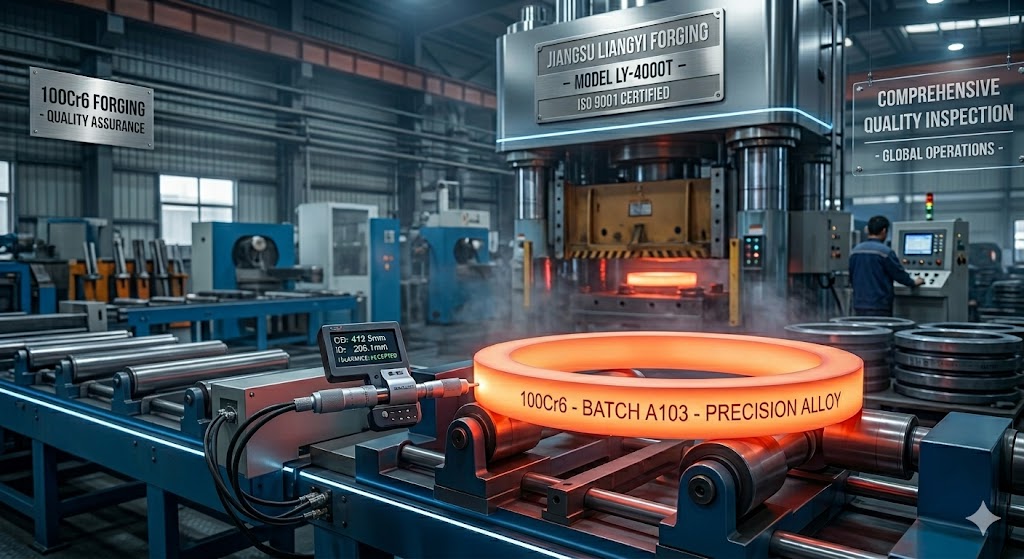
Quality at Jiangsu Liangyi is not a final inspection step — it is a process-integrated system where each production stage generates data that feeds into both the current order and our ongoing process improvement program. Our Quality Assurance department is independent of production management and reports directly to company leadership, ensuring that quality decisions are never compromised by delivery pressure.
In-Process Quality Hold Points
Every 100Cr6 production lot passes through mandatory hold points where production cannot proceed without a Quality Engineer's signoff:
- After EAF tapping: OES chemistry check. If C, Cr, S, or P are outside our internal aim specification, the heat is diverted to LF for re-adjustment before proceeding. Heats that cannot be corrected to aim spec are downgraded to a lower-alloy application — never used as 100Cr6.
- After VD/VOD degassing: Hydrogen verification by inert gas fusion method. Any heat with H > 2.0 ppm is re-degassed before casting.
- After ingot stripping: Visual and dimensional inspection of each ingot. Pipe depth, surface cracks, and shrinkage patterns are evaluated; ingots with defects are cropped to the required discard ratio before charging for forging.
- After forging, before heat treatment: Dimensional check against forging drawing; visual inspection for surface cracks (liquid penetrant on complex shapes); documentation of forge reduction ratio achieved.
- After heat treatment, before machining: Brinell hardness check at minimum 3 locations per piece. For rings: 6 locations around circumference. Any piece outside the hardness specification is rejected and, where feasible, re-heat-treated.
- After final machining, before NDT: Dimensional inspection on CMM with full report. Surface roughness measurement.
- After NDT: Evaluation and disposition of all indications per applicable UT/MT/PT acceptance standard before MTC is issued.
Full Testing Capability — In-House Laboratory
- Chemical Analysis: Optical emission spectrometer (OES) for rapid multi-element analysis including C, Si, Mn, P, S, Cr, Mo, Ni, Cu, Al, V, Ti, Nb, B. X-ray fluorescence (XRF) for cross-verification. Combustion method for carbon and sulfur at low levels. Inert gas fusion for O, N, H at ppm level.
- Mechanical Testing: Room-temperature tensile test (ASTM E8 / ISO 6892-1); elevated-temperature tensile up to 1000°C; Charpy impact -196°C to +200°C (ASTM E23 / ISO 148-1); Brinell, Rockwell (A/B/C/D/E/F scales), Vickers HV5-HV30 hardness; fatigue (rotating bending, push-pull); compression test; drop-weight test.
- Metallographic Analysis: Full optical metallography suite: grain size (ASTM E112 / ISO 643); non-metallic inclusion rating (ASTM E45 / ISO 4967 Method A); carbide network and banding assessment; decarburization depth; microstructure phase identification. SEM (scanning electron microscopy) and EDS (energy dispersive spectroscopy) for inclusion identification and fractographic analysis.
- Non-Destructive Testing (NDT): Ultrasonic testing (UT) by contact method per EN 10228-3 / ASTM A388, phased array UT (PAUT) for complex shapes; magnetic particle testing (MT) per EN 10228-1 / ASTM E709; liquid penetrant testing (PT); radiographic testing (RT) available for specific applications.
- Corrosion Testing: Intergranular corrosion per ASTM G28 Method A/B (for stainless); pitting corrosion per ASTM G48; SSC (sulfide stress cracking) per NACE TM0177 Method A; HIC (hydrogen induced cracking) per NACE TM0284.
- Dimensional Inspection: CMM (coordinate measuring machine) for 3D dimensional verification; laser tracker for large forgings; surface roughness measurement (Ra, Rz); flatness and cylindricity measurement.
Third-party inspection by customer-nominated agencies (SGS, Bureau Veritas, TÜV, Lloyd's Register, LRQA, Intertek, etc.) is accommodated at all hold points. Our factory provides dedicated inspection rooms, full documentation access, and logistical support for third-party inspectors, at no additional charge.
Why Jiangsu Liangyi — What Makes Our 100Cr6 Forgings Different from Competitors
There are many forging manufacturers in China and globally who claim to produce 1.3505 / 100Cr6 parts. After 25 years of supplying to demanding international customers across Europe, North America, the Middle East, and Asia, we have observed what actually differentiates a reliable, premium-quality forging supplier from a low-cost alternative. Here is an honest assessment of what we do differently — and why it matters to your project.
1. Full Process Ownership from Ingot to Finished Part
Many forging shops purchase steel bar stock from a mill and forge it to shape. This approach introduces an unknown variable: the quality of the bar stock, which the forge shop cannot verify beyond a mill certificate. At Jiangsu Liangyi, we melt our own steel in our 60T EAF, control the chemistry through our own LF and VD/VOD units, cast our own ingots, and forge them in our own presses. We know the history of every kilogram of steel that enters a forging because we created that history ourselves. This vertical integration is rare among mid-size Chinese forging manufacturers and is the foundation of our traceability system.
2. ESR Remelting Capability — Available On-Site
ESR (Electroslag Remelting) is widely specified by bearing and tool steel customers but not widely available at the same location as a forging capability. Most customers who need ESR-grade 100Cr6 forgings must either source the ESR ingot from a separate supplier (introducing a traceability gap) or accept a long supply chain. At Jiangsu Liangyi, our on-site ESR plant with capacity up to 32 tons produces ESR ingots that go directly into our own forge furnaces — same site, same quality system, same MTC.
3. Documented Process Parameters, Not Just Test Results
A mill certificate tells you what properties the steel achieved — it does not tell you how those properties were achieved or whether the process was under control throughout production. We generate and retain, for a minimum of 10 years: EAF chemistry records, LF refining records, degassing vacuum and time records, ingot casting records, furnace heating charts (time-temperature) for every heat treatment load, forge press tonnage records, and NDT evaluator certifications. Upon request, we can provide full process documentation packages for critical orders.
4. Technical Engineering Support Before the Order
Our in-house metallurgical engineering team reviews every customer inquiry involving a non-standard specification, a new application, or a complex geometry. We flag potential issues — quench cracking risks, impossible tolerance combinations, specification conflicts between drawing notes and referenced standards — before the order is placed, not after a non-conformance occurs. This pre-order technical review is free of charge and has saved our customers significant rework costs over the years.
5. Flexible Minimum Order Quantities
We understand that R&D projects, prototype builds, and replacement orders often require small quantities. While our optimal production batch is 3-15 tons, we accept orders from as low as 500kg for standard forged bar, and single-piece orders for rings and shafts above 500mm OD. Small orders receive the same process controls and documentation as large production runs — we do not have a "small order" quality tier.
Packaging, Preservation, and Global Logistics for 100Cr6 Forged Parts
The quality of a forged part can be compromised between the factory gate and the customer's incoming inspection if packaging is inadequate. For 1.3505 / 100Cr6 components — which have limited corrosion resistance in bare metal condition — we take packaging seriously as a final quality step.
Standard Packaging Protocol for 100Cr6 Forgings
- Rust prevention: All machined surfaces are coated with solvent-free anti-corrosion oil (VCI-type) immediately after final machining. Precision-bore surfaces receive VCI (Vapor Corrosion Inhibitor) paper wrapping in addition to oil coating.
- Individual part protection: Each part is individually wrapped in polyethylene film and cushioned with foam padding at contact points to prevent surface damage during transit vibration.
- Wooden crating: Parts are secured in ISPM-15 certified heat-treated wooden crates with custom-fitted blocking and bracing. Crate design is reviewed for each shipment to ensure parts cannot shift during ocean freight.
- Marking: Each part and crate is marked with our internal batch number, heat number, material grade, heat treatment condition, weight, customer PO number, and shipment reference — enabling complete incoming traceability at the customer's facility.
Shipping and Lead Time Information
- Port of loading: Shanghai Port (CNSHA) — approximately 2.5 hours from our factory in Jiangyin. We also use Nanjing Port (CNNJG) for bulk orders.
- Typical ocean freight transit time: 20-25 days to Rotterdam or Hamburg; 28-35 days to Houston or Los Angeles; 14-18 days to Dubai.
- Production lead time for standard 100Cr6 forgings: 25-45 days from order confirmation to ready-for-shipment, depending on size and heat treatment condition. ESR-grade orders: 35-55 days.
- Express air freight: Available for urgent small parts (under 300kg) on request. We have established relationships with air freight consolidators for fast export from Shanghai Pudong (PVG).
- Export documentation: We prepare all export documents including commercial invoice, packing list, certificate of origin (CO/Form A), phytosanitary certificate for wood packaging, and fumigation certificate where required. We support LC (Letter of Credit) and T/T payment terms.
Common Mistakes to Avoid When Ordering 1.3505 (100Cr6) Forged Parts from China
After 25 years of international sales experience, our team has seen the same specification and procurement mistakes recur across different customers and industries. We document them here — not to criticize buyers, but because awareness of these issues will save you time, money, and frustration in your next order.
Mistake 1 — Not Specifying the Delivery Condition (Heat Treatment State)
If your purchase order says "1.3505 forged ring, OD 500mm, weight 250kg" without specifying the delivery condition, you may receive a part in the as-forged condition (≈250-320 HB), in spheroidizing annealed condition (170-210 HB), or in fully hardened condition (61-66 HRC) — depending on what the supplier's default practice is. Each condition has completely different machinability and handleability. Always specify: "Delivery condition: spheroidizing annealed per DIN EN ISO 683-17, hardness 170-210 HB" or whichever condition you require.
Mistake 2 — Specifying OD/ID Tolerances Without Considering Machining Allowance
A forged ring with OD 800mm and wall thickness 80mm cannot be delivered with ±0.5mm dimensional tolerance in the as-forged condition — that is a machined part tolerance. Standard forged ring tolerances per EN 10243-1 allow ±8-12mm on OD at this size. If you need ±0.5mm, specify "rough machined to OD +3/-0mm" or "precision machined to drawing" and include your finished-part drawing. Forging tolerances and machining tolerances are completely different categories.
Mistake 3 — Comparing Suppliers Only on Price Without Checking ESR vs. Standard Grade
A standard (non-ESR) 100Cr6 heat typically has 20-30 ppm oxygen. An ESR-grade heat has 8-12 ppm oxygen. In rolling contact fatigue life, this difference translates to a 3-5× increase in L10 life. If one supplier offers standard 100Cr6 rings and another offers ESR-grade, you are not comparing equivalent products. A 20% price difference between these two is not a saving — it is a risk to your end-product's reliability.
Mistake 4 — Not Requesting a Pre-Production Chemistry Review
For critical orders, always request that the supplier share the chemistry of the specific heat intended for your order before casting, so you can verify it is within your specification before the material commits to forging. This pre-cast chemistry review is standard practice in premium forging supply chains and takes less than 24 hours. Suppliers who refuse this step may not have the in-process chemistry control needed to guarantee conformance.
Mistake 5 — Underspecifying the MTC
A generic "EN 10204 3.1 MTC" requirement can be fulfilled with a certificate that lists only the basic chemical composition and hardness. For bearing steel applications, the certificate should also specify: inclusion rating (per ASTM E45 or ISO 4967), oxygen content, UT class achieved, heat treatment temperature and time records, and grain size. If your current MTC does not include these fields, you do not have full visibility of the material quality you are receiving.
Frequently Asked Questions (FAQs) About 1.3505 (100Cr6) Forgings
1.3505 (100Cr6) is rated for continuous service at temperatures up to 120°C when in the quenched + low-temperature tempered condition (150-170°C temper). Short-term peak temperatures should not exceed 170°C — which is why the temper temperature is set at or above the maximum service temperature. If the component operates above its temper temperature, the martensite matrix continues to decompose (over-tempering), causing dimensional growth (due to volume change from martensite to lower-carbon martensite/ferrite), hardness drop, and loss of dimensional stability — effectively catastrophic failure for precision bearing applications. For continuous service above 120°C, we recommend 100CrMo7-3 (1.3537) for up to 150°C, or M50 tool steel (1.3551) for up to 320°C. Contact our technical team for application-specific material selection guidance.
The principal difference is oxygen content and resulting inclusion cleanliness. Standard 100Cr6 (VD/VOD degassed) achieves 15-25 ppm oxygen; ESR-grade achieves 8-12 ppm oxygen. This may sound like a small difference, but its effect on rolling contact fatigue (RCF) life is dramatic: reducing oxygen from 20 ppm to 10 ppm increases L10 bearing life by approximately 3-5× according to the Lundberg-Palmgren fatigue model and experimental data. Specify ESR when: (1) your component will experience rolling or sliding contact stress cycles — bearings, races, rolls; (2) your fatigue life specification is tight; (3) your components are large cross-section (above 150mm) where inclusion density has more exposure time with the contact stress field; (4) your customer or end-use standard specifies ESR or "premium clean" steel. Standard grade is fully adequate for valve bodies, structural shafts, and tooling where rolling contact fatigue is not the primary failure mode. We will recommend ESR when your application warrants it — and advise standard grade when it does not.
Our dimensional capabilities for 1.3505 (100Cr6) forged parts: forged round bars up to 2000mm diameter and 12 meters length; seamless rolled rings up to 6000mm OD, 1500mm height, with minimum wall thickness of 40mm; forged shafts up to 1800mm OD and 15 meters length; forged discs and plates up to 2500mm diameter, 20-800mm thickness. Maximum single-piece weight is 30 tons for all product forms. For rings above 3000mm OD, we recommend an early engineering consultation so we can assess the specific wall thickness and height requirements — ring rolling of very large rings requires specific D/H ratios to maintain process stability. Please submit your drawing for a free feasibility review.
Yes. Our in-house CNC machining workshop handles turning, boring, milling, and grinding operations for forged parts from 10mm to 3000mm OD. Dimensional tolerances: standard CNC turning achieves IT7-IT8 as a routine; IT6 is achievable on smaller diameters with our precision turning centers; grinding to IT5 is available for bore and OD surfaces where specified. Surface finish: standard turning Ra 1.6-3.2μm; finish turning Ra 0.8μm; external cylindrical grinding Ra 0.2-0.4μm; internal grinding Ra 0.4-0.8μm. All machined parts are dimensionally inspected on our CMM with full measurement report included in the documentation package. For high-precision applications, please share your finished-part drawing at the inquiry stage so we can confirm achievability and quote the appropriate machining operations.
We adhere to our “Frozen Process” system. For repeat order customers we maintain a documented manufacturing process specification (MPS) that captures the exact heat chemistry target, forging reduction ratio, furnace heating program, heat treatment parameters and inspection plan used to produce the first approved lot. All subsequent lots are produced to this identical MPS, with any deviation requiring engineering review and customer notification. Additionally, we retain a physical reference sample from the first approved lot for metallographic comparison with subsequent lots. Over our 25-year production history, we have never changed a frozen process specification without customer knowledge and approval. This traceability system allows customers to review the complete process history of any lot we have produced at any time.
100CrMo7-3 (DIN 1.3537) adds about 0.20-0.30% molybdenum to the 100Cr6 composition. In this instance molybdenum fulfills two roles, (1) it significantly improves hardenability so that cross-sections of up to 250-300mm OD can be hardened through compared with around 100-150 mm for standard 100Cr6 and (2) it raises the maximum continuous service temperature to approximately 150°C by stabilizing the carbide structure against over-tempering at elevated temperatures. The choice between grades is straightforward: use 100Cr6 when cross-section is below 150mm and service temperature is below 120°C; consider 100CrMo7-3 when either of these conditions is exceeded. The material cost premium for 1.3537 over 1.3505 is typically 15-25%. We produce 100CrMo7-3 forgings using the same process equipment and quality system as our 100Cr6 production. Contact us with your application details for a specific grade recommendation.
Standard lead times for 1.3505 (100Cr6) Forged Parts: Standard Grade, Spheroidizing Annealed: 25-35 Days Standard Grade, Quenched + Tempered: 35-45 Days ESR Grade (Any Condition): 40-55 Days These times are for melting, forging, heat treatment, machining (if required), NDT, inspection and documentation - from ingot to ready to ship. We maintain a restricted stock of forging blanks of 100Cr6 (round bars 100-500mm OD, rings 300-1000mm OD) in standard sizes for urgent orders, to be machined and heat treated to order in 15-25 days. If you need urgent replacement parts, contact our sales team with your drawing and required date – in many cases we can offer a partial shipment or an accelerated schedule to meet your critical need.
1.3505 (100Cr6) has very poor weldability due to its high carbon content (~1.0%), which gives it a carbon equivalent (CE) of approximately 1.40 — far above the 0.45 CE threshold above which welding is considered difficult and requires extreme precaution. Welding high-CE steel without proper controls creates a hard, brittle heat-affected zone (HAZ) that is highly susceptible to cold cracking (hydrogen-assisted) and to softening if the post-weld heat treatment is not carefully controlled. In general, we advise against welding 100Cr6 components in service. If welding is absolutely required for a specific repair or assembly situation, it must be preceded by full pre-heating to 300-350°C, performed with low-hydrogen electrodes or filler wire, followed immediately by PWHT at the tempering temperature of the base material (minimum 150°C for the hardened condition, or 650°C for the tough condition), and subjected to 100% MT or PT inspection after final cooling. This is specialist work that should only be performed by a qualified welding engineer familiar with high-carbon steel. Contact us if you have a specific weld-repair application — we will provide a detailed technical opinion.
Contact Us for Custom 1.3505 (100Cr6) Forging Parts Quotation
Jiangsu Liangyi can supply customers with premium 1.3505 (100Cr6) forged forging parts at competitive prices, along with complete technical support and reliable on-time delivery. Whether you need standard forged bars and rings or highly complicated custom components with tight tolerances, our engineering and production teams can deliver the solution based on your application needs.
To receive an accurate quotation, please send us: your finished-part drawing (PDF or DWG/STEP), material specification and delivery condition, required quantity per order and anticipated annual volume, required inspection and certification level, and your target delivery date. The more detail you provide, the more precise and competitive our quotation will be.
Inquiry Email: sales@jnmtforgedparts.com
Phone / WhatsApp: +86-13585067993
Official Website: https://www.jnmtforgedparts.com
Factory Address: Chengchang Industry Park, Jiangyin City, Jiangsu Province, China