Product Overview & Manufacturing Capabilities
Established in 1997, Jiangsu Liangyi Co.,Limited is a professional ISO 9001:2015 certified open die forging manufacturer headquartered in Jiangyin City, Jiangsu Province, China. We specialize in the custom production of DIN 1.2327 (86CrMoV7) forging parts — a high-performance cold work alloy tool steel that has become the engineering-preferred choice for cold rolling mill work rolls, straightening rolls, and heavy-duty wear components globally.
Our 80,000 m² integrated manufacturing facility provides the full production chain — from EAF/ESR steel melting , open die forging, heat treatment (including line-frequency induction quenching), to CNC machining and final NDT inspection. This full vertical integration is the foundation that allows us to guarantee consistent material quality, dimensional accuracy, and on-schedule delivery across all order sizes — 30 KGS prototype forgings to 30,000 KGS (30-ton) production parts.
With 25+ years of specialized experience in high-alloy tool steel forging, our engineering team has accumulated deep process knowledge specific to 1.2327 (86CrMoV7) — including optimal forging reduction ratios for this high-carbon grade, prevention of forging cracking during hydrogen expansion annealing, and the precise induction quenching parameters required to achieve the full 15 mm deep hardened layer with 60–62 HRC that defines this material's performance advantage. We serve clients in over 50 countries across metallurgy, automotive, semiconductor, mining, oil & gas, and power generation.
Ready to source 1.2327 (86CrMoV7) forging parts? Send your drawings or specifications — our engineering team responds within 24 hours with a technical review and detailed quotation.
Send Inquiry Now WhatsApp ChatCustom Forging Shapes, Forms & Dimensional Capability
We produce DIN 1.2327 (86CrMoV7) forgings across a comprehensive range of geometries and sizes, each manufactured with strict dimensional tolerance control and full traceability. Main dimensional capabilities include roll barrel diameters up to 700 mm, ring ODs up to 2,500 mm, bar lengths up to 6,000 mm, and single piece weights from 30 KGS to 30,000 KGS. Available forms:
Bars & Profiles
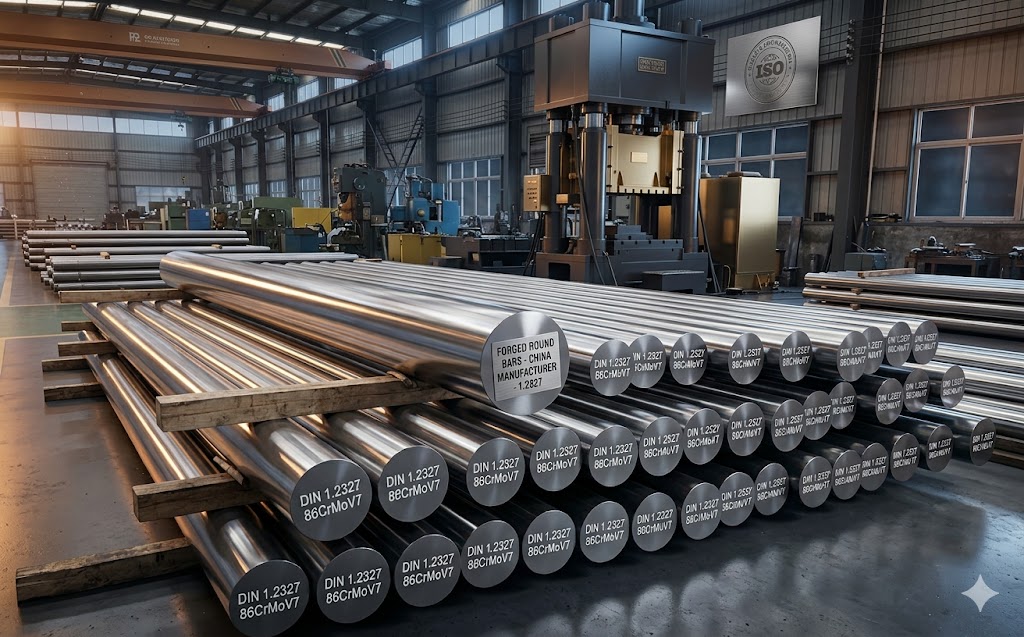
- Forged round bars (Ø30–Ø700 mm)
- Forged square, flat & rectangular bars
- Forged rods & billet sections
- Forged hollow bars (rough-bored)
Rings & Discs
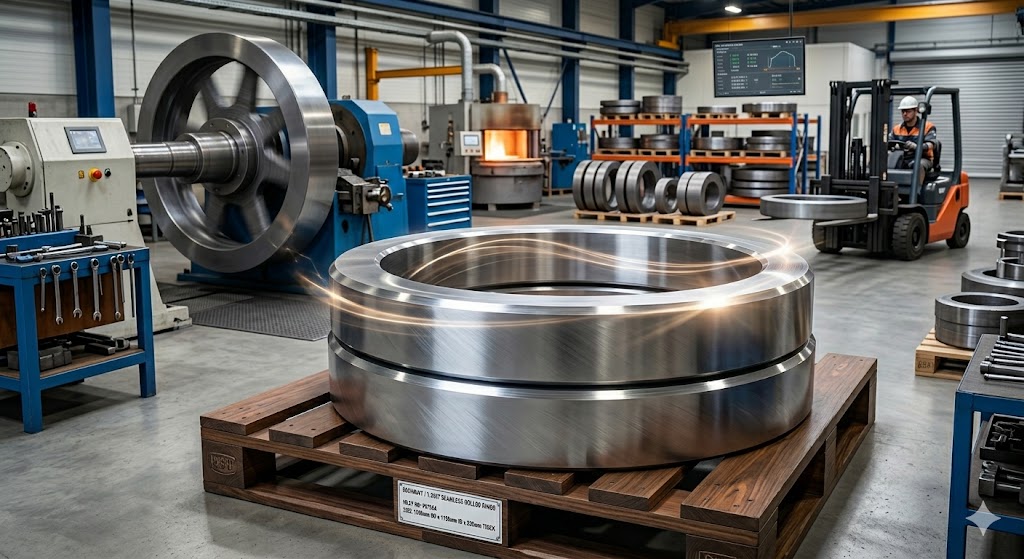
- Seamless rolled rings (OD up to 2,500 mm)
- Contoured & profiled rolled rings
- Forged gear rings & hubs
- Forged discs, blocks & plates
Rolls & Cylinders
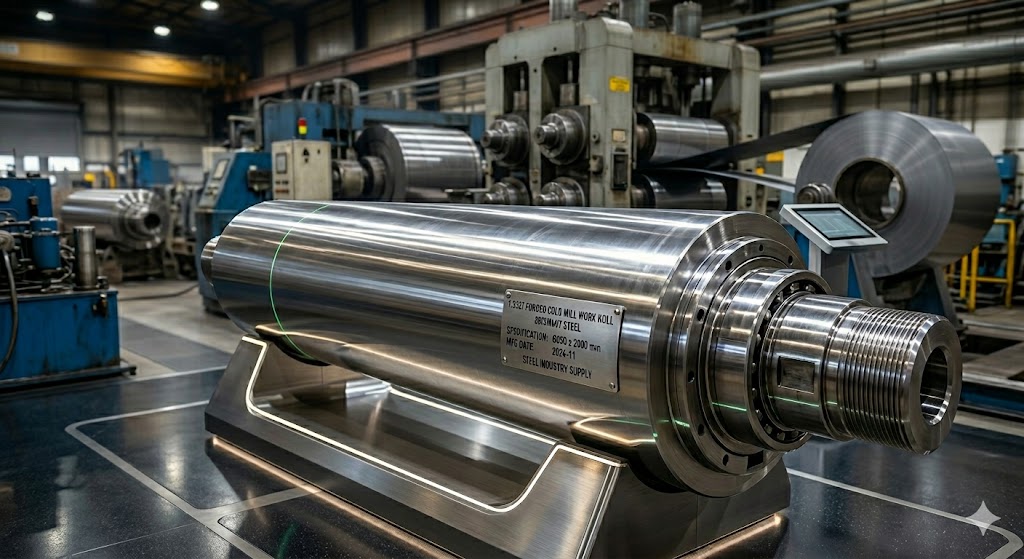
- Cold mill work rolls (barrel Ø up to 700 mm)
- Straightening & levelling rolls
- Back-up rolls & sizing rolls
- Resistance roll sleeves & cylinders
Precision Components
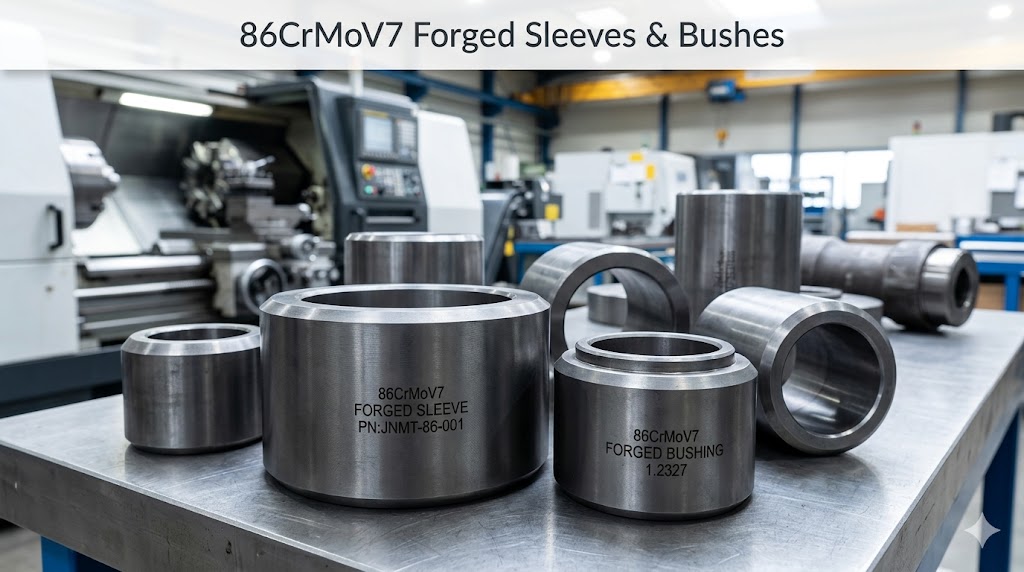
- Forged sleeves, bushes & liners
- Flanges, gear blanks & valve bodies
- Die blocks, punch dies & bending dies
- Custom CNC-machined forging parts
Standard tolerances for rough-machined 1.2327 forgings: diameter tolerance ±2.0 mm; length tolerance ±5.0 mm. Finish-machined parts achieve diameter tolerance h6/h7 (±0.010–0.025 mm), roundness ≤0.01 mm, and cylindricity ≤0.02 mm on precision roll bodies. Tighter tolerances available on request.
Metallurgy Deep Dive: Why Each Alloying Element in 1.2327 (86CrMoV7) Matters
The Critical Interaction: Why the Cr-Mo-V Balance in 1.2327 is Unique
The defining characteristic of 1.2327 (86CrMoV7) is the synergistic balance between its Cr, Mo, and V content, and it is engineered specifically for deep induction hardening capability combined with excellent roll-service toughness. This balance is not shared by other common cold work tool steels:
- Higher-Cr grades (1.2379/D2) cannot achieve deep induction hardening because undissolved primary carbides block austenitization at depth.
- Lower-alloy grades (e.g., 9CrSi) lack sufficient hardenability and red hardness for high-speed cold rolling applications.
- The specific Mo content (0.50–0.60%) in 1.2327 is tuned to provide adequate secondary hardening without over-alloying the matrix, which would reduce the diffusivity needed for rapid induction heating and quenching.
Low Sulfur and Phosphorus: Why It Matters for Forgings
Our 1.2327 material specification targets S ≤0.002% and P ≤0.015% — significantly tighter than many material standards require. This is not arbitrary. In large cross-section forgings (particularly cold mill work rolls), sulfur forms MnS inclusions that act as stress concentrators during both forging and service. Even small MnS stringers oriented transverse to the roll barrel can initiate subsurface fatigue cracks under the Hertzian contact stresses of cold rolling. Our ultra-low S specification, achieved through EAF+LF+VD or ESR processing, reduces inclusion density to a level where roll spalling from inclusion-initiated fatigue is effectively eliminated. Similarly, ultra-low P prevents grain boundary embrittlement that would otherwise manifest as brittle fracture during roll handling or in service under impact loads.
Engineering Insight from 25 Years of 1.2327 Production: The most common quality failure we observe in 1.2327 forgings sourced from less-experienced suppliers is insufficient ESR quality control — specifically, uneven slag composition during remelting that creates banding in the ingot structure. This banding survives forging and produces a circumferential variation in hardness of ±3–5 HRC across the roll barrel after induction quenching — far outside the ≤±1.5 HRC specification required for precision cold rolling. Our ESR process uses precisely formulated, temperature-controlled slag chemistries specific to 1.2327 to ensure ingot homogeneity from top to bottom.
Standard Chemical Composition (DIN 1.2327 / 86CrMoV7)
All 1.2327 (86CrMoV7) forging materials produced at Jiangsu Liangyi Co.,Limited are spectrometrically verified for each heat, with composition reports available as part of the EN 10204 3.1/3.2 Mill Test Certificate. The target composition meets or exceeds DIN EN requirements, with our internal tighter limits applied to S and P for large-section forging quality:
Quick Reference — 1.2327 (86CrMoV7) Main Elements:
C: 0.82–0.93% | Cr: 2.80–3.60% | Mo: 0.50–0.60% | V: 0.05–0.10%
Si: 0.40–0.70% | Mn: 0.40–0.70% | S: ≤0.002% | P: ≤0.015%
| Element | Symbol | DIN Standard Range | Our Internal Spec | Metallurgical Role |
|---|---|---|---|---|
| Carbon | C | 0.82–0.93% | 0.83–0.92% | Primary hardness & martensite formation |
| Silicon | Si | 0.40–0.70% | 0.40–0.65% | Deoxidation; solid-solution strengthening |
| Manganese | Mn | 0.40–0.70% | 0.40–0.65% | Hardenability; deoxidation; sulfide morphology control |
| Phosphorus | P | ≤0.030% | ≤0.015% | Grain boundary embrittlement — minimized |
| Sulfur | S | ≤0.005% | ≤0.002% | Inclusion formation — ultra-minimized for roll quality |
| Chromium | Cr | 2.80–3.60% | 2.90–3.50% | Deep hardenability; carbide former; wear resistance |
| Molybdenum | Mo | 0.50–0.60% | 0.50–0.60% | Temper resistance; secondary hardness; anti-embrittlement |
| Vanadium | V | 0.05–0.10% | 0.05–0.10% | Austenite grain refinement; fine carbide stability |
| Nickel | Ni | ≤0.20% | ≤0.02% | Residual — controlled low |
| Aluminum | Al | 0.001–0.009% | 0.001–0.008% | Fine-grained deoxidation control |
| Titanium | Ti | ≤0.0050% | ≤0.0030% | Residual — controlled low to prevent TiN inclusion formation |
* Our internal specification tightens DIN standard limits on P, S, Ni, and Ti — particularly important for large-section forgings and cold mill roll applications where inclusion content directly affects fatigue life.
International Grade Cross-Reference: DIN 1.2327 Equivalents
DIN 1.2327 (86CrMoV7) is a DIN-originating designation. When sourcing from international standards, buyers should note that no exact equivalent exists in AISI/ASTM or JIS systems — this is a DIN-specific cold work tool steel. The closest cross-references and their relationship to 1.2327 are as follows:
| Standard | Designation | Composition Similarity | Remarks |
|---|---|---|---|
| DIN / EN | 1.2327 / 86CrMoV7 | Reference grade | Primary designation for this article |
| EN | X85CrMoV3-3 | Very close (≈95%) | EN closest equivalent; nearly identical composition and properties |
| AISI / ASTM | No direct equivalent | — | AISI A2 (1.2363) is a rough equivalent but differs in Cr and C content; not interchangeable without engineering review |
| GB (China) | 8Cr3MoV | Close (≈90%) | Chinese national standard equivalent; verify S/P limits independently for roll applications |
| JIS (Japan) | SKS93 (approximate) | Partial | JIS system lacks a direct equivalent; SKS93 is lower alloy; specify by composition for JIS sourcing |
| GOST (Russia) | 8X3 (approximate) | Partial | Approximate — Cr content differs; specify full composition for GOST procurement |
Procurement Note: When specifying 1.2327 (86CrMoV7) forgings internationally, always provide the full chemical composition table (as in Table 1 above) in your purchase specification, rather than relying on grade designation alone. This avoids ambiguity between standards systems and guarantees the correct alloy is produced.
Grade Comparison: When to Choose 1.2327 vs. Other Cold Work Tool Steels
Choosing between cold work tool steel grades needs understanding both the mechanical performance differences and the manufacturing implications. The following comparison — drawn from our engineering experience producing all these grades — addresses the key decision factors engineers face when specifying large-section cold work tool steel forgings:
| Property / Factor | 1.2327 (86CrMoV7) | 1.2379 (D2/X153CrMoV12) | 1.2080 (D3/X210Cr12) | 1.2344 (H13) | 1.2363 (A2) |
|---|---|---|---|---|---|
| C Content | 0.82–0.93% | 1.45–1.60% | 2.00–2.20% | 0.35–0.42% | 0.95–1.05% |
| Cr Content | 2.80–3.60% | 11.0–13.0% | 11.0–13.0% | 4.80–5.50% | 4.75–5.50% |
| Induction Hardening Depth | 15 mm (Excellent) | 3–5 mm (Limited) | 2–4 mm (Poor) | 8–12 mm (Good) | 6–10 mm (Good) |
| Surface Hardness (HRC) | 60–62 | 58–62 | 62–65 | 48–54 | 57–62 |
| Abrasion Wear Resistance | Good | Excellent | Excellent | Moderate | Good |
| Impact Toughness | Good–Excellent | Moderate | Low | Excellent | Good |
| Red Hardness | Good (≤400°C) | Good (≤450°C) | Moderate | Excellent (≤600°C) | Good (≤425°C) |
| Dimensional Stability | Excellent (post Q&T) | Excellent | Moderate | Good | Excellent |
| Large Forging Machinability | Good (post anneal) | Moderate | Difficult | Good | Good |
| Typical Application | Cold mill work rolls, straightening rolls, large die blocks | Blanking dies, precision punches, shear blades | Drawing dies, deep-draw tooling | Hot forging dies, die casting dies | Precision cold work dies, gauges |
The Main Choice Rule: Induction Hardening Depth Drives the Choice
The single most important advantage of 1.2327 over other cold work tool steels for large-format roll applications is its uniquely deep induction-hardenable layer. A 700 mm diameter cold mill work roll needs its working surface — and 15 mm below it — to keep 60+ HRC throughout its lifetime, including multiple re-grindings. High-chromium grades like 1.2379 (D2) cannot achieve this: their abundant primary carbides (which provide wear resistance in thin-section tooling) resist dissolution during the rapid induction heating cycle, preventing martensite formation below the immediate surface layer. 1.2327's lower, balanced Cr content allows complete carbide dissolution to 15+ mm depth during induction austenitization, enabling the full hardened layer that defines roll service life.
When 1.2327 is NOT the Right Choice
With 25+ years of engineering experience, we advise our clients honestly: 1.2327 is the optimal choice for deep induction-hardened rolls and large die forgings. However, it is not the best choice for thin-section blanking dies needing maximum abrasion resistance (where 1.2379 excels), nor for hot die applications above 400°C service temperature (where 1.2344/H13 is preferred). Selecting 1.2327 for these applications would underperform competing grades. Our engineering team will always provide grade recommendations aligned with your specific application requirements — not simply sell you what we make.
Customizable Melting Process Options
The melting and refining process is the foundation of 1.2327 forging quality. Different application requirements demand different levels of steel cleanliness, homogeneity, and inclusion control. We offer five melting routes for 1.2327 (86CrMoV7), selected based on the client's application criticality, size, and budget:
| Melting Route | Process Steps | Inclusion Level | Typical Application |
|---|---|---|---|
| EAF | Electric Arc Furnace | Standard | General structural forgings, non-critical parts |
| EAF+LF+VD | EAF + Ladle Refining + Vacuum Degassing | Good | Medium-section forgings; die blocks; standard industrial rolls |
| EAF+ESR | EAF + Electro Slag Remelting | Excellent | Cold mill work rolls; large critical forgings; rolls needing ≤±1.5 HRC uniformity |
| EAF+PESR | EAF + Protective Atmosphere ESR | Superior | High-precision rolls; semiconductor equipment parts; oxidation-sensitive applications |
| VIM+PESR | Vacuum Induction Melting + Protective Atmosphere ESR | Ultra-clean | Aerospace-grade parts; highest-purity, most important applications |
For cold mill work rolls (our most common 1.2327 application), we standardly recommend EAF+ESR as the optimal balance of steel cleanliness, composition control, and cost. The ESR process eliminates macro-segregation in the ingot, reduces non-metallic inclusions by 60–80% versus EAF-only steel, and produces the directionally solidified, homogeneous ingot matrix that is essential for achieving ≤±1.5 HRC hardness uniformity across large roll barrels after induction quenching.
Forging Engineering & Process Control for 1.2327 (86CrMoV7)
1.2327 (86CrMoV7) is a high-carbon, high-alloy grade that requires more careful process control during forging than lower-alloy steels. Incorrect forging practice leads to surface cracking, internal voids, segregation banding, and coarse grain matrices that degrade the final mechanical properties. The following describes our validated forging engineering approach for this specific grade:
Forging Temperature Window
The forging temperature range for 1.2327 (86CrMoV7) is more restrictive than common engineering steels. Our validated forging window is 1,050–1,180°C for initial breakdown and 950–1,050°C for finish forging. Above 1,180°C, rapid grain coarsening occurs that cannot be fully recovered by subsequent heat treatment. Below 950°C, the partially transformed microstructure becomes brittle and surface cracking is likely — particularly dangerous for high-carbon material. All forging heats are carefully monitored with calibrated infrared pyrometers, and any piece falling below the minimum temperature is returned to the furnace before continuing forging.
Forging Ratio: The Foundation of Wrought Properties
For 1.2327 cold mill work rolls and critical parts, we apply a minimum forging ratio of 5:1, typically achieving 6:1 to 8:1 for roll body forgings. This ratio quantifies the cross-sectional reduction from ingot to final forging. At ratios below 4:1, the as-cast dendritic structure of the ESR ingot is incompletely broken down, leaving residual segregation bands and unclosed internal voids that will propagate as fatigue cracks during roll service. At ≥5:1, the grain matrix is fully recrystallized, internal voids are pressure-welded shut by the compressive forging forces, and mechanical properties become isotropic — consistent in all directions — with consistent tensile strength and toughness throughout the cross-section.
Multi-Heat Forging for Large Cross-Sections
For 1.2327 forgings exceeding 400 mm diameter or 5,000 KGS, we implement a multi-heat forging sequence: the ingot is forged in successive heats with intermediate furnace reheats to ensure that the core of the forging is processed at adequate temperature for complete grain refinement. Single-heat forging of large sections produces a temperature gradient from surface to core, resulting in inconsistent microstructure and hardness variation after heat treatment. Our multi-heat approach adds production time but is non-negotiable for roll quality. All forging sequences are documented and traceable in the production record accompanying each order.
Common Quality Risk with 1.2327 Forgings: The most frequently encountered defect in poorly produced 1.2327 forgings is hydrogen-induced delayed cracking — internal cracks that form hours to days after forging due to residual hydrogen absorbed from furnace atmosphere during heating. At Jiangsu Liangyi, every 1.2327 forging goes through immediate hydrogen expansion annealing after the final forging heat, before the forging cools to room temperature. This controlled slow-cooling and soaking cycle degasses the material and deletes hydrogen cracking risk. Suppliers who skip or shorten this step deliver forgings that may appear sound but will crack in service — a costly failure for your customers.
Professional Heat Treatment Specifications for 1.2327 (86CrMoV7)
Heat treatment is where 1.2327 (86CrMoV7) delivers its performance advantage — or fails to, if poorly controlled. Our in-house heat treatment department has computer-controlled furnaces that use type-K thermocouples to check the temperature and automatically control the atmosphere. We use four different heat treatment methods on 1.2327, each with a specific metallurgical goal:
Hydrogen Expansion Annealing (Post-Forging, Mandatory)
Performed immediately after the final forging heat, before cooling to room temperature. The forging is charged into a furnace at ≥400°C (no cold charging), heated to 880–920°C, held for 2–4 hours (based on section thickness, 1 hour per 100 mm), then furnace-cooled in stages through a hold at 700–740°C for carbide precipitation, then furnace-cooled to ≤400°C, and finally air-cooled to room temperature.
Metallurgical purpose: Deletes dissolved hydrogen (the primary cause of delayed cracking in high-carbon forgings), reduces forging residual stresses, and produces a primary annealed microstructure suitable for UT inspection.
Temperature: 880–920°C → 700–740°C → ≤400°CSpheroidizing Annealing (Pre-Machining)
After UT inspection confirms internal soundness, spheroidizing annealing transforms the lamellar pearlite microstructure from hydrogen annealing into a globular (spheroidal) carbide structure, reducing hardness to typically 220–250 HBW for optimal CNC machineability. Process: heat to 850–880°C, hold, cool to 700–740°C, hold to allow carbide spheroidization, furnace-cool to ≤400°C, air-cool.
Metallurgical purpose: Achieves minimum hardness for machining while keeping carbide homogeneity. Poorly spheroidized microstructures (lamellar carbides) cause excessive tool wear during rough machining and produce rough ground surfaces that need additional material removal.
Target Hardness: 220–250 HBW after annealingQuenching & Tempering — For Structural / Die Applications
For 1.2327 forgings used in structural, die block, or through-hardened applications (rather than surface-induction-hardened roll applications), conventional oil quench-and-temper is applied: austenitize at 890–910°C, oil quench, then high-temperature temper at 630–650°C to achieve a tempered martensite/bainite microstructure with balanced hardness and toughness.
Achieved properties: Tensile Strength 785–980 N/mm², Yield Strength ≥590 N/mm², Elongation ≥13%, Hardness 240–290 HBW. Ideal for large die blocks where through-hardness uniformity matters more than maximum surface hardness.
Quench: 890–910°C oil | Temper: 630–650°CFinal Induction Quenching & Low-Temperature Tempering — For Work Rolls
This is the defining heat treatment that makes 1.2327 the preferred work roll material. The rough-machined roll is precision-inductively heated on a CNC induction hardening machine at 960–980°C using line-frequency (50/60 Hz) induction coils that penetrate deeper into the workpiece than high-frequency systems, enabling the 15 mm deep hardened layer. The roll is continuously rotated during induction heating for circumferential uniformity, then immediately quenched with precision temperature-controlled polymer quench. Low-temperature tempering at 200–250°C within 2 hours of quenching relieves quench stress while preserving maximum hardness.
Achieved properties: Surface Hardness 60–62 HRC, Hardness at 15 mm depth ≥55 HRC, Hardness Uniformity ≤±1.5 HRC (circumferential and axial). This uniformity specification requires precise quench flow control — we use computer-controlled quench flow maps specific to each roll diameter.
Induction Quench: 960–980°C | Temper: 200–250°C | Result: 60–62 HRC @ 15mmVerified Mechanical Properties of 1.2327 (86CrMoV7) Forgings
The following mechanical properties are verified per heat on production test coupons machined from the same forging, with full traceability to the EN 10204 3.1/3.2 Mill Test Certificate. Properties vary by heat treatment route:
| Property | Spheroidized Annealed | Q&T (630–650°C Temper) | Induction Quenched (Surface) | Test Method |
|---|---|---|---|---|
| Surface Hardness | 220–250 HBW | 240–290 HBW | 60–62 HRC | EN ISO 6506 / EN ISO 6508 |
| Hardness at 15 mm Depth | — | Similar to surface | ≥55 HRC | Multi-point step grinding |
| Hardness Uniformity | ±5 HBW | ±10 HBW | ≤±1.5 HRC | 8-point circumferential test |
| Tensile Strength (Rm) | — | 785–980 N/mm² | — | EN ISO 6892-1 |
| Yield Strength (Rp0.2) | — | ≥590 N/mm² | — | EN ISO 6892-1 |
| Elongation (A5) | — | ≥13% | — | EN ISO 6892-1 |
| Impact Energy (KV2) | — | ≥35 J (at 20°C) | — | EN ISO 148-1 (Charpy V) |
| Grain Size | ASTM 6–8 | ASTM 7–9 | ASTM 8–10 | ASTM E112 |
Main Performance Benchmark: After induction quenching, 1.2327 (86CrMoV7) achieves 60–62 HRC surface hardness with a 15 mm uniform hardened layer — the deepest achievable by induction quenching among cold work tool steels. Hardness deviation across the full roll barrel is controlled to ≤±1.5 HRC, guaranteeing consistent rolling force distribution and uniform wear across the working surface life.
Surface Finishing & Grinding Requirements for 1.2327 Work Rolls
Precision grinding of 1.2327 (86CrMoV7) induction-hardened work rolls is a technically demanding final operation that directly determines roll performance in service. Incorrect grinding practice can destroy the heat treatment result even after perfectly executed induction quenching. This section — based on our production experience — covers the critical parameters that differentiate correctly ground 1.2327 rolls from grinding failures:
Why Grinding Burns are the Primary Risk for 1.2327 Rolls
1.2327 steel at 60–62 HRC has low thermal conductivity. During aggressive grinding, heat generated at the wheel-workpiece interface cannot dissipate quickly enough, causing localized surface heating above the martensite-to-austenite transformation temperature (Ac1 ≈ 760°C for this composition). This causes three levels of damage: (1) Temper burn : The surface zone was re-tempered to ≤55 HRC, which made it look straw-yellow; (2) Re-hardening burn: The surface zone was austenitized and re-quenched to untempered martensite, which made a brittle white layer with tensile residual stresses; (3) Grinding cracks: Tensile thermal stresses from rapid cooling that were stronger than the material strength made a network of surface cracks at ±45° to the grinding direction.
Our Grinding Process Controls for 1.2327
- Wheel specification: Vitrified-bond, white aluminum oxide wheels (WA 46-60 K-L, 5V), with certified grinding wheel balancing before each roll grinding session.
- Cutting parameters: Depth of cut ≤0.005 mm/pass during finishing; wheel speed 25–35 m/s; workpiece (roll) rotation speed to keep peripheral roll speed 15–25 m/min.
- Coolant: Water-soluble synthetic coolant at ≥20 L/min flood delivery directly at the wheel-workpiece contact zone; coolant temperature ≤25°C, monitored continuously.
- Stock removal: Maximum 0.3 mm/pass during rough grinding, then 0.05 mm/pass for finish grinding; minimum 0.5 mm total stock to get rid of any induction quench surface oxide layer.
- Thermal inspection: Every 0.5 mm of stock removal during finish grinding, a Barkhausen noise analysis is done to find grinding burn before it gets too deep.
Achievable Surface Finish and Dimensional Accuracy
| Parameter | Standard Finish Grinding | Precision Finish (upon request) |
|---|---|---|
| Surface Roughness (Ra) | Ra ≤0.4 μm | Ra ≤0.1 μm |
| Barrel Diameter Tolerance | ±0.020 mm | ±0.005 mm (h5) |
| Roundness | ≤0.015 mm | ≤0.005 mm |
| Cylindricity | ≤0.025 mm | ≤0.010 mm |
| Surface Residual Stress | Compressive (≥−200 MPa) | Compressive (≥−400 MPa, verified by XRD) |
* Compressive residual stresses at the roll surface are beneficial — they counteract the tensile Hertzian contact stresses during cold rolling, extending fatigue life. Grinding burns reverse this to tensile residual stress, which accelerates fatigue crack initiation.
Rigorous Quality Inspection System
Every batch of 1.2327 (86CrMoV7) forging parts produced at Jiangsu Liangyi is given a full, multi-stage inspection protocol. Our quality system is certified to ISO 9001:2015, with full traceability from raw material heat number through to finished product shipment. Our inspection program goes beyond standard requirements — we inspect what matters for roll and forging performance, not just what is needed by specification:
| Inspection Item | Method / Standard | Acceptance Criterion | Stage |
|---|---|---|---|
| Chemical Composition | OES Spectral Analysis | Per DIN 1.2327 / our internal spec | Incoming + per heat |
| Macrostructure | Sulfur print / acid etch (EN 10243) | Class 1 per EN 10243 | Post-forging |
| Ultrasonic Testing (UT) | Manual UT, EN 10228-3 | Level E4 (no reflectors >Ø3 mm) | Post-anneal; post-rough machining |
| Magnetic Particle Inspection | MPI, EN 10228-1 | No linear indications >2 mm | Post-finish machining |
| Hardness Testing | Rockwell C (HRC); 8-point circumferential | 60–62 HRC; uniformity ≤±1.5 HRC | Post-induction quench |
| Hardness Depth Profile | Step grinding + HRC test | ≥55 HRC at 15 mm depth | Test coupon per heat |
| Tensile & Yield Strength | EN ISO 6892-1 | Rm 785–980 N/mm²; Rp0.2 ≥590 N/mm² | Per heat (Q&T route) |
| Impact Energy | EN ISO 148-1 (Charpy V) | ≥35 J at 20°C (Q&T route) | Per heat |
| Grain Size | ASTM E112 (metallographic) | ASTM 7–10 | Per heat |
| Inclusion Rating | ASTM E45 / EN 10247 | Thin series ≤1.5; Thick series ≤1.0 | Per heat (ESR route) |
| Dimensional Inspection | CMM / calibrated instruments | Per drawing ±tolerance | Final machined |
| Surface Roughness | Profilometer (Ra) | Ra ≤0.4 μm (standard); ≤0.1 μm (precision) | Post-grinding |
| Grinding Burn Detection | Barkhausen noise analysis; Nital etch check | No indication of thermal damage | Post-grinding |
All test results are compiled in the EN 10204 3.1/3.2 Mill Test Certificate issued for each order. Third-party inspection by SGS, TÜV, Bureau Veritas, DNV, or Intertek is available at the client's request and cost. Our quality records are retained for a minimum of 10 years, enabling full traceability for warranty and liability purposes.
Need a technically qualified 1.2327 (86CrMoV7) forging supplier for your important rolling mill or tooling project? Contact us for a free technical consultation and quotation.
Contact Our Engineers Email InquiryTypical Industry Applications & Global Project Cases
The combination of deep induction-hardenability, balanced toughness, and controlled alloy composition makes 1.2327 (86CrMoV7) the material of choice across a specific set of demanding industrial applications. The following cases are representative of our actual production experience over 25+ years — not marketing examples, but real engineering challenges solved with 1.2327 forgings:
Cold Rolling Mill Work Rolls — Metallurgical Industry (Primary Application)
Our most significant 1.2327 application volume is cold mill work rolls for flat product cold rolling. We supply rolls with barrel diameters from 100 mm to 700 mm and barrel lengths from 800 mm to 2,800 mm to steel mills and aluminum mills in Europe (Germany, Italy, Spain, Czech Republic), Southeast Asia (Vietnam, Thailand, Indonesia), the Middle East (Saudi Arabia, UAE, Iran), and South America (Brazil, Argentina). A typical cold mill work roll project for a European 5-stand tandem cold mill involves:
- Material: 1.2327 via EAF+ESR route with S ≤0.002%
- Forging: Minimum 6:1 reduction ratio, multi-heat to guarantee through-section grain refinement
- Induction quench: 60–62 HRC, ≤±1.5 HRC across 1,800 mm barrel length
- Final grinding: Ra ≤0.2 μm barrel, cylindricity ≤0.015 mm, journal roundness ≤0.005 mm
- Documentation: EN 10204 3.2 MTC signed by third-party inspector
Client feedback and field data from rolling mill operators indicate meaningful service life improvements compared with rolls produced from EAF-only (non-ESR) material, attributable specifically to the improved hardened layer depth uniformity achieved through our ESR + precision induction quenching process. The specific improvement magnitude varies by mill type, rolling schedule, and coolant conditions.
Straightening Rolls & Sizing Rolls — Tube & Pipe Industry
Seamless and welded pipe manufacturers in the Middle East, Germany, and South Korea specify 1.2327 for straightening roll sets because of its ability to keep consistent surface hardness through dozens of regrinding cycles. A 700 mm diameter straightening roll — ground 0.5–1.0 mm per regrind cycle — requires that the full 15 mm hardened layer remain intact through at least 15 regrind cycles, providing a total effective working life of 10–12 mm of usable hard layer after minimum diameter constraints are reached. No other cold work tool steel routinely achieves this combination of depth, hardness, and toughness.
Automotive Hot Forging Die Blocks
North American and European automotive tier-1 suppliers specify 1.2327 (86CrMoV7) for forging die blocks used in hot forging of suspension parts, crankshafts, and connecting rods at temperatures up to 350–400°C. In this application, the Q&T heat treatment route is used (not induction quench), delivering 240–290 HBW core hardness with uniform hardness through large block cross-sections (500 × 500 × 400 mm is common). The Mo content (0.50–0.60%) provides critical temper resistance — these dies undergo thermal cycling from room temperature to 400°C with every forging stroke, and any decrease in matrix hardness would cause rapid impression wear. Our Q&T-processed 1.2327 die blocks have demonstrated meaningful service life advantages over lower-alloy grades in clients' production applications — contact us for reference data relevant to your specific die geometry and forging conditions.
Semiconductor Equipment Components — High-Temperature Precision Parts
European and Taiwanese semiconductor equipment OEMs source 1.2327 forged resistance roll sleeves and furnace fixture parts from us for high-temperature wafer processing environments (up to 350°C process temperature). The requirements here differ from roll applications: the priority is dimensional stability under thermal cycling (no measurable permanent deformation), combined with surface hardness sufficient to resist abrasion from wafer handling and transport. Our Q&T-processed 1.2327 forgings meet semiconductor cleanliness requirements (low non-metallic inclusion content from ESR) and achieve the dimensional stability requirements through our stress-relief aging process applied after finish machining.
Mining & Heavy Machinery Wear Parts
Mining equipment manufacturers in Australia, Chile, and South Africa specify 1.2327 forged bushings, shafts, and crusher wear parts where surface hardness and impact toughness must coexist — a combination that pure high-hardness wear steels (like D3/1.2080) cannot provide. The 0.05–0.10% V in 1.2327 provides the fine-grained microstructure needed for ductile-mode energy absorption under repeated high-energy impact loads from rock crushing, while the induction-hardened surface layer resists abrasive wear from ore particles. Typical components weigh 200–2,000 KGS per piece.
Oil & Gas & Power Generation Components
We supply custom 1.2327 (86CrMoV7) forged parts for oil and gas equipment manufacturers and power generation projects. These parts are used for valve body forgings, mandrel-type parts, flanges, and structural parts that require high strength combined with good toughness. These projects typically need full EN 10204 3.2 MTC with third-party inspector witness (arranged by the client through agencies such as TÜV, Bureau Veritas, or SGS), and comprehensive NDT including UT, MPI, and dye penetrant testing. We also produce 1.2327 turbine shaft and structural forgings for Asian thermal power plant projects, where the material's combination of high tensile strength (785–980 N/mm²) and tempering resistance to 400°C meets intermediate-pressure service requirements. Note: Jiangsu Liangyi Co.,Limited holds ISO 9001:2015 quality management certification. Compliance with any customer-specified product standards (such as API, ASME, or PED) is the responsibility of the end-equipment manufacturer; we produce to your drawing and material specification and provide full material traceability documentation. View our project portfolio at our Reference page.
Buyer's Procurement Guide: How to Specify and Source 1.2327 (86CrMoV7) Forgings Correctly
Sourcing 1.2327 (86CrMoV7) forgings — especially large-section work rolls and die blocks — involves more specification complexity than most commodity steel procurement. Based on our experience supporting procurement teams at rolling mills, die shops, and engineering companies globally, the following guidance helps buyers avoid the most common and costly mistakes:
1. Always Specify by Full Composition, Not Grade Name Alone
Because 1.2327 lacks a direct equivalent in AISI/ASTM, JIS, or GOST, specifying "1.2327 steel" on a purchase order is ambiguous unless accompanied by the full composition table. Always include Table 1 (above) in your RFQ or purchase specification. Specify your tighter internal limits for S and P if roll quality is required (S ≤0.002%, P ≤0.015%).
2. Define the Melting Route in Your Specification
For cold mill work rolls ≥200 mm diameter, specify EAF+ESR minimum melting route. For rolls ≥500 mm diameter or operating in tandem mills, consider specifying EAF+PESR. ESR produces the ingot homogeneity needed to achieve ≤±1.5 HRC hardness uniformity after induction quenching — EAF-only material cannot consistently achieve this for large cross-sections. Include the melting route requirement in your MTC specification.
3. Specify the Forging Ratio
Request a minimum forging ratio of 5:1, with 6:1 preferred for roll applications. Ask your supplier to include the actual forging ratio achieved in the production record accompanying the MTC. Suppliers who cannot state the forging ratio typically do not track it — a red flag for process control maturity.
4. Specify Hardness Uniformity as a Pass/Fail Criterion
The hardness uniformity specification (≤±1.5 HRC circumferential variation) should be an important requirement in the contract, not just a suggestion. Specify the test method: measuring the hardness of the roll at eight points around the barrel, with the results recorded in the MTC. Request the actual measured values — not just a conformance statement.
5. Third-Party Inspection for Critical Applications
For cold mill work rolls supplying ≥5-stand tandem mills, or for components destined for regulated end applications (oil & gas equipment, pressure vessels), specify third-party inspection (SGS, TÜV, Bureau Veritas, or equivalent). The inspector should witness hardness testing, UT, and dimensional inspection at minimum. The additional cost (typically 0.5–2% of forging value) is insignificant compared to the cost of a failed roll causing mill downtime or product scrap.
RFQ Checklist for 1.2327 (86CrMoV7) Forgings
- Full specification of chemical composition (with tight S ≤0.002%, P ≤0.015% for rolls)
- Specify melting route (EAF+ESR minimum for critical applications)
- Specify forging ratio (≥5:1 minimum)
- Specify heat treatment route and target hardness (induction quench 60–62 HRC / Q&T 240–290 HBW)
- Hardness uniformity: ≤±1.5 HRC circumferential as pass/fail criterion
- NDT requirements (UT per EN 10228-3 level E4; MPI per EN 10228-1)
- Specify MTC type : EN 10204 3.1 (inspection by manufacturer) or 3.2 (witnessed by third party)
- Dimensional tolerances on drawing with GD&T callouts for critical features
- Packaging specification (steel cradle for rolls ≥500 KGS; corrosion protection for sea freight)
- Lead time and delivery terms (Incoterms 2020: FOB/CIF/DAP)
Frequently Asked Questions (FAQ)
DIN 1.2327, also known as 86CrMoV7, is a cold work alloy tool steel made of high-carbon chromium-molybdenum-vanadium. It is made to be very hard at deep induction. The main difference between this steel and other cold work tool steels is that it can get a 15 mm deep hardened layer at 60–62 HRC after line-frequency induction quenching. This is much deeper than high-chromium grades like 1.2379 (D2), which can only get a 3–5 mm hardened depth because primary carbides that don't dissolve block the formation of austenite at depth.
The minimum order quantity (MOQ) is 30 KGS per piece. We can handle both small orders of one sample and large orders for mass production. Pricing is based on the project's material grade (ESR vs EAF route), piece weight and geometry complexity, heat treatment route, machining needs, inspection level (3.1 vs 3.2 MTC, third-party witness), quantity, and delivery time.We price in USD. FOB Jiangyin is our standard delivery term; CIF, DAP, DDP available. Request a quotation at sales@jnmtforgedparts.com with your drawing, quantity, required material spec, heat treatment requirement, and MTC type — we respond with a detailed, itemized quotation within 24 business hours.
Inquiry & Customization Support
Jiangsu Liangyi Co.,Limited is committed to being more than a forging supplier — we aim to be the long-term metallurgical and manufacturing partner for our clients' most challenging 1.2327 (86CrMoV7) projects. Our engineering and sales team combines decades of practical experience in 1.2327 material metallurgy, forging process engineering, heat treatment, and precision machining, and can provide genuine technical support — not just a price quote — for your most demanding forging requirements.
Whether you are sourcing your first prototype roll, scaling up to production volumes, or seeking a qualified second source for existing 1.2327 parts, we welcome your inquiry. Our response commitment: technical review and quotation within 24 business hours of receiving your complete drawings and specifications.
Inquiry Email: sales@jnmtforgedparts.com
Phone / WhatsApp: +86-13585067993
Official Website: https://www.jnmtforgedparts.com
Factory Address: Chengchang Industry Park, Jiangyin City, Jiangsu Province, China 214400
Business Hours: Monday–Friday, 08:00–17:30 CST (UTC+8)
Explore our full product range: All Forged Steel Products | Alloy Steel Material Grades | Forging Equipment | Global Project Reference