1.6657 (14NiCrMo13-4) Forging Parts | Custom Open Die Forgings Manufacturer
Established in , Jiangsu Liangyi is an ISO 9001:2015 certified professional China manufacturer and supplier of high-quality 1.6657 (14NiCrMo13-4) forging parts, covering all standard grade designations including 14NiCrMo134 and 14NiCrMo13.4. With a dedicated 80,000㎡ production facility, 120,000-ton annual capacity and a full complement of hydraulic open-die forging presses ranging from 1,600 to 8,000 metric tons, we deliver custom forgings for clients across Europe, North America, the Middle East, Southeast Asia and 50+ countries worldwide.
What sets our EN 1.6657 forging capability apart is not merely equipment scale — it is the depth of metallurgical process control that we have developed across more than 26 years of specialized production. Every 1.6657 billet we process is traced from EAF melt record to final inspection report, with tightly controlled forging temperatures (1050–1200°C working range), mandatory minimum 3:1 forging ratios and in-house heat treatment executed on programmable gas-fired furnaces with ±5°C temperature uniformity. The result is a forged microstructure and mechanical property consistency that we verify against EN standards on every single production batch.
About 1.6657 (14NiCrMo13-4) Carburizing Steel: Metallurgy & Core Advantages
14NiCrMo13-4 (EN material number 1.6657) is a premium case-hardening (carburizing) low-alloy structural steel standardized under EN 10084. Its alloy composition — approximately 3.0–3.5% Ni, 0.8–1.1% Cr and 0.2–0.3% Mo — is deliberately engineered to solve a specific engineering problem that simpler grades cannot address: how to produce a forged component that simultaneously offers a hard, wear-resistant surface layer and a tough, crack-resistant core, across cross-sections too large for leaner grades to through-harden adequately.
The Role of Each Alloying Element in 1.6657
Understanding the metallurgical function of each alloying element helps engineers make better material choice decisions and helps our customers understand why the chemistry control in our mill test certificates matters:
- Nickel (Ni, 3.00–3.50%): Nickel is the defining element of 1.6657. At this level, Ni dramatically increases hardenability by shifting the pearlite and bainite nose of the CCT diagram to longer times, allowing adequate through-hardening of sections up to ~100mm diameter during quenching. Ni also directly toughens the ferrite lattice and lowers the ductile-to-brittle transition temperature (DBTT), which is critical for components operating in cold or dynamic-load environments. This is the primary reason 1.6657 shows superior notch impact values compared to Ni-lean carburizing grades.
- Chromium (Cr, 0.80–1.10%): Chromium serves a dual function. First, it increases carburizing response by forming stable carbides at the surface that resist dissolution and maintain the case hardness gradient. Second, Cr improves overall hardenability and contributes to the steel's resistance to softening during tempering. The Cr content in 1.6657 is deliberately kept lower than in grades such as 18CrNiMo7-6 (1.5–1.8% Cr), which means 1.6657 is less prone to carbide network formation at grain boundaries during carburizing — a common defect cause in high-Cr carburizing grades when carbon potential control is imperfect.
- Molybdenum (Mo, 0.20–0.30%): At this concentration, Mo suppresses temper embrittlement, which is the tendency of Ni-Cr steels to become brittle when slowly cooled through 375–575°C after tempering. Mo also refines the martensite packet structure during quenching, improving toughness in the as-hardened state. For large forgings that cool more slowly through the furnace, Mo's anti-temper-embrittlement effect is especially valuable.
- Low Carbon (C, 0.11–0.17%): The intentionally low carbon core provides the ductile, machinable substrate needed before carburizing. After carburizing, the surface carbon rises to 0.7–0.9% — within the optimal range for achieving 58–62 HRC without excessive retained austenite. The core, remaining at 0.11–0.17% C, retains high toughness even after quenching and low-temperature tempering.
- Controlled Sulfur/Phosphorus (max 0.035/0.025%): The tight impurity limits reflect this grade's design intent for fatigue-critical components. At our EAF+LF+VD route, actual S content typically achieves ≤0.015% and P ≤0.015% — significantly better than the EN maximum, reducing the size and frequency of MnS inclusions that serve as fatigue crack initiation sites.
In our 26+ years of processing 1.6657, we have observed that the most common quality failures with this grade — when they occur — are not from chemical composition deviation but from forging ratio shortfalls and inadequate homogenization soaking time before forging. When billets above 600mm diameter are not homogenized at 1200°C for a minimum of 4 hours before press work, residual as-cast dendritic segregation of Ni and Mo can persist in the finished forging, producing a banded microstructure that reduces impact toughness by 20–30% compared to a properly homogenized piece. Our process mandates full soaking records for every heat.
Key Performance Advantages of 1.6657 for Heavy Industrial Applications
- Superior core toughness for large sections: At 100mm cross-section, 1.6657 achieves core impact values (KU2 ≥72J) that most lower-Ni carburizing grades cannot match, even with the same heat treatment
- High and uniform surface hardness (58–62 HRC): After gas carburizing and direct quenching, the carburized case provides outstanding wear resistance for gear flanks, shaft journals and bearing surfaces
- Excellent machinability in the annealed (softened) condition (≤269 HB): Allows efficient rough machining before heat treatment, minimizing tool wear and machining cost
- Good dimensional stability during heat treatment: The balanced Ni-Cr-Mo alloying produces a relatively predictable dimensional change during carburizing and quenching, reducing post-HT grinding stock requirements
- Minimum 3:1 forging ratio in our process: Ensures complete closure of any residual porosity from the ingot, refines austenite grain size, and optimizes the directionality of mechanical properties along the principal load axis
- Broad international standard coverage: Produced to EN 10084, with mechanical property requirements also compatible with relevant DIN, ASTM and API standards, facilitating project approval across different regulatory frameworks
1.6657 vs. Common Carburizing Steel Alternatives: How to Choose the Right Grade
One of the most frequently misunderstood aspects of material selection for case-hardened components is the distinction between carburizing grades. Engineers often ask whether they can substitute 1.6657 (14NiCrMo13-4) with a more common grade such as 18CrNiMo7-6 or 20MnCr5 to save cost. The answer depends critically on the cross-section size, the required core toughness and the fatigue life targets. Based on our experience producing all of these grades, here is our objective comparison:
| Property / Criterion | 1.6657 (14NiCrMo13-4) | 18CrNiMo7-6 | 15NiCr13 | 20MnCr5 | AISI 9310 |
|---|---|---|---|---|---|
| Ni Content (%) | 3.00–3.50 | 1.40–1.70 | 3.00–3.50 | — | 3.00–3.50 |
| Cr Content (%) | 0.80–1.10 | 1.50–1.80 | 0.60–0.90 | 1.00–1.30 | 1.00–1.40 |
| Mo Content (%) | 0.20–0.30 | 0.25–0.35 | — | — | 0.08–0.15 |
| Core Toughness (large section >60mm) | ★★★★★ Excellent | ★★★★ Very Good | ★★★★ Good | ★★ Limited | ★★★★★ Excellent |
| Hardenability (max cross-section) | Up to ~100mm | Up to ~80mm | Up to ~60mm | Up to ~30mm | Up to ~100mm |
| Surface Hardness after C&Q | 58–62 HRC | 58–62 HRC | 58–62 HRC | 58–62 HRC | 58–62 HRC |
| Machinability (annealed) | Excellent (≤269 HB) | Very Good (≤269 HB) | Good (≤269 HB) | Excellent (≤217 HB) | Good |
| Risk of Carbide Network | Lower (moderate Cr) | Higher (high Cr) | Low | Low | Low |
| Anti-Temper Embrittlement | Good (Mo present) | Good (Mo present) | Limited (no Mo) | Limited (no Mo) | Good |
| Relative Material Cost Index | ~1.35× | ~1.20× | ~1.25× | 1.00× (baseline) | ~1.40× |
| Best Fit Application | Large, heavy-load, fatigue-critical components >60mm section | Medium-large gears, shafts up to 80mm | Medium gears <60mm, automotive | Small gears, shafts <30mm, high volume | Aerospace & defense, critical applications |
In our experience reviewing failed RFQs, engineers sometimes specify 20MnCr5 for forgings with section sizes above 40mm to reduce cost. At these sizes, 20MnCr5 cannot develop adequate core hardness (core hardness typically falls to HRC <20 in a 50mm cross-section), resulting in plastic deformation and fatigue failure of the core under high bending or torsional loads — even if the carburized surface is perfectly hard. For sections above 40–60mm, 18CrNiMo7-6 is the minimum recommendation; for sections above 80mm or where core toughness is critical, 1.6657 is the correct grade.
When to Choose 1.6657 Over 18CrNiMo7-6
18CrNiMo7-6 is a capable and widely used carburizing grade, and for many applications it is the preferred choice. However, our engineering team recommends considering 1.6657 when any of the following conditions apply:
- Forging cross-section exceeds approximately 80mm diameter or equivalent: At larger sizes, the lower hardenability of 18CrNiMo7-6 means the core does not fully transform to martensite during quenching. The higher Ni content in 1.6657 provides the extra hardenability to maintain adequate core strength throughout the section.
- Operating temperature below –20°C: The higher Ni level in 1.6657 significantly reduces the ductile-to-brittle transition temperature, making it the safer choice for components in cold-climate mining, offshore or Arctic applications.
- Heavy shock and impact loading: The superior core toughness (impact energy) of 1.6657 provides greater resistance to single-overload fracture events — relevant for crusher shafts, mining gear components and emergency-stop scenarios in heavy equipment.
- Risk of carbide network defects in carburizing: The moderate Cr content (0.8–1.1%) of 1.6657 reduces the risk of continuous grain boundary carbide formation compared to the higher-Cr 18CrNiMo7-6 especially when gas carbon potential is not perfectly controlled.This translates to more robust carburizing process tolerance in production.
Custom 1.6657 (14NiCrMo13-4) Forged Product Types
We provide full custom manufacturing of 14NiCrMo13-4 forging parts in all common industrial forms, with strict dimensional tolerance control compliant with ISO 8062 and full international standard compliance. Weight, geometry, tolerance, heat treatment condition and surface finish are all defined by your technical drawings and specifications. Our product range covers:
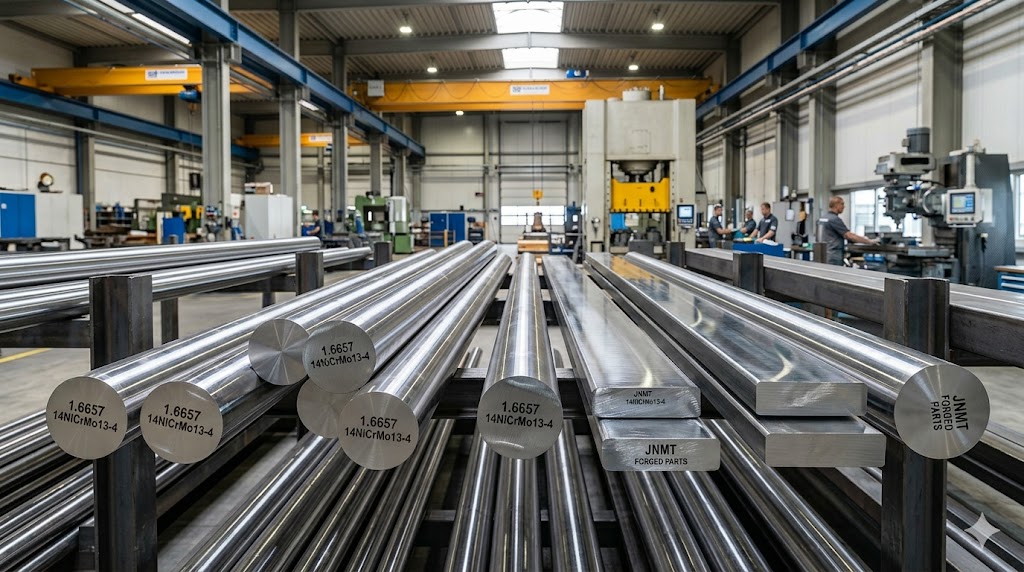
1.6657 Forged Bars & Rods
We supply precision forged 1.6657 steel bars in round, square, flat, rectangular and step rod profiles. Our forged bars benefit from the closed grain structure and optimized mechanical properties achievable only through open-die pressing — superior to rolled bar for large sections where rolling reduction ratios may be insufficient. Supporting custom diameters from 80mm to 1,200mm and lengths up to 12 meters, our forged bars are widely used as the starting material for gear blanks, spindle shafts, coupling flanges and structural fasteners in heavy industry. Each bar is ultrasonically tested to EN 10228-3 Class 3 or customer-specified acceptance class before dispatch.
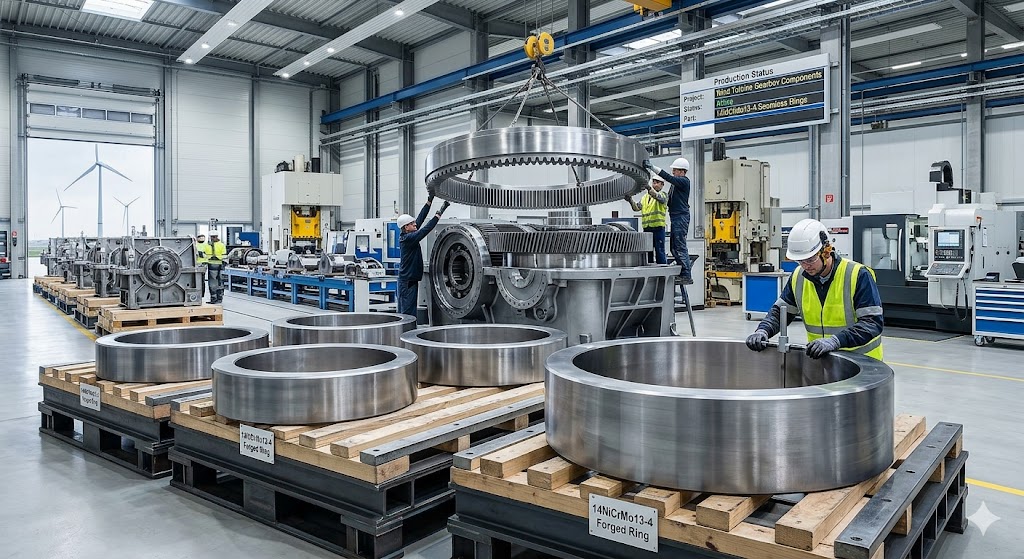
14NiCrMo13-4 Seamless Rolled Rings & Forged Rings
Our 14NiCrMo13-4 seamless rolled rings are produced on CNC radial-axial ring rolling mills with outer diameters from 200mm to 5,000mm and heights from 50mm to 1,200mm. The ring rolling process aligns the grain flow circumferentially around the ring, providing the highest possible resistance to radial and axial stresses — critical for slewing bearing races, gear rims, coupling flanges and valve seats. Compared to a cut disc (where the grain flow is radial and may intersect the critical hoop stress direction), a rolled ring offers measurably better fatigue life in service. We can also supply rings in the rough-turned condition with defined machining allowances to your drawing, ready for your own finish machining operations.
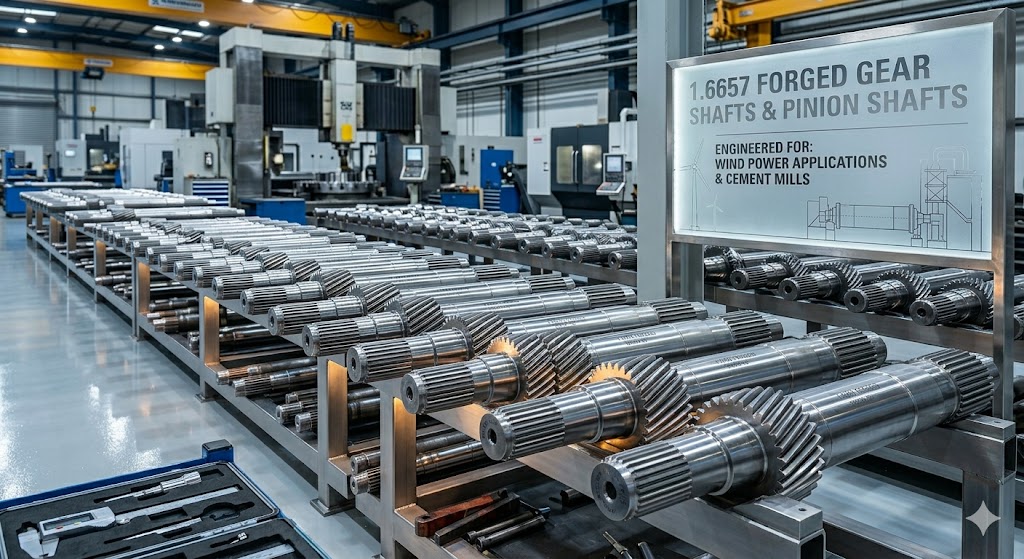
1.6657 Forged Shafts & Gear Components
We specialize in custom manufacturing of 1.6657 forged shafts and gear-related components including stepped shafts, gear shafts, pinion shafts, spindles, eccentric shafts, crankshafts and rotor shafts. Our shaft forgings are produced with strict grain flow alignment along the shaft axis (the direction of maximum bending and torsional stress), using a multi-pass press sequence with intermediate reheats to maintain the working temperature above 900°C throughout. Shaft forgings above 500mm length are straightness-checked and center-drilled before heat treatment to minimize distortion during quenching — a practical detail that significantly reduces post-HT machining time and scrap risk on complex profiles.
14NiCrMo13-4 Hollow Forgings & Cylindrical Components
Our 14NiCrMo13-4 hollow forgings — hubs, housings, shells, sleeves, bushes, casings, hollow bars, pipes and barrels — are produced by the punch-and-draw method on our hydraulic presses, preserving the integrity of the forged grain structure in the wall section. The bore is produced by hot punching rather than machining from solid bar, which means the grain flow follows the cylindrical profile (unlike a machined bore, where the grain flow is interrupted by the cutting tool). This results in superior burst resistance and fatigue life for pressure-carrying components such as hydraulic cylinder tubes, valve bodies and high-pressure pump housings.
1.6657 Forged Discs, Plates & Blocks
We provide custom 1.6657 forged discs, plates and blocks with dimensions up to 3,000mm diameter and 600mm thickness. These products are ideal for valve bodies, pump impeller discs, flanged bosses, tube sheets and machine bases requiring a combination of high strength, excellent machinability in the rough state and reliable mechanical properties after final heat treatment. All discs are ultrasonic tested on a 100% volumetric basis to EN 10228-3 or ASTM A388 before dispatch.
Have a custom drawing or RFQ for 1.6657 forged parts? Send it to us for a free technical review and quotation
Need Custom 1.6657 (14NiCrMo13-4) Forgings for Your Project?
Send us your drawings and specifications — our engineering team provides a detailed quotation and technical solution within 24 hours. We also offer free DFM (Design for Manufacturability) review for complex shapes.
Get Your Free Quote NowOur End-to-End Production Process for 1.6657 (14NiCrMo13-4) Forgings
Producing a high-quality 1.6657 forging is not simply a matter of heating a billet and pressing it to shape. The physical and metallurgical conditions at every stage of the production chain directly influence the final mechanical properties. Below is a transparent breakdown of every stage in our process — and the specific quality controls we apply at each step.
Raw Material Procurement & Incoming Inspection
We only buy 1.6657 ingots or continuous cast billets from qualified steel mills with EN 10204 3.1 mill test certificates. On receipt, our incoming QC team performs spectrometric composition verification (OES), dimensional measurement and surface condition inspection. Chemical composition must be within EN standard limits — any heat outside tolerance is rejected before entering production. Mill traceability records (heat number, melt route, ladle analysis) are retained in our MES system and linked to every finished forging.
Heating & Homogenization
Ingots and large billets are charged into our programmable gas-fired furnaces and heated to a homogenization temperature of 1,180–1,220°C. For sections above 500mm diameter, a mandatory soaking period of 4–6 hours is applied to ensure thermal equilibration and diffusion of Ni/Mo segregation from the as-cast dendritic structure. Temperature uniformity across the furnace chamber is maintained within ±10°C (verified by calibrated thermocouples). The heating rate is controlled to prevent thermal cracking of large sections — maximum 80°C/hour through the 200–500°C range where thermal gradient stresses are highest.
Open Die Forging / Ring Rolling
Forging is conducted on hydraulic presses (1,600–8,000 metric tons) with the working temperature maintained between 1,050°C and 1,200°C. Each forging sequence is planned to achieve a minimum total forging ratio of 3:1 — meaning the cross-sectional area is reduced by at least two thirds from the starting ingot. Multi-pass sequences include intermediate reheats when the surface temperature drops below 900°C. The finish forging temperature is controlled to remain above the Acm line to avoid carbide precipitation and ensure a clean austenitic microstructure entering the cooling cycle. For ring products, the same principles apply on our radial-axial rolling mills, with the rolling temperature monitored by optical pyrometer.
Controlled Cooling & Soft Annealing
Immediately after forging, parts are transferred to an insulating box or slow-cooling pit to prevent martensite formation during uncontrolled air cooling — particularly important for 1.6657 with its high hardenability. Parts are then subjected to softening annealing at 640–680°C (furnace-cooled) to achieve a maximum hardness of ≤269 HB and a spheroidized carbide microstructure, optimized for machining. This anneal also relieves forging-induced residual stresses that could cause distortion during subsequent machining.
Rough Machining (Pre-Heat-Treatment)
For finished machined deliveries, rough machining removes the surface decarburization layer (typically 3–5mm per side) and brings the forging to the near-net shape with defined machining allowances for finish turning after heat treatment. Critical datum surfaces are established in this phase. Dimensional verification against drawing is performed at this stage using CMM or manual measurement, with findings documented before the forging is released to the heat treatment queue.
Case Hardening: Carburizing, Quenching & Tempering
Case Hardening: Carburizing, Quenching & Tempering
For case hardened deliveries, parts are gas carburized at 870-900°C in our controlled atmosphere furnaces ,and carbon potential (Cp) is tightly controlled at 0.9-1.2% to get the desired surface carbon and case depth. After carburizing, a two-step quench cycle is applied (an 845-875°C quench for case hardening, optionally followed by a 780-800°C re-quench to refine core grain) using agitated oil quench to maximize cooling rate and martensite transformation. Final low-temperature tempering at 150–210°C relieves quench stresses and adjusts retained austenite to acceptable levels without significantly reducing surface hardness. Case depth (CHD at 550 HV) is verified by microhardness traverse on a coupon processed with each batch.
Finish Machining (Post-Heat-Treatment)
For finished part deliveries, grinding and finish turning are performed after heat treatment to final dimensional tolerance. Cutting parameters are optimized for hardened 1.6657 (typically CBN grinding for surfaces above 55 HRC, PVD-coated carbide turning for softer core areas). Surface roughness is measured and documented. All dimensions are verified against the drawing with full dimensional report included in the delivery documentation.
Final Non-Destructive Testing (NDT) & Inspection
Every finished 1.6657 forging undergoes comprehensive NDT: 100% volumetric ultrasonic testing (UT) per EN 10228-3/ASTM A388, and surface testing by magnetic particle inspection (MPI/MT) per ASTM E709 and/or liquid penetrant testing (PT) per ASTM E165. Mechanical test coupons (taken from the body of the forging or from integral prolongations) are destructively tested for tensile strength, yield strength, elongation, reduction of area and Charpy impact, with all results documented in the MTC 3.1 or 3.2 certificate.
Preservation, Marking & Export Packaging
Finished forgings are cleaned, anti-rust treated with a water-displacing oil or VCI paper/bag system (selected based on transit duration and destination climate), and marked with heat number, material grade, part number and weight — all per your specification. For sea freight, all forgings are packed in wooden crates with dunnage to prevent movement, and moisture-absorbing silica gel desiccant packets are placed inside. Full export documentation (commercial invoice, packing list, certificate of origin, MTC) is prepared by our experienced export team and provided with the shipment.
Industry Applications & Use Cases of 1.6657 (14NiCrMo13-4) Forgings
The following application breakdowns are drawn from our actual production experience over 26 years — not from generic grade data sheets. We have included the specific technical reasons why 1.6657 is chosen in each sector, to help engineers make more informed material decisions.
Wind & Hydro Power — Gearbox and Drivetrain Components
1.6657 is the industry-standard material for the largest and most highly stressed components in wind turbine planetary gearboxes, where the combination of high fatigue cycles, variable loading (gusty wind conditions) and large gear section sizes makes other grades inadequate. Our typical wind-power deliveries include planetary ring gears (inner diameters 600mm–2,000mm), sun gear shafts, planet carrier shafts and high-speed pinion shafts. For offshore wind applications, the extra toughness provided by Ni alloying is particularly important — wave-induced transient overloads and low ambient temperatures (–20°C or below in the North Sea) demand a grade with a low ductile-to-brittle transition temperature. We can produce forgings to material specifications aligned with IEC 61400-4, and supply full documentation (EN 10204 3.1/3.2 MTC, heat treatment records, UT/MT reports) that supports your DNV or GL certification process. For hydropower, we supply forged runner shafts and guide bearing journal shafts for Francis and Kaplan turbines, typically in diameters of 300mm–900mm.
Cement & Mining — Rotary Kiln and Crusher Components
The rotary kiln drive system in a cement plant subjects the pinion shaft to a uniquely challenging combination: continuous cyclic bending fatigue (the shaft rotates under constant load), occasional shock loads from mill upsets, and an elevated operating temperature environment. The large cross-section of typical kiln pinion shafts (300mm–800mm journal diameter, length up to 5 meters) means only grades with high hardenability — like 1.6657 — can develop adequate mechanical properties throughout the section depth. Our kiln pinion shaft forgings are rough-machined, carburized to a case depth of 1.5–2.5mm, double-quenched, and typically delivered with surface hardness of 58–62 HRC. For gyratory crusher applications (eccentric shafts and main shafts up to 600mm diameter), the primary design driver shifts from fatigue to single-overload fracture resistance — again an area where the Ni-enhanced toughness of 1.6657 outperforms alternatives.
Oil & Gas — Wellhead, Valve and Drilling Equipment
For oil and gas applications, our 1.6657 forgings are typically specified where both high strength and toughness are required at elevated working pressures. Wellhead components such as spool bodies, casing hangers and tubing heads must withstand internal pressures of 10,000–20,000 psi while maintaining full ductility at –46°C (per API 6A material requirements for PSL 3/4). Valve bodies and bonnets in gate valve and ball valve assemblies must resist not only static pressure but also fatigue from repeated open/close cycles and occasional pressure surge events. We can supply all these forgings to the chemical composition and mechanical property requirements specified in API 6A Annex D, in an annealed condition for customer heat treatment or in a quench-and-tempered condition with full Charpy impact test results at the specified test temperature. Our production process for oil and gas components includes stricter hydrogen content controls (VD degassing to ≤1.5 ppm [H]) to prevent hydrogen-induced delayed cracking in thick-section quenched forgings. Note: API 6A product certification of the finished valve or wellhead assembly is the responsibility of the equipment manufacturer; we supply the forged material to the required API 6A material specification.
Heavy Transportation — Locomotive and Marine Transmission
Locomotive traction motor drive pinions, axle gear boxes and bogie frame components all require the combination of surface wear resistance (for gear mesh contact) and core toughness (for impact and fatigue from rail irregularities). 1.6657 is frequently specified for locomotive gear shafts where the case + core property combination cannot be achieved with the lower-Ni grade 18CrNiMo7-6 in sections above 100mm. For marine applications, our ship gearwheel forgings can be produced to Lloyd's Register, Bureau Veritas or DNV material requirements when specified — with third-party witnessing of mechanical testing arranged by the customer's nominated inspection body.
Sugar Mill, Fertilizer & Rotary Kiln Equipment
This is a niche application sector where 1.6657 has particular advantages that are often overlooked in material selection guides. Sugar mill roller shafts and gearbox pinion shafts operate in a wet, abrasive environment and are subject to severe shock loads during mill start-up and when foreign objects (metal, stone) enter the roller pass. The combination of high surface hardness (for wear resistance against the abrasive sugar fiber and juice) and exceptional core toughness (to resist the shock overloads without fracture) makes 1.6657 the correct choice for shafts above 150mm diameter. We supply sugar mill components to customers in Brazil, India, Thailand and Australia and can provide experience-based case depth recommendations for specific roller configurations.
General Industrial Gearboxes & Speed Reducers
For standard industrial gearboxes (planetary reducers, helical gear reducers, bevel gear units) serving heavy-duty applications in steel mills, paper mills, cement plants and offshore platforms, 1.6657 is the material of choice for the primary shaft and gear components where section size or load severity exceeds the capabilities of lower-Ni grades. Our deliveries for this sector include output shaft forgings, ring gear forgings and planet carrier forgings, typically with tight case depth tolerances (±0.1mm CHD) and strict geometric tolerances (circularity ≤0.05mm, cylindricity ≤0.08mm) to minimize the amount of post-HT grinding required.
Application-Specific Carburizing Case Depth Guidelines for 1.6657
One of the most critical design decisions for any 1.6657 carburized component is the specification of the effective case depth (CHD, measured at 550 HV or 52 HRC). Too shallow a case will wear through under service loading; too deep a case increases residual tensile stress at the case/core interface and can reduce bending fatigue strength. The following guidelines are based on our production experience and published gear technology references (ISO 6336-5, AGMA 923, DIN 3990 Part 5):
| Application / Component Type | Module / Section Size | Recommended CHD (mm) | Surface Carbon (Cs %) | Approx. Carburizing Time at 880°C |
|---|---|---|---|---|
| Small industrial gears (helical/spur) | m = 3–6 mm | 0.5 – 0.8 | 0.75 – 0.85% | 4 – 8 h |
| Medium industrial gears | m = 6–12 mm | 0.8 – 1.2 | 0.80 – 0.90% | 8 – 14 h |
| Wind turbine planetary gears | m = 10–20 mm | 1.0 – 1.6 | 0.80 – 0.90% | 12 – 20 h |
| Cement mill pinion shafts | Ø 300–800 mm | 1.5 – 2.5 | 0.80 – 0.95% | 20 – 40 h |
| Crusher / gyratory eccentric shafts | Ø 400–700 mm | 2.0 – 3.5 | 0.85 – 0.95% | 35 – 60 h |
| Sugar mill roller shafts | Ø 200–400 mm | 1.5 – 2.5 | 0.80 – 0.90% | 20 – 40 h |
| Locomotive gear shafts | m = 8–14 mm | 1.0 – 1.5 | 0.80 – 0.90% | 12 – 18 h |
| Marine ship gearwheels | m = 10–25 mm | 1.2 – 2.0 | 0.80 – 0.90% | 15 – 30 h |
The values above are starting-point guidelines. The actual CHD specified on your drawing should reflect not just the module or section size but also the contact stress level (Hertzian stress), the tooth root bending stress and the required surface and sub-surface residual stress profile. For safety-critical applications (wind turbine gearboxes, offshore platform drives), we recommend involving a gear technology specialist to derive CHD requirements per ISO 6336-5 Annex C methodology. We are happy to discuss your specific application requirements and share our production experience to help you optimize the specification.
Surface Hardness Gradient Expectations for 1.6657
A properly carburized and quenched 1.6657 forging should exhibit the following approximate hardness profile from surface to core (measured by microhardness HV10 traverse on a metallographic cross-section):
(0–0.1mm depth)
(CHD criterion)
(1.5× CHD depth)
(≥3× CHD depth)
(at surface after temper)
Global Standards Cross-Reference & Grade Equivalency for 1.6657
Procurement of 1.6657 (14NiCrMo13-4) steel for international industrial projects often requires cross-referencing with the steel grade naming system of the client's home country or the applicable project standard. The following table provides a comprehensive cross-reference. Note that "equivalency" in material science is never exact — there are always minor chemistry differences between grades from different standards. We recommend verifying the specific chemistry ranges and property requirements against the applicable project standard before making a final substitution decision.
| Standard System | Grade Designation | Standard Reference | Key Composition Note |
|---|---|---|---|
| European (EN) | 14NiCrMo13-4 / 1.6657 | EN 10084:2008 | Primary standard — definitive reference |
| German (DIN) | 14NiCrMo134 | DIN 17210 (withdrawn, replaced by EN) | Identical composition to EN; legacy designation still used in German drawings |
| American (AISI/SAE) | AISI/SAE 9310 | ASTM A752 / AMS 6265 | Nearest US equivalent; slightly different Cr range (1.0–1.4% vs 0.8–1.1%); comparable performance |
| British (BS) | 832 M13 (En36B) | BS 970 Part 3 (withdrawn) | Historical designation; similar Ni-Cr-Mo concept; verify property requirements independently |
| French (AFNOR) | 14NiCrMo13-4 | NF A35-551 (now aligned to EN) | France adopted EN standard; same designation and requirements |
| Swedish (SS) | 2530 | SS 14 25 30 (now aligned to EN) | Older Swedish designation; composition compatible with 1.6657 |
| Japanese (JIS) | SNCM439 (close, not identical) | JIS G4053 | SNCM439 has slightly different Ni/Cr ratio; not a direct substitute for fatigue-critical applications without property verification |
| Chinese (GB) | 14Ni3CrMo (similar concept) | GB/T 3077 | No exact Chinese GB equivalent; specify as EN 1.6657 or by chemical composition for Chinese mill sourcing |
| Russian (GOST) | 13KhN3MA (close) | GOST 4543 | Similar Ni-Cr-Mo concept; slightly different Mo range; composition verification recommended |
When your project calls for AISI 9310 or another near-equivalent grade but you intend to manufacture to EN 1.6657, we recommend including a composition conformance statement in the material certification — noting that the supplied material meets EN 10084 requirements for 1.6657 and also satisfies the specified alternative grade chemistry limits where they overlap. We can prepare this dual-standard compliance statement as part of our EN 10204 3.1 certificate at no additional cost.
Advanced Melting Process Options for 1.6657 Forged Steel
The melting route chosen for 1.6657 steel has a direct impact on the steel's cleanliness (oxide and sulfide inclusion content), gas content (hydrogen, nitrogen, oxygen) and compositional homogeneity — all of which influence the fatigue life and impact toughness of the finished forging. We offer the following melt routes, selected according to your application's criticality and cost targets:
- EAF: Electric Arc Furnace melting — standard baseline route for most industrial applications. Cost-effective, with stable chemical composition control. Suitable where inclusion cleanliness requirements are moderate (e.g., ISO 4967 Method A, K3 ≤ 1.5).
- EAF+LF+VD: Electric Arc Furnace + Ladle Refining + Vacuum Degassing — the most widely used route for 1.6657 mechanical components. VD reduces hydrogen to ≤1.5 ppm and oxygen to ≤20 ppm, significantly improving fatigue life and reducing the risk of hydrogen-induced delayed cracking in thick-section quenched forgings. Sulfide inclusion morphology is also improved through Ca-treatment in the ladle. This route satisfies most gear and shaft specifications for wind, mining and industrial applications.
- EAF+ESR: Electro Slag Remelting — the remelting process passes the liquid steel through a molten slag pool that acts as a chemical filter, removing most non-metallic inclusions. ESR produces a highly directional grain structure and near-zero macro-segregation, resulting in improved Charpy toughness and better fatigue crack initiation resistance. Suitable for API 6A material specification compliance (FF/EE class, per order requirement), and for large turbine components where EN 10228-3 Quality Class 5 or 6 UT acceptance is required.
- EAF+PESR: Protective Atmosphere ESR — the same as ESR but conducted under an inert gas shield to prevent nitrogen pick-up from the atmosphere. This achieves the lowest possible nitrogen content (<50 ppm), which is important for applications where strain-age embrittlement is a concern (e.g., components subject to post-weld heat treatment).
- VIM+PESR: Vacuum Induction Melting + Protective Atmosphere ESR — the highest-purity route, combining VIM's excellent composition control (± 0.005% on most alloying elements) with PESR's inclusion removal. Reserved for the most demanding applications where material traceability to aerospace-grade specifications (AMS, DEF STAN) is required.
For the majority of heavy industrial forging applications — cement mill pinion shafts, wind turbine rings, mining gear shafts, oil and gas valve bodies — the EAF+LF+VD route delivers the best value: it achieves the cleanliness and hydrogen control required by EN 10084 and most project specifications, without the cost premium of ESR. We recommend ESR specifically when the component design calls for UT acceptance to EN 10228-3 Class 4 or better, when the cross-section exceeds 400mm (where ESR's superior macro-homogeneity is most beneficial), or when the application standard explicitly requires ESR or equivalent melting.
Chemical Composition of EN 1.6657 (14NiCrMo13-4) Steel
The chemical composition of our 1.6657 (14NiCrMo13-4) steel is controlled in strict accordance with EN 10084:2008, Table 1. For EAF+LF+VD production, our typical cast analysis consistently achieves tighter-than-standard ranges, improving batch-to-batch consistency for heat treatment response.
| Element | EN 10084 Standard Range (%) | Our Typical Achieved (EAF+LF+VD) | Function in Steel |
|---|---|---|---|
| Carbon (C) | 0.11 – 0.17 | 0.13 – 0.16 | Core carbon (low for toughness); surface C rises to 0.7–0.9% after carburizing |
| Silicon (Si) | Max 0.40 | 0.15 – 0.30 | Deoxidation; slight strengthening; excessive Si impairs carburizing rate |
| Manganese (Mn) | 0.30 – 0.60 | 0.40 – 0.55 | Hardenability; MnS inclusion shape control (with Ca-treatment in LF) |
| Nickel (Ni) | 3.00 – 3.50 | 3.10 – 3.40 | Primary hardenability element; core toughness; low DBTT |
| Chromium (Cr) | 0.80 – 1.10 | 0.85 – 1.05 | Carburizing response; temper resistance; hardenability |
| Molybdenum (Mo) | 0.20 – 0.30 | 0.22 – 0.28 | Anti-temper embrittlement; martensite refinement; hardenability |
| Phosphorus (P) | Max 0.025 | ≤ 0.015 | Impurity; promotes grain boundary embrittlement if excessive |
| Sulfur (S) | Max 0.035 | ≤ 0.015 | Impurity; MnS inclusions are fatigue initiation sites |
| Hydrogen (H) | Not specified in EN 10084 | ≤ 1.5 ppm (VD degassed) | Hydrogen-induced cracking risk in thick-section quenched forgings; controlled by VD |
We can tailor the chemical composition to the standard range to meet specific project requirements such as tighter Ni or Cr limits for traceability to a specific ingot standard, or adjusted Mn to improve hardenability for a specific section size.
Heat Treatment Specifications for 14NiCrMo13-4 Forging Parts
Heat treatment of 1.6657 is not a simple on/off process — it is a precisely engineered sequence of thermal cycles designed to develop specific microstructures and properties in both the case and the core. Our heat treatment team operates calibrated gas-fired and atmosphere furnaces with full data logging, and every heat treatment cycle for a production batch is recorded and included in the delivery documentation. Following are the standard heat treatment routes for 14NiCrMo13-4 steel :
- Soft Annealing (Delivery condition: +A): 640–680°C, hold time proportional to section size (minimum 1 hour per 25mm of section), followed by furnace cooling at ≤25°C/hour to below 400°C. Target: ≤269 HB, spheroidized carbide microstructure. Purpose: maximize machinability for customer or in-house rough machining.
- Normalizing Annealing (Delivery condition: +N): 860–880°C, austenitize and air cool. Purpose: refine as-forged grain structure and eliminate banding from forging; used as a pre-treatment before case hardening or quench-and-temper to improve microstructural homogeneity.
- Cyaniding / Carbonitriding: 850–880°C in a mixed gas atmosphere (endothermic + ammonia); produces a thin combined C+N case. Used for thin-walled or precision parts where distortion from deep carburizing must be minimized. The nitrogen in the case also contributes to improved fatigue strength and corrosion resistance.
- Gas Carburizing: 870–900°C in controlled endothermic gas atmosphere (Cp = 0.9–1.2%); hold time determined by target CHD (see case depth table above). The boost-diffuse cycle technique is used for deeper cases: boost at Cp = 1.1–1.2% to achieve rapid carbon saturation, then diffuse at Cp = 0.8% to achieve the desired carbon concentration gradient without surface carbide network formation.
- Hardening (I) — Direct Quench after Carburizing: Cool from carburizing temperature to 845–875°C and quench into oil (quench oil temperature 40–80°C, agitated). This is the primary quench for case hardening.
- Hardening (II) — Re-Quench (Double Quench): After the first quench, optionally re-austenitize at 780–800°C and re-quench. The lower re-austenitizing temperature lies below the Acm for the carburized case but above Ac3 for the core — resulting in grain refinement of the core without re-dissolving all the surface carbides, providing better core toughness. This additional step is specified for large-section or high-toughness-requirement applications.
- Low Temperature Tempering: 150–210°C, hold 2 hours minimum (longer for thick sections), air or oil cool. Purpose: relieve quench stresses and reduce retained austenite to ≤10% at the surface without significantly reducing surface hardness. The tempering temperature is precisely controlled because even a 20°C overtemper at this range can cause measurable hardness reduction in the case.
- Sub-Zero Treatment (optional): Immediately after quenching (before tempering), cool to –70°C to –80°C using dry ice or refrigerated equipment. This converts residual austenite to martensite, getting maximum surface hardness and dimensional stability in high-precision gear components. Recommended when surface hardness specification is ≥61 HRC.
- Stress Relief Annealing (for soft-annealed forgings requiring welding): 550–650°C, 1 hour per 25mm section, furnace cool. Used to relieve residual stresses introduced by rough machining before customer welding operations, minimizing distortion.
Like other Ni-Cr steels, 1.6657 is susceptible to temper embrittlement when slowly cooled through the 375–575°C range after high-temperature tempering. The Mo content (0.20–0.30%) provides partial protection, but components should not be held or slowly cooled in this temperature range after quench-and-temper heat treatment. For large forgings that cool slowly from tempering temperature, we monitor and document the cooling rate through this critical range, and can specify accelerated forced-air or water mist cooling for particularly temper-embrittlement-sensitive applications.
Mechanical Properties of 1.6657 (14NiCrMo13-4) Forged Steel
The following mechanical property requirements are specified in EN 10084:2008, Table 7 (for material in the quench-and-temper condition, test piece taken from the core of a 30mm diameter reference bar). All our production batches are tested against these requirements. Our actual results consistently exceed the minimum values by a meaningful margin, reflecting both the tight chemistry control and the optimized forging/heat treatment process we have developed for this grade.
| Mechanical Property | EN Standard Minimum | Our Typical Achieved (EAF+LF+VD) | Test Method |
|---|---|---|---|
| Tensile Strength (Rm) | ≥ 1130 MPa | 1150 – 1300 MPa | ASTM E8 / EN ISO 6892-1 |
| 0.2% Proof Strength / Yield Strength (Rp0.2) | ≥ 930 MPa | 950 – 1100 MPa | ASTM E8 / EN ISO 6892-1 |
| Elongation (A, gauge length = 5×d) | ≥ 10% | 11 – 15% | ASTM E8 / EN ISO 6892-1 |
| Reduction of Area (Z) | ≥ 50% | 55 – 65% | ASTM E8 / EN ISO 6892-1 |
| Notch Impact Toughness (KU2, 10×10mm Charpy U-notch) | ≥ 72 J | 90 – 140 J | EN ISO 148-1 / ASTM E23 |
| Hardness after Soft Annealing (HB) | ≤ 269 HB | 220 – 260 HB | ASTM E10 / EN ISO 6506 |
| Surface Hardness after Carburizing & Quenching (HRC) | 58 – 62 HRC (EN & industry practice) | 58 – 62 HRC | ASTM E18 / EN ISO 6508 |
| Core Hardness after Carburizing & Quenching (HRC) | 30 – 42 HRC (typical; verify with client) | 33 – 40 HRC | ASTM E18 / EN ISO 6508 |
| Austenite Grain Size (ASTM) | ≥ 5 (coarser grain = lower fatigue resistance) | 6 – 8 (fine grain) | ASTM E112 / EN ISO 643 |
For project-specific applications (e.g., offshore oil and gas, wind turbine certification), we can provide Charpy impact test results at sub-zero temperatures (–20°C, –40°C or –46°C) using V-notch test pieces (KV2) rather than U-notch, to meet API 6A material requirements or DNV/GL material class requirements as specified by the customer. Please specify your impact test temperature and specimen type in your RFQ.
Design & Specification Guidelines for Engineers Working with 1.6657 Forgings
After 26 years of supplying 1.6657 forgings to engineering teams worldwide, we have observed certain specification and design details that, when done well, significantly improve the outcome — both in terms of manufacturability and in-service performance. The following guidelines reflect our production experience and are offered as practical value-adds for engineers specifying 1.6657 components:
Specifying the Heat Treatment Condition on the Drawing
The most common ambiguity we encounter in RFQs is an incomplete or contradictory heat treatment specification. For 1.6657, the delivery condition should specify: (1) the heat treatment stage required (soft annealed, normalized, carburized+quenched+tempered, or Q+T without carburizing); (2) the surface hardness range (e.g., 58–62 HRC) and measurement location; (3) the core hardness range (e.g., 30–40 HRC) and measurement location; (4) the effective case depth requirement and the definition used (CHD at 550 HV, or SHD at a specific hardness, or total case depth); and (5) the sub-zero treatment requirement if applicable. Specifying only "carburized" or only "surface hardness 60 HRC" leaves too many critical parameters undefined for the forging supplier to guarantee a correct result.
Machining Allowance After Heat Treatment
One of the most important design choices for carburized components is how much post-heat-treatment grinding or turning stock to include. During carburizing and oil quenching, dimensional changes occur due to transformation plasticity (martensite formation) and thermal gradients. For 1.6657, typical dimensional changes during carburizing+oil quenching of a shaft forging are: OD change of –0.05% to +0.15% of the forged diameter; length change of 0% to +0.10% of the forged length. We recommend specifying a minimum of 0.5mm (per side) grinding allowance on critical surfaces after heat treatment, increasing to 1.0mm per side for components above 300mm diameter. For internal bores, the distortion is typically larger — 1.0–2.0mm post-HT boring or grinding allowance is typical for bore diameters above 150mm.
Grain Flow and Forging Direction
For critically loaded components such as gear shafts and pinion shafts, it is worth discussing forging direction with your supplier early. The grain flow in a forged bar or shaft runs parallel to the pressing direction; bending fatigue cracks initiate more readily when oriented transverse to the grain flow than when parallel to it. Our standard practice for shaft forgings is to orient the forging so that the primary load axis (bending and torsion in service) is parallel to the forging direction, maximizing the grain flow benefit. For disc and ring forgings, the grain flow runs circumferentially in rolled rings (favorable for hoop stress loading) and radially in discs forged from a bar billet — a distinction that is worth considering when the component is a gear rim ring or a flange under high pressure loading.
Preventing Decarburization on Critical Surfaces
As-forged 1.6657 surfaces always exhibit some degree of decarburization due to oxidation during high-temperature press work. The decarburized surface layer (typically 3–6mm per side on open-die forgings) is soft and fatigue-prone and must be completely removed by machining before case hardening. Drawings for carburized components should therefore include a minimum pre-heat-treatment machining step that removes all decarburization, or the forging supplier should include a sufficient "decarb allowance" on top of the normal machining allowance. We always communicate the estimated decarburization depth for each forging based on our measured results, so customers can set appropriate machining stock.
Areas to Protect from Carburizing
On complex components such as gear shafts with both carburized gear teeth and un-carburized thread or press-fit areas, stop-off (copper plating, anti-carburizing paint or copper foil) must be applied to areas that must remain soft and machinable. This should be specified on the drawing, with clear indication of the boundary between case-hardened and non-case-hardened zones. Stop-off application and verification is included in our pre-carburizing process qualification for each part number, and the stop-off effectiveness is verified by hardness testing on the masked areas after heat treatment.
Strict Quality Inspection & Control for 1.6657 Forgings
At Jiangsu Liangyi, quality control is integrated into the production process — not applied as a final pass/fail gate at the end. Our Quality Management System, certified to ISO 9001:2015, defines mandatory inspection hold points throughout the production chain, each of which must be signed off by a qualified QC inspector before the forging can proceed to the next stage. Following are the inspection plan for 1.6657 forgings:
Inspection Standards Reference
Our inspection procedures reference the following international standards, which we strictly follow:
- ASTM E 8 / ASTM E 8M: Standard Test Methods for Tension Testing of Metallic Materials
- ASTM E 10: Standard Test Method for Brinell Hardness of Metallic Materials
- ASTM E 18: Standard Test Methods for Rockwell Hardness of Metallic Materials
- ASTM E 23: Standard Test Methods for Notched Bar Impact Testing of Metallic Materials
- ASTM E 112: Standard Test Methods for Determining Average Grain Size
- ASTM E 139: Standard Test Methods for Conducting Creep, Creep-Rupture, and Stress-Rupture Tests of Metallic Materials
- ASTM E 292: Standard Test Methods for Conducting Time-for-Rupture Notch Tension Tests of Materials
- ASTM A 388 / EN 10228-3: Ultrasonic Examination of Steel Forgings
- ASTM E 709 / EN 10228-1: Standard Guide for Magnetic Particle Testing
- ASTM E 165 / EN 10228-2: Standard Practice for Liquid Penetrant Examination
- ASTM E 45 / EN ISO 4967: Standard Test Methods for Determining the Inclusion Content of Steel (microinclusion rating)
Full-Process Inspection Hold Points
- Incoming Material Hold: OES spectrometric composition check on all incoming billets or ingots; certificate review against EN 10084; reject if any element is outside EN limits. No material may enter the forge furnace without passing this check.
- Pre-Forge Verification: Billet weight, dimensions and surface condition (no cracks, laps or seams) verified before charging into the furnace.
- Post-Forge Dimensional Check:All dimensions measured on as-forged condition were compared to the forging drawing such as diameters, length, step diameters and cross-section profiles. Straightness of shaft forgings is measured and corrected, if necessary, before annealing.
- Visual Surface Inspection (After Annealing): Full surface examination for forging defects (laps, cold shuts, cracks, surface cavities). Shot-blasted surface makes defects visible. Any surface indications are evaluated per agreed acceptance criteria (typically ASTM A788).
- Post-Rough-Machining Dimension Test: CMM or manual dimensional check against machining drawing; all important dimensions documented in a dimensional report.
- Pre-HT Identification Verification: Heat number markings, part numbers and material grade stamps are verified before heat treatment loading — preventing any mix-up of parts or heats.
- Heat Treatment Record Review: Review and sign off the full time-temperature charts from programmed furnace controllers for every batch. Engineering team document and evaluate the deviations from the specified heat treatment program before proceeding.
- Post-HT Hardness Survey: Surface hardness measured at a minimum of 4 points per component; core hardness measured on sacrificial coupon or hardness traverse on test ring/prolongation. Results compared to specification.
- Microhardness Traverse & Metallographic Examination: At least one specimen per batch is sectioned, polished and microhardness-traversed to verify CHD, retained austenite level and carbide network absence. Metallographic examination also checks grain size, non-metallic inclusion rating and microstructure quality (martensite distribution, absence of bainite in case).
- Mechanical Properties Testing: Tensile test (Rm, Rp0.2, A, Z), Charpy impact test (KU2 or KV2 at specified temperature) and hardness (HB/HRC) on test coupons from each production batch. Results documented in MTC.
- Ultrasonic Testing (UT): 100% volumetric scanning per EN 10228-3 or ASTM A388; UT acceptance class as specified by customer (typically Class 3 or 4 for mechanical engineering, Class 5 or 6 for oil and gas/wind).
- Magnetic Particle Testing (MT) and/or Liquid Penetrant Testing (PT): 100% surface coverage per ASTM E709/E165 or EN 10228-1/2; any linear indication above the agreed acceptance threshold is cause for rejection or repair evaluation.
- Final Dimension Test: All delivery dimensions verified against final inspection plan; dimensional report signed by QC inspector and QC manager before release.
- Document Package Review: All certificates (MTC 3.1/3.2, UT report, MT/PT report, dimensional report, heat treatment record, packaging list) are reviewed for completeness and accuracy before shipment release.
All shipments are supplied with complete EN 10204 3.1 mill test certificates as standard. For EN 10204 3.2 certificates (third party witnessed inspection) we liaise with the customer nominated inspection body - typically SGS, Bureau Veritas, TÜV, Lloyd's Register, DNV or Intertek - and arrange inspection scheduling and witness attendance at our site.Please specify your required inspection body and witness scope in your RFQ.
Machining & Manufacturing Guidelines for 1.6657 Forgings
Whether our customers machine 1.6657 forgings in-house or through a subcontractor, the following practical guidance — developed from our experience finishing thousands of 1.6657 components — can help optimize machining outcomes and reduce unexpected costs:
Machining in the Annealed Condition (Before Heat Treatment)
At ≤269 HB (soft annealed), 1.6657 is fully machinable with standard high-speed steel or uncoated carbide tooling. Recommended cutting speeds for turning are 120–180 m/min with carbide inserts (ISO P-grade, e.g., P20 or P30 grade), feed rate 0.2–0.4 mm/rev, depth of cut up to 4mm for roughing. The relatively low carbon content makes chip formation easy — long, continuous chips tend to form, so chip breaker geometry inserts are preferred to avoid chip management issues on CNC lathes. Coolant-through-tool or flood coolant is recommended for deep holes (drilling) to prevent chip welding in the high-Ni steel.
Machining of Case-Hardened Surfaces (After Heat Treatment)
After carburizing and quenching, the surface hardness of 58–62 HRC requires CBN (cubic boron nitride) or ceramic tooling for hard turning, or grinding with Al₂O₃ or CBN wheels. For grinding, the critical risk is thermal damage ("grinding burn") — the temperature in the grinding zone must not exceed approximately 200°C, or the martensite will begin to over-temper, forming a white layer (re-hardened zone) or a dark layer (over-tempered zone), both of which are fatigue initiation sites. We recommend using a Barkhausen noise inspection or nital etching inspection of ground surfaces for critical components (gear teeth, bearing journals) to confirm the absence of grinding burn. Feed rates in surface or cylindrical grinding should be conservative (typically 0.005–0.015 mm/pass for finishing passes on 1.6657) with generous coolant flow.
Thread and Keyway Machining Considerations
For components with threaded ends or keyways that must remain unhardened, the stop-off process (copper plating or anti-carburizing paste) must protect these features during carburizing. Where this is not possible, threads are typically cut after heat treatment using thread milling or thread grinding with CBN tooling in the carburized region, or the thread is designed into a non-carburized zone of the component. Keyways cut after heat treatment in a fully hardened zone should use die-sinking EDM rather than milling to avoid introduction of tensile residual stresses that could initiate fretting fatigue cracks at the keyway root.
Frequently Asked Questions About 1.6657 (14NiCrMo13-4) Forgings
1.6657 is the EN material number for a low-alloy carburizing steel with the chemical designation 14NiCrMo13-4, standardized under EN 10084:2008. The "14" refers to the nominal carbon content (0.14%), "Ni13" corresponds to the ~3.25% Ni content (Ni% × 4 = designation factor for Ni), "Cr" to 0.8–1.1% chromium, and "Mo4" to 0.20–0.30% molybdenum.
It is specifically designed for case-hardening (carburizing) applications where the finished component must have both a hard, wear-resistant surface and a tough, fracture-resistant core — particularly for medium to large cross-sections (above 60mm) that lower-hardenability grades cannot adequately through-harden. The high nickel content (3.0–3.5%) is the defining feature: it provides the hardenability for large sections, dramatically improves core toughness and lowers the ductile-to-brittle transition temperature, making 1.6657 the preferred choice for heavy-duty transmission and structural components globally.
14NiCrMo13-4 is used for high-load, fatigue-critical components in heavy industries worldwide, wherever section sizes exceed the capability of lower-Ni grades. Typical applications include:
- Wind turbine planetary gearbox components: ring gears (ID 600–2,000mm), sun gear shafts, planet carrier shafts, pinion shafts
- Cement mill rotary kiln pinion shafts and girth gear segments (Ø 300–800mm, length up to 5m)
- Mining industry: crusher eccentric shafts, gyratory crusher main shafts, slewing bearing rings
- Oil and gas: wellhead components, valve bodies and bonnets for high-pressure applications, drilling gear shafts
- Sugar mill roller shafts, granulator riding rings
- Locomotive transmission shafts, railway axle gear components
- Marine ship gearwheels and propulsion gear shafts
- Industrial gear reducer primary shafts and planet carriers for heavy-duty process equipment
The closest equivalent grades to EN 1.6657 (14NiCrMo13-4) in other standards systems are:
- American (AISI/SAE): AISI 9310 — similar Ni-Cr-Mo alloying philosophy, but with slightly higher Cr (1.0–1.4% vs 0.8–1.1%) and lower Mo (0.08–0.15% vs 0.20–0.30%). AISI 9310 is used in aerospace and defense where AMS specifications apply.
- German (DIN): 14NiCrMo134 — historically the same steel, now superseded by EN 10084
- British (BS): 832 M13 (also known as En36B) — similar concept, now replaced by EN
- Swedish (SS): 2530
- Russian (GOST): 13KhN3MA — similar Ni-Cr-Mo balance, slightly different Mo range
No exact equivalent exists in the Chinese GB/T system; when specifying for Chinese mills, we recommend providing the EN 10084 chemistry and property requirements directly. Grade equivalency should always be verified by comparing the actual chemistry ranges and mechanical property requirements — not just the Ni-Cr-Mo content — before making a substitution in a critical application.
Following are the standard heat treatment routes for 1.6657 (14NiCrMo13-4) :
- Soft Annealing (+A): 640–680°C, furnace cool ≤25°C/h to below 400°C → Result: ≤269 HB, optimal machinability
- Normalizing (+N): 860–880°C, air cool → Result: refined grain, homogeneous microstructure
- Gas Carburizing: 870–900°C (Cp = 0.9–1.2%), time = f(case depth target). Boost-diffuse technique: boost at Cp=1.1–1.2%, diffuse at Cp=0.8%
- Quenching (Primary): 845–875°C → agitated oil quench (40–80°C oil). Achieves martensite in both case and core
- Re-Quenching (Optional): 780–800°C → oil quench. Refines core grain; improves core toughness for large-section or high-impact applications
- Cyaniding / Carbonitriding (alternative): 850–880°C in endothermic + NH₃ atmosphere. For thin-section or precision parts requiring low distortion
- Sub-Zero Treatment (optional): –70°C to –80°C immediately after quenching → converts residual austenite, maximizes surface hardness and dimensional stability
- Low Temperature Tempering: 150–210°C, min 2 h → surface hardness 58–62 HRC, residual austenite ≤10%
The specific process choice is based on the component geometry, desired case depth, section size and ultimate mechanical property goals. Before production, we establish a heat treat specification for each part number.
For 1.6657 (14NiCrMo13-4), the achievable effective case depth (CHD at 550 HV) depends on the carburizing time and temperature:
- 0.5–0.8mm CHD: 4–8 hours at 880°C → small industrial gears (module 3–6mm)
- 0.8–1.2mm CHD: 8–14 hours at 880°C → medium industrial gears (module 6–12mm)
- 1.0–1.6mm CHD: 12–20 hours at 880°C → wind turbine gears (module 10–20mm)
- 1.5–2.5mm CHD: 20–40 hours at 880°C → cement mill pinion shafts, large gear shafts
- 2.0–3.5mm CHD: 35–60 hours at 880°C → crusher shafts, very heavily loaded components
Case depth has a complex effect on fatigue life. Too shallow a case results in sub-surface plastic deformation below the case/core interface under contact loading (spalling). Too deep a case shifts the residual stress distribution unfavorably and can reduce bending fatigue strength by 10–20% due to higher tensile residual stress at the case/core transition. The best case depth for each application should be determined using ISO 6336-5 or AGMA 923 methodology considering actual tooth module, contact stress and required lifetime.
Yes. we make custom forging parts of 1.6657 (14NiCrMo13-4) according to your drawings, specifications and technical requirements. To get a complete and accurate quotation, please provide the following information:
- CAD drawing or sketch with all required dimensions, tolerances, GD&T requirements and surface roughness
- Material specification (EN 1.6657 / EN 10084, or equivalent AISI 9310, etc.)
- Delivery condition (soft annealed / normalized / carburized+quenched+tempered, or Q+T without carburizing)
- Heat treatment requirements (if carburized: case depth range, surface and core hardness, sub-zero treatment Y/N)
- Required NDT (UT class, MT/PT acceptance criteria, reference standard)
- MTC type required (EN 10204 3.1 or 3.2, witnessing body if 3.2)
- Annual quantity estimate and required delivery date
We support custom weights from 30 kg to 30,000 kg in any shape: bars, rings, shafts, discs, housings, hollow forgings and complex special shapes. Free DFM (Design for Manufacturability) review is also available for new designs.
We apply a minimum total forging ratio (reduction ratio) of 3:1 for all 1.6657 forgings. This means the cross-sectional area at the most critical section of the finished forging is no more than one third of the cross-sectional area of the starting ingot or billet at that point — equivalent to a 67% reduction in area from the raw material.
The forging ratio matters because it directly determines the degree of internal defect closure and microstructural refinement achieved during forging:
- Porosity closure: Residual shrinkage porosity from solidification of the ingot is only fully closed by compressive forging strain. A ratio of at least 2.5:1 is needed to close most porosity; 3:1 is the conservative industry standard that ensures closure even for large or center-heavy porosity patterns.
- Grain refinement: Repeated recrystallization of austenite during hot deformation refines the prior austenite grain size. A larger forging ratio drives more recrystallization cycles and produces a finer, more uniform final grain size — which directly improves both fatigue resistance and impact toughness.
- Segregation reduction: Mechanical working disperses the dendritic segregation of Ni and Mo from the as-cast structure, producing a more chemically homogeneous forged product with consistent mechanical properties throughout the cross-section.
The appropriate melting process depends on your application criticality, the required NDT acceptance class and the governing specification:
- EAF+LF+VD: Recommended for the vast majority of industrial applications — wind, mining, cement, general heavy machinery. Achieves EN 10084 requirements with good hydrogen control (≤1.5 ppm) and reasonable inclusion cleanliness. Best value for most projects.
- EAF+ESR: Recommended when UT acceptance class EN 10228-3 Class 4 or better is required, or for components above 400mm cross-section where macro-segregation is a concern, or for oil and gas forgings where API 6A material requirements call for high Charpy values at sub-zero temperatures.
- EAF+PESR or VIM+PESR: Reserved for the highest criticality applications — aerospace-adjacent, defense-related, or where AMS specifications are invoked alongside EN 10084. Significantly higher cost; rarely required in standard industrial forgings.
If your specification does not need ESR or PESR, EAF+LF+VD is the correct and cost-effective choice for 1.6657 industrial forgings.
Following are our standard lead times for 1.6657 (14NiCrMo13-4) forgings:
- Raw forged parts (soft annealed, no machining): 20–35 days from order confirmation
- Rough machined forgings: 25–40 days
- Carburized and heat treated forgings: 30–45 days (includes carburizing cycle time of 8–60h depending on case depth target)
- Fully finished machined parts (post-HT grinding/turning): 35–50 days
For urgent orders, we can speed up production — contact us with your project timeline and we will confirm what is achievable. Lead times for ESR route material are typically 10–15 days longer than EAF+LF+VD due to the ESR remelting cycle time. The exact lead time for your specific order is confirmed in the formal quotation based on weight, quantity, complexity and current production load.
All our 1.6657 forgings are manufactured in full compliance with international standards and can be inspected and certified to:
- Material standard: EN 10084:2008 (primary), with equivalent compliance to DIN and ASTM requirements; API 6A material chemistry and property requirements can be met on a per-order basis as specified
- Mechanical testing: ASTM E8/E8M (tensile), E10/E18 (hardness), E23 (Charpy impact), EN ISO 6892-1, EN ISO 6506/6508, EN ISO 148-1
- Creep and rupture testing: ASTM E139, ASTM E292
- Ultrasonic testing: ASTM A388 / EN 10228-3, acceptance classes 1 through 6 depending on application
- Magnetic particle testing: ASTM E709 / EN 10228-1
- Liquid penetrant testing: ASTM E165 / EN 10228-2
- Grain size: ASTM E112 / EN ISO 643
- Inclusion rating: ASTM E45 / EN ISO 4967
- Material certificates: EN 10204 3.1 (factory QC, standard with every order) or EN 10204 3.2 (customer-nominated third-party witness, arranged on request)
After standard carburizing + quenching + low-temperature tempering (150–210°C), 1.6657 (14NiCrMo13-4) achieves the following mechanical properties (EN 10084 minimum requirements for core, 30mm reference bar):
- Tensile Strength (Rm): ≥ 1,130 MPa (our typical: 1,150–1,300 MPa)
- Yield Strength / 0.2% Proof Stress (Rp0.2): ≥ 930 MPa (our typical: 950–1,100 MPa)
- Elongation (A): ≥ 10% (our typical: 11–15%)
- Reduction of Area (Z): ≥ 50% (our typical: 55–65%)
- Notch Impact Toughness (KU2, +20°C): ≥ 72 J (our typical EAF+LF+VD: 90–140 J)
- Hardness after Soft Annealing: ≤ 269 HB
- Surface hardness after C+Q: 58–62 HRC
- Core hardness (at depth): typically 33–40 HRC for a 30mm bar
For sub-zero Charpy (KV2 at –20°C or –46°C), contact us to discuss your specific requirement — we regularly perform sub-zero Charpy testing for oil & gas and offshore wind applications.
Yes. We regularly supply 1.6657 forgings with EN 10204 3.2 material certificates — meaning mechanical test and NDT witnessing by an independent third-party inspection body. We welcome and accommodate the customer's nominated inspector or inspection company at our facility, and cooperate fully with all major international inspection bodies including SGS, Bureau Veritas, TÜV, Lloyd's Register, DNV and Intertek. The customer or their project management team typically arranges and contracts the inspection body directly; we provide inspection access, test coupons and all required documentation. We also accept customer's own inspectors at our facility.
For 3.2 certificates, please specify: (a) the required inspection body; (b) the specific tests or stages to be witnessed; and (c) whether inspection hold notifications should be issued at specific stages. Typical hold points for third-party witnessing are: material incoming inspection, mechanical testing, ultrasonic testing and final dimensional inspection. Third-party inspection adds 5–10 working days to the lead time due to scheduling and travel coordination, which we factor into the confirmed delivery date.
Why Choose Jiangsu Liangyi as Your 1.6657 Forging Supplier?
With over 26 years of professional forging experience of alloy steel carburizing grades, we have built capabilities and accumulated process knowledge that a general forging shop cannot replicate. Following is what specifically distinguishes our 1.6657 forging service:
- Deep Metallurgical Expertise in 1.6657: Our engineering team has processed this specific grade continuously since the late 1990s, accumulating data on forging temperature windows, optimal homogenization cycles, carburizing parameter optimization and heat treatment response across a wide range of section sizes and weights. We can offer informed, experience-based guidance on material specification — not just "we can make it" but "here is the best way to specify it for your application."
- Full One-Stop Production Capability: We control the entire production chain in-house — from raw material acceptance, open-die forging and ring rolling, through heat treatment (annealing, normalizing, carburizing, Q&T), CNC rough and finish machining (turning, milling, boring, grinding), to full NDT and mechanical testing. No subcontracting of critical processes, no quality handoff risk between suppliers.
- Precision Heat Treatment with Full Documentation: Our furnaces are equipped with programmable controllers, SCADA data logging and calibrated thermocouples. Every heat treatment batch produces a time-temperature chart that is reviewed, signed off and included in the delivery documentation — providing traceability of the actual thermal cycle your parts experienced, not just the nominal specification.
- Flexible Weight Range & Scalable Quantity: 30 kg prototype forgings for design verification up to 30,000 kg large production components, single-piece trial orders up to multi-year repeat contracts – our production planning meets all project sizes with the same engineering rigor.
- ISO 9001:2015 Certified Quality System: Our QMS is ISO 9001:2015 certified covering all processes from order review to shipment including documented inspection plans, NCR/CAPA processes and supplier qualification.External surveillance audit is performed annually by an accredited certification body.
- Global Export Experience: We have exported 1.6657 forgings to clients in Germany, the Netherlands, the United States, Australia, Brazil, India, the UAE and 45+ other countries. Our export team handles all documentation — commercial invoice, packing list, certificate of origin (Form A, EUR.1 or CO as required), customs HS code classification and logistics booking — so you receive the parts and the paperwork without administrative friction.
- Complete Material Traceability: Every forging we ship is traceable by heat number from the steel mill cast analysis to the final inspection report. We retain batch records, heat treatment charts and NDT reports for a minimum of 10 years, supporting any future failure analysis or warranty documentation need.
- Transparent Technical Communication: We believe technical honesty is the foundation for the best supplier relationship in the long term. If we see a spec that will cause a manufacturability issue, we’ll flag it and offer a solution before we go into production — not after. Our engineers are on hand, via email and video call, to discuss technical requirements, review drawings and answer questions at any stage of a project.
Ready to Start Your 1.6657 Forging Project?
Contact us today with your drawings and requirements. We provide a professional, competitive quotation within 24 hours — and a free DFM review for complex or first-off components.
Contact Us Now — Free Quote in 24h