1.6368 (15NiCuMoNb5-6-4) Forging Parts | ISO 9001 Certified EN Standard Forged Steel Manufacturer
Founded in 1997 in Jiangyin City, Jiangsu Province, China, Jiangsu Liangyi Co., Limited is an ISO 9001:2015 certified open die forging specialist with over 26 years of dedicated manufacturing experience. We produce custom 1.6368 (15NiCuMoNb5-6-4 — also written as 15NiCuMoNb564, 15NiCuMoNb5.6.4, or EN 1.6368) forging parts across all commercial shapes: open die forged round bars, seamless rolled rings, forged valve bodies and bonnets, boiler drum shells, pressure vessel nozzles, and precision-machined structural components. Operating from an 80,000 m² factory with a verified annual output of 120,000 metric tons, our fully integrated production chain runs from electric arc furnace (EAF) steelmaking and ladle refining through open die pressing, ring rolling, controlled heat treatment, and final CNC machining — all under one roof. We supply industrial clients across 50+ countries in Germany, the Netherlands, Poland, the United Kingdom, the United States, Saudi Arabia, the UAE, Singapore, Malaysia, Australia, and beyond.
1.6368 steel is a low-alloy, precipitation-hardened, heat-resistant steel governed by EN 10028-2 and EN 10222-2. Its defining feature is the deliberate combination of nickel (Ni 1.00–1.30%), copper (Cu 0.50–0.80%), molybdenum (Mo 0.25–0.50%), and niobium (Nb 0.015–0.045%) working in concert. Nickel and copper together lower the ductile-to-brittle transition temperature and significantly improve atmospheric and dew-point corrosion resistance — a property particularly valuable in flue-gas environments inside condensing economizers and wet-gas pipelines. Molybdenum raises the creep rupture strength at temperatures above 350 °C by forming stable carbide dispersions that resist dislocation climb. Niobium acts as a grain refiner during normalizing, producing a finer austenite grain size (ASTM 6–8) that translates directly into higher impact toughness and more uniform mechanical properties throughout heavy cross-sections up to 800 mm.
This combination makes 1.6368 the internationally preferred forging material for subcritical boiler drums operating continuously at up to 375 °C, for pressure vessel shells, nuclear evaporator bodies, and high-integrity valve forgings in power generation and petrochemical service. It outperforms standard 16Mo3 or P265GH in both creep strength at elevated temperature and toughness at sub-zero inspection temperatures — which is why European boiler codes (EN 12952, EN 13445) specifically list it as an approved material for the most demanding pressure-containing components. Available product forms include hot-forged round bars, open die forged blocks, seamless rolled rings, and fully machined custom components.
Why Choose Jiangsu Liangyi for Your 1.6368 (15NiCuMoNb5-6-4) Forgings
When sourcing 1.6368 forgings for pressure equipment, power plant boilers, or nuclear-safety-related components, the consequences of choosing the wrong supplier extend far beyond delivery delays — they affect project certification, plant safety, and long-term operational reliability. Here is why engineering teams and procurement managers across Europe, the Middle East, and Southeast Asia have relied on Jiangsu Liangyi for over two decades:
Fully Integrated In-House Production — Zero Subcontracting
Our entire production chain operates under one roof: from 30-tonne EAF steelmaking and ladle furnace (LF) refining, vacuum degassing (VD), open die forging on 6,300-tonne hydraulic presses, seamless ring rolling on our 5-metre rolling mill, controlled atmosphere heat treatment, to final CNC precision machining and in-house NDT. This vertical integration means we control every variable — charge chemistry, forging reduction ratio, soaking time, quench rate — and provide an unbroken quality audit trail from melt to dispatch. No subcontracted processing, no unknown thermal histories, no traceability gaps.
Multi-Standard Manufacturing & EN 10204 3.1 Documentation
Our 1.6368 forgings are manufactured and tested to EN 10222-2, EN 10028-2, EN ISO 6892-1, EN ISO 148-1, EN 10228-3, EN 10228-1/2 — the same EN harmonized standards referenced under PED 2014/68/EU. We routinely issue EN 10204 3.1 mill test certificates as standard with every delivery. Where your project requires an EN 10204 3.2 third-party inspection certificate, we work with independent EU-accredited inspection bodies who co-sign the documentation after witness testing — please request this in your order.
Heavy-Section Custom Capability: 30 kg to 30,000 kg per Piece
Most forging suppliers are limited to lighter forgings. We routinely produce 1.6368 forged components ranging from 30 kg precision valve bodies to 30,000 kg boiler drum shells and pressure vessel heads. Our 6,300-tonne press delivers sufficient reduction ratio to fully close central porosity in large cross-sections, meeting EN 10228-3 quality class 4 ultrasonic acceptance criteria even on forgings exceeding 600 mm in thickness. We can forge to near-net shape from your DXF or STEP drawings, minimizing machining allowance and raw material waste.
26 Years of Verifiable Project Track Record
Since 1997 we have supplied 1.6368 and equivalent alloy forgings to power stations, refineries, nuclear facilities, and pump manufacturers across Germany, Poland, the Netherlands, Saudi Arabia, the UAE, Singapore, Australia, and the United States. Our project reference library is available for qualified buyers to review — real plants, real components, real performance data. This accumulated experience means we understand the unwritten specification requirements that catch less experienced suppliers off guard: the weld repair restriction clauses, the step-cooling PWHT requirements, the accelerated creep test supplementary provisions.
As a verified alloy steel forging manufacturer with a two-decade proven track record, we offer engineering support from material selection through to final dimensional inspection. Send us your inquiry today — attach your drawing, weight, and delivery requirements — and we will respond with a technical proposal and indicative quotation within 24 hours.
Available 1.6368 (15NiCuMoNb5-6-4) Forging Product Forms & Dimensional Range
We supply the complete family of 1.6368 forged steel products for heavy industrial applications. Every product form listed below is produced from our own-melted 1.6368 steel billet, forged and tested in-house, and can be supplied in the as-forged, normalized + tempered, or quenched + tempered condition as required by your project specification. Typical dimensional capabilities are listed; we also evaluate non-standard sizes on request.
Bar & Shaft Products
Our open die forged bars and shafts benefit from the directional grain flow that forging imparts, producing superior fatigue resistance compared to rolled bar of equivalent chemistry. Typical sizes and uses:
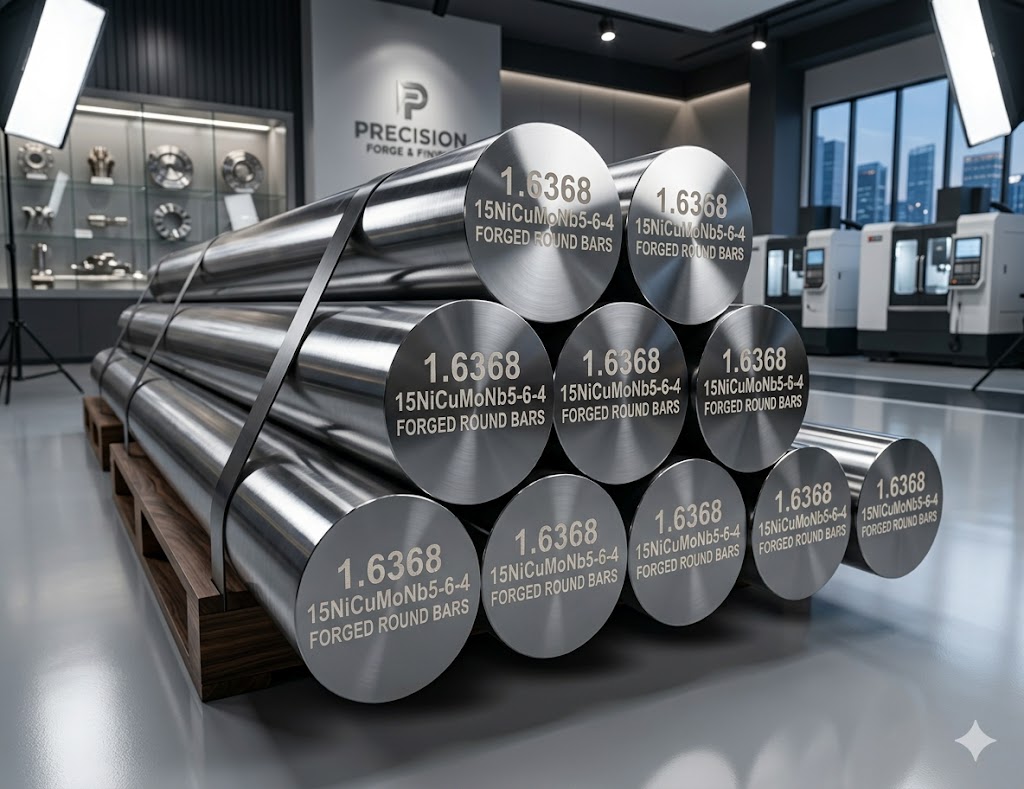
- 1.6368 forged round bars: Diameter 80 mm to 1,200 mm, length up to 6,000 mm — used as pressure vessel nozzle blanks, pump shaft pre-forms, and valve spindle stock
- 15NiCuMoNb5-6-4 forged flat bars and blocks: Thickness 50 mm to 600 mm, width up to 2,500 mm — used as tube sheet blanks, header end plate forgings, and boiler drum end caps
- Forged step shafts and gear shafts: Max O.D. up to 1,000 mm, length up to 8,000 mm — supplied rough-turned to drawing for finish machining by your workshop
- Hollow bars (forged with central hole): O.D. 200–800 mm, bore 80–400 mm — reduces downstream drilling cost on thick-walled nozzle applications
Ring & Flange Products
Seamless rolled rings from 1.6368 steel provide circumferential grain flow alignment, making them significantly stronger in the hoop direction than equivalent cut-from-bar flanges. We roll rectangular and profile cross-sections on our 5-metre ring rolling mill:
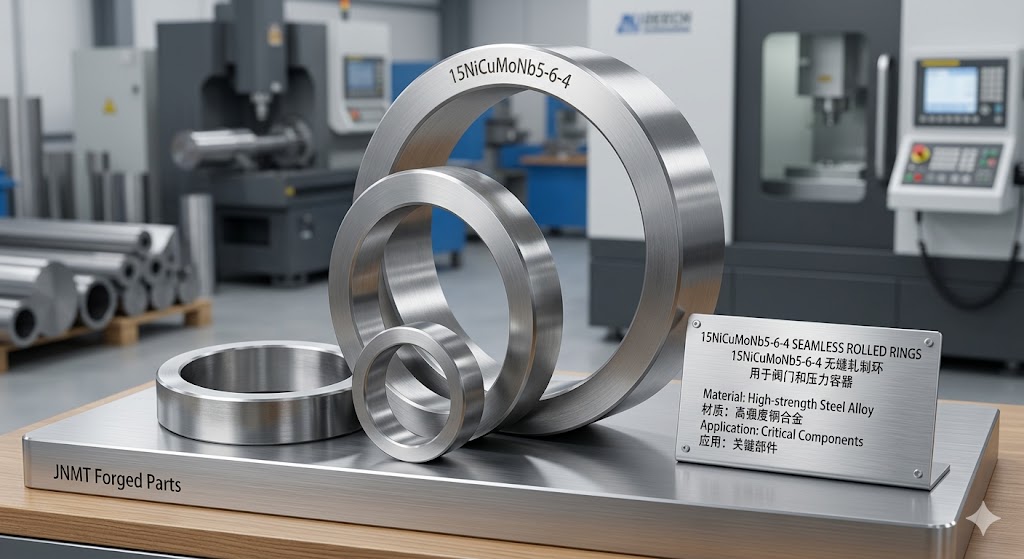
- 15NiCuMoNb5-6-4 seamless rolled rings: O.D. 300 mm to 5,000 mm, height 50 mm to 1,200 mm, wall thickness 30 mm to 500 mm
- Contoured / profile-rolled rings: T-section, L-section, and custom profiles rolled to near-net shape, reducing machining cost by up to 40%
- 1.6368 forged ring flanges: ANSI 150# through 2500#, EN PN16 through PN400 — weld-neck, slip-on, blind, and lap-joint configurations
- Double studded adapter flanges (DSAF) and integral mud flanges for subsea wellhead and Christmas tree assemblies, per API 6A/6BX requirements
Hollow & Casing Products
Complex hollow forgings — particularly pump casings and valve bodies — demand exceptional internal soundness, which is why we apply mandatory EN 10228-3 Class 4 UT acceptance on every piece. Our hollow product range includes:
- 1.6368 forged pressure vessel shells and barrel forgings: O.D. up to 2,000 mm, wall thickness 50–300 mm, length up to 3,000 mm per piece — for heat exchanger shells and reactor vessels
- 15NiCuMoNb5-6-4 forged pump casings and barrel cases: Available in split-casing and barrel designs for multistage high-pressure boiler feed pump (BFP) service
- Forged housings, sleeves, and bushings: Used as wear-resistant inserts and bearing journals in high-temperature turbine auxiliary systems
- Forged seamless pipe segments and nozzle pads: Wall thickness 30–150 mm, for weld-in pressure vessel nozzles requiring full-bore RT/UT examination
Flat & Block Products
- 15NiCuMoNb5-6-4 forged tube sheets: Diameter up to 3,000 mm, thickness 80–400 mm — supplied with drilled tube hole pattern and all faces finish-machined to Ra 3.2 or better
- 1.6368 forged discs and blanks: Used as valve disc, impeller, and backing flange applications; diameter 100–2,000 mm, thickness 20–500 mm
- Forged channel flanges and nozzle flanges for heat exchanger heads, with raised face (RF), ring-type joint (RTJ), or tongue-and-groove (T&G) finish options
Custom Fittings & Special-Shaped Parts
Many of the most demanding applications in oil and gas transmission require complex-geometry forgings that cannot be produced by any other process. Our special-shaped product range for 1.6368 includes:
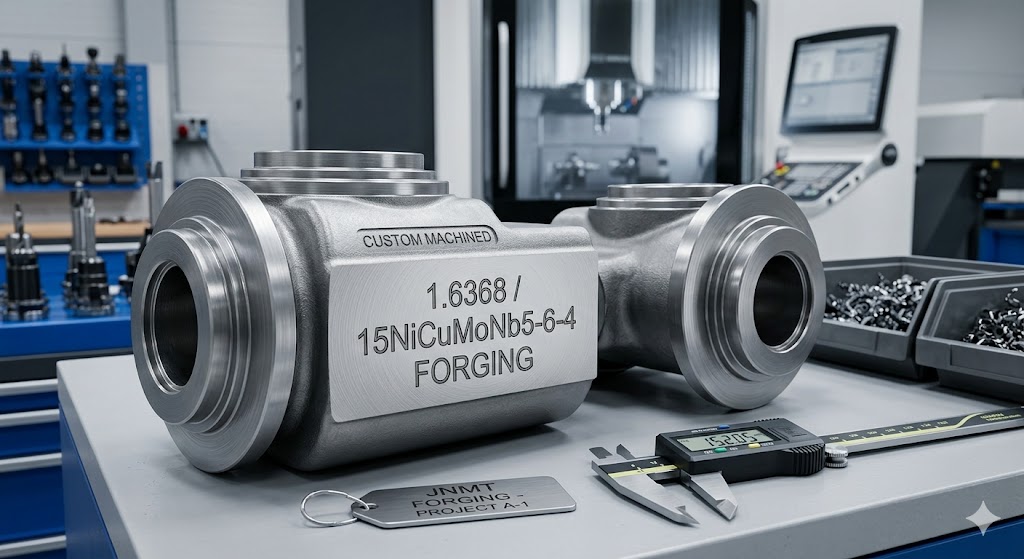
- 1.6368 forged lateral tees, T-pieces, and wye connectors: Bore sizes 2" to 24", pressure ratings up to ANSI 2500# / PN420 — used as high-pressure pipeline branch connections in gas processing plants
- 15NiCuMoNb5-6-4 swept branches and swept saddles: Integrally forged reinforcement for hot-tap and branch connections — eliminates the need for secondary reinforcing pads
- Forged transition cones and eccentric reducers: Used as stress-transition pieces in high-pressure boiler headers and steam drum nozzle zones
- Venturi cone meter bodies and flow conditioner forgings: Tight dimensional tolerances (±0.1 mm on critical bore dimensions) for custody-transfer measurement accuracy
Key Applications & Engineering Use Cases of 1.6368 (15NiCuMoNb5-6-4) Forgings
1.6368 (15NiCuMoNb5-6-4) is not a general-purpose alloy steel — it was developed specifically to solve a defined set of engineering problems: the need for a forging material that maintains structural integrity at continuous elevated temperatures, resists corrosion from process media, and retains excellent impact toughness for low-temperature inspection and pressure-test conditions. Below are the critical industries where its performance is irreplaceable, illustrated with verified regional application cases from our supply history.
1. Subcritical & Supercritical Thermal Power Plant Boiler Drums
The boiler drum is the central pressure vessel in a water-tube boiler circuit, operating continuously at steam pressures of 18–22 MPa and wall temperatures of 340–375 °C for the lifetime of the plant (often 30+ years without replacement). The demands placed on the drum shell material are uniquely severe: resistance to long-term creep deformation under sustained stress, resistance to hydrogen-induced embrittlement from water chemistry, dimensional stability through millions of thermal cycles, and toughness sufficient to survive pressure-test conditions at ambient temperature after high-temperature service.
1.6368 (15NiCuMoNb5-6-4) was standardized by European boiler codes specifically to meet these requirements. Its copper content suppresses corrosion in low-oxygen boiler water environments; its niobium grain refinement ensures uniform toughness in thick drum shells up to 200 mm wall thickness; its controlled carbon range (0.10–0.17%) allows weld repairs without preheating above 150 °C. Our forged 15NiCuMoNb5-6-4 boiler drum shells, header end plates, and manway nozzle forgings are manufactured to EN 10222-2 with EN 10228-3 Class 4 UT and EN 10204 3.1 MTC as standard, meeting the document requirements of European boiler fabricators for EN 12952 and EN 13445 class vessels.
2. Nuclear Reactor Secondary Circuit Evaporators & Pressurizer Components
In pressurized water reactor (PWR) nuclear plants, the secondary circuit steam generator operates in a chemically controlled water environment at 280–320 °C and 6–8 MPa. The forged shell and tubesheet of the evaporator (steam generator) must demonstrate consistent through-thickness mechanical properties, verifiable material traceability back to the steel melt, and documentation packages compatible with PED 2014/68/EU requirements. Forging's grain refinement over rolling gives the uniform Charpy impact properties (≥ 48 J average at 20 °C, longitudinal direction) that nuclear owner specifications routinely impose on secondary circuit components.
Our 1.6368 forged cylindrical shells, dish ends, and nozzle forgings for secondary circuit pressure equipment are manufactured with complete melt-to-dispatch traceability: spectroscopic ladle analysis, forging reduction ratio records, heat treatment furnace charts, and EN 10204 3.1 MTC as standard. Where the project requires EN 10204 3.2 with independent third-party witness, we arrange this through EU-accredited inspection bodies on a project-by-project basis.
3. High-Pressure Hydrogenation, Refinery, & Gas Processing Vessels
Hydrogen service at elevated temperature and pressure presents one of the most hostile environments for carbon and low-alloy steel: Nelson curve limits restrict conventional steels in the high-temperature/high-pressure hydrogen zone where carbide dissolution and hydrogen attack can degrade tensile strength and ductility irreversibly. 1.6368 steel's molybdenum content stabilizes carbides against dissolution (shifting the Nelson curve limit upward) while its nickel and copper additions provide additional resistance to hydrogen embrittlement and wet H₂S stress corrosion cracking.
We supply 15NiCuMoNb5-6-4 forged pressure vessel heads, shell courses, nozzle forgings, and heat exchanger tube sheets for hydrodesulfurization (HDS), catalytic reforming (CCR), and amine treating units in refineries across Saudi Arabia, the UAE, Malaysia, and Indonesia. Component weights typically range from 2,000 to 25,000 kg per piece; all are supplied with PWHT simulation tensile and impact test results to verify the delivered heat treatment condition represents post-weld-fabrication properties.
4. High-Integrity Valve Bodies & Bonnets for Power & Process Service
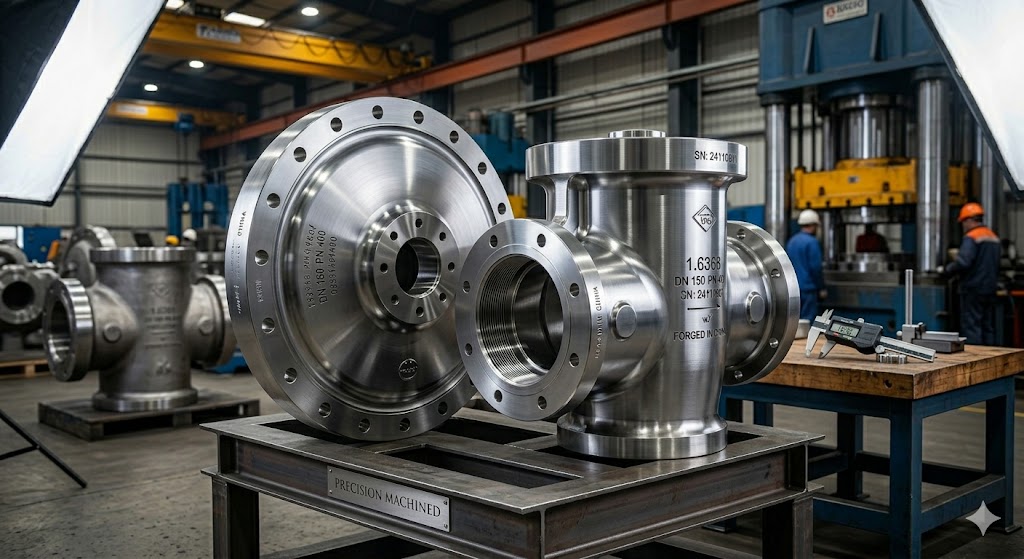
Forged valve bodies in 1.6368 are specified where cast steel valve bodies (which suffer from shrinkage porosity and segregation in heavy sections) are deemed inadequate. The forging process eliminates internal voids and produces a consistent microstructure through the full valve body cross-section — critical for gate valve seats that must seal at 250 bar and 350 °C after 10,000 operational cycles. Forged 15NiCuMoNb5-6-4 valve bodies also weld more predictably than cast equivalents, simplifying the valve body-to-pipe weld procedure qualification.
Our forged valve products for power generation and process service include gate valve bodies, globe valve bodies, check valve bodies, and pressure-seal bonnet forgings in pressure classes ANSI 600 through 2500, DN 50 through DN 600. They are supplied rough-bored to valve manufacturer drawings, with EN 10228-2 penetrant testing (PT) on all machined surfaces and EN 10228-3 UT on the body wall before machining.
5. High-Pressure Boiler Feed Pump (BFP) Barrels & Casings
Multi-stage boiler feed pumps in thermal power plants operate at discharge pressures of 20–35 MPa, temperatures up to 200 °C, and must run continuously for 8,000+ hours between major overhauls. The pump barrel (outer pressure casing) must withstand the full differential pressure between discharge and suction while maintaining dimensional stability — barrel distortion of even 0.05 mm can cause interstage seal failures and dramatic efficiency loss. 1.6368 steel has high proof strength (≥ 430 MPa at room temperature, ≥ 337 MPa at 350 °C) and excellent machinability, so that it is the best choice material for barrel casings, discharge heads, and suction heads in European and Asian power station BFP specifications. We produce barrel forgings in 1.6368 up to 1,800 mm O.D. for pump OEM clients in Germany, Austria, the United Kingdom, and Japan.
1.6368 vs Similar Steel Grades: How to Select the Right Material
Engineers specifying pressure equipment forgings often evaluate 1.6368 alongside other low-alloy heat-resistant steels. Knowing where 1.6368 has a distinct technical advantage and where other options might be just as good is important to choose the right material. The following comparison draws on our 26 years of manufacturing experience with these grades:
1.6368 vs 16Mo3 (EN 1.5415)
16Mo3 is a molybdenum-alloyed boiler plate steel widely specified for superheater headers and steam pipes. Compared to 1.6368, it has lower nickel content (typically ≤ 0.30% Ni vs 1.00–1.30% Ni in 1.6368) and no copper or niobium. In practice: 16Mo3 is suitable for steam temperatures up to 530 °C and is cost-effective for thinner pressure parts (≤ 100 mm). However, for heavy-section forgings above 150 mm wall thickness, 1.6368's niobium-enhanced grain refinement consistently delivers superior Charpy impact values and more uniform through-thickness tensile properties versus 16Mo3 in equivalent thickness. 1.6368 is also preferred where atmospheric corrosion resistance matters (outdoor drum applications, coastal power plants), because its copper content provides passive surface film protection that 16Mo3 lacks entirely.
1.6368 vs SA-508 Grade 3 (ASME equivalent)
SA-508 Grade 3 is the ASME standard equivalent for nuclear reactor pressure vessel (RPV) head forgings and is specified in many North American and Asian nuclear projects. Both grades feature nickel–molybdenum–manganese alloying but SA-508 Gr.3 typically targets higher yield strength (≥ 345 MPa vs ≥ 430 MPa for 1.6368). For European-flagged projects under EN 13480, EN 13445, or EN 12952 requiring EN 10222-2 material certificates, 1.6368 is the appropriate choice — SA-508 Gr.3 is not listed in European pressure equipment codes and cannot be directly substituted without a material equivalency review by a notified body. We supply both grades and can advise on documentation requirements for cross-standard applications.
1.6368 vs P355NH / P355NL2 (EN 10028-3)
P355NH and P355NL2 are fine-grain normalized structural steels often considered for pressure vessels where low-temperature toughness is the primary concern. They are generally cheaper than 1.6368 for ambient-temperature or mildly elevated-temperature service. However, their allowable stress rapidly decreases above 300 °C due to the absence of creep-strengthening alloying elements. Above 300 °C service temperature, 1.6368 provides 25–40% higher allowable stress values per EN 13445-3 Annex B tables, which directly reduces the required wall thickness and overall forging weight — often making 1.6368 more economically competitive than it first appears despite higher raw material cost.
Our 1.6368 Steel Making & Forging Process — Step by Step
Many forging suppliers purchase commercial bar stock or billets from a third-party steel mill and simply forge them to shape. We do not. Every heat of 1.6368 steel we forge starts from our own EAF charge in our Jiangyin facility, giving us complete metallurgical control that is simply unavailable when buying commercial billets of unknown thermal history. Our process chain for 1.6368 forgings is as follows:
Step 1 — Electric Arc Furnace (EAF) Primary Melting
We charge clean low-residual scrap into our 30-tonne EAF and melt to a primary tap temperature of approximately 1,620–1,640 °C. The EAF tap chemistry is checked by OES (optical emission spectroscopy) in our on-site metallurgical lab within 4 minutes of tapping. If any element is out of specification, the heat is corrected at the ladle furnace stage — not approved and forged regardless. Carbon is targeted at the lower end of the 1.6368 specification at this stage (C ~0.12%) to preserve post-tap decarburization headroom.
Step 2 — Ladle Furnace (LF) Refining & Alloy Trimming
The liquid steel is transferred to our ladle furnace, where precise alloy additions of ferronickel, copper master alloy, ferromolybdenum, and ferroniobium are made under synthetic slag cover. Temperature is adjusted to the target tapping range using induction heating, and calcium-silicon wire injection is performed to modify inclusion morphology — converting angular alumina clusters into rounded calcium-aluminate globules that are less damaging to toughness and fatigue life. Final sulfur is reduced to ≤ 0.008% (well below the 0.020% maximum in the EN standard) by LF desulfurization, directly improving transverse toughness in heavy cross-sections.
Step 3 — Vacuum Degassing (VD/VOD)
After ladle furnace refining, the steel is transferred to our vacuum degassing unit and held under a vacuum of ≤ 0.5 mbar for a minimum of 12 minutes. This removes dissolved hydrogen (to ≤ 1.5 ppm), nitrogen (to ≤ 60 ppm), and oxygen, dramatically reducing the risk of hydrogen-induced flaking in thick forgings and minimizing the non-metallic inclusion count. The resulting steel cleanliness significantly exceeds the minimum requirements of EN 10228-3 Class 4 UT, giving our forgings a clear margin of safety against subsurface defect indications.
Step 4 — Ingot Casting & Slow Cooling
Degassed steel is bottom-poured into cast iron ingot molds sized to match the target forging. Controlled pour rate and hot-top design minimize pipe depth and macrosegregation. After solidification, ingots are slow-cooled in annealing pits for 48–72 hours before stripping, to prevent thermal cracking and allow hydrogen to diffuse out of the solid ingot. The top (hot-top) and bottom (slab) crop allowances are calculated to ensure the forging blank derives only from the chemically uniform central ingot body.
Step 5 — Open Die Forging or Seamless Ring Rolling
Ingots are reheated to the forging temperature range (1,150–1,230 °C) and forged on our 6,300-tonne hydraulic press. We apply a minimum forging reduction ratio of 4:1 (measured on the reduction in cross-sectional area) for all structural forgings, and ≥ 5:1 for heavy flanges and drum shells where maximum soundness is critical. Multiple upset and draw-out passes under our quality forging procedure ensure central porosity closure and fibrous grain flow orientation optimized for the application. For rings and flanges, pierced billets are transferred to our 5-metre vertical ring rolling mill for finishing to dimensional tolerance.
Step 6 — Controlled Heat Treatment
All forgings are heat-treated in our calibrated car-bottom or pit furnaces using written heat treatment procedures that specify target temperature, ramp rate, hold time per unit cross-section, and cooling medium. For 1.6368, the standard delivery condition is quenched-and-tempered (QT): austenitized at 920–950 °C, water or oil quenched depending on cross-section, then tempered at 640–665 °C for a minimum soaking time of 1 min/mm of maximum cross-section. Furnace temperature uniformity is verified by Type-K thermocouple surveys to ±10 °C across the load. Heat treatment records are retained for 10 years as part of our ISO 9001 document control system.
Our complete in-house production line, supported by advanced forging, smelting and heat treatment equipment, allows us to guarantee a level of process traceability and metallurgical consistency that no billet-buying forging shop can match.
Chemical Composition of 1.6368 (15NiCuMoNb5-6-4) Steel
The chemical composition of 1.6368 is defined in EN 10028-2 and EN 10222-2. Unlike multi-purpose alloy steels where composition is a compromise across many applications, 1.6368 has a highly purposeful chemistry in which each alloying element addresses a specific performance requirement. Our production consistently targets the mid-range of each specification band — not the permitted maximum — which is why our forgings reliably pass all property tests with margin to spare. The standard composition limits are:
| Analysis Type | C | Si | Mn | P | S | Cr | Ni | Cu | Mo | Nb | N | Al | |
|---|---|---|---|---|---|---|---|---|---|---|---|---|---|
| Percentage of mass [%] | |||||||||||||
| Ladle Analysis | Min. | 0.10 | 0.25 | 0.80 | --- | --- | --- | 1.00 | 0.50 | 0.25 | 0.015 | --- | 0.015 |
| Max. | 0.17 | 0.50 | 1.20 | 0.025 | 0.020 | 0.30 | 1.30 | 0.80 | 0.50 | 0.045 | 0.020 | 0.050 | |
| Part Analysis | Min. | 0.08 | 0.20 | 0.75 | --- | --- | --- | 0.95 | 0.45 | 0.22 | 0.010 | --- | 0.010 |
| Max. | 0.19 | 0.56 | 1.30 | 0.030 | 0.025 | 0.35 | 1.35 | 0.85 | 0.54 | 0.050 | 0.022 | 0.060 | |
Note: All data are percentage of mass [%], fully compliant with EN standard requirements for 1.6368 steel.
Engineering Interpretation of the Alloying Elements
Carbon (C, 0.10–0.17%): Carbon is the primary strengthening element. The narrow band is deliberate: too low (below 0.10%) would reduce tensile strength below specification; too high (above 0.17%) increases hardenability, raises the risk of weld heat-affected zone (HAZ) hardening, and elevates the ductile-to-brittle transition temperature. The 1.6368 carbon range is specifically designed to balance strength with weldability and toughness in thick sections.
Nickel (Ni, 1.00–1.30%): The most significant alloying addition. Nickel is a powerful toughness enhancer — it lowers the DBTT (ductile-to-brittle transition temperature) by approximately 10 °C per 0.1% Ni addition, which is critical for heavy-section forgings that must be tested at 0 °C. Nickel also stabilizes the ferritic microstructure at elevated temperatures and provides solid-solution strengthening without adversely affecting weldability at this concentration level.
Copper (Cu, 0.50–0.80%): Copper serves a dual purpose unique to 1.6368. First, it improves atmospheric and aqueous corrosion resistance (including resistance to low-pH condensate in boiler environments) by forming a protective adherent rust layer. Second, small copper additions at these levels have been shown to contribute to elevated-temperature strength through fine copper-precipitate strengthening in tempered conditions — an effect particularly beneficial in the 300–400 °C service range.
Molybdenum (Mo, 0.25–0.50%): Molybdenum is the primary creep-resistance addition. It forms stable Mo₂C carbide dispersions that pin grain boundaries and resist dislocation climb at elevated temperature — the mechanism responsible for creep failure. Mo also significantly improves the temper resistance of 1.6368 by moving the tempering parameter curve to higher temperatures so that adequate strength is retained even after PWHT at 600–620 °C in fabrication.
Niobium (Nb, 0.015–0.045%): Despite its low concentration, niobium has a disproportionate impact on properties. During normalizing or austenitization heat treatment, NbC precipitates pin austenite grain boundaries, preventing grain growth to coarse sizes that would degrade toughness. The result is a consistently fine austenite grain size (ASTM 6–8 or finer) through the full cross-section of even 600 mm thick forgings — directly improving impact energy values and reducing property scatter between specimens taken from the forging surface and those from the quarter-thickness or center locations.
Aluminum (Al, 0.015–0.050%) and Nitrogen (N, ≤ 0.020%): Aluminum acts as a deoxidizer and fine-grain former (through AlN precipitation). The Al/N ratio is balanced to ensure sufficient soluble Al for grain size control without the risk of Al₂O₃ inclusion stringers that degrade transverse toughness. Controlled nitrogen in combination with Al and Nb ensures that free nitrogen (which embrittles steels through strain-ageing) is fully combined into stable nitride precipitates in the final microstructure.
Mechanical Properties of 1.6368 (15NiCuMoNb5-6-4) Forged Steel Parts
The following mechanical property requirements are extracted from EN 10222-2 for 1.6368 forgings in the quenched-and-tempered (QT) delivery condition. These are minimum guaranteed values — our actual test results, available in EN 10204 3.1 MTCs for every delivery, consistently exceed these minima, typically showing yield strength 460–510 MPa, tensile strength 600–700 MPa, and Charpy impact values 55–90 J in the longitudinal direction at 0 °C for standard QT forgings in the 80–300 mm thickness range.
Guaranteed Room Temperature Mechanical Properties
| Thickness tR [mm] | Test Piece Direction | ReH [MPa] | Rm [MPa] | Elongation A [%] |
|---|---|---|---|---|
| ≤ 800 | Transverse (Q) / Tangential (T) | ≥ 430 | 580 - 740 | ≥ 18 |
| ≤ 800 | Longitudinal (L) | ≥ 430 | 580 - 740 | ≥ 20 |
Notes: 1. If upper yield strength (ReH) does not develop, the strength requirements apply to the 0.2% proof strength (Rp 0.2). 2. The single tensile strength specification (580–740 MPa) applies for all cross-section thicknesses up to 800 mm — a direct result of the through-hardening capability provided by the Ni–Mo–Nb alloying system. 3. Longitudinal elongation (≥ 20%) exceeds transverse (≥ 18%) due to directional grain flow from forging.
Guaranteed Elevated Temperature Proof Strength (Rp 0.2)
The high-temperature proof strength data below are critical for pressure vessel and boiler designers using EN 13445-3 or EN 12952-3 design codes, as they determine the allowable stress at operating temperature. 1.6368 retains a notably high fraction of its room-temperature strength at elevated temperatures compared to non-alloyed or simple Mn-Si steels — for example, at 350 °C, Rp 0.2 is 337 MPa (78% retention), versus ~55–65% for unalloyed steels of similar room-temperature strength. For thickness ≤ 800 mm (all test directions):
| Temperature [°C] | 100 | 150 | 200 | 250 | 300 | 350 | 400 | 450 |
|---|---|---|---|---|---|---|---|---|
| Rp 0.2 [MPa] | 402 | 389 | 376 | 363 | 350 | 337 | 324 | 294 |
Practical design note: At the 375 °C long-term boiler drum operating limit, Rp 0.2 for 1.6368 is interpolated as approximately 331 MPa. Applying the EN 13445-3 safety factor of 1.5 on proof strength gives an allowable design stress of ~220 MPa at this temperature — substantially higher than would be achieved with an equivalent P265GH or P355NH grade at the same temperature, directly enabling thinner and lighter drum wall designs.
Guaranteed Impact Energy (Charpy V-notch KV2)
| Thickness tR [mm] | Test Piece Direction | KV2 Impact Energy at 0°C | KV2 Impact Energy at 20°C |
|---|---|---|---|
| ≤ 800 | Transverse (Q) / Tangential (T) | ≥ 31 J | ≥ 40 J |
| ≤ 800 | Longitudinal (L) | ≥ 39 J | ≥ 48 J |
Note: The mean value for a series of three specimens shall meet the specified value. An individual value may be lower than the required value, provided it is not below 70% of the specified mean value. Impact tests are conducted per EN ISO 148-1 on standard 10×10×55 mm specimens with a 2 mm V-notch, using a calibrated 300-J Charpy pendulum in our in-house materials lab. Test temperature is verified by calibrated thermocouple measurement of the specimen temperature immediately before impact.
Heat Treatment Process for 1.6368 (15NiCuMoNb5-6-4) Forging Components
Heat treatment is not a finishing step for 1.6368 forgings — it is an integral part of the metallurgical design. The relationship between forging reduction, austenitizing temperature, cooling rate, and tempering parameters determines the final microstructure and all consequent mechanical properties. Our heat treatment procedures are developed and validated on production-representative cross-sections before being applied to customer forgings, and every run is documented with time-temperature records available for customer review.
| Process Type | Temperature Range | Key Process Requirements |
|---|---|---|
| Quenching / Normalizing / Hardening | 880°C to 960°C | After reaching the target temperature throughout the entire cross-section, cooling in air, oil or water-based medium |
| Tempering | 620°C to 680°C | Soaking time complies with EN ISO 4885, minimum 30 minutes; final cooling in air |
| Post-welding Stress Relief Annealing | 530°C to 620°C | Soaking time based on thickness: ≤15mm ≥15min; 15-30mm ≥30min; 30-150mm ~60min; 150-400mm ~90min; 400-625mm ~120min; cooling in air |
Why These Heat Treatment Parameters? — The Metallurgical Logic
Austenitizing temperature (880–960 °C): This range is selected to fully dissolve all carbon into austenite (above the Ac3 temperature of approximately 840–860 °C for this composition) while NbC precipitates remain partially undissolved, pinning austenite grain boundaries and preventing the grain growth that would occur if temperatures exceeded 1,000 °C. The optimal target for production forgings is typically 920–940 °C, which balances complete austenitization with fine retained grain size.
Quench medium selection: Water quenching gives maximum cooling rate and is preferred for large cross-sections (≥ 150 mm) where section size alone limits the cooling rate at the center of the forging. Oil quenching is used for forgings with complex shapes or significant thickness variation where water quenching might cause thermal gradient cracking. Polymer (water-glycol) quenching is applied where a cooling rate between water and oil is required to achieve uniform through-section hardness without distortion. The cooling medium selection for each forging is specified in the forging process plan reviewed before production.
Tempering temperature (620–680 °C): Tempering transforms the hard and brittle as-quenched martensite /bainite microstructure into a tough tempered bainite or tempered martensite with the required strength and impact properties.For 1.6368, the 620–680 °C range is above the secondary hardening peak temperature (approximately 550 °C for Mo-bearing steels) and well into the over-aging region where Mo₂C carbides coarsen into a stable, non-hardening distribution. This ensures that the steel is metallurgically stable at service temperatures up to 375 °C — a tempered steel whose tempering temperature is well above its service temperature cannot undergo further softening in service. The minimum 30-minute hold time (per EN ISO 4885) is extended in our production procedures to 2 minutes per mm of maximum cross-section for forgings above 100 mm thickness, ensuring thermal equilibrium through the entire section.
PWHT stress relief (530–620 °C): After welding in fabrication, the 1.6368 forging may be subjected to post-weld heat treatment (PWHT) by the vessel fabricator to relieve residual welding stresses and restore HAZ toughness. The defined PWHT temperature range (530–620 °C) is lower than the original tempering temperature (620–680 °C) and it is guaranteed that PWHT cannot soften the forging properties below their originally certified values. The thickness-dependent soaking times make sure that even the thickest sections (400–625 mm) reach equilibrium temperature before the cooling cycle begins.
Strict Testing & Inspection Requirements for 1.6368 (15NiCuMoNb5-6-4) Forgings
Quality inspection of 1.6368 forgings is not a checkbox exercise — it is a systematic risk reduction process designed to ensure that every property specified in EN 10222-2 is actually present in the finished forging, not just in the forging material specification. Our test and inspection plan for each 1.6368 forging order is reviewed and approved before production begins, identifying every test requirement, sampling location, acceptance criterion, and documentation obligation for that specific component.
Chemical Composition Analysis — Every Heat, No Exceptions
Compulsory ladle (heat) analysis is performed for every melt of 1.6368 steel by our in-house OES spectrometer within 4 minutes of tapping. The ladle analysis result is available before the heat enters the ladle furnace refining stage, allowing real-time alloy corrections. A product (part) analysis is additionally performed on a test coupon cut from each forging after final heat treatment — providing the definitive composition of the delivered material, not just the melt average. Both analyses are reported in the EN 10204 3.1 MTC with the spectrometer calibration certificate reference included.
Mechanical Performance Testing — Sample Location Traceability
- Room temperature tensile test per EN ISO 6892-1 (Method A, strain rate 0.00025 s⁻¹): reports ReH or Rp 0.2, Rm, A%, and Z% (reduction of area). Test pieces are taken from the designated test coupon location specified in EN 10222-1 (typically the 1/4-thickness position from the largest surface of the forging) to represent the minimum property location. Both longitudinal and transverse directions are tested on disc forgings and heavy rings where through-thickness property anisotropy is relevant.
- Elevated temperature tensile test per EN ISO 6892-2 at 350 °C: verifies that the Rp 0.2 at service temperature meets the tabulated EN 10222-2 requirements. Results are reported to 3 significant figures with the actual test temperature (maintained within ±3 °C) recorded.
- Charpy V-notch impact test per EN ISO 148-1: three specimens at 0 °C — mean value must meet minimum energy requirement, no individual value below 70% of the mean minimum. Specimen dimensions are 10×10×55 mm (full-size); where geometry prevents full-size specimens, sub-size corrections are applied and noted. Test temperature is calibrated by direct thermocouple measurement of each specimen immediately before striking.
- Brinell hardness test per EN ISO 6506-1: required for all forgings ≤ 1,000 kg. For forgings above 1,000 kg, hardness is recorded as supplementary information. Hardness testing is performed at defined surface locations after final heat treatment, and all readings — including minimum and maximum — are reported verbatim in the test certificate. Our typical HBW range for QT 1.6368 is 170–210 HBW, confirming proper heat treatment condition.
Non-Destructive Testing (NDT) — Defect Detection at Every Level
- Volumetric ultrasonic testing (UT): All forgings are UT tested per EN 10228-3, acceptance Quality Class 4 (the most stringent class in the standard). Pulse-echo immersion or contact scanning covers 100% of the accessible forging volume. Class 4 acceptance rejects any single echo exceeding 50% of the calibration reflector amplitude. For seamless rolled bars ≥ 30 mm diameter, UT is performed per EN 10308 Quality Class 4. Our UT operators hold PCN/CSWIP Level 2 or equivalent certification. Equipment calibration records are part of the inspection documentation package.
- Surface magnetic particle inspection (MPI) per EN 10228-1, Quality Class 3, applied to all forging surfaces. MPI is performed after final heat treatment and after any intermediate machining that exposes new surface. Wet fluorescent magnetic particle method using UV-A illumination ensures detection of surface-breaking and near-surface linear indications (cracks, laps, seams) exceeding 3 mm in length. All indications are documented photographically before disposition.
- Liquid penetrant testing (PT) per EN 10228-2, Quality Class 3: applied as an alternative to MPI for non-magnetic welds or as supplementary examination at customer request. PT can detect surface-opening defects as fine as 0.01 mm opening width under proper cleanliness and developer conditions.
- Dimension Test: All machined or rough machined forgings are dimensionally checked with calibrated CMM (coordinate measuring machine) or manual gauging. Tolerances to ISO 286 or customer drawing requirements, whichever is more stringent.Dimensional reports are issued as part of the final documentation package.
Standard Compliance & Test Unit Definition
All test units, sample quantity, sampling location, and specimen orientation strictly follow EN 10222-1, Clause 7. A test unit consists of forgings of the same material heat (melt), same heat treatment charge (furnace load and temperature cycle), and same cross-section class. If a forging fails to meet any mechanical test requirement, EN 10222-1 provides defined retest provisions: retesting of additional specimens from the same test coupon, or if the coupon is exhausted, re-heat treatment of the forging and complete re-testing from scratch. We have never had a forging rejected by a customer AIA following final inspection — a record we attribute directly to our rigorous in-process controls rather than to good fortune.
Product Marking, Traceability & Inspection Certification for 1.6368 Forgings
Full Traceable Marking on Every Forging
Traceability is a non-negotiable requirement for pressure equipment under PED 2014/68/EU, and for safety-related components in nuclear, power, and oil and gas service. Our marking system ensures that every 1.6368 forging can be linked back to its original steel heat, heat treatment lot, and inspection records from the moment it leaves our factory until end-of-life decommissioning. All markings are applied by low-stress vibro-engraving or indelible paint stencil (for surfaces that cannot be stamped due to stress concentration concerns), and include:
- Manufacturer's identification mark: Jiangsu Liangyi's factory identifier stamped or engraved on the forging surface
- Heat number: The unique melt identifier linking the forging to the ladle analysis, vacuum degassing record, and raw material traceability — the most critical traceability link in the chain
- Test specimen number: Links the forging to the specific mechanical test coupon from which its qualifying specimens were cut, allowing any future questions about property validity to be resolved by re-examination of retained specimens
- Heat treatment number: Identifies the furnace charge, temperature program, and quench record so that any heat treatment non-conformance can be immediately correlated to affected forgings
- Material designation: Marked as "1.6368" or "15NiCuMoNb5" per EN 10027 designation system — both forms are recognized and both appear on the MTC
- Serial / part number (where applicable): Allows one-to-one correlation between the forging, the order, the drawing, and all inspection documents when a batch contains multiple pieces
EN 10204 Inspection Certificate Types — Which One Do You Need?
We issue inspection certificates in full compliance with EN 10204:2004. Understanding the difference between certificate types is important for specifying the correct documentation requirement in your purchase order:
- EN 10204 Type 2.2 (Test Report): A statement of compliance with the order, based on non-specific inspection — suitable for lower-criticality structural applications. We rarely supply 1.6368 forgings on a 2.2 certificate given the applications involved.
- EN 10204 Type 3.1 (Mill Test Certificate, MTC): Our standard offering for all 1.6368 forgings. The 3.1 certificate is issued and signed by our authorized Quality Control representative, who is independent of the production department. It contains the actual heat analysis, all mechanical test results with specimen identification, heat treatment conditions (temperature, time, furnace record reference), NDT results and acceptance class, hardness test data, and a declaration of conformity with EN 10222-2 and your order specification. The 3.1 certificate is accepted by all major European engineering contractors and pressure vessel fabricators.
- EN 10204 Type 3.2 (Third-Party Inspection Certificate): Available upon request. This certificate requires co-signature by an independent inspection authority (TÜV, Bureau Veritas, SGS, Lloyds Register, Intertek, etc.) who physically witnesses or validates our testing. Jiangsu Liangyi does not sign 3.2 alone; the external party must be present or review the records before signing. If you require 3.2, please indicate this on your purchase order and inspection agency of choice. We will coordinate the scope and logistics of the inspection jointly as appropriate.
All inspection documents are issued with unique document numbers, revision status, page numbers, and total page count. Supporting records (furnace charts, NDT reports, spectrometer printouts, load cell calibration records) are retained in our document management system for a minimum of 10 years and can be recalled for any delivery at any time. We operate under ISO 9001:2015 and our QC representative, who is independent of the production department, signs all EN 10204 3.1 MTCs. Where your project specification requires EN 10204 3.2 certificates co-signed by an independent inspection authority, please state this requirement in your purchase order and we will arrange accordingly.
Frequently Asked Questions About 1.6368 (15NiCuMoNb5-6-4) Steel Forgings
Regarding PED 2014/68/EU: PED is an EU regulatory framework, not a material certification. When your project requires PED-compliant pressure equipment, the PED assessment is performed by a Notified Body engaged by the equipment fabricator (not the forging material supplier). Our role as the forging manufacturer is to supply material to the harmonized EN standard (EN 10222-2) and provide the required EN 10204 documentation — which is exactly what we do. Where your project additionally requires EN 10204 3.2 third-party inspection certificate (co-signed by an independent inspection body), we arrange this on request with accredited inspection organizations. For non-EU projects, we can produce forgings to ASME material requirements, API 6A, or customer-specific material specifications with equivalent testing documentation.
Request a Quote for Custom 1.6368 (15NiCuMoNb5-6-4) Forging Parts
Our engineering and sales team is ready to support your 1.6368 forging requirements — from material choice and forging feasibility review through to final dimensional and documentation sign-off. We respond to all technical inquiries within 24 hours and deliver preliminary cost estimates within 2–3 working days of receiving your drawings or specifications.
To receive the most accurate quotation, please share: your part drawing (DXF / STEP / PDF), required material standard (EN 10222-2 / EN 10028-2 or equivalent), required delivery condition (QT / N+T), required certification type (EN 10204 3.1 or 3.2), and your target delivery date. We will confirm technical feasibility, forging weight, heat treatment parameters, and lead time in our response.
📧 Inquiry Email: sales@jnmtforgedparts.com
📞 Phone/WhatsApp: +86-13585067993
🌐 Official Website: https://www.jnmtforgedparts.com
📍 Factory Address: Chengchang Industry Park, Jiangyin City, Jiangsu Province, China 214400