1.6359 (X2NiCoMo18-8-5 / 18Ni-300) Forging Parts | Custom Open Die Forgings Manufacturer
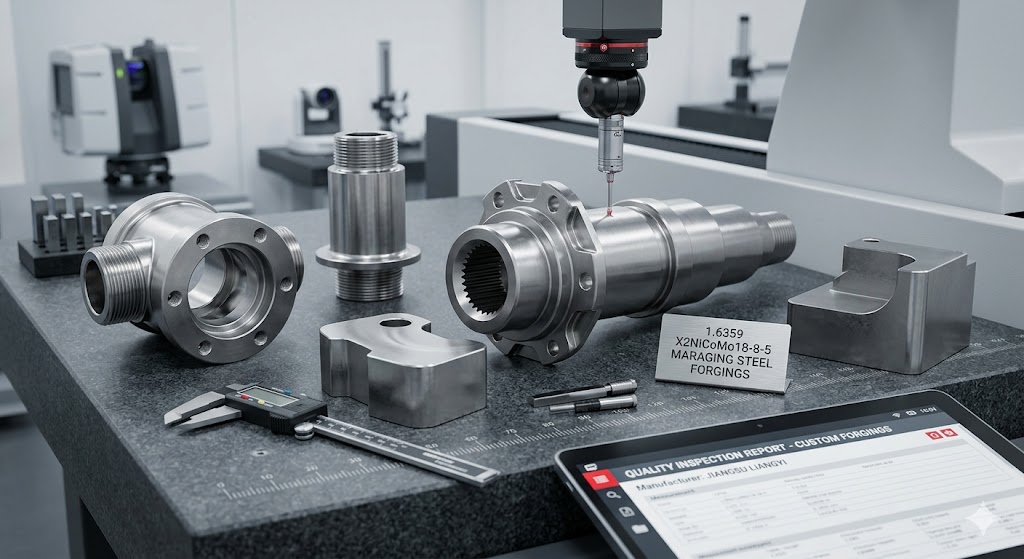
Jiangsu Liangyi Co., Limited is a professional ISO 9001:2015 certified manufacturer of 1.6359 (also designated as X2NiCoMo18-8-5, W.Nr. 1.6359, X2NiCoMo1885, 18Ni-300 maraging steel, UNS K93120) open die forging parts, seamless rolled rings and precision-machined forged components in China. Founded in 1997 and operating from an 80,000 m² campus in Jiangyin City, Jiangsu Province, we are equipped with a 6,000-ton hydraulic forging press, a 5-meter seamless rolling machine and ten automated heat treatment furnaces — forming a vertically integrated manufacturing chain from steel billet to finished component. With over 25 years of continuous export experience and an annual production capacity exceeding 120,000 tons, we deliver verified, ultra-high-strength 1.6359 forged steel products to engineering clients in more than 50 countries across Europe, North America, the Middle East, Southeast Asia, Australia and South America, manufactured and tested to the dimensional, material and inspection requirements referenced in ASTM, DIN, EN, API 6A, RCC-M and NORSOK standards, subject to customer-specified testing plans, with complete EN10204 3.1/3.2 mill test certificates and full third-party inspection support.
What Is 1.6359 (X2NiCoMo18-8-5) Maraging Steel? — Metallurgical Background
The designation "1.6359" follows the European Werkstoff numbering system, where the prefix 1.6 identifies a group of high-alloy structural steels. The chemical shorthand "X2NiCoMo18-8-5" decodes as follows: the leading "X" confirms alloy steel status; "2" indicates an ultra-low nominal carbon content of ≤0.03 wt%; and "18-8-5" denotes the nominal content of the three dominant alloying elements — 18% nickel, 8% cobalt and 5% molybdenum. In North American and ASTM/AMS terminology the same alloy family is called 18Ni-300 maraging steel, where "300" refers to its nominal yield strength of 300 ksi (≈ 2,070 MPa in the overaged condition, or a guaranteed 1,780 MPa in the standard aged condition under EN/DIN specification).
Maraging steel as a class was developed in the late 1950s by researchers at the International Nickel Company (INCO) in the United States, seeking to combine the ease of fabrication of a low-carbon steel with a final strength level previously achievable only through extremely high-carbon tool steels that were brittle and difficult to weld. The solution was elegant: keep carbon near zero to maintain a tough, machinable iron-nickel martensite after air cooling, then drive up strength exclusively through precipitation of coherent intermetallic compounds — a process called "maraging" (martensite + aging). 1.6359 / 18Ni-300 sits at the top of the commercially produced maraging steel family, offering the highest strength-to-weight ratio of any wrought steel that remains commercially weldable without preheating.
The Precipitation Hardening Mechanism — Why 1.6359 Achieves 1850 MPa
Understanding the hardening mechanism helps engineers correctly specify heat treatment and avoid costly over-aging errors in service. During solution annealing at 820–840°C, all solute atoms — primarily Ni, Co, Mo and Ti — dissolve completely into the iron matrix, forming a homogeneous face-centered-cubic (FCC) austenite. Upon air cooling below the martensite finish temperature (Mf ≈ 100°C), the austenite transforms spontaneously and completely to a low-carbon body-centered-cubic (BCC) lath martensite without any quench medium. This martensite is relatively soft (28–34 HRC), highly machinable, and essentially free of hydrogen-cracking risk — a direct consequence of the near-zero carbon content.
Aging at 480–500°C then triggers a fine and uniformly distributed precipitation of three intermetallic phases simultaneously: Ni₃Mo rods, Ni₃Ti particles and Fe₂Mo laves phase. The coherency strains these nano-scale precipitates impose on the surrounding martensite matrix are the physical source of the extraordinary strength increase — hardness rises from ~30 HRC to 52–55 HRC within 3–6 hours without any quenching, with only negligible dimensional growth (0.05–0.10% linear expansion). Cobalt's critical role is indirect but decisive: it lowers the solubility of molybdenum in the martensite, promoting a higher density of Ni₃Mo nucleation sites. Without cobalt, the same Mo content would produce far fewer, larger and less effective precipitate particles.
International Equivalent Grade Cross-Reference for 1.6359 Steel
Engineers specifying 1.6359 forgings frequently need to cross-reference the grade across different national standards. The table below consolidates all recognised equivalents, verified against current edition standards held in our materials library. Note that "equivalent" implies the same nominal composition range; minor differences in impurity limits exist between standards and should be reviewed for safety-critical applications.
| Standard / Region | Designation | Notes |
|---|---|---|
| DIN EN (Europe) — Werkstoff Nr. | 1.6359 / X2NiCoMo18-8-5 | Primary European designation used in this document |
| AISI / ASTM (USA) | 18Ni-300 Maraging Steel | Defined in ASTM A538 Grade C / AMS 6514 |
| UNS (USA) | K93120 | Unified Numbering System, USA |
| AMS (USA Aerospace) | AMS 6514 / AMS 6521 | AMS 6514: bar, billet; AMS 6521: sheet, strip, plate |
| BS (United Kingdom) | — | UK uses EN/DIN designations; no separate BS grade |
| GOST (Russia / CIS) | Н18К9М5Т (N18K9M5T) | Approximate equivalent; impurity limits differ |
| JIS (Japan) | SUS 350 | JIS G 4310 category; confirms nearest equivalent |
| GB / YB (China) | 00Ni18Co8Mo5TiAl | GB/T 3077 series |
| NF (France) | Z2NiCoMo 18-8-5 | French standard; now superseded by EN standard |
Core Performance Advantages of 1.6359 (X2NiCoMo18-8-5) Maraging Steel
Compared with conventional high-strength steels such as AISI 4340, H13 tool steel or 17-4PH stainless steel, 1.6359 maraging steel offers a fundamentally superior combination of properties. These advantages are not incidental — they result directly from the alloy's unique metallurgical design and make it the material of choice for applications where failure is not acceptable.
Ultra-High Strength With Retained Toughness
Achieves a guaranteed UTS of 1,850 MPa and 0.2% yield strength of 1,780 MPa after standard aging — values that competing steels such as AISI 4340 (UTS ~1,470 MPa max practical) can only reach at the cost of near-zero toughness. 1.6359 maintains an impact toughness (KV) of ≥35 J and a fracture toughness KIC of ≈ 80–110 MPa·m½ at full strength, enabling safe use in pressure-bearing and dynamic-load components.
Near-Zero Dimensional Change on Hardening
The aging treatment causes only 0.05–0.10% linear dimensional growth, compared with 0.1–0.3% distortion typically seen in quench-hardened alloy steels. This allows precision-machined components to be aged after finishing, eliminating post-heat-treatment grinding for tight-tolerance features — a significant cost and schedule advantage in aerospace tooling, mould inserts and precision die applications.
Excellent Thermal Stability Up to 450°C
The Ni₃Mo and Ni₃Ti precipitate system remains stable under long-term service loads up to 450°C (840°F), with creep rates below 0.01%/1000h at 400°C under 1,000 MPa stress. At temperatures above 500°C, progressive over-aging reduces strength, which is why 1.6359 is specified up to 450°C but not for continuous elevated-temperature applications beyond that threshold, where nickel superalloys are required instead.
Outstanding Weldability Without Preheating
Because carbon is effectively absent (≤0.03%), the martensite formed in the heat-affected zone (HAZ) of welds is tough and ductile, not brittle as it would be in a carbon steel. TIG and MIG welding of 1.6359 in the annealed condition requires no preheating, no post-weld stress relief before aging, and produces weld joints achieving 95–100% of base metal strength after a single post-weld aging cycle. This is a decisive advantage for complex structural assemblies in aerospace and nuclear applications.
Superior Machinability in Annealed Condition
In the solution-annealed condition (28–34 HRC), 1.6359 machines comparably to martensitic stainless steels such as 17-4PH in condition A. Carbide tooling (ISO P25–P35) achieves cutting speeds of 100–140 m/min with good surface finish. This allows complex geometries to be machined efficiently before aging — a workflow that delivers fully hardened finished parts with minimal post-aging rework.
Versatile Surface Treatment Compatibility
1.6359 accepts a wider range of surface engineering treatments than conventional tool steels: gas nitriding produces a case hardness of 60–65 HRC at 0.1–0.3 mm depth; PVD/TiN coating adheres well for tooling applications; hard chrome and electroless nickel plating are applied for wear and corrosion resistance. Ion nitriding at 450–470°C is especially compatible as it does not exceed the aging temperature, preserving bulk properties.
At-a-Glance Key Performance Figures
1.6359 vs. Competing High-Strength Steel Grades — A Technical Comparison
Material selection engineers frequently ask how 1.6359 compares with other high-strength options. The table below presents a side-by-side comparison based on the verified typical properties our metallurgical team uses in application consultations. This comparison is not available in any steel manufacturer's standard datasheet and represents Jiangsu Liangyi's accumulated application engineering knowledge.
| Property | 1.6359 (18Ni-300) | AISI 4340 (Q&T) | H13 Tool Steel | 17-4PH (H900) | 300M (AerMet) |
|---|---|---|---|---|---|
| UTS (MPa) | 1,850 Highest | ~1,470 | ~1,750 | ~1,310 | ~1,930 |
| Yield Strength (MPa) | 1,780 | ~1,380 | ~1,400 | ~1,170 | ~1,690 |
| Elongation (%) | ≥12 Good | ~10 | ~8 | ~10 | ~14 |
| Fracture Toughness KIC (MPa·m½) | 80–110 Excellent | 50–70 | 20–35 Low | 55–75 | 100–120 |
| Weldability | Excellent — no preheat ✓ | Requires preheat | Poor ✗ | Good — limited | Good — limited |
| Dimensional Change on Hardening | 0.05–0.10% Minimal | 0.2–0.5% (quench) | 0.15–0.4% | ~0.1% | 0.2–0.4% (quench) |
| Max Service Temperature | 450°C | ~300°C | 600°C High | ~350°C | ~300°C |
| Carbon Content | ≤0.03% Ultra-low | ~0.38–0.43% | ~0.32–0.45% | ≤0.07% | ~0.16% |
| Relative Material Cost | High | Low | Medium | Medium-High | Very High |
| Typical Applications | Aerospace, nuclear, ultra-high-pressure | General structural, gears | Dies, moulds, extrusion tooling | Valves, pumps, moderate-strength | Landing gear, helicopter shafts |
Full Range of Custom 1.6359 X2NiCoMo18-8-5 Forging Products
We manufacture fully customized 1.6359 (X2NiCoMo18-8-5) forging products in various shapes and specifications, strictly according to your official drawings and technical requirements. Our production capacity covers single-piece weight from 30 KG to 30,000 KG, with complete in-house production from steel melting, forging, heat treatment to precision CNC machining. Our core product range includes:
1.6359 Forged Bars & Shafts
We supply custom 1.6359 forged bars including round bars, square bars, flat bars, rectangular bars, hollow bars and step shafts, gear shafts, turbine shafts and crankshafts. Production capacity: max forging diameter up to 2,000 mm, max length up to 15 m, single-piece weight up to 30 tons. All forged bars undergo 100% ultrasonic testing (UT) per EN 10228-3 and are supplied with EN10204 3.1/3.2 mill test certificates. The forging ratio is maintained at a minimum of 4:1 for bars, ensuring a refined grain structure (ASTM grain size ≥5) with no residual casting porosity — critical for high-fatigue applications in aerospace and nuclear power.
X2NiCoMo18-8-5 Seamless Rolled Forged Rings
Our custom X2NiCoMo18-8-5 seamless rolled forged rings include gear rings, slewing bearing rings, valve seat rings, turbine guide rings, contoured rolled rings and custom forged rings. Production capacity: max outer diameter up to 6,000 mm, max height up to 2,000 mm, single-piece weight up to 30 tons. We produce both rectangular-section and contoured-profile rings on our 5-meter rolling machine with fully independent axial and radial roll drives, enabling close dimensional control and grain flow uniformity that cannot be replicated by machining ring blanks from discs. These rings are deployed in oil & gas wellhead equipment, power generation turbines, nuclear reactor closure heads and marine propulsion systems.
Seamless Hollow Forgings, Sleeves & Casings
We produce custom X2NiCoMo18-8-5 seamless hollow forgings including forged sleeves, bushes, heavy-wall cylinders, hollow bars, pipes, tubes, housings, shells and reactor nozzles. Max outer diameter up to 3,000 mm, fully customizable wall thickness and length. Hollow forgings are pierced on press and mandrel-drawn to achieve superior bore surface quality and uniform hoop strength, without the through-bore porosity risk that affects cast equivalents. These products are essential for pump barrels, valve bodies, reactor pressure vessels and nuclear power equipment, where internal surface integrity is safety-critical.
Forged Discs, Plates, Blocks & Flanges
Our 1.6359 forged discs, disks, plates, blocks and flanges are manufactured with strict forging ratio control and optimized heat treatment, guaranteeing mechanical property uniformity in all principal directions (longitudinal, long-transverse and short-transverse). These products are ideal for turbine discs, impeller blanks, valve discs, tooling dies, pressure vessel end plates and high-pressure pipeline flanges. We maintain detailed forging reduction records for every heat to demonstrate that minimum cross-section reduction ratios are met.
Custom CNC Machined Forged Components
We provide complete end-to-end solutions for custom 1.6359 components: steel melting → open die forging → heat treatment (solution anneal + aging) → rough machining → finish CNC machining → surface treatment → final inspection. Machining tolerance capability: outer diameter IT6, surface roughness Ra ≤ 1.6 µm as standard, Ra ≤ 0.8 µm for bearing surfaces on request. Our custom products include valve trim parts, fasteners, studs, turbine blades, impellers, gear blanks and custom precision-machined structural components, delivered ready for your assembly line.
Chemical Composition of 1.6359 (X2NiCoMo18-8-5) Steel (DIN EN Standard)
Our 1.6359 steel raw materials are vacuum-degassed, ladle-refined electric arc furnace (EAF) heats fully traced to the originating steel mill. Every incoming heat is verified against the certificate by our in-house optical emission spectrometer (OES) before production commences. The standard DIN EN chemical composition limits are as follows, along with our notes on each element's metallurgical role:
| Element | DIN EN Limit (Wt. %) | Metallurgical Role |
|---|---|---|
| Carbon (C) | ≤ 0.03 | Kept ultra-low to ensure tough, weldable lath martensite; prevents grain boundary carbide embrittlement |
| Nickel (Ni) — 17.0–19.0% | 17.0 – 19.0 | Stabilises BCC martensite on air cooling; primary solid-solution strengthener in the annealed state |
| Cobalt (Co) — 7.0–8.5% | 7.0 – 8.5 | Reduces Mo solubility, dramatically increasing precipitate nucleation density; primary enabler of 1,850 MPa strength |
| Molybdenum (Mo) — 4.6–5.2% | 4.6 – 5.2 | Forms Ni₃Mo and Fe₂Mo precipitates on aging; provides solid-solution strengthening and secondary hardening |
| Titanium (Ti) — 0.3–0.5% | 0.3 – 0.5 | Forms Ni₃Ti precipitates; synergistic with Ni₃Mo for maximum age-hardening response |
| Aluminum (Al) — 0.05–0.15% | 0.05 – 0.15 | Deoxidiser; controls Ti availability by competing with TiO₂ formation; fine-tunes precipitate kinetics |
| Chromium (Cr) | ≤ 0.50 | Residual element; controlled below 0.5% to prevent Cr₂N formation during nitriding which would reduce case toughness |
| Manganese (Mn) | ≤ 0.10 | Residual; kept low as Mn destabilises the martensite matrix at these Ni levels |
| Silicon (Si) | ≤ 0.10 | Residual; low Si ensures clean grain boundary chemistry and avoids Si-induced embrittlement at high strength |
| Sulfur (S) | ≤ 0.010 | Impurity; controlled tightly to eliminate MnS inclusions that initiate fatigue cracks |
| Phosphorus (P) | ≤ 0.010 | Impurity; P segregates to lath martensite boundaries and degrades impact toughness at high levels |
| Copper (Cu) | ≤ 0.50 | Residual; controlled to avoid Cu-rich phase precipitation at aging temperature |
| Iron (Fe) | Balance | Matrix element; BCC ferrite/martensite base |
Physical & Thermal Properties of 1.6359 Maraging Steel
In addition to mechanical strength data, the physical and thermal properties below are essential for component design in thermal-cycling environments such as turbines, heat exchangers and nuclear reactors. These values are based on measurements from our in-house laboratory and published reference data for 18Ni-300 grade.
| Property | Value | Condition / Temperature |
|---|---|---|
| Density | 8.00 g/cm³ | Room temperature |
| Young's Modulus (E) | 186 GPa | Room temperature, aged condition |
| Poisson's Ratio (ν) | 0.30 | Room temperature |
| Thermal Conductivity | 21 W/(m·K) | 20°C |
| Thermal Conductivity | 26 W/(m·K) | 400°C |
| Coefficient of Thermal Expansion (CTE) | 10.2 µm/(m·°C) | 20–100°C |
| Coefficient of Thermal Expansion (CTE) | 12.0 µm/(m·°C) | 20–400°C |
| Specific Heat Capacity | 460 J/(kg·K) | 20°C |
| Electrical Resistivity | 0.60 µΩ·m | 20°C, annealed |
| Magnetic Permeability (µr) | ~10–60 | Ferromagnetic; aged condition |
| Martensite Start Temperature (Ms) | ~155°C | On cooling from austenitising temperature |
| Martensite Finish Temperature (Mf) | ~80–100°C | Air cooling; transformation is complete at room temp |
Mechanical Properties & Standard Heat Treatment Process
Our 1.6359 forging parts are delivered with fully documented heat treatment cycles in accordance with your application requirements. Every heat treatment batch is tracked with time-temperature recorder charts, furnace calibration certificates (±5°C accuracy verified quarterly) and independent hardness surveys of the finished batch, all included in the final documentation package.
Standard Heat Treatment Specification
Solution Annealing (Austenitising)
Heat to 820–840°C at a controlled ramp rate of ≤100°C/hour for sections over 200 mm to avoid thermal shock. Hold for a minimum of 1 hour per 25 mm of maximum cross-section thickness (minimum total hold: 1 hour). Air cool to room temperature. This dissolves all precipitates and produces a uniform low-carbon lath martensite with hardness 28–34 HRC that is highly machinable. Complete retransformation to martensite is confirmed when the part reaches room temperature — no quench medium is required.
Optional Intermediate Machining
For complex components, rough and semi-finish machining is performed after solution annealing to within 0.3–0.8 mm of final dimension. Working in the annealed condition (28–34 HRC) allows aggressive cutting parameters: carbide inserts ISO P25–P35, cutting speed 100–140 m/min, feed 0.15–0.25 mm/rev, flood coolant recommended. Tight-tolerance features (bores, keyways, threads) may be finish-machined after aging, taking advantage of the predictable 0.05–0.10% dimensional growth.
Aging Treatment (Precipitation Hardening)
Heat to 480–500°C at ≤50°C/hour ramp rate. Hold for 3 hours for sections ≤50 mm, 4–5 hours for sections 50–150 mm, 6 hours for sections >150 mm. Air cool to room temperature. Hardness increases to 52–55 HRC; UTS increases to ≥1,850 MPa. Linear dimensional growth is 0.05–0.10%. This growth is predictable and consistent within ±0.02% across a batch, allowing final dimensional compliance to be achieved through pre-aging dimensional allowances without post-aging grinding in most cases.
Optional Surface Treatment After Aging
For applications requiring enhanced wear or corrosion resistance, gas nitriding or ion nitriding at 450–470°C for 20–40 hours may be applied after aging. This stays below the aging temperature, preventing over-aging of the bulk material while achieving a compound layer hardness of 60–65 HRC at 0.1–0.3 mm depth. Hard chrome plating, PVD/TiN coating or electroless nickel plating may alternatively be applied depending on application requirements.
Guaranteed Mechanical Properties After Standard Aging Treatment
| Mechanical Property | Min. Guaranteed Value | Typical Achieved Value | Unit | Test Standard |
|---|---|---|---|---|
| Ultimate Tensile Strength (UTS) | 1,850 | 1,900–1,950 | MPa | ISO 6892-1 / ASTM E8 |
| 0.2% Offset Yield Strength (Rp0.2) | 1,780 | 1,820–1,870 | MPa | ISO 6892-1 / ASTM E8 |
| Elongation at Break (A5) | 12 | 13–16 | % | ISO 6892-1 / ASTM E8 |
| Reduction of Area (Z) | 50 | 55–65 | % | ISO 6892-1 / ASTM E8 |
| Impact Toughness KV (Charpy V-notch, 20°C) | 35 | 40–60 | J | ISO 148-1 / ASTM E23 |
| Hardness (after aging) | 52 | 52–55 | HRC | ISO 6508-1 / ASTM E18 |
| Hardness (after annealing — machinable state) | — | 28–34 | HRC | ISO 6508-1 |
Welding Guidelines for 1.6359 (X2NiCoMo18-8-5) Maraging Steel Forgings
The weldability of 1.6359 is one of its most commercially important yet technically nuanced properties. Correct procedure execution is straightforward, but deviation from key parameters can significantly degrade weld joint properties. Our engineering team has compiled the following practical guidance based on production weld qualification records for aerospace, nuclear power and oil & gas applications.
Recommended Welding Processes and Parameters
- Process: Gas Tungsten Arc Welding (GTAW / TIG) is preferred for highest joint quality. Gas Metal Arc Welding (GMAW / MIG) is acceptable for thicker sections and higher deposition rates. Electron Beam Welding (EBW) and Laser Beam Welding (LBW) are used in aerospace applications for minimal HAZ width.
- Filler Metal: AWS A5.28 ER18Ni (18Ni-300 maraging steel filler), diameter 1.0–2.4 mm. Do not substitute with austenitic stainless steel filler (e.g. ER308L) — the mixed weld zone will not respond to aging and will have significantly lower strength.
- Shielding Gas: 99.999% argon for GTAW. Argon or Ar/He blends (70/30) for GMAW. Oxygen and CO₂ additions must not be used — they oxidise titanium and aluminium in the weld pool, disrupting the precipitate composition.
- Preheat: None required for sections up to 50 mm. For heavy sections (>100 mm), a mild preheat of 60–80°C eliminates moisture and is recommended in high-humidity environments, but is not metallurgically required.
- Interpass Temperature: Keep below 120°C to limit grain growth in the HAZ.
- Post-Weld Heat Treatment: A single aging cycle at 480–500°C for 4–6 hours, air cool. No stress relief or annealing is required before aging. Weld joint efficiency after post-weld aging: 95–100% of base metal UTS.
- Hydrogen Control: With carbon ≤0.03%, 1.6359 has negligible hydrogen-induced cracking (HIC) susceptibility. Standard tooling cleaning is sufficient; baking of electrodes is not required for GTAW process.
Global Industry Applications & Proven Project Cases
The performance profile of 1.6359 — ultra-high strength, superior fracture toughness, weldability, and dimensional stability — makes it the material of choice in a specific and well-defined set of critical applications. Below we detail each application domain with specific component examples, design drivers, and relevant international standards, drawing on over 25 years of verified project deliveries from our Jiangyin facility.
Nuclear Power Industry
1.6359 steel is widely specified for nuclear power equipment components where ultra-high strength, dimensional stability under radiation fluence and compatibility with aggressive coolant chemistry are all required simultaneously. The ultra-low carbon content and clean steel chemistry (P ≤ 0.010%, S ≤ 0.010%) align with the material purity requirements referenced in RCC-M (French nuclear equipment standard) and ASME Section III. Typical components enquired from us include reactor coolant pump (RCP) shaft and impeller blanks, containment seal housings, control rod drive mechanism (CRDM) component blanks, pressure vessel nozzle forgings and primary circuit valve body forgings — all subject to customer-defined testing plans and third-party inspection arrangements. We have supplied custom forged components for nuclear power-related projects in Southeast Asia and Europe, with deliveries subject to full EN10204 3.2 third-party inspection documentation.
Oil & Gas and Petrochemical Industry
The combination of ultra-high strength, resistance to hydrogen embrittlement (due to near-zero carbon and the BCC martensite's low H₂ diffusivity at room temperature), and excellent SSC (Sulfide Stress Cracking) resistance in accordance with NACE MR0175 / ISO 15156 makes 1.6359 the premium choice for high-pressure wellhead and subsea valve components. Specific products we manufacture to API 6A dimensional and material requirements (subject to customer-specified testing and third-party inspection) include: premium ball valve balls (7–36 inch diameter, rated to 15,000–20,000 psi working pressure), gate valve bonnets, solid stem and split-body valve bodies, choke valve body and seat ring assemblies, double studded adapter flanges (DSAFs) and wellhead spool bodies. In Middle East sour gas projects where H₂S partial pressures exceed NACE threshold limits, 1.6359 forgings have consistently demonstrated superior performance compared to 4140 and 4340-based alternatives. We have supplied custom forged wellhead valve components for oil & gas projects in Saudi Arabia, UAE and Kuwait since 2018, with end-user acceptance under third-party inspection by SGS and Bureau Veritas.
Power Generation & Turbomachinery
Gas turbine compressor discs manufactured from 1.6359 offer a tensile strength 25–30% higher than the equivalent titanium alloy (Ti-6Al-4V), at a density of 8.0 g/cm³ vs 4.43 g/cm³ — the higher density is acceptable in disc applications where centrifugal hoop stress (proportional to ρ·ω²·r²) drives bore-to-rim stress ratio rather than absolute mass. For industrial gas turbines (as opposed to aircraft engines where weight is paramount), 1.6359 forged compressor discs are proven to 450°C stage temperatures. We manufacture contoured forged turbine discs, blisks, compressor impellers, guide vane rings, labyrinth seal rings, diaphragm forgings, steam turbine valve spindles and main steam isolation valve covers. Clients include large-scale thermal power plant builders in Southeast Asia, South Asia and Africa.
Aerospace & Defense Industry
AMS 6514 and AMS 6521 are the governing SAE aerospace material specifications for 18Ni-300 maraging steel, defining tighter impurity controls (P ≤ 0.005%, S ≤ 0.005%) and mandatory vacuum arc remelting (VAR) for flight-critical applications. We can supply forgings to AMS 6514 / AMS 6521 material and testing requirements on request, subject to sourcing from VAR-qualified steelworks and customer-specified testing plans including notched tensile, fracture mechanics coupon and SCC resistance verification. Aerospace-category enquiries we have supported include rocket motor casing blanks, landing gear structural forgings, satellite structural components and precision engine accessory gearbox blanks for customers in Europe. 100% dye-penetrant (LPT) and ultrasonic (UT) inspection to aerospace acceptance criteria is applied to all such forgings.
Precision Tooling & High-Pressure Applications
1.6359 forgings are increasingly selected for high-performance tooling applications where the combination of 52–55 HRC hardness achievable without distortion, toughness superior to H13 and dimensional stability are enabling features: cold extrusion punches and dies for high-strength aluminium and steel extrusions; fine blanking dies for automotive stampings; ultra-high-pressure vessel components for isostatic pressing (HIP) equipment; plastic injection moulding inserts for abrasive-filled compounds; and zinc die-casting dies where the superior thermal fatigue resistance relative to H13 extends tool life. Clients in Germany, Italy and Japan in particular have standardised on 1.6359 for precision cold-work tooling applications where H13 service lives were inadequate.
Full In-House Production & Strict Quality Control System
Jiangsu Liangyi operates an ISO 9001:2015 certified quality management system covering the complete production chain from raw material receipt to finished product despatch. For 1.6359 maraging steel — a premium alloy where raw material authenticity and heat treatment precision are non-negotiable — our inspection regime goes significantly beyond minimum standard requirements.
Advanced Production Equipment & Manufacturing Capability
- Steel Melting & Refining: All 1.6359 heats are produced from premium-grade electric arc furnace (EAF) + ladle refining furnace (LRF) + vacuum degassing (VD) steel. The VD process reduces dissolved hydrogen to <1.5 ppm and nitrogen to <80 ppm, ensuring against hydrogen-induced flaking and nitrogen porosity in the final forging. Mill test certificates from the originating steelworks accompany every incoming heat and are verified against our acceptance specification before production release.
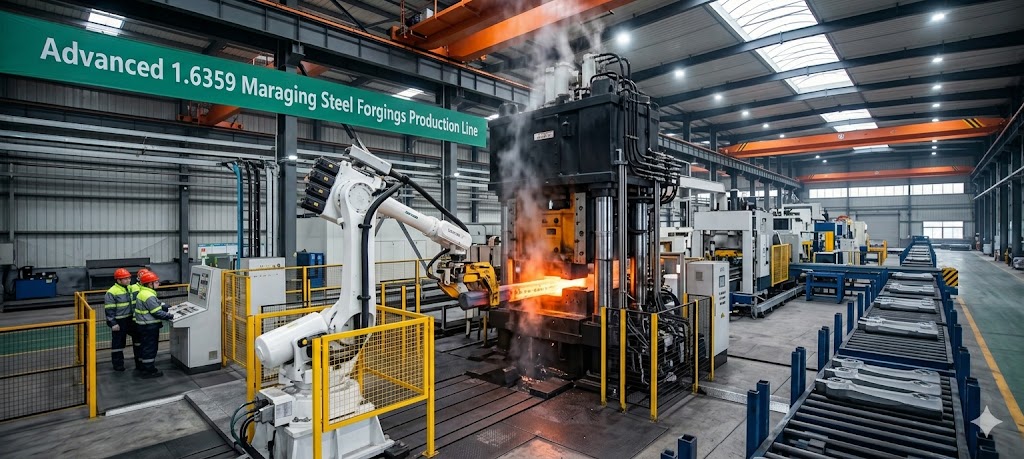
- Forging Equipment: 0.75–9 ton electro-hydraulic forging hammers for small and complex shapes; 2,000 / 4,000 / 6,000 ton hydraulic forging presses for large open-die work; 1-meter and 5-meter seamless rolling machines for ring products. All forgings are produced with a minimum upset ratio of 3:1 in the critical direction, and cross-forging procedures are applied to ensure isotropy in large disc and block forgings.
- Heat Treatment: Ten fully automated, compartmented heat treatment furnaces with independent thermocouple-per-zone temperature recording, calibrated to ±5°C accuracy per our ISO 9001:2015 quality system (thermometry method per ASTM E220). Atmosphere control uses recirculated protective gas to prevent surface oxidation during aging, eliminating the need for scale removal machining and preserving surface dimensional integrity.
- Machining Facilities: Large vertical and horizontal CNC machining centres (max swing 3,000 mm), CNC lathes (max turning diameter 2,000 mm, max between-centres 10,000 mm), deep-hole boring, milling and surface grinding. All CNC equipment is temperature-stabilised at 20±1°C for precision work, with laser compensation for thermal growth of machine structures.
Comprehensive Quality Inspection & Certification
Our in-house inspection laboratory is staffed by experienced NDT personnel performing inspections in accordance with SNT-TC-1A and EN ISO 9712 methodology, and equipped with the following instruments:
- Chemical Analysis: Oxford Instruments optical emission spectrometer (OES) for 30-element simultaneous analysis; combustion method for C and S; inert gas fusion for H, O and N. All incoming 1.6359 heats are fully re-analysed — we do not rely solely on mill certificates.
- Mechanical Testing: 600 kN universal tensile testing machine (ISO 6892-1 / ASTM E8); Charpy impact machine with sub-zero temperature conditioning to −196°C (ISO 148-1 / ASTM E23); Rockwell / Brinell / Vickers hardness testers; creep testing for elevated-temperature applications on request.
- Metallographic Examination: Macro etching of end-cut test discs for all forgings >150 mm diameter to verify internal soundness; micro-structural examination for grain size (ASTM E112), inclusion rating (ASTM E45) and phase identification per EN 10247.
- Ultrasonic Testing (UT): 100% immersion or contact UT per EN 10228-3 for all forgings; DAC / DGS evaluation methods; scan recording with A-scan documentation for customer review. Defect acceptance level: FBH 2 mm (equivalent to Quality Class 4 per EN 10228-3).
- Magnetic Particle Testing (MPT): 100% surface examination per EN ISO 17638 for all forgings >50 mm section.
- Liquid Penetrant Testing (LPT): Applied to all final machined surfaces and complex geometry areas per EN ISO 3452-1.
- Dimensional Inspection: CMM (Coordinate Measuring Machine) with Renishaw probe system; large-field laser tracker for components >1,000 mm; surface roughness measurement with Mitutoyo SJ-410 profilometer.
For every 1.6359 forging part we deliver, the full documentation package includes: EN10204 3.1 mill certificate (or 3.2 with third-party co-witness on request), chemical composition report (both mill and Jiangsu Liangyi in-house re-test), individual mechanical property test report, heat treatment time-temperature charts, full NDT reports (UT + MPT/LPT), metallographic report on request, and dimensional inspection report with CMM printout. We fully support third-party inspection by SGS, Bureau Veritas, TÜV Rheinland, Lloyds, DNV and other authoritative institutions.
Practical Procurement Guide for 1.6359 Forging Parts
After 25 years of supplying 1.6359 forgings to global clients, our sales and engineering team has identified common technical and commercial pitfalls that can delay projects or compromise outcomes. The following guidance is provided as a free pre-sales resource to help you procure correctly the first time.
How to Correctly Specify Your 1.6359 Forging Requirement
A complete 1.6359 forging specification should include all of the following elements — omitting any one often causes avoidable RFQ-stage delays or quotation ambiguity:
- Material Designation: State the controlling standard — e.g. "1.6359 per DIN EN standard" or "18Ni-300 per ASTM A538 Grade C / AMS 6514". If both are acceptable, state that explicitly — it widens our sourcing options and typically improves lead time and cost.
- Delivery Condition: Specify one of: (a) Forged & Annealed (F+A); (b) Forged, Annealed & Aged (F+A+Age); (c) Rough Machined (specify drawing stage); (d) Finish Machined (supply final drawing). The delivery condition has the largest single impact on lead time and price.
- Heat Treatment Requirements: If specific aging temperature, hold time or hardness range is required beyond the standard 480–500°C / 3–6h specification, state it explicitly. For nuclear and aerospace applications, the full aging cycle must be documented on the material certificate.
- Mechanical Property Requirements: State minimum guaranteed values, test direction (longitudinal / transverse) and test standard. If fracture toughness KIC testing is required, state this at the RFQ stage — test piece machining must be planned into the forging geometry.
- NDT Requirements: State applicable inspection standard, acceptance class and examination coverage. If 100% phased-array UT (PAUT) or time-of-flight diffraction (TOFD) is required, specify at RFQ — these require additional equipment setup and must be priced accordingly.
- Certification Level: State EN10204 3.1 or 3.2, and whether third-party inspection witness is required (and by which body). EN10204 3.2 with TÜV witness adds 5–10 working days to typical lead times.
- Drawing Format: Provide 2D drawing (PDF) plus 3D model (STEP / IGES) for all finish-machined components. For ring and bar forgings, a simple dimensional sketch with key dimensions and tolerance callouts is enough.
Common Mistakes When Purchasing 1.6359 Forgings
- Specifying "maraging steel" without grade: The maraging steel family includes 18Ni-250 (1.6356 / 250 ksi grade), 18Ni-250 (1.6357), 18Ni-300 (1.6359) and 18Ni-350 grades with significantly different strength levels. Specifying "maraging steel" without identifying the grade delays quotation and risks material substitution.
- Ordering in the aged condition when machining is still required: Machining 52–55 HRC maraging steel requires CBN tooling, specialist cutting parameters and significantly longer cycle times than machining in the annealed (28–34 HRC) condition. Unless your facility is specifically equipped for hardened machining, always order in the annealed condition and arrange aging after your final machining.
- Ignoring the 0.05–0.10% dimensional growth on aging: If tight-tolerance bores or mating surfaces are finish-machined before aging, the dimensional growth will take the feature out of tolerance. Either machine after aging, or machine to pre-aging dimensions calculated to land within tolerance after the predictable growth.
- Selecting 1.6359 for continuous service above 450°C: Above 450°C, over-aging progressively reduces strength. For continuous service at 500–650°C, nickel-base alloys such as Inconel 718 or Waspaloy are the appropriate choice. Our engineering team can recommend the correct grade for your temperature profile.
Global Supply & Market-Specific Localized Service
With over 25 years of continuous export experience, Jiangsu Liangyi has not simply shipped products internationally — we have built deep understanding of the specific technical regulations, commercial requirements and industry norms of each major market. The following region-specific service commitments are based on active client relationships, not general statements.
- PED 2014/68/EU compliance documentation
- EN10204 3.1 standard; 3.2 with TÜV / BV / DNV co-witness
- Forgings manufactured to RCC-M referenced material and dimensional requirements, subject to customer inspection plans
- German / French / Italian technical drawing interpretation
- DIN EN standards as primary specification language
- REACH-compliant materials documentation
- Products manufactured to ASTM A538 / AMS 6514 / AMS 6521 material requirements on request
- ASME Section VIII / Section III documentation
- API 6A and API 17D dimensional and material requirement experience
- NACE MR0175 / ISO 15156 material compliance documentation
- US standard unit conversion (inch/lb → metric) included
- US CBP commercial invoice and ECCN classification support
- Experience supplying components for projects operated by Aramco, ADNOC, QatarEnergy end-users
- Products manufactured to API 6A / API 6D / NORSOK M-630 dimensional and material requirements
- SASO import documentation and SABER registration guidance
- Sour gas (H₂S) service material qualification records
- Offshore and subsea operating environment expertise
- Arab letter of credit (LC) and trade documentation support
- Singapore MAS / MOM vendor registration assistance
- Nuclear power plant supply chain integration (Vietnam, Philippines)
- LNG terminal component supply experience
- FORM E / FORM D ASEAN FTA certificate of origin
- Direct export to Singapore, Malaysia, Thailand, Vietnam, Indonesia
- Sea freight from Shanghai / Ningbo: 12–18 day transit
- AS/NZS standards cross-reference capability
- Australian Border Force import documentation
- ChAFTA certificate of origin for duty preference
- Mining and mineral processing equipment component supply
- LNG plant rotating equipment component experience
- Sea freight: ~15 days to Sydney / Melbourne
- India BIS import documentation support
- Nigerian oil & gas sector NCDMB local content guidance
- South Africa NRCS / SABS requirements assistance
- Egypt ITIDA and import permit documentation
- Flexible payment terms for repeat clients (30–60 day TT)
- DHL Express airfreight for urgent small components
Our Global Logistics Capabilities
- Sea Freight (FCL/LCL): We ship from Shanghai Port and Ningbo-Zhoushan Port. Typical transit: 18–25 days to NW Europe (Hamburg/Rotterdam), 25–30 days to US Gulf Coast, 12–18 days to Singapore/Port Klang. All sea shipments include marine insurance by default.
- Air Freight: For urgent small components or time-critical project schedules, we arrange air freight via Shanghai Pudong (PVG) hub. Typical transit: 3–5 working days door-to-door Europe/North America.
- Inland Delivery: Our Jiangyin facility is 18 km from the Yangtze River container terminal and 80 km from Shanghai Pudong Airport, enabling fast inland logistics to both sea and air freight hubs.
- Packing: Heavy forgings are shipped in customised wooden crates with anti-corrosion wrapping and vibration-damping padding. All crates are marked with net weight, gross weight, centre of gravity and lifting point data per IATA/IMDG packing standards.
Frequently Asked Questions (FAQ) About 1.6359 (X2NiCoMo18-8-5) Forgings
1.6359 (X2NiCoMo18-8-5) is an ultra-high-strength precipitation-hardening steel defined under the European DIN EN standard, also internationally known as 18Ni-300 maraging steel (ASTM / AMS). The term "maraging" is a portmanteau of "martensite" and "aging" — it describes the unique hardening mechanism: the steel forms a tough, low-carbon martensite on air cooling after annealing, which is then dramatically strengthened by aging at 480–500°C. This aging precipitates fine Ni₃Mo, Ni₃Ti and Fe₂Mo intermetallic particles throughout the martensite matrix, raising ultimate tensile strength from ~900 MPa to ≥1,850 MPa with minimal dimensional change and without any quenching operation. The result is an alloy that combines extreme strength (1,850 MPa UTS) with excellent toughness (KIC 80–110 MPa·m½), weldability and machinability — a combination unmatched by any other commercially produced wrought steel.
The principal equivalents are: Europe/DIN EN: 1.6359 / X2NiCoMo18-8-5; USA/ASTM: 18Ni-300 per ASTM A538 Grade C; USA/UNS: K93120; USA/Aerospace: AMS 6514 (bar/billet), AMS 6521 (sheet/plate); Russia/GOST: N18K9M5T (approximate); Japan/JIS: SUS 350 (approximate); China/GB: 00Ni18Co8Mo5TiAl. Note that AMS 6514 imposes stricter P and S limits (≤0.005% each) than the DIN EN standard, and is required for flight-critical aerospace components. If in doubt about the correct designation for your application, our engineering team can advise on the most appropriate controlling standard.
The primary chemical difference is cobalt and molybdenum content: 1.6359 (18Ni-300) contains 7.0–8.5% Co and 4.6–5.2% Mo; 1.6356 (18Ni-250) contains approximately 7.0–8.5% Co and 4.0–4.5% Mo, with slightly lower Ti content. This results in lower precipitate density during aging, giving 1.6356 a guaranteed UTS of ~1,720 MPa (250 ksi) vs 1,850 MPa (300 ksi) for 1.6359, but marginally better ductility (elongation ~13–14% vs ≥12%) and fracture toughness (KIC 90–130 MPa·m½ vs 80–110 MPa·m½). Choose 1.6359 when maximum strength is the primary requirement; choose 1.6356 when slightly better toughness and a modest cost reduction are preferable to the highest possible strength level. We stock and forge both grades.
Our production envelope for 1.6359 forgings: Round bars and step shafts: max forged diameter 2,000 mm, max length 15,000 mm, max single-piece weight 30 tons. Seamless rolled rings: max outer diameter 6,000 mm, max height 2,000 mm, max single-piece weight 30 tons. Discs, plates and blocks: max diameter or dimension 3,500 mm, max thickness 1,500 mm, max weight 30 tons. Hollow forgings and sleeves: max outer diameter 3,000 mm, customizable wall thickness and length. Custom machined components: max turning diameter 2,000 mm, max between-centres 10,000 mm. For components approaching these size limits, we recommend early engagement with our engineering team to optimise the forging design for our equipment envelope.
Our standard documentation package for every 1.6359 forging delivery includes: EN10204 3.1 Mill Test Certificate (signed by our QC department); Chemical composition analysis report (both originating steel mill certificate and Jiangsu Liangyi in-house OES re-test); Individual mechanical property test report (tensile, Charpy impact, hardness) from test pieces sampled from the same heat; Heat treatment time-temperature chart with furnace calibration certificate; 100% Ultrasonic Testing (UT) report per EN 10228-3 with scan data; Magnetic Particle Testing (MPT) and/or Liquid Penetrant Testing (LPT) report; Dimensional inspection report. On request and at additional cost, we can also provide: EN10204 3.2 certificate with TÜV / SGS / BV third-party co-signature; Metallographic examination report with grain size and inclusion rating; Fracture toughness KIC test report; Creep test report for elevated-temperature applications. We fully support third-party inspection witness by SGS, Bureau Veritas, TÜV Rheinland, Lloyds Register, DNV, DEKRA and other authoritative bodies.
Typical lead times from order confirmation with approved drawings: Forged & annealed condition (no machining): 15–25 days. Rough machined condition (to forging drawing): 20–35 days. Finish machined condition (to component drawing): 30–45 days. Complex precision-machined components with tight tolerances: 35–55 days. For urgent orders where production slot is available, we offer an expedited service at 15–20 days to rough machined stage. Lead times vary with order complexity, batch size, third-party inspection requirements and heat treatment condition. Large orders (>10 tons) may require 5–10 additional days. We provide a confirmed delivery schedule at the time of order acknowledgement and issue weekly production progress reports for critical-path orders.
Open die forging of 1.6359 delivers several critical advantages over castings that are particularly important for high-strength maraging steel applications: (1) Elimination of porosity and shrinkage cavities — the hot working pressure fully closes internal voids that are inherent in any ingot or casting, producing a 100% dense microstructure. (2) Grain refinement — the repeated deformation and recrystallisation during forging reduces the as-cast austenite grain size from several millimetres to ASTM grain size 5–8, dramatically improving fracture toughness and fatigue initiation resistance. (3) Favourable grain flow — the fibrous texture developed during forging is oriented parallel to the part geometry, maximising strength in the principal stress direction — analogous to the grain running along the length of a wooden beam. (4) Property isotropy — controlled cross-forging produces more uniform properties in all directions for disc and block geometries. In practice, forged 1.6359 components typically achieve 30–50% higher impact toughness and 40–60% longer fatigue life than equivalent cast components at the same UTS level.
Yes — the near-zero carbon content (≤0.03%) is the key enabler. In conventional high-carbon steels, carbon migrates to the heat-affected zone during welding and forms hard, brittle martensite that is susceptible to hydrogen-induced cracking. In 1.6359, the HAZ martensite is inherently tough and ductile because carbon is essentially absent. Recommended procedure: weld in the solution-annealed condition (28–34 HRC) using GTAW (TIG) with AWS A5.28 ER18Ni filler wire; shielding gas 99.999% argon; no preheat required for sections up to 50 mm (mild 60–80°C preheat for heavy sections in high-humidity environments); interpass temperature below 120°C; post-weld age at 480–500°C / 4–6 hours to restore full strength in the weld zone. Joint efficiency after post-weld aging consistently reaches 95–100% of base metal UTS in our production weld qualification records.
Compatible surface treatments: (1) Gas nitriding / ion nitriding at 450–470°C for 20–40h — achieves compound layer hardness 60–65 HRC, case depth 0.1–0.3 mm, without exceeding aging temperature; (2) Hard chrome plating (electrodeposition) for sliding wear surfaces — apply after aging, followed by bake at 150°C to minimise hydrogen embrittlement; (3) PVD/TiN coating at ≤500°C deposition temperature — preserves bulk properties; (4) Electroless nickel plating (EN-P) for corrosion and wear — low temperature process fully compatible; (5) Passivation / chromate conversion for mild corrosion protection. Avoid or use with caution: (a) Salt bath nitriding above 500°C — risk of over-aging bulk material; (b) High-temperature CVD coating (>600°C) — causes significant over-aging and strength loss; (c) Flame hardening — not applicable to maraging steels; (d) Case carburising — contradicts the fundamental near-zero carbon chemistry of the alloy. Always confirm surface treatment parameters with our engineering team before processing aged components.
Yes. Our facility provides a complete, single-source manufacturing service from raw steel to finished, inspected component: (1) Raw material procurement and in-house chemical re-verification; (2) Open die forging on our press and hammer lines; (3) Solution annealing (820–840°C) in controlled-atmosphere furnaces; (4) Aging treatment (480–500°C) with full temperature recording documentation; (5) Rough machining in the annealed condition (28–34 HRC) using carbide tooling; (6) Finish CNC machining after aging — dimensional tolerance to IT6, surface finish Ra ≤ 1.6 µm standard (Ra ≤ 0.8 µm for bearing surfaces on request); (7) Surface treatment (nitriding, plating or coating) as required; (8) Full NDT and dimensional final inspection; (9) Complete documentation preparation and packing for export. Delivering a single-source qualified component eliminates inter-supplier specification gaps and gives you one contractual point of accountability for the complete manufacturing scope.
Inquiry for Custom 1.6359 (X2NiCoMo18-8-5) Forging Parts
Jiangsu Liangyi is your reliable, technically capable China manufacturing partner for 1.6359 forging parts, custom X2NiCoMo18-8-5 open die forgings, seamless rolled rings and precision-machined components. Our engineering team — not just a sales desk — reviews every enquiry and provides technically grounded responses including material selection guidance, heat treatment recommendations and forging process feasibility assessments at no charge.
To provide you with a detailed and accurate quotation efficiently, please include the following in your enquiry:
- Official 2D/3D drawings (PDF/DWG/STEP/IGES) — or a clear dimensional sketch with all critical dimensions and tolerances
- Material grade and controlling standard (e.g. 1.6359 / DIN EN, or 18Ni-300 / AMS 6514)
- Required delivery condition: forged & annealed / forged & aged / rough machined / finish machined
- Required heat treatment specification and mechanical property guarantees
- Quantity per order and annual volume estimate
- Required delivery date and destination port or address
- Required certification level (EN10204 3.1 or 3.2) and any third-party inspection requirement
- Application environment (industry, service temperature, pressure, medium) — enables our engineers to identify any non-obvious specification requirements
Inquiry Email: sales@jnmtforgedparts.com
Phone / WhatsApp: +86-13585067993
Official Website: https://www.jnmtforgedparts.com
Factory Address: Chengchang Industry Park, Jiangyin City, Jiangsu Province, 214400, China
We reply to all technical and commercial enquiries within 24 hours on working days. For urgent quotations, please mark your email subject "URGENT RFQ" and we will respond within 4 hours during business hours (08:00–18:00 CST, Monday–Friday).