1.6358 | 1.6354 | X2NiCoMo18-9-5 Forging Parts | ISO 9001:2015 Certified Manufacturer
What Is 1.6358 / 1.6354 / X2NiCoMo18-9-5 Maraging Steel?
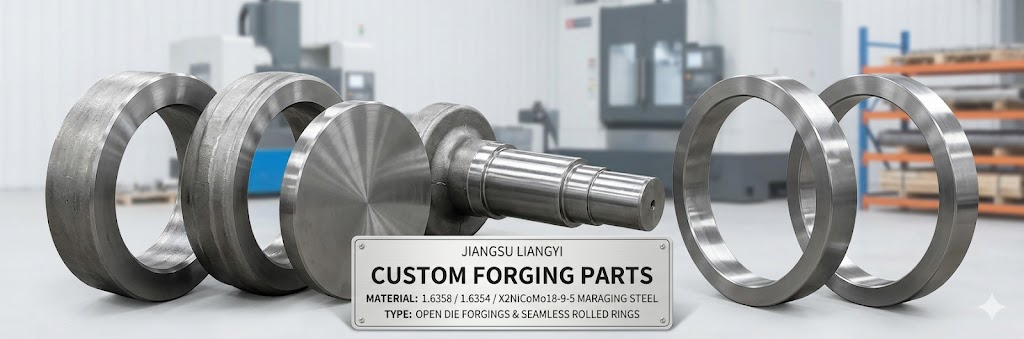
Jiangsu Liangyi Co., Limited is a professional China-based, ISO 9001:2015 certified manufacturer of high-performance 1.6358, 1.6354, and X2NiCoMo18-9-5 maraging steel open die forging parts and seamless rolled rings. With over 25 years of forging experience, we supply custom forgings to engineering and procurement teams across North America (USA, Canada), Europe (Germany, UK, France, Netherlands), the Middle East (Saudi Arabia, UAE, Kuwait), Asia-Pacific (Australia, Singapore, Japan), and South America (Brazil, Argentina). Our products can be manufactured to API 6A, API 6D, API 617, ASME BPVC, and other international specifications as required by clients — please specify your applicable standard in your RFQ and we will confirm capability and required documentation.
The designation 1.6358 is the European material number (Werkstoffnummer) for the alloy formally named X2NiCoMo18-9-5 under EN 10250-4 and EN 10222-3. In the American system, its closest equivalent is 18Ni-300 maraging steel, covered by AMS 6514, AMS 6515, and ASTM A579 Grade 74. The "18-9-5" suffix encodes its three primary strengthening elements: 18% nickel, 9% cobalt, and 5% molybdenum — a combination that delivers an unmatched combination of ultra-high strength and dimensional stability after heat treatment.
The Metallurgical Science Behind 1.6358's Outstanding Performance
Unlike all conventional high-strength steels, which rely on carbon to form hard carbide precipitates, 1.6358 maraging steel is essentially carbon-free (C ≤ 0.03%). Its hardening mechanism — called maraging, a portmanteau of "martensitic aging" — is entirely different. The steel is first solution-treated at 820–850°C, producing a soft, ductile iron-nickel martensite phase that can be machined with normal cutting tools. During subsequent aging at 480–520°C for 3–6 hours, nano-scale intermetallic precipitates of Ni₃Mo, Ni₃Ti, and Ni₃(Mo,Ti) nucleate within the martensite matrix. These precipitates, each only 5–20 nanometers in diameter, create extraordinarily dense dislocation barriers, raising the yield strength from approximately 800 MPa (solution-treated) to over 2,000 MPa (fully aged) without any significant macroscopic volume change.
This precipitation mechanism is the source of 1.6358's most commercially important advantage: minimal heat treatment distortion. The aging temperature (≈500°C) is far below conventional martensitic steel tempering temperatures, and the transformation from solution-treated martensite to aged martensite involves a volumetric change of only 0.05–0.08% — compared to 4–5% for conventional quench-and-temper martensitic transformations. Parts machined close to final dimensions before aging typically exit aging with distortions below 0.05 mm per 100 mm of length, reducing post-heat-treatment finishing work by 30–45% compared to conventional high-strength steels.
Understanding 1.6354: The Nuclear- and Cryogenic-Grade Sub-Specification
1.6354 shares the identical base chemistry of X2NiCoMo18-9-5 but carries additional trace-element restrictions for nuclear power and cryogenic safety-critical applications. The most critical differences are driven by nuclear physics: certain elements become radioactive under neutron flux, which is why:
- Boron (B) is restricted to ≤5 ppm in 1.6354 (versus ≤50 ppm in standard 1.6358), because boron-10 has a high neutron-capture cross-section and produces radioactive byproducts that cause localized embrittlement over a component's service life.
- Cobalt (Co) is either eliminated or restricted to ≤0.20%, because cobalt-59 becomes cobalt-60 (a gamma-ray emitter with a 5.27-year half-life) under neutron irradiation, creating radiation dose burdens for maintenance personnel.
- Copper (Cu) is restricted to ≤0.10%, phosphorus to ≤0.005%, and sulfur to ≤0.005% to prevent radiation-induced embrittlement over long service lives.
- Vacuum degassing (VOD or VAR process) is mandatory to minimize dissolved hydrogen and oxygen that could cause delayed cracking or reduce fracture toughness.
For non-nuclear applications, 1.6358 and 1.6354 deliver identical mechanical properties. The choice between them depends on the trace-element controls your end-application requires.
1.6358 vs. Competing High-Strength Steel Grades — Technical Comparison
The table below compares 1.6358 against AISI 4340 and 17-4PH based on published standard minimum values. All values represent minimum requirements in the delivery condition.
| Property | 1.6358 / 18Ni-300 | 1.6354 (Nuclear Grade) | AISI 4340 (Q&T) | 17-4PH (H900) |
|---|---|---|---|---|
| EN Designation | X2NiCoMo18-9-5 | X2NiCoMo18-9-5 (controlled) | 40NiCrMo6-4 / 1.6565 | X5CrNiCuNb16-4 / 1.4542 |
| Tensile Strength (min) | 2035 MPa | 2035 MPa | 1380–1480 MPa | 1310 MPa |
| Yield Strength (0.2%, min) | 2000 MPa | 2000 MPa | 1170–1380 MPa | 1170 MPa |
| Elongation (min) | ≥12% | ≥12% | ≥10% | ≥10% |
| Charpy Impact (RT, min) | ≥17 J | ≥17 J | ≥27 J | ≥34 J |
| Charpy Impact (−196°C) | ≥12 J | ≥12 J | Brittle transition | ≥10 J |
| Hardness (delivery) | 52–55 HRC | 52–55 HRC | 42–47 HRC | 40–44 HRC |
| Max Continuous Service Temp. | 450°C | 450°C | 300°C | 315°C |
| Typical Heat Treatment Distortion | <0.05 mm/100 mm | <0.05 mm/100 mm | 2–5 mm/100 mm | 0.1–0.3 mm/100 mm |
| Carbon Content | ≤0.03% | ≤0.03% | 0.38–0.43% | ≤0.07% |
In high-precision rotating components, the heat treatment distortion difference between 1.6358 and AISI 4340 is often the decisive factor — not strength. A complex shaft machined to ±0.05 mm before Q&T hardening of 4340 will typically require significant post-heat-treatment straightening, grinding, and re-inspection. The same shaft in 1.6358, machined close to final dimensions before aging, typically passes final inspection without corrective work. Over a production run of many components, the reduced rework frequently offsets the higher material cost of maraging steel.
Our Full Range of 1.6358 / X2NiCoMo18-9-5 Forged Products
We manufacture a complete range of custom 1.6358, 1.6354 and X2NiCoMo18-9-5 forging parts strictly in accordance with client drawings and technical specifications. Our forging capacity spans single-piece weights from 30 kg to 30,000 kg.
Forged Bars & Rods
1.6358 forged round bars, flat bars, square bars, and splined shafts. Max Ø2,000 mm × 15,000 mm length. Minimum forging ratio 6:1. 100% longitudinal and transverse ultrasonic testing per ASTM A388 before delivery. Axially oriented grain flow for superior fatigue resistance in rotating shaft applications.
Seamless Rolled Forged Rings
X2NiCoMo18-9-5 seamless rolled rings produced on 1M and 5M ring rolling machines with circumferential grain flow. Max OD 6,000 mm, max height 1,500 mm, max wall 800 mm, max weight 30 tons. Contoured (shaped-profile) rings available on request to reduce downstream machining costs.
Forged Shafts & Spindles
1.6354 and X2NiCoMo18-9-5 forged shafts including solid and hollow stepped shafts, splined drive shafts, valve spindles, turbine shafts, and pump shafts. Max Ø1,800 mm, max length 15,000 mm. 100% UT and magnetic particle testing (MPT) after heat treatment. Straightness tolerance ≤0.5 mm per 1,000 mm.
Forged Discs & Hubs
X2NiCoMo18-9-5 forged turbine discs, compressor impeller blanks, pump volute blanks, gear blanks, and flanged hubs. Max Ø3,500 mm × 800 mm height, max weight 20 tons. Radially oriented grain flow. Center-bore UT inspection and mechanical property coupon testing from maximum-thickness location.
Forged Valve Components
Complete forged valve component sets in 1.6358: valve bodies, bonnets, stems, seat rings, gate wedges, ball cores, and stuffing box glands. Products can be manufactured to API 6A, API 6D, and ASME B16.34 specifications on request. Mandatory UT, MPT, and LPT inspection on all valve forgings.
Forged Blocks & Custom Profiles
Open die forged X2NiCoMo18-9-5 rectangular blocks, plates, and special-section profiles. Max 3,500 × 2,500 × 800 mm. Minimum forging reduction 4:1 in all three working directions. Available in solution-treated (soft, machineable) or fully aged condition.
Manufacturing Capability — From Ingot to Finished Part
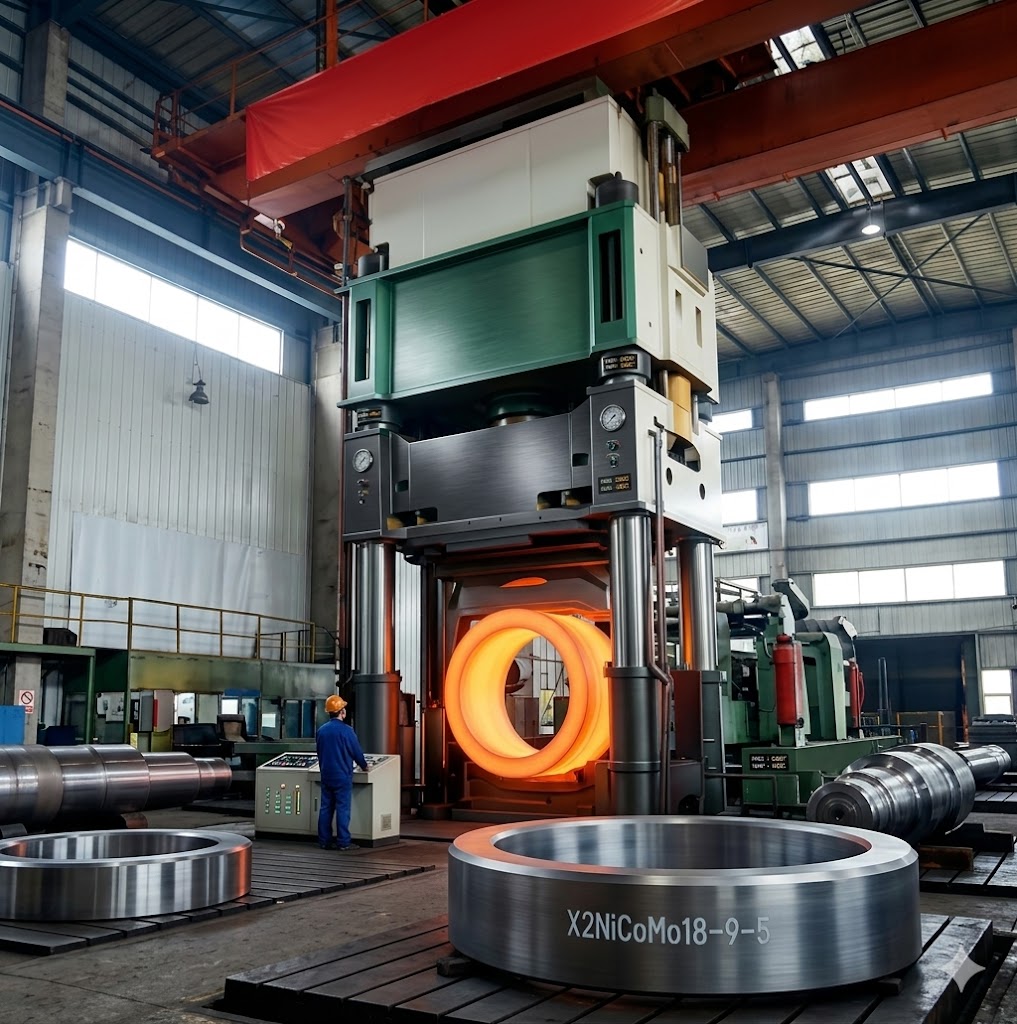
Our 80,000 m² production facility in Jiangyin, Jiangsu Province integrates the complete production chain for 1.6358 / 1.6354 maraging steel forgings under one roof — from vacuum-assisted steel melting through precision CNC machining and final NDT inspection.
Steel Melting — Controlling Chemistry at the Source
The performance of 1.6358 maraging steel forgings is determined at the melting stage. Our 30-ton Electric Arc Furnace (EAF) provides the primary charge melt, transferred to our 30-ton Ladle Refining Furnace (LRF) for precise alloying and slag chemistry control. The final step is our 30-ton Vacuum Oxygen Decarburization (VOD) furnace, which reduces dissolved hydrogen to <1 ppm and dissolved oxygen to <15 ppm — eliminating the primary sources of internal defects and delayed fracture in maraging steel forgings. For 1.6354 nuclear-grade material, VOD treatment is mandatory. For standard 1.6358, we offer both VOD and standard EAF+LRF routes depending on customer requirements.
Following melting, steel is cast as ingots of 5–30 tons with controlled solidification rates. Chemical analysis per ASTM E415 spark spectrometry is reviewed and approved against specification limits before any ingot is released for forging. Ingots failing any element check are diverted and re-melted.
Forging — Grain Flow Engineering
We operate 2000T, 4000T, and 6300T hydraulic forging presses and 1T, 3T, 5T, and 9T electro-hydraulic forging hammers. Our 5M ring rolling machine handles rings up to 6,000 mm OD. Key process parameters for 1.6358 that we strictly control:
- Forging temperature window: 1,150°C (start) to 900°C (finish) — deformation below 850°C is prohibited to prevent adiabatic shear band formation that would degrade impact toughness.
- Minimum forging ratio: 6:1 for standard industrial applications; 8:1 for nuclear and cryogenic components to ensure complete elimination of ingot porosity and dendritic segregation.
- Temperature monitoring: Calibrated optical pyrometers at all times; reheating performed in controlled gas-fired furnaces with PLC temperature logging.
- Grain flow direction: Designed to maximize resistance to the principal stress axis in service — axial for shafts, circumferential for rings, radial for discs.
Heat Treatment — Precision Aging for Consistent Properties
We operate 10+ heat treatment furnaces calibrated to AMS 2750 Pyrometry standards, with temperature uniformity within ±5°C across the work zone. Our standard 1.6358 heat treatment cycle:
Solution Treatment
820–850°C × 1 hour per 25 mm section thickness (minimum 4 hours), followed by air cooling or oil quenching depending on section size. Transforms the steel to a uniform soft martensite at approximately 28–32 HRC — easily machined with standard carbide tooling.
Aging (Maraging Treatment)
480–520°C × 3–6 hours, followed by air cooling. Ni₃Mo and Ni₃Ti precipitates form, raising hardness from ≈30 HRC to 52–55 HRC and tensile strength to ≥2,035 MPa with only 0.05–0.08% dimensional change. Temperature uniformity during aging is critical — a ±15°C deviation shifts yield strength by ±80 MPa.
We also offer nitriding services (gas nitriding and ion plasma nitriding) on 1.6358 forged parts, producing a 0.05–0.15 mm deep nitrided surface layer with hardness up to 65–68 HRC for valve spindles, cam surfaces, and bearing journals requiring enhanced wear resistance.
In-House Testing Laboratory
All 1.6358, 1.6354 and X2NiCoMo18-9-5 forging parts undergo 100% testing before delivery. Our in-house testing laboratory is equipped with:
- Chemical Analysis: Spark OES per ASTM E415 and E1086 for full 13-element analysis; Leco CS/N analyzers; ICP-MS for trace element analysis (B, Co, Cu at ppm levels for 1.6354 nuclear-grade verification).
- Mechanical Testing: 600 kN universal tensile testing machine; instrumented Charpy impact testing at temperatures from +20°C to −196°C; high-temperature tensile testing up to 600°C; Brinell, Rockwell, Vickers, and Knoop hardness testing.
- Ultrasonic Testing (UT): Immersion UT and contact UT per ASTM A388 and ASTM E2375; phased-array UT available for large discs and rings.
- Surface NDT: Magnetic particle testing (MPT) per ASTM E1444; liquid penetrant testing (LPT) per ASTM E165; eddy current testing (ET) available on request.
- Metallographic Analysis: Optical metallography and image analyzer for grain size (ASTM E112), inclusion rating (ASTM E45), and microstructure verification.
We provide full EN 10204 3.1 Mill Test Certificates (MTC) with every shipment as standard. EN 10204 3.2 certificates with witness testing by TUV Rheinland, SGS, Bureau Veritas (BV), Lloyd's Register or DNV on request. MTCs are available in English, French, Spanish, Arabic and Chinese.
Industry Applications & Representative Project Experience
Our 1.6358, 1.6354 and X2NiCoMo18-9-5 forging parts serve demanding applications across multiple heavy industries. The following project examples illustrate the types of engineering challenges our clients have brought to us and the solutions we have provided.
Nuclear Power Industry — Europe & Asia
For nuclear power applications, 1.6354 is the appropriate grade when forgings will be exposed to neutron flux. Our nuclear production route uses VOD-processed ingots with certified ICP-MS analysis for boron ≤5 ppm and cobalt ≤0.20%, a forging ratio of ≥8:1, and mandatory first-article metallographic sectioning to verify grain size, inclusion cleanliness, and forging soundness. All nuclear forgings are produced under a fully documented Manufacturing Process Plan (MPP) that can be submitted to the client's QA team for approval before production begins. We are experienced in supplying documentation packages to support client compliance with EU PED 2014/68/EU and ASME BPVC Section III requirements — however, product compliance with these standards is the responsibility of the project end customer and their engineering team; we provide materials and documentation to support that process.
Application Example: Reactor Coolant Pump Forgings — Nuclear Power Industry
Industry & Region: Nuclear power, Europe and Asia
Engineering Challenge: Reactor coolant pump (RCP) shafts, casings, and impellers must withstand 40+ years of continuous operation at 300–350°C, 15–20 MPa primary coolant pressure, and low-level neutron irradiation. Procurement teams in this sector must follow strict material traceability requirements, specific trace-element limits (boron ≤5 ppm) and documentation standards that many standard forging suppliers cannot meet.
Our Capability: We produce 1.6354 forged RCP shafts, impeller blanks, stuffing box housings, and double-ended studs using VOD-melted ingots with certified ICP-MS trace element analysis. Forging ratio ≥8:1 is documented in the MPP. Full NDT suite is applied: immersion UT, MPT, LPT, and CMM dimensional inspection. Complete material traceability from ingot heat number to finished part is maintained and provided in the documentation package.
What Clients Typically Report: Clients who have sourced nuclear-grade forgings from us describe lead time and cost advantages compared to specialist European and North American mills, while maintaining the same documentation quality standards. The key to this outcome is early engagement — providing detailed specifications before production begins so that our MPP can be tailored to each project's requirements.
Oil & Gas — Middle East, North America, and North Sea
Downhole and wellhead equipment is one of our primary application sectors for 1.6358 maraging steel. The oil and gas industry adopted maraging steel for downhole motor drive shafts when drilling depths exceeded 6,000 meters and the torque loads exceeded the fatigue strength of conventional 4340 steel. Today, 1.6358 forged drive shafts are widely used for high-performance positive displacement motors (PDM) and electrical submersible pump (ESP) systems in demanding wells. Our forgings are produced to ASTM A388 UT standards, and documentation packages to support client compliance with API 6A, API 6D, and NACE MR0175 can be provided on request.
Application Example: Downhole Motor Drive Shafts & Wellhead Valve Bodies
Industry & Region: Oil and gas, Middle East and North America
Engineering Challenge: Operators of high angle horizontal wells experience accelerated fatigue failure of conventional alloy steel down-hole drive shafts subjected to combined torsional and bending fatigue loading. Material selection is an important economic lever in well life-cycle cost management because of the cost of a shaft failure (fishing operations, workover rig time and lost production).
Our Capability: We produce 1.6358 forged splined drive shafts with a minimum forging ratio of 7:1, guaranteeing axial grain flow along the maximum principal stress direction. Heat treatment targets: solution treat 840°C/4h, age 490°C/5h, achieving ≥2,035 MPa UTS, ≥2,000 MPa Rp0.2, 52–54 HRC, and ≥17 J Charpy at room temperature. Full 100% UT per ASTM A388 and 100% MPT of all machined splines. We also supply 1.6358 forged valve bodies, bonnets, gate wedges, and seat rings for wellhead valve assemblies. Documentation to support API 6A compliance review is available on request.
Typical Outcome: The primary benefit clients report when switching from conventional alloy steel to 1.6358 drive shafts is a significant reduction in shaft replacement frequency, which directly reduces workover costs and improves well availability. The exact improvement depends on well conditions and operating parameters.
Turbomachinery & Power Generation — Global OEMs
The turbomachinery sector requires maraging steel for components where operating speed generates high centrifugal stresses, requiring both high tensile strength (to resist centrifugal bursting) and retention of mechanical properties at 400–450°C continuous operating temperatures. Our turbomachinery forgings can be produced to API 617, API 618, and API 672 specification requirements upon client request. Documentation to support OEM qualification processes is available; specific OEM qualification status should be confirmed directly with us at the RFQ stage.
Application Example: Gas Turbine Compressor Discs & Main Steam Valve Assemblies
Industry & Region: Power generation and turbomachinery, Europe and Asia
Engineering Challenge: Higher-performance turbine designs operating at increased rotational speeds require compressor disc materials that maintain ≥2,000 MPa yield strength at operating temperature, combined with heat treatment dimensional stability tight enough to preserve disc bore tolerances (typically ±0.015 to ±0.025 mm) without post-aging grinding. Conventional alloy steels require post-heat-treatment grinding to recover bore tolerances — an operation that adds lead time and cost, and can introduce residual stress patterns that shorten component fatigue life.
Our Capability: We produce 1.6358 forged compressor disc blanks with radially oriented grain flow, confirmed by first-article metallographic section. All discs are machined in the solution-treated condition — including bore, rim profile, and blade attachment features — then aged as fully machined assemblies. Post-aging CMM verification confirms that bore diameter deviation is consistently within ±0.020 mm of the pre-aging machined dimension for standard disc geometries. We also produce 1.6358 forged main steam valve bodies, cores, bonnets, and seat ring inserts for turbine trip and throttle valve systems.
Typical Outcome: Elimination of post-aging grinding from the production sequence reduces per-component production lead time and cost. Customers report that the low and predictable aging distortion of 1.6358 simplifies production scheduling and reduces scrap risk compared to alloy steel alternatives requiring quench-and-temper hardening.
Industrial Valves & Cryogenic Equipment — Global
1.6358 and 1.6354 forgings are widely used in high-performance industrial valves, especially cryogenic butterfly valves and ball valves for LNG service at −196°C, where the material retains ≥12 J Charpy impact energy. Our cryogenic valve forgings are produced to dimensional tolerances that support API 6D Class VI zero-leakage assembly requirements; client QA teams are responsible for confirming valve assembly compliance through final valve testing.
Application Example: LNG Service Cryogenic Butterfly Valve Shafts
Industry & Region: Industrial valves and cryogenic equipment, global
Engineering Challenge: Cryogenic high-performance butterfly valves (HPBV) for LNG service require shaft forgings that simultaneously deliver ≥12 J Charpy at −196°C, ≥1,800 MPa yield strength, and post-heat-treatment shaft-to-disc bore concentricity within ±0.025 mm — without post-aging grinding that could disturb the bore geometry. Most conventional stainless steels cannot simultaneously meet all three criteria.
Our Capability: We produce 1.6354 (cobalt-free grade) forged valve shafts with 7:1 forging reduction ratio, heat treated to ≥2,000 MPa Rp0.2 and ≥12 J Charpy at −196°C (typically 14–18 J in our production). Post-aging bore concentricity measurement confirms dimensional stability within the required tolerance range. We also supply X2NiCoMo18-9-5 forged valve discs, gate valve bodies, and companion valve component sets. Documentation to support API 6D compliance review by client QA teams is available on request.
Typical Outcome: Valve OEMs that have adopted 1.6358 / 1.6354 forged shafts from us in place of conventional stainless steel alternatives typically report improved first-pass valve leakage test results, attributable to the tighter shaft-to-disc bore concentricity achievable through the low-distortion maraging aging process.
Petrochemical & Flow Measurement — Asia-Pacific & South America
In petrochemical plants, fiscal flow meters require forged meter body components with bore concentricity maintained to ≤0.03 mm after all heat treatment operations. The combination of 1.6358's high strength (enabling compact, lightweight body designs) and minimal aging distortion makes it the material of choice for high-accuracy fiscal metering applications where post-heat-treatment bore grinding would disturb the calibrated internal flow profile.
Application Example: Fiscal Flow Meter Bodies & Petrochemical Pressure Vessel Nozzles
Industry & Region: Petrochemical and flow measurement, Asia-Pacific and South America
Engineering Challenge: High-accuracy fiscal flow meters (used in custody-transfer measurement of natural gas) require forged meter body components with bore concentricity maintained to ≤0.03 mm after all heat treatment, to preserve the calibrated flow profile. Post-heat-treatment bore grinding, while technically possible, risks disturbing the calibration traceability chain. Conventional alloy steel meter bodies typically require post-quench-and-temper grinding because distortion regularly exceeds the 0.03 mm limit.
Our Capability: We produce 1.6358 forged venturi cone meter bodies and ultrasonic meter housings machined in the solution-treated condition to bore concentricity of 0.020–0.025 mm (providing margin against the drawing limit), then aged. Post-aging bore concentricity measurement confirms values within the 0.030 mm limit without corrective work. We also supply X2NiCoMo18-9-5 forged pump casings, shaft sleeves, impellers, wear rings, and flanges for associated process pump systems.
Typical Outcome: Elimination of post-aging bore grinding reduces per-unit production cost and lead time, while also eliminating the risk of post-grinding recalibration requirements. Clients report that 1.6358 meter body forgings consistently meet bore concentricity requirements without corrective work, compared to variable results with conventional alloy steel.
Chemical Composition of 1.6358 / X2NiCoMo18-9-5 Steel
The chemical composition below is per EN 10222-3 and AMS 6514/6515 published standards. Each element's role in the material's performance is explained to help engineers understand the tradeoffs involved.
| Element | Standard Limit (1.6358) | Nuclear Grade (1.6354) | Metallurgical Role |
|---|---|---|---|
| Nickel (Ni) | 17.00–19.00% | 17.00–19.00% | Primary matrix element. Stabilizes BCC martensite phase; prevents iron carbide formation; reduces Ms temperature to ensure complete martensitic transformation on cooling. |
| Cobalt (Co) | 8.00–10.00% | ≤0.20% or eliminated | Reduces Mo solubility in martensite matrix, promoting denser Ni₃Mo precipitation during aging — responsible for approximately 30% of the age-hardening response. Eliminated in 1.6354 nuclear grade due to Co-59→Co-60 neutron activation. |
| Molybdenum (Mo) | 4.50–5.50% | 4.50–5.50% | Primary strengthening precipitate-former. Forms Ni₃Mo nanoscale precipitates (5–15 nm) during aging — the dominant dislocation barriers responsible for high yield strength. Also suppresses retained austenite and improves corrosion resistance. |
| Titanium (Ti) | 0.50–0.80% | 0.50–0.80% | Secondary precipitate-former. Forms Ni₃Ti precipitates synergistically with Mo precipitates. Ti above 0.80% risks coarse TiN/TiC formation during solidification — fatigue crack initiation sites — hence the tight upper limit. |
| Aluminum (Al) | 0.05–0.15% | 0.05–0.15% | Deoxidant during melting; forms NiAl precipitates contributing secondary aging response. Must be ≥0.05% for adequate deoxidation and ≤0.15% to prevent large Al₂O₃ inclusion formation. |
| Carbon (C) | ≤0.03% | ≤0.03% | Intentionally minimized. C forms TiC, consuming titanium available for age-hardening precipitation. C above 0.05% significantly reduces toughness by forming brittle iron carbides at martensite lath boundaries during aging. |
| Silicon (Si) | ≤0.10% | ≤0.10% | Restricted to minimize solid-solution softening of martensite matrix and prevent silicate formation that reduces UT cleanliness ratings. |
| Manganese (Mn) | ≤0.10% | ≤0.10% | Restricted because Mn stabilizes austenite and promotes retained austenite formation, reducing the volume fraction of martensite and therefore the age-hardenability response. |
| Phosphorus (P) | ≤0.01% | ≤0.005% | Grain boundary embrittler. Segregates to prior austenite grain boundaries during aging and reduces impact toughness. Stricter limit in 1.6354 due to radiation-enhanced P segregation in long-service nuclear applications. |
| Sulfur (S) | ≤0.01% | ≤0.005% | Forms MnS inclusions that act as fatigue crack initiation sites. VOD processing (standard for 1.6354) reduces S to ≤0.002%, improving transverse fracture toughness and fatigue life. |
| Boron (B) | ≤0.003% | ≤0.0005% (5 ppm) | Trace B improves hot ductility during forging. In 1.6354 nuclear grade, must be nearly eliminated: B-10 captures neutrons, producing helium embrittlement and radioactive Li-7 after long irradiation exposure. |
| Copper (Cu) | ≤0.10% | ≤0.10% | Forms Cu-rich precipitates contributing to radiation-induced embrittlement in nuclear applications. Also reduces corrosion resistance in H₂S-containing environments (sour service). |
Mechanical Properties & Heat Treatment Parameters
The mechanical properties of 1.6358 forgings are sensitive to aging temperature and time. A ±15°C deviation from the target aging temperature shifts yield strength by ±50–80 MPa and Charpy impact energy by ±3–5 J — which is why we control furnace temperature uniformity to ±5°C and test one coupon per forging per heat per furnace charge.
| Condition | UTS (MPa) | Rp0.2 (MPa) | Elongation | Charpy RT (J) | Hardness (HRC) | Typical Use |
|---|---|---|---|---|---|---|
| Solution treated only | 900–1,000 | 800–900 | ≥20% | ≥50 | 28–32 | Machining blank state |
| Underaged (460°C / 3h) | 1,700–1,800 | 1,650–1,750 | ≥14% | ≥25 | 48–50 | Higher toughness at moderate strength |
| Peak aged (490°C / 5h) | ≥2,035 | ≥2,000 | ≥12% | ≥17 | 52–55 | Standard delivery condition |
| Overaged (540°C / 5h) | 1,600–1,700 | 1,550–1,650 | ≥15% | ≥30 | 46–48 | Applications needing higher toughness |
| Ion plasma nitrided surface | — | — | — | — | 65–68 (surface) | Wear-critical surfaces |
Inspection, Testing Standards & Documentation
Our testing and documentation approach is designed to eliminate the gap between what is produced and what is certified. Every MTC field is linked to a calibration-controlled instrument or approved procedure reference number in our ISO 9001:2015 QMS.
Mechanical & Hardness Testing Standards
- ASTM A370: Standard Test Methods and Definitions for Mechanical Testing of Steel Products
- ASTM E8 / ISO 6892-1: Tensile testing — round bar specimens with extensometer-measured elongation to 50 mm gauge length
- ASTM E23 / ISO 148-1: Charpy V-notch impact testing — test temperature controlled to ±2°C of target
- ASTM E10 / ISO 6506: Brinell hardness testing on heat treatment coupons and as-forged surfaces
- ASTM E18 / ISO 6508: Rockwell HRC testing — production acceptance criterion for peak-aged 1.6358: 52.0–55.0 HRC
- ASTM E384 / ISO 6507: Vickers microhardness for nitrided case depth verification
Chemical Analysis Standards
- ASTM E415 / E1086: OES for Ni, Co, Mo, Ti, Al, C, Si, Mn, P, S, Cu, Cr — primary rapid-analysis method
- ICP-MS (adapted per ASTM D5673): For trace element analysis of B (≤5 ppm), Co (≤0.20%), Cu for 1.6354 nuclear-grade certification
- ASTM A751: Standard framework for chemical analysis reporting
Nondestructive Testing Standards
- ASTM A388 / A388M: UT of heavy steel forgings — Class 1 (most stringent) for critical rotating and nuclear components; Class 2 for standard industrial forgings
- ASTM E2375: UT of wrought products — for bar and ring products
- ASTM E165 / ISO 3452: Liquid penetrant testing — fluorescent penetrant Method C, sensitivity Level 2
- ASTM E1444 / ISO 9934: Magnetic particle testing — wet fluorescent method, AC yoke
- ASME BPVC Section V, Article 5: UT acceptance criteria reference for clients requiring ASME Code documentation support
Manufacturing Documentation
We prepare a fully documented Manufacturing Process Plan (MPP) for every new component and client, covering: ingot traceability; forging temperature windows and minimum reduction ratios; heat treatment furnace number, calibration reference, and temperature uniformity records; NDT procedures and acceptance criteria; dimensional inspection points; and MTC content requirements. The MPP is available for client QA team review and approval before production begins. First-article inspection programs and on-site audits at our facility are welcomed.
Practical Procurement Guide: How to Source 1.6358 Forgings Successfully
Common Specification Mistakes to Avoid
- Specifying hardness without aging condition: "52 HRC" alone is ambiguous. Always specify the complete heat treatment cycle if your application requires non-standard aging parameters.
- Omitting the required forging reduction ratio: Without this, different suppliers will assume different ratios. For rotating components, specify ≥6:1; for nuclear components, ≥8:1 explicitly in the RFQ.
- Testing only one coupon per batch: For 1.6358, furnace temperature uniformity sensitivity means one coupon per heat per furnace charge is the correct testing frequency — not one coupon per batch.
- Assuming all 1.6358 from any mill is equivalent: Trace element ranges within the standard vary. For fatigue-critical applications, request individual upper limits on each trace element rather than a combined trace limit.
- Confusing EN 10204 3.1 and 3.2: A 3.1 MTC is signed by the manufacturer's QA representative. A 3.2 MTC requires co-signature by an independent third-party inspector who witnessed the actual tests. For safety-critical applications, 3.2 is not optional.
What to Include in Your RFQ for the Fastest, Most Accurate Quote
- Dimensional drawing (PDF and CAD format) with all critical dimensions, GD&T callouts, and surface finish (Ra per ISO 4287)
- Material specification: EN designation, AMS/ASTM equivalent, or your company specification number
- Delivery condition required: solution treated only, or aged to a specific temperature-time cycle
- Minimum forging reduction ratio required
- NDT requirements: UT acceptance class, surface NDT methods, any customer-specific procedures
- Certification requirements: EN 10204 3.1 or 3.2; third-party inspection body preference
- Quantity and delivery schedule; required destination port and shipping terms
- Application description (helps us flag potential design concerns before production)
Why Engineers Choose Jiangsu Liangyi for 1.6358 Forgings
- Dedicated VOD melt capability: Our 30-ton VOD furnace is permanently configured for maraging steel heats, with no shared use with carbon steel production that could risk chemistry cross-contamination.
- 25 years of maraging steel-specific process knowledge: The forging temperature window of 1.6358 (1,150°C start, 900°C finish minimum) is narrower than for carbon or alloy steel. Our process sheets include hard limits enforced by automated temperature alarms on all presses.
- ICP-MS trace element analysis in-house: Allows same-day certification of 1.6354 boron at ≤5 ppm and cobalt at ≤0.20%, without the 3–5 day delay of third-party laboratory outsourcing.
- Full vertical integration: Ingot to machined, heat-treated, NDT-certified part — every step at our facility. No subcontracting of forging, heat treatment, or NDT.
- Transparent, data-rich MTCs: Our EN 10204 3.1 certificates include: heat chemistry OES report with instrument calibration reference; mechanical test data with specimen geometry; heat treatment chart with continuous PLC temperature log; UT scan record with calibration block data; MPT/LPT inspection records; dimensional inspection CMM report.
- Direct English-language technical communication: Our engineering and quality team communicates directly in English — no translation intermediaries. Our team understands API, ASME BPVC, and EN specifications and can discuss them directly with your metallurgists and QA engineers.
Frequently Asked Questions — 1.6358 / 1.6354 / X2NiCoMo18-9-5 Forging Parts
1.6358 (X2NiCoMo18-9-5) is the European EN designation for 18Ni-300 maraging steel, equivalent to AMS 6514 (sheet/strip/plate), AMS 6515 (bar/billet/forging), and ASTM A579 Grade 74. In the MIL spec system it corresponds to MIL-S-46850D Grade 300. It is importantly not equivalent to 18Ni-250 (1.6359, AMS 6512) — the 250-grade has lower cobalt content and a lower minimum tensile strength of 1,725 MPa vs 2,035 MPa for 1.6358. For nuclear applications, 1.6354 is specified by referencing X2NiCoMo18-9-5 per EN 10250-4 with additional trace element restrictions in a client-specific material specification.
Two fundamental differences drive the distortion advantage. First, AISI 4340 must be quenched from 840–870°C — a severe thermal shock creating steep temperature gradients and large residual stresses that cause warping. 1.6358's aging treatment at 480–520°C is far milder, generating minimal thermal gradients. Second, the martensitic transformation in 4340 involves a 4–5% volume expansion — non-uniform across the section, causing quench distortion. In 1.6358, the transformation from soft martensite (after solution treatment) to hard aged martensite involves only a 0.05–0.08% volumetric change — approximately 60× less than 4340. This combination means that parts machined close to final dimensions before aging typically pass final inspection without post-aging corrective work, which is typically not possible with quench-and-temper alloy steels.
Both share the base alloy X2NiCoMo18-9-5, but 1.6354 applies additional trace-element controls for nuclear and cryogenic applications. The four critical differences: (1) Boron restricted to ≤5 ppm in 1.6354 vs ≤50 ppm in 1.6358 — boron-10 becomes radioactive under neutron irradiation; (2) Cobalt must be ≤0.20% or eliminated — cobalt-59 becomes cobalt-60 (a dangerous gamma emitter) in reactor environments; (3) P and S restricted to ≤0.005% to prevent radiation-induced grain boundary embrittlement over 40-year service lives; (4) VOD or VAR vacuum melting is mandatory. For non-nuclear applications, 1.6358 and 1.6354 deliver identical mechanical properties. The 1.6354 premium is driven by tighter melt controls and ICP-MS trace element certification.
Our production capacity for 1.6358 forgings: Forged round bars — max diameter 2,000 mm, max length 15,000 mm, max weight 30,000 kg. Seamless rolled rings — max outer diameter 6,000 mm, max height 1,500 mm, max wall 800 mm, max weight 30,000 kg. Forged shafts — max diameter 1,800 mm, max length 15,000 mm. Forged discs and hubs — max diameter 3,500 mm, max height 800 mm. Open die forged blocks — max 3,500 × 2,500 × 800 mm. For components at the upper end of these ranges, we recommend early engagement to confirm ingot availability and furnace scheduling, as large 1.6358 ingots may require 8–12 weeks lead time for VOD melt-to-order.
Yes. EN 10204 3.1 mill test certificates (signed by our quality representative) are supplied with every shipment as standard. EN 10204 3.2 certificates with independent witness inspection are available on request through our partnerships with TUV Rheinland, SGS, Bureau Veritas (BV), Lloyd's Register, and DNV. A typical 3.2 inspection scope covers: chemical analysis certificate review; mechanical test witness; UT scan witness or record review; dimensional inspection review; document package completeness check. MTCs are available in English, German, French, Spanish, Arabic, and Chinese.
The principal application sectors for 1.6358 / X2NiCoMo18-9-5 forgings are: Oil & Gas — downhole PDM drive shafts, ESP motor shafts, wellhead valve bodies (API 6A spec); Nuclear Power — reactor coolant pump shafts and impellers, containment fittings (1.6354 grade); Turbomachinery — gas turbine compressor discs and impellers, main steam valves; Industrial Valves — cryogenic HPBV shafts (−196°C LNG service); Aerospace — rocket motor casings, landing gear pivots; Precision Measurement — fiscal flow meter bodies requiring ≤0.03 mm bore concentricity after heat treatment. The single common requirement across all these applications: strength above 1,700 MPa that cannot be achieved with acceptable dimensional stability using conventional quench-and-temper steel processing.
Yes, we offer complete machining services. Our CNC capability: turning to Ø3,000 mm × 10,000 mm; milling to 5,000 × 3,000 × 2,000 mm; boring to Ø2,000 mm × 5,000 mm depth; CNC gear hobbing to M30 module; ID/OD grinding. Our standard sequence for precision 1.6358 components: (1) Rough machine in solution-treated condition (~30 HRC) to within 2–3 mm of finished dimensions; (2) Age treat to full hardness (52–55 HRC); (3) Finish machine with light cuts to ±0.02 mm. For tolerances tighter than ±0.02 mm or for ground surface finishes (Ra ≤0.4 µm), a CBN finish grinding step is added after machining.
Standard lead times from PO confirmation: ≤5 ton components: 3–4 weeks. 5–30 ton components: 5–8 weeks. Components requiring 3.2 inspection or first-article qualification: add 1–2 weeks. Rush orders of ≤2 tons with standard ingots in stock: as short as 2 weeks. For large components requiring VOD melt-to-order ingots, add 8–12 weeks (advised at RFQ stage). Shipping terms: FOB Jiangyin Port; CIF to any major global port; DDU; DDP (Delivered Duty Paid, including import duties). Packaging: ISPM 15 certified wooden crates, VCI anti-corrosion film wrapping, desiccant packs for ocean freight.
The best alternative depends on which property of 1.6358 is the actual design driver. If ≥2,035 MPa is more than needed: 1.6359 (18Ni-250 grade) — 1,725 MPa minimum UTS, roughly 20–25% lower material cost, retaining the same minimal-distortion maraging heat treatment. If strength can be reduced to ≤1,400 MPa: 17-4PH (1.4542) offers good corrosion resistance with moderate aging distortion. If post-heat-treatment machining distortion is acceptable and strength can be ≤1,480 MPa: AISI 4340 (1.6565) is the lowest-cost option. Contact us for a free material selection consultation based on your application requirements.
For the quickest and most accurate quote, please provide the following: (1) Dimensional drawing — PDF and CAD (DXF, DWG or STEP) with all critical dimensions, GD&T callouts and surface finish requirements; (2) Material specification — EN designation, AMS/ASTM equivalent or company spec number; (3) Heat treatment condition — solution treated only, or specific aging temperature time cycle; (4) Minimum forging reduction ratio; (5) NDT requirements — UT acceptance class, surface NDT methods and any customer-specific procedures; (6) Certification requirements — 3.1 or 3.2, preferred inspection body; (7) Quantity and delivery schedule; (8) Destination port and preferred shipping terms; (9) Application description. We respond to fully completed RFQs within 24 business hours. Partial RFQs will be provided with a preliminary budget quote and a list of missing information needed to provide firm pricing.
Contact Jiangsu Liangyi for a Custom 1.6358 / X2NiCoMo18-9-5 Forging Quote
Jiangsu Liangyi Co., Limited is a China-based, ISO 9001:2015 certified manufacturer of high-performance 1.6358, 1.6354 and X2NiCoMo18-9-5 maraging steel forged parts. We welcome inquiries for custom forging projects with full support for custom drawings, material specifications and quantity requirements. Our products can be manufactured to API, ASME, EN and other international specifications upon client request — please specify your applicable standard and documentation requirements in your inquiry. We provide detailed, competitive quotations within 24 business hours of receiving a complete RFQ.
Inquiry Email: sales@jnmtforgedparts.com
Phone / WhatsApp: +86-13585067993
Website: https://www.jnmtforgedparts.com
Factory Address: Chengchang Industry Park, Jiangyin City, Jiangsu Province, 214400, China