About 1.4905 (X11CrMoWVNb9-1-1) Forging Steel
Jiangsu Liangyi Co., Limited, located in Chengchang Industry Park, Jiangyin City, Jiangsu Province, China, is a professional ISO 9001:2015 certified manufacturer specializing in 1.4905 (X11CrMoWVNb9-1-1) open die forging parts and seamless rolled steel forged rings. With over 25 years of forging experience and an annual production capacity of 120,000 tons, we supply high-quality 1.4905 steel parts to customers in more than 50 countries across Europe, North America, the Middle East, Asia and Australia.
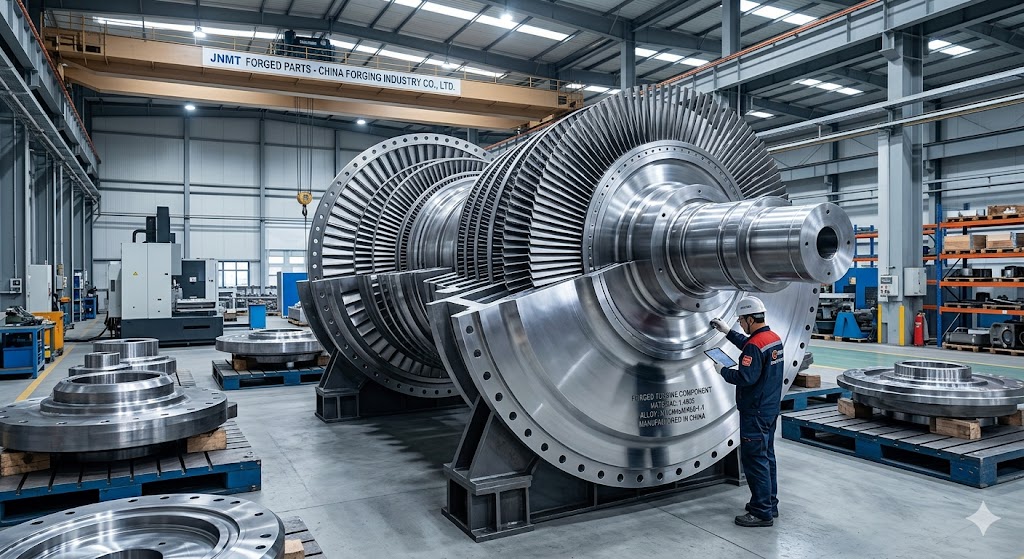
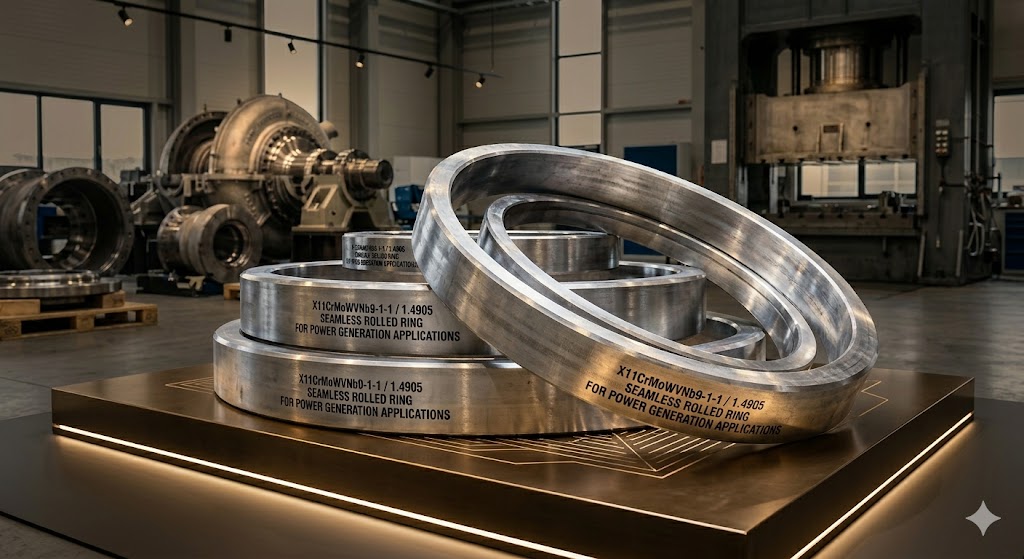
X11CrMoWVNb9-1-1 (EN 1.4905) is a high-grade martensitic creep-resistant steel specially designed for high-temperature applications up to 620°C.
Among wrought stainless steels, its distinctive chemical composition is notable for containing boron (B) and tungsten (W).Boron greatly improves hardenability even in very small concentrations, while tungsten enhances creep resistance and high-temperature strength by forming stable carbides.
So that 1.4905 is the best choice material for important parts in gas and steam turbines operating under extreme conditions.
Main Performance Advantages of 1.4905 Steel
- Excellent creep resistance up to 620°C for long-term service
- Superior high-temperature tensile strength and fatigue resistance
- Good oxidation and corrosion resistance in high-temperature environments
- Excellent hardenability and impact toughness
- Stable microstructure under continuous high-temperature operation
- Compatible with advanced welding and machining processes
Material Comparison: 1.4905 vs 1.4903 Steel
While both are creep-resistant steels, 1.4905 (X11CrMoWVNb9-1-1) contains equal amounts of molybdenum and tungsten (0.9–1.1% each), whereas 1.4903 (X10CrMoVNb9-1) contains only molybdenum.The addition of tungsten gives 1.4905 significantly improved creep resistance at elevated temperatures, so that it is suitable for more important power generation applications up to 620°C.
Available 1.4905 Forged Product Shapes & Sizes
We manufacture a full range of 1.4905 (X11CrMoWVNb9-1-1) forged steel products in all kinds of shapes and sizes, from 30kg to 30,000kg per piece, to meet your specific project requirements. All 1.4905 forged parts can be supplied as rough forgings, semi-finished, or fully machined according to your exact drawings and specifications.
Forged Bars & Rods
- 1.4905 round bars: up to 2000mm diameter, length up to 15 meters
- X11CrMoWVNb9-1-1 square bars, flat bars and rectangular bars
- Solid and hollow bars up to 3000mm outer diameter
- Custom lengths, dimensions and tolerances available
- Available in as-forged, normalized, or quenched and tempered condition
Seamless Rolled Rings
- 1.4905 seamless rolled rings up to 6 meters in diameter
- X11CrMoWVNb9-1-1 contoured rings, guide rings and seal rings
- Single-piece weight up to 30 tons with consistent grain matrix
- 100% ultrasonic testing (UT) guaranteed on all ring products
- Ideal for high-pressure and high-temperature rotating applications
Complex Forged Components
- 1.4905 hubs, housings, shells and sleeves
- X11CrMoWVNb9-1-1 discs, plates, blocks and flanges
- 1.4905 pipes, tubes and heavy-wall cylinders
- Custom shapes and geometries according to customer drawings
- Complete CAD/CAM integration for precision manufacturing
1.4905 Forgings for Gas & Steam Turbines
1.4905 (X11CrMoWVNb9-1-1) steel is the industry standard material for important parts in gas and steam turbines operating at high temperatures. Our 1.4905 forged parts are trusted by leading power plant operators and turbine manufacturers worldwide for their excellent reliability, long lifetime, and consistent performance under extreme operating conditions.
Main Turbine Parts We Produce
- 1.4905 gas and steam turbine blades and vanes
- X11CrMoWVNb9-1-1 turbine rotor shafts and spindles
- 1.4905 compressor turbine blades and diaphragms
- X11CrMoWVNb9-1-1 turbine guide rings, seal rings and labyrinth rings
- 1.4905 gas turbine wheels, discs and impellers
- X11CrMoWVNb9-1-1 turbine casings and shrouds
- 1.4905 journal and thrust bearings
- X11CrMoWVNb9-1-1 control and reheat valve discs
- 1.4905 valve spindles, stems and rods
- X11CrMoWVNb9-1-1 MSV/GV/CV/CRV valve seats, cores and sleeves
- 1.4905 main steam valve covers and bonnets
- X11CrMoWVNb9-1-1 oil guards and bearing gland seals
- 1.4905 inlet guide vanes (IGV) and control rings
- X11CrMoWVNb9-1-1 inner and outer heat shields
- 1.4905 double-headed studs and fasteners
Global Application Cases by Region
Europe
- Supplied over 5,000 tons of 1.4905 turbine parts to thermal power plants in Germany, France, Italy, Spain, and the United Kingdom
- Provided X11CrMoWVNb9-1-1 valve parts for combined cycle facilities in the Netherlands, Belgium, and Austria
- Experienced working with European engineering standards including EN 10302, EN 10243, and PED documentation requirements
North America
- Manufactured important 1.4905 turbine parts for 30+ power generation facilities in the United States and Canada
- Supplied X11CrMoWVNb9-1-1 seamless rolled rings for main gas turbine projects across North America
- Experienced with North American standards including ASME, ASTM, and API
Middle East
- Provided 1.4905 turbine parts for 15+ power plants in Saudi Arabia, UAE, Qatar, Kuwait, and Oman
- Supplied X11CrMoWVNb9-1-1 valve seats and blades for desalination plants with integrated power generation
- Experienced in high-temperature desert environment applications
Asia & Pacific
- Supplied 1.4905 rotor shafts and blades to power plants in India, Thailand, Malaysia, Indonesia, Vietnam, and Australia
- Provided X11CrMoWVNb9-1-1 parts for industrial gas turbines used in oil refineries and petrochemical plants
- Strategic location near Shanghai Port for fast and cost-effective shipping to Asia-Pacific markets
Why Choose Jiangsu Liangyi for 1.4905 Forgings
As a leading 1.4905 (X11CrMoWVNb9-1-1) forging manufacturer in China, we offer unmatched quality, competitive pricing, reliable delivery, and excellent technical support to our global customers. Our commitment to excellence has made us a trusted partner for power generation companies worldwide.
Advanced Production Equipment
We have modern equipment, such as 2000T-6300T hydraulic presses, 1-5T electro-hydraulic hammers, 5M seamless rolling machines, and 10 modern heat treatment furnaces to guarantee material properties.
Comprehensive Quality Control
We have testing facilities including UT, MT, PT, X-ray, chemical analysis, mechanical property testing, and metallographic examination to make sure every 1.4905 forging meets specifications.
Complete Production Chain
From steel melting (EAF+VD+LF+ESR) to forging, heat treatment, and final CNC machining, all processes are integrated under one roof for maximum quality control and efficiency.
Global Certifications
ISO 9001:2015 certified. Material test reports to EN 10204 3.1 supplied as standard; EN 10204 3.2 with third-party inspector countersignature available on request. Third-party inspection can be arranged through TüV, DNV, BV, ABS, LRS, RINA, and other classification societies.
Strategic Location
Located in Jiangyin, Jiangsu Province, only 150km from Shanghai Port, guaranteeing fast and cost-effective global shipping to all major ports worldwide.
Custom Solutions
We can produce custom 1.4905 (X11CrMoWVNb9-1-1) forgings according to your specific drawings, technical requirements, and performance specifications.
Our Manufacturing Capabilities at a Glance
- Established: 1997 (25+ years of forging experience)
- Factory Area: 80,000 square meters
- Annual Production Capacity: 120,000 tons
- Product Weight Range: 30kg to 30,000kg per piece
- Export Markets: 50+ countries worldwide
- Quality Certifications: ISO 9001:2015; EN 10204 3.1 / 3.2 material test reports available
Production Standards & Certifications
All our 1.4905 (X11CrMoWVNb9-1-1) forged products are made based on international standards and are given rigorous quality control processes at every stage of production, from raw material inspection to final delivery.
Applicable International Standards
Our 1.4905 forgings are produced based on following international standards. Inclusion of a standard indicates that our manufacturing processes and documentation are configured to support compliance with that standard. For customers needing formal third‑party certification to a specific code, please confirm the full certification scope with our technical team during the inquiry phase.
- EN 10302: 2008 - Creep resisting steels, nickel and cobalt alloys (primary material standard)
- EN 10216-2: 2014 - Seamless steel tubes for pressure purposes
- EN 10243-1 - Steel die forgings — tolerances on dimensions
- EN 10088-1: 2005 - Stainless steels — list of stainless steels
- ASTM A182 / A335 / A213 - US equivalent grades F92, P92, T92 can be produced to chemical and mechanical equivalence
- AD-WO/TRD 100 - German pressure vessel technical rules (applicable standard; AD-Merkblatt approval by customer's Notified Body arranged on request)
- EN 13480 / EN 13445 - European piping and pressure vessel standards
Material Test Reports & Third-Party Inspection
- EN 10204 3.1 material test reports supplied as standard with all orders — issued by our own qualified inspection department
- EN 10204 3.2 material test reports available on request — needs countersignature by an independent third-party inspector (customer to nominate or we can arrange)
- Third-party inspection during production and final testing can be arranged through TüV, LRS, BV, DNV, ABS, RINA, GL, KR, and other classification societies — inspection costs are invoiced separately
- Customer witness inspection welcomed at our Jiangyin facility at any stage of production
- PED 2014/68/EU documentation support: We can prepare the technical file and provide the material declarations required by your Notified Body for CE-marked pressure equipment; CE marking of the finished equipment is the responsibility of the equipment manufacturer
Chemical Composition of X11CrMoWVNb9-1-1 (1.4905)
The precise chemical composition of 1.4905 (X11CrMoWVNb9-1-1) steel is carefully controlled to guarantee improved creep resistance, high-temperature strength, and metallurgical stability. The following table shows the needed chemical composition ranges:
| Element | Symbol | Minimum % | Maximum % |
|---|---|---|---|
| Iron | Fe | 86.2 | 88.8 |
| Chromium | Cr | 8.5 | 9.5 |
| Molybdenum | Mo | 0.9 | 1.1 |
| Tungsten | W | 0.9 | 1.1 |
| Manganese | Mn | 0.3 | 0.6 |
| Silicon | Si | 0.1 | 0.5 |
| Nickel | Ni | 0.1 | 0.4 |
| Vanadium | V | 0.18 | 0.25 |
| Carbon | C | 0.090 | 0.13 |
| Niobium | Nb | 0.060 | 0.1 |
| Nitrogen | N | 0.050 | 0.090 |
| Aluminum | Al | 0 | 0.040 |
| Phosphorus | P | 0 | 0.020 |
| Sulfur | S | 0 | 0.010 |
| Boron | B | 0.00050 | 0.0050 |
The unique combination of chromium, molybdenum, tungsten, vanadium, and niobium provides 1.4905 steel with its excellent high-temperature properties, while the controlled addition of boron enhances hardenability throughout the section thickness of large forgings.
Mechanical Properties of 1.4905 Forged Parts
1.4905 (X11CrMoWVNb9-1-1) steel has excellent mechanical properties at both room temperature and elevated temperatures, so that it is the best choice material for demanding power generation applications. The following table shows the typical mechanical properties after appropriate heat treatment:
| Mechanical Property | Symbol | Minimum Value | Typical Range | Heat Treatment Condition |
|---|---|---|---|---|
| Tensile Strength | Rm | 620 MPa | 620 - 850 MPa | Quenched and Tempered (+QT) |
| 0.2% Proof Strength (Yield) | Rp0.2 | 450 MPa | 450 - 550 MPa | Quenched and Tempered (+QT) |
| Elongation at Fracture | A | 19% | 19 - 25% | Quenched and Tempered (+QT) |
| Impact Energy (Longitudinal) | KV | 40 J | 40 - 60 J | Normalized and Tempered (+NT) at +20°C |
| Impact Energy (Transverse) | KV | 27 J | 27 - 45 J | Normalized and Tempered (+NT) at +20°C |
| Hardness | HB | 180 | 190 - 230 | Quenched and Tempered (+QT) |
| Maximum Service Temperature | - | - | up to 620°C | Continuous service |
At elevated temperatures, 1.4905 steel keeps excellent creep strength and fatigue resistance, guaranteeing reliable performance over decades of service in gas and steam turbines. Our heat treatment processes are carefully improved to get the perfect balance of strength, toughness, and creep resistance for each specific application.
Heat Treatment Parameters for 1.4905 (X11CrMoWVNb9-1-1) Forgings
Correct heat treatment is the single most important factor determining whether a 1.4905 forging achieves its specified creep rupture life. Unlike standard stainless steels where heat treatment is primarily a softening step, in X11CrMoWVNb9-1-1 it is a precision metallurgical operation that controls the dissolution and re-precipitation of M23C6 carbides, MX carbonitrides, and Laves phases—all of which directly govern long-term creep behaviour at temperatures up to 620°C. At Jiangsu Liangyi, our heat treatment furnaces are calibrated to ±5°C uniformity, and every thermal cycle is recorded in full with time-temperature charts supplied as part of the EN 10204 3.1 material certificate.
Standard Heat Treatment Routes
| Treatment Stage | Temperature Range | Holding Time (per 25mm section) | Cooling Method | Delivery Condition |
|---|---|---|---|---|
| Normalizing (Austenitizing) | 1040 – 1080°C | ≥ 30 min (min. 2 h total) | Air cooling or forced air | +N (normalized) |
| Tempering after Normalizing | 740 – 780°C | ≥ 60 min (min. 3 h total) | Air cooling ≤ 400°C, then free | +NT (normalized & tempered) |
| Quenching (Hardening) | 1050 – 1100°C | ≥ 30 min (min. 2 h total) | Accelerated air or oil quench | +Q (quenched) |
| Tempering after Quenching | 730 – 780°C | ≥ 60 min per 25mm (min. 4 h) | Air cooling ≤ 400°C, then free | +QT (quenched & tempered) |
| Stress Relief Anneal | 700 – 760°C | ≥ 30 min per 25mm | Furnace cool ≤ 300°C, then air | Post-machining SRA |
| Soft Annealing | 840 – 900°C | ≥ 2 h then slow cool | Furnace cool ≤ 600°C at ≤50°C/h | +A (annealed, for machining) |
Important Heat Treatment Notes for Engineers
- Martensitic transformation range: Ms ≈ 395°C, Mf ≈ 155°C — forgings must cool below 150°C before tempering to guarantee full martensite conversion
- Double tempering: For heavy sections (>500mm thickness), a double temper cycle (first at 760°C, second at 750°C) is recommended to fully relieve residual austenite and homogenise carbide precipitation
- Heating rate: Forgings above 100mm wall thickness must be heated at a controlled rate of ≤80°C/h from ambient to 500°C to prevent thermal shock cracking
- Tempering parameter: The Hollomon-Jaffe parameter for 1.4905 should target T(C + log t) = 19,500–20,500 (T in Kelvin, t in hours) for optimum creep properties
- Sub-critical cooling: After the final temper, the cooling rate through 600–400°C must be controlled to ≤100°C/h to avoid temper embrittlement in the 475°C range
Heat Treatment for Different Product Forms
Seamless rolled rings up to 6m diameter are heat treated in our pit-type furnaces with full circumferential temperature uniformity. Turbine blades and vanes are individually racked to prevent distortion during quenching. Heavy rotor shafts above 5,000kg receive a dedicated sub-critical pre-heat at 450°C for 2 hours before entering the austenitizing cycle, ensuring the core reaches temperature uniformly before the surface begins to transform.
Physical and Thermodynamic Properties of 1.4905 Steel
For mechanical design calculations—thermal stress analysis, fatigue life modelling, and FEA simulations—engineers need the full set of physical properties across the operating temperature range. The following data is consistent with published values in EN 10302, ECCC (European Creep Collaborative Committee) datasheets, and standard materials references for the X11CrMoWVNb9-1-1 / P92 grade family. Actual measured values on our forged product are verified during production testing; contact us for specific test reports.
Physical Properties at Room Temperature (20°C)
| Property | Symbol | Value | Unit | Note |
|---|---|---|---|---|
| Density | ρ | 7.70 – 7.75 | g/cm³ | Quenched and tempered condition |
| Elastic Modulus (Young's Modulus) | E | 210 – 215 | GPa | Longitudinal direction |
| Poisson's Ratio | ν | 0.29 – 0.30 | — | Elastic range |
| Shear Modulus | G | 80 – 83 | GPa | Derived from E and ν |
| Thermal Conductivity | λ | 27.5 – 29.0 | W/(m·K) | Higher than austenitic grades |
| Specific Heat Capacity | cp | 470 – 490 | J/(kg·K) | At 20°C |
| Electrical Resistivity | ρe | 0.55 – 0.60 | μΩ·m | At 20°C |
| Magnetic Permeability | μr | ferromagnetic | — | Suitable for MPI testing |
Temperature-Dependent Elastic Modulus and Thermal Expansion
| Temperature (°C) | Elastic Modulus E (GPa) | Mean Thermal Expansion α (×10⁻⁶/K, from 20°C) | Thermal Conductivity λ (W/m·K) |
|---|---|---|---|
| 20 | 213 | — | 28.5 |
| 100 | 209 | 10.2 | 28.8 |
| 200 | 203 | 10.6 | 29.0 |
| 300 | 196 | 11.0 | 29.3 |
| 400 | 188 | 11.4 | 29.5 |
| 500 | 179 | 11.7 | 29.0 |
| 550 | 174 | 11.9 | 28.5 |
| 600 | 167 | 12.1 | 27.8 |
| 620 | 163 | 12.2 | 27.3 |
The relatively low thermal expansion coefficient of 1.4905 steel compared to austenitic grades (which typically run at 16–18 × 10⁻⁶/K) is a significant design advantage in turbine applications where thermal cycling causes repeated differential expansion stresses between parts. The high thermal conductivity also means temperature gradients through thick-section forgings are lower, reducing thermal stress during start-stop cycles.
Creep Rupture Strength of 1.4905 Steel Forgings
Creep rupture strength—the stress needed to cause fracture after 100,000 hours of continuous loading at elevated temperature—is the defining design parameter for power generation parts. The values below represent the mean creep rupture strength of 1.4905 (X11CrMoWVNb9-1-1) forged product in the +QT condition, consistent with data compiled in EN 10302 and the European Creep Collaborative Committee (ECCC) datasheet for this grade.
Creep Rupture Strength: Stress for Rupture at 100,000 Hours
| Temperature (°C) | Mean Rupture Stress at 10,000 h (MPa) | Mean Rupture Stress at 100,000 h (MPa) | Minimum Rupture Stress at 100,000 h (MPa) |
|---|---|---|---|
| 500 | 330 | 255 | 215 |
| 525 | 295 | 220 | 183 |
| 550 | 255 | 185 | 153 |
| 575 | 210 | 148 | 120 |
| 600 | 168 | 115 | 91 |
| 610 | 150 | 101 | 79 |
| 620 | 133 | 88 | 68 |
Creep Strength Advantage Over 1.4903 (P91 / Grade 91)
Engineers choose 1.4905 over the widely used 1.4903 (X10CrMoVNb9-1 / P91) mainly for its proven higher 100,000-hour creep rupture strength above 580°C. At 600°C, the average rupture strength of 1.4905 is about 15–20% higher than 1.4903, and at 620°C this advantage rises to over 25%.
This allows turbine designers to either raise operating temperatures for higher cycle efficiency, or reduce wall thickness in forgings and castings — both bringing direct economic and performance benefits.
Why Tungsten Is the Key to Superior Creep Performance
The 1.0% tungsten addition in 1.4905 acts through two distinct mechanisms. First, tungsten atoms are significantly larger than chromium or iron atoms and diffuse very slowly within the martensitic matrix, producing a solid‑solution strengthening effect that resists dislocation climb—the main deformation mechanism under creep conditions.Second, tungsten forms fine tungsten‑rich M6C carbides that are thermally more stable than M23C6 carbides formed by chromium and molybdenum alone, slowing down precipitate coarsening that normally leads to long‑term creep strength degradation. This dual effect is why 1.4905 retains its strength advantage over P91 at the highest operating temperatures.
Elevated Temperature 0.2% Proof Strength
| Temperature (°C) | 0.2% Proof Strength Rp0.2 (MPa, min.) | Tensile Strength Rm (MPa, typical) |
|---|---|---|
| 20 | 450 | 620 – 850 |
| 100 | 420 | 600 – 820 |
| 200 | 390 | 570 – 790 |
| 300 | 370 | 545 – 770 |
| 400 | 350 | 510 – 740 |
| 500 | 320 | 470 – 690 |
| 550 | 295 | 440 – 650 |
| 600 | 260 | 390 – 590 |
| 620 | 235 | 355 – 550 |
International Equivalent Grades Cross-Reference for 1.4905 Steel
1.4905 (X11CrMoWVNb9-1-1) belongs to the 9–12% Cr martensitic creep‑resisting steel family, often referred to as modified 9Cr steels or advanced ferritic steels.The same or closely equivalent material is listed under different national designations, depending on the end user’s country. The cross‑reference below is based on chemical composition equivalence and is provided as a technical reference only.Always confirm with your engineer or our technical team before grade substitution in important applications, as slight differences in alloy composition limits or certification requirements may apply.
| Standard | Grade Designation | Country / Region | Equivalence Level | Key Application |
|---|---|---|---|---|
| EN 10302 | X11CrMoWVNb9-1-1 / 1.4905 | Europe (EN) | Reference grade | Turbine forgings, EN standard |
| ASTM A335 | P92 (Grade P92) | USA / North America | Direct equivalent (pipe) | High-temperature seamless pipe |
| ASTM A213 | T92 (Grade T92) | USA / North America | Direct equivalent (tube) | Boiler and superheater tubes |
| ASTM A182 | F92 (Grade F92) | USA / North America | Direct equivalent (forgings) | Forged flanges, fittings, valves |
| ASTM A387 | Grade 92 | USA / North America | Equivalent (plate) | Pressure vessel plate |
| JIS G4109 | SCMV 92 | Japan | Near equivalent | Pressure vessel steel plate |
| NF A49-211 | NF 621 / VM12 | France (AFNOR) | Near equivalent | Superheater tubes (12Cr variant) |
| VdTÜV-WB 543 | X11CrMoWVNb9-1-1 | Germany | Direct equivalent | German pressure vessel approval |
| KTA 3201.1 | X11CrMoWVNb9-1-1 | Germany (nuclear) | Applicable material grade | Nuclear applications require full KTA qualification by authorities |
| GOST 20072 | 15Kh1M1FL / 15X1M1ΦЛ | Russia / CIS | Partial equivalent (lower W) | High-temperature castings |
Sourcing 1.4905 vs P92 / F92: What Procurement Engineers Need to Know
When a North American project specifies ASTM A182 F92 forgings and a European quotation refers to EN 1.4905 X11CrMoWVNb9-1-1 forgings, both denote chemically equivalent material. The main practical difference is the certification pathway: F92 forgings are usually supplied with ASME material test reports, whereas 1.4905 forgings use EN 10204 certificates.At Jiangsu Liangyi, we can provide either certification for the same forged product, and our technical team can support the document alignment needed for dual-standard projects.
Delivery Conditions for 1.4905 Forged Parts: +A, +NT, +QT Explained
The delivery condition of a 1.4905 forging determines its microstructure, hardness, and mechanical properties at the point of dispatch and must be correctly specified in the purchase order. Choosing the wrong condition can result in parts that are either too hard to machine or lack the needed creep properties after final heat treatment. The following section explains each condition and when to use it.
+A (Annealed) — For Maximum Machinability
In the soft-annealed condition (+A), 1.4905 steel is heated to 840–900°C and held long enough to fully dissolve carbides. It is then furnace-cooled at a controlled rate of ≤50°C/h through the phase-transformation range. This results in a microstructure of coarse ferrite with spheroidized carbides, achieving the material’s lowest achievable hardness (typically HB 185–220) and optimal machinability. The +A condition is intended for customers who perform their own final heat treatment after machining — common for precision turbine parts where post-machining quenching distortion would compromise tight dimensional tolerances.
+NT (Normalized and Tempered) — For General-Purpose Structural Use
Normalizing at 1040–1080°C followed by air cooling creates a fine martensitic microstructure. Tempering at 740–780°C then transforms the as-quenched martensite into tempered martensite with uniformly dispersed carbides. The +NT condition provides intermediate strength (typically Rm 620–780 MPa), good toughness (longitudinal KV ≥ 40 J at +20°C), and suitable creep properties for medium‑temperature service up to about 580°C.Many valve bodies, flanges, and non‑rotating structural parts are supplied in the +NT condition.
+QT (Quenched and Tempered) — For Maximum Creep Performance
The +QT condition employs accelerated quenching (forced air or oil) from the austenitizing temperature of 1050–1100°C, followed by tempering at 730–780°C. Compared with normalizing, the faster cooling rate generates a finer, more uniform martensitic microstructure with higher dislocation density. After tempering, this delivers superior creep rupture strength, which is especially important for rotating parts such as turbine rotor shafts, blades and discs operating continuously at 600–620°C.All critical turbine components supplied by Jiangsu Liangyi are provided in the +QT condition as standard.
| Condition | Hardness (HB) | Tensile Strength (MPa) | Yield Strength (MPa) | Best For |
|---|---|---|---|---|
| +A (Annealed) | 185 – 220 | Not specified for service | Not specified for service | Rough forgings for customer HT |
| +NT (Norm. + Temp.) | 185 – 230 | 620 – 780 | ≥ 430 | Valve bodies, flanges, structural |
| +QT (Quench. + Temp.) | 190 – 250 | 620 – 850 | ≥ 450 | Turbine blades, rotors, discs |
Welding and Fabrication Guidelines for 1.4905 Steel Forgings
1.4905 (X11CrMoWVNb9-1-1) steel can be welded using conventional arc welding processes. However, due to its martensitic phase transformation behavior and the strict requirement to maintain creep performance in the weld region, precise control of preheating, interpass temperature, and post-weld heat treatment (PWHT) is essential. Improper welding procedures are the most frequent cause of premature creep failure in 1.4905 parts. The guidelines below are based on our engineering team’s practical experience and comply with welding procedure requirements qualified to EN ISO 15614 and ASME Section IX.
Recommended Filler Materials
| Process | Filler Wire / Electrode | Classification | Notes |
|---|---|---|---|
| TIG / GTAW | W CrMoWVNb 9 1 1 | EN ISO 21952-A | Good for root passes and thin sections |
| MMA / SMAW | E CrMoWVNb 9 1 1 B 42 H5 | EN ISO 3580-A | Low-hydrogen type B; bake electrodes at 350°C min. 2 h |
| SAW (Submerged Arc) | S CrMoWVNb 9 1 1 with matching flux | EN ISO 24598-A | For heavy groove welds; flux must be re-dried at 300°C |
| FCAW | T CrMoWVNb 9 1 1 BM 1 H5 | EN ISO 17634-A | Limited to non-code applications; verify Charpy requirements |
Welding Procedure Parameters
| Parameter | Requirement | Reason |
|---|---|---|
| Preheat Temperature | 200°C – 250°C (min.) | Prevents hydrogen-induced cold cracking in high-hardenability martensitic matrix |
| Interpass Temperature | 200°C – 300°C (max. 300°C) | Exceeding 300°C risks austenite reversion and loss of creep properties |
| Heat Input | ≤ 15 kJ/cm (recommended) | Controls HAZ grain growth; excessive heat input degrades toughness |
| Hydrogen Content | ≤ 5 ml/100g deposited metal | Mandatory for cold cracking prevention; use H5 grade consumables |
| Cooling After Welding | Cool slowly to 80–100°C before PWHT | Ensures complete martensitic transformation before tempering begins |
| Post-Weld Heat Treatment (PWHT) | 730 – 770°C, ≥ 2 h (1h per 25mm wall) | Mandatory to restore toughness, relieve residual stresses, and recover creep properties |
| PWHT Heating Rate | ≤ 80°C/h above 300°C | Prevents thermal gradient-induced distortion in completed assemblies |
| PWHT Cooling Rate | ≤ 100°C/h to 300°C, then free air | Avoids temper embrittlement during cooling through 500–400°C range |
Important: Welding finished 1.4905 forgings without subsequent post-weld heat treatment (PWHT) is not permitted for any pressure equipment application.Even short repair welds on machined surfaces must be followed by a complete PWHT cycle before the part is put into service.
The welding procedures outlined above are offered as technical guidance in line with EN ISO 15614-1 and ASME Section IX. Customers needing qualified WPS/PQR documentation for their specific application should confirm the full scope with their welding engineer or inspection authority.
Dimensional Tolerances for 1.4905 Forged Parts
Knowing well the achievable tolerance ranges at each manufacturing stage helps purchasers formulate realistic procurement specifications and avoid costly over‑tight tolerance requirements that increase machining time without providing engineering value. The following tolerance classes apply to 1.4905 (X11CrMoWVNb9-1-1) forgings produced by Jiangsu Liangyi in compliance with EN 10243 (open die forgings) and customer‑approved drawings.
Open Die Forgings — As-Forged Tolerances (EN 10243-1)
| Nominal Dimension (mm) | Class E (Standard) ±mm | Class F (Fine) ±mm | Typical Application |
|---|---|---|---|
| Up to 315 | ±4 | ±2.5 | Small valve bodies, flanges |
| 315 – 630 | ±6 | ±4 | Medium hubs, discs |
| 630 – 1000 | ±9 | ±6 | Large rings, shafts |
| 1000 – 1600 | ±13 | ±9 | Heavy rotor shafts |
| 1600 – 2500 | ±18 | ±12 | Large diameter discs |
| Over 2500 | By agreement | By agreement | Special large forgings |
Rough-Machined Forgings (RMF) — Standard Allowances
Rough-machined forgings are supplied with all surfaces machined to remove scale and decarburized layer, with a consistent stock allowance for customer final machining. Following are our standard rough-machining allowances for 1.4905 forgings :
- Turned outer diameters: +3 to +8 mm per side depending on nominal size
- Bored inner diameters: −3 to −6 mm per side
- Face lengths: +3 to +6 mm per face
- Surface finish: Ra 3.2 – 6.3 μm after rough turning
- Straightness: ≤ 1.5 mm per meter for shafts and bars
Fully Machined Forgings — CNC Final Dimensions
Where 1.4905 forgings are supplied fully machined to final drawing dimensions, our CNC machining centres can achieve:
- Diameter tolerances: h6/h7 (shafts) or H6/H7 (bores) per ISO 286-1
- Positional tolerances: ±0.05 mm for critical bore centrelines
- Surface finish: Ra 0.8 – 1.6 μm on critical bearing seats; Ra 3.2 μm on general surfaces
- Flatness: ≤ 0.02 mm per 100 mm for flanged mating faces
- Roundness / cylindricity: ≤ 0.05 mm on precision journals
- 3D CMM verification: All critical dimensions verified on our Zeiss CMM equipment with full dimensional report supplied
Packaging, Marking and Export Preparation for 1.4905 Forgings
Professional packaging represents the final quality step in the manufacturing chain. Inadequate packaging of high-value 1.4905 forged parts during ocean freight can result in corrosion, impact damage, or loss of dimensional stability — especially harmful to precision-machined surfaces. Our export packaging system is engineered to address the specific challenges of long-distance ocean container transport, with solutions selected according to the type, weight, and destination of each order.
Corrosion Protection System
All machined surfaces of 1.4905 forgings get a multi-layer rust protection treatment before packaging:
- Stage 1 — Degreasing: Ultrasonic or solvent cleaning to remove all machining oils, coolant residue, and fingerprints that would trap moisture under preservative coatings
- Stage 2 — Primary preservative: Rust-preventive oil (Tectyl 506 or equivalent) applied by brush, spray, or dipping to all bare metal surfaces; provides 12–24 months protection in covered storage
- Stage 3 — Flange and bore sealing: Precision-machined bores, sealing faces, and thread forms are wrapped with VCI (Vapour Corrosion Inhibitor) film and sealed with plastic end caps
- Stage 4 — VCI bagging: Parts are enclosed in heat-sealed VCI polyethylene bags; VCI molecules continuously release in the enclosed atmosphere to protect metal surfaces even after mechanical damage to the oil film
- Stage 5 — Desiccant: Silica gel sachets (minimum 10g per 100cm³ void volume) are placed inside each VCI bag to absorb residual moisture; silica gel condition is tracked with humidity indicator cards
Wooden Crating Standards
| Forging Weight | Packaging Type | Wood Specification | ISPM 15 |
|---|---|---|---|
| Under 500 kg | Closed wooden box with internal blocking | Min. 25mm solid timber | Heat-treated, stamped |
| 500 – 3,000 kg | Heavy-duty open timber crate with steel strapping | Min. 50mm structural timber | Heat-treated, stamped |
| 3,000 – 15,000 kg | Skid-mounted open steel crate or flat rack | Steel frame with timber blocking | Heat-treated where timber present |
| Over 15,000 kg | Flat rack container or breakbulk cargo | Steel cradle with chain lashing | By agreement |
Identification Marking
Every 1.4905 forged part dispatched from our factory carries permanent identification marking applied by low-stress vibro-engraving (not punching, which can initiate fatigue cracks) in a designated marking zone per the drawing. Standard markings include:
- Material grade: X11CrMoWVNb9-1-1 / 1.4905
- Heat/melt number for full raw material traceability
- Jiangsu Liangyi work order number and item number
- Delivery condition: +A / +NT / +QT
- Inspection body stamp (e.g. TüV, DNV, BV) where third-party inspection applies
- Net weight and gross weight (in kg)
- PED documentation support available for customers needing CE-marked pressure equipment (CE marking issued by the equipment manufacturer or their Notified Body)
All shipping documentation—including packing list, commercial invoice, bill of lading, certificate of origin, and material test certificates—is provided in English and can be supplemented with Chinese translation. Export customs classification under HS Code 7326.19 or 8406.90 (depending on part type) is handled by our dedicated export team.
Quality Controlled Production Process
We provide a 15-step production process to make sure every 1.4905 (X11CrMoWVNb9-1-1) forged part meets the highest quality standards and customer specifications. Each step is carefully documented and controlled to guarantee full traceability and consistent quality:
- Raw Material Inspection - Steel ingot received with full chemical analysis and verification
- Precision Cutting - Cutting to needed dimensions with minimal material loss
- Open Die Forging - Controlled forging process with temperature monitoring
- Post-Forging Heat Treatment - Normalizing and tempering for optimal microstructure
- First Ultrasonic Testing (UT) - Initial inspection for internal defects
- Rough Machining - Machining to near-net shape for further processing
- Second Ultrasonic Testing (UT) - Quality verification after rough machining
- Quenching and Tempering (QT) - Final heat treatment for optimal mechanical properties
- Comprehensive Inspection - UT, mechanical properties, hardness, grain size verification
- Grooving and Precision Machining - CNC machining to final dimensions
- Stress Relieve Tempering - Elimination of residual machining stresses
- Machining Holding Positions - For rotors and shafts as required
- High-Speed Machining (HST) - Final precision machining for critical surfaces
- Final Dimensional Inspection - Complete verification of all dimensions and surface finish
- Packing, Marking & Shipment - Professional packaging with complete documentation
Comprehensive Inspection & Testing Services
- Chemical Analysis - Spectral analysis and verification of all elements
- Mechanical Property Testing - Tensile, bending, and impact testing at room and elevated temperatures
- High-Temperature Mechanical Testing - Creep and stress rupture testing
- Non-Destructive Testing (NDT) - Ultrasonic testing (UT), magnetic particle testing (MPI), dye penetrant test (PT)
- X-Ray Testing - Radiographic examination for internal defects
- Hardness Measurement - Brinell, Rockwell, and Vickers hardness testing
- Metallographic Examination - Grain size analysis and microstructure evaluation
- Corrosion Testing - Intergranular corrosion test and Huey test
- 3D Dimensional Check - Precision measurement using CMM equipment
- Positive Alloy Material Identification (PAMI) - Verification of material identity
Frequently Asked Questions About 1.4905 Forgings
A: 1.4905 (X11CrMoWVNb9-1-1) contains both molybdenum and tungsten in equal amounts (0.9-1.1% each), while 1.4903 (X10CrMoVNb9-1) contains only molybdenum. The addition of tungsten gives 1.4905 significantly better creep resistance at higher temperatures, so that it is suitable for more demanding applications up to 620°C. Both steels are used in power generation, but 1.4905 is preferred for the most important high-temperature applications.
A: Yes, third-party inspection set by any big classification society including TüV, DNV, BV, ABS, LRS, RINA, GL, KR, NIPPON, and NORSOK is available per request.All inspections are done by trained professionals who write detailed reports on what they find. We can also set up for certain customer representatives to watch any part of the production and inspection process at our Jiangyin, China, facility.
A: Normal lead time is 4-6 weeks for 1.4905 rough forgings, and the lead time is 8-12 weeks for machined 1.4905 parts, The actual lead time depends on the drawings, size, and quantity. We also can speed up production for urgent orders . If you need large or complicated parts, please contact us early so we can improve the production schedule to meet your delivery requirements.
A: Yes, all our 1.4905 forgings are supplied with EN 10204 3.1 material test certificates as standard.EN 10204 3.2 certificates with independent third‑party verification are also available upon request. Every material certificate includes full chemical composition, mechanical properties, complete heat treatment records, and inspection results.We maintain full traceability from raw material input to finished forged parts for every order.
A: Absolutely. We specialize in custom open die forgings and can manufacture any shape according to your technical drawings and specifications.Our engineering team will review your drawings and provide a detailed quotation within 24 hours, including suggestions for forging design, heat treatment, and inspection requirements.We support all mainstream CAD formats and can provide 3D models for your approval prior to production.
A: We can produce 1.4905 forgings from 30kg up to 30,000kg per piece. For seamless rolled rings, we can produce up to 6 meters in diameter. For round bars, we can produce up to 2000mm in diameter and 15 meters in length. For hollow bars and tubes, we can produce up to 3000mm outer diameter. If you have requirements beyond these sizes, please contact us to discuss feasibility.
Contact Jiangsu Liangyi for 1.4905 Forging Solutions
As a top China manufacturer of 1.4905 (X11CrMoWVNb9-1-1) forged parts, we are committed to supplying high-quality products, competitive pricing, and professional service to customers worldwide. Whether you need standard parts or custom 1.4905 forgings produced to your drawings, our expertise and manufacturing capacity fully meet your demands.
We ship our 1.4905 forgings to all main global ports, including Hamburg, Rotterdam, Antwerp, Houston, Los Angeles, New York, Dubai, Jeddah, Singapore, Tokyo, Sydney, and others. Our experienced logistics team manages all shipping arrangements to guarantee on-time, intact delivery, with complete documentation prepared for smooth customs clearance.
Get a Free Detailed Quotation Today
- Email: sales@jnmtforgedparts.com
- Phone/WhatsApp: +86-13585067993
- Website: https://www.jnmtforgedparts.com
- Address: Chengchang Industry Park, Jiangyin City, Jiangsu Province, China
Please send us your custom drawings, material requirements, quantity, and delivery schedule for a detailed quotation. We respond to all inquiries within 24 hours. Our technical team is also available to discuss your specific application requirements and provide recommendations for the optimal 1.4905 (X11CrMoWVNb9-1-1) forging solution.