1.4406 (X2CrNiMoN17-11-2) Forged Forging Parts | China ISO 9001 Manufacturer
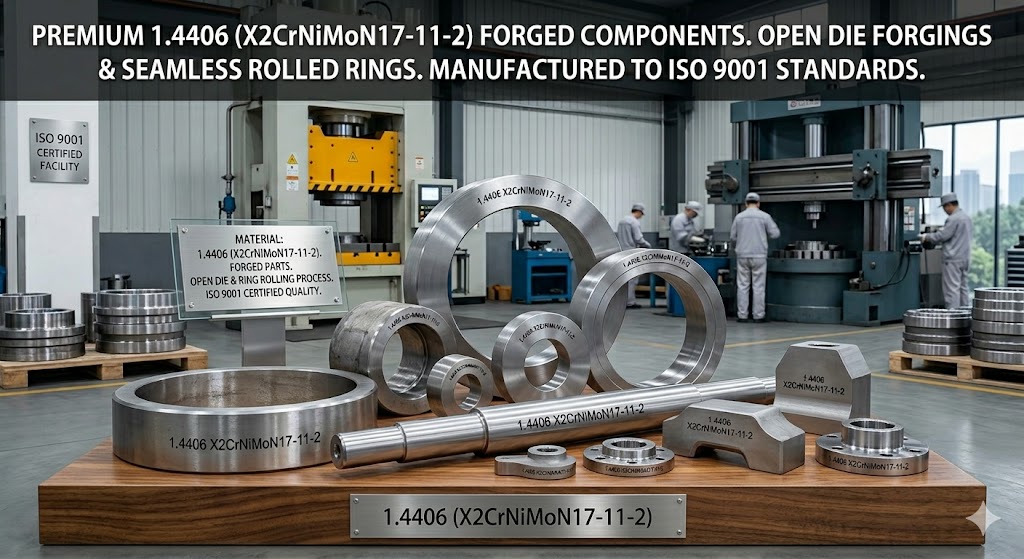
Jiangsu Liangyi Co., Limited is a professional ISO 9001:2015 certified manufacturer of 1.4406 (X2CrNiMoN17-11-2, X2CrNiMoN17112, X2CrNiMoN17.11.2) open die forging parts and seamless rolled steel forged rings in Jiangyin City, Jiangsu Province, China. Established in 1997, our 80,000㎡ production facility operates a vertically integrated manufacturing chain spanning steel melting, precision open-die forging, ring rolling, controlled solution heat treatment and in-house CNC machining — all under a single roof with ISO 9001:2015 quality management. With an annual forging capacity of 120,000 metric tons and a proven track record of supplying engineered components to projects in more than 50 countries across Europe, North America, the Middle East, Southeast Asia and Oceania, we are the partner of choice for procurement engineers who require traceable, certified 1.4406 stainless steel forgings with zero compromises on material integrity.
1.4406 Forging — Quick Reference Specifications
Full Range of 1.4406 (X2CrNiMoN17-11-2) Forged Steel Products
Every 1.4406 forging we ship begins with our own in-house steel melting, ensuring complete chemical traceability from ingot heat number to finished part serial number — a level of integration that most forging trading companies simply cannot offer. Our manufacturing capabilities cover the full spectrum of open-die forging geometries, with single-piece weights from 30 kg up to 30,000 kg and multiple product forms as described below.
1.4406 Forged Bars, Round Bars & Custom Step Shafts
We produce X2CrNiMoN17-11-2 forged round bars (solid), square bars, flat bars, hexagonal bars, step shafts, gear shafts, splined drive shafts and multi-diameter transition shafts. Maximum forged bar diameter reaches 2,000 mm with bar lengths up to 15 meters, covering the full range from small valve spindles to heavy pump drive shafts used in desalination plants and offshore platforms. All forged bars are produced with a minimum forging reduction ratio of 3:1 from the original ingot cross-section, guaranteeing a refined grain structure (ASTM grain size ≥ 5) and the elimination of centerline shrinkage porosity that is inherent in cast or rolled bar stock. 100% volumetric ultrasonic testing (UT) per EN 10228-3 or ASTM A388 is available as standard. Explore our full forged bars and shafts product range.
X2CrNiMoN17-11-2 Seamless Rolled Forged Rings
Our seamless ring rolling facility handles 1.4406 rings from 200 mm to 6,000 mm outer diameter and up to 30,000 kg per ring. Product forms include flat rings, profiled/contoured rings, gear rings, retaining rings, valve seat rings, flange blanks, bearing races, and large-bore pressure vessel shell courses. The ring rolling process gives 1.4406 a circumferentially oriented grain flow that is structurally superior to a machined disc cut from plate or bar — the grain lines follow the ring geometry rather than being cut by machining, producing measurably better fatigue strength and crack resistance in rotating applications. All rolled rings are solution annealed, water-quenched, and dimensionally inspected using calibrated 3D coordinate measuring equipment. EN 10204 3.1 and 3.2 mill test certificates are available with third-party witness. Learn more about our seamless rolled rings manufacturing capabilities.
1.4406 Hollow Forgings, Heavy-Wall Sleeves & Pressure Vessel Casings
Hollow forgings and heavy-wall cylinders in X2CrNiMoN17-11-2 are manufactured by piercing and mandrel forging or by ring rolling, delivering outer diameters up to 3,000 mm with wall thicknesses from 30 mm to over 400 mm. Typical products include pump casings, compressor cylinders, reactor pressure vessels, heat exchanger shells, riser sections, subsea wellhead housings and nuclear containment components. The absence of a longitudinal weld seam is the critical advantage of seamless hollow forgings over fabricated weldments for pressure-critical service: there is no heat-affected zone sensitisation, no weld root defect risk, and no need for post-weld heat treatment. For wall thicknesses exceeding 200 mm, we routinely specify optional Electroslag Remelting (ESR) of the starting ingot to achieve the premium inclusion cleanliness and macro-segregation control demanded by nuclear and subsea codes.
X2CrNiMoN17-11-2 Forged Discs, Flanges, Tube Sheets & Custom Machined Components
We produce forged discs, disk blanks, blocks, custom-profile flanges, tube sheets, baffle plates, pump impeller blanks, valve body blanks and fully finish-machined components to customer drawing. Tube sheets for heat exchangers are a specialty: we supply 1.4406 forged tube sheets with drilled tube holes, faced surfaces and dimensional tolerances per TEMA or ASME standards, ready for direct assembly. Our in-house turning, milling, drilling and grinding centers (CNC, 5-axis capability) allow us to take a raw forging to a finished near-net-shape component in a single controlled supply chain — eliminating the inspection gaps and dimensional inconsistencies that arise when forging and machining are sourced separately.
Material Overview: What is 1.4406 (X2CrNiMoN17-11-2) Stainless Steel?
1.4406 — formally designated X2CrNiMoN17-11-2 under EN 10088 and cross-referenced as AISI 316LN (UNS S31653) in ASTM standards — belongs to the austenitic stainless steel family. It is metallurgically engineered as a direct upgrade to the widely used 316L (EN 1.4404) by the deliberate introduction of 0.12–0.22% nitrogen into the alloy chemistry. This single compositional modification triggers a cascade of performance improvements that make 1.4406 the preferred specification in demanding sectors where 316L is considered borderline in strength, corrosion resistance or cryogenic toughness.
The alloy's full chemical name, X2CrNiMoN17-11-2, decodes as follows: "X2" denotes ultra-low carbon (≤ 0.030 wt%), "Cr17" is approximately 17% chromium, "Ni11" is approximately 11% nickel, "Mo2" is approximately 2% molybdenum, and "N" signals the controlled nitrogen addition that distinguishes this grade from standard 316L. Understanding this nomenclature helps procurement engineers verify that mill certifications reference the correct grade and avoid costly grade substitution errors in the supply chain.
The Metallurgical Role of Nitrogen in 1.4406 — Why It Matters for Forgings
Nitrogen is an interstitial solid-solution strengthening element in austenitic stainless steels — it occupies the gaps between iron atoms in the face-centred cubic crystal lattice and impedes dislocation movement, which is the atomic-scale mechanism of plastic deformation. The practical result is that 1.4406 achieves a guaranteed minimum 0.2% proof strength of 280 MPa (our typical controlled value: ≥ 300 MPa), compared to approximately 220–230 MPa for standard 316L — a yield strength advantage of approximately 25–30% in real production data.
In addition to strengthening, nitrogen performs three further metallurgical functions that are particularly valuable in heavy forgings. First, it stabilises the austenitic phase and suppresses the formation of chromium-depleted sigma phase during elevated-temperature service exposure — a critical benefit for components operating continuously at 300–450°C in chemical reactors and power plant steam systems. Second, nitrogen is a strong austenite stabiliser that delays recrystallisation during hot forging, allowing us to achieve finer grain sizes at equivalent forging reduction ratios compared to nitrogen-free grades. Third, nitrogen increases the Pitting Resistance Equivalent Number (PREN), directly improving resistance to localised corrosion in chloride environments.
Understanding the PREN of 1.4406 — A Calculated Corrosion Resistance Index
The Pitting Resistance Equivalent Number is the standard industry formula to compare localized corrosion resistance of stainless steel grades in chloride-bearing environments. The formula is: PREN = %Cr + 3.3 × %Mo + 16 × %N. Taking the mid-range chemical composition of our controlled production 1.4406 (Cr = 17.5%, Mo = 2.25%, N = 0.17%), the calculated PREN value is 27.6. By comparison, standard 316L with typical composition (Cr = 17.0%, Mo = 2.2%, N ≈ 0.02%) achieves a PREN of around 24.6. This shows our 1.4406 forged parts maintain a steady PREN lead of roughly 3 points over conventional 316L. This noticeable gap brings noticeably better practical performance in seawater splash zones, chlorinated process water and sour gas service conditions. A PREN value of no less than 25 is the common threshold specified by project engineers for offshore and coastal industrial applications.
Physical Properties of 1.4406 (X2CrNiMoN17-11-2) Stainless Steel
Beyond mechanical strength, physical properties govern how 1.4406 performs in thermal cycling, heat transfer equipment, precision-fitted assemblies and high-speed rotating machinery. The following values are representative of solution-annealed forged material at room temperature:
| Physical Property | Value | Significance for Forged Components |
|---|---|---|
| Density | 7.98 g/cm³ | Used for weight calculation of large forged rings and shafts; slightly higher than 316L (7.95) due to nitrogen |
| Elastic Modulus (Young's Modulus) | 200 GPa (20°C); 170 GPa (400°C) | Governs deflection calculations for shafts and structural forgings; comparable to 316L |
| Thermal Conductivity | 13 W/(m·K) at 20°C; 17 W/(m·K) at 300°C | Low thermal conductivity vs. carbon steel requires careful heat treatment ramp rates for heavy sections to avoid thermal shock |
| Coefficient of Thermal Expansion | 16.0 × 10⁻⁶ /K (20–100°C); 17.5 × 10⁻⁶ /K (20–400°C) | Critical for flanged joint design and clearance calculations in heat exchangers and turbomachinery |
| Specific Heat Capacity | 500 J/(kg·K) | Determines heating and cooling energy requirements during solution annealing of heavy forgings |
| Magnetic Permeability | ≤ 1.02 (solution annealed) | Essentially non-magnetic in the annealed condition; important for MRI equipment and marine degaussing applications |
| Charpy Impact Energy (−196°C) | ≥ 100 J (typical: 120–180 J) | Outstanding retained toughness at LNG temperature — a primary reason 1.4406 is specified over duplex grades for cryogenic service |
1.4406 vs Alternative Grades — Engineering Selection Comparison
Selecting the right stainless steel grade for a forged component requires balancing corrosion resistance, mechanical strength, cryogenic performance and cost. The table below presents our direct comparison of 1.4406 against the four grades most frequently considered as alternatives in global industrial procurement:
| Property / Criterion | 1.4406 (316LN) — Our Grade | 1.4404 (316L) | 1.4438 (317L) | 1.4539 (904L) | 1.4462 (2205 Duplex) |
|---|---|---|---|---|---|
| Min. Yield Strength (MPa) | 280 (our typ. 300) | 220 | 220 | 220 | 450 |
| Calculated PREN (typical) | ≈ 27.6 | ≈ 24.6 | ≈ 28.5 | ≈ 36.0 | ≈ 35.0 |
| Cryogenic Toughness (−196°C) | Excellent (≥ 100 J) | Good | Good | Good | Limited — not suitable below −50°C |
| Chloride SCC Resistance (ambient) | Moderate | Moderate | Moderate | Good | Very Good |
| Weldability | Excellent | Excellent | Good | Good | Moderate (tight heat input control) |
| Typical Relative Material Cost | 1.0× (baseline) | 0.95× | 1.15× | 1.80–2.20× | 1.30–1.50× |
| EN 10222-5 Pressure Forging Standard | Listed grade | Listed grade | Listed grade | Listed grade | Not listed (separate standard) |
| Best Fit Application | LNG, nuclear, chloride service needing strength + cryogenic toughness | General corrosive service, lower cost | Higher-chloride process streams | Sulphuric/phosphoric acid | High-chloride structural at ambient temp |
The comparison above clarifies why 1.4406 occupies a unique position in the stainless steel selection matrix: it is the only common austenitic grade that simultaneously offers improved yield strength over 316L, adequate PREN for moderate chloride service, and certified suitability for cryogenic duty down to −196°C — all at a price premium of less than 5% over standard 316L.
Chemical Composition & Mechanical Properties of X2CrNiMoN17-11-2
All 1.4406 raw material ingots used in our forgings originate from our in-house electric arc furnace (EAF) melting, AOD (Argon Oxygen Decarburisation) refining and VOD (Vacuum Oxygen Decarburisation) finishing. This triple-refining route is essential for achieving the simultaneously low carbon (≤ 0.025%, our target) and controlled nitrogen (0.14–0.20%, our target) chemistry that defines high-quality 1.4406: carbon and nitrogen compete for the same interstitial lattice sites, and controlling both simultaneously requires precise gas atmosphere management during the VOD stage. For high-integrity and ultra-clean applications, we additionally offer ESR (Electroslag Remelting) re-melt, which further reduces non-metallic inclusions by 40–60% and improves macro-segregation homogeneity in heavy ingot cross-sections exceeding 800 mm diameter.
Chemical Composition of 1.4406 (X2CrNiMoN17-11-2) Stainless Steel
| Chemical Element | Role in Alloy Performance | EN 10088-3 Standard Range (wt%) | Our Precision Control Target (wt%) |
|---|---|---|---|
| Iron (Fe) | Matrix base metal | Balance (~63–71%) | Balance |
| Chromium (Cr) | Primary passive film former; each 1% Cr increases PREN by 1 point | 16.5 – 18.5 | 17.0 – 18.0 |
| Nickel (Ni) | Austenite stabiliser; improves toughness and cryogenic ductility | 10.0 – 12.5 | 10.5 – 12.0 |
| Molybdenum (Mo) | Pitting and crevice corrosion inhibitor; each 1% Mo adds 3.3 PREN points | 2.0 – 2.5 | 2.1 – 2.4 |
| Nitrogen (N) | Solid-solution strengthener; austenite stabiliser; adds 16 PREN points per 1% N | 0.12 – 0.22 | 0.14 – 0.20 |
| Carbon (C) | Must be ≤ 0.030% to prevent sensitisation; our target ≤ 0.025% provides additional safety margin | Max 0.030 | Max 0.025 |
| Manganese (Mn) | Deoxidiser; secondary austenite stabiliser; controlled to avoid hot shortness | Max 2.0 | Max 1.8 |
| Silicon (Si) | Deoxidiser; high Si reduces corrosion resistance in acidic media — kept lean | Max 1.0 | Max 0.8 |
| Phosphorus (P) | Tramp element that concentrates at grain boundaries and reduces hot ductility — minimised | Max 0.045 | Max 0.035 |
| Sulfur (S) | Forms MnS inclusions that act as pitting initiation sites — our target is ~30% lower S than EN requirement | Max 0.015 | Max 0.010 |
Mechanical Properties of 1.4406 Forged Steel (Solution Annealed + Water Quenched)
| Mechanical Property | Test Standard | EN 10222-5 Minimum | Our Typical Guaranteed Value |
|---|---|---|---|
| Tensile Strength (Rm) | EN ISO 6892-1 | 580 – 800 MPa | 620 – 750 MPa |
| 0.2% Proof Yield Strength (Rp0.2) | EN ISO 6892-1 | Min 280 MPa | Min 300 MPa |
| Elongation at Fracture (A5, longitudinal) | EN ISO 6892-1 | Min 30% | Min 35% |
| Brinell Hardness (HBW) | EN ISO 6506-1 | Max 250 HBW | 180 – 220 HBW |
| Charpy V-Notch Impact (+20°C) | EN ISO 148-1 | Min 60 J (avg of 3) | Typical 150 – 220 J |
| Charpy V-Notch Impact (−196°C) | EN ISO 148-1 | Min 40 J (avg of 3) | Typical 100 – 180 J |
| Grain Size (ASTM E112) | ASTM E112 | — | Grade 5 – 8 (our controlled target) |
| Reduction of Area (Z, longitudinal) | EN ISO 6892-1 | — | Min 60% |
The inclusion of Charpy impact data at both +20°C and −196°C in every material test report we issue reflects our understanding that most critical applications for 1.4406 — LNG equipment, nuclear auxiliaries, cryogenic valve bodies — require verified impact toughness at service temperature, not just at ambient. We perform these tests in-house with calibrated Charpy impact machines and provide the full set of three individual specimen results alongside the averaged value.
Precision Forging Process for X2CrNiMoN17-11-2 Stainless Steel
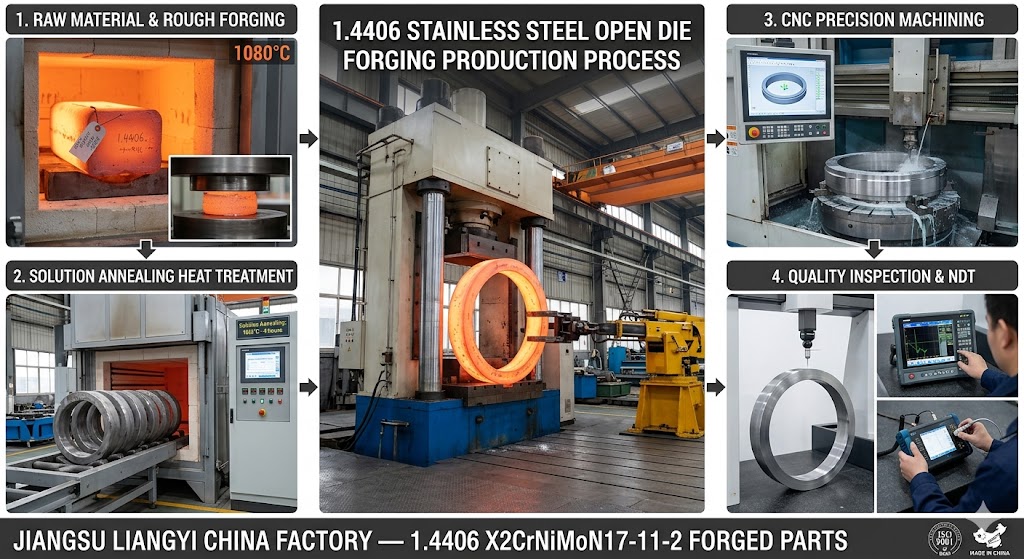
Producing high-quality 1.4406 forgings requires more than simply heating the material and pressing it — the nitrogen-alloyed chemistry creates specific metallurgical sensitivities during hot working that, if not controlled, result in nitrogen bubble formation, grain boundary oxidation and recrystallisation behaviour that degrades both mechanical properties and corrosion resistance. Over 25 years of forging this grade, our production engineers have developed proprietary process parameters for 1.4406 that go beyond what any published standard specifies. We are confident that our process window is tighter than any trading company that sources forgings from unknown third-party producers. Our advanced forging and inspection equipment supports every stage of this controlled process.
Step-by-Step 1.4406 Production Process Flow
- Incoming Chemical Verification — Every Ingot, Every Heat: Before any ingot enters our forge, we conduct independent OES (Optical Emission Spectrometry) spark analysis on the ingot end face to verify all 10 controlled elements — particularly nitrogen content, which is notoriously difficult to control during melting and which directly determines whether the finished forging will meet the 0.12–0.22% N specification. Only heats with confirmed nitrogen in our tighter target range (0.14–0.20%) are released for forging. Heats outside this window are rejected or re-melted. This pre-forge OES verification step is not required by any standard — it is our own internally mandated safeguard against grade substitution and chemistry drift during melting.
- Ingot Homogenisation Soak: All 1.4406 ingots ≥ 600 mm diameter receive a pre-forge homogenisation soak at 1200–1230°C for a minimum of 1 hour per 100 mm of cross-section diameter. This diffusion treatment reduces dendritic segregation of chromium, molybdenum and nitrogen that occurs during solidification. Skipping this step — common in lower-quality production — results in banded microstructure with alternating high- and low-alloy zones that appear as corrosion-susceptible streaks in service.
- Controlled Open Die Forging within 1150–950°C Window: Forging is performed within a strict temperature window: start temperature 1150°C maximum, finish temperature 950°C minimum. Working above 1150°C risks nitrogen gas bubble formation (porosity) and excessive grain coarsening; working below 950°C causes work-hardening that makes the steel resistant to further deformation and can introduce cracking. We use calibrated optical pyrometers on the press lines to monitor billet surface temperature in real time. The minimum cumulative deformation ratio is 3:1 from the ingot cross-section; critical applications specify 4:1 or greater.
- Precision Solution Annealing at 1050–1100°C & Rapid Water Quench: All 1.4406 forgings are solution annealed and held for a minimum of 1 minute per millimetre of cross-section thickness — for a 300 mm thick forging, this means a minimum 5-hour isothermal hold at temperature. Immediately following the soak, parts are water-quenched at a cooling rate sufficient to bring the surface temperature below 400°C within 3 minutes. This rapid quench freezes the alloy carbides and nitrides in solution, preventing re-precipitation during cooling through the sensitisation range (550–850°C). Full heat treatment data — furnace chart with thermocouple traces, charge weight, actual temperature profile and quench time — is included in every delivery documentation package.
- In-House CNC Machining to Drawing: Our machining centre handles turning diameters up to 5,000 mm and workpiece lengths up to 12,000 mm on CNC vertical and horizontal lathes. All machining is performed with cutting parameters and coolant flow rates optimised for austenitic stainless steel — a material known for work-hardening during cutting, which requires sharp tooling, positive rake angles, and consistent depth of cut to avoid glazing the surface and inducing residual tensile stresses.
- Full-Process Quality Inspection & Documentation: Each production step is recorded in a job traveller card that accompanies the forging through the entire production flow. The final inspection package is compiled from step-level records and third-party test results into a bound document set that supports full material traceability from raw ingot heat number to finished part.
International Production & Inspection Standards Compliance
| Standard | Scope & Applicability |
|---|---|
| EN 10088-3:2014 | Stainless steels: technical delivery conditions for semi-finished products, bars, rods, wire for general engineering purposes. Defines 1.4406 as a listed grade with full composition and property requirements. |
| EN 10028-7:2016 | Flat products made of steels for pressure purposes — stainless steels. Governs the use of 1.4406 in pressure-retaining flat forged components (tube sheets, flanges, plates). |
| EN 10222-5:2000 | Steel forgings for pressure purposes: austenitic and austenitic-ferritic stainless steels. The primary European standard for 1.4406 pressure vessel forgings; specifies inspection categories and documentation requirements. |
| EN 10272:2016 | Stainless steel bars for pressure purposes — governs forged and hot-rolled bar products intended for pressure equipment fabrication. |
| EN 10250-4:2000 | Open steel die forgings for general engineering purposes — stainless and heat-resisting steels. Governs dimensional tolerances, surface condition, and inspection for open-die forged products. |
| ASTM A604 / A604M | Ultrasonic examination of consumable electrode remelted steel forgings — applicable for ESR-grade billets and premium hollow forgings. |
| EN ISO 148-1:2016 | Metallic materials — Charpy pendulum impact test. Individual/average result reporting per this standard, including mandatory cryogenic tests at −196°C for LNG-service components. |
| EN 10228-3 / ASTM A388 | Ultrasonic testing of forgings — volumetric UT examination with acceptance criteria selected per project specification (typically Quality Class 3 or 4 per EN 10228-3). |
| NACE MR0175 / ISO 15156-3 | Materials for use in H2S-containing environments in oil and gas production — 1.4406 is listed as a qualified material when supplied in solution-annealed condition with hardness ≤ 22 HRC. |
| API 6A (20th Edition) | Wellhead and tree equipment — we can manufacture 1.4406 forged wellhead components to meet the material, dimensional and mechanical testing requirements specified in API 6A when required by customer project specifications. API 6A Monogram licensing is held by the end-equipment manufacturer; we supply conforming forged materials with full traceability documentation to support their monogram application. |
Welding Guidelines for 1.4406 (X2CrNiMoN17-11-2) Forgings
Our customers frequently ask for welding guidance when joining 1.4406 forged components into fabricated assemblies. The following recommendations are based on the established behaviour of this grade and reflect current best practice in the industry. Always qualify welding procedures (WPS/PQR) per applicable codes (ASME IX, EN ISO 15614-1) before production welding.
| Welding Process | Recommended Filler Metal | AWS Classification | Notes |
|---|---|---|---|
| GTAW (TIG) | ER316LN | AWS A5.9 | First choice; nitrogen-matching filler preserves PREN in weld metal |
| GTAW (TIG) — alternative | ER316L | AWS A5.9 | Acceptable; slight PREN reduction in weld zone vs. ER316LN |
| SMAW (MMA) | E316LN-16 or E316L-16 | AWS A5.4 | Lime-fluorite (low-hydrogen) electrode preferred for heavy-section joints |
| FCAW | E316LT1-4 (gas-shielded) | AWS A5.22 | Ar/CO2 mixed shielding gas; used for thick-walled pressure vessel nozzles |
Critical welding parameters for 1.4406: Inter-pass temperature must be kept below 150°C. Net heat input should be limited to 1.5 kJ/mm for butt joints and 2.0 kJ/mm for fillet welds to control grain growth. Post-weld heat treatment (PWHT) is not required for most applications given the ultra-low carbon content — and is specifically not recommended unless code requirements demand it, as solution annealing of the complete welded assembly at 1050–1080°C followed by water quenching would be required.
Global Compliance & GEO-Specific Market Requirements
Regulatory access to different global markets requires different certification paths and documentation packages. Based on 25+ years of international project deliveries, we understand the local requirements of each major industrial market and pre-configure our quality documentation packages accordingly.
European Union & EEA (Germany, Netherlands, France, Scandinavia)
The EU Pressure Equipment Directive (PED 2014/68/EU) requires that all pressure-retaining components used in Category II, III and IV pressure equipment be manufactured from materials listed in a harmonised standard or covered by a European Material Approval (EMA). 1.4406 is listed in EN 10222-5, EN 10028-7 and EN 10088-3, covering forged pressure parts across all product forms. As a forged material supplier, CE marking is applied by the final pressure equipment manufacturer (our customer), not by us as the material supplier. However, our 1.4406 forgings are produced from materials listed in EN 10222-5, EN 10028-7 and EN 10088-3 — the harmonised EN standards referenced under PED 2014/68/EU — which means our materials are directly suitable for use in CE-marked pressure equipment without additional material approval. We issue EN 10204 Type 3.1 mill test certificates signed by our internal Quality Manager (independent of production), or Type 3.2 certificates arranged with an appointed third-party inspection body such as TÜV, DNV or Bureau Veritas on a per-project basis. For pharmaceutical sector customers in Germany, Switzerland and the Netherlands, we can provide surface roughness measurement reports (Ra values) for product-contact surfaces to support their internal equipment qualification documentation.
North America — USA & Canada (ASME, API, NACE Applications)
Our 1.4406 forgings are manufactured and documented to meet ASTM requirements (316LN, UNS S31653 chemistry and property limits), with full UNS designation cross-referenced on the mill test certificate. For oil and gas wellhead and Christmas tree equipment where the end-equipment manufacturer requires API 6A conforming forged materials, we can manufacture to meet the material composition, mechanical property and non-destructive examination requirements of API 6A PSL-2 and PSL-3 specifications, with full traceability documentation to support the equipment manufacturer's API monogram application. For sour gas service (H2S-containing environments), all 1.4406 forgings meet NACE MR0175/ISO 15156 Part 3 requirements for austenitic stainless steels: solution annealed, hardness ≤ 22 HRC (our typical production: 18–21 HRC equivalent). We provide a written material compliance statement confirming delivery condition (solution annealed), measured hardness results, and basis of compliance with NACE MR0175/ISO 15156 Part 3 material requirements with every delivery of sour-service forgings.
Middle East — Saudi Arabia, UAE, Kuwait & Qatar (Aramco, ADNOC, KOC, QatarEnergy)
Our experience with Saudi Aramco SAES-A-007, SAES-H-001, SAES-M-001 and related specifications, as well as ADNOC AGES and KOC technical standards, means we know which specific deviations from EN or ASTM standards are required before we begin production. For example, Aramco project specifications for sour service frequently require hardness testing at multiple locations on each forging (not just one test per heat), supplementary PMI by XRF on 100% of parts, and specific requirements for heat treatment record format. We have delivered over 2,000 pieces of 1.4406 forged wellhead components to a large onshore sour gas field project in Saudi Arabia — with stable performance over 5+ years in H2S concentrations exceeding 15 mol% and zero reported quality incidents.
Southeast Asia & Oceania — Singapore, Australia, Indonesia, Malaysia
LNG receiving terminals in Singapore (Jurong Island) and Australia (Darwin, Gladstone, Karratha) represent major end markets for our 1.4406 cryogenic forgings. Our 1.4406 cryogenic valve bodies, pump casings and rolled rings supplied to Singapore LNG projects are produced to BS EN 10222-5 with Type 3.2 certification and cryogenic impact testing at −196°C per EN ISO 148-1, confirmed by a third-party laboratory. Australian mining sector customers (iron ore, lithium, copper processing in Western Australia) use 1.4406 for slurry pump components in high-chloride, abrasive process streams, where our forgings have demonstrated service life 35–50% longer than standard 316L castings or plate-fabricated alternatives.
East Asia — Japan & South Korea (JIS, KS Standard Applications)
Japanese customers specify materials under JIS G 4303 (SUS 316LN) for bar and wire. Our mill test certificates can be issued with dual standard cross-referencing (EN/JIS) to facilitate domestic Japanese regulatory approval. Korean customers (shipbuilding, semiconductor, petrochemical) typically reference KS D or ASTM equivalent specifications. In both markets, surface finish and dimensional tolerance requirements are stricter than European norms: we routinely supply 1.4406 forged valve shafts and pump shafts to Japanese customers with diameter tolerances of +0/−0.05 mm and surface roughness Ra ≤ 0.8 µm on bearing journals.
Industry Applications & Verified Project Cases
Oil & Gas — Wellhead Equipment, Downhole Tools & Subsea Components
1.4406 is specified in upstream oil and gas applications where the combination of NACE MR0175 compliance, mechanical strength ≥ 280 MPa Rp0.2, and API 6A quality documentation is required simultaneously — a set of requirements that eliminates most alternative materials. We manufacture 1.4406 forged wellhead components including casing heads, tubing heads, casing hangers, spacer spools, cross-over flanges, adapter flanges (DSA), Christmas tree flanges and mandrel-type wellhead housings. For downhole applications, we produce ESP (Electrical Submersible Pump) motor shafts in 1.4406, where the combination of high strength (to handle start-up torque surges) and chloride resistance (in formation water brines typically containing 20,000–200,000 ppm Cl−) is critical. Verified Delivery — Saudi Arabia Sour Gas Field: Between 2018 and 2020, we supplied 2,340 pieces of 1.4406 forged wellhead components (casing heads, spacer spools and adapter flanges) for a large onshore sour gas development in the Eastern Province of Saudi Arabia. All parts were supplied to the material and testing requirements of API 6A PSL-2, NACE MR0175 and Aramco project specifications — with API Monogram application managed by the equipment manufacturer — with 100% dimensional inspection, PMI verification and TÜV Rheinland-witnessed EN 10204 3.2 certificates arranged on a project basis. As of 2025 (5+ years in service), the customer confirmed zero quality-related field failures across the supplied batch.
Cryogenic Valves & LNG Equipment
1.4406's austenitic structure is intrinsically stable at cryogenic temperatures: there is no ferritic-to-austenitic phase transformation (ductile-brittle transition) that occurs in carbon and low-alloy steels, and the austenite remains stable without the risk of strain-induced martensite transformation that limits some lower-nickel austenitic grades. Our 1.4406 forged cryogenic valve bodies, bonnets, stems, balls and seat rings are used in ball valves, gate valves, globe valves and check valves for LNG carrier loading arms, LNG terminal regasification systems, liquid nitrogen distribution systems and industrial gas cryogenic storage. Verified Delivery — Singapore LNG Terminal: We supplied 480 pieces of 1.4406 forged cryogenic valve bodies and bonnets for a large LNG receiving terminal expansion project on Jurong Island, Singapore, in 2021. All specimens exceeded 100 J at −196°C in Charpy testing (minimum requirement: 40 J). EN 10204 Type 3.2 certificates with DNV-witnessed inspection arranged on a project basis, 100% liquid penetrant examination (PT) per EN ISO 3452. The valves are now operating in −162°C LNG service.
Chemical, Petrochemical & Pharmaceutical Pressure Equipment
In the European chemical and pharmaceutical sectors, 1.4406 is favoured over standard 316L in process environments where the 25–30% yield strength advantage reduces vessel wall thickness and therefore reduces system weight and fabrication cost with no compromise on corrosion resistance. The ultra-low carbon and controlled nitrogen chemistry of 1.4406 is particularly valued in pharmaceutical manufacturing: the low carbon content eliminates the sensitisation risk that could create micro-galvanic cells at grain boundaries and cause trace metal contamination of pharmaceutical process streams. Verified Delivery — German Pharmaceutical Manufacturer: In 2019, we supplied 1.4406 forged heat exchanger shells (OD 850 mm, wall 65 mm, length 3,200 mm), tube sheets (OD 920 mm, thickness 120 mm) and nozzle forgings to a major pharmaceutical API manufacturer in Baden-Württemberg, Germany. All components were supplied to the material requirements of PED 2014/68/EU Category III, with TÜV-witnessed EN 10204 3.2 certificates arranged on a project basis, and surface roughness documentation (Ra ≤ 1.6 µm on product-contact surfaces) for the customer's equipment qualification. The equipment has been in continuous service in a GMP-regulated facility since 2019 — 6+ years with no reported corrosion or dimensional issues reported by the customer.
Nuclear Power — Reactor Auxiliaries & Coolant System Components
Nuclear applications impose the most demanding material qualification requirements of any industry: every kilogram of structural material in a nuclear power plant must be traceable to its original melt heat, with a complete unbroken chain of certified inspections from ingot to installed component. For projects requiring enhanced inspection scope, our 1.4406 forgings can be produced under an extended quality plan (QP) that includes heat-specific OES chemical verification, forging ratio documentation per piece, solution anneal furnace chart with calibrated thermocouple traceability, 100% UT per EN 10228-3 Quality Class 4, 100% MT or PT surface inspection, and metallographic grain size determination per ASTM E112. The quality plan scope is agreed with the customer and any appointed third-party inspector before production begins. Project Reference — Nuclear-Related Auxiliary Equipment, China: We have supplied 1.4406 forged pump casings and seal chamber components for auxiliary systems in a large power generation project in Coastal China, produced under an enhanced inspection quality plan with 100% UT and MT examination and zero recordable indications in the final delivery. All project-specific quality requirements were agreed and documented in the purchase order before production commenced.
Pump & Turbomachinery — Shafts, Impellers & Casings
1.4406 forged shafts are superior to cast or rolled bar equivalents for pump service because the aligned grain flow from controlled forging processing gives measurably better fatigue endurance limit — typically 15–20% higher than the same steel in a cast or machined-from-plate condition. We manufacture 1.4406 forged pump shafts (solid and hollow), impeller blanks, diffuser rings, casing half-shells, and wearing rings for slurry pumps, centrifugal pumps, submersible pumps and multistage high-pressure pumps used in the oil and gas, mining, desalination, nuclear and chemical sectors. Verified Delivery — Western Australian Mining Project: In 2022, we supplied 1.4406 forged pump shafts (diameter 280 mm, length 3,800 mm), impeller blanks (OD 620 mm, hub thickness 180 mm) and casing components for a copper mineral processing plant in the Pilbara region of Western Australia. The process medium was a high-chloride (55,000 ppm Cl−) copper sulphate slurry at 45–60°C. The customer reported a 42% longer service interval compared to the previous standard 316L cast pump components, translating to approximately 3 fewer unplanned maintenance shutdowns per year across the affected pump stations.
Marine, Desalination & Coastal Infrastructure
Seawater and brackish water environments (chloride concentration 15,000–35,000 ppm Cl−) sit at the upper limit of reliable service for 316L stainless steel — pitting corrosion can initiate on 316L surfaces in quiescent seawater at temperatures above approximately 25–30°C. 1.4406 with its PREN ≥ 26.5 provides a meaningful improvement in this regime, particularly in heat exchanger tube sheets, seawater intake valve bodies, desalination plant components and marine shaft couplings operating in splash zones. We have supplied 1.4406 forged tube sheets (OD up to 1,800 mm), valve bodies and flanges for seawater intake systems in desalination plants in the UAE and Saudi Arabia, and for offshore platform seawater lift pump systems in the North Sea.
Full-Process Quality Control & Inspection System
Quality at Jiangsu Liangyi is embedded into every production step through our ISO 9001:2015 quality management system, which we have maintained continuously since its first certification in 2004. Every batch of finished 1.4406 forged parts is supplied with a complete bound inspection documentation package, comprising:
- Material Test Report (MTR / Mill Certificate): Chemical composition results from both the original ingot certificate and our own OES verification. EN 10204 Type 3.1 (signed by our QC Manager) or Type 3.2 (countersigned by approved third-party inspection body) available.
- Mechanical Properties Test Report: Full tensile test results (Rm, Rp0.2, A%, Z%) with test piece location and test direction. Brinell hardness results from multiple measurement points. Charpy V-notch impact test results at specified test temperature — three individual specimen values and average, with full compliance statement.
- Metallographic Examination Report: Micro-section photographs at 100× and 400× magnification showing fully equiaxed recrystallised austenite grain structure, confirmed ASTM grain size number (our typical result: Grade 5–8), inclusion content rating per ASTM E45, and confirmation of absence of delta-ferrite and sigma-phase.
- Heat Treatment Record: Actual furnace temperature chart from the solution annealing and quench cycle, with calibration certificate reference numbers for the thermocouples used. For ESR ingot material: ESR process record confirming slag composition.
- Non-Destructive Testing Reports: UT report per EN 10228-3 or ASTM A388 with scan coverage map, calibration details, and acceptance statement. MT or PT surface examination report per EN ISO 9934 or EN ISO 3452.
- Dimensional Inspection Report: All critical dimensions per the approved drawing, measured with calibrated instruments, with actual measured values, drawing nominal values, tolerances and pass/fail status.
- PMI (Positive Material Identification) Report: 100% XRF or OES PMI on all pieces if specified (standard for Aramco, ADNOC, KOC and nuclear projects).
- Third-Party Inspection Report: Signed inspection report and release note from the appointed third-party inspection body (BV, SGS, TÜV, Lloyd's Register, DNV, Intertek, or customer-nominated inspector), arranged on a per-project basis. Third-party inspection is available upon request; the inspection scope and appointed body are agreed in the purchase order.
How to Specify 1.4406 Forgings — Procurement Engineer's Checklist
Drawing from our experience in dealing with enquiries from procurement and engineering teams across the globe, the following checklist explains what information is needed to generate an accurate quotation and avoid ambiguity in the purchase order:
- Material specification: EN designation (X2CrNiMoN17-11-2, 1.4406) or ASTM equivalent (316LN, S31653), together with the specific production standard (EN 10222-5 for pressure forgings, EN 10250-4 for general engineering). If the project requires NACE MR0175 material compliance or API 6A material and testing specifications, please state this clearly in your enquiry. This allows us to set up the correct production and inspection plan accordingly.
- Product form and dimensions: Ring, bar, disc, hollow forging or machined component. Provide 2D drawing in PDF and native CAD format (DWG, STEP, IGES) for custom components. Indicate whether rough forged (with machining allowance) or finish machined to drawing is required.
- Delivery condition: Standard for 1.4406 is solution annealed + water quenched. State if ESR (Electroslag Remelting) is required for premium cleanliness.
- Mechanical property requirements: State the applicable standard and any supplementary requirements (cryogenic Charpy testing, specific test temperature, minimum individual specimen Charpy value).
- Inspection and NDT requirements: Specify UT acceptance class (EN 10228-3 Class 1–4 or ASTM A388 quality level), surface NDT method (MT or PT), and any supplementary inspection (100% PMI, ASTM A262 intergranular corrosion test, etc.).
- Certification type: EN 10204 Type 3.1 (standard) or Type 3.2 (third party witness) If required 3.2, please nominate your preferred inspection body or we can arrange from bodies we have worked with on previous customer projects including BV, TÜV, DNV, Lloyd’s and SGS.
- Quantity and delivery schedule: Total quantity and required on-site date. For urgent deliveries, ask about our stock availability of standard-size forged bars and rings in 1.4406.
Frequently Asked Questions (FAQ) About 1.4406 Forging Parts
1.4406 (X2CrNiMoN17-11-2) is the European EN standard designation. Cross-standard equivalents: ASTM/UNS: 316LN (UNS S31653); JIS: SUS 316LN; BS (old UK): 316S13; ISO: X2CrNiMoN17-11-2. When ordering from us, always quote the EN material number 1.4406 or UNS S31653 to avoid confusion with the non-nitrogen-alloyed grade 1.4404 (316L, UNS S31603). Our mill test certificates can reference both EN and ASTM designations simultaneously.
The only compositional difference is the addition of nitrogen: 1.4406 contains 0.12–0.22% N while 1.4404 (316L) contains typically ≤ 0.10% N (not controlled as a specified minimum). The consequences: (1) minimum Rp0.2 increases from 220 MPa to 280 MPa — a 27% strength increase enabling wall thickness reduction in pressure vessels; (2) PREN increases by approximately 3 points, improving pitting resistance in chloride service; (3) cryogenic toughness at −196°C is maintained and verified by mandatory Charpy testing in EN 10222-5; (4) austenite stability is improved, reducing risk of strain-induced martensite under cold-working. The price premium is typically 3–7% for forged products over standard 316L — extremely cost-effective wherever the strength or corrosion resistance benefit is required.
Yes — 1.4406 is one of the standard material choices for cryogenic service from −100°C down to −196°C (liquid nitrogen temperature) and even to −269°C (liquid helium temperature). Its face-centred cubic (FCC) austenitic crystal structure has no ductile-brittle transition temperature — unlike ferritic and martensitic steels. EN 10222-5 requires mandatory Charpy V-notch impact testing at −196°C for 1.4406 forgings intended for cryogenic pressure service, with a minimum average of 40 J (our typical values: 100–180 J, well above the minimum). For LNG service specifically (−162°C boiling LNG), 1.4406 is fully compliant with EN 13445, ASME BPVC Section VIII Div.1, and EN 1473 (LNG installation design).
Our production capabilities for 1.4406: Single-piece weight: 30 kg to 30,000 kg. Seamless rolled rings: OD up to 6,000 mm, face width up to 1,500 mm, weight up to 30,000 kg. Forged solid bars and shafts: diameter up to 2,000 mm, length up to 15,000 mm. Hollow forgings and pressure vessel shells: OD up to 3,000 mm, wall thickness up to 400 mm. Forged discs and tube sheets: OD up to 3,500 mm, thickness up to 600 mm. For specific enquiries outside these parameters, please contact us — we can assess feasibility based on actual ingot availability and press capacity scheduling.
Yes. NACE MR0175 / ISO 15156 Part 3, Table A.2 lists austenitic stainless steels including 316LN (1.4406) as acceptable for sour service when supplied in the solution-annealed condition with hardness ≤ 22 HRC, equivalent to approximately 237 HBW. Our 1.4406 forgings in the standard solution-annealed condition consistently achieve 180–220 HBW (well within the limit). We provide a written material compliance statement confirming the delivery condition (solution annealed), all measured hardness results, and the specific basis of compliance with NACE MR0175/ISO 15156 Part 3 material requirements with each delivery. Note that cold-working or strain-hardening after solution annealing invalidates compliance — we advise against any cold-forming of 1.4406 components intended for sour service without re-solution-annealing.
We can facilitate third-party witnessed inspection and EN 10204 Type 3.2 certificate countersignature by internationally recognised inspection bodies, arranged on a per-project basis. Bodies we have worked with on customer projects include Bureau Veritas (BV), TÜV Rheinland, TÜV SÜD, DNV, Lloyd's Register, SGS, and Intertek; customer-nominated inspectors are also welcomed. Available certification types: EN 10204 Type 2.1 (declaration of compliance), Type 2.2 (test report), Type 3.1 (signed by our internal QC Manager, independent of production), and Type 3.2 (countersigned by the appointed third-party inspector). For projects with enhanced quality plan requirements, the specific inspection scope is agreed between us, the customer and the appointed inspector before production begins.
Lead time varies by product form, size, and inspection requirements: Small to medium forgings (≤ 500 kg, standard dimensions): 3–4 weeks from PO confirmation if raw material stock is available. Custom forgings (medium complexity, 500–5,000 kg): 5–7 weeks from PO confirmation. Large heavy forgings (5,000–30,000 kg), special inspection (3.2 cert, cryogenic Charpy, 100% PMI): 8–12 weeks. ESR-grade premium forgings or projects with an extended inspection quality plan: 10–16 weeks. Lead times begin from receipt of approved drawings, confirmed purchase order, and any advance payment required. Expedited production slots are sometimes available for urgent requirements — please discuss with our sales team.
1.4406 is designed to resist intergranular corrosion (sensitisation) due to its ultra-low carbon content (≤ 0.030%, our target ≤ 0.025%). When customers specify an intergranular corrosion test (most commonly ASTM A262 Practice B — oxalic acid etch screening, or Practice E — copper-copper sulphate-sulphuric acid immersion test), our 1.4406 forgings in the solution-annealed condition consistently pass without sensitisation structures. We perform ASTM A262 testing on request and include the results in the inspection documentation package.
Yes. For applications requiring premium inclusion cleanliness, reduced macro-segregation and enhanced fatigue performance — typically nuclear components, high-speed rotating machinery, and subsea pressure-critical forgings — we offer 1.4406 starting material produced via ESR in addition to the standard EAF+AOD+VOD route. ESR reduces total non-metallic inclusion content by approximately 40–60% compared to conventionally melted material and essentially eliminates macro-segregation banding in large ingot cross-sections. ESR material adds approximately 15–25% to raw material cost and 2–4 weeks to lead time.
1.4406 is approved for pressure service up to 450°C in EN 10222-5. At 300°C, the 0.2% proof strength of solution-annealed 1.4406 is approximately 195–210 MPa (reduced from room-temperature 300 MPa minimum due to thermal softening). At 400°C, it is approximately 170–185 MPa. One important consideration above 400°C is sigma-phase formation: sigma phase can precipitate in austenitic stainless steels after extended exposure above 500°C, reducing toughness and corrosion resistance. The nitrogen addition in 1.4406 delays sigma-phase kinetics compared to standard 316L, providing a useful advantage for components with long design lives at 400–450°C. For continuous service above 450°C, we would typically recommend a more thermally stable grade such as 1.4571 or 1.4547 — our technical team can advise on material selection for your specific application.
Request a Quotation for Custom 1.4406 (X2CrNiMoN17-11-2) Forging Parts
Jiangsu Liangyi Co., Limited has been manufacturing certified 1.4406 stainless steel forgings for demanding global industries since 1997. Our vertical integration from steel melting through final machining, our 25+ years of grade-specific process expertise, and our established relationships with international inspection bodies mean that we can support your project from the first technical enquiry through to final delivery — with a single point of contact and full documentation traceability. We currently supply customers in more than 50 countries, from engineering companies placing first-time sample orders of 5 pieces to major EPC contractors placing frame agreements for hundreds of metric tons per year. Explore our full range of stainless steel and alloy steel forging grades for your other project requirements.
To receive an accurate quotation, please send us your technical enquiry with: material specification (1.4406 / X2CrNiMoN17-11-2), product form, drawing or dimensions, quantity, delivery condition, applicable standard, certification type required, and required delivery date. Our technical and sales team responds within 24 hours on business days.
Contact Us for a Free 1.4406 Forging Parts Technical Consultation & Quotation
Inquiry Email: sales@jnmtforgedparts.com
Phone / WhatsApp: +86-13585067993
Official Website: www.jnmtforgedparts.com
Factory Address: Chengchang Industry Park, Jiangyin City, Jiangsu Province, China 214400
Response Commitment: Technical and commercial response within 24 hours for all enquiries with complete drawing or dimension information.