1.8509 (41CrAlMo7-10) Nitriding Steel Forgings — Manufacturer Overview
Founded in 1997 and ISO 9001:2015 certified, Jiangsu Liangyi Co.,Limited is one of China's most experienced dedicated manufacturers of custom open die forgings and seamless rolled rings in 1.8509 (41CrAlMo7-10) nitriding steel, produced in full compliance with EN 10085:2001. Our 80,000 m² forging campus in Jiangyin, Jiangsu Province — a region recognized internationally as China's core heavy-industry forging corridor — houses the complete production chain from raw steel melting through precision CNC machining under one roof.
What separates 1.8509 from general alloy steels is its carefully engineered aluminum content (0.80–1.20 wt%). During gas nitriding at 480–570 °C, aluminum reacts preferentially with nitrogen to form coherent aluminum nitride (AlN) precipitates within the surface layer. This mechanism produces a uniquely hard, thermally stable nitrided case — measured at 900–1100 HV — that is substantially harder than what is achievable with standard Cr-Mo nitriding steels such as 31CrMoV9. At the same time, the relatively low nitriding temperature (well below the steel's Ac1 transformation point) ensures virtually zero dimensional distortion, making 1.8509 the material of choice for precision components where post-nitriding grinding is either undesirable or impossible.
Our facility operates four hydraulic forging presses rated at 2,000–6,300 tonnes alongside electro-hydraulic forging hammers, supported by ten computer-controlled heat treatment furnaces and a dedicated gas nitriding shop with atmosphere monitoring systems. Annual forging output capacity stands at 120,000 metric tons. We manufacture single forgings from 30 KG to 30,000 KG per piece and seamless rolled rings with outer diameters up to 5,000 mm, and we have supplied clients in more than 50 countries across Europe, North America, the Middle East, and Southeast Asia.
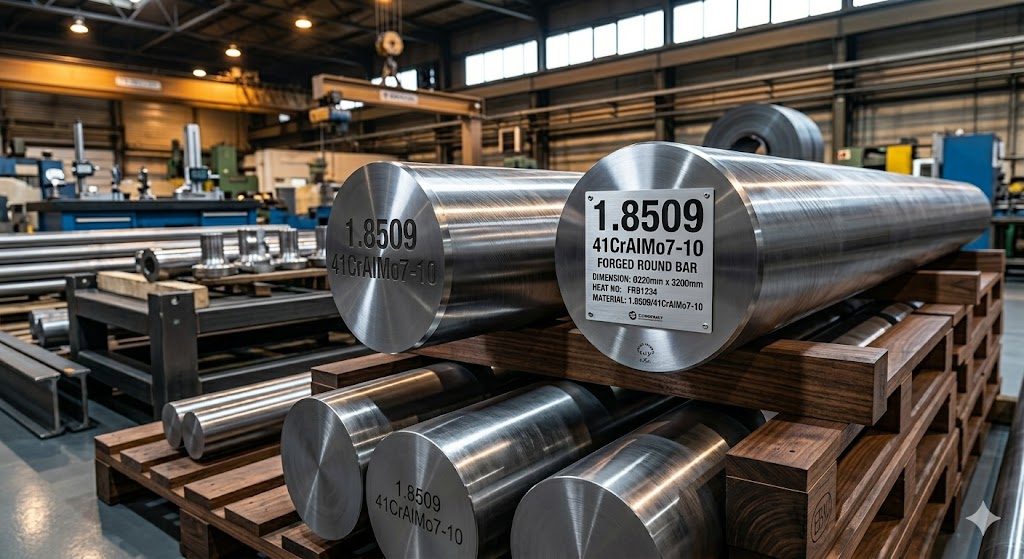 1.8509 Forged Round Bars
 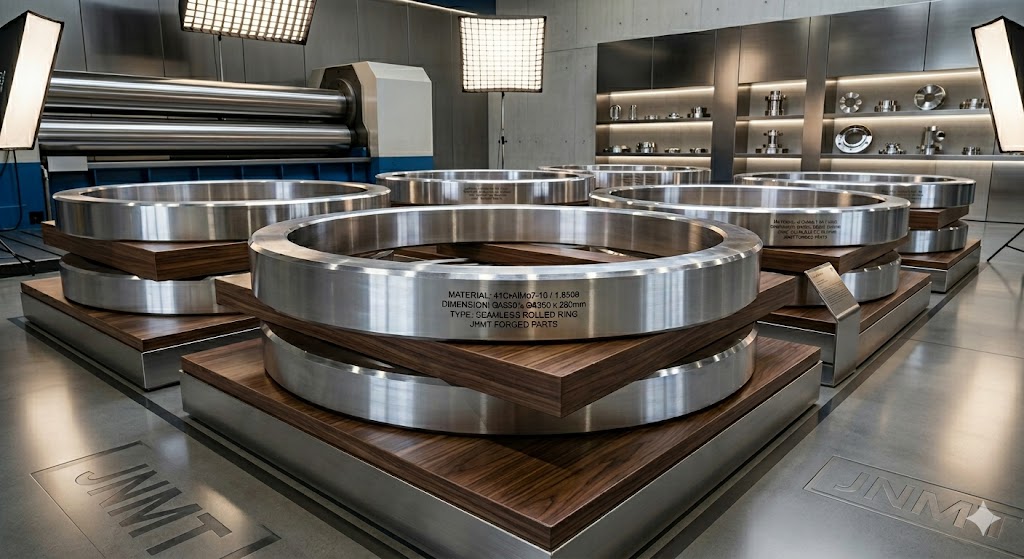 41CrAlMo7-10 Seamless Rolled Rings
 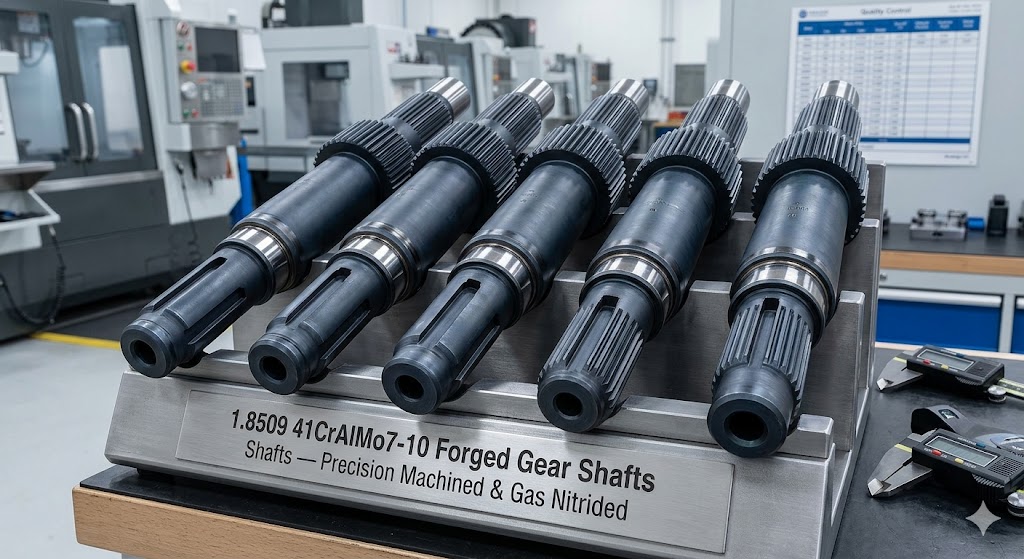 1.8509 Forged & Nitrided Gear Shafts
 What Makes 1.8509 (41CrAlMo7-10) the Premier Nitriding Steel for Heavy Forgings?
Engineers specifying nitriding steel forgings routinely face a choice between several EN 10085 grades. Understanding the metallurgical role of each alloying element in 1.8509 is essential to appreciating why it outperforms alternatives in the most demanding applications:
- Carbon (C: 0.38–0.45 %): Balanced at a level that delivers adequate core hardness and tensile strength after quench-and-temper without compromising toughness. Too low and the core is insufficiently strong to support the hard nitrided surface under contact stress; too high and impact toughness drops unacceptably. The 0.38–0.45 % range represents the proven optimum for heavy cross-section forgings in this steel family.
- Chromium (Cr: 1.5–1.8 %): Chromium is the primary hardenability element, enabling full through-hardening of large-section forgings (up to 350 mm ruling section per EN 10085 mechanical property classes). It also forms chromium nitrides (CrN, Cr2N) in the diffusion zone during nitriding. This provides secondary hardening and corrosion resistance to the nitrided case.
- Aluminum (Al: 0.8–1.2 %): The defining alloying element of 1.8509 and the principal reason for its excellent nitriding response. Aluminum has an extremely high affinity for nitrogen. During gas nitriding, Al atoms combine with N to form finely dispersed, coherent AlN precipitates, generating a surface hardness that easily reaches 900–1100 HV — roughly 150–200 HV higher than achievable with aluminum-free Cr-Mo-V grades. AlN precipitates are also thermally stable up to approximately 500 °C, so that 1.8509 has excellent resistance to surface softening in elevated-temperature service environments.
- Molybdenum (Mo: 0.20–0.35 %): Molybdenum serves two critical functions. First, it suppresses temper brittleness (Snoek-Köster embrittlement) that would otherwise occur in the 450–550 °C tempering range, allowing engineers to temper at higher temperatures and get superior toughness without sacrificing strength. Second, Mo refines the as-forged austenitic grain size, improving the uniformity of mechanical properties across the entire forging cross-section ,which is really important for large forgings where thermal gradients during heating and cooling can cause microstructural heterogeneity.
- Manganese (Mn: 0.4–0.7 %): Provides supplementary hardenability and assists deoxidation during steel melting. The controlled upper limit prevents excessive retained austenite formation during quenching in large sections.
- Silicon (Si: max 0.4 %): A primary deoxidizer during the EAF/LF melting process. Controlled at the lower end of our internal specification (0.20–0.35 %) to minimize oxide inclusions and keep clean steel with consistent fatigue properties.
1.8509 vs. 31CrMoV9 — Choosing the Right Nitriding Grade
The two most commonly specified EN 10085 nitriding steel grades for heavy forgings are 1.8509 (41CrAlMo7-10) and 1.8519 (31CrMoV9). The choice depends on the specific balance of properties required:
| Property | 1.8509 — 41CrAlMo7-10 | 1.8519 — 31CrMoV9 |
|---|---|---|
| Nitrided Surface Hardness (typical) | 900–1100 HV | 700–900 HV |
| Case Depth (500 HV, 25 h @ 520 °C) | 0.35–0.55 mm | 0.45–0.65 mm |
| Compound Layer Brittleness | Higher (thicker compound layer) | Lower (thinner compound layer) |
| Dimensional Stability After Nitriding | Excellent | Good |
| Core Tensile Strength (16–40 mm Q&T) | 950–1150 N/mm² | 900–1100 N/mm² |
| Recommended For | Maximum surface hardness, precision components, wind gearboxes, mining shafts | Deeper case depth, moderate surface hardness, hydraulic components |
For projects that need the highest surface hardness and precise dimensional accuracy after nitriding — such as wind turbine gearbox output shafts, cement kiln pinion shafts and high-precision industrial gear spindles — 1.8509 is the better technical option. When a deeper diffusion layer with moderate hardness is the main priority, like heavy-load hydraulic cylinder rods with thick walls, 31CrMoV9 is more suitable. Our engineering team can help you choose the right steel grade according to your actual load conditions, required case depth and working environment.
Custom 1.8509 (41CrAlMo7-10) Forging Shapes, Dimensions & Manufacturing Capabilities
We manufacture fully custom 41CrAlMo7-10 forgings across the complete range of industrial shapes and geometries. All production is strictly executed per your engineering drawings, material specifications, and heat treatment requirements. The table below summarizes our standard dimensional capabilities per product form:
| Product Form | Dimensional Range | Weight Range | Typical Tolerance Grade |
|---|---|---|---|
| Seamless Rolled Rings | OD: 300–5,000 mm; Wall: ≥ 50 mm; Height: 50–2,500 mm | 50–15,000 KG | IT8–IT10 (as-forged); IT5–IT7 (after CNC) |
| Open Die Forged Round Bars | Ø 80–1,200 mm; Length: up to 8,000 mm | 30–20,000 KG | EN 10243-1 class E; machined to H7/h6 |
| Shafts & Stepped Shafts | Ø 60–1,000 mm; Length: up to 10,000 mm | 30–18,000 KG | IT6 on journal diameters after finish CNC turning |
| Discs, Hubs & Flanges | Ø 200–3,500 mm; Thickness: 50–1,500 mm | 50–12,000 KG | IT7–IT8 (as-forged); IT5–IT6 (after CNC) |
| Hollow Bars & Sleeves | OD: 150–1,200 mm; ID: 80–800 mm; Wall: ≥ 40 mm | 30–10,000 KG | Bore to H7; OD to h6 after boring/turning |
| Custom Blocks & Plates | Up to 2,500 × 2,000 × 800 mm | 100–30,000 KG | EN 10243-2; machined to IT7 |
For each product, the forging ratio is maintained at a minimum of 3:1 (and typically 4:1–6:1 for critical-application components such as wind turbine ring gears), ensuring complete elimination of as-cast dendritic segregation, internal shrinkage porosity, and pipe defects from the original ingot. The resulting wrought microstructure delivers isotropic mechanical properties and the fatigue performance that is simply not achievable with rolled bar or cast product.
- Forged Bars & Rods: Round, square, flat and rectangular cross-sections in 1.8509, with flexible cut lengths. Supplied as forged, normalized, quenched-and-tempered, or in a machined condition per your specification. Available with full 3.1 material certificates, hardness test records, and UT per EN 10228-3.
- Seamless Rolled Rings: Manufactured on our dedicated radial-axial ring rolling mills. Ring geometry can include profiled cross-sections (L-shaped, T-shaped, stepped OD/ID) to reduce machining allowance and material waste. Rings are routinely supplied for gear rim blanks, slewing bearing races, large industrial flanges, and main bearing housings.
- Hollow Cylindrical Components: Full-through-bore hollow forgings (housings, barrels, sleeves, thick-walled bushes) produced by open die forging over a mandrel, retaining the superior grain flow and fatigue properties of a fully wrought structure. Bore diameters from 80 mm to 800 mm.
- Gear Shafts & Pinion Shafts: Stepped and profiled shafts with integral flanges, splines, and shoulders forged close to final shape to minimize CNC machining stock. Journal diameters ground or turned to IT6 or better. Nitriding performed as the penultimate step before final precision grinding where specified.
- Custom Complex Geometries: Discs with through-bore, eccentric shafts, crankshaft blanks, stub shafts, and other irregular profiles produced via die-assisted open die forging techniques. Full 3D-model review and DFM (design for manufacturability) support provided by our engineering team at the quotation stage.
We operate a dedicated one-stop production chain: EAF/LF/VD steelmaking → ingot/billet casting → hot forging → normalizing/annealing → quench & temper → CNC rough machining → ultrasonic testing → CNC finish machining → gas nitriding → final inspection → packaging & export. This integrated model eliminates sub-contracting, preserves full material traceability, and gives our customers a single point of accountability for quality.
Industry Applications of 41CrAlMo7-10 Forgings — Engineering Context & Selection Rationale
The following sections explain not just where 1.8509 forgings are used, but why the specific properties of this grade make it the preferred material in each application context — information drawn from our 25+ years of direct project experience across global heavy industries. Full project reference details are available in our project portfolio.
Wind Power & Renewable Energy
- Wind Turbine Planetary Gearbox Shafts & Ring Gears: Modern multi-megawatt wind turbines impose extraordinarily demanding conditions on gearbox components. The output shaft of a 3–6 MW turbine gearbox transmits up to 4 MNm of torque at variable speeds, subjected to millions of fatigue load cycles annually. Surface fatigue (pitting) initiated at hertzian contact stress concentrations is the primary failure mode. The 900–1100 HV nitrided surface of 1.8509 forgings provides the contact fatigue resistance to meet or exceed ISO 6336-5 material quality class ML (and typically MQ or ME), while the near-zero distortion of gas nitriding eliminates costly post-nitriding grinding of large ring gears. We have supplied 41CrAlMo7-10 seamless rolled ring gear blanks (OD 1,200–2,800 mm) and planetary carrier shafts to wind gearbox manufacturers in Germany, Denmark, and China.
- Hydroelectric Turbine Main Shafts: Large Kaplan and Francis turbine main shafts (Ø 400–900 mm, weight 3,000–18,000 KG) operate under continuous torsional and bending loads from the turbine runner. 1.8509 is selected for its deep hardenability, which ensures consistent core mechanical properties at the large ruling sections involved, combined with a corrosion-resistant nitrided surface that tolerates long-term water contact without protective coatings. Our forgings for hydro turbine applications are produced with a minimum impact toughness (KV) of 60 J at −20 °C to accommodate cold-climate hydroelectric installations.
- Thermal Power FGD Atomizer Shafts: The rotating atomizers in spray-dryer FGD (flue gas desulfurization) systems operate at 8,000–15,000 rpm in a severely corrosive acidic environment (pH 3–5, SO₂-rich atmosphere) at temperatures reaching 150 °C. The combination of 1.8509's high-hardness nitrided surface, the Al-rich nitrided layer's natural corrosion resistance, and the ability to hold tight dimensional tolerances after nitriding makes it the dominant material choice for FGD atomizer shafts worldwide.
Mining & Heavy Construction Equipment
- Crusher Eccentric Shafts & Main Spindles: The cone crusher eccentric shafts and the gyratory crusher main spindles are subjected to heavy cyclic impact loadings together with surface abrasion from mineral particles embedded in the crusher cavity.The 1.8509 nitrided surface achieves a hardness comparable to case-carburized 18CrNiMo7-6 steel while the core quench-and-temper properties ensure the shaft does not fracture under shock loading. We supply eccentric shafts (Ø 180–450 mm, length 600–2,000 mm) for GP, HP, and Symons crusher models as well as gyratory crusher main spindles (Ø 400–800 mm) for capacities up to 4,000 t/h. Typical nitriding depth on these components: 0.35–0.55 mm, compound layer controlled ≤ 15 µm.
- Mining Excavator Slewing Bearing Races & Centre Pintles: Large mining shovels and draglines require slewing bearing components (ring diameters 2,000–5,000 mm) to withstand axial and radial loads over 10 MN, while rotating continuously in dusty, abrasive environments. The excellent hardenability and controlled distortion of 1.8509 seamless rolled rings after nitriding are important to keeping the geometric accuracy of the bearing raceway over years of operation.
- Mine Hoist Drum Shafts & Head Sheave Shafts: Mine hoist drum shafts carry cyclic bending loads from multi-rope winder systems at loads up to 2,000 kN in underground mining operations. Shafts with diameters of 350 to 700 mm require complete section hardenability. This can only be achieved with high-alloy steels, e.g. 1.8509. For this application our forgings are supplied to the most stringent UT acceptance class as per EN 10228-3 (usually class 3 or class 4) with full longitudinal and transverse Charpy impact test reports.
Cement, Lime & Mineral Processing
- Rotary Kiln Pinion Shafts & Riding Gear Rings: A cement rotary kiln operates 24 hours a day, 330+ days a year, with the main drive pinion shaft transmitting 500–3,000 kW of continuous power. The pinion tooth flanks must resist pitting under hertzian contact stresses of 1,000–1,500 N/mm², while the shaft journals must keep dimensional accuracy in high-temperature ambient conditions (50–80 °C bearing housing temperatures). 1.8509 nitrided pinion shafts achieve gear quality grade 6 per DIN 3962 with nitrided flank hardness ≥ 850 HV, eliminating the periodic re-grinding required with through-hardened alternatives. Our cement plant pinion shafts (Ø 200–500 mm, module 16–50, length 1,500–5,000 mm) are in continuous service at kiln lines in Turkey, Iran, Saudi Arabia, India, and Southeast Asia.
- Granulator & Dryer Riding Gear Rings: Large-diameter riding gear rings (OD 1,200–3,500 mm) for rotary granulators and dryers in fertilizer and cement plants are manufactured as seamless rolled rings in 1.8509, with gear teeth hobbed after rough machining and the tooth flanks gas nitrided. The nearly distortion-free nitriding process eliminates the risk of gear ring cracking during heat treatment that is a persistent issue with large through-hardened rings.
- Sugar Mill Roller Shafts & Gear Couplings: The sugar mill tandem units use roller shafts (Ø 300–600 mm) to crush up to 600 tonnes of sugarcane per hour under combined bending and torsional loads in a highly corrosive, sugar-rich wet environment. Excellent corrosion resistance of the nitrided surface of 1.8509 leads to a considerable increase in the service life of the shaft compared to conventional case hardened steels.
Oil & Gas, Offshore & Drilling
- Mud Pump Gear Shafts & Herringbone Gear Pinions: Drilling rig mud pumps operating at 300–600 rpm transmit 1,000–2,200 kW of power through herringbone gearsets.The abrasive nature of drilling mud and the high cyclic stress and vibration call for a material with high contact fatigue resistance and good dimensional stability. 1.8509 nitrided gear shafts and pinion shafts (Ø 120–280 mm, module 8–20) are a proven solution both offshore and onshore. These components are available to API or ISO specifications, with optional hardness mapping and extended UT acceptance criteria as required.
- Offshore Winch Components & Anchor Chain Wildcat Shafts: Offshore anchor handling winch shafts (Ø 200-400 mm) and mooring system spindles need to combine high strength, good low temperature toughness (KV ≥ 50 J at -40 °C) and corrosion resistant surfaces for long term subsea deployment. Gas nitriding of 1.8509 is performed after all machining is complete, producing a conformal surface layer with no dimensional change that would affect mating tolerances.
Transportation & Power Transmission
- Locomotive Traction Gearbox Shafts: High-speed locomotive traction gear pinions (operating at pitch-line velocities of 20–40 m/s) require surface hardness ≥ 850 HV to meet pitting life requirements over 1.5 million km of service. 1.8509 nitrided pinion shafts achieve the necessary contact fatigue life at a fraction of the distortion seen with carburizing and hardening of competing grades, which is critical in maintaining gear mesh accuracy at high operating speeds.
- Industrial Gearbox Ring Gears & Planet Gears: Large planetary gearboxes (center distances 400–1,600 mm) for steel mill drives, cement mills, and heavy reducers use 1.8509 seamless rolled ring gears (OD 500–2,500 mm) and solid planet gear blanks, typically at module 12–40. We supply ring gear forgings to gear quality grade 5–6 per ISO 1328, with nitriding and finish grinding performed either in-house or by the customer to their own nitriding specification.
- Compressor Crankshafts & Crosshead Pins: The high fatigue limit of 1.8509, together with the corrosion resistance of its nitrided journal surfaces, is beneficial for process gas applications such as reciprocating gas compressor crankshafts (stroke 200–600 mm, Ø 200–450 mm main journals), leading to extended maintenance intervals in hydrogen-rich or sour-gas compressor environments.
- Steel Mill Mandrel Drum Shafts: Cold-rolling mill entry/exit coiler drum shafts (Ø 300–600 mm, length 2,000–5,000 mm) transmit high torques in a contaminated environment with intermittent shock loading. 1.8509 nitrided shafts exhibit both the bending fatigue resistance and the surface wear resistance needed to achieve 3–5 year service intervals between overhauls.
1.8509 Forging Manufacturing Process — From Steel Melting to Finished Component
Our fully integrated production process for 41CrAlMo7-10 forgings is designed around one principle: delivering material whose cleanliness, grain structure, and mechanical properties are as consistent on piece 1 as on piece 1,000. Below is a detailed walkthrough of each production stage, the specific process parameters applied, and why each step is critical to the final component's performance:
Stage 1: Steel Melting — EAF + LF + VD
All 1.8509 raw steel is melted in our own 30-tonne Electric Arc Furnace (EAF), followed by mandatory Ladle Furnace (LF) refining and Vacuum Degassing (VD). This triple-process route is essential for this grade because:
- LF refining enables precise trimming of the Al content to the narrow 0.90–1.10 wt% window we target (tighter than the 0.80–1.20 % EN 10085 limit), ensuring consistent nitriding response batch-to-batch
- VD treatment reduces dissolved hydrogen to below 2.0 ppm (measured by in-ladle degassing sensor), eliminating hydrogen-induced flaking — a known risk in thick 1.8509 sections due to the relatively high aluminum content
- VD also reduces total oxygen to below 15 ppm and removes nitrogen to controlled levels, preventing AlN precipitation during solidification that would create inclusions and reduce ductility
- Our raw alloy additions are sourced from top-tier Chinese specialty steel mills — including Baosteel, Xianggang Steel, and Dongte Special Steel — with incoming mill certificates verified by our own OES (Optical Emission Spectrometer) analysis before any heat is accepted into production
Stage 2: Ingot/Billet Casting & Soaking
Steel is cast into ingots ranging from 1 tonne to 35 tonnes depending on the final forging weight. Ingots are soaked at 1,180–1,240 °C for 6–24 hours in dedicated soaking pits before forging to ensure complete homogenization of segregated alloying elements, particularly chromium and aluminum which tend toward dendritic micro-segregation during solidification. Uniform composition across the ingot cross-section is the foundation for achieving consistent hardenability and nitriding response across the full forging geometry.
Stage 3: Hot Forging — Press & Hammer
Hot forging of 1.8509 ingots/billets is conducted at a working temperature of 1,050–1,200 °C (start) to 850 °C minimum (finish), using our hydraulic forging presses (2,000 T, 3,150 T, 5,000 T, 6,300 T) and electro-hydraulic forging hammers. Key process controls include:
- Minimum forging ratio 3:1 (measured as the total reduction in cross-sectional area from ingot to final forging). For critical applications (wind gearbox rings, mine hoist shafts), we apply forging ratios of 5:1–8:1, further refining the grain structure and closing any residual porosity that survived soaking
- Controlled finish forging temperature: Finishing above 850 °C prevents the formation of mixed grain microstructures (coarse + fine grains) that would create banded hardness variations after heat treatment. Our pyrometers monitor surface temperature continuously during final forging passes
- Grain flow alignment: For shaft forgings, we align forging reduction with the part's principal stress axis so that the elongated grain flow runs parallel to the shaft axis, maximizing bending fatigue resistance
- Post-forge cooling control: Heavy forgings (section > 250 mm) are cooled in temperature-controlled pits or annealing furnaces after forging to prevent hydrogen-induced cracking and allow stress relaxation before subsequent heat treatment
Stage 4: Preliminary Heat Treatment — Normalizing or Annealing
All forgings are given preliminary heat treatment immediately after forging and cooling, before any machining. For 1.8509, this consists of:
- Normalizing at 860–900 °C for forgings where a uniform bainitic/pearlitic microstructure is acceptable for rough machining, followed by air cooling
- Softening annealing at 650–700 °C (subcritical annealing) for forgings requiring maximum machinability. This produces a spheroidized carbide microstructure and relieves internal forging stresses, resulting in less tool wear and less risk of cracking when removing heavy stock. Target hardness after annealing: 230–280 HB
Stage 5: Quench & Temper (Q&T) Heat Treatment
After rough machining to near-final profile, components are austenitized and quench-and-tempered to achieve the core mechanical properties required before nitriding:
- Austenitizing: 870–930 °C, holding 2–4 minutes per mm of section thickness (minimum 45 minutes for thin sections, up to 12 hours for 500 mm+ diameter forgings) in computer-controlled furnaces with ±5 °C temperature uniformity
- Quenching medium: Water quench for sections up to 150 mm; polymer quenchant (5–12 % PAG concentration) for 150–350 mm sections; oil quench for complex geometries to minimize thermal gradient and distortion
- Tempering: 580–700 °C, hold time 1 hour per 25 mm of section thickness minimum. Tempering in this range takes advantage of molybdenum's suppression of temper embrittlement. Target core hardness after Q&T: typically 286–340 HB (for a subsequent nitriding cycle)
- All temperature-time curves are recorded by data logger and included in the inspection dossier. Re-heat-treatment is permitted only once and fully documented in the 3.1 certificate
Stage 6: CNC Rough Machining & Pre-Nitriding Final Machining
After Q&T and UT inspection, forgings proceed to CNC machining on our fleet of 3-axis and 5-axis machining centers and CNC lathes (maximum turning diameter: 2,500 mm; maximum turning length: 10,000 mm). The pre-nitriding machined finish is critical: surface roughness Ra ≤ 0.8 µm on surfaces to be nitrided, and all machined features must be within 0.05 mm of nominal position to allow for the slight growth (typically 0.01–0.03 mm per side) that occurs during nitriding.
Stage 7: Gas Nitriding (Where Specified)
Precision gas nitriding is performed in our dedicated nitriding facility at 480–530 °C (standard) or 530–570 °C (accelerated cycle) in controlled ammonia/nitrogen atmospheres monitored by continuous Kn (nitriding potential) measurement. Following are main process parameters and outcomes:
- Nitriding potential (Kn): Controlled at 0.3–1.5 depending on the process stage (high Kn during compound layer formation, reduced Kn during diffusion stage) to get a compound layer ≤ 15 µm thick. Thin compound layers are preferred for precision gear applications to avoid spalling of the brittle white layer during service
- Case depth: Defined by the 50 HV depth (total case depth) or 500 HV depth (effective case depth, per ISO 18203). Typical effective case depth for 1.8509 at 520 °C × 24 h: 0.30–0.45 mm. For extended cycles (48–72 h): 0.45–0.65 mm
- Surface hardness: 900–1100 HV (microhardness, HV0.1), measured per ISO 6507-1. Core hardness remains within 5 HB of the pre-nitriding Q&T value, confirming no microstructural degradation of the forging core during the low-temperature nitriding cycle
- Dimensional change: Diameter growth typically 0.01–0.025 mm/side per 0.1 mm effective case depth, allowing pre-nitriding machining allowances to be calculated with precision. This predictability is a defining advantage of 1.8509 vs. carburizing grades, where quench distortion requires individual post-heat-treatment grinding of every component
Stage 8: Final CNC Machining, Grinding & Full Inspection
Post-nitriding, components requiring grinding (journal surfaces, gear tooth flanks) proceed to precision cylindrical or gear grinding. Final dimensional inspection is performed using our CMM (co-ordinate measuring machine) for complex geometries, and calibrated contact profilometers for Ra/Rz measurement. Full inspection report and 3.1 certificate are compiled and reviewed by our QA manager before shipment authorization.
Full details of our production equipment are available on our Equipment page.
Chemical Composition of 1.8509 (41CrAlMo7-10) — EN 10085:2001 vs Our Internal Control
The table below compares the EN 10085:2001 standard composition limits with our tighter internal control ranges, which we maintain through LF trim additions and OES verification on every heat. The "why" column explains the engineering rationale behind our specific targets:
| Element | EN 10085 Range (wt%) | Our Internal Target (wt%) | Why This Target Matters |
|---|---|---|---|
| Carbon (C) | 0.38 – 0.45 | 0.40 – 0.43 | Narrowing the C range to ±0.015 % reduces scatter in as-quenched hardness by ≈20 HB, improving lot-to-lot consistency of mechanical test results |
| Silicon (Si) | max 0.40 | 0.20 – 0.35 | Lower Si limits silicate inclusion density, improving transverse toughness and ultrasonic inspectability in large sections |
| Manganese (Mn) | 0.40 – 0.70 | 0.50 – 0.65 | Mid-range Mn avoids both insufficient hardenability (below 0.50 %) and excessive retained austenite (above 0.70 %) after quenching of large sections |
| Phosphorus (P) | max 0.025 | max 0.018 | P segregates to grain boundaries during solidification and severely embrittles the nitrided compound layer. Our 0.018 % cap is 28 % lower than the standard limit, significantly reducing white-layer brittleness risk |
| Sulfur (S) | max 0.035 | max 0.022 | Lower S reduces MnS inclusion stringers that act as fatigue crack initiation sites. Critical for rotating bending fatigue life of shafts and gear spindles |
| Chromium (Cr) | 1.50 – 1.80 | 1.60 – 1.75 | Midrange Cr maximizes hardenability at minimum risk of excessive carbide banding. Cr contributes CrN/Cr₂N to the nitrided diffusion zone, adding corrosion resistance to the case |
| Molybdenum (Mo) | 0.20 – 0.35 | 0.25 – 0.32 | Mo above 0.25 % is essential to suppress temper brittleness during the 580–700 °C tempering cycle. Also refines the as-forged austenitic grain size (ASTM 6–8 achieved vs. ASTM 4–6 with lower Mo) |
| Aluminum (Al) | 0.80 – 1.20 | 0.90 – 1.10 | Al is the key nitriding element. Below 0.80 %, surface hardness after nitriding drops below 800 HV. Above 1.20 %, risk of AlN precipitation during ingot solidification increases. Our 0.90–1.10 % target maximizes hardness while preserving steel cleanliness |
In addition to the above elements, we specify maximum limits for tramp elements: Sn ≤ 0.020 %, As ≤ 0.020 %, Sb ≤ 0.005 %. These residual elements accelerate temper embrittlement (reversible temper embrittlement, also called 450 °C embrittlement) in Cr-Mo steels and are particularly harmful in 1.8509 because nitriding takes place close to the embrittlement temperature range. By tightly controlling tramp elements, we ensure impact toughness after nitriding remains within specification for the component's service life.
Heat Treatment Specifications for 41CrAlMo7-10 (1.8509) Forgings
The heat treatment of 1.8509 forgings is not a single step but a carefully sequenced multi-stage process. Each stage has specific temperature windows, holding times, and cooling rate requirements determined by the section size and the final mechanical properties specified. Our heat treatment workshop operates ten computer-controlled furnaces (maximum load: 40 tonnes; temperature accuracy: ±5 °C; atmosphere-controlled for nitriding) with full data-logger recording of every heat treatment cycle.
- Softening Annealing (650–700 °C): Applied after forging and normalizing as a pre-machining step. Components are loaded into the furnace, heated at ≤ 80 °C/hour to the target temperature, held for 1 hour per 25 mm of section thickness (minimum 4 hours), then furnace-cooled at ≤ 20 °C/hour to below 300 °C before air cooling. This produces a spheroidized carbide structure with hardness 215–255 HB, allowing clean chip formation during heavy CNC roughing. Failure to properly anneal before machining large 1.8509 forgings is a common source of tool wear complaints — our softening protocol eliminates this issue.
- Hardening (870–930 °C): Austenitizing temperature is chosen based on section diameter: 870–890 °C for sections ≤ 100 mm (to prevent excessive grain growth); 900–930 °C for sections 100–350 mm (to guarantee complete dissolution of Cr and Mo carbides for maximum hardenability). Hold time: 2–4 minutes per mm of minimum section after the furnace reaches temperature, confirmed by thermocouple in a representative dummy piece. Quench medium is selected per section size and geometry as described in Stage 5 above.
- Tempering (580–700 °C): Tempering temperature is specified to achieve the target core hardness (and hence tensile strength) for the component's application. Guide values: 580–620 °C for 950–1,050 MPa Rm (max strength for small sections); 640–680 °C for 830–950 MPa Rm (balanced strength/toughness for medium sections); 680–700 °C for ≥ 800 MPa Rm with maximum toughness (large sections, impact-critical applications). Holding time: minimum 2 hours per 100 mm of section. Important note: All tempering of 1.8509 is performed above 600 °C to avoid the temper brittleness trough (typically 450–550 °C for this composition). Temperature is never reduced below 580 °C for final tempering.
- Precision Gas Nitriding (480–570 °C): As detailed in Stage 7 above. The nitriding cycle is agreed with the customer based on required case depth and compound layer specification. The standard treatment is two stage gas nitriding cycle: Stage 1 - 520 oC, high Kn (1.0-1.5) to develop compound layer (first 4-8 hours); Stage 2 - 520 oC, low Kn (0.3-0.5) to develop diffusion zone.
- Compared to single-stage nitriding, this produces a thinner, less-brittle compound layer without sacrificing case depth, which is the preferred result for precision gear and shaft applications. Post-nitriding, components are cooled in the nitriding furnace to below 150 °C in a protective atmosphere to prevent oxidation of the freshly nitrided surface.
| Heat Treatment Stage | Temperature (°C) | Atmosphere / Medium | Key Outcome |
|---|---|---|---|
| Softening Annealing | 650–700 | Furnace (air or N₂) | 215–255 HB, optimum machinability |
| Austenitizing (Hardening) | 870–930 | Furnace (protective atmosphere) | Full carbide dissolution, optimum hardenability |
| Quenching | Room temperature | Water / polymer (PAG) / oil | Martensite formation, max core hardness |
| Tempering | 580–700 | Furnace (air) | Target Rm, adequate toughness, stress relief |
| Gas Nitriding (Stage 1) | 505–530 | NH₃/N₂, Kn 1.0–1.5 | Compound layer ≤ 15 µm |
| Gas Nitriding (Stage 2) | 505–530 | NH₃/N₂, Kn 0.3–0.5 | Diffusion zone, effective case depth 0.30–0.65 mm |
All heat treatment processes are fully documented and recorded, with complete temperature-time curve graphs printed from our data loggers provided in the final inspection dossier (EN 10204 3.1 certificate).
Mechanical Properties of 1.8509 (41CrAlMo7-10) Forged Material per EN 10085
The mechanical properties of our 1.8509 forgings are systematically tested and guaranteed in accordance with EN 10085:2001. Properties vary by ruling section (diameter or equivalent thickness) following the standard quench-and-temper heat treatment. All values below represent the minimum guaranteed values from longitudinal test specimens machined per EN ISO 377. Our forgings are produced to meet and typically exceed these minimums, as reflected in our production mechanical test records:
| Ruling Section (mm) | Tensile Strength Rm (N/mm²) | Min. Yield Strength Rp0.2 (N/mm²) | Min. Elongation A5 (%) | Min. Reduction of Area Z (%) | Hardness (HB) |
|---|---|---|---|---|---|
| 16 – 40 | 950 – 1,150 | 750 | 11 | 25 | 286 – 347 |
| 40 – 100 | 900 – 1,100 | 720 | 13 | 25 | 271 – 331 |
| 100 – 160 | 850 – 1,050 | 670 | 14 | 30 | 253 – 319 |
| 160 – 250 | 830 – 980 | 625 | 15 | 30 | 240 – 298 |
| 250 – 350 | 800 – 950 | 600 | 14 | 28 | 230 – 285 |
Notes on section-size dependency: The reduction in properties with increasing ruling section is a normal characteristic of all hardenable alloy steels and results from slower quench cooling rates at the center of large sections, which produce less martensite and more bainite/pearlite in the core microstructure. 1.8509's deep hardenability (Jominy J = 50 HRC at 11 mm minimum distance from quenched end) means that core properties in sections up to 350 mm ruling section remain within the EN 10085 guaranteed range when properly quenched — a significantly better performance than lower-alloy nitriding grades. For forgings exceeding 350 mm ruling section or requiring properties beyond the standard table, our engineering team can design an optimized heat treatment cycle with extended austenitizing times and controlled quench rates validated by test coupon mechanical testing before final treatment of the production forgings.
Impact toughness: EN 10085 does not mandate Charpy impact testing, but we routinely perform KV (Charpy V-notch) testing as standard for sections ≥ 40 mm. Typical values at room temperature (20 °C): KV ≥ 55 J (longitudinal); at −20 °C: KV ≥ 35 J. For applications requiring guaranteed low-temperature toughness (offshore, cryogenic environments), supplementary KV testing at −20 °C to −60 °C is available at customer request.
Beyond the EN 10085 table, the heat treatment parameters can also be adapted to specific mechanical property requirements, e.g. higher minimum KV, narrower Rm/Rp0.2 ratio, decreased hardness variation, and compliance can be confirmed by test coupon with complete documentation included in the 3.1 certificate.
Quality Assurance & Inspection for 1.8509 (41CrAlMo7-10) Forgings
Every 1.8509 forging produced by Jiangsu Liangyi undergoes a rigorously documented multi-stage quality control program spanning raw material receipt through final shipment. Our ISO 9001:2015 quality management system mandates the following inspection and test sequence for each order:
- Incoming Raw Material Verification: Every heat of steel is analyzed by our OES (optical emission spectrometer) within 24 hours of receipt. The measured composition is compared against both the EN 10085 standard range and our internal tighter targets. Any heat outside our internal target — even if within EN 10085 — is quarantined and reviewed before release to production. Mill 3.1 certificates are archived and referenced in the final forging certificate.
- In-Process Dimensional Inspection: Forging dimensions are checked hot (calibrated pyrometer and manual measurement) and again after cooling. Before parts are heat-treated, the forging shape, draft angle and parting-line flash are checked against the forging drawing.
- Hardness Survey After Q&T: Brinell hardness is measured at a minimum of 3 positions per piece (both end faces + mid-body) using a calibrated EMCO-TEST hardness tester. Results are recorded and compared to the target range. Pieces outside the Brinell range trigger a root-cause review; re-tempering is permitted once with full documentation.
- Ultrasonic Testing (UT) per EN 10228-3: All 1.8509 forgings ≥ 50 mm section are given 100% volumetric UT. Our standard acceptance class is EN 10228-3 Class 3 (equivalent to SEP 1921 Class D/E for most geometries). For offshore, wind energy and critical mining applications Class 4 or Class 5 is used as specified by customer. Our Level 2 certified operators perform UT using calibrated digital ultrasonic flaw detectors and frequency appropriate probes (2.5-10 MHz depending on section size and attenuation).
- Magnetic Particle Testing (MT) per EN 1369: Surface and near-surface MT inspection is performed on all machined forgings before and after final heat treatment. Acceptance class per EN 1369 Level 1 as standard; Level 2 available. MT is particularly important for detecting quench cracks or grinding cracks in 1.8509 due to its relatively high surface hardness after Q&T.
- Mechanical Testing: Longitudinal tensile test (EN ISO 6892-1), reduction of area, Charpy KV impact (EN ISO 148-1), and Brinell hardness are performed on test bars sampled from sacrificial test extension material forged integrally with each heat. Test bars are taken from sacrificial test extension material forged integrally with each heat and are subjected to longitudinal tensile test (EN ISO 6892-1), reduction of area, Charpy KV impact (EN ISO 148-1) and Brinell hardness tests.
- Metallographic Examination: Austenitic grain size per EN ISO 643 and microstructure examination are performed on sample material from each production lot. Our target austenitic grain size for Q&T forgings: ASTM 5–8. Abnormal grain growth (ASTM < 4) triggers immediate furnace calibration review.
- Dimensional Final Inspection: All final dimensions are checked against the customer’s drawing using calibrated vernier callipers, micrometers, bore gauges and where required by complex machined geometries our CMM (co-ordinate measuring machine).
The complete inspection package — including all of the above test reports plus the heat treatment temperature-time graphs — is compiled into the EN 10204 3.1 Inspection Certificate reviewed and signed by our authorized QA signatory before shipment authorization. EN 10204 3.2 third-party inspection (issued by BV, SGS, TÜV, or any other accredited body specified by the customer) is available for every order.
Why Specify Jiangsu Liangyi for Your 41CrAlMo7-10 Forging Requirements
- Dedicated Nitriding Steel Forging Expertise Since 1997: Jiangsu Liangyi has specialized exclusively in alloy steel forgings — with nitriding steel grades representing over 60 % of our annual tonnage — since our founding. This focus means our metallurgists, forging engineers, heat treatment specialists, and QA team understand the specific challenges of 1.8509 production (hydrogen sensitivity, aluminum burn risk, nitriding potential control, compound layer management) at a depth that general-purpose forging shops cannot match.
- Full In-House Vertical Integration — Zero Sub-contracting: From scrap and alloy additions in our EAF to the final dimensional report in the 3.1 certificate, every production and inspection step is performed under our own roof and within our ISO 9001:2015 quality system. No sub-contracting of heat treatment, machining, or nitriding. This is not just a convenience — it is a quality guarantee. Traceability of every piece from ingot heat number to finished component is maintained in our ERP system and available on request.
- Maximum Custom Range: 30 KG to 30,000 KG Per Piece: Our combination of forging presses (up to 6,300 tonnes), ring rolling mills (rings to OD 5,000 mm), and heavy hammer equipment covers a weight range that few competitors can match under a single management structure. A client specifying both a 50 KG pinion shaft and a 12,000 KG seamless ring gear for the same gearbox can source both from a single supplier with a single quality system and a single point of contact.
- Engineering Support from Drawing Review to DFM Advice: Our team of mechanical and materials engineers reviews every new inquiry for design-for-manufacturing feasibility. We regularly advise customers on forging weight optimization, near-net-shape geometries that reduce machining cost, heat treatment selection for their specific application loads, and nitriding specifications that balance case depth with compound layer control. This service is provided free of charge at the quotation stage.
- Strict Raw Material Sourcing — Tier 1 Chinese Steel Mills Only: Our primary 1.8509 raw steel suppliers are top-tier Chinese specialty alloy steel producers — including mills such as Baosteel, Xianggang Steel, and Dongte Special Steel — all operating internationally recognized quality management systems. Every incoming heat is verified by our own OES spectrometer before release to production, providing a second independent check on composition compliance beyond the mill certificate.
- Export Packaging & Logistics Expertise for 50+ Countries: All forgings are prepared for international shipment with appropriate rust preventive treatment (Tectyl 506 or equivalent), wooden crating in accordance with ISPM-15 phytosanitary requirements and full export documentation (commercial invoice, packing list, B/L, certificate of origin and material certificates). We support all the major Incoterms (EXW, FCA, FOB, CFR, CIF, DAP, DDP). We’ve built relationships with freight forwarders that service Europe, North America, the Middle East and South East Asia.
- Typical Lead Time: 20–45 Days from Order Confirmation: Standard production lead time for 1.8509 forgings without CNC machining: 20–30 calendar days. With rough machining and Q&T: 25–35 days. With full precision machining and gas nitriding: 35–55 days. Expedited production (15–20 days for unmachined forgings) is available for urgent orders subject to capacity. We provide weekly production status updates during manufacturing.
Frequently Asked Questions — 1.8509 (41CrAlMo7-10) Forgings
1.8509 (designated 41CrAlMo7-10 in the European standard system, equivalent to 41CrAlMo7.10 in the DIN legacy designation) is a heat-treatable alloy steel specified in EN 10085:2001 for nitriding applications. Its unique suitability for nitriding comes from its high aluminum content (0.80–1.20 wt%). Aluminum has an exceptionally strong thermodynamic affinity for nitrogen: during gas nitriding at 480–570 °C, Al atoms react with nitrogen atoms from the gas atmosphere to form aluminum nitride (AlN) precipitates within the first 0.5–1.0 mm of the steel surface. These AlN precipitates are extremely hard (microhardness of AlN ≈ 1200 HV), finely dispersed (particle spacing ≈ 5–20 nm), and coherent with the iron matrix, producing a case surface hardness of 900–1100 HV — the highest achievable in any commercial nitriding steel grade. Equally important, all of this hardening occurs at temperatures far below the steel's Ac1 transformation point (~700 °C for this composition), meaning the component's core microstructure and dimensions are unaffected. This combination of maximum hardness and virtually zero distortion is what makes 1.8509 irreplaceable for precision heavy-duty components.
The primary applications of 1.8509 / 41CrAlMo7-10 forgings are in industries where components must simultaneously resist surface fatigue (pitting), abrasive wear, and corrosion while maintaining dimensional accuracy for the life of the machine. Following are the most common applications we supply : (1) Wind turbine gearbox output shafts, planet carrier shafts, and ring gear blanks — demanding contact fatigue resistance at ISO 6336-5 MQ/ME grade; (2) Cement kiln pinion shafts and riding gear rings — continuous 24/7 operation under high hertzian contact stress; (3) Mining crusher eccentric shafts and main spindles — severe impact combined with abrasion; (4) Hydro turbine main shafts — large section (Ø 400–900 mm), combined bending/torsion, wet corrosive environment; (5) Offshore drilling rig mud pump gear shafts — high-speed operation in abrasive slurry; (6) Sugar mill and FGD atomizer shafts — corrosive process environments; (7) Industrial gearbox ring gears and planetary gear sets — precision gear quality class 5–6 per ISO 1328; (8) Locomotive traction gear pinions — ultra-high pitting fatigue life requirement.
Our 1.8509 (41CrAlMo7-10) forgings are produced in compliance with the following international standards: EN 10085:2001 (Nitriding steels — Technical delivery conditions) for chemical composition and heat treatment; EN 10083-1/3 for general technical delivery conditions of alloy steels; ISO 6336-5 / DIN 3990-5 MQ material quality grade for gear applications; EN 10228-3 (Ultrasonic testing of ferritic and martensitic steel forgings — Class 3 or 4) for volumetric NDT; EN 1369 (Magnetic particle testing of steel castings and forgings) for surface NDT; EN 10204 3.1 (Type 3.1 inspection certificate, signed by our authorized inspection representative). EN 10204 3.2 third-party certificates from BV, SGS, or TÜV are available on request at additional cost. For special national standards or customer specifications (DNV GL, Lloyds, ASME, etc.), please share your requirements at the inquiry stage and we will confirm applicability.
Yes, we make custom OEM production according to customers' drawings. We accept drawings in all formats (PDF, DWG, DXF, STEP, IGS, SolidWorks, CATIA). During quoting, our engineering team conducts a DFM (design for manufacturability) review to optimize the forging geometry, establish the most appropriate forging process (open die, seamless ring rolling or combination) and recommend machining allowances and heat treatment sequences. We produce single forgings from 30 KG to 30,000 KG per piece, in prototype quantities (1-5 pieces) as well as in serial production (100-1,000+ pieces/year). Typical information required for a quote: finished part drawing with all tolerances and surface finishes specified; material specification (1.8509 / 41CrAlMo7-10 / EN 10085); heat treatment specification (Q&T condition, hardness range, nitriding case depth and hardness if applicable); NDT requirements (UT/MT class); inspection certificate type (3.1 or 3.2); annual quantity and delivery schedule. Lead time from drawing receipt to first article: 25–55 days depending on weight and complexity.
Every order of 1.8509 forgings is accompanied by a full EN 10204 Type 3.1 Inspection Certificate, which is prepared by our authorized inspection representative (QA Manager) and contains: heat analysis report with all elements verified by our OES spectrometer; product analysis if specified; complete heat treatment records with temperature-time curves from our data loggers; tensile test results (Rm, Rp0.2, A5, Z); Charpy KV impact test results (if specified); Brinell hardness survey; ultrasonic test report per EN 10228-3 (class, probe frequency, sensitivity calibration, any indications found); magnetic particle test report per EN 1369; dimensional final inspection report with all critical dimensions measured and recorded; unique heat number and piece identification providing full traceability from finished component back to the original steel heat; certificate of compliance with EN 10085:2001 and all additional standards specified in the purchase order. EN 10204 Type 3.2 certification, co-signed by an accredited third-party inspection body (BV, SGS, TÜV, Intertek, or the customer's nominated inspector), is available at additional cost. Witness inspection by the customer's own inspector during production is also welcome.
The standard multi-stage heat treatment cycle for 1.8509 forgings consists of four successive stages: (1)Annealed to soften at 650-700 °C (furnace cooled at ≤ 20 °C/h to below 300 °C) to produce a spheroidized carbide structure, hardness 215-255 HB, for best machinability before CNC machining.
(2) Hardening/austenitizing at 870–930 °C (temperature selected per section size; hold 2–4 min/mm of section thickness), followed by quenching in water, polymer quenchant, or oil depending on section geometry. (3) Tempering at 580–700 °C (temperature selected per target tensile strength; hold minimum 2 h/100 mm section), always above 580 °C to avoid the temper brittleness range. This establishes the core mechanical properties. (4) Gas nitriding at 480–570 °C using a dual-stage cycle (high Kn / low Kn) to form compound layer ≤ 15 µm and diffusion zone to 0.30–0.65 mm effective case depth, achieving 900–1100 HV surface hardness with diameter growth typically 0.01–0.025 mm/side. All stages are data-logged and records included in the 3.1 certificate.
Both gas nitriding and plasma (ion) nitriding can be applied to 1.8509 forgings, and both produce the AlN/CrN-based hardened case characteristic of this grade. The key differences are: Gas nitriding (our standard process) uses a controlled NH₃/N₂ atmosphere at 480–570 °C, is suitable for large batch processing (multiple pieces in one furnace load), and produces predictable, uniform case depths across complex geometries. Plasma nitriding uses a DC glow discharge in a low-pressure N₂/H₂ atmosphere, which allows local masking (preventing nitriding on specific surfaces using simple metallic fixtures), produces a thinner or negligible compound layer, and is preferred for components requiring precise selective nitriding or maximum compound layer control. For 1.8509 forgings in gear applications, gas nitriding with Kn control is our standard recommendation because the chemistry of this grade (particularly its high Al content) responds consistently to atmosphere nitriding across large cross-sections. Plasma nitriding of 1.8509 is available for components with bore surfaces or features requiring non-nitrided zones. Please specify your preference at the inquiry stage.
This is one of the most common material selection questions in industrial gear engineering. The two grades address different design priorities: 18CrNiMo7-6 (carburized & case hardened) achieves 58–62 HRC (≈680–750 HV) case hardness at case depths of 0.8–2.5 mm, providing excellent load-carrying capacity in thick-section contact zones. Its main disadvantages are: dimensional distortion during quenching (requiring post-carburizing grinding of all precision surfaces); very high process cost and time (carburizing cycles of 8–30+ hours plus high-temperature quenching); and limited applicability to large-section forgings (> 300 mm) where through-hardening of the core is difficult. 1.8509 (nitrided) achieves 900–1100 HV surface hardness at an effective case depth of 0.3–0.65 mm. Its advantages are: virtually zero distortion during nitriding (allowing finish machining before the final surface treatment step in many cases); much lower process temperature (480–570 °C vs. 900+ °C for carburizing); excellent dimensional stability and corrosion resistance. The limitation is shallower case depth, which makes it less suitable for very heavily loaded, large-module gear pairs where deep case hardening is needed to prevent subcase fatigue. As a general guideline: for industrial gearboxes at module 6–30 and pitch-line velocities up to 35 m/s with hardness ≥ 850 HV required, 1.8509 nitrided is the technically and economically superior choice. For high-torque compact automotive or aerospace gearboxes requiring maximum load-carrying capacity per unit volume, carburized 18CrNiMo7-6 is typically preferred. Our engineering team can perform a specific material comparison for your application on request.
Get Your Custom 1.8509 (41CrAlMo7-10) Forging Quote Today
Whether you need standard forged bars, custom seamless rolled rings, or complex precision machined and gas nitrided 41CrAlMo7-10 components, our engineering team is ready to review your drawings and provide a technically detailed proposal and competitive quotation. Send us your part drawing, material specification, and annual quantity — we will respond within 24 hours with a preliminary DFM review and quotation.
Send Your Drawing & Get a QuoteContact Person: Mr. Mark Ma
Phone / WhatsApp / WeChat: +86-13585067993
Email: sales@jnmtforgedparts.com
Factory Address: Chengchang Industry Park, Jiangyin City, Jiangsu Province 214400, China
Business Hours: Monday–Friday 08:00–18:00 CST (UTC+8) | Emergency inquiries: 24/7 via WhatsApp
About Jiangsu Liangyi — 1.8509 Forging Manufacturer
Jiangsu Liangyi Co.,Limited (founded 1997, ISO 9001:2015 certified) is a professional manufacturer of custom 1.8509 (41CrAlMo7-10) nitriding steel forgings, located at Chengchang Industry Park, Jiangyin City, Jiangsu Province, China (31.9133°N, 120.2749°E). The company operates an 80,000 m² modern forging facility with an annual production capacity of 120,000 tons and has supplied custom forgings to industrial clients in more than 50 countries across Europe, North America, the Middle East, and Southeast Asia.
Core products include: open die forgings, seamless rolled rings (OD up to 5,000 mm), forged gear shafts, pinion shafts, and precision machined & gas nitrided components in 1.8509 / 41CrAlMo7-10 nitriding steel, all compliant with EN 10085:2001. Single-piece weight range: 30 KGS to 30,000 KGS. Surface hardness after gas nitriding: 900–1100 HV. Inspection certificates: EN 10204 3.1 standard, with optional 3.2 third-party certificates (BV, SGS, TÜV).
Contact: Mr. Mark Ma | +86-13585067993 (Phone / WhatsApp / WeChat) | sales@jnmtforgedparts.com | Chengchang Industry Park, Jiangyin City, Jiangsu Province 214400, China