1.6963 27NiCrMoV16-7 Forging Parts | China Professional Forged Steel Manufacturer
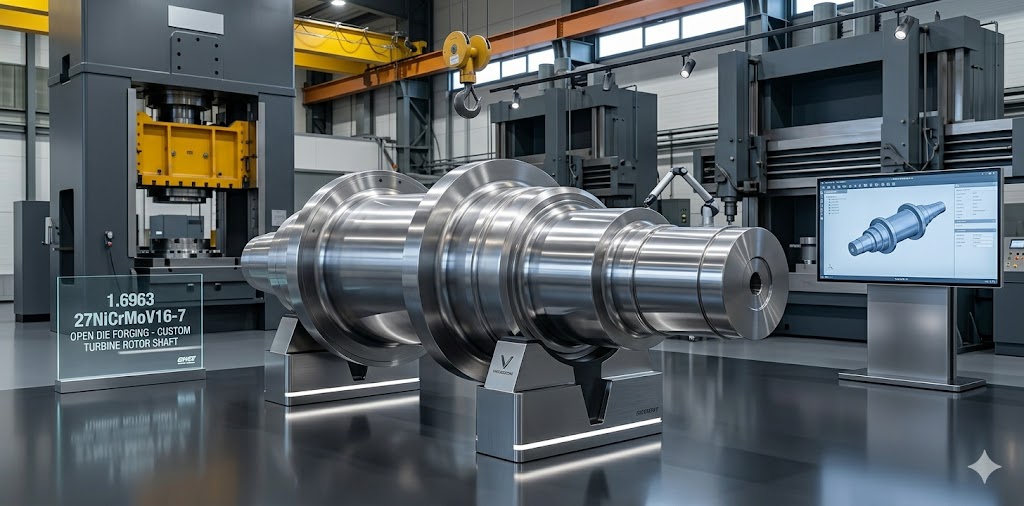
Custom 1.6963 27NiCrMoV16-7 turbine rotor forgings manufactured by Jiangsu Liangyi Co., Limited
1.6963 27NiCrMoV16-7 — Complete Technical Reference at a Glance
- EN Material No.: 1.6963
- Grade Designation: 27NiCrMoV16-7 (also 27NiCrMoV16.7 / 27NiCrMoV167)
- Governing Standard: EN 10083-3 (chemical composition & properties)
- Forging Standard: EN 10228-3 (UT, grain, surface)
- Tensile Strength (Rm): 850–1000 MPa
- Yield Strength (Rp0.2): ≥ 700 MPa (RT); ≥ 400 MPa @ 500°C
- Fatigue Limit (σ-1): 380–460 MPa @ 10⁷ cycles (small section)
- Fracture Toughness KIc: 100–140 MPa·m⁰·⁵
- Max Service Temperature: 500°C (continuous operation)
- Grain Size (ASTM E112): ≥ 6 (Liangyi in-house control)
- Melting Route: EAF + LF + VOD ± optional ESR
- Heat Treatment: Q+T (830–870°C austenitize; 580–640°C temper)
- Max Single-Piece Weight: 30 tons
- Max Ring OD: 6,000 mm (seamless rolled)
- Max Shaft Length: 15,000 mm
- Annual Capacity: 120,000 tons
- Compliance: EN 10083-3 · EN 10228-3 · ASTM · DIN
- Factory Certificate: ISO 9001:2015 Quality Management System
- Product Documents: EN 10204 3.1 MTC (standard) · EN 10204 3.2 (arrangeable on request)
- TPI Witness (arrangeable): DNV-GL · BV · Lloyd's · ABS · RINA · TÜV
- Export Reach: 50+ countries across 5 continents
Jiangsu Liangyi Co., Limited is a China ISO 9001:2015 certified professional manufacturer of 1.6963 27NiCrMoV16-7 forging parts, with 25+ years of professional experience in custom open die forgings and seamless rolled rings for global high-end industries. Our 27NiCrMoV16-7 forged steel products are fully compliant with EN 10083-3, ASTM, and DIN standards, manufactured from steel melting, forging, heat treatment to precision machining in strict accordance with customer 2D/3D drawings and technical specifications. With an annual production capacity of 120,000 tons and single-piece weight capacity from 30 kg to 30 tons, we have supplied high-performance 1.6963 forging parts to customers from more than 50 countries across Europe, North America, Middle East, Southeast Asia, and Oceania.
1.6963 27NiCrMoV16-7 Forged Steel Material Overview
1.6963 (also written as 27NiCrMoV16-7, 27NiCrMoV16.7, or 27NiCrMoV167) is a high-hardenability low-alloy Ni-Cr-Mo-V forging steel developed specifically for large-section, heavy-duty rotating components in steam and gas turbine systems. The designation itself encodes the alloy architecture: 27 = 0.27% nominal carbon for strength foundation; Ni16 = 4% nominal nickel for deep hardenability; Cr = chromium for oxidation resistance and secondary hardening; Mo = molybdenum for elevated-temperature strength and temper embrittlement resistance; V = vanadium for grain refinement and creep resistance through fine VC precipitates.
What distinguishes 1.6963 from general-purpose alloy steels is this precisely engineered multi-element synergy. The 4% nickel level — nearly three times that of 34CrNiMo6 — enables through-hardening of rotor sections exceeding 1,500 mm in diameter without the need for accelerated quenching media that risk quench cracking in heavy sections. The vanadium addition pins grain boundaries and forms fine carbide precipitates that resist coarsening and dislocation movement at temperatures up to 500°C, providing creep resistance that standard Ni-Cr-Mo steels cannot match.
Excellent Through-Hardenability
Superior through-hardening performance for large-section components up to 2 meters in diameter, ensuring uniform structure and consistent mechanical properties from surface to core, no internal soft spots.
Outstanding High-Temperature Performance
Stable yield strength and creep resistance at up to 500°C, keeping excellent mechanical stability under long-term high-temperature working conditions in thermal power plants.
Superior Fatigue & Impact Resistance
High tempering resistance, excellent low-temperature impact toughness, and anti-fatigue performance, which effectively extend the lifetime of turbine parts by 20–30% compared to standard alloy steels.
Ultra-Low Impurity Control
Strictly control the harmful elements like P (≤0.003%) and S (≤0.002%), with the option to use the ESR process to make the steel matrix ultra-pure, which lowers the risk of internal defects and makes the material more reliable.
Chemical Composition of 1.6963 27NiCrMoV16-7 Forging Steel (EN 10083-3)
The chemical composition of our 27NiCrMoV16-7 forged steel is strictly controlled based on EN 10083-3 standard, with precise element ratio control to guarantee the stability of material hardenability, mechanical properties, and processing performance. All batches are subject to full-spectrum chemical analysis (OES spectrometer) before forging, with complete traceability records from raw material to finished product. Jiangsu Liangyi applies tighter in-house control limits than the standard requires — particularly for S, P, Ni, and V — to guarantee batch-to-batch consistency across large production runs.
| Element | EN 10083-3 Standard | Liangyi In-House Control | Metallurgical Role |
|---|---|---|---|
| Carbon (C) | 0.22% – 0.32% | 0.24% – 0.30% | Strength matrix; controls base hardness & hardenability |
| Manganese (Mn) | ≤ 0.06% | ≤ 0.05% | Low Mn prevents temper embrittlement in large sections |
| Silicon (Si) | ≤ 0.06% | ≤ 0.05% | Deoxidizer; restricted to control toughness |
| Phosphorus (P) | ≤ 0.004% | ≤ 0.003% | Harmful impurity; low P critical for toughness & fatigue life |
| Sulfur (S) | ≤ 0.003% | ≤ 0.002% | Harmful impurity; controls inclusion morphology & anisotropy |
| Chromium (Cr) | 1.50% – 2.00% | 1.60% – 1.90% | Hardenability, oxidation resistance, secondary hardening |
| Nickel (Ni) | 3.8% – 4.0% | 3.85% – 3.95% | Primary deep-hardenability agent; lowers ductile-brittle transition temp |
| Molybdenum (Mo) | 0.40% – 0.60% | 0.45% – 0.55% | High-temp strength, anti-temper embrittlement, secondary hardening |
| Vanadium (V) | 0.05% – 0.15% | 0.08% – 0.12% | Grain refinement (ASTM ≥6), creep resistance via fine VC precipitates |
Why Liangyi controls tighter than EN 10083-3: For critical turbine forgings with section thickness exceeding 500 mm, even small variations in P, S, and Ni at the boundaries of the EN standard range can cause measurable scatter in Charpy impact values and fatigue crack propagation rates. Our narrower in-house targets reduce this scatter, giving customers more consistent performance from batch to batch across multi-year supply contracts.
Mechanical Properties of 27NiCrMoV16-7 Forging Parts
All our 1.6963 27NiCrMoV16-7 forging parts are given strict mechanical property testing at room temperature and elevated temperatures, with each batch accompanied by complete test reports. We can customize heat treatment processes according to customer requirements to get specific mechanical property targets for different working conditions.
Room Temperature Mechanical Properties (Longitudinal Test Specimens)
| Property | Standard Requirement | Typical Achieved Value | Test Standard |
|---|---|---|---|
| Tensile strength (Rm) | 850 – 1000 MPa | 870 – 980 MPa | ISO 6892-1 / ASTM E8 |
| 0.2% Proof stress (Rp0.2) | ≥ 700 MPa | 720 – 830 MPa | ISO 6892-1 / ASTM E8 |
| Elongation at fracture (A) | ≥ 15% | 16 – 20% | ISO 6892-1 / ASTM E8 |
| Reduction of area (Z) | ≥ 40% | 45 – 60% | ISO 6892-1 / ASTM E8 |
| Charpy V-notch (KV, 20°C) | ≥ 80 J | 100 – 140 J | ISO 148-1 / ASTM E23 |
| Charpy V-notch (KV, −20°C) | ≥ 54 J (customer-specified option) | 65 – 110 J | ISO 148-1 / ASTM E23 |
| Brinell hardness (HBW) | 240 – 280 HBW | 248 – 272 HBW | ISO 6506-1 / ASTM E10 |
High-Temperature Yield Strength (Rp0.2) Guaranteed Minimum Values
Our 27NiCrMoV16-7 turbine forgings maintain stable mechanical properties at high temperatures, fully meeting the long-term working requirements of steam and gas turbine equipment. The guaranteed minimum yield strength values at different service temperatures are as follows:
| Test Temperature | Min. Rp0.2 (Guaranteed) | Typical Achieved |
|---|---|---|
| Room Temp. (20°C) | ≥ 700 MPa | 720 – 830 MPa |
| 200°C | ≥ 625 MPa | 645 – 720 MPa |
| 250°C | ≥ 600 MPa | 620 – 690 MPa |
| 300°C | ≥ 580 MPa | 595 – 660 MPa |
| 350°C | ≥ 550 MPa | 565 – 620 MPa |
| 400°C | ≥ 510 MPa | 525 – 575 MPa |
| 450°C | ≥ 480 MPa | 490 – 535 MPa |
| 500°C | ≥ 400 MPa | 415 – 460 MPa |
Note on section size effect: The values above are measured from standard test bars machined from the 1/4-radius position of the forging cross-section, per EN 10250-1 and EN 10228-3. For very large forgings exceeding 1,000 mm in diameter, the core mechanical properties may be 5–10% lower than the 1/4-radius values due to the statistical size effect. We clearly specify the sampling position in every Mill Test Certificate and can provide core drilling test data on request.
1.6963 27NiCrMoV16-7 Equivalent Grades Across International Standards
Procurement engineers across regions often face a main challenge: identifying the corresponding material designation of 1.6963 27NiCrMoV16-7under non-European standards. Factually, there is no fully identical direct equivalent in ASTM, JIS or BS specifications. This alloy grade was originally developed by German and French power generation equipment manufacturers for the European turbine industry, featuring a unique chemical composition design that cannot be precisely matched by materials from other standard systems. The table below documents the closest functional equivalents and their main differences, to help engineers make informed cross-standard decisions:
| Standard System | Closest Grade | Designation | Key Difference vs 1.6963 | Direct Substitute? |
|---|---|---|---|---|
| EN (Europe) | EN 10083-3 | 1.6963 / 27NiCrMoV16-7 | This is the primary reference standard | — Reference — |
| ASTM (USA) | ASTM A470 / A471 | Class 7 / Class 10 | Different Ni content (1.5–3.75%), no V addition, different testing requirements. Application-defined (turbine rotors) rather than composition-defined. | Functional only — not chemically equivalent |
| ASTM (bolting) | ASTM A193 | Grade B7M / B16 | Much lower Ni content, different strength range, for pressure vessel bolting only | Not equivalent |
| JIS (Japan) | JIS G 4108 | SNB 7 (approx.) | Lower Ni (0.4% max), no V addition, significantly lower hardenability for large sections | Not equivalent for large sections |
| GOST (Russia/CIS) | GOST 20072 | 38KhN3MFA (38ХН3МФА) | C: 0.33–0.40% (higher), Ni: 3.0–3.5% (slightly lower), Mo: 0.35–0.45%, V: 0.10–0.18%. Overall closest composition match; slightly higher strength, marginally lower toughness. | Closest alternative; not identical |
| AFNOR (France) | NF EN 10083-3 | 35NiCrMo16 (hist.) | Historical French designation for a related grade; EN 10083-3 supersedes this. Slightly different C range (0.30–0.38%). | Superseded; use EN 10083-3 1.6963 |
| BS (UK) | No direct equivalent | BS 970 817M40 (En24) is closest general Ni-Cr-Mo | 817M40 has Ni 1.3–1.8% — far below 1.6963's 3.8–4.0%. Cannot substitute for large turbine forgings. | Not equivalent |
Important for cross-standard procurement: When a European engineering drawing specifies 1.6963 / 27NiCrMoV16-7, sourcing to an ASTM A470 Class 7 specification does NOT guarantee equivalent chemistry. For safety-critical turbine applications, always confirm the chemical composition against EN 10083-3 Table 3 and request heat analysis + product analysis on the Mill Test Certificate. Jiangsu Liangyi can manufacture to any of the above specifications on request and issue the corresponding mill documentation.
How Does 1.6963 27NiCrMoV16-7 Compare to Similar Turbine Forging Steels?
When selecting forging steel for turbine rotors and high-temperature pressure components, procurement engineers frequently compare 1.6963 27NiCrMoV16-7 with other alloy steels such as 34CrNiMo6 (1.6582) and 30CrNiMo8 (1.6580). The following table provides an evidence-based comparison across 10 technically decisive dimensions:
| Property / Factor | 1.6963 27NiCrMoV16-7 | 1.6582 34CrNiMo6 | 1.6580 30CrNiMo8 |
|---|---|---|---|
| Nickel (Ni %) | 3.80 – 4.00% | 1.30 – 1.70% | 1.80 – 2.20% |
| Vanadium (V %) | 0.05 – 0.15% (creep ↑) | None | None |
| Tensile Strength (Rm) | 850 – 1000 MPa | 900 – 1100 MPa | 1000 – 1200 MPa |
| Yield Strength @ 20°C | ≥ 700 MPa | ≥ 750 MPa | ≥ 850 MPa |
| Yield Strength @ 500°C | ≥ 400 MPa | ~280–310 MPa | ~300–330 MPa |
| Through-Hardenability (large Ø) | Excellent — up to Ø 2000 mm | Good — up to Ø 500 mm | Good — up to Ø 700 mm |
| Low-temp Charpy KV @ −20°C | ≥ 54 J (on request) | ≥ 35 J | ≥ 35 J |
| Temper Embrittlement Risk | Very low (low Mn + Mo) | Moderate (higher Mn) | Moderate |
| Primary Application | Heavy turbine rotors, HP/LP shafts > 500 mm | Shafts, gears, machinery < 500 mm | High-strength bolting, shafts |
| Low-Temp Service (−20°C) | Achievable on request | Moderate | Moderate |
Engineering conclusion: 1.6963 27NiCrMoV16-7 is specifically engineered for scenarios where cross-section hardenability, creep resistance at 450–500°C, and long-term fatigue life in heavy rotating components are the governing design constraints. Its significantly higher Nickel content and Vanadium addition make it technically superior to 34CrNiMo6 and 30CrNiMo8 for turbine rotor shafts exceeding 500 mm in diameter. For components below 300 mm diameter at moderate temperatures, the simpler 34CrNiMo6 may be the more cost-effective choice.
Heat Treatment Specifications & Parameters for 1.6963 27NiCrMoV16-7 Forgings
Heat treatment is the single most decisive manufacturing step for 1.6963 27NiCrMoV16-7 forgings. Unlike standard structural steels where generic Q+T parameters are acceptable, this grade needs a section-size-specific, meticulously controlled thermal cycle. Jiangsu Liangyi has accumulated over 25 years of heat treatment process data for this specific grade, so that we can formulate customized parameters that consistently get the needed mechanical properties with batch-to-batch repeatability. The following specifications represent our standard production process for various cross-section size ranges.
Stage 1 — Pre-Forging Soft Annealing (When Required)
For forgings that require extensive intermediate machining before final Q+T, or when customer drawings specify an annealed delivery state, we apply a controlled full annealing cycle: heat to 640–680°C, hold for ≥2h per 25 mm section thickness (minimum 8h), slow furnace cool at ≤30°C/h to below 300°C. This produces a predominantly ferritic-pearlitic structure with Brinell hardness typically 180–220 HBW, optimized for machinability before final heat treatment.
Stage 2 — Austenitizing (Quench Hardening)
| Forging Section Thickness | Austenitizing Temperature | Min. Hold Time at Temperature | Quench Medium |
|---|---|---|---|
| ≤ 250 mm | 840 – 870°C | 2h + 30 min per 25 mm | Polymer solution (PAG) |
| 250 – 600 mm | 835 – 865°C | 2h + 45 min per 25 mm | Water or polymer, agitated |
| 600 – 1200 mm | 830 – 860°C | 3h + 60 min per 25 mm | Water, high agitation; staged cool |
| > 1200 mm | 830 – 855°C | ≥ 4h + 60 min per 25 mm | Water; may require double quench cycle |
Why austenitizing temperature matters for 1.6963: Too high a temperature (above 880°C) risks grain coarsening that reduces toughness. Too low a temperature (below 825°C) results in incomplete austenitization — particularly in regions of carbide segregation — which creates localized hardenability deficits visible as "soft spots" in large-section UT inspection. Our thermocoupled furnace system monitors temperature at ±5°C accuracy at multiple points within the load.
Stage 3 — Tempering
| Target Rm Range | Tempering Temperature | Min. Hold Time | Cooling after Temper | Resulting HBW Range |
|---|---|---|---|---|
| 950 – 1000 MPa | 580 – 600°C | ≥ 8h (per below) | Furnace cool to <200°C, then air | 272 – 295 HBW |
| 900 – 950 MPa | 600 – 620°C | ≥ 8h (per below) | Furnace cool to <200°C, then air | 258 – 278 HBW |
| 850 – 900 MPa | 620 – 640°C | ≥ 8h (per below) | Furnace cool to <200°C, then air | 242 – 265 HBW |
Tempering hold time is calculated as: 8 hours minimum + 1 hour per 25 mm of ruling section, subject to a minimum 8h regardless of section size. For a 600 mm diameter turbine rotor shaft, this equates to 8 + (600/25) = 32 hours of tempering hold. Rushing this step to reduce lead time is a known cause of residual stress and non-uniform hardness gradients in large forgings, and Liangyi does not compromise on this parameter.
Stage 4 — Mandatory Hydrogen Diffusion Annealing (Anti-Flake Treatment)
This stage is non-negotiable for all 1.6963 forgings with ruling section ≥ 250 mm. Dissolved hydrogen absorbed during EAF melting and quenching can cause hydrogen-induced flaking (internal cracking) in Ni-Cr-Mo steels if not removed before the material cools fully to room temperature. Our mandatory hydrogen diffusion annealing protocol:
| Ruling Section | Anti-Flake Temperature | Minimum Hold Time | Performed After |
|---|---|---|---|
| 250 – 500 mm | 220 – 260°C | 4 – 8 hours | Immediately after quench (before cooling to RT) |
| 500 – 1000 mm | 220 – 260°C | 8 – 16 hours | Immediately after quench |
| > 1000 mm (turbine rotors) | 220 – 260°C | 24 – 48 hours | Immediately after quench; repeated after tempering |
Flaking risk in 1.6963: Due to its high Ni and alloy content, 1.6963 has relatively high hydrogen solubility compared to plain carbon steel. Hydrogen-induced flaking in large turbine rotors is a critical defect that cannot be repaired — it results in rejection of the entire forging. Forging suppliers who skip or shorten the anti-flake annealing step to reduce cycle time are taking an unacceptable technical risk. Liangyi's anti-flake records are documented in every heat treatment report issued with each forging.
Post-Machining Stress Relief (Optional, Per Customer Request)
For forgings that undergo extensive rough machining before delivery, residual stress redistribution can cause dimensional instability. We offer a post-machining stress relief anneal at 550–580°C (≥2h per 25 mm section, minimum 4h), which reduces residual stress without significantly altering the tempered structure or mechanical properties already achieved. This is particularly recommended for thin-walled hollow forgings and precision-ground seal rings.
Advanced Metallurgical Performance Data: Fatigue, Creep & Fracture Toughness
Standard room-temperature tensile data and hardness values are the minimum information needed to purchase structural steel. However, engineers specifying 1.6963 27NiCrMoV16-7 for turbine rotors and critical pressure components typically require three additional categories of performance data to validate design life calculations: fatigue limit, creep behavior, and fracture toughness. The following data is based on Liangyi's in-house testing records and published literature for this grade family, and represents typical achievable values for standard Q+T condition (Rm 850–1000 MPa).
Fatigue Performance (Rotating Bending, R = −1)
The fatigue limit of 27NiCrMoV16-7 is significantly section-size-dependent — a critical factor that generic material datasheets often obscure by only reporting small-specimen values. Jiangsu Liangyi provides the following realistic, size-corrected data:
| Component Diameter | Fatigue Limit σ-1 (R=−1, 10⁷ cycles) | Surface Condition | Note |
|---|---|---|---|
| Test bar (Ø 7–10 mm) | 420 – 470 MPa | Ground, Rz ≤ 4 μm | Laboratory reference |
| Small forgings (Ø ≤ 200 mm) | 380 – 440 MPa | Turned, Rz ≤ 10 μm | Size factor Kd ≈ 0.90 |
| Medium forgings (Ø 200 – 600 mm) | 320 – 380 MPa | Turned, Rz ≤ 10 μm | Size factor Kd ≈ 0.76 |
| Large turbine rotors (Ø 600 – 1500 mm) | 260 – 330 MPa | Turned, Rz ≤ 10 μm | Size factor Kd ≈ 0.65 |
| Large turbine rotors (Ø 600 – 1500 mm) | +20 – 40 MPa improvement | Shot-peened surface | Compressive residual stress benefit |
Why fatigue limit decreases with section size: Three independent mechanisms operate simultaneously in large forgings. First, the statistical size effect: a larger stressed volume contains more critical defects (inclusions, micro-cracks) at any given stress level. Second, the surface condition effect: larger forgings tend to have coarser surface finishes that act as stress concentrators. Third, the microstructural gradient effect: even with excellent through-hardenability, the core microstructure of a 1200 mm diameter forging differs subtly from the surface, creating a small local strength reduction. For turbine rotor design calculations, always use the size-corrected value appropriate for the specific component dimensions.
Creep Performance at Elevated Temperatures
Creep — the time-dependent plastic deformation of metal under sustained stress below the yield point — is the governing failure mode for steam turbine components operating continuously above 400°C. The vanadium in 1.6963 forms fine VC carbide precipitates during tempering that remain stable at temperatures up to approximately 530°C, acting as effective obstacles to dislocation creep. Typical creep data for standard Q+T condition:
| Test Condition | Steady-State Creep Rate | Rupture Time | Design Significance |
|---|---|---|---|
| 450°C / 150 MPa | < 1 × 10⁻⁵ %/h | > 200,000 h | Suitable for 25-year continuous service life |
| 500°C / 100 MPa | < 3 × 10⁻⁵ %/h | > 100,000 h | Suitable for typical HP turbine rotor service |
| 500°C / 150 MPa | ~1 × 10⁻⁴ %/h | ~50,000 h | Acceptable for peak-load turbines with rest periods |
| 525°C / 100 MPa | ~5 × 10⁻⁴ %/h | ~20,000 h | Above recommended continuous service temperature |
Fracture Toughness
Fracture toughness quantifies a material's resistance to crack propagation — a critical parameter for turbine components where fatigue cracks may initiate at stress concentration points (keyways, shaft steps, disc attachment bores). A higher KIc value means larger tolerable crack sizes before fracture, providing greater margin for inspection interval calculations.
| Test Condition | KIc (MPa·m⁰·⁵) | Crack Arrest Benefit |
|---|---|---|
| Room temperature (20°C), Q+T, Rm ≈ 870 MPa | 120 – 145 MPa·m⁰·⁵ | Tolerates surface crack up to ~8–12 mm depth before unstable propagation |
| Room temperature (20°C), Q+T, Rm ≈ 980 MPa | 100 – 120 MPa·m⁰·⁵ | Tolerates surface crack up to ~5–8 mm depth |
| −20°C (low-temp option on request) | 85 – 110 MPa·m⁰·⁵ | Remains ductile at cold-weather startup; DBTT well below −20°C |
| With ESR melting (ultra-pure) | +10–20% vs standard EAF | ESR reduces oxide inclusions that act as crack initiation sites |
Ductile-Brittle Transition Temperature (DBTT): For standard Liangyi Q+T production heats, the DBTT (defined as the temperature at which Charpy KV = 54 J) typically falls between −30°C and −50°C. This ensures safe cold-start operation of turbines in arctic or sub-arctic environments and also provides a comfortable safety margin for transportation and handling in winter climates.
Metallurgical Cleanliness & Grain Size Requirements for 27NiCrMoV16-7 Forgings
For safety-critical turbine forgings, the internal quality of the steel — quantified through non-metallic inclusion ratings and austenite grain size — is as important as the bulk mechanical properties. Inclusions act as micro-stress concentrators that reduce fatigue life, and coarse grain structures reduce toughness. Jiangsu Liangyi applies strict cleanliness and grain size controls that exceed the minimum requirements of EN 10083-3.
Non-Metallic Inclusion Cleanliness (per EN 10247 / ASTM E45)
| Inclusion Type | Description | EN 10083-3 (max) | Liangyi EAF+LF+VOD (max) | Liangyi ESR Option (max) |
|---|---|---|---|---|
| Type A (Sulfide) | Elongated MnS stringers — most harmful for transverse toughness | ≤ 2.0 (thin) | ≤ 1.5 | ≤ 0.5 |
| Type B (Alumina) | Angular Al₂O₃ clusters — act as fatigue initiation sites | ≤ 1.5 | ≤ 1.0 | ≤ 0.5 |
| Type C (Silicate) | Deformable glassy inclusions — least harmful of the four types | ≤ 1.0 | ≤ 0.5 | ≤ 0.5 |
| Type D (Globular Oxide) | Spherical oxides — critical for high-cycle fatigue | ≤ 1.5 | ≤ 1.0 | ≤ 0.5 |
Our optional ESR (Electroslag Remelting) process is recommended for the most demanding applications: gas turbine rotor shafts operating above 480°C, components where non-destructive testing access is limited after assembly, and applications with design fatigue cycles exceeding 10⁸. ESR reduces all inclusion ratings by 50–70% compared to conventional EAF+LF+VOD production, directly translating to improved fatigue life scatter (tighter Weibull distribution) and higher guaranteed fatigue limit values.
Austenite Grain Size (per ASTM E112 / ISO 643)
| Parameter | EN 10083-3 Requirement | Liangyi In-House Requirement | Impact if Coarser |
|---|---|---|---|
| Prior Austenite Grain Size | ≥ 5 (ASTM E112) | ≥ 6 (ASTM E112) | Coarser grain → lower toughness, higher DBTT, reduced fatigue crack initiation resistance |
| Grain Uniformity | No requirement | No mixed grain (max 20% grains coarser than ASTM 5) | Mixed grain creates localized toughness minima — the weakest zone governs fracture |
| Test Method | Metallographic section | McQuaid-Ehn test (ASTM E112, Method A) on each heat | — |
How we control grain size: Grain refinement in 1.6963 is achieved through two mechanisms: (1) Vanadium carbide precipitation at grain boundaries during controlled tempering — these fine VC particles pin boundaries and prevent grain growth during elevated-temperature service. (2) Controlled austenitizing temperature — we maintain strict upper limits on austenitizing temperature (max 870°C) to avoid grain coarsening. Large turbine rotor forgings are subjected to grain size metallographic assessment at 3 sampling positions per heat (surface, quarter-radius, core) to verify uniformity across the cross-section.
Weldability & Preheat Requirements for 1.6963 27NiCrMoV16-7
It is important to state upfront: 1.6963 27NiCrMoV16-7 is not a weldable structural steel. It was designed as a forging steel for machined components, not welded assemblies. Engineers should not design 1.6963 forgings into welded joints as a primary load path. However, in service reality — particularly for in-field repair of turbine components — controlled weld repair procedures are sometimes necessary and technically feasible when applied under strictly controlled conditions.
Carbon Equivalent and Hardness Risk
The carbon equivalent (CE) quantifies hydrogen cracking risk. Using the IIW formula:
CE = C + Mn/6 + (Cr+Mo+V)/5 + (Ni+Cu)/15
CE = 0.27 + 0.05/6 + (1.75+0.50+0.10)/5 + 3.90/15
CE ≈ 0.27 + 0.008 + 0.47 + 0.26 ≈ 1.01
A CE of ~1.01 is extremely high — more than twice the commonly cited "weldable without preheat" threshold of ≤ 0.43. This means that without adequate preheat, hydrogen-assisted cold cracking in the heat-affected zone (HAZ) is almost certain. The weld repair is therefore technically demanding and must only be undertaken by certified welding engineers following a qualified WPS (Welding Procedure Specification) per EN ISO 15614-1 or ASME Section IX.
Weld Repair Procedure Guidelines (When Unavoidable)
| Step | Parameter | Requirement |
|---|---|---|
| 1 | Pre-weld heat treatment | Temper at 600–620°C for ≥4h to soften HAZ and improve resistance to cold cracking |
| 2 | Preheat temperature | Minimum 300°C; maintain throughout welding and 2h after completion |
| 3 | Interpass temperature | 300 – 400°C; do not allow the joint to cool below 300°C between passes |
| 4 | Filler metal | Low-hydrogen consumables (H4 or H2 classification per ISO 3690); typically matching Ni-Cr-Mo wire |
| 5 | Heat input control | Restrict to 1.5–2.5 kJ/mm to control HAZ grain coarsening |
| 6 | Post-weld hydrogen release | Immediately after welding: 300–350°C hold for ≥4h (hydrogen bake-out) before any cooling |
| 7 | Post-weld heat treatment (PWHT) | Temper at 580–620°C for ≥2h per 25 mm joint thickness; slow furnace cool |
| 8 | NDT after PWHT | Full UT + MT after PWHT and cooling to room temperature; delay at least 48h before final NDT |
Weld repair is not a standard Liangyi service offering for finished forgings. We supply forgings in machined or semi-machined condition; any weld repair on our forgings must be performed by the customer's qualified welding team per an approved WPS. If weld-repaired forgings require re-testing to the original mechanical property specification, we can arrange supplementary mechanical testing and witness inspection by a customer-nominated third-party inspection body.
Supply Conditions & Delivery States for 1.6963 27NiCrMoV16-7 Forgings
Customers frequently specify a delivery condition alongside the material grade and geometry. 1.6963 27NiCrMoV16-7 forging parts can be supplied from Jiangsu Liangyi in six distinct delivery conditions, each appropriate for different downstream processing scenarios. Understanding which condition best fits your manufacturing workflow can significantly reduce your total part cost and lead time.
| Condition Code | Description | Typical Hardness | Best Used When… | Dimension Allowance |
|---|---|---|---|---|
| AF | As-Forged: No heat treatment after forging; retains forged scale and draft angles | 280–350 HBW (variable) | Customer applies their own complete Q+T in-house | +5 to +15 mm on all dimensions |
| A | Annealed: Full or sub-critical anneal applied; softened structure for machining | 170–220 HBW | Customer requires extensive roughing before final Q+T; maximum machinability needed | +3 to +10 mm on all dimensions |
| N+T | Normalized + Tempered: Air-cooled from austenitizing temperature + tempered | 220–260 HBW | Intermediate strength needed; limited quench distortion risk; typically not used for large 1.6963 sections | +3 to +8 mm on all dimensions |
| Q+T | Quenched + Tempered: Full Q+T per heat treatment specification; meets EN 10083-3 mechanical properties | 240–280 HBW | Final mechanical properties required before delivery; customer performs finish machining only | +2 to +5 mm on all dimensions |
| RM | Rough-Machined (Q+T + Rough Machined): Q+T completed, then rough-machined to near-net dimensions per customer drawing | 240–280 HBW | Customer has limited machining capacity; saves customer roughing time; reduces shipping weight | +1.5 to +3 mm on machined surfaces |
| FM | Finish-Machined (Q+T + Finish Machined): Fully machined to final dimensions per 2D drawing; ready for assembly or coating | 240–280 HBW | Customer requires a drop-in component; no further machining needed | Per drawing tolerances (IT6 achievable) |
Recommendation for most turbine forging orders: Q+T condition (with hydrogen diffusion annealing included) is the most common delivery state for 27NiCrMoV16-7 forging parts. This allows customers to verify mechanical properties before final machining, eliminates the risk of heat treatment distortion after precision machining, and simplifies customer incoming inspection. When ordering, please specify your required surface condition, dimensional allowances, and whether rough or finish machining is required from Liangyi's side.
Custom 1.6963 27NiCrMoV16-7 Forging Product Forms & Capabilities
We are a professional manufacturer of 1.6963 forging steel , and we can make 27NiCrMoV16-7 forging parts in any shape, size, or level based on your 2D/3D drawings and technical specifications. Following are the main types of our products and how we make them:
- Forged Bars & Rods: Round bars, square bars, flat bars, rectangular bars, and turbine blade flat bars, max diameter up to 2000 mm, max length up to 15 m
- Seamless Rolled Rings: Seamless rolled rings, guide rings, seal rings, labyrinth rings, casing rings, and contoured rings, max outer diameter up to 6000 mm, max weight up to 30 tons
- Hollow Forgings: Hubs, housings, shells, sleeves, bushes, hollow bars, seamless tubes, and heavy-wall cylinders, max outer diameter up to 3000 mm
- Discs & Plates: Forged discs, turbine disks, blocks, plates, and flanged blanks, max diameter up to 3000 mm, max weight up to 20 tons
- Shafts & Rotors: Gas turbine rotor shafts, steam turbine rotor shafts (high/medium/low pressure), generator rotors, valve spindles/stems/rods, max diameter up to 2000 mm, max length up to 15 m, max weight up to 30 tons
- Fasteners & Fittings: Double-headed studs, bolts, nuts, and other high-strength fasteners for turbine and high-temperature pressure systems

Advanced 6300T open die hydraulic press producing 27NiCrMoV16-7 turbine rotor forgings at Jiangsu Liangyi
Our manufacturing capabilities cover the full industrial chain from raw steel melting, open die forging, precision heat treatment, rough & finish machining to non-destructive testing, providing one-stop custom forging solutions for global customers. We also offer small-batch prototyping services to help you test and validate your designs before mass production.
Advanced Production Process for 27NiCrMoV16-7 Forgings
To ensure the superior quality and performance of our 27NiCrMoV16-7 forging parts, we have built a full-process advanced production system with in-house core equipment, and formulated a special production process for the characteristics of 1.6963 material:
Stage 1 — Premium Melting: EAF + LF + VOD ± ESR
Our 1.6963 27NiCrMoV16-7 forging steel adopts a premium melting process: Basic Electric Arc Furnace (EAF) + Ladle Furnace (LF) refining + Vacuum Oxygen Decarburization (VOD) vacuum degassing, with optional Electroslag Remelting (ESR) process according to customer requirements for ultra-pure steel. We are equipped with 30t EAF, 30t LF, VOD vacuum degassing furnace, and ESR plant with max single-piece weight up to 32 tons, strictly controlling the content of harmful elements and non-metallic inclusions to ensure the uniformity of material structure.
Stage 2 — Precision Open Die Forging
We have 2000T, 4000T, and 6300T open die hydraulic presses, supporting heavy-duty manipulators with lifting capacity up to 60 tons, and heating furnaces with max capacity up to 150 tons. For 27NiCrMoV16-7 material, we strictly control the forging ratio (≥ 4:1 for critical components), heating temperature, holding time, and deformation rate, to break the cast structure, refine the grain, eliminate internal defects, and ensure the isotropic performance of the material.
Stage 3 — Customized Q+T Heat Treatment
We have a semi-automatic precision heat treatment system with furnaces up to 18 m in length, quenching tanks up to 16 m deep, and professional hydrogen bake-out furnaces up to 14 m long. We provide a unique quenching and tempering heat treatment process for 1.6963 turbine forgings based on the size, thickness, and performance needs of the parts. All heavy-section forgings must go through hydrogen diffusion annealing, so that they have the best strength, toughness, and resistance to fatigue.
Stage 4 — Precision CNC Machining
We have large vertical lathes, CNC horizontal lathes, NC boring machines, milling machines, gantry machining centers, and other equipment. These equipment provide rough machining, semi-finish machining, and finish machining services. We can get a machining accuracy of up to IT6, surface finish up to Ra 0.8 μm, which fully meet the precision requirements of turbine parts and high-end pressure parts.
Full-Process Quality Assurance & Certifications
Quality is the core of our 27NiCrMoV16-7 forged steel products. We have established a strict full-process quality management system based on ISO 9001:2015 standard, covering every link from raw material incoming inspection to finished product delivery. All our 1.6963 forging parts are 100% inspected and traceable throughout the whole process.
Factory Certification
- ISO 9001:2015 — Quality Management System Certification (our held certification)
Product Test Documentation
Every 1.6963 27NiCrMoV16-7 forging order is supplied with comprehensive test documentation. These are product-level documents, not factory certifications:
- EN 10204 3.1 Mill Test Certificate — issued by our own quality department as standard for all orders. Covers heat analysis, product analysis, full mechanical property test results (Rm, Rp0.2, A%, Z%, KV), hardness survey, heat treatment records, and UT/MT inspection report.
- EN 10204 3.2 Mill Test Certificate — available upon request. This requires a nominated, accredited third-party inspection body (TPI) to witness and co-sign the testing. We can coordinate this with DNV-GL, Bureau Veritas, Lloyd's Register, ABS, RINA, or TÜV at the customer's arrangement and cost. Please specify the required TPI body and scope at time of order placement, as 3.2 inspection adds approximately 2–4 weeks to lead time.
Product Standard Compliance
Our 1.6963 forging parts are manufactured and tested based on the following product standards. Compliance is verified through chemical analysis and mechanical testing documented in the MTC — this is product-level compliance, not factory certification:
- EN 10083-3 — Chemical composition and mechanical property requirements for alloy steels
- EN 10228-3 — Non-destructive testing of steel forgings (UT acceptance classes)
- ASTM A388 — Standard practice for ultrasonic examination of steel forgings
- DIN EN 10083-3 — German adoption of the EN standard
Full-Process Inspection & Testing Capabilities
We operate an in-house testing laboratory equipped with chemical composition testing equipment (OES spectrometer), mechanical property testing equipment, high-temperature tensile testing machine (up to 600°C), metallographic microscope, and non-destructive testing (NDT) equipment. All 1.6963 27NiCrMoV16-7 forging parts are given the following inspections according to applicable standards and customer requirements:
- Raw material incoming inspection: full OES chemical composition analysis, metallographic structure inspection
- Forging process inspection: forging ratio control, dimensional inspection after forging, surface crack inspection
- Heat treatment inspection: hardness survey (minimum 4 points per face), mechanical property testing at room temperature & elevated temperatures, microstructure and grain size assessment
- Non-destructive testing: UT (Ultrasonic Testing) per ASTM A388 / EN 10228-3, MT (Magnetic Particle Testing), PT (Penetrant Testing), RT (Radiographic Testing) as required
- Finished product inspection: dimensional inspection, surface finish measurement (Ra), final documentation review and MTC compilation
Industry Applications & Global Proven Project Cases of 1.6963 Forgings
With its excellent comprehensive performance, 1.6963 27NiCrMoV16-7 forging parts are widely used in critical components that require high strength, high temperature resistance, creep resistance, and excellent fatigue performance. Our products have been successfully applied in global high-end industrial projects, with typical proven cases as follows:
- Thermal Power Generation Steam Turbine Project (Southeast Asia)
We custom manufactured 27NiCrMoV16-7 high, medium, and low pressure steam turbine rotor shafts (35 MW, 50 MW, 60 MW, 70 MW) for 12+ thermal power plants in Thailand, Indonesia, and Vietnam. All products met EN 10228-3 standard, passed 100% UT/MT non-destructive testing, and have been working stably for more than 8 years, fully meeting the long-term high-temperature and high-pressure working requirements of thermal power units.
- Industrial Gas Turbine Project (Europe)
We supplied 1.6963 gas turbine blade flat bars and rotor shaft forgings for a well-known European aerospace and power generation equipment manufacturer. The products adopt ESR ultra-pure melting process, with strict control of non-metallic inclusions and grain size, passed the customer's strict high-temperature fatigue and creep performance tests, and have been used in the core components of industrial gas turbines for distributed power generation projects.
- Oil & Gas Centrifugal Compressor Project (Middle East)
We provide custom 27NiCrMoV16-7 forged valve spindles, double-ended studs, high-strength fasteners, and seal ring forgings for a big oil and gas gathering and transportation project of Saudi Arabia. The products met the technical requirements set by the customer for H₂S service conditions. The EN 10204 3.1 Mill Test Certificates show the mechanical properties and chemical composition of the products. They have been successfully used in high-pressure natural gas compressor units.
- Combined Cycle Power Plant Turbine Auxiliary Project (China)
We delivered 1.6963 forged turbine guide rings, labyrinth seal rings, diaphragm components, and valve seat forgings for 3 large domestic combined cycle power plants. The products adopt precision heat treatment and CNC machining, and their dimensional tolerance fully meet the design requirements, which guarantees reliable sealing performance and operation stability under extreme alternating load and high-temperature working conditions.
- Marine Power Equipment Project (Oceania)
We supplied custom 27NiCrMoV16-7 forged shaft forgings and disc parts for a large Australian shipbuilding company. These parts are used in the main power system of ocean-going cargo ships. The products passed strict marine classification society certification, with excellent low-temperature impact toughness and anti-fatigue performance, adapting to the harsh working conditions of marine equipment.
How to Prepare Your 1.6963 27NiCrMoV16-7 Forging RFQ — Complete Checklist
The quality of a forging quotation is only as good as the information provided in the RFQ. Incomplete inquiries result in over-specified (costlier) or under-specified (non-conforming) products. To help customers receive an accurate quotation from Jiangsu Liangyi within 24 hours, the following information should be provided. Items marked as essential are required for any quotation; recommended items allow us to provide a more precise price and lead time.
Essential Information (Required for All Quotations)
- Material Grade: Confirm "1.6963 / 27NiCrMoV16-7 per EN 10083-3" or specify the governing standard if different (e.g., ASTM A470, GOST 38KhN3MFA). If you have an internal material spec number, attach it.
- Product Form: Specify the forging shape — forged bar, seamless rolled ring, disc, shaft, hollow forging, etc. A 2D drawing or dimensioned sketch is strongly preferred over text dimensions alone.
- Key Dimensions: For bars: OD × Length. For rings: OD × ID × Height. For shafts: maximum OD × total length + any major steps. For discs: OD × thickness. Include dimensional tolerances if known.
- Quantity & Batches: Number of pieces per order and expected annual volume. Larger volumes qualify for better pricing; framework agreements for recurring orders are available.
- Delivery Condition: Specify one of: AF, Annealed, N+T, Q+T, Rough-Machined, or Finish-Machined (see Supply Conditions section above). "Q+T" is the most common for 1.6963.
- Required Mechanical Properties: Specify Rm, Rp0.2, A%, Z%, KV (Charpy impact energy and test temperature) — or reference the EN 10083-3 Table values if standard properties are acceptable.
- Certificate Requirements: Specify EN 10204 3.1 (our standard, issued by our quality department) or EN 10204 3.2 with a named TPI body (DNV-GL, BV, Lloyd's, ABS, RINA, TÜV — arranged at your cost). Note: 3.2 inspection adds 2–4 weeks to lead time and requires TPI scheduling in advance.
Recommended Information (Improves Quotation Accuracy)
- NDT Requirements: Specify UT acceptance class per EN 10228-3 (Class 3 or Class 4 for turbine-critical), and any MT/PT requirements. Default is EN 10228-3 Class 3 if not specified.
- Melting Route Requirement: State whether standard EAF+LF+VOD is acceptable, or whether ESR is required. ESR adds approximately 20–35% to material cost but significantly improves inclusion cleanliness (see cleanliness section).
- Heat Treatment Witness: If customer or TPI witness of heat treatment is required, specify at time of order placement so we can schedule furnace runs accordingly.
- Grain Size Requirement: If a specific ASTM E112 grain size (e.g., ≥5 or ≥6) is required, specify in the order. Our standard is ≥6.
- End-Use Application: Knowing the application (e.g., "HP steam turbine rotor, 560°C design temperature, 30-year design life") helps our engineering team flag potential technical concerns and recommend the most appropriate process route.
- Delivery Deadline: Provide your required delivery date and any project milestones (e.g., "must arrive before first assembly window on [date]"). We will confirm feasibility in our quotation response.
- Packing & Shipping: Specify destination port (for sea freight pricing), whether wooden crate or container is required, and any export documentation needs (e.g., Form A certificate of origin, EUR.1).
Send your complete RFQ package (drawings, specifications, this checklist) to sales@jnmtforgedparts.com. Our technical sales team reviews every inquiry personally and responds with a detailed technical-commercial proposal — not a generic price list — within 24 business hours.
Frequently Asked Questions (FAQ) About 1.6963 27NiCrMoV16-7 Forgings
1.6963 27NiCrMoV16-7 is a high-strength low-alloy forging steel primarily used for heavy-duty rotating components and high-temperature pressure parts in steam/gas turbines, such as turbine rotor shafts, blades, valve spindles, seamless rolled rings, and double-ended studs. It is also used in oil & gas centrifugal compressors, marine power equipment, and other high-end industrial applications requiring sustained mechanical stability at temperatures up to 500°C. Its defining advantages over simpler Ni-Cr-Mo steels are deep through-hardenability in large cross-sections (up to Ø 2000 mm) and enhanced creep resistance from its Vanadium addition.
There is no direct ASTM, JIS, or BS equivalent for 27NiCrMoV16-7 (1.6963). The closest by application is ASTM A470 Class 7 / A471 Class 10 for turbine rotor forgings, but these have different chemical compositions (particularly lower Ni and no V). The closest by composition is the Russian GOST grade 38KhN3MFA (38ХН3МФА), which has slightly higher carbon (0.33–0.40%) and somewhat lower Ni (3.0–3.5%). For safety-critical turbine applications, we recommend always sourcing explicitly to EN 10083-3 and verifying the heat analysis on the MTC rather than accepting cross-standard substitutions without metallurgical review. We can supply to any of these specifications on request.
Standard Q+T heat treatment for 1.6963: Austenitize at 830–870°C (hold ≥1h per 25 mm section thickness), quench in water or polymer. Temper at 580–640°C (8h minimum + 1h per 25 mm section) depending on target strength range. Mandatory hydrogen diffusion annealing at 220–260°C for ≥4h (sections 250–500 mm) to ≥48h (turbine rotors >1000 mm) is performed immediately after quenching to prevent hydrogen-induced flaking. See our detailed Heat Treatment Specifications section for complete parameters by section size.
Our annual manufacturing capacity is 120,000 tons. We can produce 1.6963 27NiCrMoV16-7 forging parts with single-piece weight from 30 kg to 30 tons, maximum diameter up to 6,000 mm (seamless rolled rings), and maximum length up to 15,000 mm (turbine rotor shafts). We also offer small-batch prototyping services and are equipped with 2000T, 4000T, and 6300T open die hydraulic presses.
The rotating bending fatigue limit (σ-1, R=−1) of 27NiCrMoV16-7 forgings in Q+T condition (Rm 850–1000 MPa) is typically 380–460 MPa at 10⁷ cycles for small test bars and small-section components (Ø ≤ 200 mm). For large turbine rotor sections (Ø 600–1500 mm), the effective fatigue limit is reduced to approximately 260–330 MPa due to the statistical size effect. ESR melting can improve these values by 10–15% by reducing critical inclusion sizes. Always use the size-corrected value for your specific component diameter in design calculations.
Our factory holds ISO 9001:2015 Quality Management System certification. All products are supplied with EN 10204 3.1 Mill Test Certificates as standard, covering heat analysis, product analysis, full mechanical property results, hardness survey, heat treatment records, and UT/MT inspection report. EN 10204 3.2 certificates with third-party witness inspection by DNV-GL, Bureau Veritas, Lloyd's Register, ABS, RINA, or TÜV can be arranged upon customer request (customer specifies the TPI body and covers the witness cost). Products are manufactured in compliance with EN 10083-3, EN 10228-3, ASTM, and DIN standards — compliance is verified through chemical and mechanical testing documented on the MTC.
Standard lead time for 1.6963 27NiCrMoV16-7 forging parts (Q+T, EN 10204 3.1) is 30–60 days after order confirmation, depending on forging complexity, section size (larger sections require longer heat treatment cycles), and machining scope. For large turbine rotor shafts (section >600 mm) requiring ESR melting, ESR minimum lot requirements, and EN 10204 3.2 third-party inspection, lead time typically extends to 75–90 days. A detailed production milestone schedule (melting, forging, HT, machining, inspection, shipping dates) is issued with each order confirmation.
Custom 1.6963 27NiCrMoV16-7 Forging Parts Inquiry & Global Support
As a professional China 1.6963 27NiCrMoV16-7 forging parts manufacturer and global supplier, Jiangsu Liangyi is committed to providing high-quality custom forging solutions with competitive prices, professional technical support, and reliable delivery time for global customers. Whether you need small-batch prototyping or large-scale mass production, we can provide you with a one-stop service from drawing review, process formulation, production and manufacturing to quality inspection and global logistics.
Welcome to send your custom 2D/3D drawings, material requirements, quantity, technical specifications, and delivery time requirements to us. Our professional technical and sales team will reply with a detailed technical-commercial proposal within 24 business hours. For complex or urgent orders, please indicate this in your email subject line for priority handling.
Contact Us For Quotation
📧 Inquiry Email: sales@jnmtforgedparts.com
📞 Phone/WhatsApp: +86-13585067993
🌐 Official Website: https://www.jnmtforgedparts.com
📍 Factory Address: Chengchang Industry Park, Jiangyin City, Jiangsu Province, China (214400)