1.4864 (X12NiCrSi35-16) Forged Forging Parts | China Leading Manufacturer
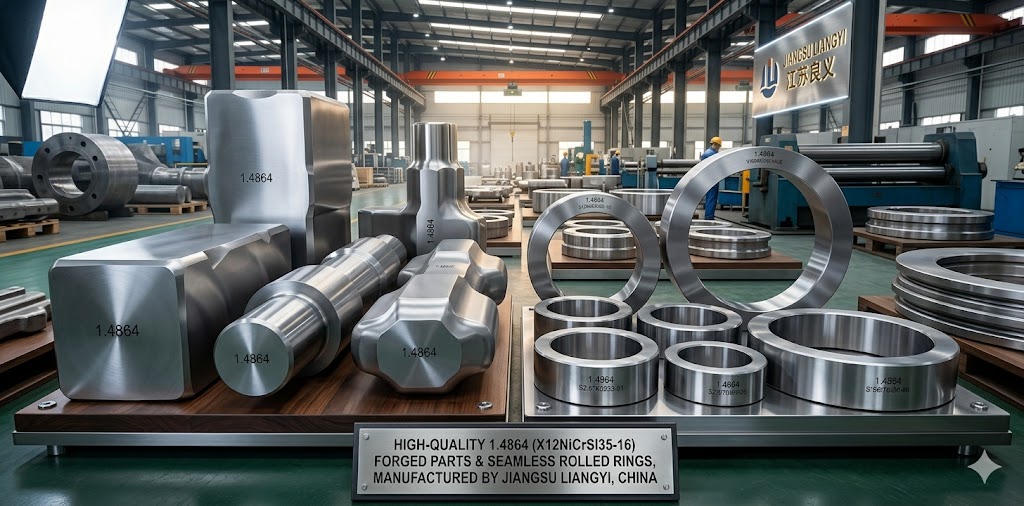
About EN 10095 1.4864 (X12NiCrSi35-16) High-Temperature Alloy & Jiangsu Liangyi
Jiangsu Liangyi Co., Limited is a professional ISO 9001:2015 certified manufacturer of 1.4864 (X12NiCrSi35-16, also written X12NiCrSi3516 or X12NiCrSi35.16) open die forging parts and seamless rolled rings in China. Located in Jiangyin — the heart of China's forging industrial cluster in the Yangtze River Delta — we have over 25 years of focused manufacturing experience in high-temperature alloy forgings. Our entire production chain, from vacuum-grade steel melting through hot forging, solution heat treatment, machining and multi-method NDT inspection, is performed in-house under one roof, giving us complete control over quality, consistency and delivery timelines.
Unlike trading companies or general steel mills that merely re-sell standard bar stock, Jiangsu Liangyi specializes exclusively in custom-shaped forgings: we work directly from your engineering drawings or specifications, select the appropriate melting process grade (double or triple melt), engineer the precise forging ratio and heat treatment cycle for your specific wall thickness and component geometry, and deliver a finished, fully documented forging that meets your application demands — not just a standard catalog item.
1.4864 (X12NiCrSi35-16), standardized in EN 10095 (formerly DIN 17470), is an austenitic nickel-chromium-iron-silicon alloy specifically engineered for extreme, long-duration high-temperature service. Its composition is deliberately designed around three interconnected performance pillars: outstanding carburization resistance, sustained oxidation resistance to 1200°C, and resistance to thermal fatigue in cyclically heated and cooled structures. It is the definitive choice for industrial environments where the simultaneous attack of heat, carbon activity and oxidizing gases would quickly destroy standard austenitic stainless steels or lower-nickel heat-resistant grades.
Metallurgical Science: Why 1.4864 (X12NiCrSi35-16) Outperforms Other Alloys
To specify the right alloy, engineers need to understand not just the data sheet numbers but the underlying metallurgical mechanisms that produce the observed performance. Below is a systematic analysis of each major alloying element in 1.4864 and the specific role it plays in the alloy's behavior at extreme temperatures.
Element-by-Element Metallurgical Role
The defining element. Nickel above ~33% is the threshold for near-complete carburization immunity: it raises the carbon solubility limit in austenite, dramatically reducing the driving force for carbon ingress. High Ni also stabilizes the austenite matrix at all service temperatures, eliminating the austenite-to-martensite transformation on thermal cycling that causes cracking in lower-Ni grades.
Chromium forms the primary Cr₂O₃ surface oxide scale that acts as the first line of defense against oxidizing atmospheres. The 15–17% level is carefully balanced: sufficient to form a continuous, adherent scale without promoting sigma phase precipitation at intermediate service temperatures (700–900°C range), which would embrittle the alloy and reduce impact toughness.
Silicon is the critical element that distinguishes 1.4864 from many competing Ni-Cr alloys at temperatures above 1000°C. Si selectively oxidizes beneath the Cr₂O₃ layer to form a continuous, glassy SiO₂ sub-scale. This dual-layer protective system — outer Cr₂O₃ plus inner SiO₂ — is far more effective at blocking carbon ingress than chromium oxide alone, particularly in strongly carburizing atmospheres. This is the primary reason 1.4864 outperforms 310S in furnace and carburizing applications.
Carbon is kept low and tightly controlled for two reasons: firstly, to avoid chromium carbide precipitation at grain boundaries (sensitization) during heat treatment cooling, which would deplete chromium from the matrix and reduce corrosion resistance; secondly, to maintain sufficient ductility and weldability. Our controlled upper limit of 0.12% provides a meaningful additional margin over the standard maximum of 0.15%.
Manganese is primarily a deoxidizer and austenite stabilizer. Our tighter maximum of 1.5% (vs the standard 2.0%) helps avoid the formation of complex Mn-Si oxide inclusions that can reduce oxide scale adhesion at extreme cycling temperatures. Lower Mn also supports better impact toughness in the as-heat-treated condition.
Nitrogen can cause porosity during welding and embrittlement in the heat-affected zone after multi-pass welding of thick sections. Our tighter nitrogen control (max 0.08% vs standard 0.11%) is especially important for components destined for oil & gas and nuclear applications, where weld-zone integrity is safety-critical.
The Dual-Layer Protective Oxide Mechanism
The exceptional carburization resistance of 1.4864 at temperatures above 1000°C cannot be fully explained by nickel content alone. A distinctive feature of this alloy is the spontaneous formation of a two-tier protective oxide architecture on the exposed surface:
- Outer layer (Cr₂O₃): Forms first on initial exposure to high-temperature oxidizing gas. This chromia layer is dense, adherent and provides the primary barrier against oxygen and carbon ingress for temperatures up to approximately 1050°C.
- Inner sub-layer (SiO₂): As temperatures exceed 1000–1050°C, the silicon in the alloy selectively oxidizes internally, forming a continuous, glassy silicon dioxide sub-layer at the oxide/metal interface. SiO₂ has extremely low carbon permeability — far lower than Cr₂O₃ — and essentially acts as a molecular sieve against further carbon ingress.
- Why this matters practically: When a heat treatment basket made from 310S (1.4845) carburizes and fails after 18–24 months, an equivalent 1.4864 component in the same furnace will still be in service at 4–5 years, because the SiO₂ sub-layer remains structurally intact through thermal cycling in a way that the simpler Cr₂O₃-only protection of 310S cannot sustain.
Austenite Stability & Its Role in Thermal Fatigue Resistance
A less-discussed but critically important property of 1.4864 is the exceptional stability of its austenite phase across the full operating temperature range. Low-nickel austenitic steels (Ni content below 20%) can partially transform to martensite on rapid cooling from high temperatures — this volume change generates internal stress that causes progressive crack initiation at grain boundaries, the mechanism behind classical thermal fatigue failure in cyclically heated furnace components. At 33–37% Ni, 1.4864's austenite is thermodynamically stable from ambient to 1200°C service temperature, eliminating this transformation-induced stress cycle entirely. This is why 1.4864 components subjected to daily heating-cooling cycles in industrial furnaces maintain structural integrity far longer than their lower-nickel counterparts.
Complete Physical & Thermal Properties of 1.4864 (X12NiCrSi35-16)
The physical and thermal properties below are critical inputs for thermal-mechanical design calculations, including thermal stress analysis, thermal fatigue life prediction, heat transfer modeling, and bolt load calculations for flanged assemblies operating at elevated temperatures. Values are representative of the solution-annealed (+AT) condition.
Physical Properties at Room Temperature
| Property | Value | Unit | Significance for Engineering Design |
|---|---|---|---|
| Density | 7.95 | g/cm³ | Weight estimation for heavy forgings; buoyancy calculations |
| Modulus of Elasticity (E) at 20°C | ~196 | GPa | Elastic deflection; spring-back in forming |
| Modulus of Elasticity (E) at 600°C | ~170 | GPa | Hot stiffness for high-temperature structural calculations |
| Modulus of Elasticity (E) at 1000°C | ~140 | GPa | Creep regime stiffness; thermal fatigue modeling |
| Thermal Conductivity at 20°C | ~13 | W/(m·K) | Heat transfer coefficient for heat exchanger design |
| Thermal Conductivity at 800°C | ~20 | W/(m·K) | Conductivity increases with temperature unlike many steels |
| Specific Heat Capacity (cp) | ~500 | J/(kg·K) | Thermal inertia; heating/cooling time estimation |
| Mean CTE (20–200°C) | ~15.0 | μm/(m·K) | Differential thermal expansion in assemblies |
| Mean CTE (20–600°C) | ~16.5 | μm/(m·K) | Pipe expansion calculations in medium-temp service |
| Mean CTE (20–1000°C) | ~17.5 | μm/(m·K) | High-temperature thermal expansion; growth prediction |
| Electrical Resistivity at 20°C | ~1.05 | μΩ·m | Eddy current NDE calibration; resistance heating calculations |
| Magnetic Permeability (solution-annealed) | ~1.02 (max) | μr | Essentially non-magnetic; MPI inspection note applies |
Temperature-Dependent Mechanical Properties
The following short-time mechanical properties at elevated temperatures are key design inputs for pressure vessel and structural calculations under ASME BPVC, EN 13480 and PED frameworks. Values represent representative minimum expected performance for the solution-annealed condition (+AT) at our controlled composition range.
| Temperature (°C) | Rp0.2 (MPa) Min. | Rm (MPa) Typ. | Elongation A (%) | Design Note |
|---|---|---|---|---|
| 20 (RT) | 230 | 550–750 | ≥28 | EN 10095 standard delivery condition |
| 200 | ~175 | ~500 | ≥30 | Proof strength drops; ductility maintained |
| 400 | ~150 | ~460 | ≥30 | Design allowable stress still useful |
| 600 | ~135 | ~430 | ≥32 | Ductility typically increases with temperature |
| 800 | ~120 | ~380 | ≥35 | Creep begins to govern long-term design |
| 1000 | ~70 | ~200 | ≥40 | Creep rupture strength governs; use time-dependent data |
| 1100 | ~45 | ~130 | ≥45 | Structural load must be minimal; carburization protection still active |
Performance Comparison: 1.4864 (X12NiCrSi35-16) vs Common High-Temperature Alloys
Selecting the correct high-temperature alloy is not simply a matter of choosing the highest-performing material — it involves balancing actual application demands against cost, fabricability and supply reliability. The table below provides an objective side-by-side comparison to help engineering procurement teams make an informed specification decision.
| Performance Factor | 1.4864 (X12NiCrSi35-16) | 310S (1.4845) | Incoloy 800H (1.4958) | 304/316 SS |
|---|---|---|---|---|
| Ni Content (%) | 33–37 | 19–22 | 30–35 | 8–14 |
| Max continuous temp (°C) | 1200 | 1050 | 1150 | 800–900 |
| Carburization resistance >1000°C | Excellent (SiO₂ sub-layer) | Poor (no SiO₂ barrier) | Moderate | Very Poor |
| Oxidation resistance | Excellent | Good | Excellent | Moderate |
| Thermal fatigue resistance | Excellent (stable austenite) | Moderate | Moderate-Good | Poor |
| Cyanide/neutral salt bath resistance | Excellent | Moderate | Good | Unsuitable |
| Weldability | Good | Good | Good | Excellent |
| Relative material cost | High | Moderate | High | Low |
| Typical service life in furnace app. | 4–6 years | 18–24 months | 3–4 years | <12 months |
| Sulfur atmosphere suitability | Not recommended | Limited | Limited | Limited |
From our 25 years of working with clients across the heat treatment, petrochemical and power generation sectors, the total cost of ownership calculation consistently favors 1.4864 over 310S or 304/316 for applications above 950°C: the longer replacement cycle and elimination of unplanned downtime due to premature carburization failure more than offset the higher initial material cost.
Custom 1.4864 (X12NiCrSi35-16) Forged Products We Supply
We manufacture 1.4864 forged steel products across the full shape spectrum, with single-piece weight from 30 kg to 30 tons, serving global clients from prototype quantities through sustained mass production. All products are available with a minimum forging ratio of 3:1 (we routinely achieve 4:1–6:1 for critical applications), ensuring a fully worked microstructure, closed porosity and uniform mechanical properties throughout the cross-section.
1.4864 Forged Bars & Step Shafts
We supply round bars, square bars, flat bars, rectangular bars and multi-diameter step shafts in 1.4864, with maximum forging diameter up to 2 meters and maximum length up to 15 meters. Each bar is forged from vacuum-melted ingot with a minimum 3:1 forging reduction to ensure complete closure of as-cast porosity and refinement of the coarse dendritic ingot grain structure into a uniform, fine-grained wrought microstructure. All bars are available with full EN 10204 3.1 or 3.2 MTC (mill test certificate) covering chemical composition, mechanical properties, hardness, non-destructive test (UT per EN 10308 or ASTM A388) and heat treatment records. We can also supply bars in the rough-turned condition with 3–5 mm machining allowance on diameter, ready for your final machining.
X12NiCrSi35-16 Seamless Rolled Forged Rings
Our seamless ring rolling capability for 1.4864 covers outer diameters from 200 mm to 6,000 mm, heights from 50 mm to 1,500 mm, and single-ring weights up to 30 tons. The ring rolling process imparts a circumferential grain flow orientation that maximizes hoop strength and fatigue resistance — critical for rings used in rotating equipment such as turbine casings, compressor stages and pump stages. We produce rectangular-section rings, contoured rings (with flanges, steps or profile sections rolled in), gear ring blanks, flange blanks and complete custom-profile rings per your engineering drawing. All rings are solution-annealed after rolling, with dimensional inspection performed using calibrated 3D measurement systems to confirm OD, ID, height and out-of-roundness within drawing tolerance.
1.4864 Hollow Forgings, Sleeves & Tubes
We produce custom hollow bars, seamless sleeves, pipes, tubes, housings, shells and bushing blanks in 1.4864, with outer diameters up to 3,000 mm and wall thicknesses from 20 mm upward. The hollow forging process — punching, mandrel forging or ring-and-disc combined forging depending on geometry — preserves uniform grain flow in the wall section while delivering true seamless integrity with no weld seam. Every hollow forging undergoes 100% full-bore UT inspection at our in-house NDT laboratory using immersion or contact techniques per ASTM A578 or EN 10308, ensuring no internal segregation, porosity or lamination anywhere in the wall.
X12NiCrSi35-16 Forged Discs, Plates, Tube Sheets & Blocks
Our disc and plate forgings in 1.4864 cover diameters up to 3 meters and single-piece weights to 20 tons, widely used for heat exchanger tube sheets, pressure vessel nozzle blanks, pump casing covers, venturi meter bodies, ultrasonic flow meter housings and furnace hearth plates. Tube sheet forgings receive full UT inspection in the drilling-zone area to confirm no inclusions or laminar defects that could compromise tube-to-tube sheet weld integrity. We can supply these components in the forged-and-solution-annealed blank condition or fully rough-machined to your drawing, reducing your in-house machining time and tool wear on this work-hardening alloy.

1.4864 Forged Valve Components
We supply complete valve body assemblies and individual valve components in 1.4864 for global valve OEMs: valve bodies, bonnets, closures, balls, seats, stems, discs, cores and cage blanks. Our valve forgings are produced to net-near-shape to minimize machining cost on this relatively hard alloy (HB 150–223), with all internal flow bores and seat pockets pre-bored to a rough machining allowance of 3–5 mm. We are familiar with the API 6A, ASME B16.34, PED 2014/68/EU and DIN-PN designation requirements that govern valve pressure-temperature ratings, and can provide the full material documentation package (chemical/mechanical test reports, PMI, Charpy impact data, NACE MR0175 / EN ISO 15156 material compliance declaration) required by major EPCs and end users in refining and chemical processing.
X12NiCrSi35-16 Pump, Turbine & Nuclear Power Forgings
Our X12NiCrSi35-16 forgings for rotating and power generation equipment include pump casings, impellers (closed and open), wear rings, shaft sleeves, gas turbine tie rods, compressor impeller blanks and auxiliary-system components for power generation facilities. For applications requiring elevated material purity — such as auxiliary cooling system components in industrial or power generation contexts — premium VIM+ESR+VAR triple melting is available through our qualified remelting supply chain, with material purity certification to DIN 50602-K1 (K1 ≤2.0) and comprehensive MTR traceability from ingot heat through finished component dimensions. Please note: components intended for nuclear safety-classified systems require customer-specific quality assurance programs; please discuss your regulatory requirements with our team at the inquiry stage.
Explore our full portfolio of forged steel products and high-temperature alloy materials.
1.4864 (X12NiCrSi35-16) Forging Process Engineering
Forging 1.4864 successfully requires process parameters that differ meaningfully from conventional austenitic stainless steels. The high nickel and silicon content gives this alloy a narrower hot-working window and higher flow stress than 304/316 or even 310S, so experience and tight process control are essential to avoid forging defects and achieve the specified microstructure.
Ingot Heating
Charge temperature must not exceed 850°C to avoid thermal shock to large ingots. Soak temperature: 1180–1220°C. Minimum soak time: 1 hour per 100 mm of section thickness. Uniform heat penetration is confirmed by pyrometer and thermocouple measurement before pressing begins.
Forging Temperature Window
Start forging: 1150–1200°C. Stop forging (finish temperature): 950°C minimum. Below 950°C, work-hardening rate increases sharply and incipient cracking at grain boundaries becomes a risk in thick sections. Light finishing passes below 1000°C are permissible only for shape correction on thin features.
Forging Ratio Control
Minimum 3:1 reduction ratio for all standard forgings. Critical rotating components (turbine rings, nuclear pump parts) require ≥4:1 to ensure complete breakdown of the coarse as-cast dendrite structure and full closure of micro-shrinkage. Higher ratios improve UT response by tightening grain size, improving ultrasound attenuation uniformity.
Inter-pass Reheating
For large or complex-shape forgings requiring multiple press passes, intermediate reheat to 1150–1180°C is performed between passes to restore hot workability. Residency time at temperature is minimized to prevent excessive grain growth. Each reheat cycle is logged with time and temperature for the MTC record.
Post-Forge Cooling
After the final forging pass, components are cooled in air (for routine applications) or in a controlled-temperature furnace at 800°C to avoid rapid cooling-induced thermal gradients in thick sections (>200 mm). Rapid cooling directly from forging temperature is avoided because it can introduce surface-to-core thermal stresses exceeding the material's hot tensile strength, causing quench cracking.
Solution Heat Treatment (+AT)
The standard delivery condition for 1.4864 is solution-annealed (+AT): heating to 1050–1100°C, holding for a calculated time (minimum 30 min + 1 min/mm of section thickness), then rapid quenching in water or forced air. This dissolves any carbides or nitrides precipitated during forging and cooling, restores maximum corrosion resistance, and sets the room-temperature mechanical properties to the EN 10095 specified values.
Engineer's Selection Guide: When to Specify 1.4864 (X12NiCrSi35-16)
Not every high-temperature application justifies the cost of 1.4864. Below is a practical framework our application engineers use when reviewing a new project inquiry to determine whether 1.4864 is the optimum choice — or whether a more cost-effective alternative should be evaluated.
Specify 1.4864 When Your Application Meets ≥3 of These Criteria:
- Continuous operating temperature exceeds 950°C
- Process atmosphere contains significant carbon activity (carburizing gas, solid carbon contact, or hydrocarbon decomposition products)
- Component is subjected to repeated thermal cycling (furnace charge/discharge, on/off process cycles)
- Service life target exceeds 3 years without major replacement
- Application involves cyanide, neutral salt bath or reducing atmosphere at high temperature
- Dimensional stability under thermal cycling is critical (tight-tolerance furnace fixtures, flow meter bodies)
- Nuclear or critical pressure-bearing application requiring ultra-high material purity (K1 ≤2.0)
Consider Alternatives to 1.4864 When:
- Operating temperature is below 900°C: 310S (1.4845) or 309S provides adequate performance at substantially lower material cost. Reserve 1.4864 for the highest-temperature zones.
- Sulfur is present in the process atmosphere: No standard austenitic grade performs well in high-temperature sulfidizing atmospheres. Evaluate Alloy 625 or other sulfidation-resistant compositions with guidance from a materials engineer.
- Budget is the overriding constraint and service life is secondary: In non-critical, easily replaceable furnace fixtures, the economics may favor 310S with a planned shorter replacement cycle.
- Low-temperature corrosion resistance (below 300°C) is the primary requirement: 1.4864 is optimized for high-temperature resistance, not for aqueous corrosion resistance. For room-temperature or low-temperature corrosion services, 316L, duplex or super-duplex grades are more appropriate.
Common Failure Modes in High-Temperature Equipment & How 1.4864 Prevents Them
Based on our experience reviewing returned components and failure analysis reports from clients in the heat treatment, petrochemical and power generation industries, the following failure mechanisms most frequently cause premature retirement of high-temperature equipment. Understanding how 1.4864's microstructure addresses each mechanism is essential for making the business case for the material upgrade.
Failure Mode 1: Through-Wall Carburization & Embrittlement
How it happens: Carbon from a carburizing atmosphere diffuses through the protective oxide scale and into the metal matrix, preferentially precipitating as Cr₂₃C₆ carbides at grain boundaries. These carbides are brittle and deplete the surrounding matrix of chromium, progressively weakening the grain boundary network until catastrophic brittle fracture occurs under normal operating stress — often at a temperature ramp-up cycle when thermal stress is highest.
How 1.4864 prevents it: The 33–37% Ni content raises the carbon activity threshold required for carburization to a level rarely encountered in industrial carburizing atmospheres. More critically, the SiO₂ sub-scale (described in the metallurgy section) provides a second physical barrier against carbon ingress that is not present in lower-silicon alloys. Our field data shows that 1.4864 components in industrial carburizing furnaces operated at 1050°C show measurable carbon ingress depths of only 0.05–0.15 mm after 12 months of operation, compared to 2–5 mm or complete through-carburization for 310S in the same application.
Failure Mode 2: Thermal Fatigue Cracking at Stress Concentration Points
How it happens: Every heat-cool cycle in a furnace or process vessel generates cyclically alternating compressive (heating) and tensile (cooling) thermal stresses in constrained structural sections — particularly at holes, notches, weld toes and section changes. In alloys with modest thermal fatigue resistance, cracks initiate at these concentration points after a few hundred cycles and propagate progressively until leakage or structural failure occurs.
How 1.4864 prevents it: Stable austenite microstructure (no phase transformation on cycling), the relatively low modulus of elasticity at high temperature (140 GPa at 1000°C vs ~196 GPa at RT), and the good elevated-temperature ductility (elongation >35% at 800–1000°C) combine to significantly reduce both the stress amplitude generated per cycle and the rate of fatigue crack propagation. In client applications where cyclic cracking of 310S weld-zone areas was the recurring failure mode, switching to 1.4864 with properly matched filler metal has extended fatigue crack-initiation life by factors of 3–5×.
Failure Mode 3: Oxide Scale Spalling & Accelerated Oxidation
How it happens: In applications with rapid thermal cycling (especially air quench operations or process upset conditions), the thermal expansion mismatch between the protective surface oxide scale and the metal substrate causes the oxide to crack and spall off, exposing fresh metal and resetting the oxidation protection clock. Each spalling event accelerates the net oxidation rate (metal loss per unit time) and introduces oxide debris into process streams.
How 1.4864 prevents it: The SiO₂ inner sub-layer has a thermal expansion coefficient closer to that of the metal substrate than Cr₂O₃ alone, which improves the oxide-to-metal adhesion through thermal cycling. Further, the high nickel content improves the plasticity of the oxide/metal interface region, reducing the driving force for spallation during rapid temperature changes. This is why 1.4864 is especially selected for use where cyclic temperature excursions are unavoidable, for example in continuous heat treatment furnaces with a cycle between 800°C and 1150°C several times a day.
Customization Capabilities for 1.4864 (X12NiCrSi35-16) Forging Parts
We understand that every industrial application has unique requirements, so we offer comprehensive customization services covering every stage of the manufacturing chain:
- Custom Shapes & Dimensions: We produce any forging shape — bars, rings, discs, hollows, flanges, valve bodies, turbine components, or complex multi-feature parts — from your CAD/CAM drawing or 2D sketch. Our in-house modeling team can convert DXF, DWG, STEP or PDF drawings into forging design layouts and issue a DFM (design for manufacturability) review before production starts.
- Custom Melting Process Selection: We offer VIM+VAR double melting for general industrial applications and VIM+ESR+VAR triple melting (via our qualified remelting supply chain) for applications requiring elevated material purity — such as oil & gas equipment produced to API 6A customer specifications, critical pressure vessel components, and other high-integrity applications. We advise on which melting level suits your application so you don't over-specify unnecessarily.
- Custom Composition Targeting: For customers with specific microstructural requirements for high-cycle fatigue or nuclear applications, we can aim for narrower composition windows – e.g., holding Ni at 34.5-35.5% and Si at 1.3-1.7% – within the EN 10095 allowable range.
- Custom Heat Treatment: In addition to the standard +AT solution annealing we can provide stabilization annealing, step-quench cooling programs and custom aging cycles for customers with specific delta ferrite content or hardness requirements.
- Custom Machining: In-house 5-axis CNC machining, turning centers (up to Ø3000 mm), vertical and horizontal milling, deep-hole drilling, bore grinding and surface grinding for net-shape or near-net-shape delivery.
- Custom Inspection & Certification: Third-party inspection by TÜV, Bureau Veritas, SGS, Lloyd's Register, Intertek or DNV can be arranged at client's request and cost. EN 10204 3.1 MTC is our standard; EN 10204 3.2 MTC is available when a client-nominated inspector co-signs. We can produce materials and documentation to support clients' own PED CE marking processes, API 6A qualification submissions, and NACE MR0175 material compliance declarations — however, formal PED CE marking and API monogram certification are held by the end-product manufacturer, not the material forging supplier.
Chemical Composition & Room-Temperature Mechanical Properties
Chemical Composition per EN 10095 (X12NiCrSi35-16)
| Element | EN 10095 Allowable Range | Our Controlled Aim Range | Key Function |
|---|---|---|---|
| Carbon (C) | Max 0.15% | 0.08% – 0.12% | Matrix hardening; sensitization risk if too high |
| Silicon (Si) | 1.0% – 2.0% | 1.2% – 1.8% | Forms protective SiO₂ sub-scale; carburization barrier |
| Manganese (Mn) | Max 2.0% | Max 1.5% | Deoxidizer; austenite stabilizer; impact toughness |
| Nickel (Ni) | 33.0% – 37.0% | 34.0% – 36.0% | Carburization immunity; austenite stability; thermal fatigue resistance |
| Chromium (Cr) | 15.0% – 17.0% | 15.5% – 16.5% | Primary Cr₂O₃ oxide scale; corrosion resistance |
| Phosphorus (P) | Max 0.045% | Max 0.035% | Grain boundary embrittlement risk if high; kept low |
| Sulfur (S) | Max 0.015% | Max 0.010% | Hot shortness and weldability; minimum required |
| Nitrogen (N) | Max 0.11% | Max 0.08% | Porosity in welds; HAZ embrittlement risk in thick sections |
Heat Treatment & Microstructure Control
Our 1.4864 forged material undergoes standardized solution annealing: heating to 1060–1090°C (above the lower EN 10095 limit of 1000°C, providing additional margin for complete carbide dissolution in heavy sections), holding for a calculated time based on cross-section thickness, then rapid quenching in water or forced air. This produces a stable austenite + minor delta ferrite microstructure. Delta ferrite content is strictly controlled below 5% — verified per ASTM E45 Method A (Worst Field Method) at minimum 4 test fields per heat — to ensure reliable magnetic particle inspection (MPI) performance on machined surfaces and to avoid high-temperature embrittlement effects associated with elevated ferrite levels in service.
Room-Temperature Mechanical Properties (Delivery Condition +AT)
- Tensile Strength (Rm): 550 – 750 MPa
- 0.2% Proof Strength (Rp0.2): Minimum 230 MPa (our typical heat average: 245–265 MPa)
- Elongation at Fracture (A): Minimum 28% (our average: 30–33%)
- Reduction of Area (Z): Typically 45–60%
- Brinell Hardness (HB): Maximum 223 (typical range: 150–190 HB)
- Charpy Impact (KV, 0°C, transverse): Typically 80–130 J (application-specific requirements available)
1.4864 Forging Parts: Global Industry Applications
1.4864 (X12NiCrSi35-16) forged steel parts are widely applied in high-temperature, high-pressure and carburization-resistant industrial equipment worldwide. The following sections outline the primary industry segments we serve, the specific component types we supply and the technical reasons why 1.4864 is selected for each application.
Industrial Heat Treatment & Furnace Equipment
This is the original and most established application domain for 1.4864. Industrial furnace components — radiant tubes, pot liners, baskets, grids, fixtures, retorts and hearth rails — operate under continuous temperatures of 900–1150°C in cyclically alternating carburizing, oxidizing and nitriding atmospheres, combined with frequent thermal shock from charge loading and unloading. The SiO₂ carburization barrier and austenite thermal-fatigue stability of 1.4864 are uniquely matched to this environment. We supply forged basket frames, grid supports, hearth rail blanks and custom fixture components to heat treatment equipment manufacturers in Europe, North America and Asia. These applications are among our longest-standing supply relationships, and clients in this segment routinely report significantly extended service life compared to lower-grade 310S or cast alternatives.
Boiler, Heat Exchanger & Pressure Vessel Industry
1.4864 forged tube sheets, shell flanges, nozzle forgings and channel heads are used in high-temperature process heat exchangers, waste heat recovery units, steam reformer outlet headers and syngas coolers. The combination of high-temperature strength and carburization resistance is critical in reformer service, where tube sheets are exposed to process gas containing CO, H₂ and light hydrocarbons at temperatures exceeding 900°C. We have supplied 1.4864 forged heat exchanger and pressure vessel components to clients in the power generation and petrochemical sectors across Southeast Asia, the Middle East and Europe, produced to ASME BPVC Section VIII or EN 13445 material requirements depending on project specification.
Oil & Gas Exploration & Production Industry
X12NiCrSi35-16 forgings address two distinct oil & gas niches: surface wellhead equipment requiring high-temperature corrosion resistance and material traceability, and downhole high-temperature equipment where conventional tool steels fail due to thermal degradation. Downhole mud motor drive shafts, ESP motor shafts, flexible joints and wellhead spool body forgings are among the components we supply. Clients in this sector typically require comprehensive material test reports covering chemical composition, mechanical properties, Charpy impact, PMI and UT inspection results; we provide full documentation packages to support their own API 6A or project-specific qualification process.
Industrial Valve Manufacturing
Valve manufacturers in Germany, Italy, the United Kingdom and the United States specify 1.4864 for valve bodies, bonnets, balls, stems and seat ring blanks for high-temperature process services in petrochemical, refinery and power generation piping. The alloy's machinability relative to nickel superalloys, its weldability, and its high-temperature mechanical integrity make it practical for large-diameter high-pressure valve forgings. We supply valve component forgings in the forged-and-annealed blank or rough-machined condition with defined stock allowances, typically to PED 2014/68/EU material requirements for European clients or to ASME B16.34 for North American markets; the product certification under these frameworks is obtained by the valve manufacturer as the final equipment manufacturer.
Thermal Power Generation & High-Pressure Rotating Equipment
X12NiCrSi35-16 forgings for power generation equipment include pump casings, impellers, wear rings, shaft sleeves, gas turbine tie rods and compressor impeller blanks. Clients in this sector typically require stringent inclusion control and comprehensive traceability; we offer VIM+ESR+VAR triple melting through qualified remelting partners for such applications, with DIN 50602-K1 purity documentation (K1 ≤2.0) and full heat-to-component traceability. If your project involves nuclear safety-class qualification (HAF, N-Stamp, RCC-M, KEPIC, or equivalent), please contact us to discuss your specific qualification framework, as this requires assessment beyond our standard ISO 9001 quality system scope.
Chemical Processing & Petrochemical Industry
High-temperature reactors, reformer outlet headers, cracking furnace tube sheets and pyrolysis reactor components in ethylene, ammonia, methanol and hydrogen production require materials that resist carburizing process gases above 900°C and the thermal shock of periodic decoking or shutdown cycles. We supply 1.4864 forged tube sheets, transition piece flanges, nozzle blanks and manifold forgings for these applications to clients in Europe, the Middle East and Asia. Components are produced to the applicable pressure vessel or piping code specified by the client (ASME BPVC, EN 13480, AD 2000, etc.) with full chemical and mechanical test documentation.
Advanced Melting Process & Full-Scope Quality Control
Premium Melting Process Options for 1.4864
The performance of a forged component begins with the quality of the starting material. For 1.4864 at the compositions and purities we specify, conventional electric arc furnace (EAF) melting and casting is insufficient — vacuum melting and remelting are essential to remove dissolved gases (oxygen, hydrogen, nitrogen), reduce non-metallic inclusion content, and produce the uniform composition distribution that enables consistent mechanical properties and NDT inspectability throughout large forging cross-sections.
- VIM + VAR Double Melting Process: Vacuum Induction Melting (VIM) produces a precisely controlled melt under vacuum, removing dissolved gases and enabling accurate alloy addition. Vacuum Arc Remelting (VAR) of the VIM electrode refines the solidification structure, reduces macrosegregation and further lowers inclusion content. This process is appropriate for general industrial applications including furnace components, heat exchangers, standard valves and most oil & gas equipment, where it provides excellent material quality at a commercially favorable cost level.
- VIM + ESR + VAR Triple Melting Process: An additional Electroslag Remelting (ESR) step between VIM and VAR passes the alloy through a reactive calcium-aluminate-based slag that acts as a high-temperature filter for oxide inclusions, sulfides and other non-metallic particles. The ESR electrode then becomes the VAR consumable, providing a third controlled solidification cycle. The triple-melt route is recommended for critical purity applications — such as high-pressure rotating equipment, demanding oil & gas components, or any application where EN 10204 3.2 documentation must confirm K1 ≤2.0 purity per DIN 50602.
All our 1.4864 forged materials are certified to DIN 50602-K1 purity standard, with K1 ≤2.0 per 1,000 mm², verified by a minimum of 4 test fields per heat measured on polished cross-section samples.
10-Step Quality Assurance Process
- Raw Material Incoming Inspection: Ingot chemical composition verified by optical emission spectrometry (OES) at our in-house laboratory. Positive material identification (PMI) by XRF confirms heat identity before any production begins.
- Forging Process Monitoring: Furnace time-temperature charts reviewed against forging plan before pressing. Forging ratio verified by dimensional measurement. Die temperatures logged.
- Dimensional Inspection (Forging Stage): All critical forging dimensions checked to drawing tolerances immediately after forge and trim, confirming sufficient machining stock on all surfaces.
- Heat Treatment Monitoring: Solution annealing temperature confirmed by calibrated furnace thermocouples (NIST-traceable calibration). Cooling medium temperature and flow rate logged. Hold time verified against section thickness calculation record.
- Post-Heat-Treatment Hardness Survey: Brinell hardness measured at minimum 3 locations per component face. Results recorded on heat treatment record and MTC.
- Non-Destructive Testing — Ultrasonic Inspection (UT): 100% volumetric UT per EN 10308, ASME SA-388 or client-specified code. Calibration to DAC curve or flat-bottom hole (FBH) reference blocks matched to the test frequency and material attenuation. All indications ≥50% DAC reported; ≥100% DAC cause rejection unless accepted by engineering disposition.
- Non-Destructive Testing — Surface Methods: Liquid penetrant testing (PT per EN ISO 3452) on all machined surfaces as standard. Magnetic particle testing (MPI per EN ISO 9934) applied to components where specified by client drawing or applicable code. Radiography (RT) for castings or weld-repaired areas where required.
- Mechanical Property Testing: Tensile test (room temperature), yield strength (Rp0.2), ultimate tensile strength (Rm), elongation (A) and reduction of area (Z) per EN ISO 6892-1. Charpy impact testing at specified temperature(s) per EN ISO 148-1. All test specimens taken from dedicated test coupons attached to or representative of the production forging.
- Microstructure & Metallographic Inspection: Grain size determination per ASTM E112. Delta ferrite content measurement per ASTM E45 Method A. Carbide distribution assessment. Photographs at standard magnifications included in MTC for critical orders.
- Final Inspection, Documentation & Packaging: 3D CMM dimensional inspection for precision-machined components. Full MTC package compiled (chemical, mechanical, NDT reports, heat treatment record, calibration certificates). Export packaging to ISPM 15 phytosanitary standard with VCI rust-prevention treatment and foam edge protection for machined surfaces.
Learn more about our advanced forging and NDT inspection equipment.
Shipping & Logistics for Global Clients
Jiangsu Liangyi is located in Jiangyin, Jiangsu Province, about 100 kilometers from Shanghai Yangshan Deep-Water Port, one of the world's largest container ports, and 180 kilometers from Nanjing Lukou International Airport, providing clients with excellent access to sea and air freight services on all continents. We have over 15 years of experience in export documentation for heavy industrial forgings and we can take care of the whole export process for you.
- Sea Freight (FCL/LCL): Standard for forging shipments above 500 kg. Transit times: 25–30 days to US East Coast; 18–22 days to Rotterdam; 10–14 days to Singapore/Malaysia; 7–10 days to South Korea/Japan. We issue full commercial invoice, packing list, bill of lading, EN 10204 3.1/3.2 MTC, certificate of conformance and certificate of origin (Form E for ASEAN, EUR.1 for EU preferences where applicable).
- Air Freight: For urgent prototype deliveries, replacement parts and time-critical project schedules. DHL, FedEx, UPS and TNT express services available. Transit time to most global destinations: 3–7 business days door-to-door.
- Rail Freight (China-Europe Railway Express): An increasingly popular alternative for large shipments to European clients. Transit time: 18–22 days to Germany/France, significantly faster than sea freight and more cost-effective than air for the 500 kg – 5,000 kg weight range.
- Customs Documentation: Our team prepares all HS code classifications, customs invoices, packing declarations and standard export documents required for destination customs clearance. ISPM 15 phytosanitary treatment certificates issued for all wood-pallet shipments to regulated markets. For PED-governed products, the CE Declaration of Conformity is the responsibility of the final equipment manufacturer; we provide the EN 10204 3.1/3.2 MTC and material compliance documentation to support that process.
- Marine Insurance: We offer full marine cargo insurance on all shipments. All-risk coverage available for high-value precision-machined forgings. Claims are handled through our established relationship with a tier-1 marine insurer.
- Real-Time Tracking: Shipment booking number, vessel name, voyage number, ETD and ETA provided immediately upon booking confirmation. Online tracking links shared for all courier/express shipments.
Our active shipping destinations span 50+ countries including the United States, Canada, Mexico, United Kingdom, Germany, France, Italy, Netherlands, Spain, Norway, Sweden, Poland, Saudi Arabia, UAE, Kuwait, Qatar, Bahrain, India, Thailand, Vietnam, Indonesia, Malaysia, South Korea, Japan, Singapore, Australia, New Zealand, Brazil, Argentina and South Africa.
Procurement Checklist for Buyers: What to Specify When Ordering 1.4864 Forgings
From our experience processing thousands of 1.4864 forging inquiries over 25 years, the following information checklist enables us to provide an accurate quotation on the first exchange, without back-and-forth clarifications that delay your project timeline. We recommend using this as a standard RFQ template for any high-temperature alloy forging procurement:
Technical Specification Checklist
- Material grade and applicable standard: Specify "EN 10095 Grade 1.4864 (X12NiCrSi35-16)" and whether the EN 10095 standard governing the delivery is the current version or a specific historical edition. If an equivalent grade (Z12NCS35-16, etc.) is acceptable, note it.
- Melting process requirement: State whether VIM+VAR double melt or VIM+ESR+VAR triple melt is required. If unspecified, we will recommend based on application details.
- Delivery condition and heat treatment: Specify +AT (solution-annealed, the EN 10095 standard delivery condition) or state any custom heat treatment requirement. Note the hardness target range if applicable.
- Forging shape and dimensions: Supply a dimensioned drawing (DXF, DWG, PDF, STEP). For rings, specify OD x ID x Height. For bars, give Diameter x Length Include all machining allowances and datum reference points for complex shapes.
- Weight range: Approximate single-piece weight and total quantity per order batch. This determines whether large press forging, ring rolling or hydraulic press forging is most appropriate.
- Forging ratio requirement: Minimum acceptable forging reduction ratio (state "min 3:1" or your project-specific requirement). If none stated, we apply our standard minimum of 3:1.
- NDT acceptance criteria: Reference applicable standard (EN 10308 quality class, ASME SA-388 acceptance level, API 6A inspection level, project-specific UT scan level). State whether PT, MPI and/or RT are additionally required and per which code.
- Mechanical test requirements: Standard EN 10095 room-temperature tensile + hardness, or elevated-temperature tests, charpy impact (specify temperature and absorbed energy minimum), fracture toughness (K_IC), or other special tests?
- MTC type: EN 10204 3.1 (issued by our quality department on Jiangsu Liangyi letterhead) or EN 10204 3.2 (co-signed by nominated third-party inspector, who must be stated in your PO).
- Third-party inspector: If EN 10204 3.2 is required, nominate your preferred inspector (TÜV, BV, SGS, Intertek, Lloyds, DNV, etc.) and confirm their local office contact in China (Jiangyin / Shanghai area preferred for logistics).
- Special codes and standards: State any governing codes that apply to your project: ASME BPVC Section II (material requirements), API 6A PSL level (customer-specified inspection level), NACE MR0175 / EN ISO 15156 (material compliance for sour service), PED 2014/68/EU (applicable when you as equipment manufacturer CE-mark the final assembly), EN 13480, or other project-specific codes. We produce material documentation to support your qualification process under these frameworks.
- Purity requirement: If DIN 50602 K1 purity certification is required, state your maximum K1 value. The EN 10095 / DIN 50602 standard limit is K1 ≤2.0. Triple-melt (VIM+ESR+VAR) heats typically achieve lower K1 values than the standard limit; the actual achieved value depends on the specific alloy heat and melt configuration and is reported on the MTC.
- Delivery timeline: Specify your required delivery date and whether expedited production is required. Early notification of time pressure allows us to schedule your order in the appropriate production slot.
Frequently Asked Questions (FAQ) About 1.4864 (X12NiCrSi35-16) Forging Parts
What is 1.4864 steel equivalent to in other standards?
1.4864 (X12NiCrSi35-16) is the designation used in EN 10095 (European standard for heat-resistant steels). The French equivalent is Z12NCS35-16 per NF standard. There is no direct AISI/SAE equivalent — it is a distinctively European grade developed for the specific combination of very high Ni content (33–37%) and Si content (1.0–2.0%) that provides the dual-layer oxide protection described in our metallurgy section. It should not be confused with AISI 330 (18Ni-18Cr), which has substantially lower nickel and no intentional silicon addition for carburization protection, nor with Alloy 800H (UNS N08810), which has a different Cr:Ni ratio and no silicon-based oxide mechanism.
What is the maximum continuous operating temperature for 1.4864 steel?
1.4864 is rated for continuous service at temperatures up to 1200°C in oxidizing and carburizing atmospheres. For intermittent high-temperature exposure (such as process upset conditions or decoking burns), it can withstand short-term peaks to 1250°C. This is determined by the stability of the SiO₂ protective sub-scale (which becomes partially molten above 1650°C, so it is fully effective at 1200°C), and the creep strength of the austenite matrix at extreme temperature. Above 1100°C, mechanical design must be based on creep rupture strength rather than short-time tensile properties, as the material operates in the creep-dominant regime.
Can 1.4864 steel be welded, and what filler metal should be used?
Yes, 1.4864 has good weldability and is routinely welded in fabrication shops producing furnace equipment, valve assemblies and pressure vessels. Recommended processes: TIG (GTAW) for root passes and thin sections; MIG (GMAW) for fill and cap passes on thicker sections. Recommended filler metal: AWS ERNiCr-3 (similar to Inconel 82 / AWS A5.14) for TIG, or ENiCrFe-3 (Inconel 182 equivalent) for SMAW. The filler metals deposit a weld with a higher nickel content than the 1.4864 base metal and ensure at least equivalent corrosion resistance for the weld zone.Pre-heating is generally not required for thicknesses below 15 mm. For sections above 15 mm in thickness or highly restrained joints, post-weld solution annealing at 1050–1080°C is strongly recommended to dissolve sensitized zones and restore full corrosion resistance in the HAZ.
What is the lead time for custom 1.4864 forging parts?
Standard lead times from confirmed PO to ex-works shipment: (1) Standard shapes (bars, rings, discs) from stock-grade VIM+VAR material: 20–28 working days. (2) Custom-shape forgings from VIM+VAR material with standard 3.1 MTC: 25–35 working days. (3) Complex custom forgings with VIM+ESR+VAR triple-melt material and EN 10204 3.2 MTC requiring third-party witness inspection: 35–50 working days. We can also speed up production (target 15–20 working days) for urgent orders when we have a compatible ingot heat in stock — please advise at inquiry stage if timing is critical.
What is the minimum order quantity (MOQ) for 1.4864 forging parts?
We have no formal minimum order quantity. We accept single-piece prototype orders from 30 kg individual component weight, through small batch quantities (5–20 pieces) for spare parts programs, to full mass production runs of hundreds of pieces per batch for established OEM supply contracts. For very small prototype quantities (<50 kg total), a minimum order value may apply to cover setup and documentation costs; please contact us with your specific requirements for a commercial discussion.
Is 1.4864 steel magnetic? Does this affect MPI inspection?
In the solution-annealed condition, 1.4864 is predominantly austenitic and therefore non-magnetic (magnetic permeability μr ≈ 1.01–1.03). However, because our process controls delta ferrite content up to 5%, some areas of a forging may respond weakly to a handheld magnet. This does not affect the material's performance in service. For magnetic particle inspection (MPI) purposes: standard DC MPI works effectively on 1.4864 due to the ferrite phase. However, clients should be aware that MPI on this grade cannot be performed with AC yoke only — we always use prod or DC coil techniques to ensure adequate flux density penetration into the surface through the predominantly austenitic matrix.
Can 1.4864 (X12NiCrSi35-16) be used in sulfur-containing atmospheres?
No — this is one of the most important limitations of 1.4864 that we consistently communicate to clients during the application review stage. At temperatures above approximately 500°C, sulfur (whether present as H₂S, SO₂, elemental sulfur vapor, or sulfur-bearing combustion products) rapidly attacks the high-nickel austenite via intergranular sulfidation: sulfur diffuses along grain boundaries faster than it can be oxidized at the surface, forming nickel and iron sulfides at grain boundaries. Because these sulfides have much lower melting points than the austenite matrix, grain boundary penetration is rapid and catastrophic. If your process contains any significant sulfur concentration, please discuss your requirements with our application engineering team before specifying 1.4864 — alternative materials such as 310S-Si, Alloy 625 (for moderate temperatures) or SiC-based ceramics (for extreme conditions) may be more appropriate.
What physical properties does 1.4864 have at elevated temperature?
Key physical properties of 1.4864 at room temperature: Density 7.95 g/cm³; Modulus of elasticity 196 GPa (falling to ~140 GPa at 1000°C); Thermal conductivity 13 W/(m·K) at 20°C (rising to ~20 W/(m·K) at 800°C); Mean coefficient of thermal expansion 15.0 μm/(m·K) from 20–200°C, rising to 17.5 μm/(m·K) from 20–1000°C; Specific heat capacity approximately 500 J/(kg·K). These values are essential for thermal stress calculations in pressure vessel, piping and structural designs operating at elevated temperature. Our technical team can provide application-specific thermal-mechanical analysis support — please enquire when submitting your RFQ.
How does Jiangsu Liangyi control delta ferrite content in 1.4864 forgings?
Delta ferrite forms in 1.4864 during solidification of the ingot and is partially retained through forging and heat treatment. Its content is a function of the precise alloy composition (specifically the Cr-Ni ratio and Si level) and the solution annealing temperature and cooling rate. Our approach to controlling it below 5% is three-fold: (1) Composition control — we aim our Ni at 34–36% (toward the upper part of the standard range) and limit Si to 1.2–1.8% (within the standard 1.0–2.0% range), because higher Ni and lower Si favor austenite formation over ferrite; (2) Solution annealing temperature — our 1060–1090°C target ensures maximum ferrite dissolution during the annealing cycle; (3) Cooling rate — sufficiently rapid quenching after annealing prevents ferrite re-precipitation during cooling. We verify delta ferrite content by metallographic examination of test coupons per ASTM E45 Method A at a minimum of 4 fields per heat, and include the measured value on the MTC for every order.
What is the cost comparison between 1.4864 and 310S or Alloy 800H for furnace components?
As a raw material, 1.4864 forged components typically cost 40–70% more per kilogram than equivalent 310S (1.4845) components, and 20–35% less per kilogram than Alloy 800H (1.4958), reflecting the nickel content. However, when evaluated on a total cost of ownership basis over a 5-year horizon for typical continuous furnace applications operating above 950°C: 310S components generally require complete replacement at 18–24 months due to carburization-induced embrittlement and thermal fatigue cracking; 1.4864 typically achieves 4–6 years service life with no unscheduled downtime attributable to material failure. When factoring in replacement labor, furnace downtime and process yield losses during unscheduled maintenance, 1.4864 routinely proves less expensive than 310S over any 5-year period in carburizing service. We can prepare a specific cost-of-ownership model for your application — please provide your operating temperature, cycling frequency and current 310S replacement interval when enquiring.
Contact Us for Custom 1.4864 (X12NiCrSi35-16) Forging Solutions
Jiangsu Liangyi Co., Limited is a specialized, ISO 9001:2015 certified manufacturer of open die forgings and seamless rolled rings in high-temperature alloys, with over 25 years of production experience and an active export portfolio spanning more than 50 countries and regions. We are not a trading company or steel distributor — every component we quote and deliver is manufactured in our own facility, under our own quality system, by our own engineering and production team.
Whether your requirement is a single prototype in 1.4864 for development testing, a replacement forging needed urgently to avoid a production shutdown, or a sustained long-term supply contract for a multinational valve or pump OEM program, we have the manufacturing capability, quality infrastructure and logistics experience to meet your requirements. We actively welcome technically complex requests — the more challenging the application, the more value our 25 years of focused high-temperature alloy forging expertise can deliver to your project.
To receive a detailed technical and commercial quotation, please send your dimensioned drawing, quantity, required MTC type, delivery timeline and any applicable code or standard to our team at the contact details below. Our application engineers will review your submission and respond with a complete offer within 24 working hours.
Inquiry Email: sales@jnmtforgedparts.com
Phone / WhatsApp: +86-13585067993
Website: https://www.jnmtforgedparts.com
Factory Address: Chengchang Industry Park, Jiangyin City, Jiangsu Province, China
Working Hours: Monday – Friday, 08:00 – 18:00 CST (UTC+8)