1.4565 (X2CrNiMnMoN25-18-6-5) Super Austenitic Stainless Steel Forged Parts
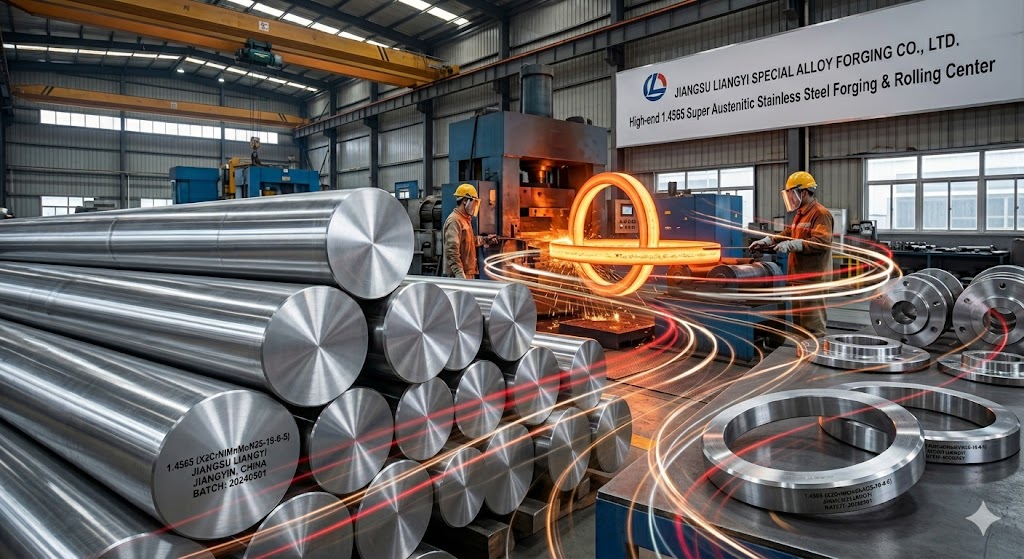
🔑 1.4565 (X2CrNiMnMoN25-18-6-5) — Key Facts at a Glance
| Material Designations | 1.4565 (EN) · X2CrNiMnMoN25-18-6-5 (EN) · Alloy 24 |
| Material Type | Super Austenitic Stainless Steel (fully austenitic, non-magnetic, single-phase FCC) |
| PREN Value | ≥ 42 — vs. 316L (≈25), 904L (≈36), 254SMO/1.4547 (≈43) |
| Critical Pitting Temperature (CPT) | > 70°C in 1M NaCl (compared to 316L at ≈15°C) |
| Tensile Strength (Rm) | 800 – 950 MPa |
| Yield Strength (Rp0.2) | Min. 420 MPa |
| Elongation (A) | Min. 30% |
| Charpy Impact Energy (+20°C) | Min. 100 J (longitudinal) |
| Density | ≈ 8.0 g/cm³ |
| Key Alloying Elements | Cr 24–26% · Ni 16–19% · Mo 4–5% · Mn 5–7% · N 0.3–0.6% |
| Applicable Standards | EN 10088-1/3/5 (material) · ASME BPVC (material ref.) · NACE MR0175 (hardness req.) · API 6A/6D (customer's product standard) · ISO 9001:2015 (our QMS certification) |
| Delivery Condition | Solution Annealed (+A), Water Quenched (1100–1150°C) |
| Manufacturer | Jiangsu Liangyi Co.,Limited — Jiangyin, Jiangsu, China (ISO 9001:2015, 25+ years) |
| Key Applications | Oil & Gas · Chemical Processing · Nuclear Power · Marine & Offshore · Power Generation |
What is 1.4565 (X2CrNiMnMoN25-18-6-5) Stainless Steel?
1.4565, standardized under EN 10088 as X2CrNiMnMoN25-18-6-5 and known commercially as Alloy 24, is a fully austenitic super stainless steel engineered specifically to overcome the chloride corrosion limitations of conventional grades like 316L and 904L. Unlike most stainless steels that rely solely on chromium and molybdenum for corrosion protection, 1.4565 employs a four-element corrosion-resistance strategy: high chromium (24–26%), high molybdenum (4–5%), elevated nitrogen (0.3–0.6%), and a uniquely high manganese content (5–7%) that simultaneously enables nitrogen dissolution above its normal solubility limit. The result is a Pitting Resistance Equivalent Number (PREN = %Cr + 3.3×%Mo + 16×%N) of ≥42 — a threshold that engineers in the offshore, chemical, and nuclear sectors use as the entry point for truly aggressive chloride service.
The high manganese content in X2CrNiMnMoN25-18-6-5 serves a purpose that many procurement engineers overlook: manganese is a nitrogen-stabilizing austenite former that replaces a portion of the nickel content compared to earlier super austenitics, reducing raw material cost sensitivity without sacrificing phase stability. The nitrogen, in turn, does double duty — it strengthens the austenite matrix by solid-solution hardening (contributing roughly 85–100 MPa additional yield strength compared to a nitrogen-free equivalent), and it suppresses sigma-phase and chi-phase precipitation kinetics, giving 1.4565 forgings a wider thermal processing window than many duplex grades. This is a critical advantage from a forging manufacturer’s perspective: sigma-phase embrittlement, which can destroy impact toughness in a matter of hours if material lingers in the 700–950°C danger zone, is significantly more forgiving in 1.4565 than in super duplex grades like 2507.
As an ISO 9001:2015 certified China forging manufacturer with over 25 years of experience processing super austenitic grades, Jiangsu Liangyi Co.,Limited — located in Jiangyin, Jiangsu Province — has developed proprietary forging temperature protocols, soaking time curves, and post-forge solution treatment cycles specifically validated for 1.4565. Our 1.4565 forged parts have been qualified and accepted by end users and EPCs in Europe, North America, the Middle East, and Asia-Pacific across more than 50 countries.
How the Alloying Chemistry of X2CrNiMnMoN25-18-6-5 Works Together
To understand why 1.4565 performs where 316L or even 904L fails, it helps to examine each alloying element’s specific contribution in the context of forged components under real service loading:
- Chromium (24–26%): Forms the primary passive oxide film (Cr₂O₃) on the surface. At this concentration level, the passive film is dense, self-repairing, and stable up to approximately 350°C in oxidizing acidic environments. Each 1% increase in Cr above 18% provides roughly a 3-unit improvement in effective pitting resistance before molybdenum and nitrogen synergies further multiply the effect.
- Molybdenum (4–5%): The most critical element for resistance to localized corrosion (pitting, crevice). Mo enriches preferentially at the base of pits and crevices, forming molybdate ions (MoO₄²⁻) that act as corrosion inhibitors and stabilize the passive film under acidic, chloride-rich conditions. At 4–5%, 1.4565 has roughly double the Mo of standard 316L (2–3%) — and this difference is decisive in environments like seawater, FGD slurry, and oilfield brine above 40°C.
- Nitrogen (0.3–0.6%): Perhaps the most misunderstood alloying element. In 1.4565, nitrogen acts as a corrosion inhibitor by replacing chloride ions in passive film defects (nitrogen preferentially adsorbs at active sites on the oxide surface), as a solid-solution strengthener (each 0.1% N adds approximately 15–20 MPa yield strength), and as a phase stabilizer that keeps the microstructure fully austenitic even at the slow cooling rates possible during thick-section forgings. The combination of high N and high Mo in 1.4565 creates a synergistic corrosion barrier that outperforms either element acting alone.
- Manganese (5–7%): A deliberate trade-off. Mn is a weaker austenite stabilizer than Ni, but it dramatically increases the solubility of nitrogen in liquid steel — allowing 1.4565 to achieve its 0.3–0.6% N target without gas porosity during ingot solidification. Without elevated Mn, achieving this N level would require pressure metallurgy (PREN) in a nitrogen-atmosphere furnace for every heat. Mn also contributes to work hardening, which is beneficial for some wear-resistant applications but requires careful monitoring during forging to avoid excessive deformation resistance in thick sections.
- Nickel (16–19%): Provides austenite phase stability, improves toughness (particularly at sub-zero temperatures), and increases resistance to stress corrosion cracking (SCC) in H₂S environments. The Ni content in 1.4565 is sufficient to fully suppress martensite transformation even under severe cold deformation, ensuring non-magnetic behavior in service — important for subsea instrumentation housings and sensor bodies.
Core Performance Advantages of 1.4565 Stainless Steel
Chloride Corrosion Resistance Far Beyond 316L
1.4565 achieves a Critical Pitting Temperature (CPT) exceeding 70°C in 1M NaCl — compared to approximately 15°C for 316L and 45°C for 904L. In seawater at 35°C, 1.4565 forgings have demonstrated zero measurable pitting after more than 5,000 hours in accelerated ASTM G48 Method C testing at 50°C. This isn’t just a data sheet advantage: it translates directly to zero unplanned shutdowns over 20-year offshore project lifecycles where a 316L valve body would require replacement every 3–5 years.
Strength That Enables Component Downsizing
With a minimum yield strength of 420 MPa — approximately twice that of annealed 316L (210 MPa) — 1.4565 forgings allow engineers to reduce wall thickness, flange face width, or shaft diameter compared to a 316L equivalent design, while meeting the same pressure class or torque rating. On one project, a European EPC replaced 316L ANSI Class 600 flanges with 1.4565 Class 600 flanges at 22% lower wall thickness, saving 18% total assembly weight without any re-rating. The nitrogen-driven solid-solution strengthening means this advantage is maintained across the full service temperature range from –196°C to +300°C.
Fully Austenitic: No Ferrite, No Phase Instability
Unlike duplex and super duplex stainless steels, 1.4565 maintains a single-phase FCC (face-centered cubic) austenitic microstructure at all temperatures below its solution treatment point. This means no ferrite content to monitor, no delta-ferrite-related anisotropic toughness, and no ductile-to-brittle transition at sub-zero temperatures. For cryogenic applications (LNG heat exchangers, liquid nitrogen transfer piping), 1.4565 forgings retain Charpy impact energies above 100 J at –196°C — a property that dual-phase microstructures simply cannot match reliably at production scale.
Total Cost of Ownership Advantage Over 5–25 Years
The initial material cost of 1.4565 forgings is typically 2.5–4× higher than equivalent 316L components — a gap that disappears rapidly when total lifecycle costs are calculated. Based on field data from chemical plant heat exchangers in Europe operating in 35% H₂SO₄ service at 80°C: 316L tube sheets required replacement every 2.5 years; 904L tube sheets lasted 6 years; 1.4565 tube sheets installed in 2009 are still in original service. When maintenance labor, plant downtime (typically USD 80,000–250,000/day for a mid-size chemical plant), and safety inspection costs are added, 1.4565 consistently delivers a lower net present cost over any project life exceeding 8 years.
1.4565 vs Alternative Grades: When to Specify Which Material
One of the most common engineering decisions our customers face is: how far up the corrosion-resistance hierarchy do I need to go? Specifying 1.4565 when 316L would suffice wastes budget; specifying 316L where 1.4565 is needed wastes everything. Here is how 1.4565 compares to the most common alternatives in the context of forged components:
| Property / Criterion | 316L (1.4404) | 904L (1.4539) | 1.4565 (X2CrNiMnMoN25-18-6-5) | 254SMO (1.4547) |
|---|---|---|---|---|
| PREN | ≈ 24–26 | ≈ 34–36 | ≥ 42 | ≈ 42–44 |
| Critical Pitting Temp. (CPT) | ≈ 15°C | ≈ 40–45°C | > 70°C | > 70°C |
| Yield Strength Rp0.2 | Min. 200 MPa | Min. 220 MPa | Min. 420 MPa | Min. 300 MPa |
| Cr content | 16–18% | 19–21% | 24–26% | 19–21% |
| Mo content | 2–3% | 4–5% | 4–5% | 6–6.5% |
| N content | < 0.1% | < 0.1% | 0.3–0.6% | 0.18–0.22% |
| Cryogenic toughness | Good | Very Good | Excellent | Very Good |
| Weldability (forged components) | Excellent | Good | Good | Good |
| Relative material cost (forged) | 1× (baseline) | 2.2–2.8× | 3.0–4.2× | 3.5–5.0× |
| Best for | Mild aqueous, food, pharma | Sulfuric acid, phosphoric acid | Seawater, brine, FGD, nuclear | High-Mo seawater, bleach plants |
Engineer’s Decision Guide: Should You Specify 1.4565?
Based on 25+ years of supplying super austenitic forgings to engineers across Europe, North America, and Asia, we have distilled the key decision triggers into the following framework. Specify 1.4565 when two or more of these conditions apply to your service environment:
- Chloride concentration in process fluid exceeds 5,000 ppm (or the fluid is seawater, brine, or FGD slurry)
- Operating temperature exceeds 40°C in the chloride-containing environment (above this, 316L and 904L become unreliable for >5-year service)
- pH of process fluid falls below 3 (strongly acidic conditions accelerate crevice corrosion mechanisms even in moderate-chloride environments)
- H₂S partial pressure exceeds 0.05 MPa and chloride concentration exceeds 50 ppm (sour service conditions per NACE MR0175 Zone 3)
- Component lifetime requirement exceeds 15 years without scheduled replacement (applies to buried piping, subsea components, nuclear internals)
- Mechanical design requires yield strength above 280 MPa in a corrosion-resistant material (eliminates 316L and 904L simultaneously)
Why Choose Jiangsu Liangyi for 1.4565 Forged Parts?
Procuring 1.4565 forgings from a manufacturer with genuine super austenitic processing expertise — not just one that treats it as “another stainless steel order” — is the single most important quality decision in the supply chain. The material’s high alloy content makes it significantly less forgiving than 316L or 304: incorrect forging temperatures cause surface cracking and subsurface micro-segregation; insufficient post-forge solution treatment leaves chromium carbides or sigma-phase precipitates in grain boundaries that destroy corrosion resistance; inadequate NDT misses internal voids in thick-section rings that will only manifest as in-service failures under pressure cycling.
At Jiangsu Liangyi Co.,Limited, we have specifically invested in the equipment, process controls, and quality protocols required to produce 1.4565 forgings that meet the standards of Europe’s most demanding end users:
Manufacturing Infrastructure Purpose-Built for Super Austenitics
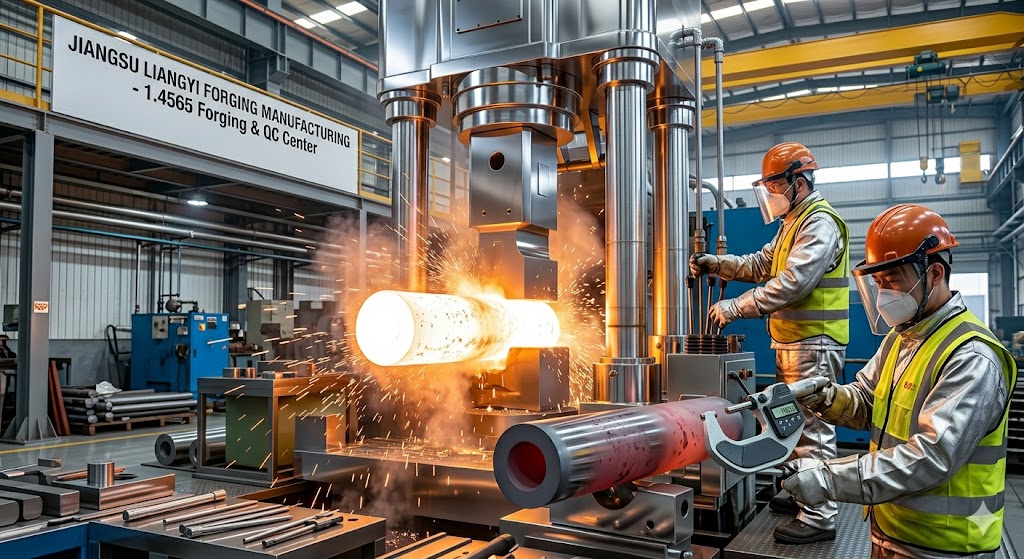
- 6,300-tonne Hydraulic Forging Press — Maximum Plastic Deformation Capability: The high hot strength of 1.4565 (flow stress at 1150°C is approximately 40% higher than 316L at the same temperature) requires significantly higher press tonnage to achieve equivalent deformation in a single stroke. Our 6,300-tonne press — the heaviest in our fleet — handles single ingots up to 30 tonnes, enables forging ratios of 5:1 or higher on heavy shafts and blocks, and ensures full penetration of deformation to the center of large cross-sections. Insufficient deformation in the core is the primary source of anisotropic mechanical properties in thick-section super austenitic forgings.
- Radial Axial Ring Rolling Mill (Ø up to 6m): Our ring rolling capability produces seamless rolled rings up to 6 metres in outer diameter with wall thicknesses from 50 mm to 800 mm. For 1.4565 rings specifically, we control rolling temperature within a ±15°C window throughout the ring rolling cycle — not just at the start of rolling — using infrared thermometry on the ring surface. This prevents the formation of coarse-grain banding that degrades ultrasonic testing (UT) interpretability in thick-wall rings.
- Computer-Controlled Heat Treatment Furnaces (±5°C uniformity, up to 60-tonne capacity): The solution treatment of 1.4565 is more critical — and narrower — than most stainless grades. At temperatures below 1,080°C, sigma phase and M₂₃C₆ carbides remain partially undissolved, leaving corrosion-compromised grain boundaries. Above 1,200°C, grain growth becomes excessive and ductility drops. Our fully automated furnace control system holds the solution treatment window at 1,100–1,150°C with ±5°C uniformity at all measurement points, then executes water quenching in under 90 seconds for sections up to 300 mm — fast enough to suppress carbide reprecipitation.
- Full Inline NDT Capability for Super Austenitic Grain Structures: The coarser grain size of solution-annealed super austenitic stainless steel increases acoustic noise during UT, making flaw detection more challenging than in fine-grained carbon steel. Our NDT team uses phased-array ultrasonic testing (PAUT) for thick-section rings and blocks, calibrated against reference reflectors in 1.4565 material — not generic stainless steel blocks — to ensure detection sensitivity meets ASTM A388 / EN 10228-3 Level 3 requirements at the actual grain noise background of the specific heat.
- In-House Spectral Lab with Nitrogen/Oxygen Analyzer: The nitrogen content (0.3–0.6%) of 1.4565 is the element most difficult to analyze accurately and most consequential if out-of-specification. A heat with 0.28% N instead of 0.32% N looks identical visually and behaves similarly during forging, but has a PREN value approximately 0.6 lower and a measurably reduced CPT. Our nitrogen/oxygen inert gas fusion analyzer provides N measurement repeatability of ±0.002% — ensuring every heat meets the intended specification, not just the minimum.
Quality Credentials & Compliance
- ISO 9001:2015 — Quality management system covering the full process from raw material receipt through final delivery documentation
- EN 10204 3.1 Mill Test Certificates — Full chemical, mechanical, and NDT results by heat and piece number, issued and signed by our authorized quality department. EN 10204 3.2 inspection (countersigned by a customer-nominated independent inspection body) is available upon request; customers may appoint their preferred inspection authority (e.g., Bureau Veritas, SGS, TÜV, Lloyd's Register, or DNV) at their cost.
- PED 2014/68/EU compatible manufacturing — Our forgings are manufactured to EN material standards (EN 10088-3, EN 10228) suitable for use in PED-compliant pressure equipment. CE marking under PED requires involvement of a customer-appointed Notified Body (NB); we fully support NB witness inspections and documentation requirements throughout production.
- NACE MR0175 / ISO 15156 — Hardness control and documentation for sour service (H₂S) applications in oil & gas
- API 6A / API 6D conformance manufacturing — Our forged valve and wellhead components are manufactured to meet the material, dimensional, and testing requirements specified in API 6A and API 6D. Customers holding their own API license may specify our forgings as raw material in their qualified products. We do not hold an independent API manufacturer license.
- Third-party QA oversight capability — For high-integrity applications, we fully accommodate customer-specified third-party inspection and QA hold-point requirements throughout the manufacturing process, including witness points at melting, forging, heat treatment, and final inspection stages.
Full Range of Custom 1.4565 Forged Products
Our capability covers the complete range of forged shapes and sizes in 1.4565. Below we describe not only what we produce, but also the specific forging challenges we have solved for each product category — because with super austenitic grades, the manufacturing detail is inseparable from the quality result:
1.4565 Forged Bars, Round Bars & Stepped Shafts
Available in diameters from 40 mm to 2,000 mm and lengths up to 15 metres. 1.4565 forged round bars for machining into valve stems, pump shafts, and drill collar components require a minimum forging ratio of 4:1 to ensure that the as-cast dendritic segregation — particularly the Cr and Mo-depleted interdendrite regions that form during ingot solidification — is fully broken down. Bars forged below this ratio retain micro-segregation bands that resist acid pickling and create local PREN deficits as large as 6–8 points, enough to initiate pitting in service in areas that the bulk chemistry analysis would suggest should be immune. All of our 1.4565 round bars are 100% UT inspected per EN 10228-3 / ASTM A388 Class C or better, with hardness mapping at both ends to confirm solution treatment uniformity.
1.4565 Seamless Rolled Rings & Contoured Rings
Outer diameters from 200 mm to 6,000 mm, wall thickness 50–800 mm, height 50–2,500 mm. 1.4565 seamless rolled rings are used for pressure vessel flanges, heat exchanger shell flanges, pump casing rings, valve seat rings, and bearing races. The key quality challenge in ring rolling this grade is controlling the temperature drop across the ring’s cross-section during extended rolling campaigns: the outer surface cools faster than the bore, and if the bore temperature drops below approximately 1,050°C while rolling continues, surface hot tears or internal adiabatic shear bands can form. Our ring rolling mill is equipped with bore-side induction heating capability for rings above 800 mm OD, maintaining thermal uniformity during multi-pass rolling cycles that would otherwise take the bore below the safe deformation temperature. Contoured ring profiles (flanged rings, T-rings, profiled cross-sections) in 1.4565 are also available, reducing post-forge machining stock and saving material in high-cost super austenitic forgings.
1.4565 Forged Hollow Bars, Sleeves & Tube Blanks
OD up to 1,800 mm, ID from 80 mm, wall thickness 40–600 mm. 1.4565 forged hollow bars and sleeves are used as pump barrel blanks, chemical reactor tube blanks, and downhole tool housings. Hollow forging in 1.4565 is more demanding than solid forging because the bore surface, which receives the least deformation, is also the surface most exposed to corrosive process fluids in service. We use a combination of internal mandrel forging and controlled bore-surface UT to verify that the inner wall has achieved adequate plastic deformation (minimum local reduction ratio >2.5:1 at the ID surface) and that no central residual porosity from the ingot core remains within 20 mm of the bore face.
1.4565 Forged Discs, Tube Sheets & Baffle Plates
Diameter up to 2,000 mm, thickness 20–500 mm. Large-diameter 1.4565 forged disc and tube sheet production requires multi-directional forging — alternating axial and radial pressing sequences — to eliminate the strong crystallographic texture that develops in single-direction pressed discs. Without this step, the mechanical properties of a 1.4565 disc are significantly anisotropic: tensile strength and elongation measured in the thickness direction can fall 12–18% below the rolling-direction values, creating a potential failure path exactly aligned with the tube-to-tubesheet joint, which is the highest-stress location in a heat exchanger under thermal cycling. Our multi-directional forging protocol, developed and validated over 15 years of tube sheet production for European chemical plant customers, ensures that the property ratio (short-transverse vs. long-transverse direction) exceeds 0.90 for all 1.4565 disc forgings above 300 mm diameter.
1.4565 Forged Shafts & Marine Propulsion Components
Diameter up to 1,800 mm, length up to 15 metres. 1.4565 forged shafts for marine propulsion, ESP (electrical submersible pump) applications, and downhole drilling tools represent some of the most demanding combinations of requirements: high torsional fatigue resistance, high corrosion resistance in seawater or brine, and dimensional stability under alternating loads. The key metallurgical requirement is achieving a fine, equiaxed grain size (ASTM grain size number 4 or finer) throughout the shaft cross-section, which requires careful control of both deformation temperature and post-forge recrystallization kinetics during solution treatment. Shafts produced at Jiangsu Liangyi are 100% longitudinal UT inspected, and for critical marine shafts, we provide full-length hardness mapping to confirm uniform microstructure. Splined shaft profiles for mud motors and ESP systems are forged as close-to-net-shape as possible to minimize machining time on this high-work-hardening material.
1.4565 Forged Valve Bodies, Bonnets & Fluid Control Components
From DN25 (1”) to DN500 (20”) in pressure classes compatible with API 6D and API 6A requirements. 1.4565 forged valve bodies and bonnets for offshore block valves, subsea isolation valves, and chemical plant control valves must satisfy both corrosion resistance requirements and pressure containment integrity under cycling service. Closed-die forging (impression die forging) of valve bodies allows us to produce near-net-shape preforms with forged fiber flow lines that follow the component contour — delivering higher fatigue life than machined-from-bar-stock alternatives at equivalent yield strength. For NACE MR0175 sour service compliance, all 1.4565 valve forgings are solution annealed and water quenched to achieve a Rockwell C hardness of 22 HRC maximum (Brinell 237 HB maximum), verified by Brinell indentation testing on the actual forging surface.
1.4565 Forged Pump Casings, Impellers & Reactor Components
Custom 1.4565 forged pump casings, impellers, reactor coolant pump (RCP) casings, and pressure vessel nozzle forgings represent the highest complexity tier of our product range. These components combine complex geometry, large section thickness, tight dimensional tolerances, and the most stringent inspection requirements (typically ASME Sec. V, Level 3 UT + RT + PT as a minimum). For nuclear-grade reactor coolant pump casings in 1.4565, we have developed a specialized multi-stage forging sequence that produces the complex near-net-shape geometry while maintaining a minimum forging ratio of 3:1 throughout the part — verified by FEM (finite element modeling) simulation prior to the first forging campaign. This approach eliminates the trial-and-error iterations that are typical in first-article production of complex super austenitic forgings and significantly reduces lead time for critical path nuclear project schedules.
Advanced Manufacturing Process & Quality Control for 1.4565 Forgings
Melting Route Selection: Why it Matters More for 1.4565 Than for Standard Stainless
The melting route for 1.4565 has a disproportionately large impact on final forging quality compared to conventional stainless steels. The high alloy content — particularly the combination of Mo (4–5%), N (0.3–0.6%), and Mn (5–7%) — creates significant elemental segregation during ingot solidification. Mo and Cr segregate to the last-to-freeze interdendritic regions, creating microsegregation bands with PREN values as much as 8–12 points lower than the nominal specification. In a standard EAF heat without further remelting, this segregation can only be partially eliminated by forging and homogenization, leaving residual “micro-PREN-deficient” zones that are invisible to bulk chemical analysis but highly susceptible to pitting initiation in aggressive service.
We select the melting route for each 1.4565 order based on the application criticality:
- EAF + LF + VD (Standard quality): Suitable for less critical applications where pitting initiation at micro-segregation bands is tolerable and the bulk corrosion performance is the primary concern. Lead time is shortest and cost is lowest for this route. Applicable for general chemical plant hardware, storage tank fittings, and non-critical pump bodies.
- EAF + ESR (Electro Slag Remelting) — Recommended for most applications: ESR refining dramatically reduces inclusion density (particularly Type A sulfide inclusions, which are nucleation sites for pitting) and reduces macro-segregation by a factor of 3–5× compared to a straight EAF ingot. The slow, controlled solidification during ESR also allows Mn (which would otherwise partially oxidize during conventional casting) to be fully retained, ensuring the N solubility target is met without recourse to pressure metallurgy. This is our standard recommendation for offshore valve bodies, chemical plant tube sheets, and pump shafts.
- EAF + PESR (Protective Atmosphere ESR) — For N-critical applications: Conventional ESR uses air-atmosphere slags that can partially oxidize nitrogen, reducing the N content by 0.03–0.06% compared to the EAF input. For 1.4565 specifications requiring N at the upper end of the range (0.45–0.60%), we use PESR with nitrogen over-pressure atmosphere to maintain N content through the remelting cycle.
- VIM + PESR — Nuclear and high-purity applications: Vacuum Induction Melting (VIM) provides the lowest possible non-metallic inclusion content, tightest alloy element control, and minimum dissolved gas content. Combined with PESR for macro-segregation control, VIM + PESR is the route we recommend for the highest-purity 1.4565 forgings where customers require maximum alloy homogeneity and minimum inclusion content, particularly for safety-critical or high-integrity applications.
The 1.4565 Forging Process: Temperature Control is Everything
1.4565 has a narrower safe forging temperature window than 316L. The upper limit is determined by incipient melting of Mn-rich segregation regions (approximately 1,230°C for poorly homogenized ingots, 1,270°C for ESR-refined material). The lower limit is set by the onset of sigma-phase precipitation kinetics, which in 1.4565 begins around 850–950°C at low strain rates — significantly higher than in 316L (where sigma formation requires much longer times at equivalent temperatures). Forging below 1,000°C in 1.4565, if the deformation is slow and the material is in the sigma-precipitation temperature range, risks embedding brittle sigma-phase particles in the forging microstructure. These are subsequently invisible to standard UT but catastrophically reduce impact toughness from >100 J to as low as 5–15 J.
Our forging protocol for 1.4565 specifies:
- Furnace soak temperature: 1,200–1,220°C for ESR ingots, with minimum soak time of 1 hour per 100 mm of ruling section to ensure full thermal homogenization before press contact
- Forging start temperature: 1,180–1,200°C (verified by contact thermocouple on ingot surface immediately before first press stroke)
- Forging stop temperature: Minimum 1,020°C at any point on the workpiece surface (infrared thermometry monitored continuously during pressing)
- Reheat frequency: Return to furnace when surface temperature drops to 1,050°C, regardless of whether the target deformation has been achieved — no “cold forging to finish” allowances
- Minimum forging ratio: 3:1 for all product forms; 4:1 preferred for bars and shafts; 5:1 for heavy-section disc forgings where center-line soundness is critical
Solution Treatment & Water Quenching: The Critical Last Step
Even a perfectly forged 1.4565 component can fail in service if the solution treatment is inadequate. The solution treatment must dissolve all sigma phase, all M₂₃C₆ carbides precipitated during the forging thermal cycle, and any Laves-phase or chi-phase particles that may have formed in Mo-segregated regions. For 1.4565, complete dissolution requires temperatures of 1,100–1,150°C held for a minimum of 30 minutes per 25 mm of section thickness. Critically, the subsequent water quench must bring the temperature below 600°C within 90 seconds for sections up to 100 mm, and below 700°C within 90 seconds for sections up to 300 mm, to prevent carbide reprecipitation in the cooling curve. Our quench tank capacity of 500,000 litres with forced water circulation achieves these cooling rates for the largest forgings we produce, verified by thermocouple-in-part records retained in the heat treatment certificate.
Full-Process Quality Inspection System
Every 1.4565 forging produced at Jiangsu Liangyi passes through the following quality gates before dispatch:
- Incoming material verification: Full chemical analysis (18 elements including N by inert gas fusion) and incoming UT on all ingots/billets to confirm no pre-existing segregation cracks before forging begins
- Dimensional inspection: CMM (coordinate measuring machine) verification for complex forgings; manual dimensional inspection with calibrated equipment for standard shapes
- Hardness testing: Brinell hardness mapping at minimum 4 points per forging; Rockwell C for NACE MR0175 sour service components (maximum 22 HRC / 237 HBW)
- Mechanical property testing: Tensile test (Rm, Rp0.2, A, Z) and Charpy V-notch impact test at +20°C and –46°C (or as specified) from product-representative test samples, heat treated alongside the forging
- Chemical composition: Full OES (optical emission spectroscopy) analysis plus N/O analyzer verification of nitrogen content on material cut from the actual forging
- Non-destructive testing:
- UT: Phased-array or conventional per EN 10228-3 / ASTM A388, acceptance level per customer specification (minimum Level 3)
- PT (Liquid Penetrant): per EN 10228-2 / ASTM E165, all accessible surfaces
- MT or RT: Upon customer request for specific component geometries
- Corrosion test (optional): Intergranular corrosion test per ASTM A262 Practice E (Strauss test) or pitting corrosion test per ASTM G48 Method A/C for critical applications or when requested
- Positive Material Identification (PMI): 100% XRF PMI on all forgings before final marking and dispatch
All test results are documented in a full EN 10204 3.1 Inspection Certificate providing complete heat-level and piece-level traceability from ingot to finished forging. EN 10204 3.2 documentation (with countersignature by a customer-nominated independent inspection body) is available upon customer request.
Material Specifications, Physical Properties & Standards
Chemical Composition of X2CrNiMnMoN25-18-6-5 (1.4565) per EN 10088-3
| Element | Min. | Max. | Role in 1.4565 |
|---|---|---|---|
| Carbon (C) | — | 0.030% | Low C minimizes carbide precipitation risk at grain boundaries; critical for weld HAZ corrosion resistance |
| Silicon (Si) | — | 1.00% | Deoxidizer; above 1% promotes sigma phase formation, so kept low |
| Manganese (Mn) | 5.00% | 7.00% | Enables high N solubility without pressure melting; austenite stabilizer; partial Ni substitute |
| Chromium (Cr) | 24.00% | 26.00% | Primary passive film former; major PREN contributor (+24 to +26 PREN points) |
| Nickel (Ni) | 16.00% | 19.00% | Austenite stability, SCC resistance, cryogenic toughness; non-magnetic behavior in service |
| Molybdenum (Mo) | 4.00% | 5.00% | Pit propagation inhibitor; PREN +13.2 to +16.5 points; critical for crevice corrosion resistance |
| Nitrogen (N) | 0.30% | 0.60% | Solid-solution strengthener; passive film stabilizer; PREN +4.8 to +9.6 points; sigma suppressor |
| Niobium (Nb) | — | 0.15% | Optional stabilizer; precipitates as NbC to prevent sensitization in high-temperature service zones |
| Phosphorus (P) | — | 0.030% | Controlled low to maintain grain boundary integrity and weldability |
| Sulfur (S) | — | 0.015% | Controlled low to minimize MnS inclusions, which are the primary pitting initiation sites in austenitic stainless steels |
Mechanical Properties of 1.4565 Forgings (Delivery Condition +A)
| Mechanical Property | Symbol | Requirement | Typical Achieved Value* | Unit |
|---|---|---|---|---|
| Tensile Strength | Rm | 800 – 950 | 840 – 920 | MPa |
| 0.2% Proof Yield Strength | Rp0.2 | Min. 420 | 430 – 510 | MPa |
| Elongation at Fracture | A | Min. 30% | 38 – 46% | % |
| Reduction in Area | Z | Min. 50% | 55 – 65% | % |
| Charpy Impact Energy (+20°C) | KV | Min. 100 | 160 – 250 | J |
| Charpy Impact Energy (–196°C, cryogenic) | KV | — (typical reference) | 110 – 180 | J |
| Hardness (Brinell) | HBW | Max. 250 | 195 – 235 | HBW |
* Typical values achieved in Jiangsu Liangyi production; actual values vary by forging weight, section thickness, and melting route. Standard specification values per EN 10088-3 govern acceptance.
Physical Properties of 1.4565 (X2CrNiMnMoN25-18-6-5) at Room Temperature
| Physical Property | Value | Unit |
|---|---|---|
| Density | ≈ 8.0 | g/cm³ |
| Elastic Modulus (Young’s Modulus) | ≈ 195 | GPa |
| Thermal Conductivity (20°C) | ≈ 12.5 | W/(m·K) |
| Coefficient of Thermal Expansion (20–200°C) | ≈ 17.5 × 10⁻⁶ | K⁻¹ |
| Specific Heat Capacity (20°C) | ≈ 480 | J/(kg·K) |
| Electrical Resistivity (20°C) | ≈ 0.85 | μΩ·m |
| Magnetic Permeability | ≈ 1.003 μr (non-magnetic) | — |
| Melting Range | 1,300 – 1,390 | °C |
Applicable Standards & Equivalent Grades
- Primary Standards: EN 10088-1 (general), EN 10088-3 (semi-finished products, bars, rods, wire for general purposes), EN 10088-5 (bars, rods, wire, sections and bright products for construction purposes)
- Equivalent Designations: X2CrNiMnMoN25-18-6-5, 1.4565, Alloy 24
- Common Industry Application Standards (referenced by customers): API 6A, API 6D (customer's product standards; we supply conforming forging raw material), ASME BPVC Section II Part A (material allowables reference), NACE MR0175 / ISO 15156 (sour service hardness requirements; met by our hardness-controlled delivery condition)
- Note on ASTM/ASME equivalent: 1.4565 does not have a direct ASTM forging specification (SA-965 does not currently cover this grade by number). For ASME-coded pressure vessels, we supply this material under ASME Code Case 2.XXX or with engineering approved material qualification per ASME BPVC Section II Part D upon customer request.
Weldability, Machinability, Storage & Packaging of 1.4565 Forgings
Weldability of 1.4565 — What Fabricators Need to Know
1.4565 (X2CrNiMnMoN25-18-6-5) is inherently weldable with the correct procedures, but it presents three challenges that fabricators must anticipate if they are transitioning from 316L or duplex stainless steels:
- Delta ferrite content near zero — hot cracking risk management: Unlike conventional austenitic grades that are intentionally alloyed to contain 3–8 FN (Ferrite Number) of delta ferrite to prevent hot cracking in the weld metal, 1.4565 is fully austenitic with essentially zero ferrite. The absence of delta ferrite removes the beneficial intergranular ferrite network that absorbs impurity elements (S, P) that segregate to grain boundaries during solidification and cause “hot tears.” To compensate, joint preparation must aim for low heat input, a tight sulfur and phosphorus budget in the filler wire, and low dilution ratios. We recommend GTAW (TIG) for the root pass and GMAW with controlled heat input for fill and cap passes.
- Filler metal selection: Use matching or near-matching filler metals — ERNiCrMo-10 (AWS A5.14, equivalent to Alloy 22) for GTAW/GMAW, or ENiCrMo-10 (AWS A5.11) for SMAW. These nickel-based fillers provide the necessary corrosion resistance in the weld metal while avoiding hot cracking. Stainless steel fillers (e.g., ER308L or ER316L) must not be used — they will produce a weld zone with drastically lower PREN than the parent material, creating a preferential corrosion site that defeats the purpose of using 1.4565 in the first place.
- Interpass temperature and heat input control: Interpass temperature must be kept below 100°C (strongly preferred below 75°C for highly corrosive service). Heat input per pass should remain below 1.5 kJ/mm for critical corrosion service. These controls minimize the width of the heat-affected zone and the time spent in the sensitization range (600–900°C) where Cr₂₃C₆ can precipitate at grain boundaries, reducing local Cr to below the passivation threshold. For applications requiring maximum corrosion resistance (seawater immersion, aggressive FGD environments), post-weld solution annealing at 1,100–1,150°C followed by water quenching is specified to fully restore the as-forged corrosion properties in the weld HAZ.
- Back purging: Argon back purging of the weld root is mandatory for welds on components in pitting-critical service. The root side surface, if oxidized during welding, develops a chromium-depleted sub-oxide layer that has a local PREN value 6–10 points lower than the base material — enough to initiate pitting within the first year of seawater service.
Machinability of 1.4565 — Practical Parameters for CNC Operations
1.4565 is significantly more difficult to machine than 316L, primarily because of its high work hardening rate and high tensile strength. In our in-house CNC machining operations, we have developed the following parameter guidelines after extensive tooling trials on production 1.4565 forgings:
- Turning (OD/ID roughing): Carbide inserts (ISO K20 or P20 grade with TiAlN coating), cutting speed 40–65 m/min, feed rate 0.15–0.30 mm/rev, depth of cut 2–5 mm. Never dwell the tool — work hardening builds rapidly if the tool slows or stops in contact with the workpiece, leading to tool breakage on re-engagement.
- Turning (finishing): Carbide (fine grain), cutting speed 50–75 m/min, feed 0.08–0.15 mm/rev, depth of cut 0.3–0.8 mm. PVD-coated inserts (TiCN or TiAlN) give better surface finish than CVD at these parameters.
- Milling (face/end milling): Carbide end mills (4-flute, high helix), cutting speed 35–55 m/min, feed per tooth 0.04–0.08 mm/z. Use climb milling (down-milling) wherever possible — conventional milling rubs the tool against the work-hardened surface and significantly reduces tool life.
- Drilling: Carbide-tipped drills, cutting speed 20–35 m/min, feed 0.08–0.15 mm/rev, with high-pressure through-tool coolant (50–80 bar) to clear chips aggressively. Work hardening in the drilled hole bottom is the main failure mode — use sharp tools and never “peck” without full chip clearance between pecks.
- Coolant: Flood coolant at all times; 7–10% emulsion or neat oil for difficult operations. Never dry machine 1.4565.
- Tolerances achievable: IT6 (e.g., ±0.008 mm on a 50 mm bore) for fine-finished shafts and bores in the annealed condition. Tighter tolerances require stress-relief steps between roughing and finishing passes.
Storage of 1.4565 Forged Parts
Passivated 1.4565 forgings are highly corrosion resistant in most storage environments, but several precautions prevent contamination that can compromise the passive film before installation:
- Store in a clean, dry, covered warehouse. Avoid environments with chloride aerosols (coastal locations, salt spray exposure, cold storage facilities using NaCl deicing) — sustained chloride deposition on a bare 1.4565 surface at ambient temperature can initiate superficial pitting that must be pickled out before service.
- Do not store in contact with carbon steel components, zinc-coated racks, or copper alloy fixtures. Contact with less noble metals creates galvanic cells that can cause corrosion at the contact points even in dry conditions.
- Use dedicated stainless steel or nylon-coated lifting equipment. Carbon steel slings and chains leave embedded iron particles that rust on the 1.4565 surface and create false pitting indicators during pre-installation inspection.
Packaging of 1.4565 Forged Parts for Export
All 1.4565 forgings dispatched from Jiangsu Liangyi are prepared for long-distance sea or air transport:
- Anti-corrosion treatment: VCI (Volatile Corrosion Inhibitor) paper wrapping for machined surfaces; oil coating (Shell Ensis Oil SX or equivalent) for as-forged rough surfaces
- Wooden crates or pallets manufactured from ISPM 15 heat-treated timber for international phytosanitary compliance; individual pieces separated by foam spacers to prevent surface contact and fretting during transit
- Markings: piece number, purchase order, material grade (1.4565 / X2CrNiMnMoN25-18-6-5), heat number, net weight, gross weight, and shipping dimensions marked in permanent ink and on attached stainless steel identification tags
- Custom packaging (shock-absorbing foam, individual cases, humidity-indicator cards) available for sensitive precision-machined components upon request
Global Industry Applications & Proven Project Experience
Specifying the right material for a severe service application is only half the challenge. The other half is finding a forging manufacturer who has actually produced that material in the required shape, size, and quality level before — because first-time production of a complex super austenitic forging always carries process risk. Below is a detailed account of the industries and applications where Jiangsu Liangyi’s 1.4565 forgings have been qualified and delivered, with the specific engineering challenges we solved for each:
Offshore Oil & Gas — Subsea and Topsides
Offshore oil and gas is the single largest market for 1.4565 forgings globally, and for good reason: produced water in offshore wells typically contains 30,000–200,000 ppm chloride, H₂S at partial pressures exceeding 0.1 MPa in sour fields, CO₂, and temperatures of 60–120°C. In this environment, 316L fails by chloride stress corrosion cracking within months; duplex grades are borderline at temperatures above 80°C. 1.4565 has been the material of choice for subsea isolation valve bodies, HIPPS (High Integrity Pressure Protection System) valve trim, wellhead connector forgings, and production separator internals where chloride service life exceeding 25 years is required without intervention.
Our supply experience for offshore oil and gas includes 1.4565 forged valve bodies and bonnet forgings for subsea and topsides gate valves with pressure ratings to ANSI 5,000 psi and bore sizes DN100 to DN250. The thick-wall nature of these forgings (120–200 mm section thickness) requires the full EAF + ESR or PESR melting route to achieve homogeneous chemistry to the forging center; we have validated this requirement through customer-witnessed third-party UT inspection programs confirming zero reportable indications at acceptance levels equivalent to EN 10228-3 Level 3 or higher.
We also supply ESP motor splined drive shafts in 1.4565 for electrical submersible pumping systems deployed in high-chloride, high-temperature oilfield wells in the Middle East (Saudi Arabia, UAE, Kuwait). These shafts, produced from 1.4565 ESR ingots with forging ratios of 4:1 minimum, are subsequently splined-machined in our CNC machining center and 100% inspected by MT + UT + dimensional check before export.
Chemical Processing — Acids, FGD, and Halogenated Media
1.4565 is the first choice for forged components in contact with sulfuric acid at concentrations between 10–80% and temperatures above 60°C — a service window where 316L corrodes at rates exceeding 1 mm/year and 904L corrodes at 0.1–0.5 mm/year, while 1.4565 achieves less than 0.05 mm/year. The same superiority applies in hydrochloric acid below 2%, phosphoric acid at all concentrations, and mixed acid environments (H₂SO₄ + HCl + HF) encountered in fertilizer and rare-earth processing.
Flue Gas Desulfurization (FGD) systems are another dominant application: the absorber slurry (CaSO₃ + CaSO₄ + HCl + HF at pH 3–5 and 50–80°C) is uniquely aggressive because it combines acidic pH, high chloride, abrasive particles, and periodic partial drying that concentrates all corrosive species at the wall surface. In Europe, 1.4565 has become the de facto standard for FGD absorber nozzle flanges, slurry pump casings, agitator shaft forgings, and spray header components after successive generations of 316L and duplex grades failed in 3–7 year intervals. We supply forged 1.4565 slurry pump casings and impellers to major European FGD equipment manufacturers for coal and biomass power plants in Germany, Poland, Spain, and the UK.
Nuclear Power — Safety-Class Components
1.4565 is specified in several nuclear power plant designs for safety-class primary coolant system components where the combination of high borated water chemistry (containing boric acid at 0–2,500 ppm), high temperature (285–325°C), irradiation environment, and 60-year design life eliminates most other stainless grades. The key requirement unique to nuclear applications is resistance to irradiation-assisted stress corrosion cracking (IASCC) — a mechanism by which neutron flux causes microstructural changes (radiation-induced Ni and Si segregation to grain boundaries, depletion of Cr at grain boundaries) that dramatically accelerate SCC in primary coolant water. The high nitrogen content of 1.4565 appears to retard IASCC initiation, though this is an active area of ongoing nuclear materials research.
Jiangsu Liangyi has supplied 1.4565 large-scale forged components including pump casing sections and seal ring forgings for power and industrial projects in China and Southeast Asia with demanding corrosion and pressure requirements. All products are supported by full EN 10204 3.1 inspection documentation with 100% NDE (PAUT + PT), and we actively support third-party witness inspection programs specified by the end customer or EPC contractor.
Marine & Offshore Engineering — Seawater Systems
The global shipping industry learned hard lessons about stainless steel in seawater over the past 30 years. 316L fails by pitting within 1–3 years in stagnant seawater at ambient temperature. Super duplex grades (2507, Zeron 100) perform well but are difficult to weld in thick sections and have a sharp ductile-to-brittle transition that limits their use in cryogenic LNG applications. 1.4565 occupies a unique niche: it matches the seawater pitting resistance of super duplex while retaining the weldability, toughness, and single-phase microstructural simplicity of a fully austenitic grade.
We supply 1.4565 forged marine propulsion shafts and propeller shaft intermediate shafts to shipbuilders in South Korea, Japan, Norway, and the Netherlands for application in ice-class vessels, naval auxiliary ships, and offshore support vessels where seawater immersion of the shaft line is expected and cathodic protection alone is insufficient. We also supply seawater cooling system valve bodies, strainer housings, and pump shaft forgings for FPSO (Floating Production Storage and Offloading) vessels and semisubmersible drilling platforms.
Power Generation & Turbomachinery
In industrial turbomachinery, 1.4565 fills the gap between standard austenitic stainless steels (sufficient for clean air or steam service) and nickel superalloys (required above 550°C). For wet gas compressor impellers, centrifugal pump impellers handling hot brine, and process pump shafts in acidic services, 1.4565 forgings provide the corrosion resistance necessary for 15-20 year impeller life while the high yield strength (420 MPa minimum) enables the thin-web, high-efficiency impeller geometry that fluid dynamics require. For waste-heat recovery turbines and organic Rankine cycle (ORC) expanders operating with fluorinated refrigerant working fluids, 1.4565’s excellent resistance to halogenated media makes it the forging material of choice for expander impellers, inlet guide vane rings, and bearing housings.
Frequently Asked Questions (FAQ)
1.4565 is the EN material number designation. The full EN chemical designation is X2CrNiMnMoN25-18-6-5, where the numbers indicate approximate Cr (25%), Ni (18%), Mn (6%), and Mo (5%) contents. The commercial trade name is Alloy 24. It belongs to the super austenitic stainless steel family, characterized by a PREN of ≥42. There is no directly equivalent ASTM forging specification; the closest related standard is ASTM A182/A182M Grade F 44 (for 254SMO), which is a similar but distinct super austenitic grade.
The PREN (Pitting Resistance Equivalent Number) of 1.4565 is ≥ 42, calculated as PREN = %Cr + 3.3×%Mo + 16×%N. This is decisively higher than 316L (PREN ≈25), 904L (PREN ≈36), and most super duplex grades (PREN ≈38–42). PREN is the industry’s primary screening tool for chloride pitting resistance: materials with PREN <25 will pit in seawater at room temperature; materials with PREN >40 typically resist pitting in seawater up to 70°C+. For engineers, the PREN value of ≥42 in 1.4565 is the minimum threshold for offshore seawater service, FGD absorber environments, and concentrated chloride chemical processing without expecting pitting within a 20-year design life.
1.4565 (X2CrNiMnMoN25-18-6-5) and 254SMO (1.4547, X1CrNiMoCuN20-18-7) are both super austenitic grades with comparable PREN values (≥42 for 1.4565; ≈43 for 254SMO). The key engineering differences are: (1) Molybdenum content: 254SMO has higher Mo (6–6.5%) vs. 1.4565 (4–5%), giving 254SMO a slight edge in reducing chloride-containing acids and bleach environments; (2) Nitrogen and strength: 1.4565 has significantly higher N (0.3–0.6% vs. 0.18–0.22% in 254SMO), resulting in meaningfully higher yield strength (420 MPa minimum vs. 300 MPa in 254SMO) — a 40% advantage that is critical for high-pressure or load-bearing forged components; (3) Manganese: 1.4565 uses high Mn (5–7%) to enable the elevated N; 254SMO uses lower Mn (≤1%) and instead relies on Cu (0.5–1.0%) for additional corrosion benefits in reducing acids. In practice, 1.4565 is preferred when mechanical strength is as important as corrosion resistance; 254SMO is preferred when maximum Mo and Cu content are needed for specific reducing-acid resistance.
Three fundamental differences make 1.4565 significantly more challenging to forge than 316L: (1) Higher hot strength: At 1,150°C, 1.4565 has a flow stress approximately 35–45% higher than 316L at the same temperature, requiring larger press tonnage to achieve equivalent deformation per stroke — which is why a 6,300-tonne press is needed where a 2,000-tonne press suffices for 316L; (2) Narrower safe forging window: 316L can be forged safely from 1,280°C down to 900°C (a 380°C window). 1.4565 has an effective safe window from approximately 1,200°C to 1,020°C (a 180°C window) — once the surface drops below 1,020°C, sigma-phase precipitation risk becomes significant at slow deformation rates; (3) Segregation sensitivity: The high alloy content (especially Mo and Cr) creates stronger solidification segregation in 1.4565 ingots than in 316L, requiring higher forging ratios (4:1 vs. 2.5:1) to break down the dendritic structure and achieve uniform chemistry and corrosion resistance throughout the section.
Yes, field welding of 1.4565 forgings is feasible with the correct procedures. Key requirements: use ERNiCrMo-10 or ENiCrMo-10 filler (not stainless steel fillers); keep interpass temperature below 100°C; use argon back purge on all root passes in pitting-critical service; limit heat input to ≤1.5 kJ/mm. Unlike duplex stainless steels, 1.4565 does not require post-weld heat treatment (PWHT) for most applications — but for the highest-corrosion-resistance requirements (seawater immersion, concentrated acid service), a full post-weld solution anneal at 1,100–1,150°C plus water quench is specified to restore HAZ corrosion properties to base-metal level. Preheating is not required under any circumstances.
1.4565 retains adequate mechanical strength up to approximately 350°C for structural applications; above this temperature, creep becomes significant and the design must account for reduced allowable stress. For corrosion resistance specifically, the critical limitation is the sigma-phase embrittlement range of 700–950°C — sustained exposure in this temperature band (hours to days depending on section size) will precipitate sigma phase and dramatically reduce impact toughness. For pressure vessel service, the maximum ASME Code allowable design temperature for austenitic stainless steels is typically 816°C, but at temperatures above 400°C, design engineers should request specific high-temperature tensile data for the actual heat to be used. For cryogenic service, 1.4565 performs excellently down to –196°C with no ductile-to-brittle transition.
Our MOQ for 1.4565 forged parts is flexible and depends on the product type. For standard forged round bars (diameter 40–300 mm) and seamless rolled rings, we can accept orders as small as 1 piece. For custom close-die forgings or complex near-net-shape components requiring dedicated tooling, MOQ depends on tooling economics — we will discuss this transparently with you during the quotation stage and always offer forging-from-solid alternatives for small quantities where the machining cost is acceptable. We are also happy to batch small orders from multiple customers on shared ingot heats to reduce per-piece cost for low-volume requirements.
We offer EXW Jiangyin, FOB Shanghai, CIF/CFR (Los Angeles, Rotterdam, Dubai, Sydney, Singapore, Houston), and DDP terms to most countries. Standard lead times from order confirmation to dispatch are 8–14 weeks for typical forged bars and rings (including melting, forging, heat treatment, and full inspection). Complex custom forgings or components requiring special melting routes (ESR, PESR, VIM) may require 14–22 weeks. We can expedite for urgent requirements — contact us with your delivery needs and we will advise on available schedule slots. Air freight is available for small, urgent items; sea freight via Shanghai Yangshan Port is standard for most shipments.
Contact Jiangsu Liangyi for a Free Technical Consultation & Quotation
Jiangsu Liangyi Co.,Limited is a proven, ISO 9001:2015 certified China manufacturer of custom 1.4565 (X2CrNiMnMoN25-18-6-5) super austenitic stainless steel forged parts with 25+ years of experience and more than 2,000 global customers. We invite you to share your drawings, material specifications, required standards, and delivery requirements — our engineering team will respond within one business day with a technical review and competitive quotation. We speak your engineering language: PREN, CPT, NACE zones, ASME Code, PED modules, API classes — and we will identify the melting route, forging sequence, and inspection level that truly fits your application, not just the minimum required to win the order.
- Inquiry Email: sales@jnmtforgedparts.com
- Phone/WhatsApp: +86-13585067993
- Official Website: https://www.jnmtforgedparts.com
- Factory Address: Chengchang Industry Park, Jiangyin City, Jiangsu Province, China 214400
- Tel/Fax: +86-510-86107550