1.4539 (X1NiCrMoCu25-20-5) Super Austenitic Stainless Steel Forgings | China Professional Forging Manufacturer
1.4539 (X1NiCrMoCu25-20-5) Super Austenitic Stainless Steel Forging Parts1.4539 Forgings Production Line - Jiangsu Liangyi Factory
About 1.4539 (X1NiCrMoCu25-20-5) Forging Material | China Factory Direct Supply
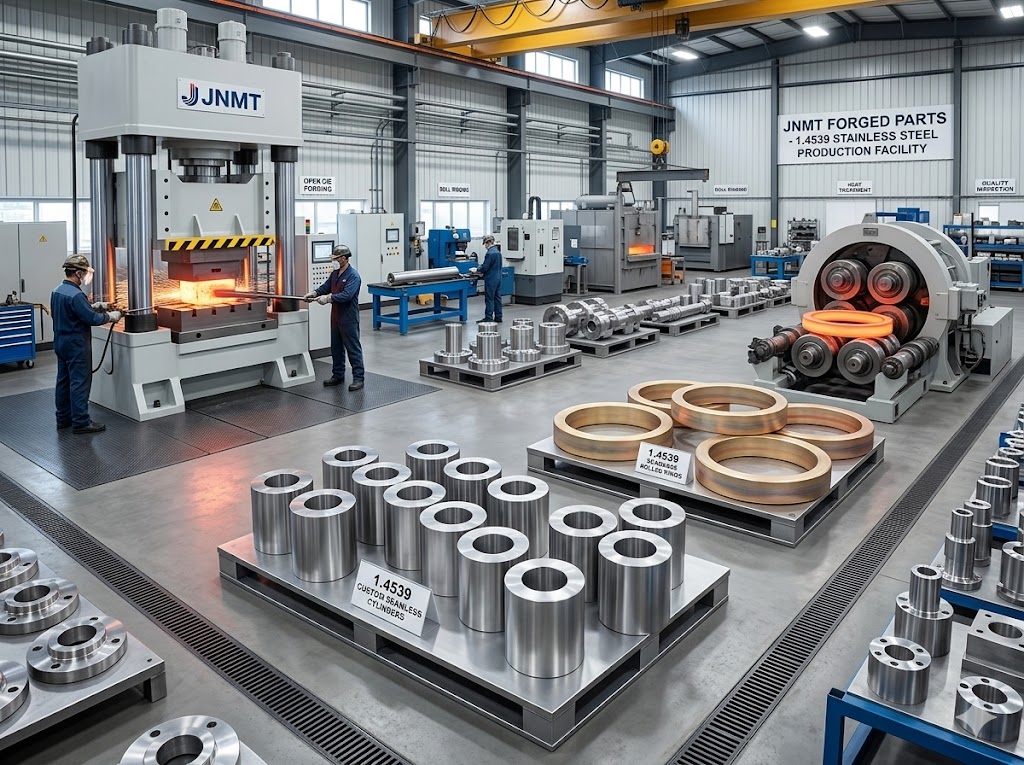
Jiangsu Liangyi Co., Limited is a professional ISO 9001:2015 certified manufacturer and supplier based in China, specializing in open die forgings and seamless rolled forged rings made from 1.4539 (also referred to as X1NiCrMoCu25-20-5, X1NiCrMoCu25205). Founded in 1997, we have more than 25 years of professional forging experience, and our 1.4539 forged products are exported to over 50 countries and regions around the world. 1.4539 is a high-alloy super austenitic stainless steel containing nickel, chromium, molybdenum and copper, designed specifically for highly corrosive environments. It has excellent resistance to many organic and inorganic acids, strong resistance to seawater corrosion, and outstanding resistance to pitting and crevice corrosion. With an ultra-low carbon content (≤0.02%), 1.4539 retains excellent resistance to intergranular corrosion even after welding, making it the best choice material for important forged parts used in harsh working conditions. Our 1.4539 forged parts are used in industries with high performance requirements, including chemical and petrochemical processing, oil and gas, marine engineering, nuclear power, pulp and paper production, and flue gas desulfurization systems.
Full Range of 1.4539 (X1NiCrMoCu25-20-5) Forged Products
We produce custom 1.4539 (X1NiCrMoCu25-20-5) forgings fully meeting EN, ASTM, ASME, DIN international standards and customer drawings, with weight ranges from 30 kg up to 30,000 kg per piece. Following are our full product range.
1.4539 Forged Bars & Shafts
We supply 1.4539 forged round bars, square bars, flat bars, rectangular bars, step shafts, gear shafts and custom forged rods, with a maximum diameter of up to 2 meters and maximum length up to 15 meters. All forged bars are given complete mechanical property tests and ultrasonic inspection, and we also provide EN 10204 3.1 / 3.2 material certificates for all parts.
1.4539 Seamless Rolled Forged Rings
We provide custom X1NiCrMoCu25-20-5 seamless rolled forged rings, profile rings, gear rings, flange rings and valve body rings, with a maximum outer diameter of up to 6 meters and weight up to 30 tons per piece. Our 1.4539 forged rings are the best choice material for important rotating and pressure-retaining parts in the oil and gas, chemical and power generation industries.
1.4539 Hollow Forged Components
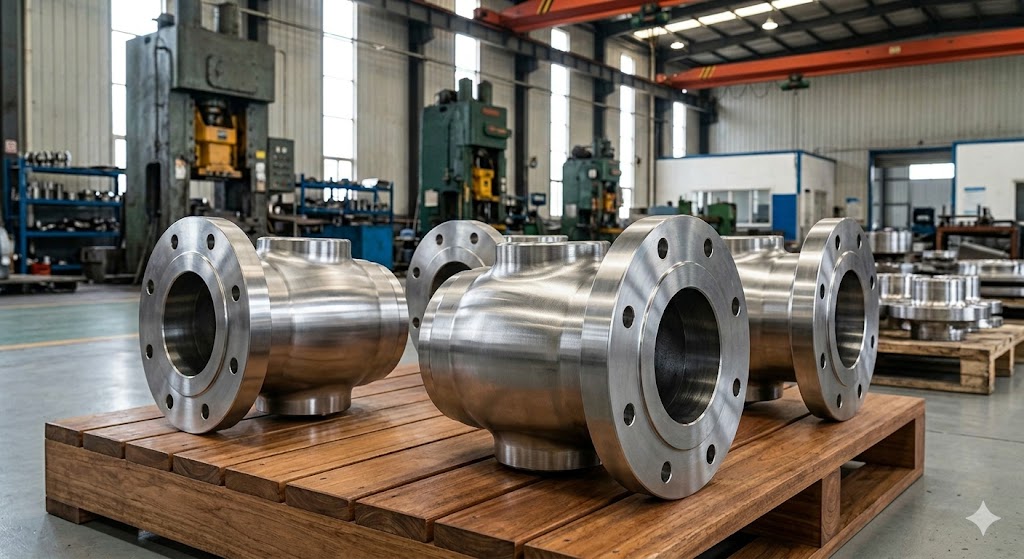
We provide 1.4539 forged hubs, housings, shells, sleeves, bushes, heavy-wall cylinders, seamless hollow bars and custom hollow forgings, with an outer diameter up to 3000 mm. These parts go into pumps, valves, pressure vessels, heat exchangers, and equipment that moves fluids.
1.4539 Forged Discs, Plates & Custom Components
We provide X1NiCrMoCu25-20-5 forged discs, blocks, plates, flanges and custom forged blanks, with complete heat treatment and CNC machining based on clients technical requirements. We also supply 1.4539 forgings for pressure vessels, heat exchangers, reactors and boilers, such as tube sheets, baffle plates, nozzles and channel flanges.
1.4539 (X1NiCrMoCu25-20-5) Steel: Chemical Composition & Mechanical Properties
Our 1.4539 forging material strictly meets EN 10088-1, EN 10095 international standards, its chemical composition and mechanical properties are strictly controlled , making sure the material has stable performance in harsh environments.
Chemical Composition (Weight %)
1.4539 (X1NiCrMoCu25-20-5) Chemical Composition
Element
Standard Range
Element
Standard Range
Carbon (C)
≤ 0.02
Chromium (Cr)
19.00 - 21.00
Silicon (Si)
≤ 0.70
Nickel (Ni)
24.00 - 26.00
Manganese (Mn)
≤ 2.00
Molybdenum (Mo)
4.00 - 5.00
Phosphorus (P)
≤ 0.03
Copper (Cu)
1.20 - 2.00
Sulfur (S)
≤ 0.01
Nitrogen (N)
≤ 0.15
Iron (Fe)
Balance
Mechanical Properties (Solution Treated Forgings)
1.4539 (X1NiCrMoCu25-20-5) Mechanical Properties
Mechanical Property
Standard Requirement
Test Method
Tensile Strength (Rm)
530 - 570 MPa
EN ISO 6892-1
Yield Strength (Rp0.2)
≥ 230 MPa
EN ISO 6892-1
Elongation (A)
≥ 35%
EN ISO 6892-1
Hardness
≤ 230 HB
ASTM E10
1.4539 International Equivalent Grades & Designation Cross-Reference
1.4539 is the European EN designation for this alloy. Buyers from different regions may know the same material under different naming systems. The table below lists its confirmed equivalent grades.Note that while 904L and 1.4539 have some similar chemical makeup, they arenot interchangeable. 1.4539 has stricter limits on sulfur and phosphorus, and is produced to EN 10088‑1 instead of ASTM B649, even though both have a maximum carbon content of ≤0.02%.
1.4539 (X1NiCrMoCu25-20-5) International Equivalent Grade Designation Table
Standard System
Designation
Standard
Remarks
European (EN)
1.4539 / X1NiCrMoCu25-20-5
EN 10088-1, EN 10095
Primary designation used in this page
UNS (USA)
N08904
ASTM B649, ASTM B673
Nearest UNS equivalent; check C, S, P limits before substitution
German (DIN)
X1NiCrMoCu25-20-5
DIN 17006, DIN 17440
Same chemical designation as EN
French (AFNOR)
Z1 NCDUA 25-20-5-2
NF A35-573
Legacy French designation, now superseded by EN
Swedish (SS)
SS 2562
SS-EN 10088
Historical Swedish standard reference
Trade Name
904L (partial overlap only)
Various
Not a direct equivalent. Composition range and standard differ. Verify specification before substitution.
When placing an order, always check the applicable standard (EN 10088-1 or ASTM B649) with your metallurgical team, as testing requirements and acceptance criteria vary between these two specifications. Our technical team can help verify material equivalences and provide standard-specific documentation.
1.4539 Physical Properties & Thermal Data
Unless otherwise stated, the physical properties below apply to solution‑annealed 1.4539 at 20°C. These values are essential for mechanical design, thermal calculations, and equipment sizing in heat exchangers, pressure vessels, and piping systems.
1.4539 (X1NiCrMoCu25-20-5) Physical Properties at 20°C
Physical Property
Value
Unit
Density
8.00
g/cm³
Elastic Modulus (Young's Modulus)
195
GPa
Thermal Conductivity (at 20°C)
12.0
W/(m·K)
Thermal Conductivity (at 200°C)
14.5
W/(m·K)
Mean Thermal Expansion Coefficient (20–100°C)
14.5
×10⁻⁶ /K
Mean Thermal Expansion Coefficient (20–300°C)
15.5
×10⁻⁶ /K
Specific Heat Capacity (at 20°C)
450
J/(kg·K)
Electrical Resistivity (at 20°C)
1.00
µΩ·m
Magnetic Permeability (solution annealed)
< 1.005
µr
Melting Range
1300 – 1360
°C
Solution-annealed 1.4539 has low magnetic permeability, so it works well for non-magnetic uses in offshore projects and near-MRI equipment.Keep in mind that cold forming or incorrect heat treatment can slightly increase permeability. Our solution heat treatment at 1080–1150°C with fast water quenching keeps the material fully non-magnetic.
Designers of pressure vessels and heat exchangers often need high-temperature strength data to meet codes such as ASME BPVC Section VIII or EN 13445.The data below shows the normal minimum yield strength of 1.4539 forgings at elevated temperatures, as well as Charpy V-notch impact toughness at sub-zero temperatures for low-temperature service.
Minimum Yield Strength Rp0.2 at Elevated Temperature (Indicative, Solution Annealed)
1.4539 Rp0.2 at Elevated Temperature
Test Temperature
Min. Rp0.2 (MPa)
Reference
20°C (ambient)
≥ 220
EN 10088-2 / EN ISO 6892-1
100°C
≥ 187
EN ISO 6892-2
150°C
≥ 177
EN ISO 6892-2
200°C
≥ 170
EN ISO 6892-2
250°C
≥ 163
EN ISO 6892-2
300°C
≥ 157
EN ISO 6892-2
350°C
≥ 153
EN ISO 6892-2
All elevated-temperature mechanical property data provided in our material test certificates (EN 10204 3.1 / 3.2) are obtained from specimens cut from the actual forging, tested in the delivery heat treatment condition. Design engineers should use their governing pressure equipment code's allowable stress tables for final calculation.
Charpy V-Notch Impact Toughness (KV₂)
1.4539 has excellent low-temperature toughness due to its fully austenitic microstructure. There is no ductile-to-brittle transition temperature (DBTT) in austenitic stainless steels, making 1.4539 forgings suitable for cryogenic and low-temperature service without additional alloying or special heat treatment.
1.4539 Charpy V-Notch Impact Energy (KV₂), Longitudinal Direction
Test Temperature
Min. KV₂ (J) — Individual
Min. KV₂ (J) — Average of 3
+20°C
≥ 60
≥ 80
0°C
≥ 55
≥ 70
−40°C
≥ 50
≥ 65
−196°C (LN₂)
≥ 41
≥ 55
Actual measured values on production forgings typically exceed minimum requirements significantly. Impact testing temperature and acceptance criteria can be agreed per customer specification, EN 10228-4, or project-specific quality plan.
1.4539 Corrosion Resistance Performance: PREN Value & Critical Pitting Temperature
When picking materials for applications that are sensitive to corrosion, you shouldn't just use qualitative descriptions; you should also use quantitative corrosion resistance metrics. The Pitting Resistance Equivalent Number (PREN) and the Critical Pitting Temperature (CPT) are the two most important factors for making decisions about 1.4539.
PREN Value of 1.4539 (X1NiCrMoCu25-20-5)
PREN is calculated using the formula:PREN = %Cr + 3.3×%Mo + 16×%N .Based on the typical chemical composition of 1.4539 (20% Cr, 4.5% Mo, 0.08% N), its PREN value ranges from about 34.8 – 36.7, depending on the actual batch composition.This puts 1.4539 clearly in the super austenitic stainless steel class, with a much higher PREN than regular 316L (≈24) and 904L (≈32). This proves it performs well in chloride and acidic environments where lower-alloy steels tend to fail early.
PREN Comparison: 1.4539 vs Common Stainless Steel Grades
Grade
PREN (typical)
Chloride Service Suitability
316L (1.4404)
≈ 24
Mild chloride only; limited offshore use
904L (N08904)
≈ 32 – 33
Moderate; suitable for dilute acid and seawater with limitations
1.4539 (X1NiCrMoCu25-20-5)
≈ 34.8 – 36.7
High; recommended for concentrated acid, seawater, FGD service
254SMO (1.4547)
≈ 42 – 43
Very high; for the most aggressive chloride environments
2507 Duplex (1.4410)
≈ 42
Very high; note different mechanical and thermal behaviour vs austenitic
Critical Pitting Temperature (CPT) & ASTM G48 Test Performance
Pitting Temperature (CPT) is tested according to ASTM G48 Method C, using a 6% FeCl₃ solution with 72 hours of immersion.In standard production condition, 1.4539 has a CPT between 35°C and 45°C. This is much higher than 904L (usually 20–25°C) and 316L (15–18°C).This means 1.4539 resists pitting corrosion at common operating temperatures in chemical plants, offshore facilities and desalination systems. In addition, solution‑annealed 1.4539 passes the ASTM A262 Practice E (Strauss test) for intergranular corrosion resistance.Its ultra‑low carbon content (≤0.02%) effectively prevents sensitization during welding and heating, which is especially important for heat exchanger tube sheets and reactor nozzle forgings.
Unless otherwise noted on your purchase order, all 1.4539 forgings from Jiangsu Liangyi are supplied in the standard solution-annealed and water-quenched state. Below are the available delivery conditions and surface finishes for custom 1.4539 forgings.
Heat Treatment Delivery States
1.4539 Forging Heat Treatment Delivery Options
Delivery State
Process Parameters
Typical Application
Solution Annealed + Water Quenched (Standard)
1080°C – 1150°C, rapid water quench
All standard corrosion-resistant applications; chemical equipment; pressure vessels
As-Forged (AF)
No post-forge heat treatment
Only for subsequent machining blanks where customer performs own heat treatment
Solution Annealed + Aged (upon request)
Custom thermal cycle per customer specification
Special nuclear or proprietary application requirements
Surface Finish Options for 1.4539 Forgings
1.4539 Forging Surface Finish & Machining Options
Surface Condition
Description
Black / As-Forged Surface
Shot-blasted oxide scale removed; rough forged surface. Dimensional tolerance per EN 10243 or ASTM A788 forging tolerance.
Acid-Pickled (Descaled)
Full surface pickling in HF/HNO₃ mixed acid bath; removes all heat tint, oxide scale and free iron contamination. Recommended for corrosion-sensitive applications.
Rough Machined (RM)
CNC rough machined to leave 3–5 mm stock on all machined surfaces. Customer performs final machining.
Finish Machined (FM)
CNC finish machined to final drawing dimensions per customer DXF/DWG/STEP files. Surface roughness Ra 1.6–3.2 µm standard; tighter on request.
Non-Destructive Testing (NDT) Options
Standard NDT for all 1.4539 forging orders includes Ultrasonic Testing (UT) per EN 10228-3 / ASTM A388 and Penetrant Testing (PT) per EN 10228-2 / ASTM E165. The following additional NDT options are available on request at no extra charge for orders with third-party inspection requirement:
Magnetic Particle Testing (MT) — Note: 1.4539 is non-magnetic in solution-annealed condition; MT is not applicable as a standard method. PT is the correct surface examination method for this grade.
Radiographic Testing (RT) per EN 12681 / ASTM E1316 for complex-shaped hollow forgings
Hardness Survey — full surface Brinell mapping per ASTM E10
Intergranular Corrosion Test per ASTM A262 Practice A or E
Ferrite Content Measurement per ASTM E562 / AWS A4.2 (applicable for weld procedure qualification)
1.4539 Forging Size & Weight Range Quick Reference
The table below provides a consolidated size and weight capability reference for all 1.4539 forging product forms available from Jiangsu Liangyi. Custom dimensions outside these ranges may be achievable — contact our technical team with your specific requirements.
1.4539 Forging Product Form Size & Weight Capability
Product Form
Max. Outer Diameter / Width
Max. Length / Height
Single-Piece Weight Range
Tolerance Reference
Forged Round Bar / Billet
Ø 2,000 mm
15,000 mm
30 kg – 30,000 kg
EN 10243-1 / ASTM A788
Forged Square Bar / Flat Bar
2,000 × 2,000 mm
10,000 mm
50 kg – 20,000 kg
EN 10243-1
Seamless Rolled Forged Ring
Ø 6,000 mm (OD)
Height 1,500 mm
30 kg – 30,000 kg
EN 10243-2 / ASTM A788
Contoured / Profiled Ring
Ø 4,500 mm (OD)
Height 1,200 mm
50 kg – 20,000 kg
Per customer drawing
Forged Disc / Block
Ø 2,500 mm
Thickness 1,000 mm
30 kg – 25,000 kg
EN 10243-1
Hollow Forging (Tube / Shell / Sleeve)
Ø 3,000 mm (OD)
5,000 mm
50 kg – 15,000 kg
Per customer drawing
Step Shaft / Gear Shaft
Max. Ø 1,500 mm (largest step)
12,000 mm
30 kg – 20,000 kg
Per customer drawing
Forged Flange / Tube Sheet
Ø 3,000 mm (OD)
Thickness 800 mm
30 kg – 15,000 kg
ASME B16.5 / EN 1092 / Per drawing
All dimensions listed show our maximum single-piece capacity. Wall thickness, bore diameter, length-to-diameter ratio, and forging ratio requirements are assessed individually.For important applications needing a minimum forging ratio of ≥3:1 or ≥4:1 (as required by NORSOK M-122, API 6A, or nuclear codes), this can be checked in the Forging Procedure Qualification (FPQ) document supplied with your order.
1.4539 Forging Material: Core Advantages vs Common Stainless Steels
As a professional China 1.4539 forging manufacturer, we fully understand the material performance differences to help customers make the optimal selection. The core advantages of 1.4539 steel are as follows:
1.4539 vs 316L Austenitic Stainless Steel
Compared with 316L, 1.4539 contains much higher nickel (24–26% vs 10–14%), molybdenum (4–5% vs 2–3%) and copper.It provides far better corrosion resistance in sulfuric acid, phosphoric acid and other reducing acid environments, along with stronger seawater and pitting resistance.It is designed for more severe corrosive conditions where 316L cannot meet the needed lifetime.
1.4539 vs 904L Stainless Steel
1.4539 has a more optimized alloy composition, with lower carbon content and tighter control over harmful elements, giving it superior intergranular corrosion resistance after welding.It also provides higher mechanical stability at high temperatures and better resistance to stress corrosion cracking, making it the best choice material for welded structural forgings used long-term in harsh environments.
1.4539 vs 254SMO Super Austenitic Stainless Steel
While keeping excellent corrosion resistance, 1.4539 also has better hot forging performance and lower processing difficulty, which helps lower production costs for intricate-shaped forgings.With a well-balanced combination of mechanical properties and corrosion resistance, it serves as a cost-effective solution for most industrial corrosion-resistant applications.
Full-Process Production & Quality Control for 1.4539 Forgings
1.4539 is a high-alloy super austenitic stainless steel that needs strict forging and heat treatment processes.As an experienced Chinese manufacturer specializing in 1.4539 forgings, we maintain a mature production system to guarantee the performance and quality of every forged parts.
Full Production Process
Premium Steel Melting: We use advanced melting processes for 1.4539 steel, including double melted (VIM+VAR) and triple melted (VIM+ESR+VAR) processes, to make sure the material has ultra-high purity , great homogeneity and low gas content, meeting the requirements of important applications.
Precision Forging Process: We strictly control the hot forging temperature range of 1150℃ to 900℃ for 1.4539 steel, using 2000T-6300T hydraulic forging presses and seamless rolling machines, with sufficient forging ratio to make sure of internal compactness and delete casting defects.
Solution Heat Treatment: All 1.4539 forging parts are given solution heat treatment at 1080℃-1150℃ followed by rapid water quenching, to fully dissolve alloy carbides, make sure all parts have improved corrosion resistance and stable mechanical properties.
Precision CNC Machining: We provide a full range of machining services with CNC lathes, milling machines, boring machines and machining centers to produce finished 1.4539 forged parts according to customer drawings with tight dimensional tolerance control.
Comprehensive Quality Inspection: Every 1.4539 forging part is given strict inspection before delivery, including chemical composition analysis, mechanical property testing, ultrasonic testing (UT), magnetic particle testing (MT), penetrant testing (PT), dimension test and metallographic examination.
Production & Inspection Standards
Production Standards: EN 10095, EN 10297-2, EN 10088-1, ASTM A484 and ASTM A276
Inspection Standards: ASTM A604, ASTM E112, EN ISO 6892-1 and EN 10204
We keep all material quality documents and inspection reports for at least 15 years after delivery, making sure every batch of 1.4539 forging parts are fully traceable.
Global Compliance & Certification
As a China 1.4539 forging manufacturer with export experience, we make sure our products fully meet the regulatory requirements of different countries and industries, to support customers' project applications around the world.
European Union Market: Our forgings are manufactured per EN standards and supplied with EN 10204 3.1 / 3.2 material test certificates.For projects needing PED 2014/68/EU conformity, third-party inspection by DNV-GL, TÜV, Bureau Veritas or Lloyd’s Register are also available upon customer request.Please check the applicability and classification of PED with your engineering team.
North American Market: We can provide material test reports based on ASTM, ASME standards , as well as AMS and ASME BPVC requirements, All parts are suitable for North American oil and gas, chemical and power generation projects.
Oil & Gas Industry: Our production process meets the material requirements of API 6A for wellhead equipment, as well as NORSOK M‑122 / M‑123 offshore material standards.Our 1.4539 forgings have been used in onshore and offshore oil and gas projects across the Middle East, North Sea, and Southeast Asia.Please provide your project specification so we can confirm compliance and prepare standard‑specific documentation.
Nuclear Power Industry: Upon request, our 1.4539 forged parts can be manufactured to meet RCC-M and ASME Section III nuclear material standards.Complete forging procedure documents (FPS, FPQR) and extended test packages are also available.Please send us your detailed nuclear project requirements for a professional evaluation.
System Certifications: Our factory has passed ISO 9001:2015 quality management system certification, providing a stable and auditable quality assurance framework for all 1.4539 forging orders.
Main Industry Applications & Project Cases
Our 1.4539 forging parts are used in harsh working conditions that need high corrosion resistance, high strength and long lifetime. We have accumulated rich project experience in global markets, with mature cases including:
Oil & Gas Industry
Our 1.4539 (X1NiCrMoCu25-20-5) forgings are used in wellhead and Christmas tree equipment for large onshore and offshore oilfield projects.Typical applications include casing heads, tubing heads, tubing hangers, double studded adapter flanges, and core valve parts: valve bodies, ball valves, gate valves, check valves, valve stems and seat rings. Featuring excellent resistance to H₂S, CO₂ and seawater corrosion, our 1.4539 forgings deliver an extra-long lifetime in high-sulfur oil and gas production environments.
Chemical & Petrochemical Industry
We supply 1.4539 seamless rolled rings, forged pipes, tube sheets, baffle plates and reactor nozzles for large refineries, petrochemical plants and fine chemical facilities.These parts are widely used in sulfuric acid and phosphoric acid production equipment, flue gas desulfurization (FGD) systems, pulp and paper bleaching tanks, and organic acid production lines. The high-alloy composition of 1.4539 makes sure these parts have stable corrosion resistance in all kinds of organic and inorganic acid environments, while its excellent weldability helps lower equipment installation and maintenance costs for our customers.
Nuclear Power & Marine Engineering
Our 1.4539 forged parts are suitable for nuclear power applications, including casing shells, impellers, seal chambers and shafts for reactor coolant pumps. They can be made to meet RCC-M or ASME Section III requirements per customer specifications. We also supply 1.4539 seawater-resistant forgings for global shipyards and offshore platforms, such as sleeves, flanges, valve parts, pipe shells and seawater treatment parts.They have excellent pitting and crevice corrosion resistance during long-term seawater immersion.
Why Choose Jiangsu Liangyi as Your 1.4539 Forging Supplier
25+ Years of Specialized Experience: Established in 1997, we have focused on open die forging and seamless rolled rings for over 25 years, with rich experience in 1.4539 super austenitic stainless steel forging production and material performance control.
Full Production Chain Capacity: We provide a full range of service from steel melting, forging, heat treatment to CNC machining, with advanced equipment including 6300T hydraulic forging press, 5M seamless rolling machine, and complete inspection equipment.
Strict Full-Process Quality Control: All 1.4539 forging parts are 100% inspected before delivery, with complete material test certificates and third-party inspection support,making sure all parts meet international standards and customer requirements.
Flexible Customization Support: We can make custom 1.4539 forged parts according to customer drawings and technical requirements, with adjusted production capacity for both one piece sample orders and large-volume mass production.
Global Export & Service: Our products are exported to more than 50 countries around the world, with a professional sales and technical team providing 7×24 hours fast response, multilingual support, and full technical support from material selection to after-sales service.
Competitive Price & Fast Delivery: With the industrial chain advantages of China's Yangtze River Delta, we provide competitive ex-factory prices, with standard delivery time of 20-35 days, and expedited production supported for urgent projects.
Frequently Asked Questions (FAQ)
1.4539 (also referred to as X1NiCrMoCu25-20-5) is a super austenitic stainless steel with high nickel, chromium, molybdenum and copper content.Engineered for extreme corrosive environments, it has outstanding resistance to acids, seawater, pitting and intergranular corrosion, so that it can be used in the chemical, oil and gas, marine and nuclear power industries.
Yes, 1.4539 has excellent weldability. With an ultra-low carbon content (≤0.02%), it keeps excellent intergranular corrosion resistance after welding, without the need for post-weld heat treatment in most cases. We can provide welded 1.4539 parts with full performance testing and certification.
We can produce 1.4539 forging parts with weight from 30KGS to 30,000KGS per piece. For forged bars, the maximum diameter is up to 2 meters and maximum length is up to 15 meters; for seamless rolled rings, the maximum outer diameter is up to 6 meters; for hollow forgings, the maximum outer diameter is up to 3000 mm.
We can provide EN 10204 3.1 mill test certificates for all 1.4539 forging parts as standard.EN 10204 3.2 certificates with third-party inspection by DNV-GL, TÜV, BUREAU VERITAS, LLOYD'S REGISTER and other international authorities are also available per request.
The standard delivery time for custom 1.4539 forging parts is 20-35 days. The actual lead time depends on clients drawings, size and quantity of the parts. We can speed up production for urgent orders ,with delivery time as short as 15 days.
1.4539 (called EN designation) and 904L (a trade name, UNS N08904) are made with similar alloy ideas but cannot be used completely interchangeably. 1.4539 is produced according to EN 10088-1, with stricter limits on carbon (≤0.02%), sulfur (≤0.01%) and phosphorus (≤0.03%). Because we control its chemical composition more strictly, its PREN value (≈34.8–36.7) is a little higher than standard 904L (≈32–33). For projects that follow EN pressure equipment standards, 1.4539 is the right material to use. For projects that follow ASTM/ASME standards, N08904 is the right one. Always check the standard your project uses before replacing one material with another — our technical team can help make the specification clear.
Yes. 1.4539 is specially designed to resist pitting and crevice corrosion caused by chloride in seawater and marine environments. With a PREN value of about 35–37 and 1.2–2.0% copper content, it reliably protects against both general and local corrosion in seawater at room temperature.It is commonly used for offshore platform pipes, seawater treatment equipment, pump parts and marine heat exchangers.If seawater flows continuously at temperatures above 35–40°C, higher-alloy materials such as 254SMO or 2507 duplex should be considered. Our application engineers can help you choose the right material for your actual seawater working conditions.
All our 1.4539 forgings are supplied as standard in solution‑annealed and water‑quenched condition (1080°C–1150°C, fast water cooling). This heat treatment dissolves carbide deposits completely, restores the best possible corrosion resistance, and guarantees the needed mechanical properties.Surface finishes can be acid‑pickled (scale removed), rough machined, or finish machined based on customer needs.Untreated forged blanks (no heat treatment after forging) are only provided when the customer will carry out their own heat treatment.
Our production process and documentation are designed to meet the requirements of NORSOK M-122/M-123, API 6A, and RCC-M/ASME Section III.We can provide Forging Procedure Specification (FPS), Forging Procedure Qualification Record (FPQR), and complete material documentation packages as your project specification needs.Whether we have specific third-party certification for a standard depends on the standard itself.Please contact us with your project code for clear confirmation.
Yes. We accept small-batch orders for 1.4539 forgings with no minimum order quantity. We welcome single-piece prototype orders, especially for new equipment development, material qualification, or sourcing replacement parts.For prototype orders, we provide the same full documentation as production orders, including material test certificates, dimension test reports, and NDT reports.The lead time for prototype forgings is usually 20–30 days after drawing confirmation.
Contact Us for Custom 1.4539 (X1NiCrMoCu25-20-5) Forgings Quotation
We are glad to provide the best ex-factory price and great quality 1.4539 forging parts for all clients around the world. Welcome to send your custom drawing, material requirement, quantity and project details for a detailed and fast quotation!