1.4449 (X3CrNiMo18-12-3) Forged Parts | China Leading ISO 9001:2015 Forging Manufacturer & Global Exporter
Get a Free Custom Quotation in 24 Hours
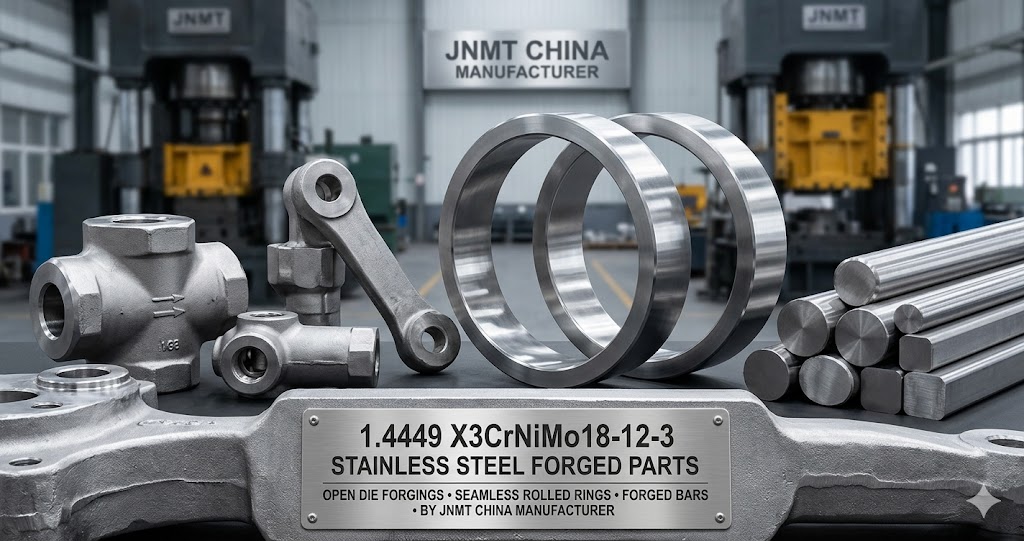
What is 1.4449 (X3CrNiMo18-12-3) Forging Stainless Steel?
Grade designation: 1.4449 per EN 10027-2; X3CrNiMo18-12-3 per EN 10027-1; closest AISI equivalent: 316L (upgraded).
Defining chemistry: Cr 17.0–18.2% | Ni 11.5–12.5% | Mo 2.25–2.75% | C ≤0.035% | PREN (Cr + 3.3Mo + 16N) ≈ 26.
Standout properties: Superior pitting & crevice corrosion resistance vs. 316L; austenitic toughness maintained to −196 °C; no post-weld cracking risk; tensile strength 520–720 MPa.
Applicable standards: EN 10088-3, EN 10222-5, DIN 17440, ASTM A182 F316L (equivalent), API 6A, API 6D, ASME VIII, EU PED 2014/68/EU, AD 2000-W0, NORSOK M-630.
Typical uses: Offshore wellhead valves, cryogenic LNG valve bodies, seawater heat exchangers, pressure vessel nozzles, subsea Christmas tree components.
Manufactured by: Jiangsu Liangyi Co.,Limited (JNMT) – ISO 9001:2015, founded 1997, Jiangyin, Jiangsu, China. Weight range: 30 kg – 30,000 kg per forged piece.
1.4449 (designated X3CrNiMo18-12-3 under EN 10027-1) is an austenitic stainless steel that sits one step above the ubiquitous 316L/1.4404 in the molybdenum-bearing family. The grade was formalised in EN 10088 precisely because the engineering community recognised a demand for a stainless alloy that could handle more aggressive chloride environments than 316L without crossing into the cost territory of higher-alloyed duplex or super-austenitic grades.
The defining characteristic of 1.4449 is its tightly bracketed nickel content of 11.5–12.5%. Unlike 316L, where the Ni window runs from 10 to 13%, the narrow band in 1.4449 guarantees a fully austenitic microstructure at all times — eliminating ferrite formation during rapid cooling after solution annealing, and ensuring consistent cryogenic impact values batch to batch. Combined with a minimum molybdenum of 2.25% and a carbon ceiling of 0.035%, the alloy achieves a Pitting Resistance Equivalent Number (PREN) of approximately 26, versus 316L's typical ~24.
Established in 1997, Jiangsu Liangyi Co.,Limited (JNMT) is an ISO 9001:2015 certified professional China 1.4449 forged parts manufacturer with 25+ years of industry experience, an 80,000 m² modern factory, and 120,000 tons annual production capacity. Our in-house engineering team and full-line production facilities — from 30t EAF+LF+VOD steel melting, 2000T–6300T hydraulic forging presses, and 1m/5m seamless ring rolling machines, to ten CNC precision machining centres — enable us to provide genuine one-stop custom forging solutions. We manufacture X3CrNiMo18-12-3 open die forgings, seamless rolled rings, forged bars, shafts, valve components and custom machined parts from 30 kg to 30,000 kg per piece, certified to EN, DIN, ASTM, API and ASME international standards. Our 1.4449 forgings serve critical industrial projects in 50+ countries across Europe, the Middle East, North America, Southeast Asia and Oceania.
Alloying Elements & Their Metallurgical Role in 1.4449 Forgings
Understanding what each element does in 1.4449 helps engineers appreciate why this specific composition is demanded in critical applications — and why substituting a cheaper heat can have costly consequences in service. The following is a plant-floor-level explanation based on our 25+ years of melting, forging and testing X3CrNiMo18-12-3 material.
Chromium (Cr) — 17.0–18.2%: The Passive Film Foundation
Chromium is the backbone of stainless steel corrosion resistance. At 17%, it forms a self-repairing Cr₂O₃ passive oxide film roughly 2–3 nm thick on the metal surface. This film is thermodynamically stable at neutral to mildly acidic pH values, and it re-forms spontaneously in oxygenated environments if mechanically damaged. In 1.4449, the Cr minimum of 17.0% is deliberately higher than the 16.5% floor of 316L, providing a wider safety margin for the passive film in fluctuating chloride concentrations. From a forging metallurgy perspective, chromium raises the hot-working resistance of the steel, requiring us to maintain precise forging start temperatures (≥1150 °C) to avoid tearing during heavy reduction passes.
Nickel (Ni) — 11.5–12.5%: Austenite Stabiliser & Toughness Anchor
Nickel is the element that maintains the face-centred cubic (FCC) austenitic crystal structure from room temperature down to −196 °C. The tight 1% bandwidth (11.5–12.5%) in 1.4449 — versus the 3% window in 316L — has two practical consequences. First, it virtually eliminates the risk of martensite formation during cold work, which could make the steel brittle in cryogenic service. Second, it ensures Charpy V-notch impact values exceed 100 J (longitudinal) at room temperature even in heavy forgings, a value that many pressure vessel codes require as a minimum. Our internal testing on forgings exceeding 10 tonnes routinely returns longitudinal KV values of 130–160 J at 20 °C, significantly above the EN 10222-5 minimum.
Molybdenum (Mo) — 2.25–2.75%: Pitting & Crevice Corrosion Resistance
Molybdenum is the element that makes 1.4449 genuinely superior to 316L in seawater and halide-containing process streams. Mo has a threefold effect: it strengthens the passive film against chloride attack, it forms protective MoO₄²⁻ oxyanions in acidic crevices (acting as a buffer that prevents local pH drop), and it raises the critical pitting temperature (CPT). In practical terms, a 0.25% increase in Mo adds approximately 1.5 units to the PREN. This explains why 1.4449 (PREN ~26) withstands chloride concentrations that would rapidly pit 316L (PREN ~24) — a difference that translates directly into longer service life in offshore valves and seawater-cooled heat exchangers.
Carbon (C) — ≤0.035% (Our Control: ≤0.030%): Sensitisation Prevention
The "L" in 316L and the "3" prefix in X3CrNiMo both signify low carbon. In austenitic stainless steels, carbon above ~0.03% can precipitate as chromium carbides (Cr₂₃C₆) at grain boundaries during heat treatment or welding, locally depleting the matrix of chromium and leaving chrome-depleted zones (CDZs) vulnerable to intergranular corrosion — a phenomenon called sensitisation. By controlling carbon to ≤0.035% (and in our own melt, ≤0.030%), we ensure the alloy passes the Strauss test (ASTM A262 Practice E) and remains resistant to intergranular attack even after welding without post-weld heat treatment.
Nitrogen (N) — ≤0.08%: PREN Booster & Strength Supplement
Nitrogen is the most cost-effective PREN booster available — each 1% N adds 16 PREN units in the formula PREN = %Cr + 3.3×%Mo + 16×%N. Even at the sub-0.08% levels typical in 1.4449, nitrogen contributes approximately 1 PREN unit, adds 15–25 MPa to yield strength without sacrificing ductility, and suppresses sigma-phase formation during prolonged elevated-temperature service. We control our N ceiling to ≤0.06% to maintain predictable, code-compliant mechanical properties.
Silicon (Si) — 0.20–0.60%: Deoxidation & Melt Cleanliness
Silicon serves primarily as a deoxidiser during steelmaking. Our tighter range (0.20–0.60% vs the EN maximum of 1.00%) reflects our VOD refining capability: excessive silicon creates large silicate inclusions that degrade ultrasonic transparency and act as fatigue initiation points in forged shafts. Our spectrometer records for every heat confirm Si is kept in the lower half of the permissible range for forging grades.
Product Specification Quick Reference
| Material Grade | 1.4449 / X3CrNiMo18-12-3 (EN 10088) |
| Closest Equivalent Grades | ASTM A182 F316L (chemical equivalent); UNS S31603 |
| Weight Range per Piece | 30 kg – 30,000 kg |
| Max Ring OD (Seamless Rolled) | 6,000 mm |
| Max Ring Height | 1,500 mm |
| Max Bar / Shaft Diameter | 2,000 mm |
| Max Bar / Shaft Length | 15,000 mm |
| Delivery Condition | Solution Annealed (SA) – 1050–1100 °C + rapid water quench |
| Applicable Standards | EN 10222-5, EN 10088-3, DIN 17440, ASTM A182, API 6A, API 6D, ASME VIII Div.1, ASME B16.34 |
| Regional Compliance | EU PED 2014/68/EU, AD 2000-W0, NORSOK M-630; production to customer-supplied ARAMCO / ADNOC supplementary requirements available on request |
| Certifications | ISO 9001:2015; EN 10204 3.1 (standard); EN 10204 3.2 via TÜV / BV / SGS (on request) |
| NDT Methods | UT (100%), MT, PT; RT on request; per ASTM E165, ASTM A388 |
| MOQ | Single piece (min. 30 kg); no batch quantity minimum |
| Standard Lead Time | 15–20 working days (stock material); 25–35 working days (large orders) |
| Surface Condition | As-forged, rough-turned, precision machined, or passivated/electropolished to customer spec |
| Accepted Drawing Formats | DXF, DWG, PDF, STEP, IGES |
1.4449 vs 316L vs 1.4571 vs Duplex 2205: Comprehensive Grade Comparison
Selecting the wrong grade for a critical forging costs far more in field repair or replacement than the initial material premium. The table below compares 1.4449 against three grades it frequently competes with, using the criteria that matter most to design engineers and procurement managers:
| Parameter | 1.4449 (X3CrNiMo18-12-3) | 316L (1.4404) | 316Ti (1.4571) | Duplex 2205 (1.4462) |
|---|---|---|---|---|
| Cr % | 17.0–18.2 | 16.5–18.5 | 16.5–18.5 | 21.0–23.0 |
| Ni % | 11.5–12.5 | 10.0–13.0 | 10.5–13.5 | 4.5–6.5 |
| Mo % | 2.25–2.75 | 2.00–2.50 | 2.00–2.50 | 2.50–3.50 |
| C % max | 0.035 | 0.030 | 0.080 | 0.030 |
| Ti / N addition | N ≤0.08% | — | Ti 5×C min. | N 0.10–0.22% |
| PREN (approx.) | ~26 | ~24 | ~24 | ~34 |
| Microstructure | Fully austenitic | Austenitic (may have trace ferrite) | Austenitic | Duplex (50% ferrite / 50% austenite) |
| Cryogenic service (–196 °C) | ✅ Excellent – fully austenitic FCC | ✅ Good | ✅ Good | ❌ Limited – ferrite phase becomes brittle below –50 °C |
| Chloride pitting resistance | Good (PREN 26) | Moderate (PREN 24) | Moderate (PREN 24) | Excellent (PREN 34) |
| Sensitisation control method | Low C (≤0.035%) | Low C (≤0.030%) | Ti stabilisation | Low C (≤0.030%) |
| Weldability | ✅ Excellent – no PWHT required | ✅ Excellent | ✅ Good (Ti loss in weld pool) | ⚠️ Requires controlled heat input; no PWHT |
| Yield strength (Rp0.2) | ≥220 MPa | ≥170 MPa | ≥200 MPa | ≥450 MPa |
| Forgeability | Good – wide hot-work window | Good | Moderate (Ti inclusions) | Moderate – duplex structure requires controlled reduction rates |
| Relative material cost | Low–Medium | Low | Low–Medium | Medium–High |
| Primary selection rationale | Upgraded 316L for chloride or cryogenic service; cost-effective vs. duplex | General corrosion service; lowest cost Mo-bearing grade | High-temperature service (550–800 °C) where sensitisation risk exists without PWHT | Highest strength + PREN; where wall thickness reduction is needed |
* PREN values calculated as %Cr + 3.3×%Mo + 16×%N using mid-range compositions. Actual values depend on heat chemistry. Data based on EN 10088-3.
Material Selection Guide: When Should You Specify 1.4449?
The following decision framework is based on our engineering team's experience reviewing hundreds of customer RFQs and drawings from oil & gas, chemical, LNG and valve manufacturing projects worldwide. Use it as a starting point — always consult your project-specific codes and corrosion engineering input.
✅ Choose 1.4449 when…
- Operating in seawater or high-chloride (Cl⁻ >1,000 ppm) process streams
- Design temperature below −100 °C and above −196 °C (cryogenic LNG)
- Specifying to EN 10222-5 for pressure vessel forgings
- Customer or EPC requires NORSOK M-630 or AD 2000-W0 compliance
- Component will be welded in situ without post-weld heat treatment
- Budget does not justify duplex (1.4462) but 316L is insufficient
- Offshore / subsea application requiring PREN ≥ 25
⚠️ Consider upgrading to 1.4462 Duplex when…
- PREN >30 is required (highly concentrated MgCl₂ or CaCl₂ brines)
- High mechanical strength is needed to reduce wall thickness (Rp0.2 >300 MPa)
- Design temperature stays above −50 °C (duplex ferrite phase constraint)
- Erosion-corrosion is a key failure mode (duplex has better erosion resistance)
🔽 Downgrade to 316L (1.4404) when…
- Chloride content is below 200 ppm and temperature below 60 °C
- Application is in dilute acids or pharmaceutical / food service
- Cost is the primary driver and corrosion risk is assessed as low
- No cryogenic temperature requirement
🌡️ Choose 316Ti (1.4571) instead when…
- Operating temperature is continuously >400 °C where sensitisation risk increases
- Welding must be performed without any PWHT and post-weld service is at elevated temperature
- Cryogenic temperatures are not involved (>−60 °C lower limit)
Chemical Composition of 1.4449 (X3CrNiMo18-12-3) Forging Material
Our 1.4449 stainless steel is produced through a full primary-to-secondary refining route: 30t Electric Arc Furnace (EAF) → Ladle Furnace (LF) → Vacuum Oxygen Decarburisation (VOD), with optional Electro-Slag Remelting (ESR) available for safety-critical applications requiring exceptional cleanliness (e.g., nuclear-adjacent components or aerospace-grade forgings). This multi-stage process ensures ultra-low sulfur and phosphorus, tight composition uniformity from heat top to bottom, and a clean inclusion population that performs reliably under 100% UT inspection.
The table below shows both the EN 10088-3 standard limits and our tighter internal heat-to-heat control ranges — a key differentiator from traders re-selling non-dedicated mill material:
| Element | EN 10088-3 Standard Range | JNMT Internal Control Range | Function in Alloy |
|---|---|---|---|
| Carbon (C) | ≤0.035 | ≤0.030 | Sensitisation prevention |
| Silicon (Si) | ≤1.00 | 0.20–0.60 | Deoxidiser; lower Si = fewer silicate inclusions |
| Manganese (Mn) | ≤2.00 | 1.00–1.80 | Austenite former; MnS inclusion control |
| Phosphorus (P) | ≤0.045 | ≤0.035 | Lowers grain boundary embrittlement risk |
| Sulfur (S) | ≤0.015 | ≤0.010 (≤0.005 for NACE) | MnS inclusion control; pitting initiation sites |
| Chromium (Cr) | 17.00–18.20 | 17.20–18.00 | Passive film; base corrosion resistance |
| Nickel (Ni) | 11.50–12.50 | 11.80–12.30 | Austenite stabiliser; cryogenic toughness |
| Molybdenum (Mo) | 2.25–2.75 | 2.40–2.60 | Pitting/crevice resistance; PREN contribution |
| Nitrogen (N) | ≤0.08 | ≤0.06 | PREN booster; strength; sigma suppression |
Every heat is verified by optical emission spectrometer (OES) before forging commences. Results are retained in our MES (Manufacturing Execution System) and form part of the EN 10204 3.1 Mill Test Certificate delivered with every order.
Mechanical Properties of 1.4449 Forged Parts at Ambient & Elevated Temperature
All 1.4449 forgings are delivered in the solution annealed (SA) condition after rapid water quenching from 1050–1100 °C. This heat treatment dissolves all chromium carbides and secondary phases, ensuring a uniform austenitic microstructure throughout the cross-section — even in heavy sections up to 500 mm thickness. The properties below are guaranteed and are reported in the EN 10204 3.1 MTC for every shipment:
| Property | EN 10222-5 Minimum | JNMT Typical Achieved (Heavy Forgings) | Test Method |
|---|---|---|---|
| Tensile Strength Rm | 520–720 MPa | 560–680 MPa | EN ISO 6892-1 |
| Yield Strength Rp0.2 | ≥220 MPa | 240–270 MPa | EN ISO 6892-1 |
| Elongation A₅ | ≥45% | 50–60% | EN ISO 6892-1 |
| Reduction of Area Z | ≥60% | 65–75% | EN ISO 6892-1 |
| Longitudinal KV (20 °C) | ≥100 J | 130–160 J | EN ISO 148-1 |
| Transverse KV (20 °C) | ≥60 J | 80–110 J | EN ISO 148-1 |
| Hardness | ≤215 HB | 150–190 HB | EN ISO 6506-1 |
Elevated Temperature Strength Data
For pressure vessel design to ASME VIII or EN 13445, allowable design stress values at elevated temperatures are critical. The following indicative values are based on EN 10088-3 and ASME II Part D for the 1.4449 / 316L austenitic family:
| Temperature | Approx. Rp0.2 (MPa) | Approx. Rm (MPa) |
|---|---|---|
| 20 °C (ambient) | 220–270 | 520–680 |
| 100 °C | 165–200 | 480–610 |
| 200 °C | 140–170 | 440–570 |
| 300 °C | 125–155 | 420–540 |
| 400 °C | 115–145 | 400–520 |
| 500 °C | 105–135 | 380–500 |
* Values are indicative, for guidance only. Use certified material data from EN 10088-3 Annex or ASME II Part D for actual pressure design calculations. For temperatures above 550 °C, specify 1.4571 (316Ti) instead to mitigate sensitisation.
Corrosion Resistance of 1.4449 Forgings: Mechanisms, Test Data & Environment Suitability
Corrosion resistance in stainless steel is not a single property — it is a family of behaviours that depend on the corrosion mechanism, environment temperature, chloride concentration, pH, and oxygen availability. The following breakdown addresses each mechanism relevant to 1.4449 forged components:
Pitting Corrosion
Pitting occurs when chloride ions penetrate the passive oxide film at microscopic defects, typically at MnS inclusion boundaries or surface mechanical damage sites. The PREN (Pitting Resistance Equivalent Number) is the primary predictive index: PREN = %Cr + 3.3×%Mo + 16×%N. For a mid-range 1.4449 heat (Cr 17.6%, Mo 2.5%, N 0.04%), PREN = 17.6 + 8.25 + 0.64 = 26.5. The critical pitting temperature (CPT) in 6% FeCl₃ (ASTM G48 Method C) for 1.4449 forgings in solution annealed condition is typically 20–25 °C, compared to 12–18 °C for 316L/1.4404. This 7–10 °C advantage is significant in environments where process temperature fluctuates seasonally.
Crevice Corrosion
Crevice corrosion initiates in geometrically occluded areas (flange gasket seats, threaded connections, under deposit) where the oxygen concentration falls and local pH drops as corrosion products accumulate. Molybdenum is particularly effective here: the MoO₄²⁻ anions produced by Mo dissolution act as buffers, raising local pH and slowing the autocatalytic acidification cycle. Our forged valve seats and flange faces are designed with specific surface finish requirements (Ra ≤ 3.2 μm on sealing surfaces) to minimise crevice geometry that could initiate this mechanism.
Chloride Stress Corrosion Cracking (SCC)
Austenitic stainless steels are susceptible to chloride SCC above a threshold temperature (typically >60 °C for 316L in concentrated chloride environments). The low-carbon chemistry and tight Ni control of 1.4449 improve its SCC resistance margin compared to 316L, but it is not immune. For applications combining high chloride (>10,000 ppm), temperature >120 °C, and tensile stress, consider specifying solution annealed plus low-temperature stress relief (LTSR at 300–350 °C) or upgrading to a duplex or super-austenitic grade. Our engineering team can advise on the optimal specification for your process parameters.
Intergranular Corrosion (Sensitisation)
Controlled by the low-carbon chemistry ≤0.035%. Our standard internal control to ≤0.030% means that 1.4449 forgings from JNMT are resistant to intergranular attack even without post-weld heat treatment. For verification, we can provide ASTM A262 Practice E (Strauss test) results on request for critical orders.
Environment Suitability Quick Guide
| Environment | Suitability | Condition / Note |
|---|---|---|
| Seawater (ambient temperature) | ✅ Good | Velocity <3 m/s; no stagnant zones; SA condition essential |
| Seawater (>40 °C, stagnant) | ⚠️ Marginal | Consider 1.4462 duplex or super-austenitic |
| Chloride ≤1,000 ppm, T ≤60 °C | ✅ Excellent | Preferred over 316L |
| Chloride 1,000–10,000 ppm, T ≤80 °C | ✅ Good | Verify with PREN and CPT calculation |
| LNG / Cryogenic (−196 °C to −100 °C) | ✅ Excellent | Maintain fully austenitic structure; KV ≥60 J at test temp |
| Dilute H₂SO₄ (pH >3, T <60 °C) | ✅ Good | Passive film stable |
| Concentrated H₂SO₄ or HCl | ❌ Not suitable | Use high-Mo alloy (e.g., 904L, C-276) |
| Sour service (H₂S >0.3 kPa) per NACE MR0175 | ✅ Compliant | Specify NACE MR0175 / ISO 15156 compliance; S ≤0.005% |
| Atmospheric / indoor storage | ✅ Excellent | No special precautions |
Heat Treatment of 1.4449 Forgings: Solution Annealing & Sensitisation Prevention
Heat treatment is not merely a step in the manufacturing process for 1.4449 — it is the mechanism that determines whether the corrosion resistance specified in the drawing is actually present in the finished part. At JNMT, all 1.4449 forgings undergo a controlled solution annealing cycle as the final heat treatment step before inspection and dispatch.
Solution Annealing Process (Standard)
Our ten computer-controlled heat treatment furnaces (maximum capacity per chamber: 100 tonnes) perform the following cycle for 1.4449 forgings:
- Loading and thermal equilibration: Forgings are loaded with minimum spacing to ensure uniform gas circulation. Temperature uniformity within ±10 °C across the working zone is verified at the start of each campaign using calibrated thermocouples.
- Heating rate: Controlled at ≤100 °C/hour for heavy sections (>200 mm cross-section) to prevent thermal gradient cracking. Lighter sections are heated at furnace rate.
- Soaking temperature and time: 1050–1100 °C for a minimum of 1 minute per millimetre of section thickness (minimum 30 minutes). For a 300 mm diameter forging, this means a guaranteed 300-minute soak. Soaking temperature is held within a ±10 °C band.
- Quenching: Transfer from furnace to water quench tank within 90 seconds — a critical specification. Slow transfer allows chromium carbides to begin re-precipitating at grain boundaries between ~850 °C and ~550 °C (the sensitisation range). Our furnaces are positioned directly adjacent to our quench tanks to guarantee sub-90-second transfer for forgings up to 30 tonnes.
- Post-quench inspection: Hardness check on every piece confirms quench effectiveness. Target: ≤215 HB. Values significantly below confirm full dissolution of secondary phases. Pieces outside the 150–215 HB range trigger a mandatory re-treatment investigation.
ESR (Electro-Slag Remelting) Option for Critical Applications
For applications where conventional VOD-refined material is insufficient — typically nuclear-adjacent components, deepwater subsea hardware, or cryogenic storage vessels — we offer ingot material produced by Electro-Slag Remelting (ESR). ESR passes the electrode through a liquid slag blanket, reducing oxide inclusions by 60–80% and achieving a near-perfect columnar-to-equiaxed transition in the solidification structure. Ultrasonic attenuation in ESR-remelt forgings typically improves by one full ASTM quality level compared to VOD-only material, enabling reliable UT inspection in the heaviest sections (400–600 mm cross-section).
Weldability of 1.4449 Forgings: Filler Selection, Preheat & Post-Weld Guidance
One of 1.4449's most commercially significant properties is its ability to be welded in the field without post-weld heat treatment — a practical advantage in offshore installation and plant-site valve replacement work where furnace access is not feasible.
Why 1.4449 Welds Without PWHT
Post-weld heat treatment in carbon steels is required to temper hard martensite in the heat-affected zone (HAZ). In austenitic stainless steels like 1.4449, no martensite forms during welding (because the austenitic FCC structure is stable at room temperature). The only risk is sensitisation — chromium carbide precipitation in the HAZ between approximately 550–850 °C during cooling. The ≤0.035% carbon ceiling makes carbide precipitation thermodynamically slow enough that standard multi-pass TIG welding with controlled heat input does not produce a sensitised structure. No preheating is required for 1.4449 (preheat would increase HAZ time in the sensitisation range — the opposite of what is needed).
Recommended Filler Materials
| Welding Process | Recommended Filler | Designation | Notes |
|---|---|---|---|
| GTAW (TIG) | ER316L | AWS A5.9 / EN ISO 14343-A W 19 12 3 L | Primary choice; matching low-C Mo-bearing filler |
| SMAW (MMA) | E316L-16 / E316L-17 | AWS A5.4 / EN ISO 3581-A E 19 12 3 L R | For site repairs and structural joints |
| GMAW (MIG) | ER316L | AWS A5.9 | Use low heat input; inter-pass temperature ≤150 °C |
| SAW (submerged arc) | EB316L + flux | EN ISO 14343-A S 19 12 3 L | For heavy deposition in pressure vessel nozzle welds |
| Extra-demanding (high Cl⁻) | ER317L or ER318 | AWS A5.9 | Slightly higher Mo for improved pitting resistance in weld metal |
Key Welding Parameters to Specify
- Inter-pass temperature: Maximum 150 °C to limit HAZ sensitisation time and control distortion in heavy flanges and valve bodies.
- Heat input: Prefer ≤1.5 kJ/mm for critical corrosion service to minimise HAZ width.
- Back-purge gas: Argon back-purge is mandatory for full-penetration butt welds in pipe and tubesheet applications to prevent oxidation of the root bead.
- WPS qualification: We recommend qualifying welding procedures to EN ISO 15614-1 or ASME IX for all pressure-boundary welds in 1.4449 forgings.
Full Range of Custom 1.4449 (X3CrNiMo18-12-3) Forged Products We Manufacture
As a professional custom 1.4449 forging manufacturer in China, we produce all types of forged components from 30 kg to 30,000 kg per piece, strictly to international standards and your detailed drawings, with full CNC precision machining available in-house. Our main product categories:
1.4449 Forged Bars & Custom Shafts
We manufacture 1.4449 forged bars including round bars, square bars, flat bars, rectangular bars and hollow bars, as well as step shafts, gear shafts, turbine shafts, crankshafts and pump shafts. Production capacity: max diameter 2,000 mm, max length 15 m, max single-piece weight 30 tonnes. All forged bars undergo 100% straight-beam ultrasonic testing (UT) per ASTM A388 before dispatch, and are supplied with full EN 10204 3.1 MTC including OES chemistry, mechanical test results and heat treatment records. Grain flow is oriented along the shaft axis for maximum fatigue resistance.
1.4449 Seamless Rolled Forged Rings
Our 1.4449 seamless rolled rings are manufactured on our 1-metre and 5-metre ring rolling machines, which can produce rings with outer diameter from 200 mm up to 6,000 mm, max height 1,500 mm, wall thickness from 30 mm to 500 mm, and individual weight up to 30 tonnes. The ring rolling process ensures circumferential grain flow — the fibre structure follows the ring contour, maximising hoop strength and fatigue resistance under cyclic pressure cycling in valve bodies, bearing rings, and turbine casings. All rings comply with API 6A (for wellhead and Christmas tree applications) and EN 10222-5 for pressure vessel use.
1.4449 Forged Valve & Fluid Control Components
We are a specialised supplier of 1.4449 forged valve bodies, bonnets, closure members, seats, stems, and flanges for ball valves, gate valves, globe valves, butterfly valves, check valves and cryogenic valves. The forging process produces superior grain orientation compared to casting — critical in valve bodies where the pressure boundary experiences both internal pressure and external bending loads. Our valve forgings comply with API 600, API 602, API 6D and EN 12516-2 wall thickness requirements, and are widely supplied to valve manufacturers in Germany (DIN valves), Italy, the UK and the USA. We can supply in rough-forged condition or fully machined to final dimensions with pressure test ports, threaded connections and seat bores.
1.4449 Forged Pressure Vessel & Heat Exchanger Components
We supply custom 1.4449 forged tube sheets (up to 3,000 mm diameter), pressure vessel nozzles, flanges, blind flanges, discs, shells and dished heads for pressure vessels, heat exchangers, reactors, condensers and separators in petrochemical, chemical and nuclear-adjacent service. All components are manufactured to ASME VIII Div.1, ASME B16.5, EN 1092-1 or customer-specific drawing requirements. For tubesheets, we can provide pre-drilled tube holes with finish bore tolerances meeting TEMA Class R standards.
1.4449 Custom Forged Components to Drawing
Beyond standard categories, we produce custom 1.4449 forged sleeves, hollow cylinders, hubs, casings, impellers, crane wheels, guide rings, piston rods and other complex-geometry parts from your DXF/PDF/STEP drawings. Our in-house design-for-forgeability review ensures that draft angles, fillet radii and machining allowances are optimised before tooling is committed, reducing lead time and minimising material waste. CNC machining to tight tolerances (H6/h6 fits, Ra ≤1.6 μm on bearing surfaces) is available entirely in-house.
Our 1.4449 Forging Production Process & Technical Challenges We Manage
Forging austenitic stainless steels like 1.4449 is technically more demanding than forging carbon or low-alloy steels — a fact that separates specialist forging manufacturers from general workshops. The following process overview includes the specific engineering challenges of X3CrNiMo18-12-3 and explains how our 25 years of experience handling this grade mitigates each risk.
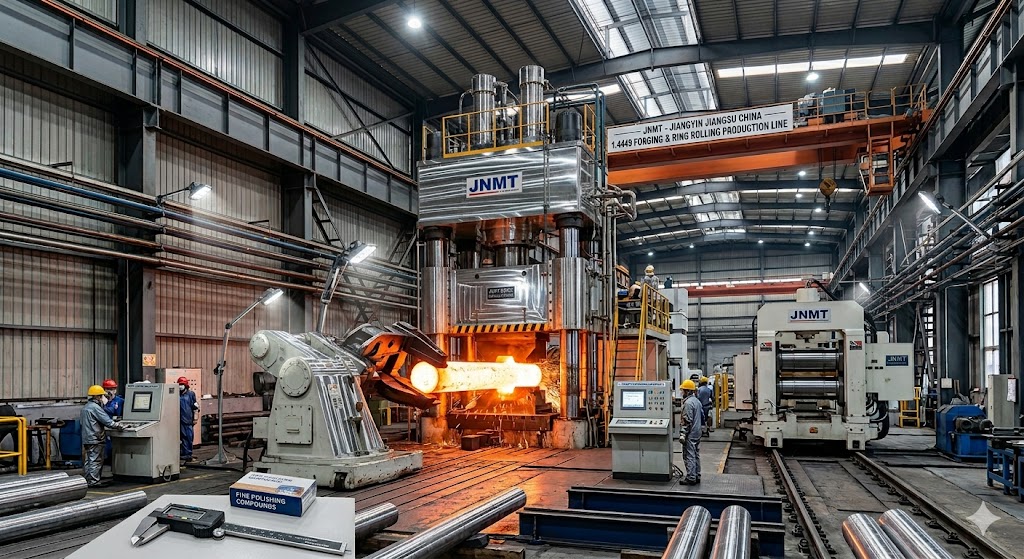
- Raw Material Verification & Ingot Preparation: Incoming ingots are verified by OES spectrometer against the heat certificate before any processing. For 1.4449, we specifically verify that Ni ≥11.5% and Mo ≥2.25% — the two elements most likely to be under-tolerance in heats produced without dedicated X3CrNiMo18-12-3 schedules. Ingots are then marked with heat number and customer PO number for full traceability throughout the process.
- Ingot Preheating (1150–1230 °C): 1.4449 has a narrower hot-working window than carbon steel. The deformation start temperature must be above 1100 °C to avoid cracking in the coarse-grained cast structure of the ingot, and forging must complete before the temperature drops below 950 °C. Our preheating furnaces soak the ingot for a minimum of 2 hours per 100 mm ingot diameter to ensure thermal homogeneity throughout the cross-section — critical for avoiding surface tearing during initial upsetting.
- Initial Upsetting & Drawing Out (2000T–6300T Presses): The first forging operation — upsetting — breaks down the coarse columnar solidification structure inherited from the ingot and initiates recrystallisation. For 1.4449, we target a minimum total reduction ratio of 4:1 (ideally 6:1 for critical applications) to ensure a fine, equiaxed recrystallised grain structure (ASTM grain size No. 5 or finer) throughout the cross-section. Our 6,300-tonne press can deliver this reduction even on large-diameter ingots (>600 mm) in a single heat.
- Seamless Ring Rolling (1m and 5m Mills): Ring rolling of 1.4449 requires close control of feed rate and rolling temperature to prevent edge cracking — a risk because Mo-bearing austenitic grades have higher flow stress than plain austenitic grades at equivalent temperatures. Our operators follow material-specific rolling programmes with defined ring growth rates and inter-pass temperature checks using contact pyrometers. The rolling process simultaneously refines grain size and establishes circumferential fibre texture for maximum hoop strength.
- Final Forging Geometry & Dimensional Check: After the final forging pass, all dimensions are checked against the forging drawing with allowances for heat treatment distortion and machining stock. For rings and discs, roundness is checked with a laser measurement system. Pieces outside dimensional tolerance are reworked — never dispatched with documented deviations unless the customer has specifically approved them.
- Solution Annealing (1050–1100 °C + Water Quench <90 sec transfer): As described in Section 9. This is the most quality-critical step in the entire process for corrosion-sensitive applications. Our furnace-to-quench transfer time record is fully documented in the production data record attached to the MTC.
- Precision Machining (CNC Centres, Lathes, Boring Mills): 1.4449 is classified as a moderately difficult material to machine — its work-hardening rate is higher than carbon steel, and it generates long, stringy chips that can re-weld to the cutting tool if feeds and speeds are not carefully managed. Our machining programmes for X3CrNiMo18-12-3 use carbide tooling, high coolant pressure, and conservative depth-of-cut per pass. Surface finish, bore diameter and length dimensions are 100% checked against the drawing before dispatch.
- Full NDT Inspection, Marking & MTC Compilation: 100% ultrasonic testing, magnetic particle testing (MT) or liquid penetrant testing (PT), dimensional inspection, hardness check, and visual inspection are completed before the EN 10204 3.1 MTC is compiled. Each forging is permanently marked (low-stress stamp or vibro-engraving) with material grade, heat number, piece number, and customer PO reference.
Explore our full equipment list on our Equipment Page.
Full-Process Quality Control & Inspection Standards
As an ISO 9001:2015 certified manufacturer, every 1.4449 forging order passes through a documented, multi-stage quality gate system from raw material receipt to final packing. Our Quality Management System (QMS) is structured around the APQP (Advanced Product Quality Planning) framework — the same approach used in the automotive and aerospace sectors — adapted to the forging and pressure equipment industry.
Stage 1 – Incoming Material Control
Every heat of raw material received is verified by OES spectrometer against the supplier MTC before it enters our warehouse. Heats with Ni <11.5%, Mo <2.25%, or C >0.035% are quarantined and rejected regardless of the supplier MTC. This incoming stage eliminates the risk of using misidentified or off-specification material — the root cause of most field failures in forged components that are later attributed to "manufacturing defects."
Stage 2 – In-Process Control During Forging
- Ingot temperature monitoring: Contact pyrometers on ingot surface before each forging pass.If the temperature drops under 950 °C the forging is suspended to avoid hot tearing.
- Reduction ratio tracking: Weight and dimension measurements after each major reduction pass confirm the target reduction ratio of ≥4:1 is being achieved.
- Geometry check after final pass: All important dimensions are measured with calibrated instruments before transferring to heat treatment. Pieces outside dimensional tolerance trigger rework before annealing.
Stage 3 – Heat Treatment Verification
- Furnace temperature uniformity survey every six months on each chamber, verifying temperature uniformity within ±10 °C across the working zone. Survey thermocouple records are retained and available to customers on request.
- Type-K thermocouple batch records retained for every heat treatment run, confirming soak temperature, soak time and transfer-to-quench time for every piece.
- Hardness check on 100% of pieces after quench: target ≤215 HB.
Stage 4 – Non-Destructive Testing (NDT)
- Ultrasonic Testing (UT): 100% straight-beam and angle-beam UT per ASTM A388 or EN 10228-3 (as applicable). Our phased-array UT equipment can inspect forgings up to 600 mm thickness with sensitivity calibrated on 2 mm flat-bottom hole reference reflectors.
- Magnetic Particle Testing (MT): Not applicable to fully austenitic 1.4449 (non-magnetic). MT is performed on weld repair areas or ferritic substrates only.
- Liquid Penetrant Testing (PT): 100% PT on all accessible surfaces per ASTM E165 or EN ISO 3452, detecting surface-breaking discontinuities that UT would miss.
- Radiographic Testing (RT): Available on request for complex-geometry forgings where UT coverage is geometrically limited. Performed by certified Level II/III RT technicians at our partner NDT facility.
Stage 5 – Destructive / Mechanical Testing
- Tensile and yield testing: Per EN ISO 6892-1, on specimens machined from integral test material (ITM) attached to each forging batch, not from a separate test bar.
- Charpy V-notch impact testing: Per EN ISO 148-1 at 20 °C (standard) or lower temperature (−46 °C, −196 °C) on request. Three specimens per direction; average and minimum values reported.
- Hardness testing: Brinell hardness on machined surface of every piece per EN ISO 6506-1.
- Intergranular corrosion test: ASTM A262 Practice E (Strauss test) available on request for food-grade, pharmaceutical or nuclear-adjacent applications.
- Ferrite measurement: Fischer feritscope measurement available for applications where residual ferrite content must be confirmed ≤1 FN.
Certification & Documentation
Standard delivery includes an EN 10204 3.1 Mill Test Certificate signed by our QC manager, containing: heat number, heat chemistry (OES results), mechanical test results (tensile, yield, elongation, RA, Charpy KV), heat treatment parameters (furnace number, set/actual temperature, soak time, quench method), NDT reports, dimensional inspection report, and marking verification. EN 10204 3.2 Third-Party Inspection by TÜV SÜD, Bureau Veritas, or SGS is available on request — witness inspection of forging, heat treatment and NDT can be arranged with minimum 5 working days notice.
Core Application Industries for 1.4449 Forgings — Technical Rationale by Sector
The following section explains not just where 1.4449 forgings are used, but why this specific grade is the technically correct choice in each sector — information that helps design engineers write better material specifications and procurement managers avoid costly substitutions.
Oil & Gas — Wellhead Equipment, Christmas Trees, Subsea Valves
NORSOK M-630 and ASTM A182 both specify austenitic stainless steels for wellhead and Christmas tree components where the produced fluid contains seawater injection, CO₂ and low-level H₂S. 1.4449 satisfies the PREN ≥25 requirement of many operator specifications for subsea components in seawater-flooded annuli, where pitting initiation on internal surfaces could allow produced fluid breakthrough. We have supplied over 5,000 tonnes of 1.4449 wellhead component forgings to major oilfield projects in Saudi Arabia, UAE, Qatar, the North Sea (UK/Norway) and West Africa. Typical components: Christmas tree body forgings (cross sections to 300 mm), gate valve body blocks, tubing hanger mandrels, and tree cap forgings.
LNG & Cryogenic Processing — Cryogenic Valve Bodies, Pump Shafts, Storage Equipment
LNG plants operate at temperatures as low as −162 °C, at which most steels become brittle. Duplex stainless steels are excluded (ferrite embrittlement below −50 °C); standard 316L is borderline. 1.4449's tight Ni control ensures that Charpy impact values remain above the ASME B31.3 minimum of 40 J even at −196 °C — verified by our low-temperature testing capability (impact machine rated to −196 °C using liquid nitrogen bath). Applications include cryogenic ball valve bodies, LNG pump barrel forgings, cold-box manifold flanges, and pressure vessel nozzles for ethylene and propylene processing.
Valve Manufacturing — API 6A, API 6D, EN 12516-2 Compliant Bodies
Europe's leading valve manufacturers — in Germany (Valves DIN/EN spec), Italy (ANSI/ASME class), and the UK — specify 1.4449 forgings for ball valves ≥DN50 and gate valves in chloride-bearing process service. The superior forged-grain orientation of 1.4449 vs. cast 316L provides significantly better fatigue resistance under cyclic pressure loading — a well-established engineering advantage of wrought forgings over castings. We supply valve body forgings in near-net-shape configuration with rough-bored seats and pre-machined end flanges, reducing machining time at the valve assembler.
Petrochemical & Chemical Plants — Pressure Vessel Nozzles, Flanges, Tube Sheets
Process plants handling chlorinated organic solvents, hydrochloric acid (dilute), sulphuric acid (dilute, hot), phosphoric acid and chloride-contaminated cooling water specify 1.4449 for pressure-boundary forgings when the design temperature is below 400 °C. Above 400 °C, consider 1.4571 (Ti-stabilised) to prevent elevated-temperature sensitisation. We manufacture tubesheet forgings to TEMA Class R, with tube hole drilling, pass partition groove machining and peripheral O-ring groove machining completed in-house — a one-stop-shop solution that eliminates a sub-contractor and typically saves 2–3 weeks of lead time.
Nuclear Power — Non-Nuclear-Grade Adjacent Components
While full nuclear qualification (e.g., ASME NCA-3800 material certification) requires additional steps beyond standard EN 10204 3.1, many nuclear plant Balance of Plant (BOP) systems specify 1.4449 forgings under conventional pressure vessel codes for heat exchanger shells, feedwater system flanges and cooling water valve bodies. We supply these applications with 100% PMI (Positive Material Identification) verification by portable XRF, full heat treatment documentation, and third-party witness inspection as standard — matching the documentation discipline expected in nuclear-adjacent supply chains.
Marine Engineering — Seawater Systems, Propeller Shafts, LNG Vessel Components
Marine Class Societies (Lloyd's Register, DNV-GL, Bureau Veritas, ABS) approve 1.4449 for seawater-wetted components in shipboard systems where the chloride concentration precludes the use of 316L. Applications include seawater cooling pump shafts (where forged bar outperforms machined bar in fatigue life by 20–30% due to superior surface grain orientation), overboard valve bodies, thruster housing nozzles, and LNG carrier cryogenic manifold forgings. We can manufacture forgings to meet the material and testing requirements approved by Marine Class Societies, with full documentation packages to support Class Society verification.
Global Market Coverage & Regional Compliance Requirements
Different export markets impose distinct regulatory and specification frameworks on industrial forgings. The following section summarises the key compliance requirements, logistics arrangements and payment preferences for each of our primary export regions — based on 25+ years of direct export experience.
European Market (Germany, Italy, France, UK, Netherlands, Norway)
Europe is our most technically demanding export market and accounts for approximately 40% of our 1.4449 forging shipments. European buyers — primarily valve manufacturers in Germany and Italy, petrochemical EPC contractors in France and the Netherlands, and offshore operators in Norway and the UK — require full compliance with the EU Pressure Equipment Directive (PED) 2014/68/EU, which mandates EN 10204 3.1 material certification as a minimum for pressure-bearing parts. For critical applications (Category III/IV equipment), AD 2000-W0 and TÜV 3.2 certification are commonly specified. Norwegian projects additionally require NORSOK M-630 compliance for all alloy steel forgings. We ship to Hamburg, Rotterdam and Antwerp ports via our established freight partner, with typical port-to-customer transit of 20–25 days. We accept T/T and L/C at sight for European customers.
Middle East Market (Saudi Arabia, UAE, Kuwait, Qatar, Oman)
Middle East oil & gas projects represent the most volume-intensive segment of our 1.4449 forging business, driven by ARAMCO, ADNOC, KOC and PDO capital expansion programmes. The compliance landscape combines API 6A (wellhead), API 6D (pipeline valves), ASME VIII (pressure vessels) and client-specific supplementary requirements — including ARAMCO and ADNOC supplementary requirements, which typically impose additional toughness requirements (e.g., minimum KV at −46 °C for sour service). We review customer-supplied supplementary specifications and confirm compliance scope in our written quotation. We have supplied over 5,000 tonnes of 1.4449 forgings to Middle East projects. Logistics via Jebel Ali (UAE), Dammam (Saudi Arabia) and Shuwaikh (Kuwait) ports. We accept T/T, L/C and Western Union for Middle East customers.
North American Market (USA, Canada)
North American buyers specify 1.4449 forgings under ASTM A182 Grade F316L (the closest ASTM equivalent in chemistry) or explicitly under EN 10088 designation when European project standards are applied. ASME Boiler and Pressure Vessel Code (Section VIII Div.1 and Div.2) governs pressure vessel design, and material certification follows ASME Code Section II. We supply LNG terminal valve forgings to US Gulf Coast projects (Houston port logistics) and pipeline compression station components to Canadian operators (Vancouver port). We accept T/T, L/C and PayPal for North American customers.
Southeast Asia & Oceania (Singapore, Malaysia, Indonesia, Australia, New Zealand)
Singapore-based EPCs and FPSO operators, Malaysian petrochemical plants, and Australian LNG projects (Wheatstone, Ichthys, Scarborough) all require 1.4449 forgings in their valve and pressure vessel packages. Australian projects apply AS 4041 (pressure piping) and AS 1210 (pressure vessels), both of which accept EN 10204 3.1 material certificates. We ship to Singapore (PSA terminal), Port Klang (Malaysia), and Fremantle / Port Hedland (Western Australia). We accept T/T and L/C for Southeast Asia and Oceania customers.
Surface Treatment & Post-Forging Finishing Options for 1.4449 Forgings
The surface condition of a 1.4449 forging directly affects its in-service corrosion resistance. A contaminated or mechanically damaged surface can reduce the effective PREN of the surface layer and initiate pitting at chloride concentrations far below the bulk material's theoretical threshold. The following finishing options are available at JNMT:
1. As-Forged Surface (Scale Present)
The oxidised scale surface from forging and heat treatment is removed by shot blasting (Sa 2.5 standard) before dispatch for customers who will perform their own final machining. This is the standard delivery condition for rough-machining blanks.
2. Rough Turned / Semi-Finished
A rough-turned skin pass removes the heat treatment scale, decarburised surface layer, and any forging surface laps, exposing the base metal beneath. Typical stock removal: 3–8 mm per side. Ra typically 6.3–12.5 μm. This is the standard delivery condition for bars and ring blanks that will be finish-machined by the customer.
3. Precision CNC Machining
Full finish machining to drawing dimensions performed in-house on our CNC turning centres and machining centres. Achievable tolerances: diameter tolerance H6/h6 (±0.01 mm on bores to 500 mm diameter), surface finish Ra ≤0.8 μm on bearing and sealing surfaces, Ra ≤1.6 μm on general machined surfaces. We provide dimensional inspection reports with every precision-machined order.
4. Electrochemical Passivation
Citric acid passivation (ASTM A967 Method C1, 4–10% citric acid at 49–60 °C for 4–10 minutes) or nitric acid passivation (ASTM A967 Method N1) dissolves surface free iron contamination and promotes rapid Cr₂O₃ passive film growth. This is recommended for components that will be in prolonged contact with process fluids immediately after installation, before the natural re-passivation cycle can establish the full oxide film. We specify passivation as standard for food-grade, pharmaceutical and medical gas system forgings.
5. Pickling & Passivation
For components with discolouration from welding, hot-forming or heat treatment, pickling in HNO₃/HF solution (10–15% HNO₃ + 1–3% HF at 40–55 °C) followed by passivation restores the full corrosion resistance of the surface. This process is essential for weld-repaired components and is commonly required by offshore operators and LNG clients. We outsource pickling to our certified chemical treatment partner for full process traceability.
6. Electropolishing
Electropolishing (electrochemical material removal in phosphoric/sulphuric acid electrolyte) simultaneously removes surface metal, smooths micro-roughness, and enriches the Cr:Fe ratio at the surface — producing a surface PREN effectively 2–4 units higher than the bulk PREN. This treatment is specified for pharmaceutical bioreactor components, ultra-high-purity gas delivery forgings and subsea flowline connectors where the absolute minimum crevice and contamination initiation risk is required. Typically combined with Ra ≤0.4 μm pre-electropolish machining.
Frequently Asked Questions (FAQ) About 1.4449 Forged Parts
1.4449 (X3CrNiMo18-12-3) is a low-carbon molybdenum-alloyed austenitic stainless steel standardised in EN 10088. Compared to 316L (1.4404), 1.4449 has a tighter nickel range (11.5–12.5% vs. 10.0–13.0%), which guarantees a fully austenitic microstructure and superior cryogenic impact values. Its PREN (Pitting Resistance Equivalent Number) of approximately 26 — versus ~24 for 316L — translates to a higher Critical Pitting Temperature in seawater environments, longer service life in chloride-bearing service, and better resistance to stress corrosion cracking (SCC). The grade was specifically designed for applications where 316L is borderline or insufficient but the full cost of duplex (1.4462) is not justified.
Our MOQ is a single piece with a minimum weight of 30 kg. We supply both one-off prototype forgings for engineering qualification and serial production batches of several hundred pieces for mass-market valve manufacturing. There is no minimum batch quantity — the minimum is driven purely by the minimum weight per piece that our forging process can effectively work on (30 kg). For orders below 30 kg, we recommend reviewing whether the component can be redesigned as a machined forging blank from a larger bar, which we can also supply.
Our standard compliance suite includes: EN 10222-5 (pressure vessel forgings – stainless steels), EN 10088-3 (semi-finished products, bars, rods, wire), DIN 17440 (stainless steel bars and wire), ASTM A182 Grade F316L (the closest ASTM chemical equivalent), API 6A (wellhead and Christmas tree equipment), API 6D (pipeline valves), and ASME VIII Div.1/Div.2 (pressure vessels). Regional compliance available on request: EU PED 2014/68/EU, AD 2000-W0, NORSOK M-630, ARAMCO SAMSS, and Australian AS 4041.
For small-batch orders with raw material in stock, the normal lead time is 15–20 working days; For large-volume or complex precision-machined orders, the lead time is 25–35 working days .Lead time is mainly affected by four factors:(1) Raw material availability — X3CrNiMo18-12-3 ingots are normally custom-produced at the steel mill, while we keep safety stock for standard sizes;(2) Forging complexity — custom shapes that need multiple forming steps take longer to process than simple bars or rings;(3) Machining scope — complex part geometries with extensive CNC machining will add 5–10 working days per piece;(4) Third-party inspection arrangement — witness inspections by TÜV, BV and other agencies usually add 3–5 working days.We will confirm the exact delivery schedule in our formal quotation according to your specific drawings and technical requirements.
Standard delivery includes an EN 10204 3.1 Mill Test Certificate signed by our Quality Manager, containing: heat number, OES chemical analysis, mechanical test results (Rm, Rp0.2, A₅, Z, KV), heat treatment parameters (furnace no., set temp., actual temp., soak time, quench transfer time), NDT reports (UT, PT/MT), dimensional inspection, and permanent marking verification. EN 10204 3.2 Third-Party Inspection by TÜV SÜD, Bureau Veritas, SGS or Intertek is available on request. NACE MR0175 compliance certification and Positive Material Identification (PMI by XRF) records are also available.
Yes — more than 90% of our production is custom to customer drawings. We accept DXF, DWG, PDF (dimensioned), STEP and IGES file formats. Upon receipt of your drawing, our engineering team performs a free Design for Forgeability (DFF) review, which checks draft angles, fillet radii and machining allowances against our forging process capabilities, and proposes optimisations that can reduce material consumption, machining time or lead time. We provide a written DFF review report with our quotation. For proprietary designs, we routinely sign NDAs before reviewing drawings.
Sensitisation (chromium carbide precipitation at grain boundaries) is prevented by a combination of chemistry control and heat treatment. Our internal carbon ceiling of ≤0.030% — tighter than the EN 10088-3 maximum of 0.035% — minimises the thermodynamic driving force for Cr₂₃C₆ formation. Solution annealing at 1050–1100 °C dissolves any carbides formed during forging, and rapid water quenching (transfer to quench tank within 90 seconds) prevents re-precipitation during cooling. The combination guarantees that finished 1.4449 forgings from JNMT pass the Strauss test (ASTM A262 Practice E) — we can provide this test result on demand for critical applications.
Yes. Because 1.4449 is fully austenitic and contains ≤0.035% carbon, no martensite forms during welding, and sensitisation (carbide precipitation in the HAZ) is thermodynamically suppressed. The material can be welded without post-weld heat treatment (PWHT) or preheating using ER316L or ER317L filler wire. PWHT is neither required nor recommended — applying a stress-relief anneal at temperatures in the sensitisation range (500–850 °C) without going to full solution annealing temperature (1050–1100 °C) would actually induce sensitisation, not prevent it. We recommend following EN ISO 15614-1 WPS qualification for all pressure-bearing welds.
EN 10204 defines the type of material test report and who validates it. Type 3.1 is a certificate validated and signed by the manufacturer's own authorised quality representative (our QC Manager). It is the most common specification for industrial forgings. Type 3.2 is validated and co-signed by both the manufacturer's representative AND an independent third-party inspector (TÜV, BV, SGS, or a customer's own representative). It provides additional assurance that the tests were witnessed and verified by an independent party — required by some project specifications for safety-critical applications. We arrange 3.2 inspections with our established third-party partners, with 5 working days notice typically required for scheduling the inspector's attendance.
Yes, 1.4449 austenitic stainless steel is recognised as acceptable for sour service under NACE MR0175 / ISO 15156-3 (H₂S-containing environments) in the solution annealed condition with hardness ≤22 HRC (≤237 HV/~220 HB). Our standard delivery hardness of ≤215 HB satisfies this requirement. For maximum NACE compliance confidence, we additionally control sulfur to ≤0.005% (vs. the EN 10088-3 maximum of 0.015%) to minimise MnS inclusions that can act as hydrogen trapping sites and pitting initiation points in sour environments. Please specify "NACE MR0175 service" in your enquiry so we apply the enhanced sulfur control from the melt stage.
We offer the following surface conditions: (1) Shot-blasted as-forged (scale removed, Ra ~25 μm) – standard for rough-machining blanks; (2) Rough-turned (Ra 6.3–12.5 μm) – scale and decarburised layer removed; (3) Precision CNC machined (Ra ≤0.8 μm on bearing surfaces, tolerances to H6/h6); (4) Citric or nitric acid passivated per ASTM A967; (5) Pickled and passivated (HNO₃/HF process for weld-area cleaning); (6) Electropolished (Ra ≤0.4 μm; surface Cr enrichment for maximum corrosion resistance). Please specify the required surface condition in your RFQ.
Yes. ESR-remelted 1.4449 ingots are available for applications requiring exceptional cleanliness and ultrasonic transparency — typically nuclear BOP components, deepwater subsea hardware, and aerospace-adjacent components. ESR reduces oxide inclusion content by 60–80% compared to VOD-only material, and improves UT inspection coverage in thick cross-sections (above 400 mm). There is a cost and lead time premium for ESR material (typically +20–30% on material cost, +7–10 working days for ingot procurement). Please flag "ESR required" in your RFQ.
Normal payment terms for all overseas markets: T/T bank transfer - 30% deposit when order confirmed, balance 70% paid against a copy of Bill Lading.For the clients who prefer documentary credit, we also accept irrevocable sight L/C issued by reputable banks.For regular customers with a good transaction record, flexible extended payment terms can be discussed individually.PayPal is available for small orders under USD 5,000. Western Union is supported for Middle East clients. Personal checks and cash payments are not accepted.
Small forged parts under 500 kg each are wrapped with anti-rust paper and VCI corrosion inhibiting film, then packed in export wooden crates.Medium forgings ranging from 500 kg to 5,000 kg are placed on wooden pallets or open steel frames, fully covered with VCI wrapping and weatherproof tarpaulin.Large forgings over 5,000 kg are shipped without outer packaging. Machined surfaces are coated with anti-rust oil or Tectyl protection, and the parts are fixed firmly on flat-rack containers or shipped as breakbulk cargo.
We can arrange sea freight, air freight for small urgent orders, and multimodal transport combining sea and road delivery to inland areas across Europe and the Middle East.All trade documents including commercial invoice, packing list, bill of lading, certificate of origin and material test certificate are provided in both hard copy and PDF digital format.
Yes. Our ISO 9001:2015 QMS includes a formal NCR (Non-Conformance Report) and CAPA (Corrective and Preventive Action) process. If a customer identifies a quality issue with delivered goods, we ask for (1) photographs of the defect, (2) the dimensional or test data showing non-conformance, and (3) the piece number/heat number from the marking. Our QC Manager will acknowledge the NCR within 24 hours and provide a root cause analysis and corrective action plan within 5 working days. We offer replacement, full credit, or repair as appropriate. Our documented CAPA process ensures systematic resolution of every non-conformance, with our commitment to standing behind every order we ship.
Contact Us for Custom 1.4449 (X3CrNiMo18-12-3) Forged Parts Quotation
As your trusted China 1.4449 forging manufacturer and global supplier, Jiangsu Liangyi (JNMT) is committed to providing high-quality 1.4449 forged parts, competitive pricing, short lead times and full technical support — backed by 25 years of X3CrNiMo18-12-3 forging expertise and an ISO 9001:2015 quality system. We export to Europe, the Middle East, North America, Southeast Asia and worldwide, and provide customised compliance solutions for every regional market.
Send us your drawings (DXF / PDF / STEP), material requirements, quantity, applicable standards and delivery port — we will return a detailed technical review and commercial quotation within 24 hours.
Send Your Drawings – Free Engineering Review & Quote in 24H
📧 Inquiry Email: sales@jnmtforgedparts.com
📞 Phone / WhatsApp: +86-13585067993
🌐 Official Website: https://www.jnmtforgedparts.com
📍 Factory Address: Chengchang Industry Park, Jiangyin City, Jiangsu Province, China 214400