1.4404 (X2CrNiMo17-12-2) Forged Forging Parts | China Professional Forging Manufacturer
Founded in 1997 in Jiangyin City — one of China's most established heavy forging manufacturing corridors along the Yangtze River Delta — Jiangsu Liangyi Co.,Limited has spent nearly three decades building a single, focused expertise: manufacturing world-class custom forgings from corrosion-resistant stainless steels for demanding global industrial applications. Among all the materials we work with, 1.4404 (X2CrNiMo17-12-2) accounts for the largest share of our annual forging output — and for good reason. Our ISO 9001:2015 certified production system — with products manufactured per API 6A, PED 2014/68/EU, and international standards — processes over 120,000 tons of forgings per year across our 2,000-ton, 4,000-ton, and 6,300-ton open die forging press lines. Every 1.4404 forging we produce — from a 30 KG valve stem blank to a 30-ton seamless rolled ring — goes through the same disciplined sequence: EAF + AOD/VOD refining of raw material, precision-controlled multi-heat forging with computer-monitored furnace temperatures, solution annealing with timed immersion quenching, and full mechanical + NDT inspection against your MTC requirements before shipment. Trusted by 1,200+ customers across 50+ countries including the United States, Germany, the Netherlands, the UAE, Saudi Arabia, Singapore, Australia, and Brazil, we deliver end-to-end service with zero secondary processing required on your end.
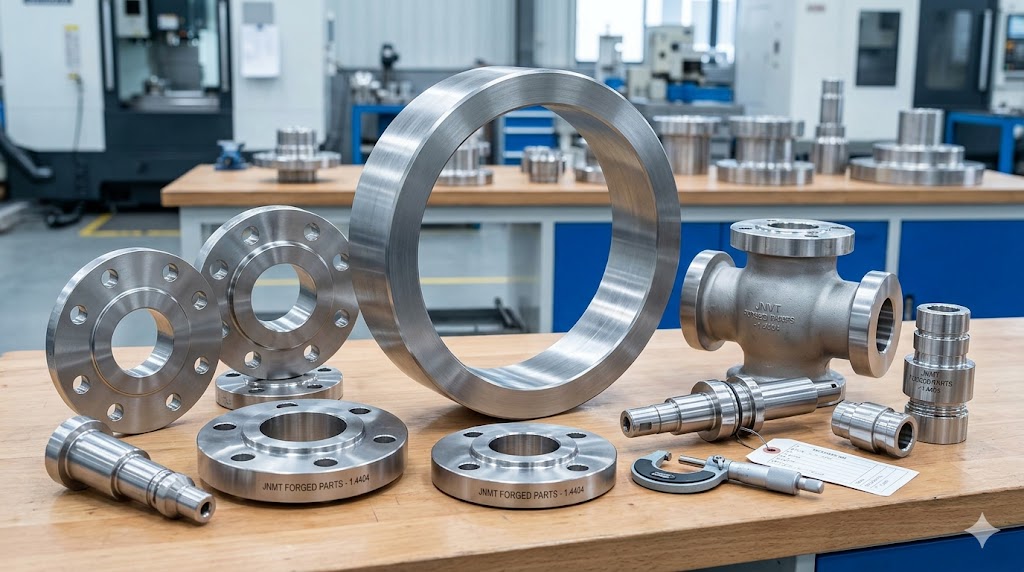
True Open Die Forging Capacity: 30 KG – 30,000 KG Per Piece
Our 2,000T / 4,000T / 6,300T open die forging presses and 60-ton forging manipulators allow us to produce 1.4404 forgings that most smaller mills cannot — from precision valve blanks under 5 KG to large-diameter pressure vessel shells exceeding 20 tons. No subcontracting. Every piece is made in our own plant under our own quality system.
Seamless Rolled Rings Up to Ø5,000 mm
Our ring rolling mill produces seamless 1.4404 forged rings from Ø300 mm to Ø5,000 mm in diameter, with radial and axial profiling capability for near-net-shape flanges, gear blanks, and bearing races. Grain flow follows the ring circumference — a structural advantage that cast or fabricated alternatives simply cannot replicate.
Full In-House Melting, Heat Treatment & Machining Chain
We control the entire production chain: EAF + AOD/VOD refining, forging, 18-meter solution annealing furnaces, 16-meter-deep quenching tanks, and multi-axis CNC machining centres. This single-source control eliminates inter-supplier variation, cuts lead time, and gives you one MTC document covering every stage of production.
7–15 Day Prototype Delivery for Urgent Projects
For clients in the engineering and validation phase, we offer accelerated prototype delivery of 1.4404 forgings within 7–15 working days. This is made possible by our dedicated prototype forging line and standing stocks of certified 1.4404 billets, eliminating the typical 4–6 week raw material lead time bottleneck.
Multi-Standard MTC 3.1 / 3.2 as Standard, Not Optional
Every shipment of 1.4404 forgings is accompanied by a complete EN 10204 3.1 or 3.2 Mill Test Certificate covering chemical composition (by heat), mechanical properties (by lot), hardness, grain size, and NDT results. Third-party inspection by SGS, BV, TÜV, Intertek, or your nominated inspector is routinely accommodated. The inspector witnesses our tests and countersigns the MTC — the MTC 3.2 certification authority rests with the inspector, not with Jiangsu Liangyi.
29+ Years of NACE, API, PED, ASTM Multi-Standard Manufacturing Experience
Our quality engineers hold deep expertise in manufacturing to simultaneous multi-standard requirements — producing a single 1.4404 forging that satisfies ASTM A182, EN 10222-5, NACE MR0175, API 6A, and PED 2014/68/EU technical requirements in the same production run. Customers apply for the relevant product certification on their own product scope; we supply the forgings with the full documentation package to support their certification process.
1.4404 (X2CrNiMo17-12-2) Stainless Steel: A Manufacturer's Technical Overview
What Exactly Is 1.4404 — and Why Does It Dominate Corrosion-Critical Forgings?
1.4404 (X2CrNiMo17-12-2) is a low-carbon austenitic chromium-nickel-molybdenum stainless steel, defined under European standard EN 10088-3. It is recognised under multiple national and international standard systems, with equivalent designations in DIN, JIS, ASTM, and ISO standards — each with their own grade numbering, though the chemical and mechanical requirements are closely aligned. In the forging industry, it is one of the top three most-specified stainless steels globally, and for good reason: its chemical design addresses the two most common failure modes in corrosive industrial service — intergranular corrosion and pitting.
The key to understanding 1.4404 lies in two design decisions made by its metallurgical creators. First, the carbon content is tightly controlled to a maximum of 0.03% (hence the "L" for Low Carbon, and "X2" in the EN designation meaning ≤0.03% C). This low carbon ceiling prevents the formation of chromium carbide precipitates (Cr₂₃C₆) at grain boundaries when the material is exposed to the 450–850°C sensitization range during welding or slow cooling. Second, 2.0–2.5% molybdenum is added to the chromium-nickel austenitic matrix. Molybdenum increases the Pitting Resistance Equivalent Number (PREN) of the alloy to approximately 24–26, calculated as: PREN = %Cr + 3.3 × %Mo + 16 × %N. This PREN value places 1.4404 significantly above standard 1.4301 (304, PREN ≈ 18–20) and makes it suitable for environments containing chlorides, sulfuric acid at moderate concentrations, phosphoric acid, and many organic acids that would rapidly attack lower-grade stainless steels.
Microstructure: Why a Forged 1.4404 Component Outperforms a Cast or Rolled Bar Equivalent
In its correctly solution-annealed and quenched condition, 1.4404 exhibits a fully austenitic face-centred cubic (FCC) microstructure with an average grain size of ASTM No. 5–8 for properly processed forgings. This grain structure is what gives the material its combination of good tensile strength (Rm: 500–700 MPa), excellent ductility (A: ≥30%), and outstanding low-temperature impact toughness — properties that are retained right down to cryogenic temperatures of –196°C, making it one of the few materials qualified for LNG service without any special cryogenic heat treatment.
The critical advantage of forging over casting or machining from rolled bar becomes clear at the microstructural level. During the open die forging process, the original cast ingot structure — including any residual dendritic segregation, micro-porosity, or inclusion stringers — is mechanically broken down and redistributed through repeated compression under our 2,000T–6,300T presses. The resulting forged microstructure is denser, more uniform, and directionally isotropic compared to cast equivalents. For seamless rolled rings, the grain flow aligns circumferentially with the ring geometry, providing superior tangential and radial mechanical properties versus a ring cut from a plate or machined from a solid bar. This is not marketing language — it is a documented metallurgical advantage confirmed by comparative fatigue, impact, and fracture toughness testing data across the forging industry.
Understanding the Sensitization Risk in 1.4404 Forgings — and How We Eliminate It
Even with its low-carbon specification, 1.4404 is not immune to metallurgical risks if processed incorrectly. The most significant is sensitization — the precipitation of chromium carbides at grain boundaries when material is held in the 450°C–850°C temperature range for extended periods, depleting the chromium content in the boundary zones and creating localized corrosion susceptibility. In forging practice, this risk arises primarily during slow cooling after forging if furnace temperature control is inadequate, or during prolonged heat treatment cycles at incorrect temperatures.
Our process control addresses this specifically: all 1.4404 forgings are solution annealed at 1,020°C–1,080°C (within the EN 10222-5 specified range of 1,000°C–1,100°C) and then rapidly quenched — either by water immersion in our 16-meter-deep quenching tanks for heavy sections, or by forced-air cooling for thinner sections — to bring the material through the sensitization zone as quickly as possible. Our computerized furnace monitoring logs temperature profiles for every heat treatment batch, providing documentary evidence of sensitization avoidance as part of your MTC package.
Global Standard Cross-Reference: 1.4404 (X2CrNiMo17-12-2) International Designations
When sourcing 1.4404 forgings for global projects, engineers frequently need to verify grade equivalences across different national standards. The table below provides our factory's comprehensive cross-reference guide, drawn from direct experience producing forgings against each of these standards:
| Standard / Region | Local Grade Designation | Key Specification Document | Notable Differences vs. EN 1.4404 |
|---|---|---|---|
| European (EN) | 1.4404 / X2CrNiMo17-12-2 | EN 10088-3, EN 10222-5 | Reference grade for this page |
| American (ASTM) | Low-carbon MoCrNi austenitic grade (forgings & bar) | ASTM A182, ASTM A276, ASTM A240 | Rm min. 485 MPa; slightly different hardness limit (≤223 HB) |
| American (UNS) | UNS number (chemical composition master reference) | SAE / ASTM unified numbering cross-reference | Chemical composition master reference for ASTM grades |
| German (DIN) | 1.4404 / X2CrNiMo17-12-2 | DIN 17440, DIN 17458 | Precursor to EN designation; essentially identical |
| Japanese (JIS) | Low-carbon MoCrNi austenitic stainless (JIS) | JIS G4303, JIS G4304 | Mo range 2.00–3.00% (slightly wider); same mechanical minimums |
| British (BS) | 316S11 (legacy British designation, superseded) | BS 970 Part 1, BS 1501 | Legacy designation; fully superseded by EN 1.4404 |
| ISO | X2CrNiMo17-12-2 | ISO 15510, ISO 683-13 | Same chemistry as EN; international cross-reference document |
| Oil & Gas (API) | Low-carbon austenitic type (per Annex F) | API 6A (Annex F), API 17D | Additional hardness (≤22 HRC), NACE MR0175/NACE MR0103 compliance required |
| Pressure Equipment (PED) | 1.4404 | PED 2014/68/EU, AD 2000 W2 | CE marking requires Notified Body assessment — applied by the equipment manufacturer, not the forging supplier |
| Chinese (GB) | 022Cr17Ni12Mo2 / 0Cr17Ni12Mo2 | GB/T 4237, GB/T 1220 | Chemistry nearly identical; impact testing not always mandatory in Chinese standard |
1.4404 vs. Related Grades: Choosing the Right Material for Your Forging
A question we receive frequently from engineers is: "My design calls for a molybdenum-bearing austenitic stainless — should I specify 1.4404 or one of the nearby grades?" The answer depends on your specific application. Below is our practical guide based on 29 years of processing all these grades:
| Grade (EN / ASTM) | Carbon Max (%) | Mo Range (%) | PREN (approx.) | Best Suited For | Limitation vs. 1.4404 |
|---|---|---|---|---|---|
| 1.4404 (X2CrNiMo17-12-2) | ≤0.03 | 2.00–2.50 | ~24–26 | Welded assemblies, sour service, cryogenic, general corrosion-resistant forgings | Reference grade — no limitation |
| 1.4401 / 316 | ≤0.07 | 2.00–2.50 | ~24–26 | Machined components, no welding required | Higher carbon = sensitization risk after welding; API sour service typically requires the low-carbon variant (1.4404) |
| 1.4432 (X2CrNiMo18-14-3) | ≤0.03 | 2.50–3.00 | ~26–28 | Marine, more aggressive chloride environments | Higher cost; typically only needed when 1.4404 PREN is insufficient |
| 1.4435 (X2CrNiMo18-14-3, high Ni) | ≤0.03 | 2.50–3.00 | ~27–29 | Pharmaceutical (GMP/FDA), high-purity chemical processing | Premium pricing; ferrite content specification (≤1%) adds complexity |
| 1.4307 / 304L | ≤0.03 | None | ~18–20 | General-purpose, low-cost corrosion-resistant components | No Mo = poor chloride and pitting resistance; unsuitable for seawater or acidic media |
| 1.4462 / 2205 Duplex | ≤0.03 | 3.00–3.50 | ~34–36 | Structural, high-stress corrosion-resistant, seawater service | Higher strength but lower cryogenic toughness; more complex heat treatment; higher cost |
Our recommendation: for the vast majority of oil & gas, chemical, pharmaceutical, and power generation forging applications — and virtually all applications that require welded assemblies — 1.4404 (X2CrNiMo17-12-2) is the optimal balance of corrosion performance, weldability, mechanical properties, material availability, and cost. If your environment contains chloride concentrations above ~3,000 ppm combined with temperatures above 60°C, we would discuss upgrading to 1.4432 or a duplex grade. Contact our technical team for a free material selection consultation.
Custom 1.4404 Forging Capabilities: Products, Sizes & Tolerances
Our Full Range of X2CrNiMo17-12-2 Forged Product Forms
We produce the complete spectrum of 1.4404 (X2CrNiMo17-12-2) open die forged components on our in-house press lines. Unlike trading companies that sub-contract your forging order to a third-party mill, every piece listed below is produced entirely within our own Jiangyin factory under our ISO 9001:2015 quality system. Typical size ranges and tolerances are provided as a reference — non-standard dimensions are our specialty:
1.4404 Forged Round Bars, Flat Bars & Block Forgings
Open die forged round bars in 1.4404 are available from Ø40 mm to Ø1,500 mm diameter, in lengths up to 8,000 mm, with standard machining allowance of +5 mm per side. Flat bars and block forgings are produced to custom cross-sections from 50×50 mm up to 1,200×800 mm. All are supplied in the solution annealed + quenched condition as standard, with optional rough-turning or precision machining to drawing. Typical applications include valve body blanks, pump shaft pre-forms, pressure vessel nozzle blanks, and general structural blocks for machining.
1.4404 Seamless Rolled Forged Rings
Our ring rolling mill is one of our most requested capabilities for 1.4404. We produce seamless forged rings from Ø300 mm to Ø5,000 mm outside diameter, with wall thicknesses from 30 mm to 500+ mm, and heights from 50 mm to 800 mm per ring. Rectangular cross-section, flanged, profiled (L-section, T-section), and contoured ring profiles are all available with our axial-radial ring rolling capability. Tolerances on OD/ID are typically ±3 mm before machining, achievable to ±0.5 mm after CNC turning. Grain flow in seamless rolled rings follows the ring circumference — a critical structural advantage for flanges, gear rings, slewing rings, bearing races, and pressure vessel shell courses subject to circumferential stress.
1.4404 Forged Discs, Hubs, Flanges & Blanks
Forged discs and hub forgings in 1.4404 are available from Ø100 mm to Ø3,000 mm diameter, with heights from 20 mm to 600 mm. These cover pump impeller pre-forms, valve gate blanks, flange forgings (ASME B16.5, EN 1092, DIN 2631–2638, API 6A flange classes), hub forgings for turbo-machinery, and custom geometric blanks to your net-shape drawings. We regularly produce forged disc blanks for precision CNC machining by our customers and can also provide fully machined-to-drawing delivery.
1.4404 Forged Hollow Bars, Shells, Sleeves & Bushings
Hollow bar and sleeve forgings in 1.4404 are produced by punching and drawing on our press lines or by ring rolling for larger diameters. OD range: Ø60 mm to Ø1,200 mm; ID range: Ø30 mm to Ø900 mm; wall thickness: 15 mm minimum; length: up to 4,000 mm. These are widely used for pump barrel casings, pressure vessel shell liners, heat exchanger tube sheet sleeves, valve body preforms requiring internal bore machining, and cryogenic vessel inner shells.
1.4404 Forged Steel Pipes, Barrels & Tubular Components
For heavier-wall tubular forgings not covered by seamless tube standards, our open die forged pipe blanks and barrel forgings in 1.4404 offer wall thicknesses from 20 mm to 300 mm, ODs from Ø100 mm to Ø800 mm, and lengths up to 5,000 mm. These are routinely used for wellhead spool bodies, high-pressure valve body pre-forms, heat exchanger shell forgings, and turbomachinery casing segments.
Complex & Near-Net-Shape Custom Forgings
For customers with high volumes or complex geometries, we offer near-net-shape open die forging services that minimize your CNC machining time and material waste. Our engineering team reviews your 3D CAD drawings and advises on the optimal forging geometry — adding directional grain flow where your stress analysis demands it, and reducing billet weight (and your cost) by forging closer to final shape. Examples include: forged valve body preforms with integral boss and port geometry, forged pump impeller blanks with rough contour, forged compressor impeller discs with hub profile, and custom fitting forgings for sweepolet, sockolet, and weldolet applications.
1.4404 Forging Applications: Industry-by-Industry Technical Guide
The following section documents how our 1.4404 (X2CrNiMo17-12-2) forgings are used across each major industry vertical, based on real projects executed over 29 years in Jiangyin. Each entry specifies the exact component, the technical reason 1.4404 was selected, and the manufacturing requirements we meet. This level of application-specific detail is what distinguishes a genuine forging manufacturer from a trading intermediary.
Oil & Gas: Wellhead, Completion & Subsea Applications
In the oil and gas sector, 1.4404 forged components serve both surface and subsurface applications where carbon steel would suffer rapid corrosion from produced water, CO₂, and H₂S. Our forgings are fully API 6A compliant and, where specified, meet NACE MR0175 / ISO 15156 for sour service hardness requirements (≤22 HRC for 1.4404 per NACE MR0175 Table A.5). Specific forged components we produce for oil and gas include:
- Christmas Tree & Wellhead Components: Forged spool bodies, casing heads, tubing heads, casing hangers, tubing hangers, casing spools, tubing spools, spacer spools, double studded adapter flanges, and studded crosses — all forged and machined to API 6A dimensional and pressure-class requirements from 2,000 PSI to 20,000 PSI working pressure
- Downhole Drilling Tool Components: ESP motor forged splined drive shafts and couplings, mud motor stator housings, downhole gauge subs, and packer mandrels — where material fatigue strength under cyclic torsional loading is as critical as corrosion resistance
- Subsea Connector Components: Forged connector hubs, clamp connector bodies, and subsea flange blanks for ROV-installed trees and manifolds, where the forging grain structure provides the fracture toughness required under subsea cyclic fatigue loading
- Flow Measurement Components: Forged ultrasonic flow meter bodies, venturi cone meter bodies, and Coriolis flow meter tube pre-forms for produced water and multiphase flow measurement in process piping systems
Valve Manufacturing: Ball Valves to Cryogenic Butterfly Valves
Valve manufacturers are our largest single customer segment for 1.4404 forgings. They require consistent dimensional accuracy for machining to ASME B16.34 / EN 13709 bore and face-to-face tolerances, plus reliable batch-to-batch mechanical properties. We produce the full range of forged valve components in 1.4404 as standard production or to exact custom drawings:
- Ball Valve Components: Forged valve bodies (top-entry, side-entry, trunnion-mounted), forged ball blanks, forged valve stems, seat ring blanks, and bonnet forgings for ½″ through 60″ Class 150 to Class 2500 ball valves per API 6D / ASME B16.34
- Gate, Globe & Check Valve Components: Bonnet forgings, stem blanks, disc forgings, and body pre-forms for rising-stem gate valves, globe valves, and swing check valves per API 602, API 623, and BS 5160
- Cryogenic HPBV Spindles & Shafts: Forged spindles for DN50 to DN1000 high-performance butterfly valves (HPBV) for LNG cryogenic service at –196°C. The spindle must achieve dimensional tolerances of ±0.01 mm on the sealing diameter, Charpy impact energy ≥100 J at –196°C (exceeding the standard minimum of 38 J), and surface finish Ra ≤0.4 μm after finish grinding. Our long-term experience supplying these spindles to European LNG valve manufacturers represents our strongest product qualification for cryogenic applications
- Pressure Relief Valve Components: Forged valve bodies, nozzle forgings, and cap blanks for spring-loaded and pilot-operated PRVs to API 520/526, where heat-to-finished-part material traceability is mandatory for safety certification
Chemical Processing & Petrochemical: Corrosion-Specific Engineering
For chemical processing applications, the choice of 1.4404 is driven by verified corrosive media compatibility data, not general assumptions. Our technical team verifies suitability for your specific process media before confirming any chemical processing order. Following are main1.4404 corrosion resistance data for common chemical process media:
- Sulfuric Acid (H₂SO₄): Resistant at concentrations below ~5% at up to 60°C and above ~90% at ambient. In the 5–90% range, 1.4404 corrodes rapidly — for these cases, we recommend Alloy 20, 904L, or Hastelloy C276 forgings (all grades we produce)
- Phosphoric Acid (H₃PO₄): Excellent resistance at all concentrations up to approximately 85°C, making 1.4404 the dominant material for forged phosphoric acid process components
- Chloride Solutions: Good resistance up to approximately 1,000 ppm below 60°C. Above this threshold, upgrade to 1.4432 or duplex grades to prevent stress corrosion cracking and pitting
- Organic Acids (Acetic, Formic, Lactic): Excellent resistance across wide concentration and temperature ranges — the primary driver for 1.4404 dominance in food and pharmaceutical forging specifications worldwide
Specific chemical process components we produce: forged swept branch fittings and swept saddles for process piping, forged ultrasonic and venturi flow meter bodies, pressure vessel nozzle forgings and transition cones, heat exchanger tube sheets and baffle rings, and chemical pump casing and impeller components.
Power Generation: Nuclear, Thermal & Renewable Applications
Power generation applications impose the most stringent material qualification requirements of any industry. Our 1.4404 forgings for power generation are manufactured under enhanced quality plans that include additional NDE scope, supplementary chemical analysis by independent laboratory, and extended documentation packages:
- Nuclear Power (PWR/BWR): Forged coolant pump casing shells and containment seal chambers for reactor coolant pump systems. Forgings are manufactured per customer-specified enhanced quality plans referencing ASME BPVC Section III, RCC-M, or KTA 3201 requirements, with the formal nuclear certification held and applied by our customer on their product scope. Electroslag remelting (ESR) is specified for nuclear-class billets to minimize macro-segregation and optimize ultrasonic inspectability per ASTM A388 Level C acceptance criteria (no indication ≥3.2 mm equivalent flat-bottomed hole)
- Turbomachinery: Forged centrifugal compressor impeller blanks (shrouded and open-face), turbine end seal rings, and thrust collar forgings for process gas compressors used in LNG plants, refineries, and petrochemical facilities per API 617
- Geothermal Energy: 1.4404 forged wellhead components and heat exchanger tube sheets for geothermal plant fluid circuits, where high-temperature saline brine combined with H₂S requires the full corrosion resistance profile of a molybdenum-bearing low-carbon austenitic grade
Pump, Heat Exchanger & Pressure Vessel Components
Process equipment OEMs require forgings that are dimensionally consistent batch-to-batch to maintain CNC programming efficiency. Our forging-to-tolerance consistency and material traceability system make us the preferred source for:
- Pump Components (API 610/676/685): Forged pump casing blanks, barrel casings, impeller blanks (radial and axial flow), shaft blanks, mechanical seal housing bodies, wear ring blanks, and suction/discharge nozzle forgings — all with forging-to-machining allowances agreed in advance with your CNC programming team
- Heat Exchanger Components (TEMA R/C/B): Forged tube sheet blanks (fixed, floating, U-tube), shell nozzles, channel head forgings and channel flanges, baffle ring forgings, and pass partition plate blanks with guaranteed flatness ≤0.5 mm/m after forging and rough machining
- Pressure Vessel Components (ASME VIII / PED): Forged vessel nozzle blanks (weld neck, set-on, long-weld-neck), forged head blanks, manhole frames, transition cones, and saddle support brackets with PED 2014/68/EU technical requirement documentation (the CE Declaration of Conformity and EU Declaration are issued by the equipment manufacturer; we supply the forging with the material documentation to support that process) and ASME material certification where required
Food, Beverage & Pharmaceutical: Hygienic Forging Requirements
Buyers in the food, beverage, and pharmaceutical sectors specify four 1.4404 forging attributes that generic industrial buyers rarely require: surface finish achievability (Ra ≤0.8 μm for CIP-cleanable surfaces, Ra ≤0.4 μm for pharmaceutical contact surfaces), ferrite content (≤1% delta ferrite for consistent passivation response and pitting resistance), freedom from sulfide inclusions, and food contact compliance documentation. Our billets are sourced with actual S ≤0.010%, ferrite content is measured by ferritoscope on each production batch, and surface finish to Ra ≤0.4 μm is standard on our pharma-grade CNC machining line. FDA 21 CFR 177.2600 food contact declaration is available on request.
Marine & Offshore: Seawater-Exposure Applications
1.4404's PREN of ~24–26 is the minimum threshold for intermittent seawater exposure and performs reliably where the corrosive medium is not continuous full-immersion seawater. We supply 1.4404 forged deck fittings, fairleads, mooring accessories, hatch cover components, and exhaust system flanges for commercial shipping. For continuous seawater immersion service such as sea chests and seawater cooling pumps, we recommend and produce 1.4462 duplex or 6% molybdenum super-austenitic grade forgings — our technical team provides a free material upgrade recommendation when your application conditions are described.
What Our Global Customers Say About Our 1.4404 Forgings
"We have relied on Jiangsu Liangyi as our sole-source forging supplier for 1.4404 valve body and stem blanks for over five years. What sets them apart is not just the material quality — it is their understanding of valve manufacturing tolerances and their ability to hold forging-to-forging dimensional consistency across large production batches. Our CNC team rarely needs to adjust programs between batches."
"The 1.4404 seamless rolled rings for our chemical processing plant expansion arrived on time, fully compliant with EN 10222-5, and with MTC 3.2 documentation that passed our third-party auditor review without a single query. The Charpy impact values at –60°C significantly exceeded our minimum requirements. We have placed our second order already."
"Jiangsu Liangyi completed our urgent prototype order for 1.4404 forged pump casing blanks in 11 working days — a lead time that our local European suppliers said was impossible. The forgings came with full chemical and mechanical MTC, pre-machined to our drawing tolerances, and were dimensionally perfect. We are now qualifying them as our standard forging source for this product line."
1.4404 (X2CrNiMo17-12-2) Complete Material Specifications
The following specification data is drawn from our factory's working knowledge of EN 10088-3, EN 10222-5, and related international standards, combined with our actual production testing records from over two decades of 1.4404 forging manufacture. We present this data for engineers specifying our forgings, not as a substitute for the published standards, which should always be referenced for contractual purposes.
Raw Material Production Route: Why Our Billets Are Different
Our 1.4404 billets are produced via Electric Arc Furnace (EAF) melting with Argon Oxygen Decarburization (AOD) or Vacuum Oxygen Decarburization (VOD) secondary refining. The AOD/VOD step is critical for 1.4404 specifically because it is the process step that reduces the carbon content from the typical EAF melt level (0.05–0.08% C) down to the ≤0.03% maximum required for the grade. Without AOD/VOD, reliable carbon control to 0.030% maximum cannot be guaranteed — this is a process-quality differentiator that separates quality mills from lower-cost alternatives.
For applications requiring maximum ultrasonic inspectability and the lowest possible macro-segregation — particularly nuclear power, offshore pressure-containing components, and large-diameter ring forgings above Ø2,000 mm — we offer optional Electroslag Remelting (ESR) of the billet as a supplementary process step. ESR removes macro-inclusions and reduces chemical segregation to levels that cannot be achieved by conventional casting alone. ESR-grade billets are certified separately and documented in the MTC.
Chemical Composition of 1.4404 (X2CrNiMo17-12-2)
The table below presents both the standard specification limits per EN 10088-3 and our factory's typical actual chemistry achieved in production. Our typical actual values reflect our mill's process capability and are provided to help engineers understand the true performance margin available in our forgings:
| Element | EN 10088-3 Limit | ASTM A182 Limit | Our Typical Actual | Role in Material Performance |
|---|---|---|---|---|
| Carbon (C) | ≤0.030% | ≤0.030% | 0.015–0.025% | Low carbon prevents sensitization (chromium carbide precipitation) at grain boundaries during welding and heat treatment |
| Silicon (Si) | ≤1.00% | ≤0.75% | 0.35–0.65% | Deoxidizer in steelmaking; contributes to high-temperature oxidation resistance |
| Manganese (Mn) | ≤2.00% | ≤2.00% | 1.20–1.70% | Austenite stabilizer; improves hot workability during forging |
| Phosphorus (P) | ≤0.045% | ≤0.045% | ≤0.025% | Tramp element — reduced as much as possible; high P reduces impact toughness and weldability |
| Sulfur (S) | ≤0.015% | ≤0.030% | ≤0.008% | Tramp element — sulfide inclusions are initiation sites for pitting corrosion; we consistently achieve well below standard maximum |
| Chromium (Cr) | 16.50–18.50% | 16.00–18.00% | 16.80–17.80% | Primary corrosion resistance element — forms the passive chromium oxide film; also contributes directly to PREN calculation |
| Nickel (Ni) | 10.00–13.00% | 10.00–14.00% | 10.50–12.50% | Primary austenite stabilizer; critical for maintaining FCC microstructure and low-temperature toughness |
| Molybdenum (Mo) | 2.00–2.50% | 2.00–3.00% | 2.10–2.45% | The defining element of 1.4404 vs 1.4307 — dramatically increases pitting and crevice corrosion resistance, especially in chloride environments; contributes 3.3× its concentration to the PREN calculation |
| Nitrogen (N) | ≤0.10% | ≤0.10% | 0.04–0.08% | Austenite stabilizer; contributes to PREN at 16× its concentration; slightly increases strength without reducing ductility |
| Iron (Fe) | Balance | Balance | Balance | Matrix element |
Mechanical Properties: Guaranteed Standard Values vs. Our Typical Test Results
All mechanical properties below are measured on test specimens taken from the forgings themselves (not from separately forged test coupons), in the solution annealed and quenched delivery condition. The standard specifies minimum guaranteed values; our typical actual production values are provided to illustrate the performance margin available in practice:
| Mechanical Property | EN 10222-5 Minimum | ASTM A182 Minimum | Our Typical Actual | Test Method |
|---|---|---|---|---|
| Tensile Strength (Rm) | 500–700 MPa | 485 MPa min. | 530–660 MPa | ASTM E8 / EN ISO 6892-1 |
| 0.2% Proof Strength (Rp0.2) | ≥200 MPa | ≥170 MPa | 220–280 MPa | ASTM E8 / EN ISO 6892-1 |
| Elongation at Break (A) | ≥30% | ≥30% | 38–50% | ASTM E8 / EN ISO 6892-1 |
| Reduction of Area (Z) | ≥50% | Not specified | 55–72% | ASTM E8 / EN ISO 6892-1 |
| Hardness (HB / HRC) | ≤215 HB | ≤223 HB / ≤96 HRB | 150–195 HB | ASTM E18 / EN ISO 6506-1 |
| Charpy Impact Energy (KV, room temp.) | ≥60 J (avg.), ≥40 J (min.) | Not mandatory (available on request) | 130–220 J | ASTM E23 / EN ISO 148-1 |
| Charpy Impact Energy (KV, –46°C) | Not in standard (available on request) | Not mandatory | 80–160 J | ASTM E23 low-temp fixture |
| Charpy Impact Energy (KV, –196°C) | Not in standard (available on request) | Not mandatory | 60–120 J | ASTM E23 cryogenic fixture |
| ASTM Grain Size | No. 5 or finer recommended | No standard requirement | No. 5–8 | ASTM E112 |
Physical & Thermal Properties of 1.4404 (X2CrNiMo17-12-2)
Physical properties are important for equipment designers calculating thermal expansion, heat transfer coefficients, and elastic behaviour. The following values are for solution annealed 1.4404 at the indicated temperatures:
| Physical Property | Value | Temperature | Significance for Design |
|---|---|---|---|
| Density | 7.98 g/cm³ | 20°C | Used for weight calculation and buoyancy analysis |
| Modulus of Elasticity (E) | 195 GPa (20°C) / 170 GPa (300°C) | 20–300°C | Lower than carbon steel (210 GPa) — affects deflection calculations in structural applications |
| Thermal Expansion Coefficient | 16.0 × 10⁻⁶ /K (20–100°C) / 17.5 × 10⁻⁶ /K (20–300°C) | 20–300°C | Approximately 50% higher than carbon steel — critical for thermal cycling design, bolted flange calculations, and dissimilar metal joint design |
| Thermal Conductivity (λ) | 14.6 W/(m·K) at 20°C / 17.9 W/(m·K) at 300°C | 20–300°C | Approximately 25% of carbon steel conductivity — heat exchanger surface area calculations must account for this reduced conductivity |
| Specific Heat Capacity (cp) | 500 J/(kg·K) | 20°C | Used in thermal transient analysis for thick-section forgings |
| Electrical Resistivity | 0.75 × 10⁻⁶ Ω·m | 20°C | Used in eddy current NDE calibration and electromagnetic applications |
| Magnetic Permeability | ≤1.02 μr (solution annealed) | 20°C | Essentially non-magnetic in correctly solution-annealed condition — important for MRI equipment, magnetic compass housings, and subsea instrument applications where magnetic interference must be minimised |
Heat Treatment Requirements for 1.4404 Forgings
Correct heat treatment is not optional for 1.4404 forgings — it is the step that eliminates residual forging stresses, restores the solution-annealed microstructure, and dissolves any chromium carbide precipitates that may have formed during the forging thermal cycle. Our standard heat treatment procedure for 1.4404 forgings is as follows, and is documented by furnace recorder charts in every MTC package:
- Heating Rate: Maximum 150°C/hour for sections above 100 mm thickness to avoid thermal gradient cracking
- Solution Annealing Temperature: 1,020°C – 1,080°C (our standard target: 1,050°C ± 15°C), held for 1 hour per 25 mm of maximum cross-section thickness, minimum 30 minutes
- Quenching Method: Water immersion quench in our 16-meter-deep quenching tank for sections above 100 mm; forced-air quench for thinner sections. The quench is initiated within 3 minutes of removal from the furnace to prevent sensitization zone exposure
- Post-Quench Inspection: Surface hardness verification (target: ≤215 HB), visual inspection for quench cracking in complex geometries, dimensional inspection for quench distortion (corrected by straightening if required before final machining)
- Stress Relief: For precision-machined components where dimensional stability is critical, a supplementary stress relief at 300–400°C (below the sensitization range) for 2 hours is available on request
Delivery Conditions, Surface Finish & Machining Allowances
Our standard delivery condition for 1.4404 forgings is solution annealed + water quenched, with black (as-forged) surface or with scale removed by shot blasting (standard for inspection). The following machining allowances are our standard unless otherwise agreed:
| Forging Type | Standard Machining Allowance | Tighter Allowance Available | Notes |
|---|---|---|---|
| Round bars (Ø ≤ 300 mm) | +3 mm per side on diameter | +1.5 mm per side (rough turned) | Rough turning to drawing available |
| Round bars (Ø 300–800 mm) | +5 mm per side on diameter | +2.5 mm per side (rough turned) | Precision turning to H7/h6 available |
| Seamless rolled rings (OD ≤ Ø1,000 mm) | +3 mm per side on OD/ID, +3 mm per face | +1.5 mm per side (rough turned) | Profiled (flanged) rings available |
| Seamless rolled rings (OD Ø1,000–5,000 mm) | +5 mm per side on OD/ID, +5 mm per face | +3 mm per side (rough turned) | OD/ID/face CNC turning available in-house |
| Discs / Hubs (Ø ≤ 800 mm) | +4 mm per side on diameter, +3 mm per face | +2 mm per side (rough turned) | Fully machined to drawing available |
| Complex custom forgings | Agreed per drawing review | Near-net-shape available | 3D drawing review and DFM consultation provided free |
Our 1.4404 Forging Production Process: Step-by-Step
Unlike many suppliers who present a forging as simply "pressing hot metal," our 1.4404 production process involves nine controlled stages, each with defined process parameters, in-process checks, and documented records that form part of your MTC package. Understanding our process is the clearest evidence that we are a true manufacturer — not a trading company placing your order with an unknown mill.
Stage 1: Raw Material Selection & Incoming Inspection
Every 1.4404 forging starts with certified billet supplied by our qualified mill partners, all producing via EAF + AOD/VOD route with full EN 10204 3.1 MTCs. Our incoming inspection team performs: visual inspection for surface cracks and seams, dimensional verification against the billet schedule, independent PMI (Positive Material Identification) by X-ray fluorescence analyzer on every heat number, and random hardness checks. Billets that fail any incoming criterion are quarantined and returned — we do not use sub-specification raw material regardless of schedule pressure.
Stage 2: Billet Calculation & Forging Plan Development
Our forging engineers will use professional volume calculation software to calculate the weight and dimensions of billet for every order. The calculation covers forging yield efficiency, scale loss (normally 2–3% for stainless steel), and machining allowances into full consideration. For complex parts, we make a standard forging plan to set the number of heating runs, intermediate forming reductions and rotation steps. This guarantees the required forging ratio is met, with a minimum ratio of 3:1 for most common specifications and at least 4:1 for nuclear and pressure vessel applications. The plan will be checked to meet customer drawings and technical specifications before mass production starts.
Stage 3: Furnace Heating — Temperature-Controlled to ±10°C
1.4404 requires careful furnace heating management. We use PID temperature controllers to heat billets in our gas-fired furnaces to a forging start temperature of 1,150°C–1,200°C. This is high enough for plasticity but not high enough for the austenite matrix to start melting (for this composition, it's about 1,380°C). For heavy billets over 5 tons, there is a two-stage heating process. First, the billets are soaked in heat at 800°C for 2 hours to make sure the temperature is the same throughout the section. Then, the temperature is raised to forging temperature. Every three months, we keep records of the calibration of the furnace thermocouples, which customers can check.
Stage 4: Open Die Forging on 2,000T / 4,000T / 6,300T Presses
Open die forging of 1.4404 requires careful control of reduction per pass and billet temperature during forging to achieve full microstructure refinement without cold working below the dynamic recrystallization temperature (~950°C for this alloy). Our press operators are trained to monitor billet temperature using contact pyrometers and to re-heat whenever the surface temperature drops below 1,000°C. The forging sequence — number of passes, reduction ratio per pass, rotation angles — is defined in the forging plan and monitored by our production supervisor. For ring rolling, the radial and axial feed rates are computer-controlled to maintain consistent wall thickness reduction and ring geometry.
Stage 5: Solution Annealing — Documented Furnace Charts in Every MTC
Within 8 hours of forging completion (before any cold transformation can occur), forgings enter our semi-automatic heat treatment system. Our 18-meter continuous-belt solution annealing furnaces maintain temperature uniformity of ±10°C across the full furnace length, operated per AMS 2750 pyrometry requirements, with furnace temperature uniformity surveys performed annually. Every heat treatment batch generates an automatic temperature recorder chart showing actual furnace temperature vs. time for the entire cycle. This chart is scanned and included in your MTC package — not just a signed statement that heat treatment was performed.
Stage 6: Rapid Quenching — 16-Meter Deep Quenching Tanks
Immediately after solution annealing, forgings are transferred to our 16-meter-deep water quenching tanks within the maximum allowed transfer time (typically ≤3 minutes for sections above 100 mm). The quench water temperature is monitored and maintained below 40°C using recirculation chillers to ensure consistent cooling rate. For thick-section forgings above 300 mm cross-section, we use agitated water quenching (propeller agitation at ≥1 m/s water velocity) to overcome the insulating effect of the vapour film on the forging surface. Post-quench hardness is verified by Brinell testing before the forgings proceed to inspection.
Stage 7: Non-Destructive Testing (NDT)
All 1.4404 forgings are given our standard NDT regime before dimension test:
- Ultrasonic Testing (UT): 100% volumetric UT per ASTM A388 or EN 10228-3 as applicable. Our UT operators are qualified and trained in accordance with ASNT SNT-TC-1A or EN ISO 9712 requirements. For nuclear and pressure-vessel-critical forgings, ASTM A388 Level C (no indication ≥3.2 mm equivalent flat-bottomed hole) or equivalent is standard
- Magnetic Particle Testing (MT): Not applicable for austenitic stainless steel in the solution-annealed condition (essentially non-magnetic). If requested, we perform Penetrant Testing (PT) for surface crack detection using a fluorescent or visible dye penetrant system per ASTM E165 / EN ISO 3452
- Dye Penetrant Testing (PT): 100% surface PT is performed on cryogenic butterfly valve spindles, nuclear-class components, and any other components where specification requires it, or where forging geometry creates stress concentration risk
- Dimensional Inspection: All forgings are dimensionally inspected against the drawing using calibrated instruments. For precision components, we use a Zeiss coordinate measuring machine (CMM) with SPC capability for batch process control
Stage 8: Mechanical & Chemical Testing — Witnessed by Third-Party Inspectors
Mechanical testing is performed on specimens machined directly from the forgings (or from integrally forged test extensions on the same piece) by our in-house metallurgical laboratory, which is equipped with a 600 kN universal testing machine, Charpy impact testing machine with cryogenic fixture (capable of testing down to –196°C), Brinell/Rockwell/Vickers hardness testers, and optical microscope for grain size evaluation per ASTM E112. Chemical analysis is performed by OES (Optical Emission Spectrometry) on our Bruker Q4 TASMAN spectrometer, with verification by ICP-OES on selected heats. Third-party witness inspection from SGS, BV, TÜV, Intertek, DEKRA, or your nominated inspector is standard practice — we receive approximately 40–60 third-party inspection visits per month across all materials and customer specifications.
Stage 9: CNC Precision Machining — One-Stop Delivery
For customers requiring machined-to-drawing delivery, our CNC machining centre operates six Mazak and Okuma 5-axis machining centres and two large-capacity CNC lathes (turning diameter up to Ø3,000 mm, length up to 6,000 mm). Our machining team works directly from your 3D drawing files (STEP, IGES, DWG, PDF) and produces first article inspection (FAI) reports for all new components. Surface finish from our CNC machining line: Ra 3.2 μm as standard, Ra 1.6 μm with fine finishing passes, Ra 0.8 μm with superfinishing, Ra 0.4 μm and below for pharmaceutical and valve seating surfaces with grinding and polishing operations.
Production Equipment Summary
View our full 1.4404 forging production equipment list and specifications for complete details. Key equipment used for 1.4404 forgings includes:
- 6,300 ton, 4,000 ton, and 2,000 ton open die hydraulic forging presses
- Ring rolling mill: radial-axial rolling capability, max ring diameter Ø5,000 mm
- Forging manipulators: lifting capacity up to 60 tons, fully synchronized with press operation
- Gas-fired heating furnaces: maximum charge weight 150 tons per furnace
- Hydrogen bake-out furnaces: maximum length 14 meters (for stress relief of large-bore tubular forgings)
- Semi-automatic solution annealing furnaces: 18 meters belt length, ±10°C temperature uniformity, operated per AMS 2750 pyrometry requirements
- Water quenching tanks: 16 meters depth, agitated, recirculating cooling system
- CNC machining centres: Mazak and Okuma 5-axis, turning diameter up to Ø3,000 mm
- Bruker Q4 TASMAN OES spectrometer for in-house chemical analysis
- Zeiss CMM for precision dimensional inspection and SPC reporting
- 600 kN universal testing machine, Charpy impact tester with cryogenic fixture (–196°C capability)
Frequently Asked Questions About 1.4404 Forgings — Answered by Our Engineers
The following questions are compiled from real technical enquiries we receive from engineers, procurement managers, and quality teams worldwide. Where possible, we provide specific technical answers with data, not generic responses.
Inquire About Custom 1.4404 (X2CrNiMo17-12-2) Forgings
We are a professional China-based 1.4404 forging manufacturer with more than 29 years of experience, we are committed to delivering high-quality custom X2CrNiMo17-12-2 forged steel parts that meet your exact specifications. Whether you need standard forged bars, rings, or custom complex parts for important industrial applications, we have the expertise and capacity to support your project.Get a free quotation within 24 hours.
Send Your Inquiry Now📧 Inquiry Email: sales@jnmtforgedparts.com
📞 Phone/WhatsApp: +86-13585067993
🌐 Official Website: https://www.jnmtforgedparts.com
📍 Factory Address: Chengchang Industry Park, Jiangyin City, Jiangsu Province, China